Blog

  • Remembering the 1996 Grey Cup (Part One)

    Thirty years ago, the City of Hamilton welcomed football fans from across Canada and beyond to what was billed as the “Showdown in Steeltown” aka the 1996 Grey Cup. I had been following the CFL and the Tiger-Cats for a few years by then. But this was my first Grey Cup I was able to attend since it was being held in my hometown, so I was super excited for this one.

    My story actually begins on an August morning in 1994. My Dad had just returned home from working the night shift at the steel mill. He popped his head into my room and told me that he just heard on the radio that Hamilton had been awarded the 1996 Grey Cup game. Well, this news got me out of bed. I turned on the radio to AM 900 CHML, the voice of the Tiger-Cats, and sure enough they were talking about Hamilton’s hosting the Grey Cup in two years at Ivor Wynne Stadium. It was going to be a good day.

    Now, a lot happened between the announcement in August 1994 and the Grey Cup in November 1996. For starters, the Tiger-Cats nearly folded, almost killing the notion of a Hamilton-hosted Grey Cup. But they were saved thanks to a successful season ticket drive during the offseason. Then, the U.S.-based teams in the league were disbanded, putting the entire CFL in jeopardy as it retreated back to Canada. And a new technology called the Internet was really becoming mainstream, opening up all sorts of possibilities for the CFL in the future.
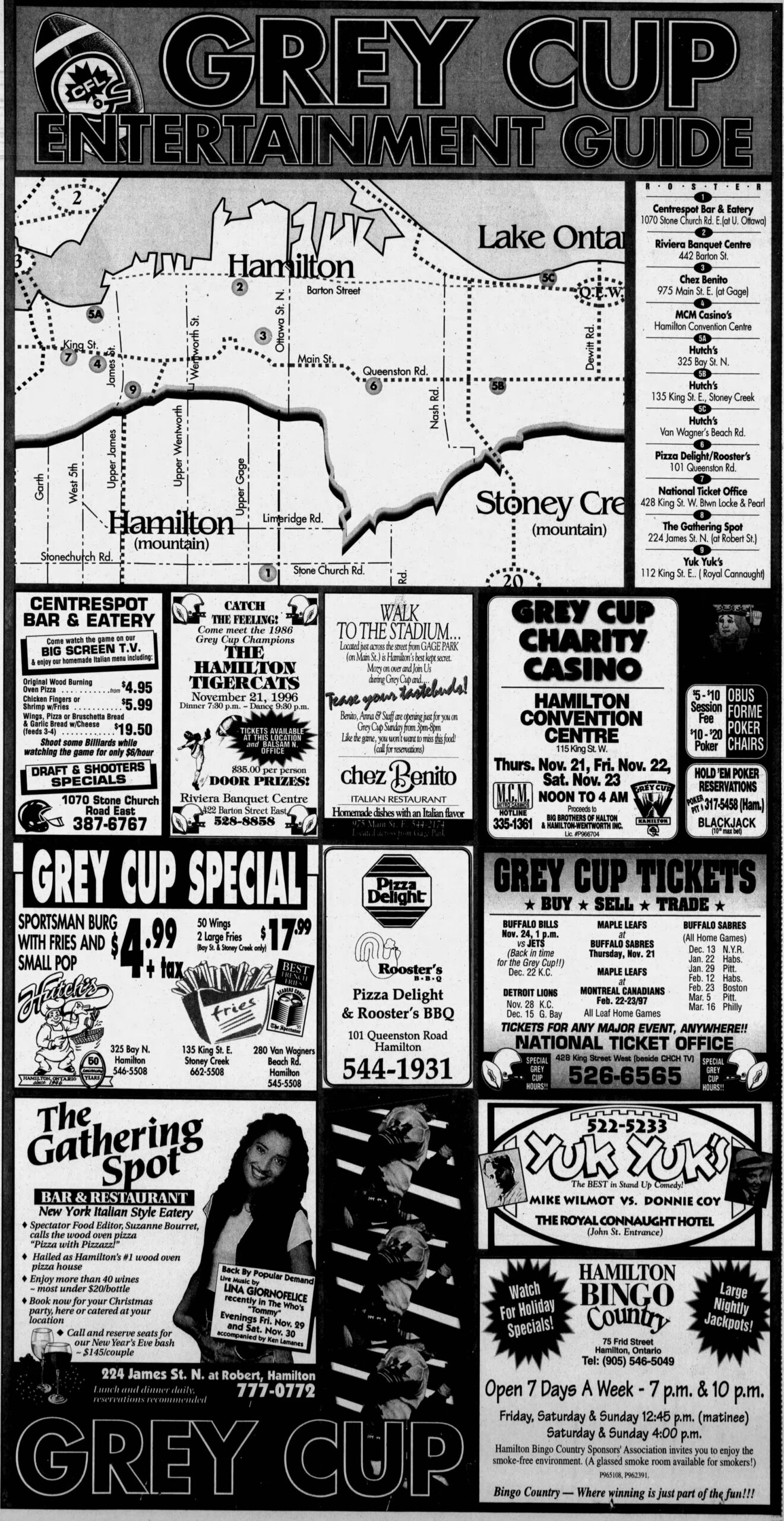
    The 1996 Grey Cup Entertainment Guide in the Hamilton Spectator (19 November 1996).
    The 1996 Grey Cup Entertainment Guide in the Hamilton Spectator (19 November 1996).

    There were big changes for yours truly, too. I was about to enter Grade 11 the summer of the announcement. By the time the Grey Cup rolled into town I was in my first year at McMaster University. Plus, I just turned 19 – legal drinking age in the Province of Ontario if I wanted to have an alcoholic beverage during Grey Cup week.

    Grey Cup week kicked off on Tuesday November 21st. Fans from out of town started trickling into the city, and I definitely remember the buzz that was building as the week progressed. There was something for everyone. You didn’t even need to be a Ti-Cat fan or a sports fan to enjoy what was being offered. There were concerts, charity casinos, hospitality tents, pancake breakfasts, fancy dinners, dance parties, and lots of entertainment.
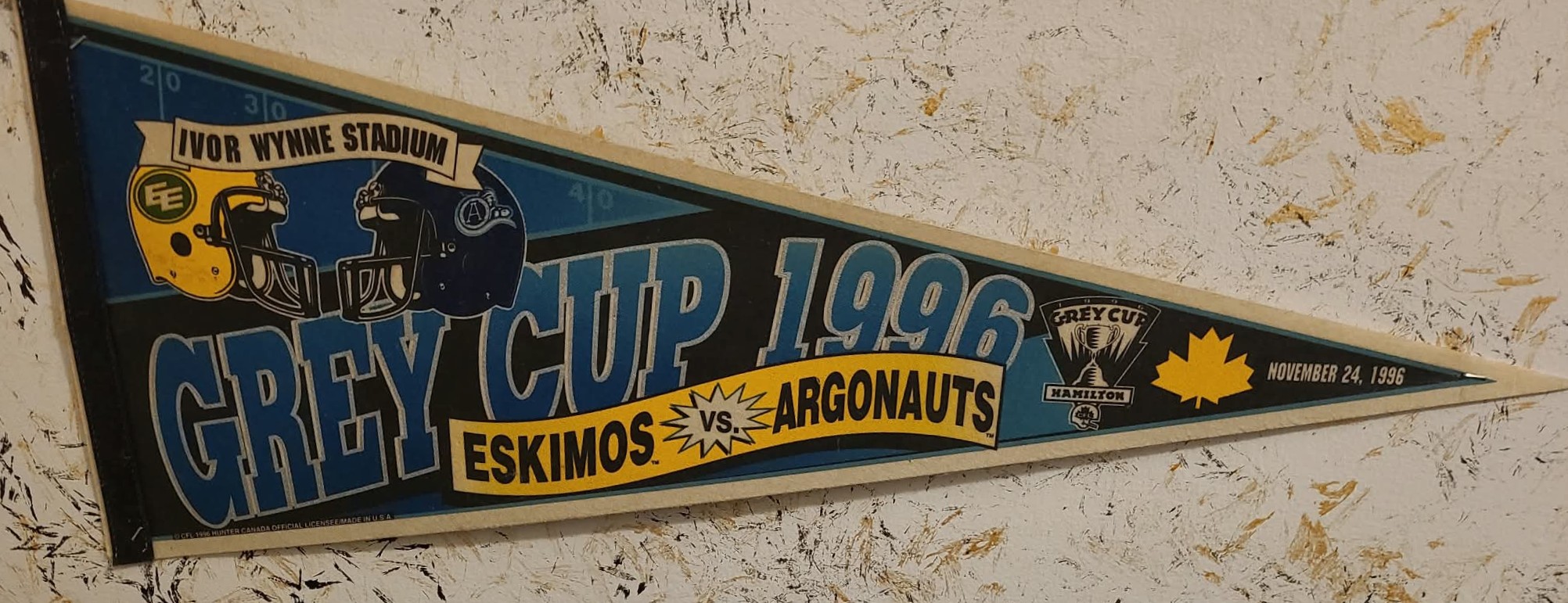
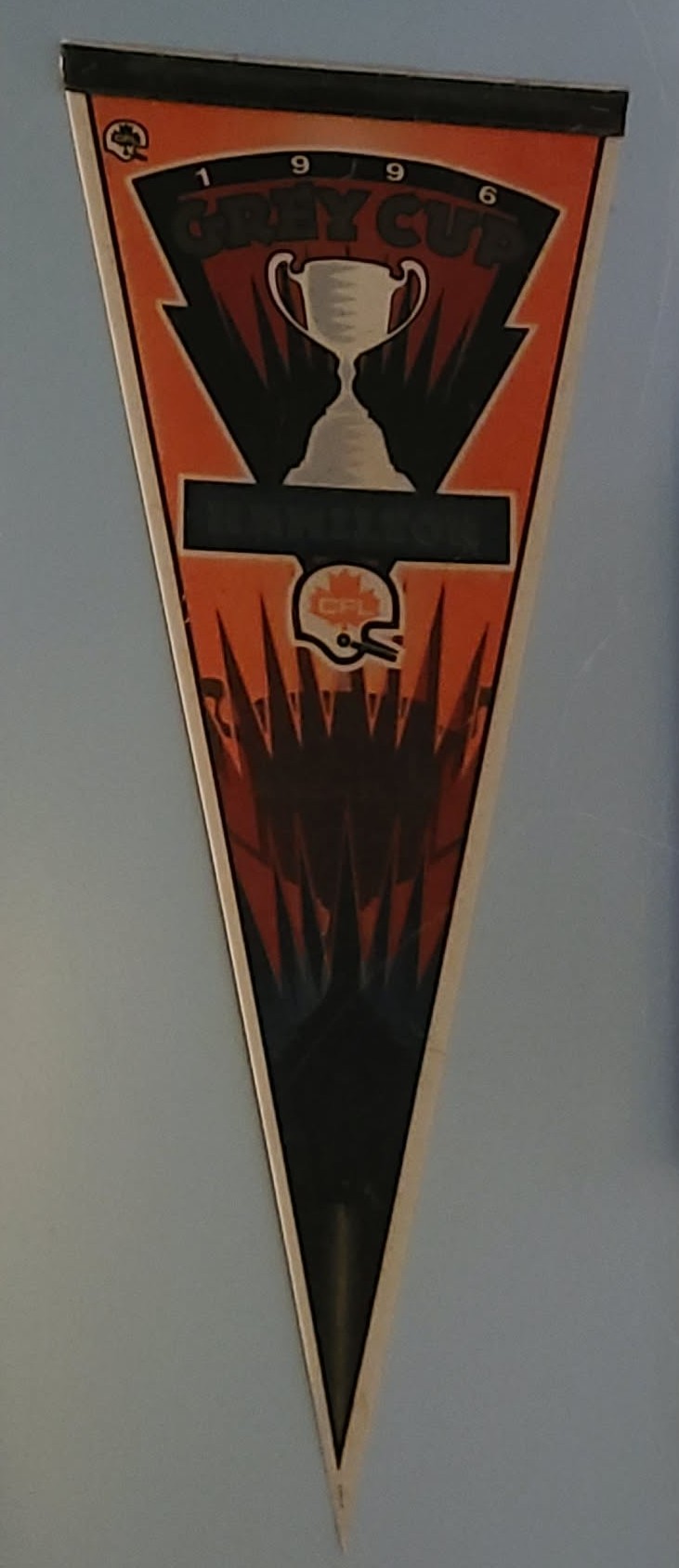
    Pennants we purchased at the 1996 Grey Cup.
    Pennants we purchased at the 1996 Grey Cup.

    On Thursday I ditched my Commerce 1B03 Introduction to Business study group (sorry guys!) to head downtown and meet my brother. It was time to hit the Roarrr Store for some Grey Cup merchandise and check out the various festival tents that were set up.

    The following morning, my brother and I made our way to the famous Calgary Outdoor Breakfast. I still have the paper hat they gave us and thought I’d try it out some thirty years later. Later that night we returned to check out the various hospitality tents and entertainment offerings.
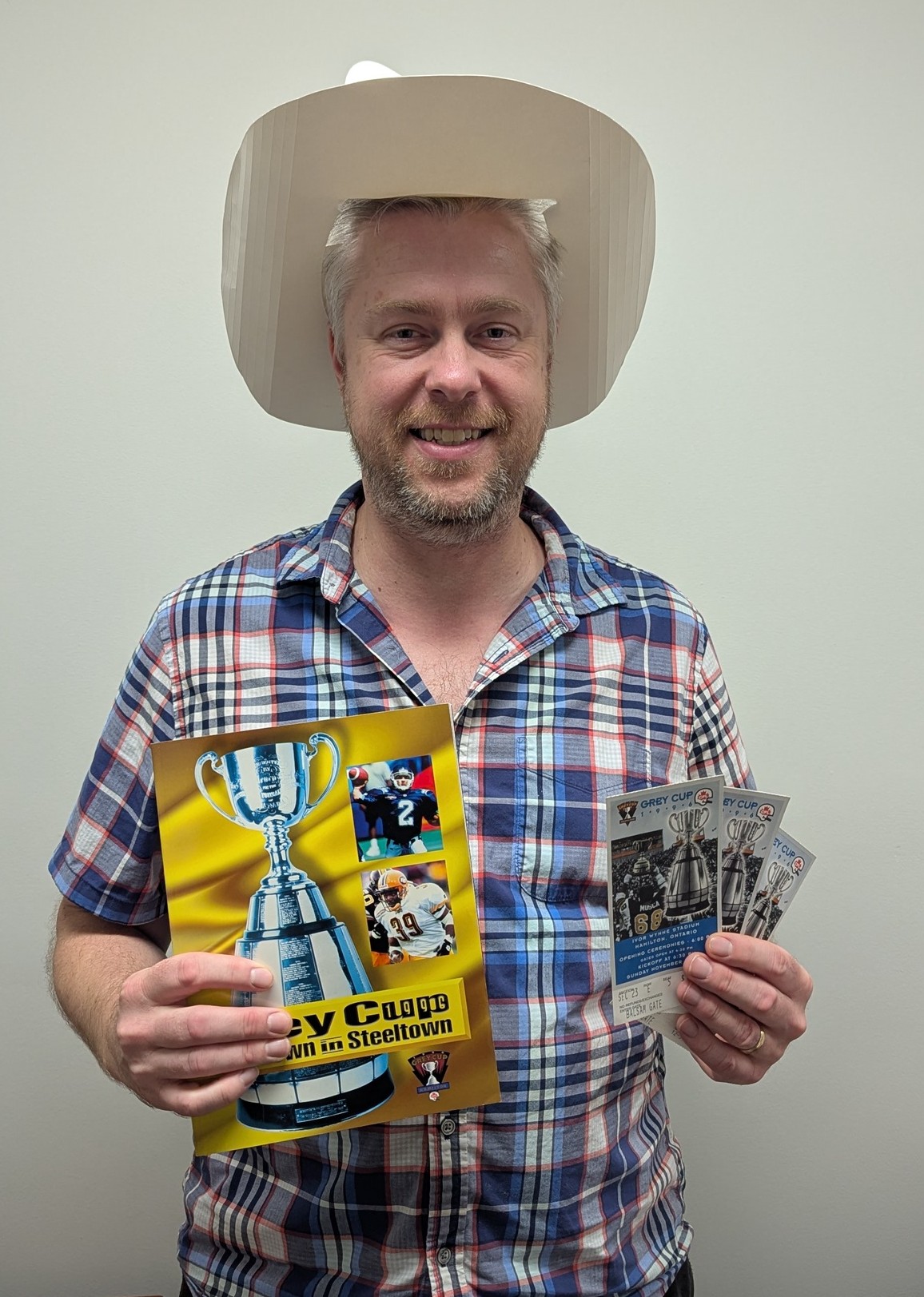
    Thirty years later, here I am donning my paper cowboy hat from the Calgary Outdoor Breakfast at the 1996 Grey Cup.
    Thirty years later, here I am donning my paper cowboy hat from the Calgary Outdoor Breakfast at the 1996 Grey Cup.

    We were back downtown for Grey Cup Saturday where the Grey Cup Santa Claus Parade was the highlight of the afternoon. Tens of thousands lined the streets downtown for what was undoubtedly the longest parade I’ve ever seen. We brought our Mom to this one and parked ourselves towards the end of the parade route along King Street. Thankfully, it was close to a vendor selling hot chocolate, which came in handy as the day went on and temperature dropped.
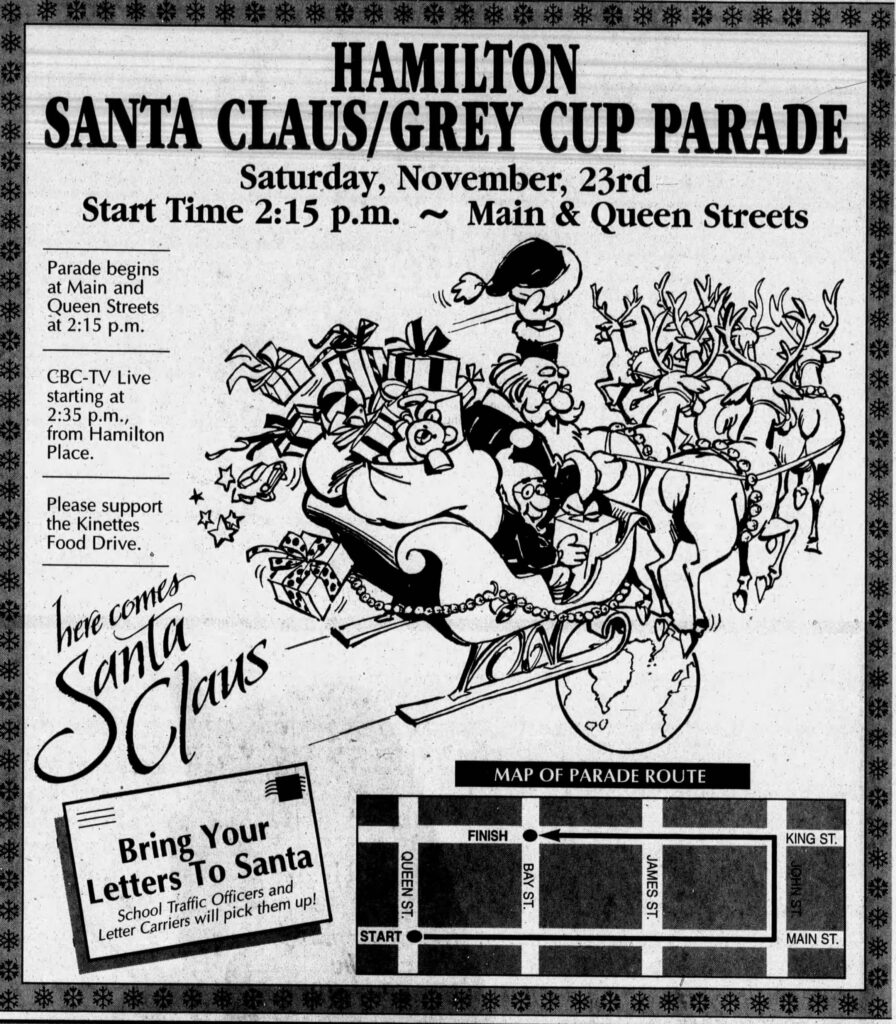
    Ad in the Hamilton Spectator for the Grey Cup Santa Claus Parade.
    Ad in the Hamilton Spectator for the Grey Cup Santa Claus Parade.
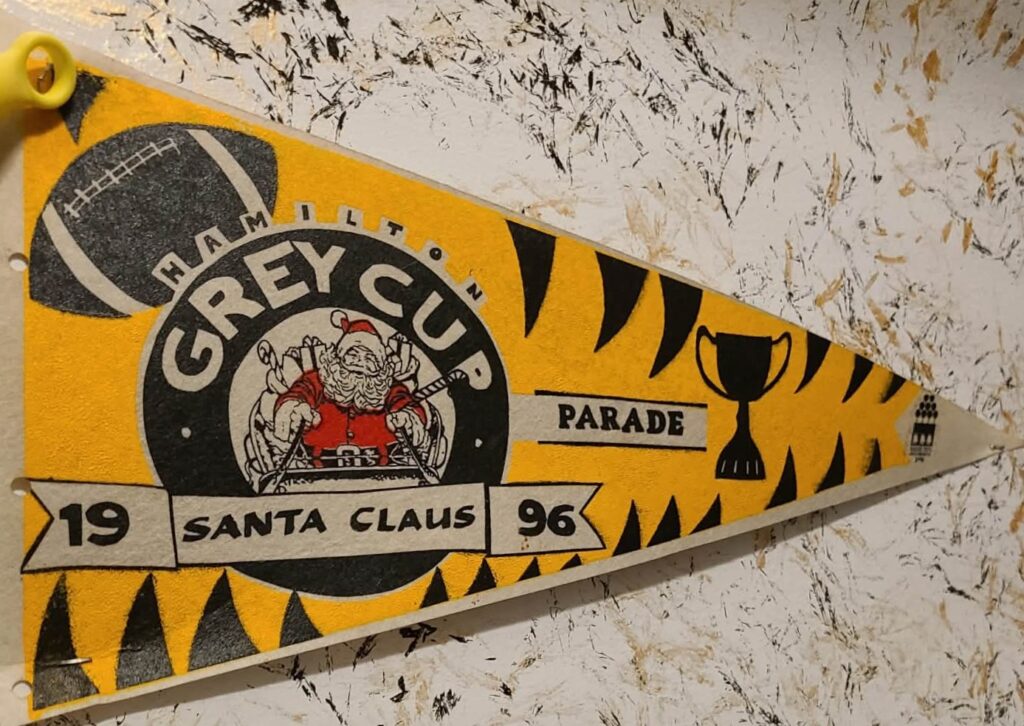
    The Grey Cup Santa Claus Parade pennant we purchased at the parade.
    The Grey Cup Santa Claus Parade pennant we purchased at the parade.

    The parade itself drew an odd mix of young families with kids there to see Santa Claus and dancing elves and football fans there to see team floats and cheerleaders. But, despite the length of it all, the whole thing kind of worked. Of all the floats and participants in the parade, the one that stood out for me was seeing a sombre group of Ottawa fans carrying a coffin emboldened with an Ottawa Rough Riders logo along with the words “RIP 1876-1996.” The Rough Riders had sadly ceased operations just weeks prior.
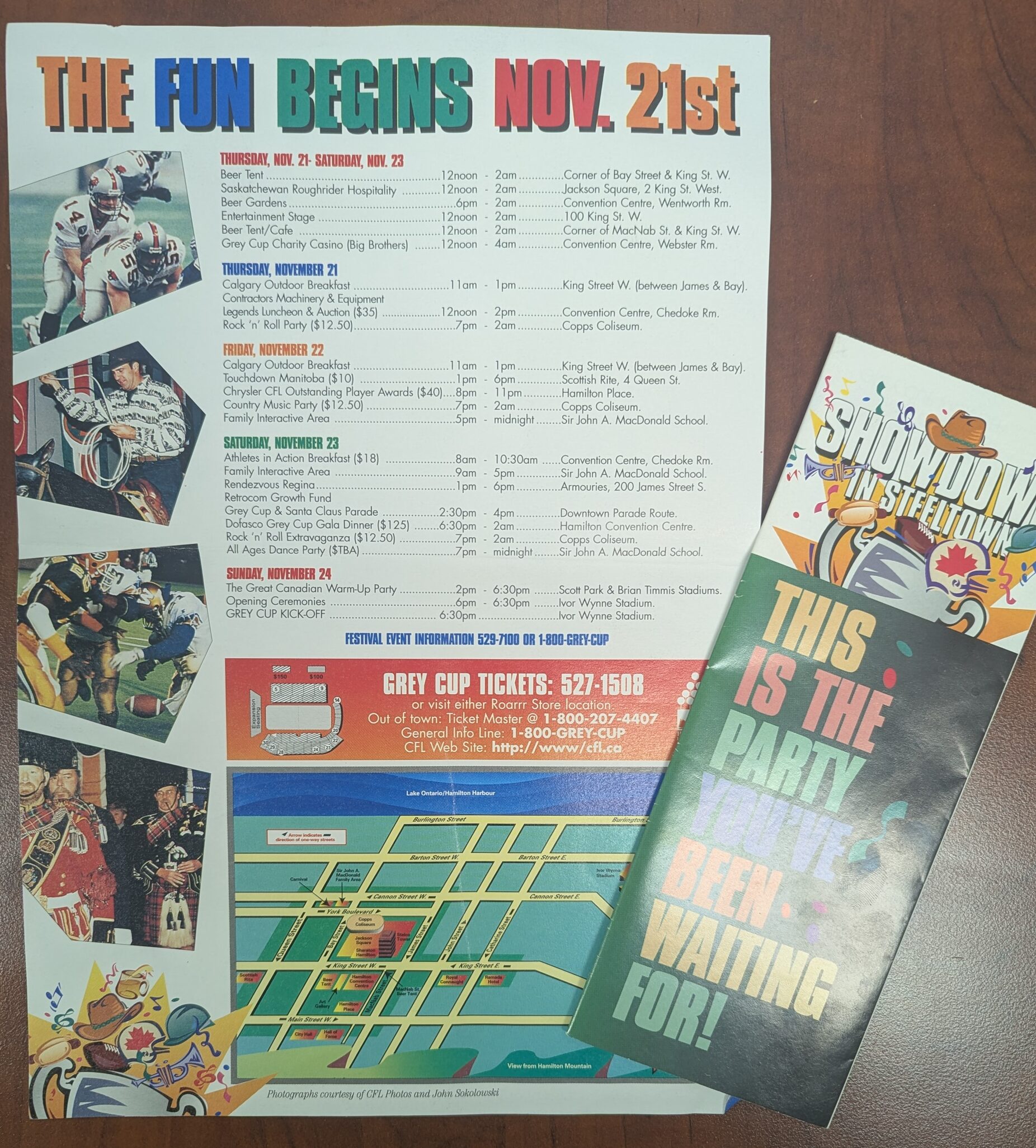
    Brochures I kept from the 1996 Grey Cup “the Showdown in Steeltown.”

    By the halfway mark, my feet were freezing. The crowd did thin out as the afternoon progressed. The cold and cranky, restless children are never a good mix. We ended up leaving early, as well, and ultimately missed the star attraction – old Father Christmas himself holding Earl Grey’s trophy. It was OK, though. I saw the highlights later on TV. We were tired. And we needed to rest up. Because the next day was Grey Cup Sunday and the word on the street was that a storm was brewing…

    To be continued…


    Sources:
    Hamilton Spectator, 19 November 1996
    Hamilton Spectator, 21 November 1996

    Fediverse Reactions
  • Advertisements During Grey Cup Week in 1996

    It’s been thirty years since I attended my first Grey Cup. In 1996, the City of Hamilton welcomed Canadian football fans from across the country (and beyond) to what was billed as the “Showdown in Steeltown.”

    I thought it would be fun to share some of the great (and not so great) advertisements that ran in the Hamilton Spectator in the days leading up to the big game. Enjoy.

    Zarky’s Fine Foods was your go-to “Grey Cup Food Centre.” Check out those prices from 1996.

    Zarky's Fine Foods ad in the Hamilton Spectator during the 1996 Grey Cup.

    The contrast is horrible on this ad for the Roarrr Store, but their retail locations were the place to go to land some official Grey Cup merchandise. The Roarrr Store was the official retail store of the Hamilton Tiger-Cats. I got many a t-shirt and sweatshirt from here.

    Roarrr Store ad in the Hamilton Spectator during the 1996 Grey Cup.

    Here’s an ad for Neon Products, who specialized in signs and advertising. They may have provided the various banners seen around town during Grey Cup week.

    Neon Products ad in the Hamilton Spectator during the 1996 Grey Cup.

    Who remembers Grand & Toy? They ran a Grey Cup draw where you could win four tickets to the game. I presume listing your home fax was optional.

    Grand & Toy ad in the Hamilton Spectator during the 1996 Grey Cup.

    Hutch’s, a Hamilton staple, offered a $2.29 Grey Cup breakfast special at their Stoney Creek location. Now, that’s a smoking deal.

    Hutch's ad in the Hamilton Spectator during the 1996 Grey Cup.

    As part of Grey Cup week, radio stations Y95, 900 CHML and and 820 CHAM, and the Hamilton Spectator presented the Chrysler Grey Cup Concert series at Copps Coliseum. I didn’t go to any of these, but my sister still brags that she went to the November 21st show featuring the Crash Test Dummies.

    Chrysler Grey Cup Concert Series ad in the Hamilton Spectator during the 1996 Grey Cup.

    There was something for everybody during Grey Cup week. You could even check out “Canada’s Hottest Duo” at Chez “M”, Hamilton’s premier exotic adult entertainment establishment.

    Chez "M" ad in the Hamilton Spectator during the 1996 Grey Cup.

    You could win a Motorola StarTac “the phone you could wear” at Bell Mobility’s tailgate party giveaway on the day of the game.

    Bell Mobility ad in the Hamilton Spectator during the 1996 Grey Cup.

    Well, there you have it. As a marketer by trade, I always enjoy looking at vintage (if you can the 1990s vintage) advertising. There was some real hype around the 1996 Grey Cup in Hamilton. A lot of local companies wanted in on it.

    Fediverse Reactions
  • Ad For Football Equipment (1907)

    The football season is in full swing? Are you equipped? Check out this ad for Hurd & McBride that appeared in the Ottawa Citizen on October 2, 1907.

    Fediverse Reactions
  • Argonauts vs. Tiger-Cats in a Two Game Total Point Eastern Final

    The Canadian Football League introduced some significant structural changes in 1986. Not only did the league move to an 18-game season, but it also tweaked its playoff format. Up until then, the top three teams in each of the Eastern and Western divisions qualified for the playoffs. Now, a fourth team in a division was eligible to qualify for the playoffs provided they had more points in the standings than the third place team in the other division. That third place team in the weaker division would lose its playoff berth.

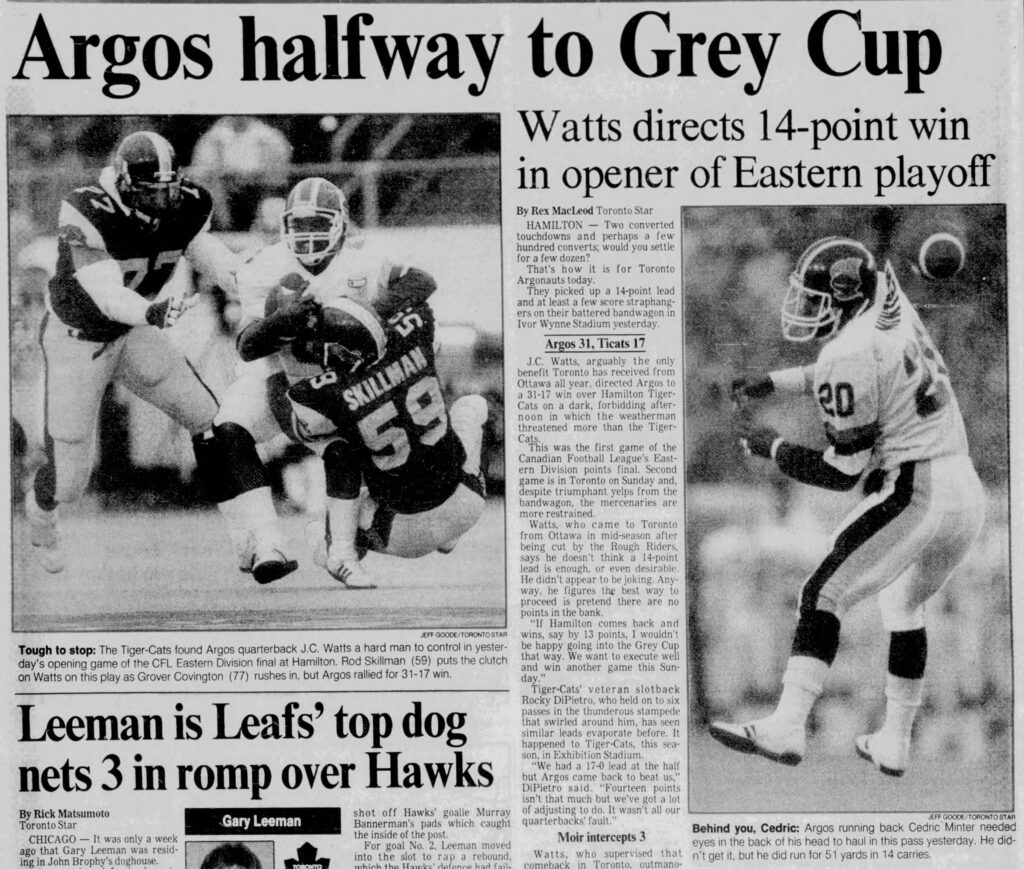
    Toronto Star coverage of Game One of the 1986 Eastern Final (17 November 1986).
    Toronto Star coverage of Game One of the 1986 Eastern Final (17 November 1986).

    The new playoff system was put to use in the first season it was adopted. The final standings in 1986 produced four teams in the Western Division who qualified for the playoffs and just two in the Eastern Division. But rather than the western team crossing over to play in the Eastern Division like today, the playoff teams competed in their respective divisions.

    Here’s how it worked. The four western teams each played a division semi-final with the winners of those two games meeting in the Western Final. In the East, the top two teams – Toronto and Hamilton – competed in a two game, total point series for the Eastern Final.

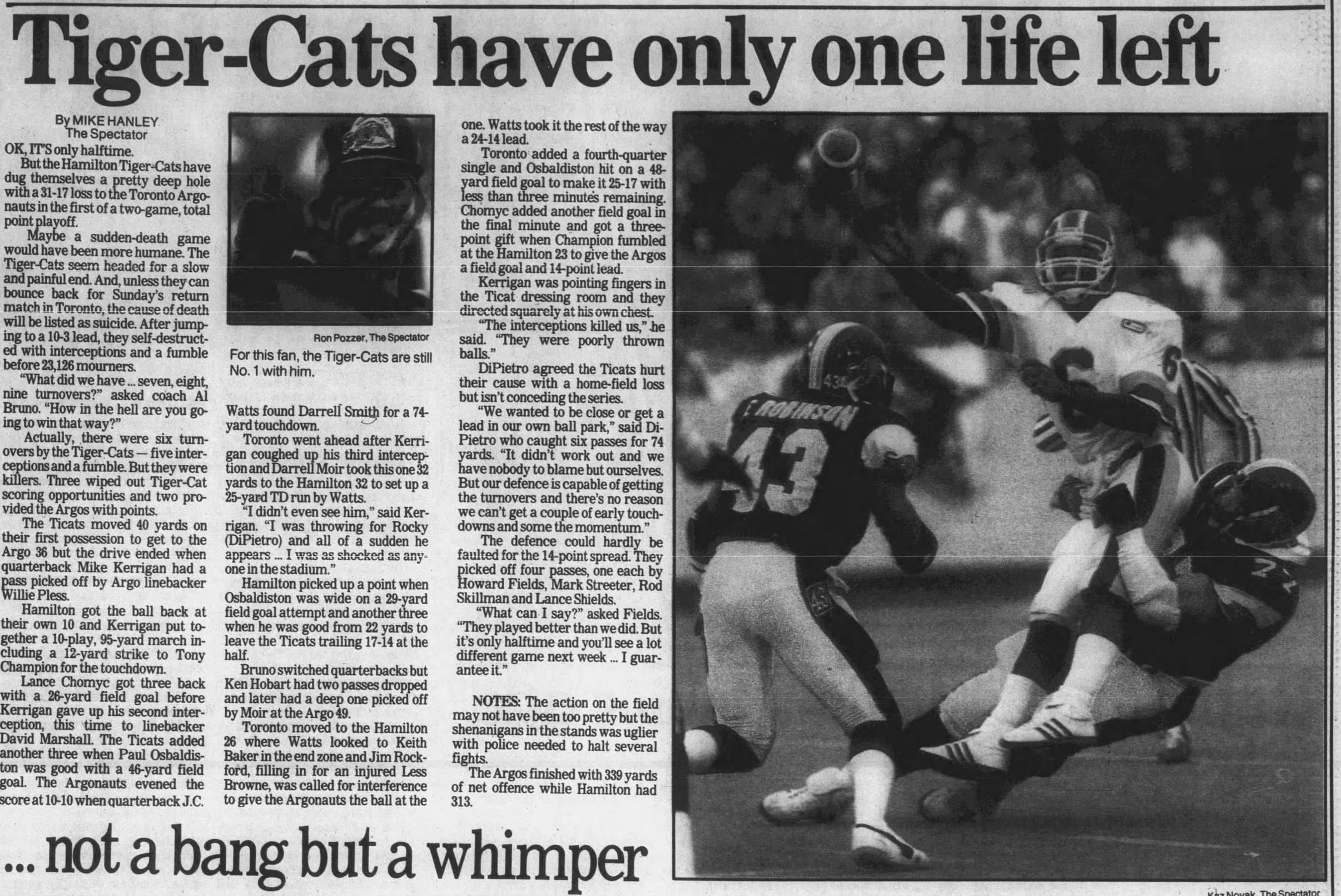
    Hamilton Spectator coverage of Game One of the 1986 Eastern Final (17 November 1986).
    Hamilton Spectator coverage of Game One of the 1986 Eastern Final (17 November 1986).

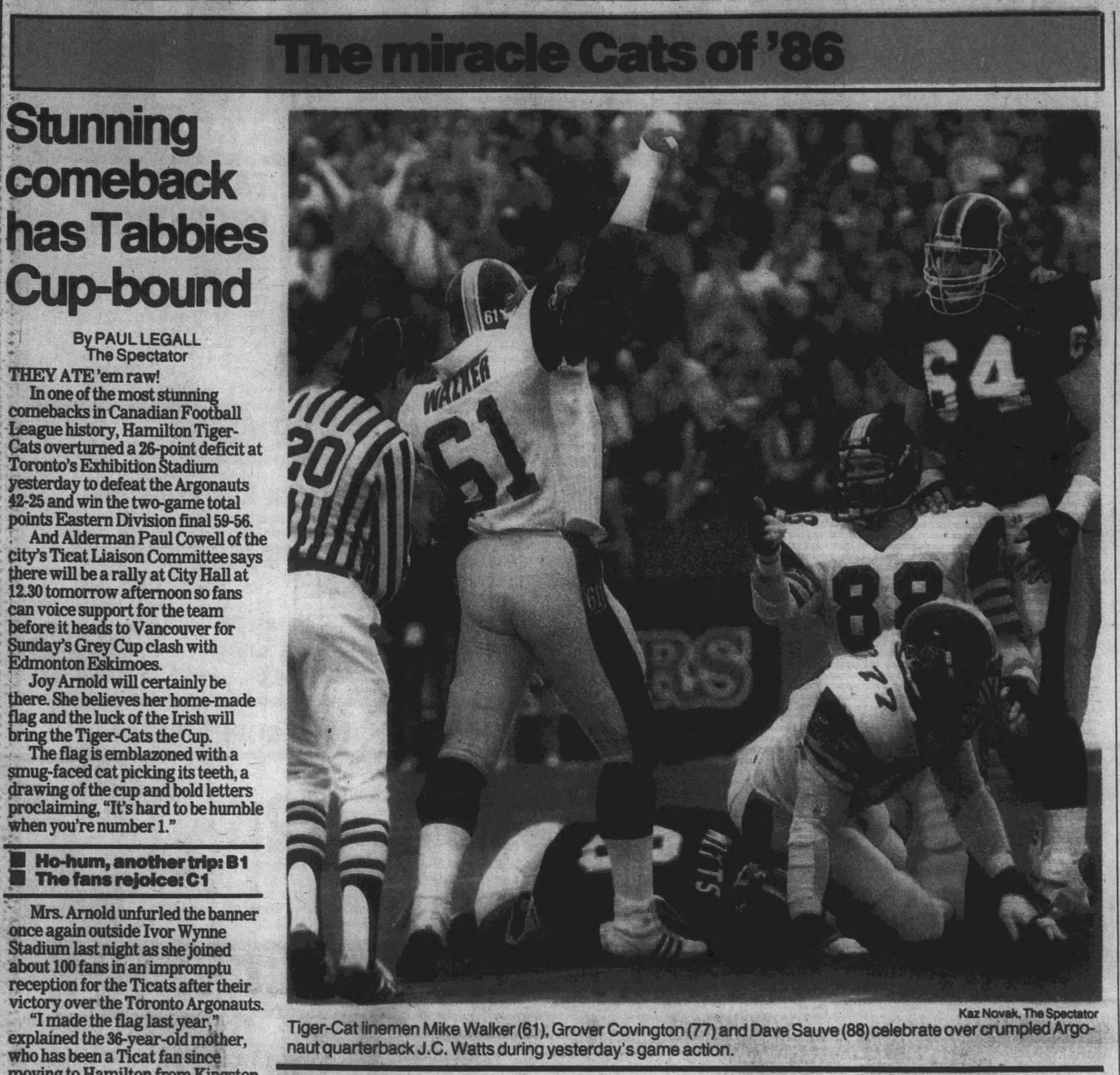
    The Toronto Argonauts were 10-8 on the season while the Hamilton Tiger-Cats finished the year with a 9-8-1 record. The first game was held on Sunday November 16 at Ivor Wynne Stadium in Hamilton. Turnovers plagued the Ti-Cats in Game One, infuriating Hamilton coach Al Bruno. Hamilton turned the ball over six times – five interceptions and one fumble. Ouch.

    Toronto quarterback J.C. Watts, who joined the team after being released by Ottawa midseason, went 9 for 22 and passed for 177 yards – leading the Argos to a 31-17 victory. This meant the Argonauts carried a 14-point lead into Game Two, held on Sunday November 23 at Exhibition Stadium in Toronto.

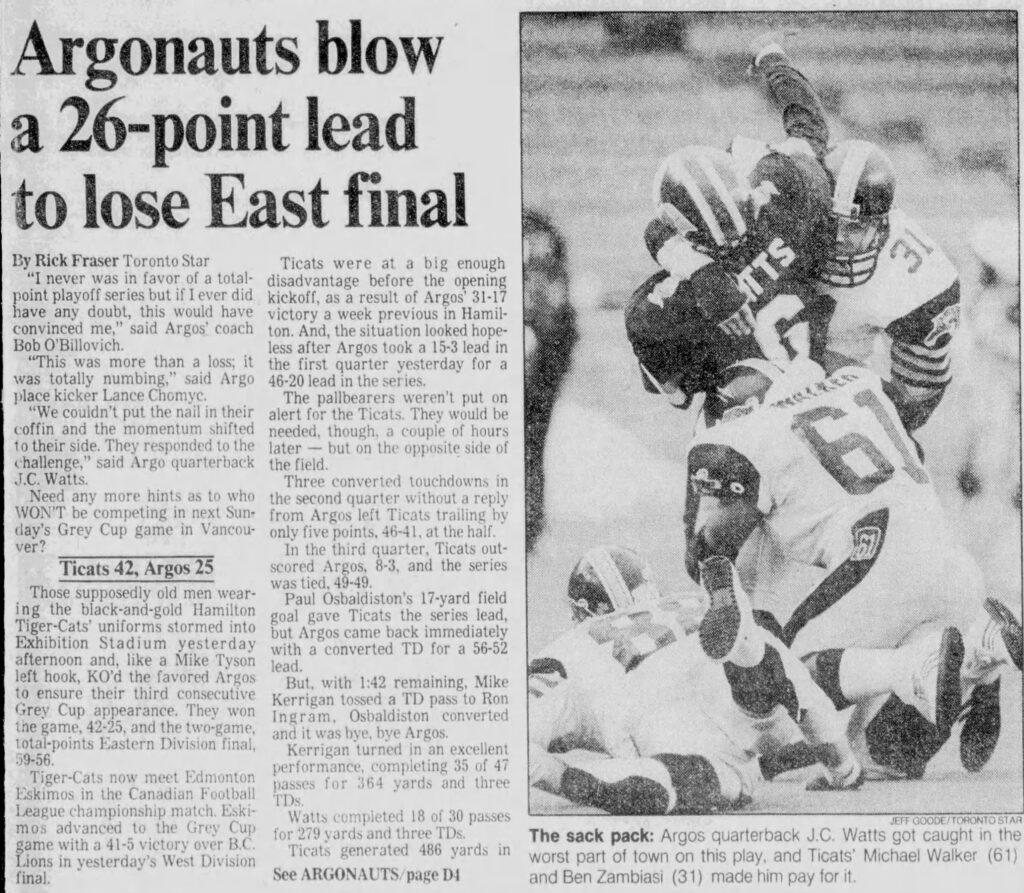
    Toronto Star coverage of Game Two of the 1986 Eastern Final (24 November 1986).
    Toronto Star coverage of Game Two of the 1986 Eastern Final (24 November 1986).

    In the second game, the Argos jumped to a 15-3 lead in the first quarter – or a 26-point lead total in the two-game series. Hamilton quarterback Mike Kerrigan then got to work. Going 35 for 47, Kerrigan passed for 364 yards and three touchdowns. Against all odds, Hamilton erased the 26-point deficit and outscored Toronto 42-25 to win the two game total point series 59-56.

    Hamilton Spectator coverage of Game Two of the 1986 Eastern Final (24 November 1986).
    Hamilton Spectator coverage of Game Two of the 1986 Eastern Final (24 November 1986).

    Here are some great quotes in the Hamilton and Toronto newspapers worth sharing:

    “I was never in favour of a total-point playoff series but if I ever did have any doubt, this would have convinced me.” – Toronto Argonauts head coach Bob O’Billovich

    “The Argos are such a gutless bunch. Even their owners have not guts…they want to sell the team.” – Hamilton Tiger-Cats owner Harold Ballard

    “Last week I said we were so close to exploding. This week was the explosion.” – Hamilton quarterback Mike Kerrigan

    The Tiger-Cats would go on and defeat Edmonton the following week in the Grey Cup.

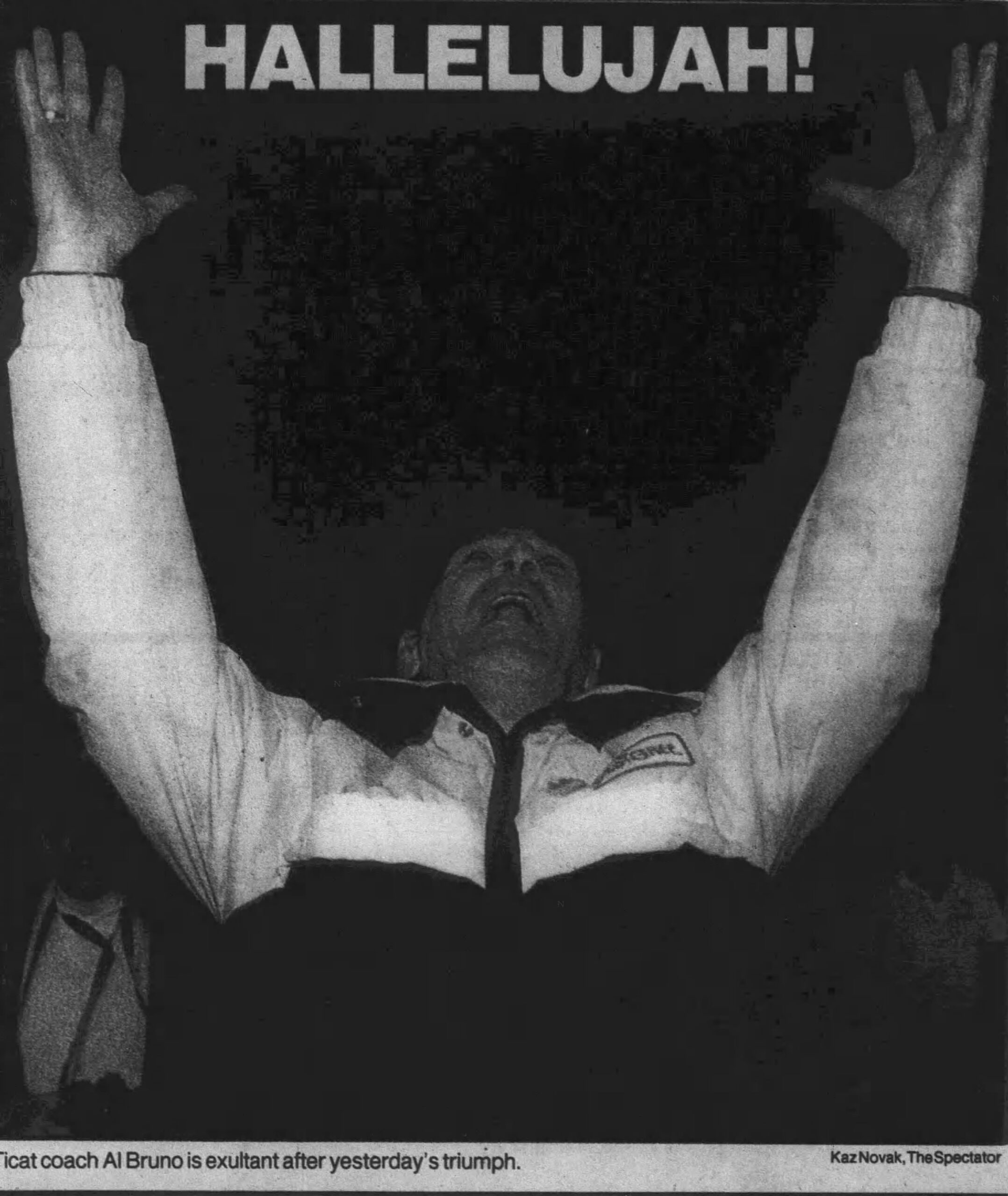
    Photo of Tiger-Cats head coach Al Bruno in the Hamilton Spectator after Hamilton's victory in 1986 Eastern Final (24 November 1986).
    Photo of Tiger-Cats head coach Al Bruno in the Hamilton Spectator after Hamilton’s victory in 1986 Eastern Final (24 November 1986).

    I was too young (and not yet a football fan) to recall these games. But when the Tiger-Cats had their store at the old Centre Mall in Hamilton, they used to play these two games on the big screen TV there all the time. That’s how I actually learned that the 1986 Eastern Final comprised of not one but two games.

    Would-be shoppers, as well as the curious and the nostalgic, would often wander into the store just to catch some footage of these games. And of course the talk would always turn to how the Tiger-Cats came back to win it all.


    Sources:
    Hamilton Spectator, 17 November 1986
    Hamilton Spectator, 24 November 1986
    Toronto Star, 17 November 1986
    Toronto Star, 24 November 1986

    Fediverse Reactions
  • 1907 IRFU Debut Game Draws Controversy On and Off the Field

    In 1907, four football clubs – Hamilton Tigers, Toronto Argonauts, Ottawa Rough Riders, and Montreal Football Club – formed a new league called the Interprovincial Rugby Football Union. Up until then, the champions of the Ontario Rugby Football Union and the Quebec Rugby Football Union would usually square off for a Dominion championship. But there were otherwise no meaningful games between clubs from the two leagues. So the new league was established to become a new competition for what were considered the top teams in the ORFU and QRFU.

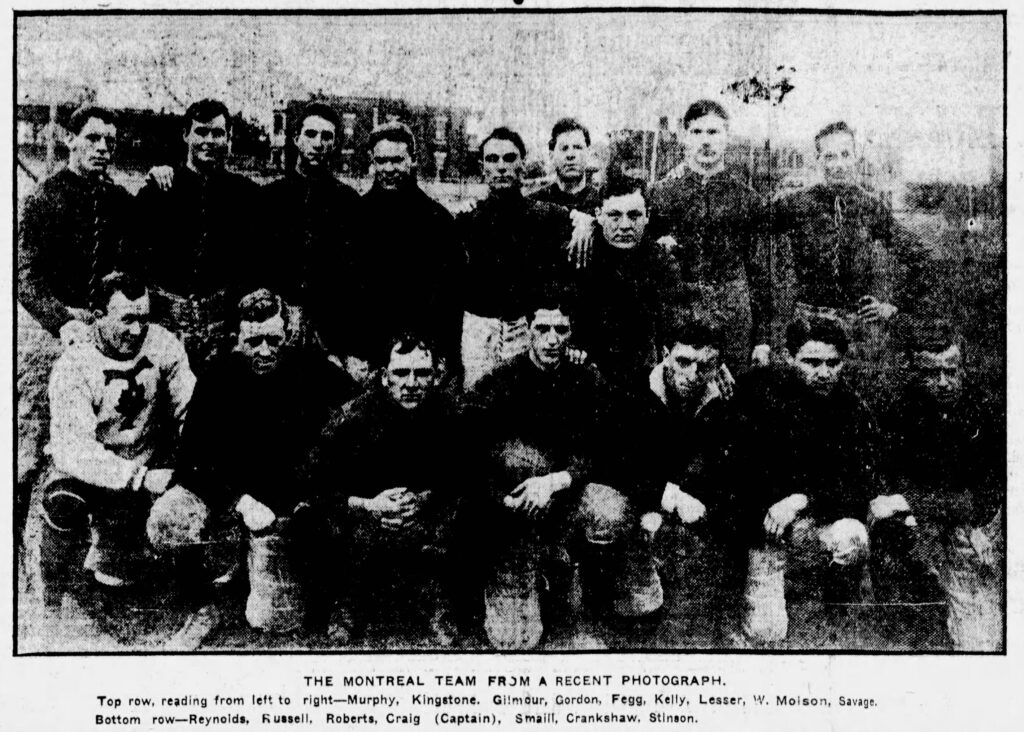
    Montreal Football Club players including Babe Reynolds and Ernie Russell (Montreal Star, 24 October 1907).
    Montreal Football Club players including Babe Reynolds and Ernie Russell (Montreal Star, 24 October 1907).

    On October 5, 1907, the first ever game in the new IRFU was held before a crowd of 3,000 fans at the M.A.A.A. grounds in Montreal. The home side hosted the Toronto Argonauts (kind of, sort of) in the historic matchup.

    The game attracted more attention for its controversy than historical significance, though. Both on and off the field.

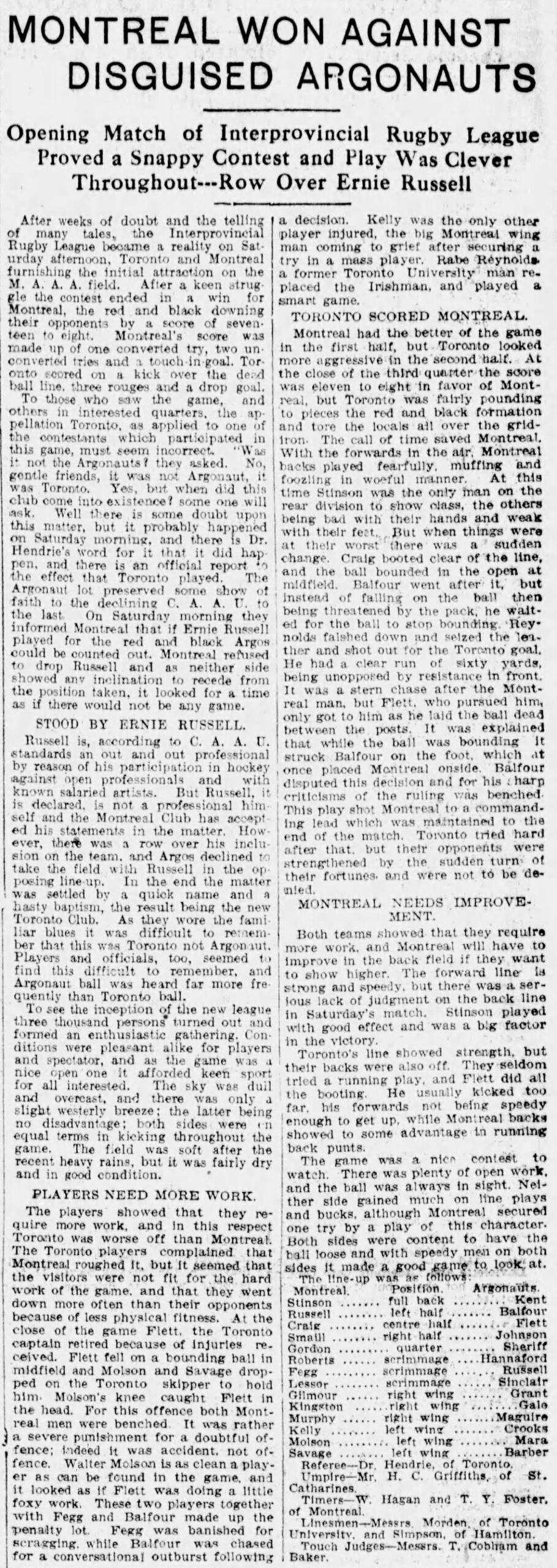
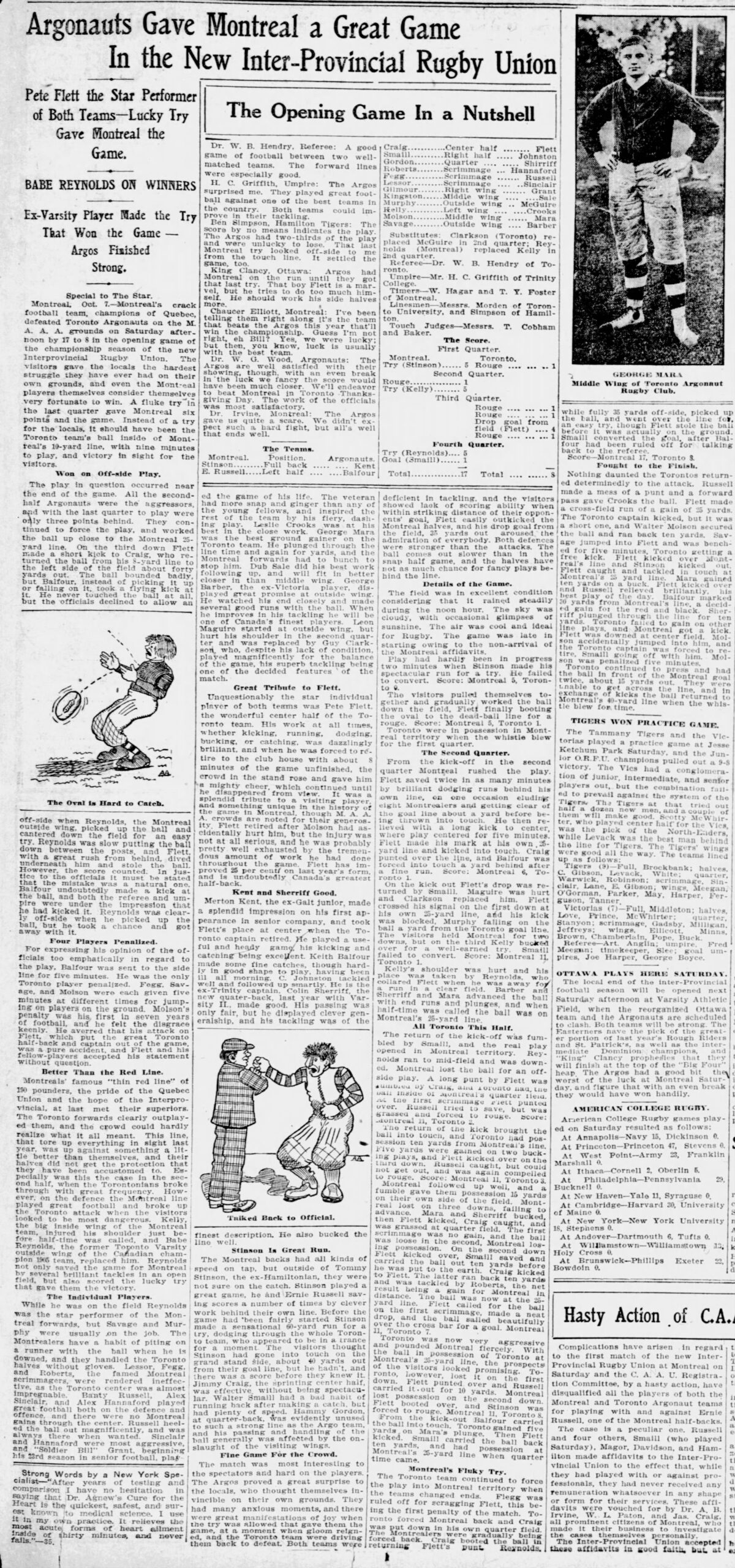
    Coverage of the IRFU's first game between Montreal and Toronto (Montreal Star, 7 October 1907).
    Coverage of the IRFU’s first game between Montreal and Toronto (Montreal Star, 7 October 1907).

    While Montreal had dominated the first half of play, Toronto arguably had the upper hand in the second half. In the fourth quarter, Toronto’s Peter Flett kicked the ball on third down to Montreal’s James Craig, who returned the ball some 40 yards before either punting or fumbling the ball (I’ve read differing accounts). Toronto’s G.B. Balfour, instead of picking it up or falling on it, attempted to kick it. Montreal’s left wing substitute Babe Reynolds picked it up and scurried into Toronto’s end zone for a try. Reynolds should’ve been called offside and the touchdown disallowed. But no instant replay in those days. Toronto’s comeback attempt was over. The final score was 17-8 in favour of Montreal.

    Coverage of the IRFU's first game between Montreal and Toronto (Toronto Star, 7 October 1907).
    Coverage of the IRFU’s first game between Montreal and Toronto (Toronto Star, 7 October 1907).

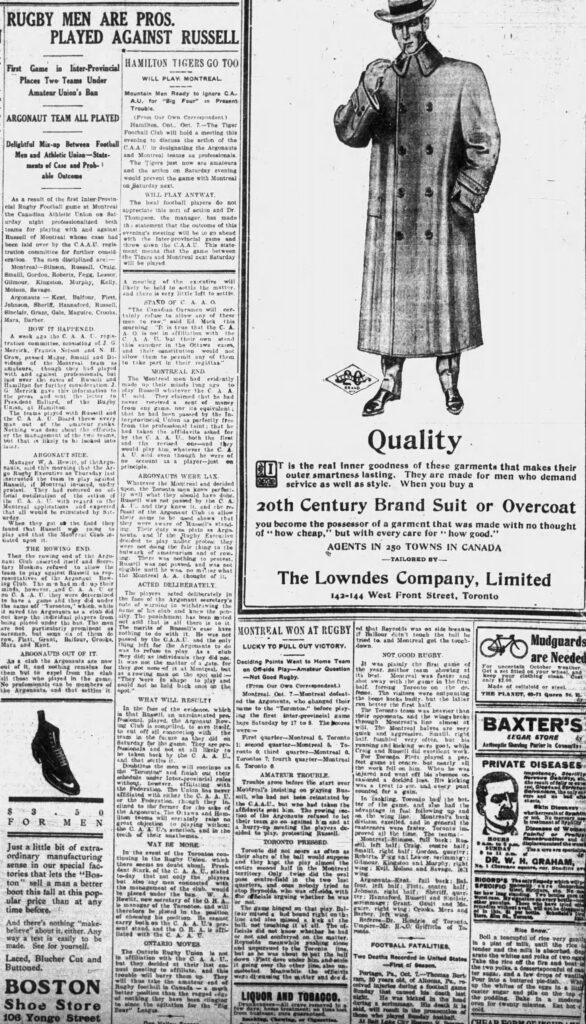
    The bigger controversy happened off the field thanks to a player named Ernie Russell (of Hockey Hall of Fame fame). At the time an organization called the Canadian Amateur Athletic Union was the governing body for amateur sports in Canada. Football was still an amateur sport. And many football players at the time played other sports, as well.

    Coverage of the IRFU's first game between Montreal and Toronto (Toronto Telegraph, 7 October 1907).
    Coverage of the IRFU’s first game between Montreal and Toronto (Toronto Telegraph, 7 October 1907).

    To say the CAAU’s strict interpretation of professionalism tested the IRFU’s patience is an understatement.

    The CAAU deemed a player to be professional even if he simply played with or against a professional player. It is this rule that caused Ernie Russell to be “professionalized” by the CAAU. While Russell had sworn an affidavit that he was an amateur player having never taken money himself, he still didn’t receive clearance by the CAAU by the time the Argonauts arrived in Montreal.

    Rather than risk losing amateur status for the Argonaut Rowing Club, the Argonaut players cleverly rebranded themselves as the “Torontos” for the IRFU debut game.

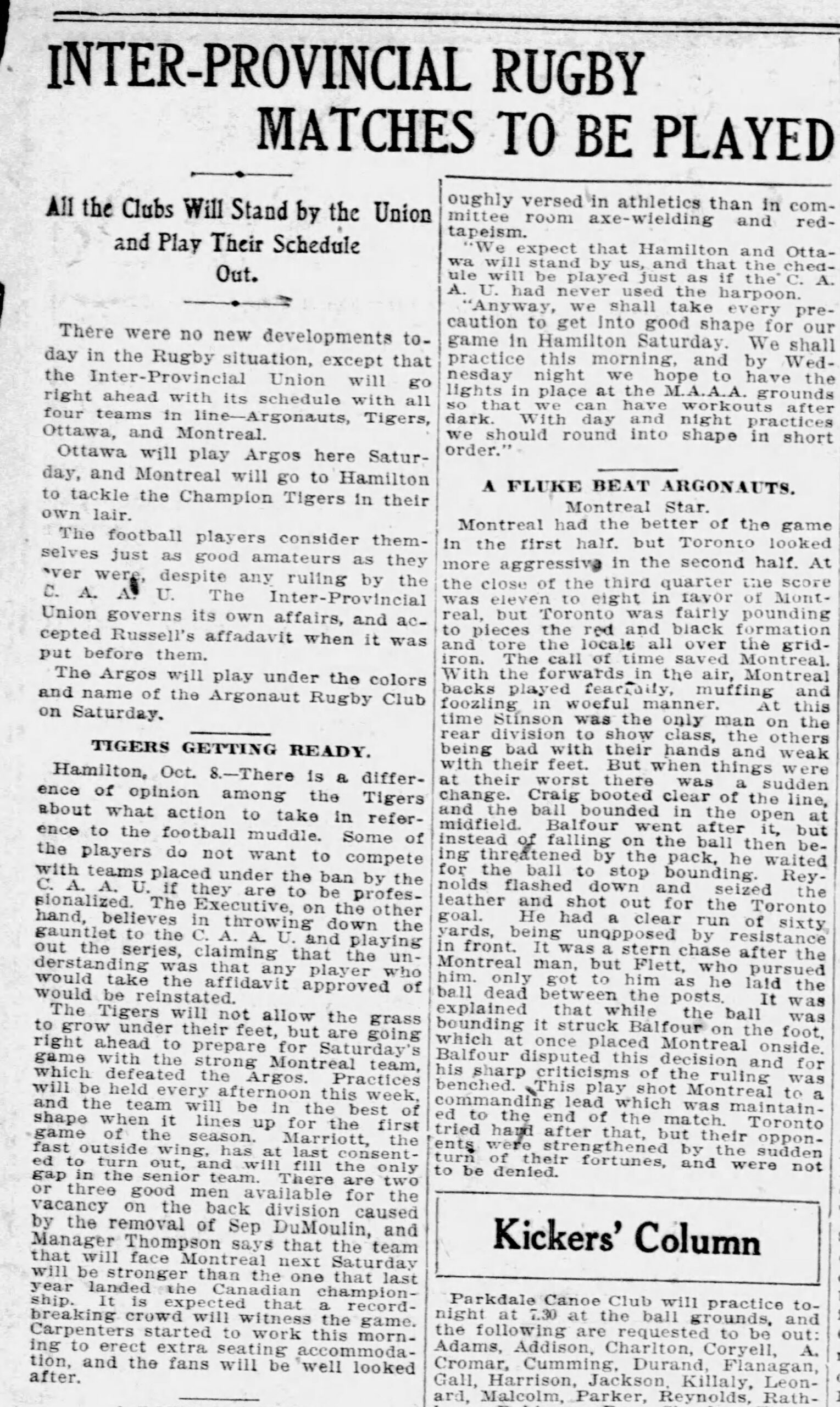
    In hindsight, the CAAU flexed its muscle a bit too much here. Other IRFU teams simply decided to proceed without the sanction of the amateur athletic union. In time, of course, the IRFU would become a fully professional league anyway. And the CAAU would soon cease to even exist.

    Article about the new IRFU proceeding with games despite row with the CAAU (Toronto Star, 8 October 1907).
    Article about the new IRFU proceeding with games despite row with the CAAU (Toronto Star, 8 October 1907).

    So, what should have been a day of celebration for the new Interprovincial Rugby Football Union was largely overshadowed by a blown call by the referees and a nasty public spat with the Canadian Amateur Athletic Union.


    Sources:
    Montreal Star, 7 October 1907
    Toronto Star, 7 October 1907
    Toronto Star, 8 October 1907
    Toronto Telegram, 7 October 1907