Category: Stadiums

  • Calgary Companies Celebrate the Opening of McMahon Stadium

    Last week’s post was about the construction of Calgary’s McMahon Stadium in just 103 days. The stadium replaced Mewata Stadium as the new home of the Calgary Stampeders.

    The first game played at McMahon Stadium featured the Stampeders hosting the Winnipeg Blue Bombers on August 15, 1960. On the day of the game, many Calgary-based companies took out ads in the Calgary Albertan and Calgary Herald newspapers to celebrate the opening of the new stadium. A lot of these firms were directly involved in the stadium’s construction.

    Below is an assortment of the advertisements. Do you see any companies you recognize?

    McMahon Stadium Ad 1960
  • Calgary’s McMahon Stadium Built in 103 Days

    McMahon Stadium turned 65 this month. It is one of just a few of the “old” CFL stadiums still in use. Most CFL teams are playing in either relatively new or refurbished facilities. But back in 1960, the new McMahon Stadium was hailed as one of the finest football stadiums in the country.

    Talk of building a new home for the Calgary Stampeders had been around for years. After some false starts and delays things finally got moving on March 15, 1960 when Stampeders President George McMahon unveiled plans for a new stadium to be constructed on land reserved for a future university campus.

    Construction began the following month. Most of the concrete and other materials used was pre-fabricated offsite, and with a crew of up to 200 a day working the site, it meant construction could be expedited. Plus, the weather cooperated greatly so there were no delays on that front. With solid project management, an efficient labour team, and a little bit of luck, the stadium was completed in just 103 days.

    Article about the McMahon Brothers of Calgary
    Article in the Calgary Albertan about George and Frank McMahon

    The total cost of McMahon Stadium came in at just over a million dollars. About a third of that was covered by George McMahon and his brother Frank. The McMahons were oil businessmen who were among the biggest boosters for the city of Calgary. They were respected and connected. It’s doubtful the stadium would’ve gotten built without their support. Not only did they put their own money into the project, but they were also the ones who arranged for its financing.

    The initial capacity of McMahon Stadium was about 20,000. But it was built with expansion in mind. Over the years more seats and corporate amenities were added. At the time it was opened it was suggested that capacity could one day reach as high as 70,000.
    The Stampeders opened McMahon Stadium on August 15, 1960 against the Winnipeg Blue Bombers. Unfortunately for Stampeders fans, the home side came up short losing 38-23.

    Article in the Calgary Herald comparing McMahon Stadium to other CFL stadiums.

    McMahon Stadium hosted the 1975 Grey Cup, the first to be played in Calgary on November 23rd of that year. Since then, the Grey Cup has been played there four more times and will once again host the championship in 2026.

    Arguably the biggest event held at McMahon Stadium was the Opening and Closing Ceremonies of the 1988 Winter Olympics.


    Burns and Dutton was the main contractor hired to construct McMahon Stadium. The firm was led by Mervin “Red” Dutton, who was a former president of the Stampeders. He bet George McMahon $1500 that the stadium wouldn’t be able to be completed in time for the Stampeders’ home opener. Well, his crew and subcontractors’ hard work cost him $1500. The stadium was completed on time. He lost the bet and ended up paying McMahon the $1500 in one-dollar bills.


    I sometimes wonder why the McMahon Stadium model can’t be replicated when it comes to construction and financing. Today’s stadiums easily cost north of $200 million (and that’s on the cheap side) and take years to build. But there’s something to be said about the so-called McMahon way. Just get building it. Get the barebones up and going and add the capacity and amenities over time. It may not be ideal, but at least you’ll have a stadium to play in. I’m talking to you, Halifax – or anywhere else for that matter.


    When McMahon Stadium opened, numerous companies (many of whom participated in its construction) ran ads in the Calgary newspapers praising the new facility. I’ll feature some of these in a subsequent post.


    Sources:

    The Calgary Albertan (August 15, 1960)

    The Calgary Herald (August 10 and 16, 1960)

    Fediverse Reactions
  • Montreal Crushes Ottawa in Olympic Stadium Opener Before Record Crowd

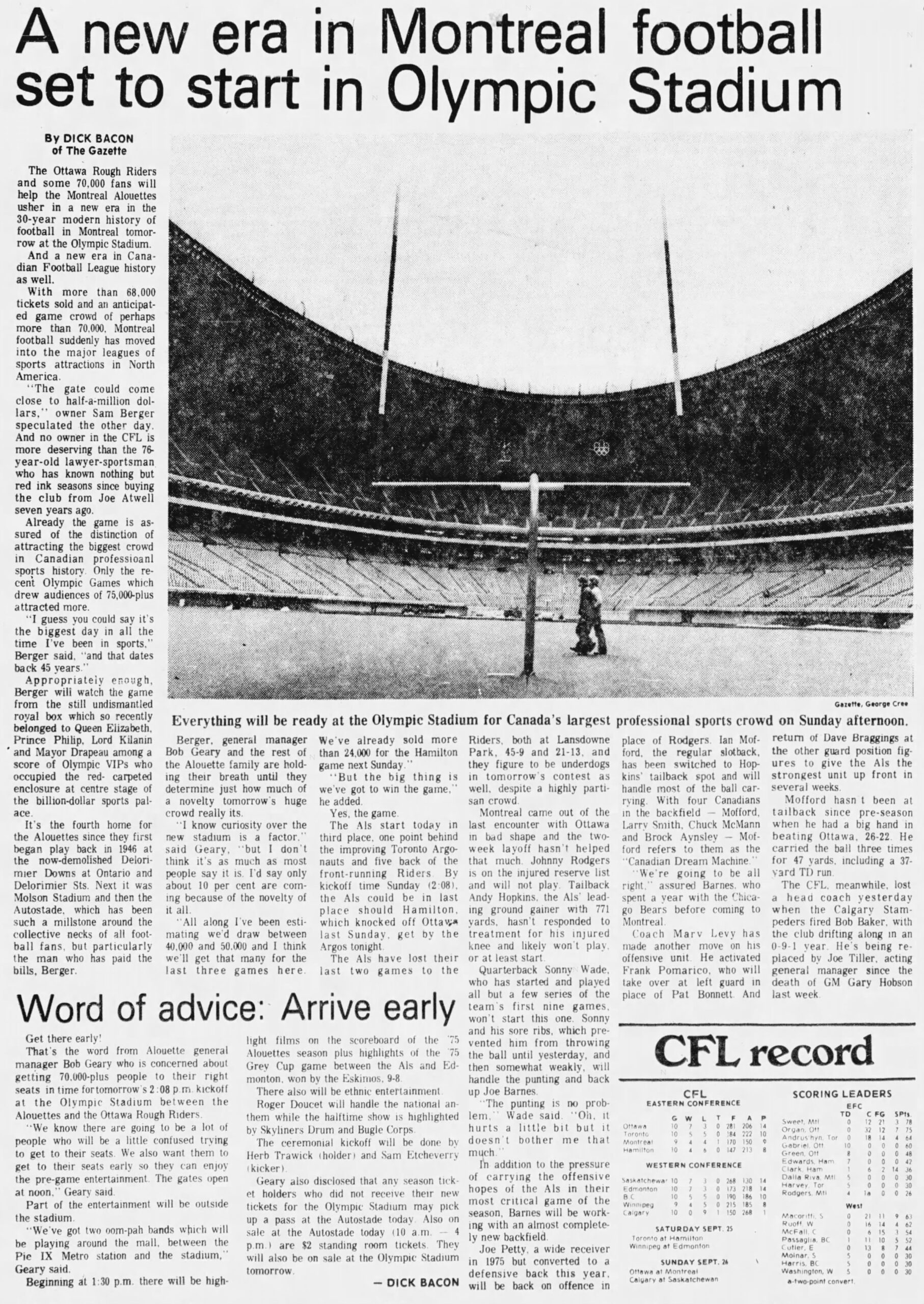
    Midway through the 1976 CFL season, the Montreal Alouettes played their first game in their new home. After leaving behind the Autostade (that stadium likely warrants its own article), the Als hosted the Ottawa Rough Riders at the Olympic Stadium, the largest stadium ever built in Canada.

    A new era in Montreal football set to start in Olympic Stadium
    Bacon, Dick. “A new era in Montreal football set to start in Olympic Stadium.” Montreal Gazette,
    25 September 1976, p. 11.

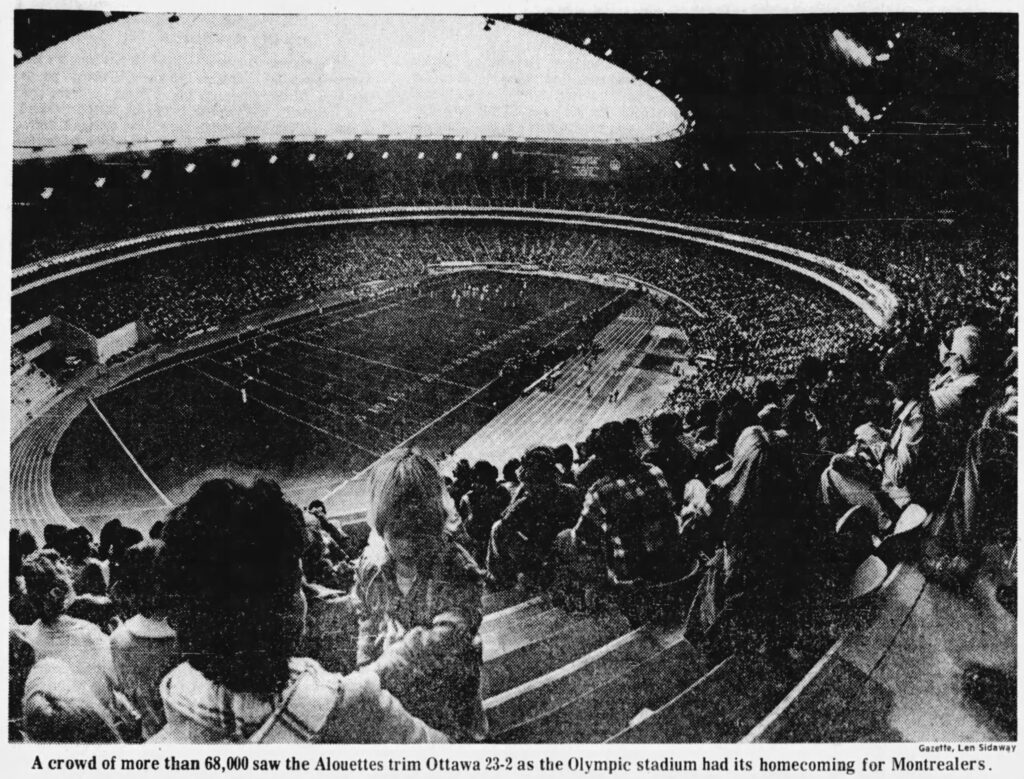
    Post-Olympic fever was still gripping Montreal in the weeks leading up to the game. The Alouettes were expecting a record crowd to come see a .500 home side take on the East Division leaders from Ottawa. No doubt, many just wanted to catch a glimpse of the so-called billion-dollar sports palace. Without question, Olympic Stadium – affectionately known as the Big O or disparagingly known as the Big Owe – with its sheer size and modern-day amenities put other CFL stadiums to shame. In 1976, Edmonton’s Commonwealth Stadium was still a couple years away and the domed stadiums in Vancouver and Toronto came much later.

    The stadium was designed by Roger Taillibert, a French architect, and was the main stadium for the 1976 Summer Olympics in Montreal. It featured state-of-the-art scoreboards with video capabilities as well as modern artificial turf. Plus comfortable seats and corporate boxes. Of course, the promised “retractable” roof would have to wait.

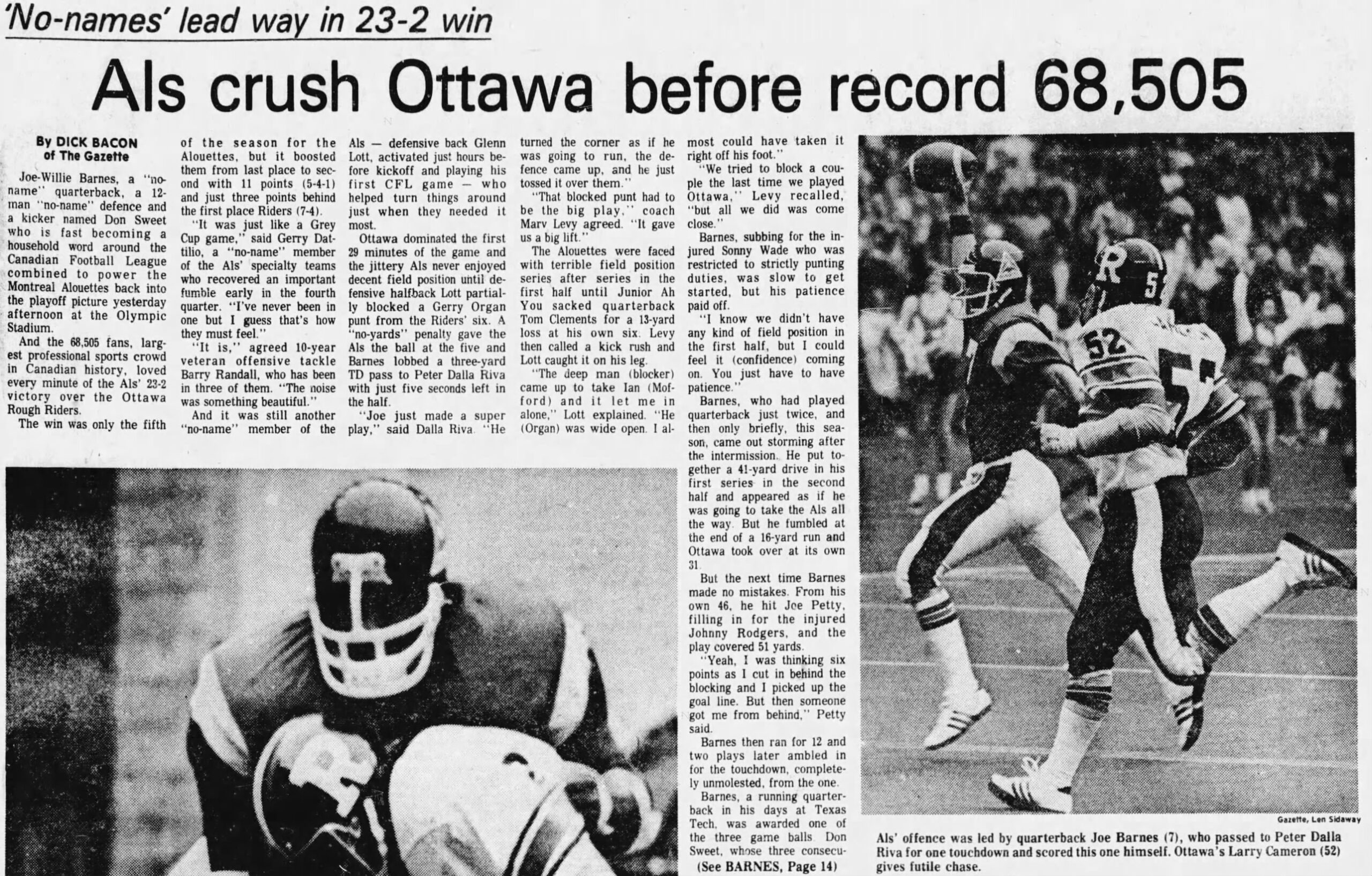
    The Alouettes were the first permanent tenant for the Big O once the Olympics were over. On Sunday September 25, 1976, a record Canadian Football League crowd of 68,505 fans were on hand to see the first game. They were treated to a pre-game ceremony that included former Montreal quarterback Sam Etcheverry performing the ceremonial kickoff.

    Als crush Ottawa before record 68,505
    Bacon Dick, “Als crush Ottawa before record 68,505.” Montreal Gazette, 27 September 1976, p. 13.

    Led by quarterback Joe Barnes and kicker Don Sweet, the Alouettes cruised to a 23-2 victory over the Rough Riders. The Alouettes’ win helped put Montreal back in the playoff hunt in the CFL East. The 1976 Alouettes were coached by the legendary Marv Levy. Levy understood the impact a large vocal crowd could have on the game.

    “The crowd could be the 13th man on the field. If they’re a supportive crowd, it could be the start of a new era in fan enthusiasm and what it means to the team.”
    – Marv Levy

    I’ve been to Olympic Stadium only once. That was for a Grey Cup game. When the place is packed – just like it was in the late 70s – it’s an awestriking experience. But the atmosphere diminishes exponentially the smaller the crowd.

    Today, the Alouettes play their home games at the much more intimate (and much older) Percival Molson Memorial Stadium on the campus of McGill University. They haven’t played a football game at the Big O since 2012. But a new roof is being constructed, and there are hints of a further refurbishment down the road.
    Is it possible that the Alouettes will once again look at playing some if not all their games at Olympic Stadium in the future?

    Perhaps the team can recapture some of that post-Olympic pride that helped them shatter attendance records. At the very least, it won’t be too long before the Grey Cup game returns to Montreal – and with that the roar of the crowd will once again reverberate throughout Olympic Stadium.

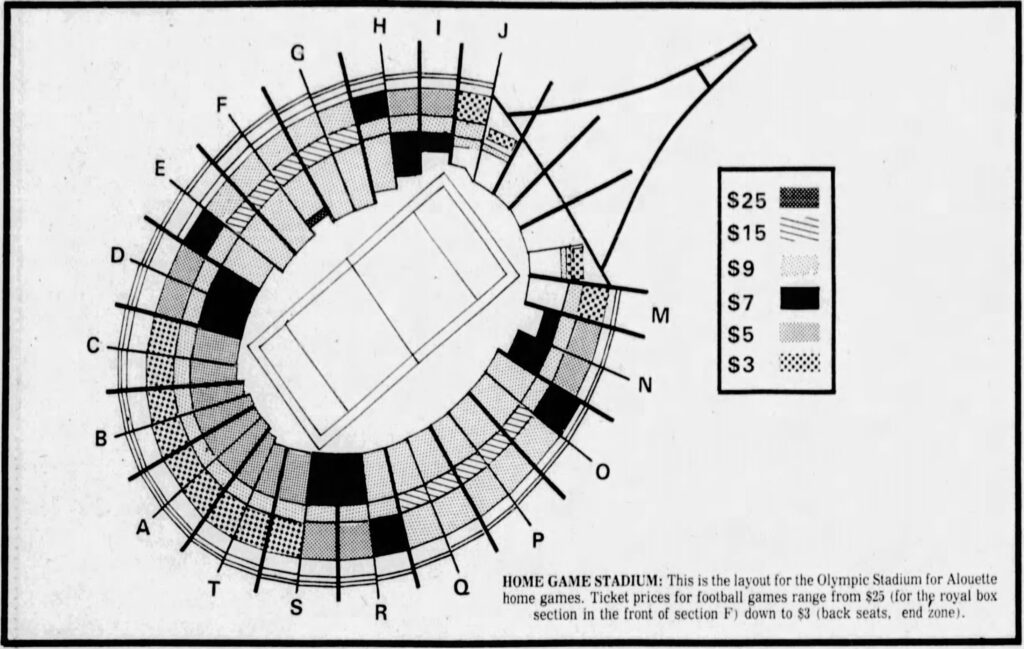
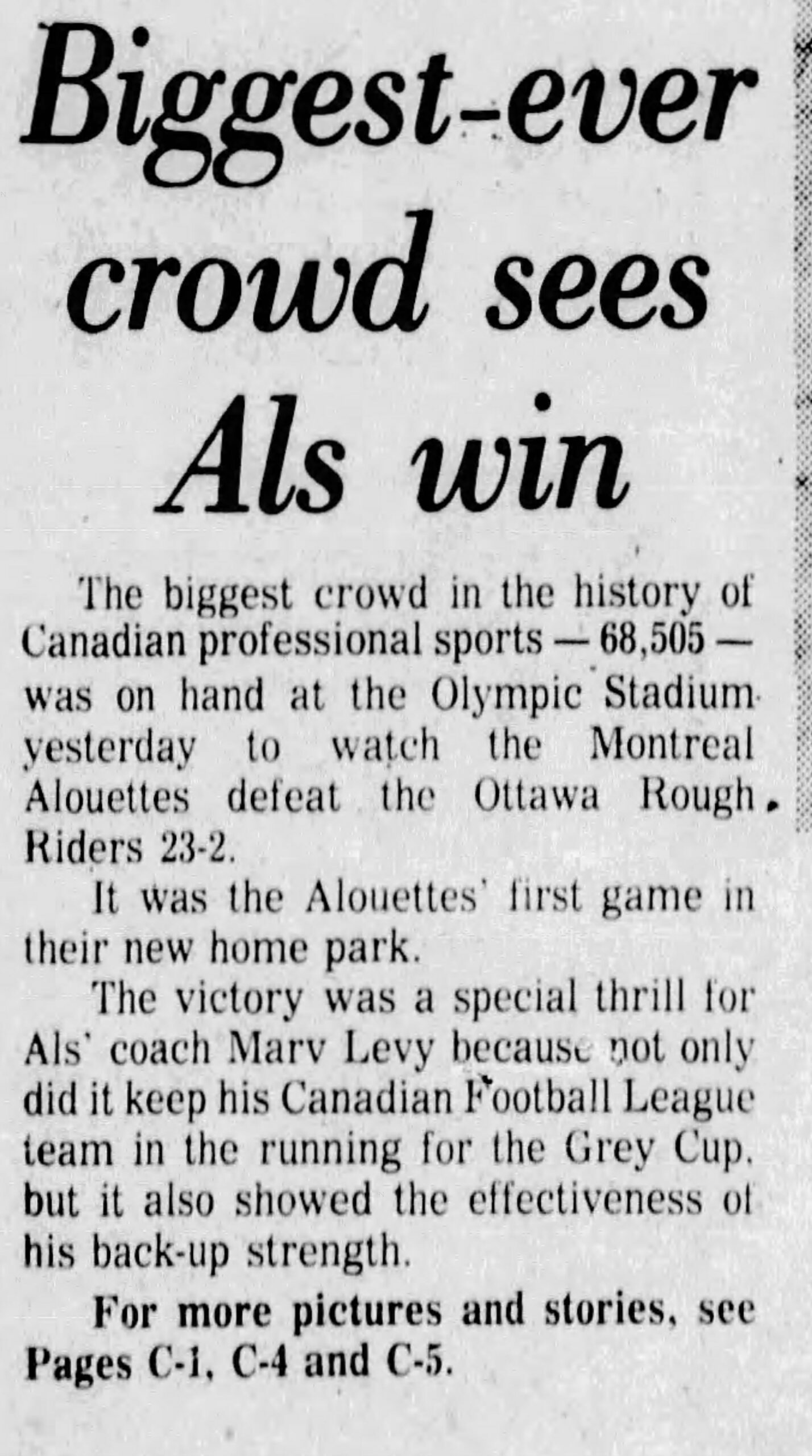
    Biggest CFL Crowd
    Montreal Star, 27 September 1976
  • Presenting Hamilton’s New Ivor Wynne Stadium

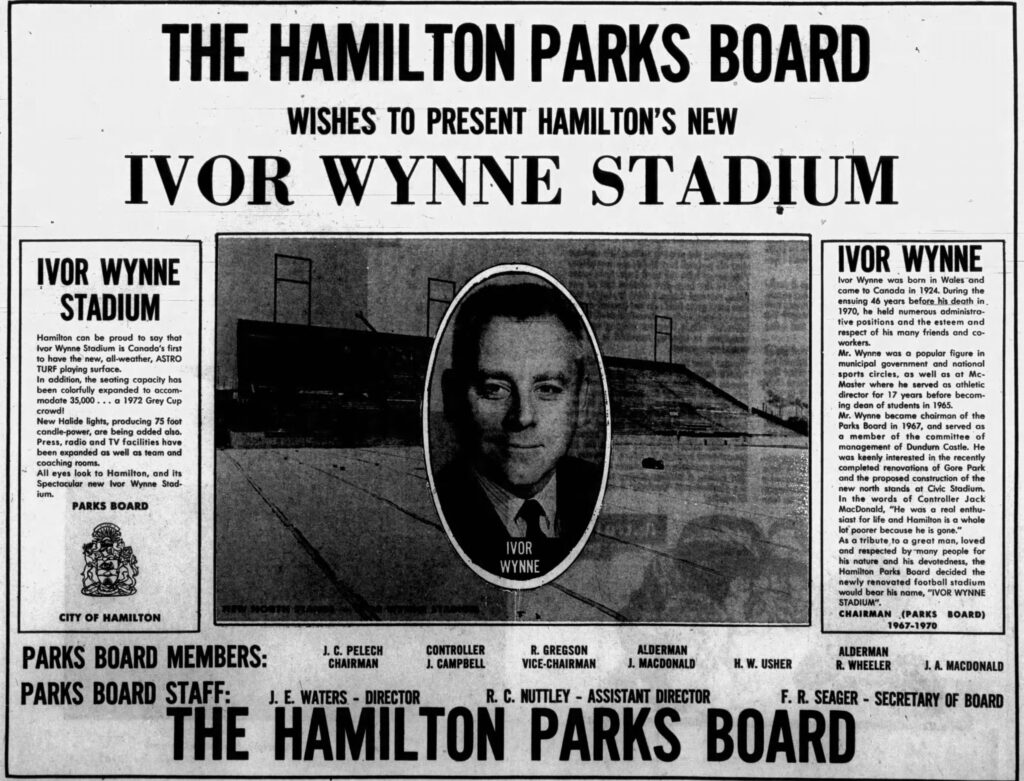
    New Ivor Wynne Stadium ad in the Hamilton Spectator
    Source: The Hamilton Spectator, June 21, 1971 page 22.

    In 1970-71, Hamilton’s Civic Stadium was heavily rebuilt to meet the needs of a modern professional football stadium. Originally built in 1928 for the British Empire Games (the forerunner to the Commonwealth Games), the stadium was dated and considered one of the worst stadiums in the country.

    A new north grandstand was built, bringing the capacity to about 35,000. New lights were added – much to the delight of television broadcasters. And, all-season AstroTurf was installed, the first stadium in Canada to have it.

    In 1971, the stadium was renamed Ivor Wynne Stadium in honour of the former chairman of the Hamilton parks board and athletics director at McMaster University. Ivor Wynne had died a year earlier.

    The new state of the art stadium would host the 1972 Grey Cup the following year and continued to be Hamilton Tiger-Cats’ home until it was replaced by Tim Horton’s Field in 2014.