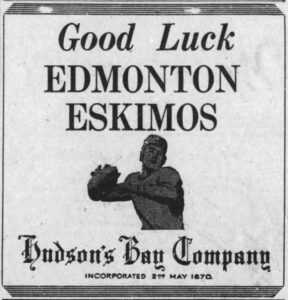
Category: Edmonton

  • Flutie Freezes as Edmonton Defeats Calgary in Frigid, Snowy 1993 Western Final

    Canadian football in November can be cold – especially when played on the Prairies. Bone-chilling temperatures, coupled with blowing snow, made the 1993 Western Final at McMahon Stadium between the Calgary Stampeders and the Edmonton Eskimos one of those games where the weather might have played a bigger role in the game than the players on the field.
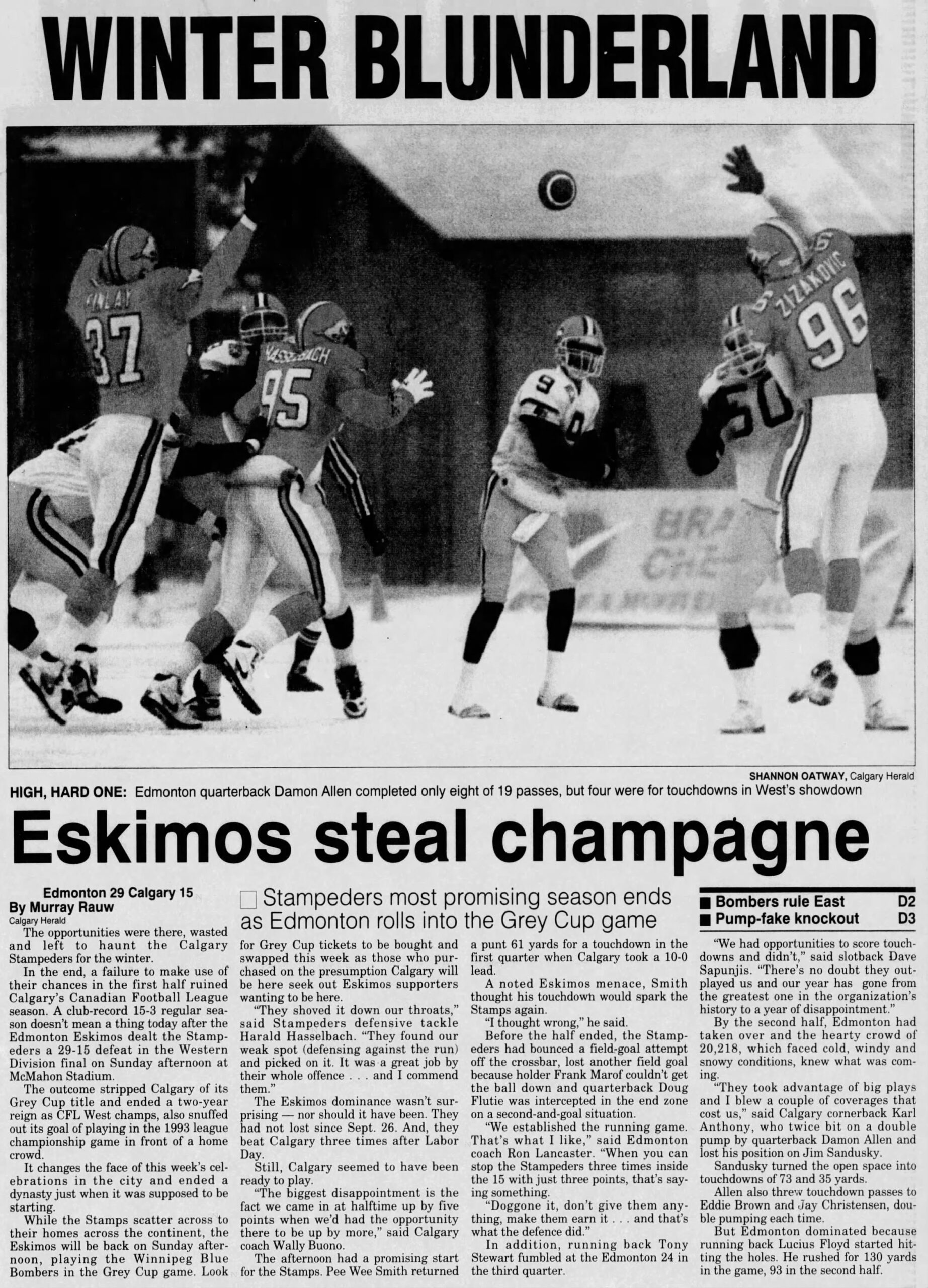
    1993 Western Final coverage in the Calgary Herald
    Coverage of the 1993 Western Final in the Calgary Herald (22 November 1993)

    Led by marquee quarterback Doug Flutie, the Stampeders entered the game with a league best 15-3 regular season record. They were the defending Grey Cup champions and were, without a doubt, the class of the CFL in 1993. While the underdog, Edmonton was still a strong team, having finished second in the West Division with a 12-6 record.

    The city of Calgary and much of Alberta was under a winter storm warning. Game time temperatures hovered below minus 20 degrees Celsius with a windchill making it feel even colder. The cold along with the wind and snow created blizzard-like conditions. Not exactly an ideal day for football.
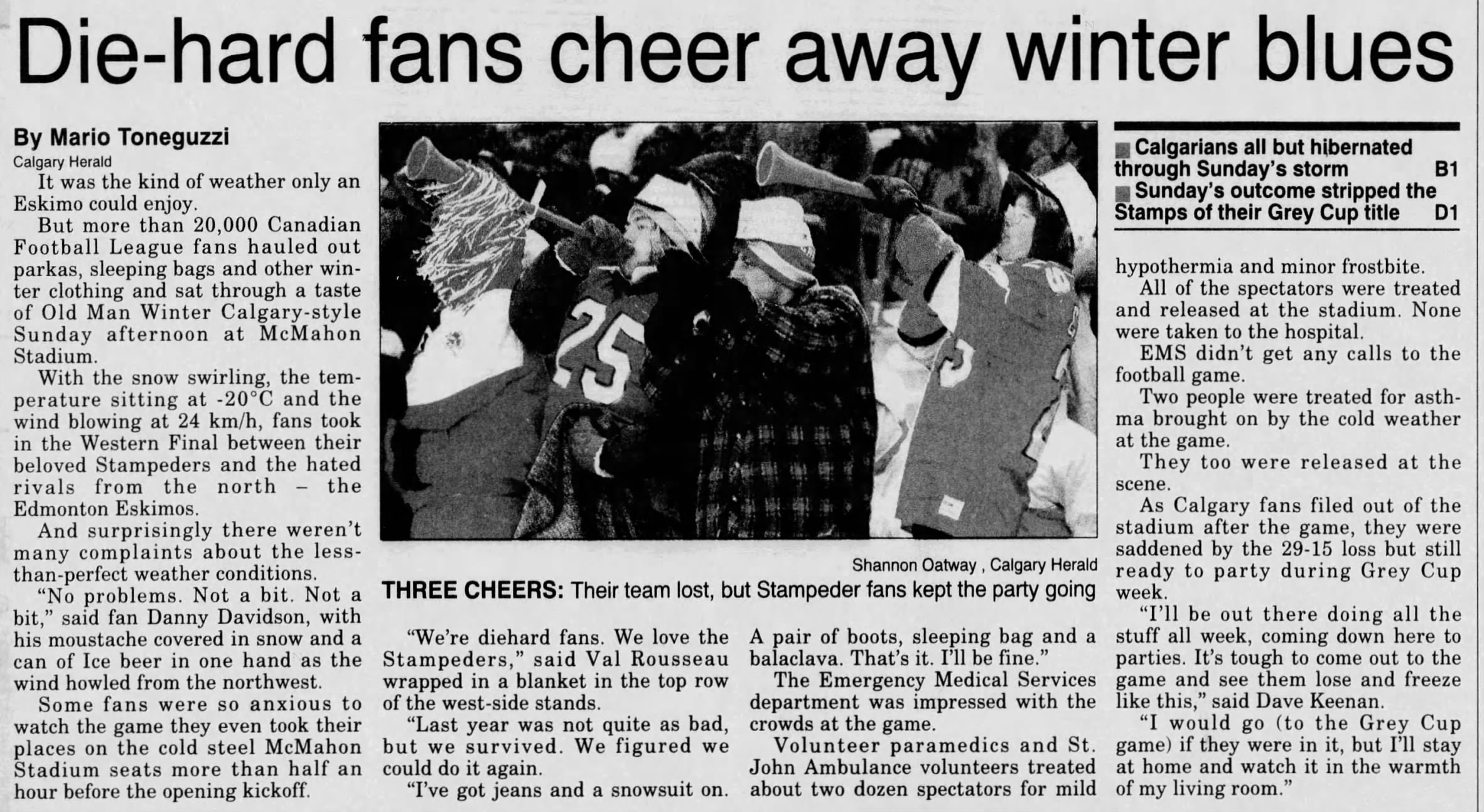
    Coverage of the 1993 Western Final in the Calgary Herald (22 November 1993)
    Coverage of the 1993 Western Final in the Calgary Herald (22 November 1993)

    Calgary scored first thanks to a punt return touchdown by Pee Wee Smith. A field goal by Mark McLoughlin put the Stampeders up 10-0 after the first quarter. Calgary continued to lead 13-8 at the half. The third quarter was delayed thanks to the accumulation of snow. But when the teams returned to the field, Edmonton got on a roll.

    Edmonton quarterback Damon Allen made only 8 completions on 19 passing attempts in the game. But four of those completions were touchdowns. Edmonton scored 28 points in the second half compared to Calgary’s meagre 2 (a safety late in the game). As the temperature continued to fall, Flutie’s hands literally froze, affecting his ability to throw the football. Fans in the stands and television viewers across the country were in disbelief that the CFL’s best quarterback seemed to be completely neutralized by the cold weather.
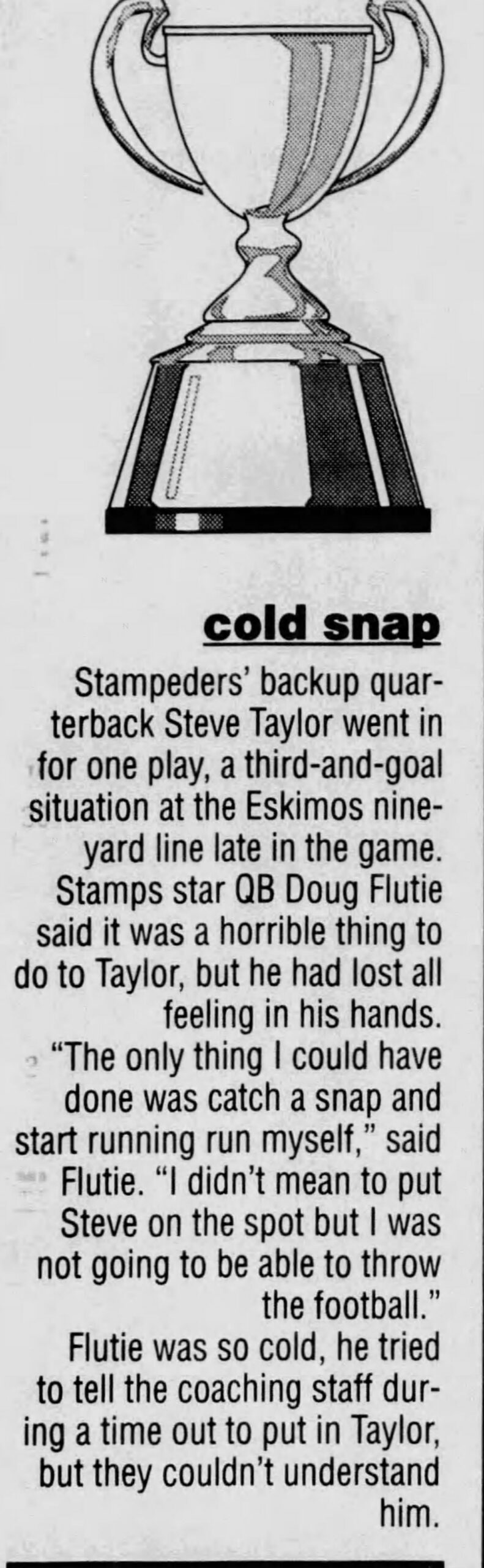
    Coverage of the 1993 Western Final in the Calgary Herald (22 November 1993)
    Freezing Flutie (Calgary Herald)

    When the final whistle was blown, Edmonton had secured a 29-15 victory and advanced to the Grey Cup that was being played at McMahon Stadium the following week. A dedicated crowd of over 20,000 braved the elements but left disappointed that their team wasn’t going to repeat as champions. The hope of the hometown team playing in the Grey Cup was over.

    Coverage of the 1993 Western Final in the Calgary Herald (22 November 1993)
    Stampeders owner Larry Ryckman’s reaction (Calgary Herald)

    In the aftermath of the loss, Stampeders owner Larry Ryckman was not a happy camper. He insisted the CFL move up the season to avoid such wintery games in the future. Either that or build a domed stadium in Calgary. The Western Final on November 21, 1993, was one of the coldest – if not the coldest – football games played in Canada. He might’ve had a good point.


    Source(s):
    The Calgary Herald, 22 November 1993

    Fediverse Reactions
  • CFL Media Guides in the 1960s

    For eons, the Canadian Football League published Media Guides or Fact Books for its teams. These little handbooks were meant to familiarize local journalists with the players and coaching staff of the team they were covering. They included biographies, statistics, records, and team histories.

    Team media guides were also a great little souvenir for the savvy football fan. I have several in my own collection I like to peruse every now and then.

    The CFL still produces them at least in electronic form. At least for some teams. I’m not sure if the league still offers print copies, though. It looks like they’ve met the same fate as game day programs and printed tickets, which is unfortunate.

    Anyway, I thought what better way to spend the dog days of summer than by taking a look at some of these CFL media guides from the 1960s (or the late 1950s in a couple of cases). It was an exciting decade for the CFL and Canadian football.

    Here are some photos of the media guides (front and back covers) for each CFL team from that era:

    The above photos are courtesy of the good folks at the Canadian Football Research Society.

    Fediverse Reactions
  • The Edmonton Elks 2.0

    This is the third of a series of posts that will explore the stories behind the names of the existing Canadian Football League teams. See the previous post on the Calgary Stampeders.


    Throughout the long history of Canadian football, there’s been very little controversy surrounding team nicknames. Sure, there was a time in the not too distant past where there was one team called the Rough Riders and another called the Roughriders. But, for the most part the country’s professional football club names have been a bit quirky sounding but certainly not eyebrow raising.

    The one exception to this rule is Edmonton.

    Football has been played in the Alberta capital since 1895. Just as it is today, the early Edmonton team’s main rival was Calgary. The story goes that a Calgary sportswriter took a jab at the Edmonton team by calling them “the Esquimaux” (the French translation of Eskimos) in reference to the rather cold northern Alberta climate. The Edmonton team embraced the insult and used the moniker for a number of years before adopting the Anglicized version of the word in 1910.

    The team was known as the Edmonton Elks in 1922, foreshadowing a name change that would come a century later, and played Queen’s University in the Grey Cup that year.

    The original Eskimo team folded in the 1920s. In 1938, the Edmonton Eskimos were reborn and played in the Western Interprovincial Football Union. However, this team too ceased operations due to the onset of the Second World War.

    It wasn’t until 1949 that the current Edmonton club returned to the WIFU. Once again Edmonton adopted the Eskimos moniker although there were some suggestions that the team be called the Oilers, the name later given to the city’s future professional hockey team.

    For the next seventy years, the Edmonton Eskimos represented Northern Alberta and were considered a model CFL franchise. They won three Grey Cups in a row in the 1950s and won five championships from 1978-1982, an astonishing feat no other team has been able to accomplish.

    However. over time a growing number of people voiced their concern over the use of the name “Eskimos.” Facing mounting public pressure, the team announced that it would be dropping the “Eskimos” name in July 2020.

    A year later, June 1, 2021, the team announced its new yet familiar name: the Edmonton Elks.

  • Queen’s Over Elks in 1922 Grey Cup

    On Saturday December 2, 1922, Queen’s University defeated the original Edmonton Elks 13-1 in the 10th Grey Cup game held at Richardson Stadium in Kingston, Ontario. In those days, the road to the national championship was a convoluted affair featuring playoffs between the champions of multiple leagues across the country. The Wikipedia article “1922 in Canadian football” does a good job illustrating the national playoff picture.

    Edmonton was the champion of the Alberta Rugby Football Union and had defeated Regina and Winnipeg to emerge as the western champion. Queen’s was the champion of the Intercollegiate Rugby Football Union, the conference featuring university teams, and emerged as the eastern representative after defeating the Toronto Argonauts.

    Click on the article below to read a detailed write up of the game that appeared in the Edmonton Bulletin the following Monday.