Category: Hamilton

  • Tigers, Wildcats Merge to Form the Tiger-Cats

    Depending on the criteria chosen and who you ask (relax, Argo fans!) the city of Hamilton boasts Canada’s oldest football club. The Hamilton Foot Ball Club was founded on November 3, 1869. Yes, they spelled football with two words back then. The team played in the Ontario Rugby Football Union from 1893 to 1906 before joining the new Interprovincial Rugby Football Union in 1907.

    A news article in the Hamilton Spectator announcing the founding of the Hamilton Foot Ball Club
    A news article announcing the founding of the Hamilton Foot Ball Club
    (The Hamilton Spectator, 4 November 1869, p 2.)

    The team wore black and orange and later black and yellow uniforms and were known as the Tigers. It was this Tigers team that played in the second Grey Cup in 1910.

    In 1941, the Tigers suspended play as a result of the Second World War. The IRFU itself shut down a year later. To fill the void, the Hamilton Wildcats were formed and played in the ORFU, winning the Grey Cup in 1943. Due to the high number of air force personnel playing for the team, the club was known as the Flying Wildcats during the war years.

    After the war ended, the IRFU and the Hamilton Tigers resumed play. Unfortunately, the Hamilton market couldn’t support two football teams. Both the Tigers and the Wildcats found themselves competing for business and facing financial challenges. After a dispute with the IRFU, the Tigers and Wildcats actually swapped leagues for a couple of seasons with the Tigers playing in the ORFU and the Wildcats joining the IRFU in 1948.

    Article announcing merger of the Hamilton Wildcats and Hamilton Tigers
    “Merger of Wildcats, Tigers, Completed.” The Hamilton Spectator, 31 January 1950, p 24.

    Finally, a group of Hamilton citizens pushed for the amalgamation of the Tigers and Wildcats. It was clear that Hamilton could sustain only one team, especially with the growing professionalization of the game of football.

    Thus, in 1950, the Hamilton Tigers and the Hamilton Wildcats merged into one club and became the Hamilton Tiger-Cats.


    This is the sixth of a series of posts that will explore the stories behind the names of the existing Canadian Football League teams. See the previous post on the Winnipeg Blue Bombers.
  • The Drive for ’95. Football is Saved in Hamilton.

    Sell 12,500 season tickets. Raise $1 million in corporate sponsorship. Build adequate corporate boxes at Ivor Wynne Stadium. Provide stable ownership.

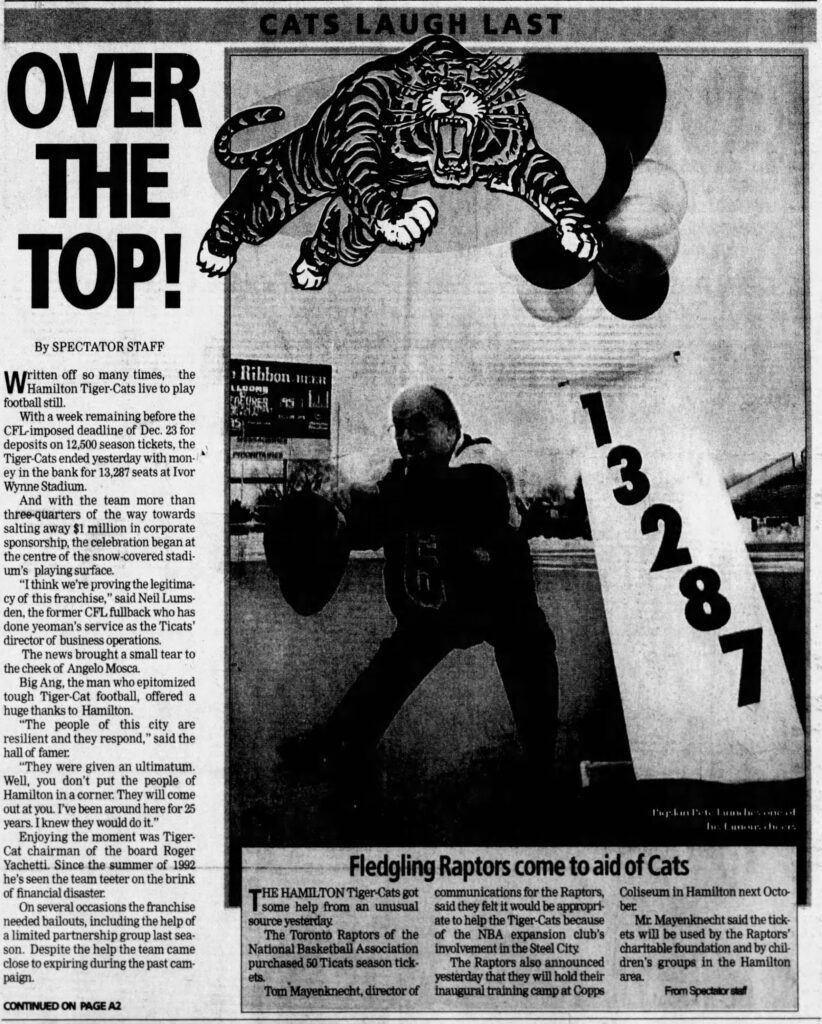
    Those were the four demands set out by the Canadian Football League to the Hamilton Tiger-Cats in October 1994. If the Ti-Cats failed to meet those demands by a league-imposed December 23rd deadline, a 125 year old tradition would end. Professional football would be done in Hamilton.

    The so-called “Drive for ’95” was in full swing around this time thirty years ago. Daily, the Hamilton Spectator ran tallies showing how many season tickets were sold for the 1995 season. Hamilton had a meagre 6,400 season ticket holders in 1994. Doubling that figure was a daunting task.

    13,287

    On Friday December 16, 1994, the Hamilton Tiger-Cats announced that they had sold 13,287 season tickets for 1995. What was considered the most “challenging” of the four demands was met…and with time to spare.

    “The people of this city are resilient and they respond” – Ticat Legend Angelo Mosca

    In the weeks to follow, the corporate sponsorship quota was met and the ownership situation became clearer, paving the way for David Macdonald and George Grant to purchase the franchise. As the 1995 season drew closer, the Hamilton Tiger-Cats – for the first time in years – were financially stable. Football was alive and well in Hamilton.


    The Drive for ’95 stands out for me because that was the year I became a season ticket holder myself. My parents bought season tickets for me, my brother, and my sister for Christmas in 1994. I remember my Mom somewhat panicking because she didn’t have anything physically to give us, to show us we were now season ticket holders. So, she wrote each of us a note saying, “You are invited to attend every Hamilton Tiger-Cats home game in 1995.” She also referenced where we would be sitting: Section 23. I look back now and think – wow – we’ve been season ticket holders for 30 years. – RF

  • Tiger-Cat Defence Strangles Roughriders

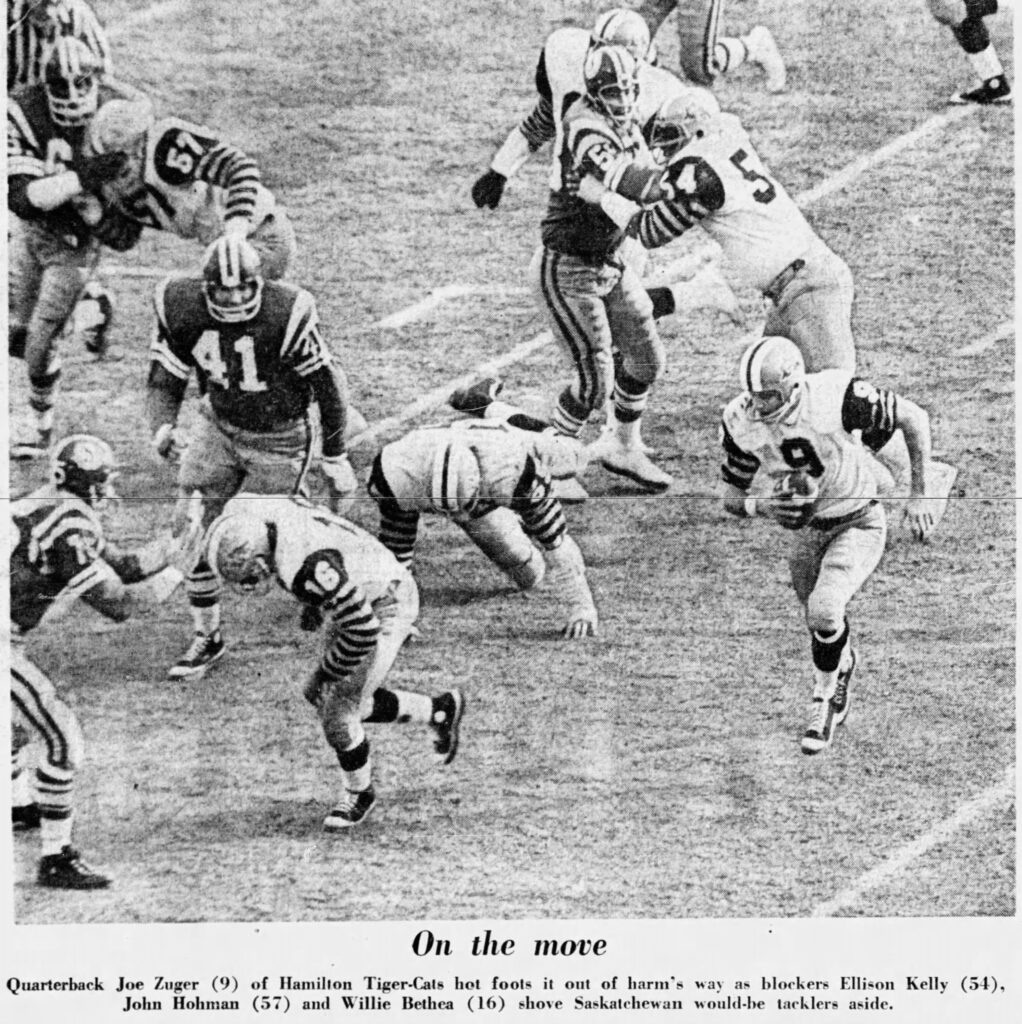
    “Tiger-Cat defence strangles Roughriders” read the headline in The Ottawa Citizen on Monday December 4, 1967. That pretty much sums up Hamilton’s 24-1 win over Saskatchewan in the 1967 Grey Cup game played a couple days earlier.

    1967 Grey Cup action (Ottawa Citizen)
    Source: The Ottawa Citizen, 4 December 1967, page 23.

    1967 – being Canada’s Centennial and all – featured the Grey Cup being played at Lansdowne Park in Ottawa. Tiger-Cats quarterback Joe Zuger (who recently passed away at the age of 84) scored a running touchdown, passed for a touched down, and kicked three singles, leading him to be named Grey Cup MVP.

    The Hamilton Tiger-Cats used this commemorative logo in 1967 to celebrate Canada’s Centennial. (courtesy SportsLogos.Net)
  • Presenting Hamilton’s New Ivor Wynne Stadium

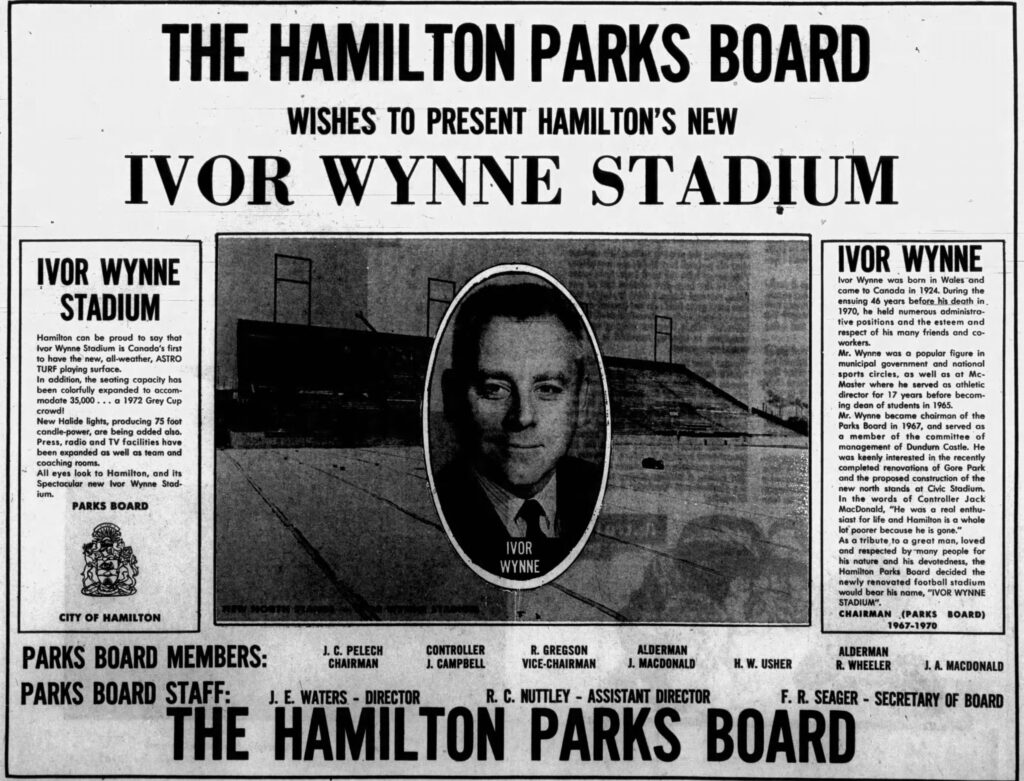
    New Ivor Wynne Stadium ad in the Hamilton Spectator
    Source: The Hamilton Spectator, June 21, 1971 page 22.

    In 1970-71, Hamilton’s Civic Stadium was heavily rebuilt to meet the needs of a modern professional football stadium. Originally built in 1928 for the British Empire Games (the forerunner to the Commonwealth Games), the stadium was dated and considered one of the worst stadiums in the country.

    A new north grandstand was built, bringing the capacity to about 35,000. New lights were added – much to the delight of television broadcasters. And, all-season AstroTurf was installed, the first stadium in Canada to have it.

    In 1971, the stadium was renamed Ivor Wynne Stadium in honour of the former chairman of the Hamilton parks board and athletics director at McMaster University. Ivor Wynne had died a year earlier.

    The new state of the art stadium would host the 1972 Grey Cup the following year and continued to be Hamilton Tiger-Cats’ home until it was replaced by Tim Horton’s Field in 2014.

  • Facts About the Final | 1910 Grey Cup

    Here’s an interesting snippet of some facts about the 1910 Grey Cup final held in Hamilton, including the team rosters for the Hamilton Tigers and the University of Toronto.

    1910 Grey Cup summary in the Hamilton Spectator
    Source: The Hamilton Spectator, November 25, 1910, page 12