Category: IRFU/Big Four

  • Canada’s First National Commissioner of Football

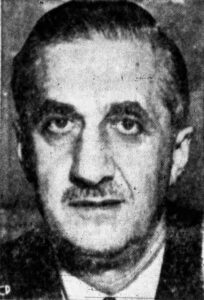
    As the CFL formally introduces Stewart Johnston as its new Commissioner this week, Canadian Football History looks back at the very first CFL Commissioner: Gerald Sydney Halter.

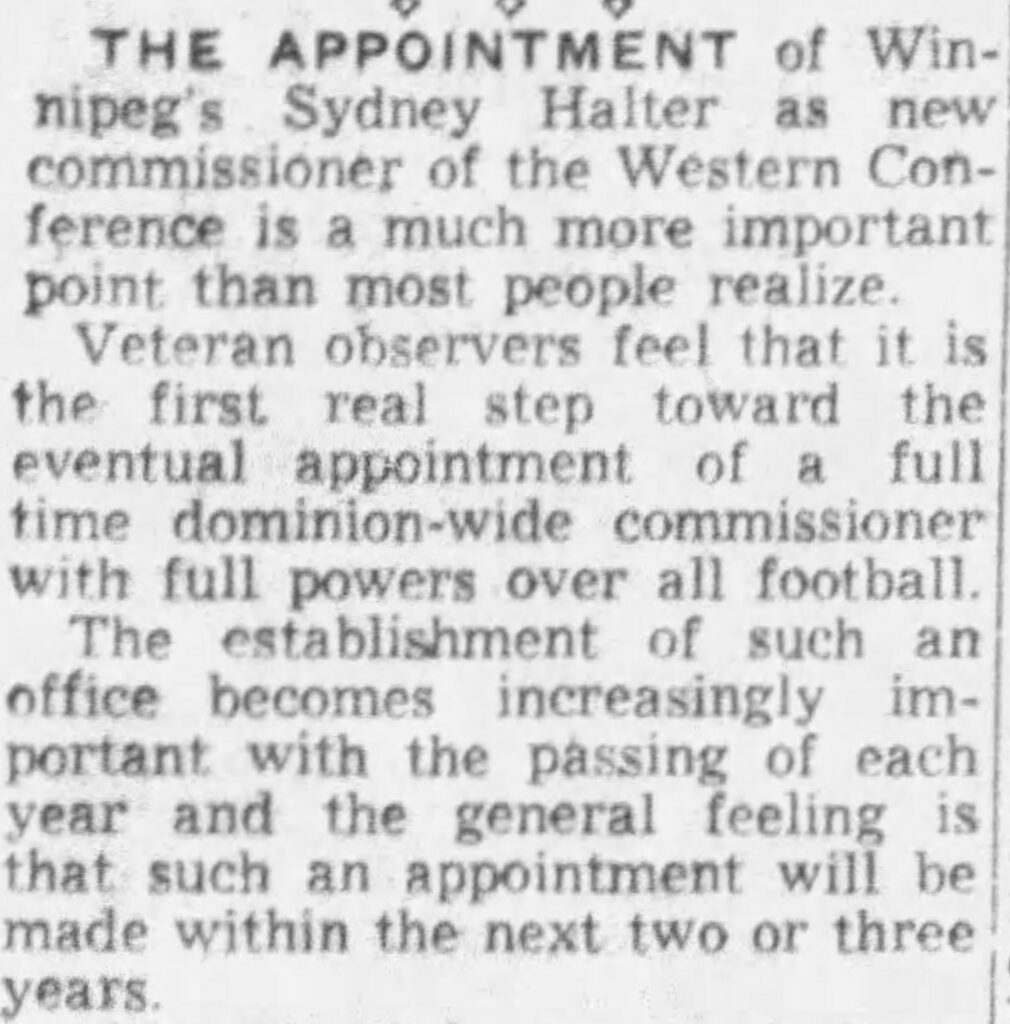
    Sydney Halter was born and raised in Winnipeg, Manitoba. He held various roles, including treasurer and president, in the Winnipeg Blue Bombers organization before being named the Commissioner of the Western Interprovincial Football Union in 1953.

    In 1956, he became the Registrar of the Canadian Football Council (CFC), a newly formed umbrella organization for both the WIFU and the eastern Interprovincial Rugby Football Union (the “Big Four”).

    Well regarded in football circles across the country, Sydney Halter was named “Canada’s first national commissioner of football” when the Canadian Football League was established by the CFC in 1958. By the way, I totally think the CFL should adopt “National Commissioner of Football” as the official job title for its top role.

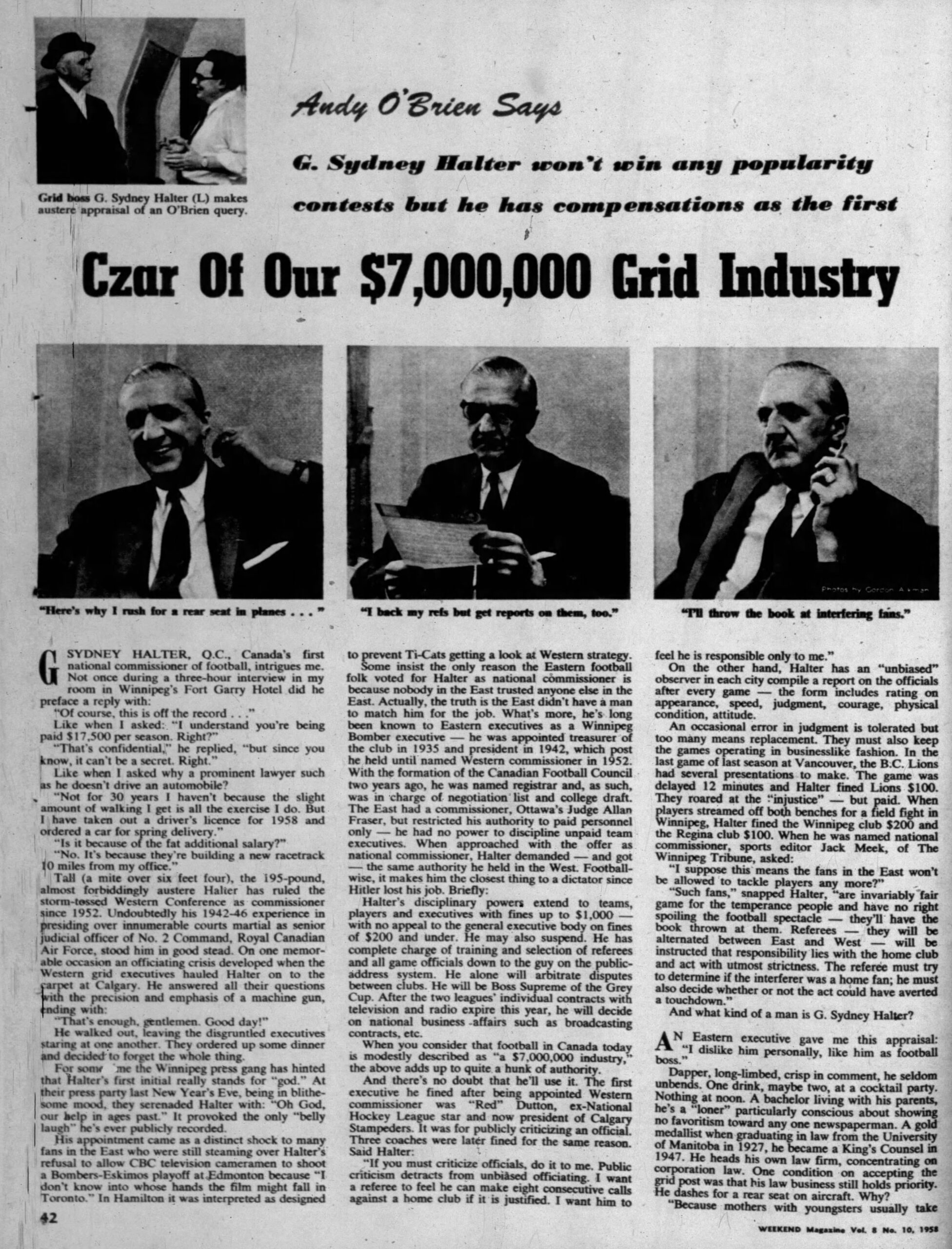
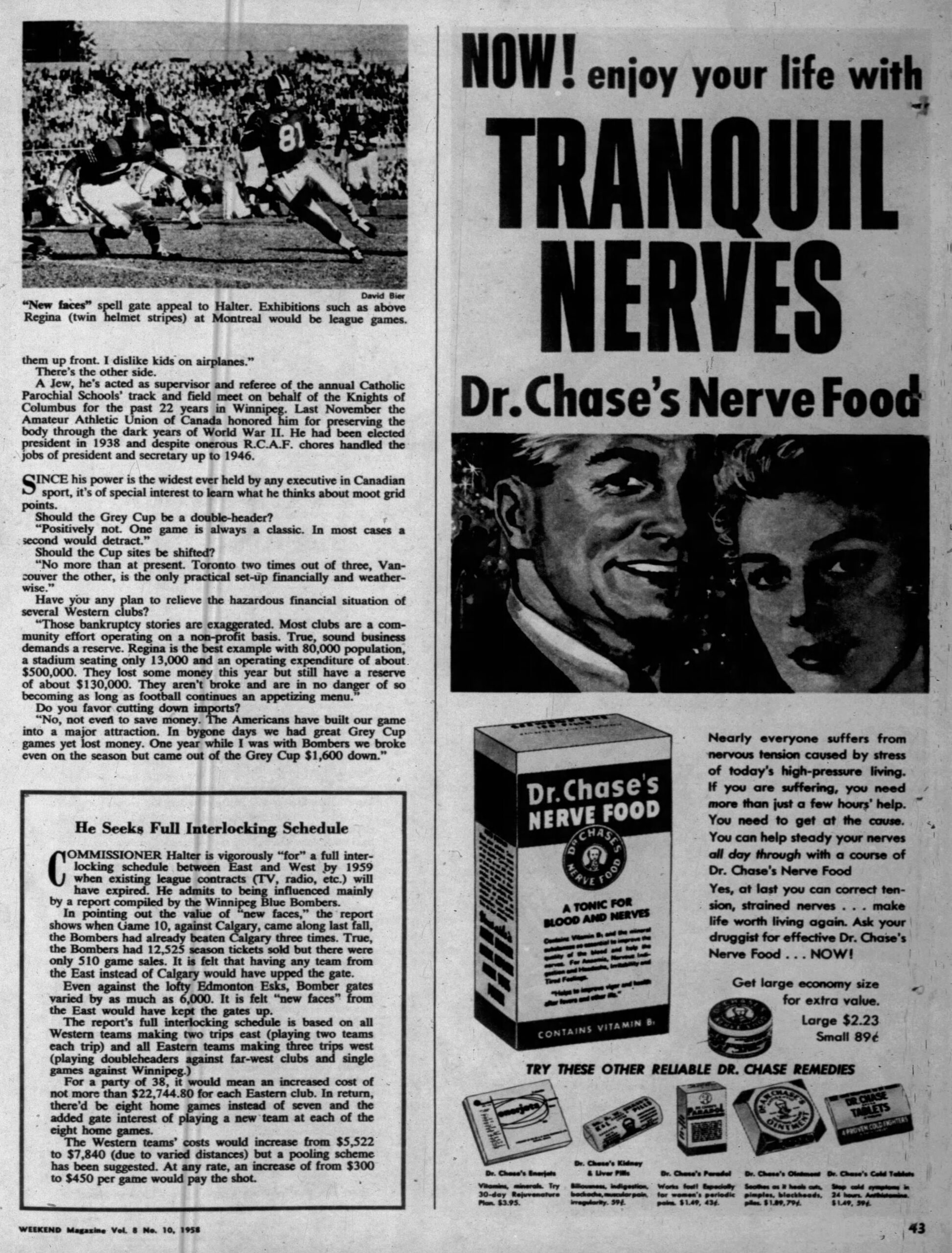
    Described as a chain-smoking bachelor or “loner” by some, Sydney Halter wielded quite a bit of power in his role as Canada’s professional football boss. The article below (click on them to enlarge) is lengthy but well worth the read. It portrays Halter as a straight shooter and touches on how he didn’t hesitate to deliver fines to players and teams – or fans who interfered in the game. Apparently, home fans tackling opposing players from scoring touchdowns was a thing. Yikes.

    O’Brien, Andy. “Czar of Our $7,000,000 Grid Industry.” The Hamilton Spectator, 8 March 1958, p. 90.
    O’Brien, Andy. “Czar of Our $7,000,000 Grid Industry.” The Hamilton Spectator, 8 March 1958, p. 91.

    Sydney Halter served as the CFL’s commissioner until 1966. He was an early advocate for an interlocking schedule between the East and the West. A lawyer by profession, he also served in the Royal Canadian Air Force and held leadership positions in other Canadian sporting organizations outside of football.

    Sydney Halter is a member of the Canadian Football Hall of Fame, inducted in 1966, as “the architect of the modern-day Canadian Football League.” He died in 1990. He was Jewish and was inducted posthumously into the International Jewish Sports Hall of Fame in 2005.

  • Tigers, Wildcats Merge to Form the Tiger-Cats

    Depending on the criteria chosen and who you ask (relax, Argo fans!) the city of Hamilton boasts Canada’s oldest football club. The Hamilton Foot Ball Club was founded on November 3, 1869. Yes, they spelled football with two words back then. The team played in the Ontario Rugby Football Union from 1893 to 1906 before joining the new Interprovincial Rugby Football Union in 1907.

    A news article in the Hamilton Spectator announcing the founding of the Hamilton Foot Ball Club
    A news article announcing the founding of the Hamilton Foot Ball Club
    (The Hamilton Spectator, 4 November 1869, p 2.)

    The team wore black and orange and later black and yellow uniforms and were known as the Tigers. It was this Tigers team that played in the second Grey Cup in 1910.

    In 1941, the Tigers suspended play as a result of the Second World War. The IRFU itself shut down a year later. To fill the void, the Hamilton Wildcats were formed and played in the ORFU, winning the Grey Cup in 1943. Due to the high number of air force personnel playing for the team, the club was known as the Flying Wildcats during the war years.

    After the war ended, the IRFU and the Hamilton Tigers resumed play. Unfortunately, the Hamilton market couldn’t support two football teams. Both the Tigers and the Wildcats found themselves competing for business and facing financial challenges. After a dispute with the IRFU, the Tigers and Wildcats actually swapped leagues for a couple of seasons with the Tigers playing in the ORFU and the Wildcats joining the IRFU in 1948.

    Article announcing merger of the Hamilton Wildcats and Hamilton Tigers
    “Merger of Wildcats, Tigers, Completed.” The Hamilton Spectator, 31 January 1950, p 24.

    Finally, a group of Hamilton citizens pushed for the amalgamation of the Tigers and Wildcats. It was clear that Hamilton could sustain only one team, especially with the growing professionalization of the game of football.

    Thus, in 1950, the Hamilton Tigers and the Hamilton Wildcats merged into one club and became the Hamilton Tiger-Cats.


    This is the sixth of a series of posts that will explore the stories behind the names of the existing Canadian Football League teams. See the previous post on the Winnipeg Blue Bombers.