Category: Montreal

  • Marv Levy Named CFL’s 1974 Coach of the Year

    Recently, Marv Levy – a legend in both Canadian and American football – celebrated his 100th birthday. He was born on August 3, 1925 in Chicago, Illinois, USA.

    After several college and professional coaching gigs in the United States, Marv Levy headed north in 1973 to become the new head coach of the CFL’s Montreal Alouettes.

    In 1974, his second season at the helm in Montreal, Levy guided the Alouettes to a 9-5-2 regular season record to finish first in the Eastern Division. After knocking off Ottawa in the Eastern Final, Levy’s Alouettes defeated Edmonton 20-7 to win the Grey Cup.

    Levy’s quick success in the CFL earned him the 1974 Coach of the Year. He was presented with the Annis Stukus Trophy (the trophy awarded to the CFL’s top coach) by Mr. Annis Stukus himself on January 15, 1975 at league meetings in Edmonton.

    Article in the Edmonton Journal about Marv Levy being named the CFL's Coach of the Year in 1974.
    Annis Stukus presenting the Coach of Year trophy to Marv Levy as well as pictures of the CFL’s other eight head coaches.
    (Jones, Terry. “No surprises, Levy coach of the year.” The Edmonton Journal, 16 January 1975, p. 53.)

    Montreal and Edmonton met again in the Grey Cup in 1975. This time Edmonton came out on top. But in the 1977 Grey Cup, the Alouettes crushed Edmonton 41-6 on an icy turf at the Olympic Stadium.

    In his five years as head coach of the Montreal Alouettes, Marv Levy led the team to three Grey Cups, winning two of them. Not bad.

    In 1978, he returned to the United States to coach in the National Football League. His most successful run in the NFL was with the Buffalo Bills. Unfortunately, Levy’s regular season success in Buffalo didn’t translate into championships. His Bills failed to win a Super Bowl despite four straight appearances from 1990 to 1993.

    Marv Levy was inducted into the Pro Football Hall of Fame in 2001 and into the Canadian Football Hall of Fame in 2021. He is one of only two head coaches to have coached in both a Grey Cup and a Super Bowl, the other being Bud Grant.

    Here’s to Marv Levy, the Canadian Football League’s Coach of the Year in 1974, who can now add Centenarian to his long list of titles and accomplishments.

    Picture of Marv Levy published in the Montreal Gazette.
    A picture of Alouettes head coach Marv Levy published in the Montreal Gazette after winning the CFL’s 1974 coach of the year award.
  • Montreal Crushes Ottawa in Olympic Stadium Opener Before Record Crowd

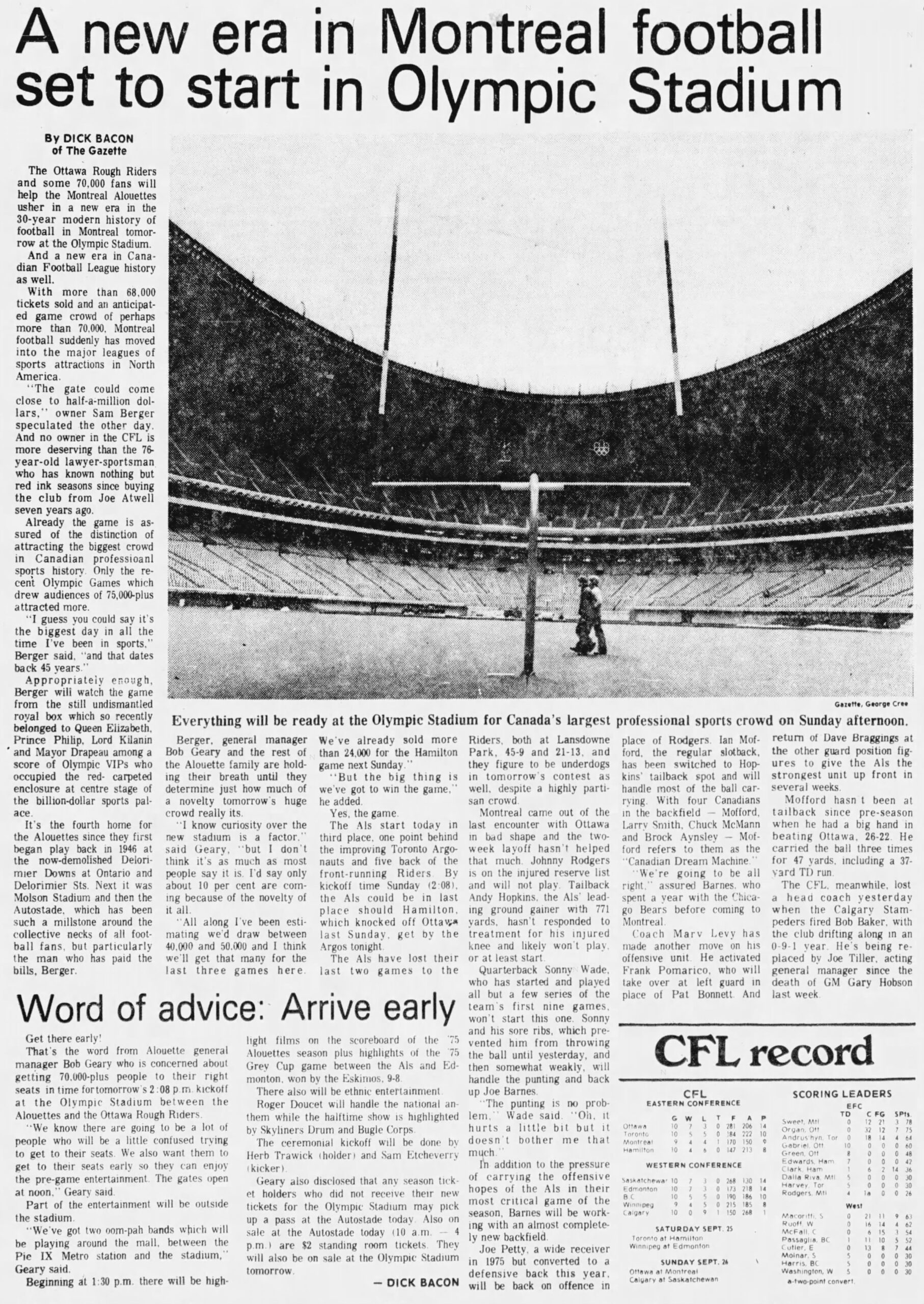
    Midway through the 1976 CFL season, the Montreal Alouettes played their first game in their new home. After leaving behind the Autostade (that stadium likely warrants its own article), the Als hosted the Ottawa Rough Riders at the Olympic Stadium, the largest stadium ever built in Canada.

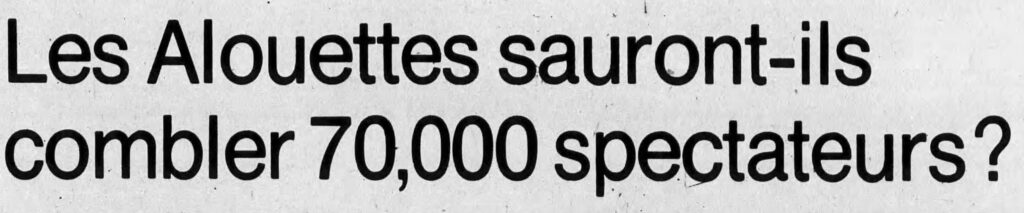
    A new era in Montreal football set to start in Olympic Stadium
    Bacon, Dick. “A new era in Montreal football set to start in Olympic Stadium.” Montreal Gazette,
    25 September 1976, p. 11.

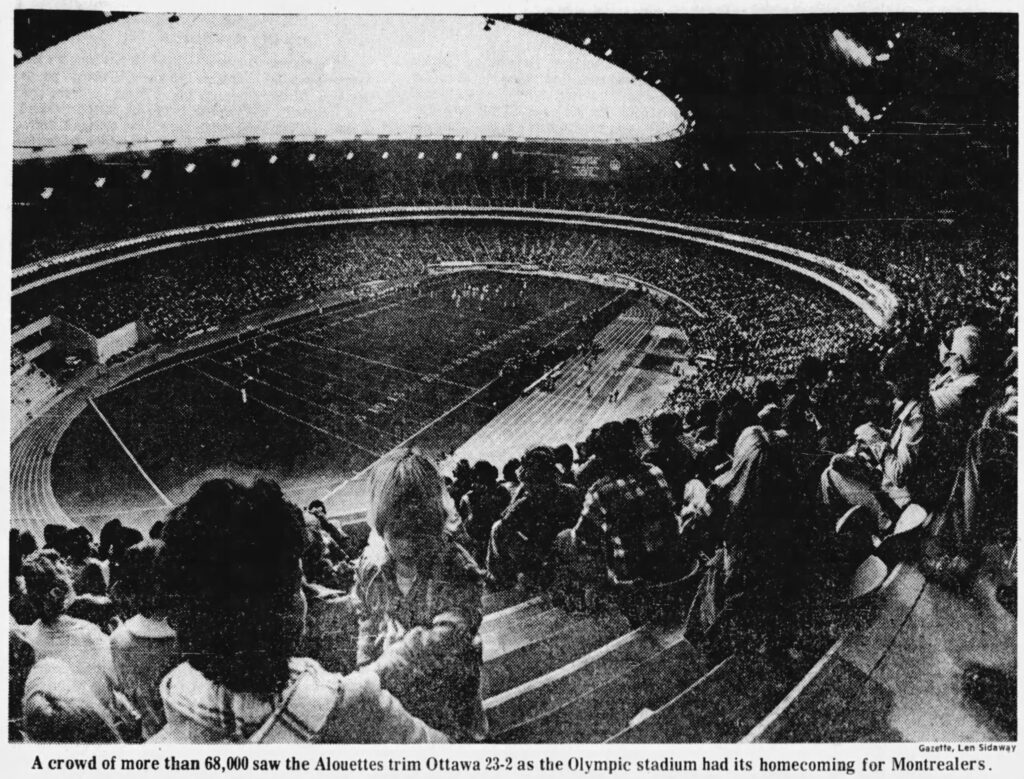
    Post-Olympic fever was still gripping Montreal in the weeks leading up to the game. The Alouettes were expecting a record crowd to come see a .500 home side take on the East Division leaders from Ottawa. No doubt, many just wanted to catch a glimpse of the so-called billion-dollar sports palace. Without question, Olympic Stadium – affectionately known as the Big O or disparagingly known as the Big Owe – with its sheer size and modern-day amenities put other CFL stadiums to shame. In 1976, Edmonton’s Commonwealth Stadium was still a couple years away and the domed stadiums in Vancouver and Toronto came much later.

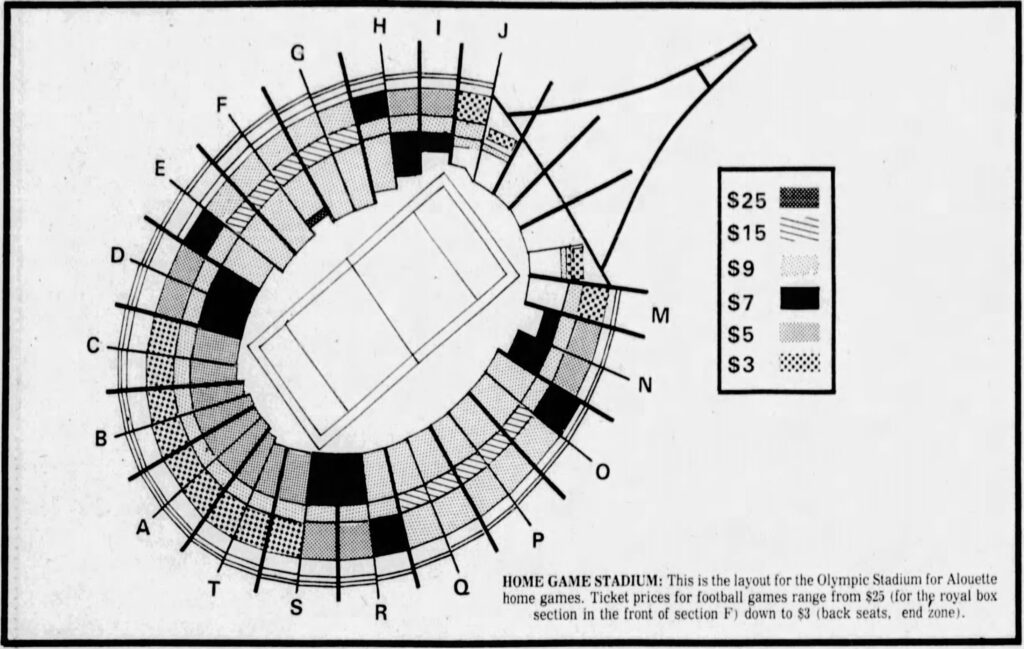
    The stadium was designed by Roger Taillibert, a French architect, and was the main stadium for the 1976 Summer Olympics in Montreal. It featured state-of-the-art scoreboards with video capabilities as well as modern artificial turf. Plus comfortable seats and corporate boxes. Of course, the promised “retractable” roof would have to wait.

    The Alouettes were the first permanent tenant for the Big O once the Olympics were over. On Sunday September 25, 1976, a record Canadian Football League crowd of 68,505 fans were on hand to see the first game. They were treated to a pre-game ceremony that included former Montreal quarterback Sam Etcheverry performing the ceremonial kickoff.

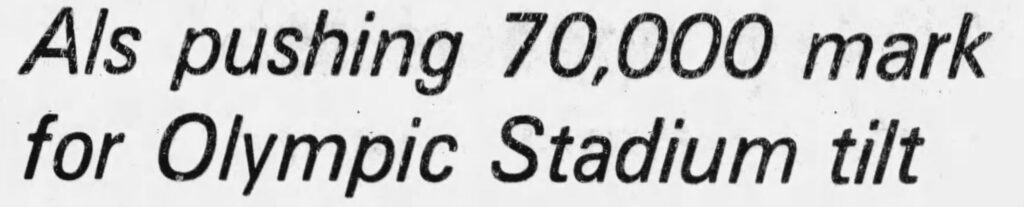
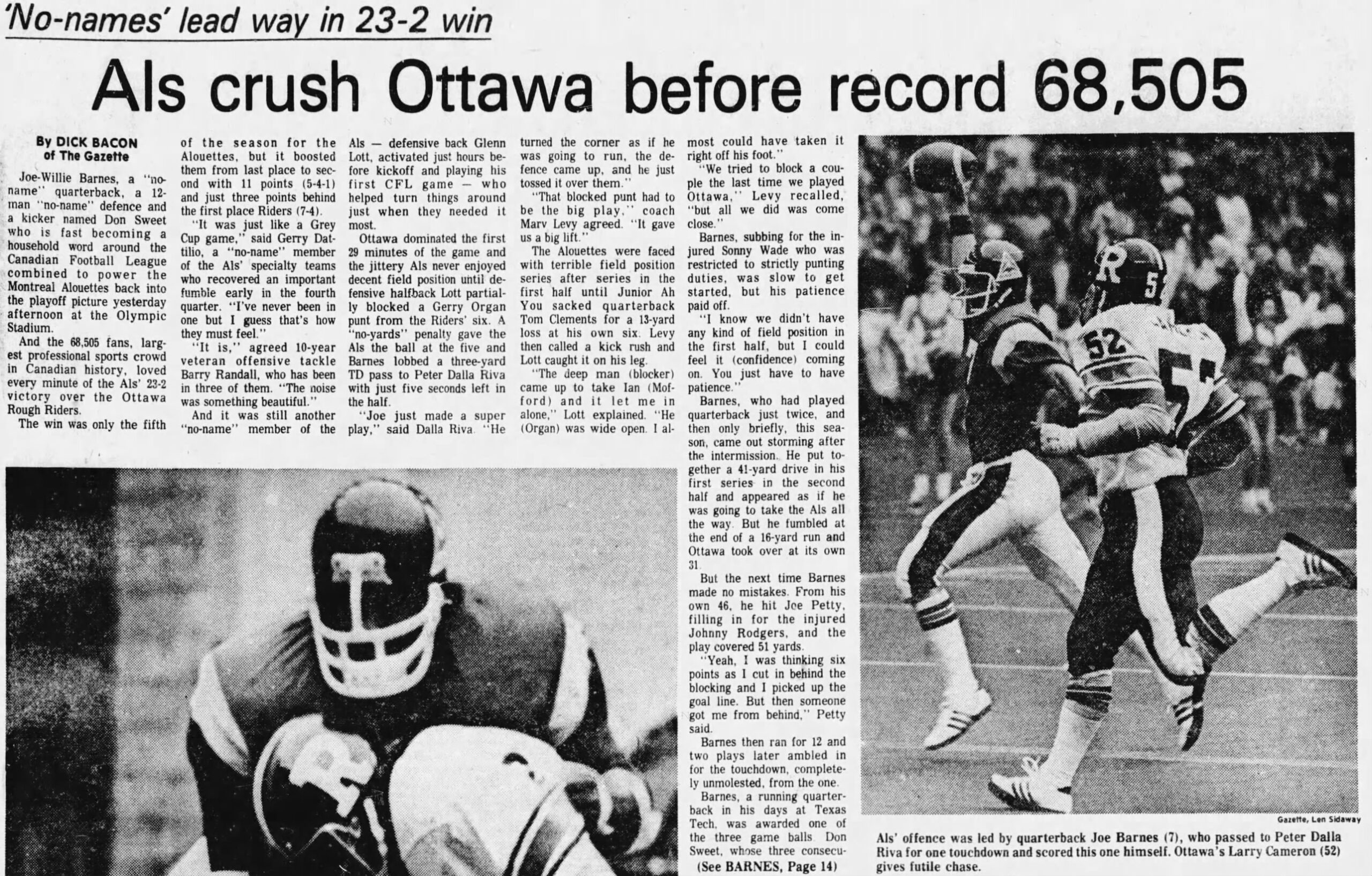
    Als crush Ottawa before record 68,505
    Bacon Dick, “Als crush Ottawa before record 68,505.” Montreal Gazette, 27 September 1976, p. 13.

    Led by quarterback Joe Barnes and kicker Don Sweet, the Alouettes cruised to a 23-2 victory over the Rough Riders. The Alouettes’ win helped put Montreal back in the playoff hunt in the CFL East. The 1976 Alouettes were coached by the legendary Marv Levy. Levy understood the impact a large vocal crowd could have on the game.

    “The crowd could be the 13th man on the field. If they’re a supportive crowd, it could be the start of a new era in fan enthusiasm and what it means to the team.”
    – Marv Levy

    I’ve been to Olympic Stadium only once. That was for a Grey Cup game. When the place is packed – just like it was in the late 70s – it’s an awestriking experience. But the atmosphere diminishes exponentially the smaller the crowd.

    Today, the Alouettes play their home games at the much more intimate (and much older) Percival Molson Memorial Stadium on the campus of McGill University. They haven’t played a football game at the Big O since 2012. But a new roof is being constructed, and there are hints of a further refurbishment down the road.
    Is it possible that the Alouettes will once again look at playing some if not all their games at Olympic Stadium in the future?

    Perhaps the team can recapture some of that post-Olympic pride that helped them shatter attendance records. At the very least, it won’t be too long before the Grey Cup game returns to Montreal – and with that the roar of the crowd will once again reverberate throughout Olympic Stadium.

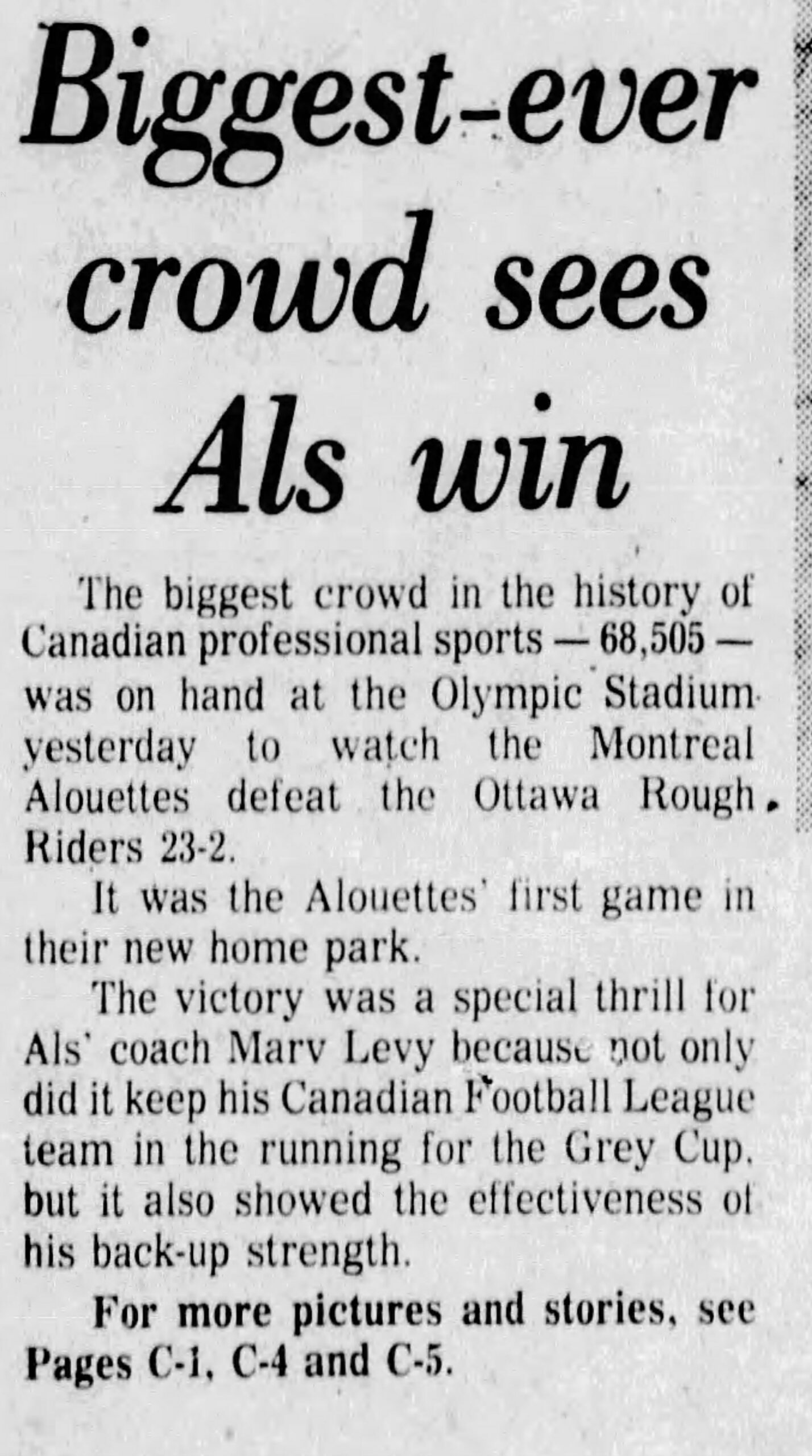
    Biggest CFL Crowd
    Montreal Star, 27 September 1976
  • CFL Media Guides in the 1960s

    For eons, the Canadian Football League published Media Guides or Fact Books for its teams. These little handbooks were meant to familiarize local journalists with the players and coaching staff of the team they were covering. They included biographies, statistics, records, and team histories.

    Team media guides were also a great little souvenir for the savvy football fan. I have several in my own collection I like to peruse every now and then.

    The CFL still produces them at least in electronic form. At least for some teams. I’m not sure if the league still offers print copies, though. It looks like they’ve met the same fate as game day programs and printed tickets, which is unfortunate.

    Anyway, I thought what better way to spend the dog days of summer than by taking a look at some of these CFL media guides from the 1960s (or the late 1950s in a couple of cases). It was an exciting decade for the CFL and Canadian football.

    Here are some photos of the media guides (front and back covers) for each CFL team from that era:

    The above photos are courtesy of the good folks at the Canadian Football Research Society.

    Fediverse Reactions
  • Alouettes Defeat the Tiger-Cats 82-14 in 1956 Blowout

    A close game always makes for good entertainment for us football fans. We enjoy the back-and-forth battle and the inevitable drama that ultimately decides the final score. But sometimes the game is anything but close. That was the case on October 20, 1956 when the Montreal Alouettes cruised to an 82-14 victory over the Hamilton Tiger-Cats.

    The headline in the Montreal Gazette tells the story.

    The crowd at Molson Stadium witnessed history in the making that Saturday afternoon with the Alouettes breaking a couple dozen IRFU/Big Four records. Newspapers in both Hamilton and Montreal remarked how the game kept the statisticians busy.

    A recap of records broken as outlined in the Montreal Gazette.
    (Degeer, Vern. “Team, Game Scoring Marks Fall in Fantastic Frolic.” Montreal Gazette, 22 October 1956, p. 25.)
    The Hamilton Spectator’s recap of records broken.
    (“Statisticians Go Crazy.” Hamilton Spectator, 22 October 1956, p. 17.)

    Montreal’s opening kickoff by Johnny Blaicher sailed through the Hamilton endzone to put the Alouettes up 1-0 from the get-go. What followed can only be described as good old fashion Canadian walloping.

    Led by quarterback Sam “The Rifle” Etcheverry, Montreal scored an incredible 12 touchdowns. Yes, twelve! The Alouettes were up 20-0 after the first quarter and went into halftime with a commanding 54-7 lead. I certainly wouldn’t’ve wanted to be in the Hamilton dressing room at the half.

    Alouette players who scored touchdowns vs. Hamilton on October 20, 1956
    Montreal players who scored touchdowns in the record-setting game. Future Alabama Governor Fob James scored four touchdowns for the Alouettes.

    Unfortunately for the Ti-Cats the second half wasn’t any better. Montreal’s Hal Patterson returned Hamilton’s kickoff to start the third quarter a record-breaking 104 yards for a touchdown. Talk about going from bad to worse. Having his way with the Tiger-Cat defence all afternoon, the Rifle might’ve put the Als over the 100-point mark had he stayed in the entire game. His favourite target Fob James, who years later would become the Governor of Alabama, scored four majors for the Alouettes.

    The Hamilton Spectator didn’t mince words.
    (Miller, Ivan. “Alouettes Re-write Record Book in Wild Game.” Hamilton Spectator, 22 October 1956, p. 16.)

    With the astounding lopsided victory, Montreal clinched first place in the Big Four conference. The two teams would meet again the following month in a two-game total-point series for the IRFU final. Montreal came out on top, winning by a 78-62 combined score, but would lose to the Edmonton Eskimos in the 1956 Grey Cup game.

    The 82-14 score set on October 20, 1956 still stands today as the largest margin of victory in a game played in the modern era of Canadian football.

    The scoring summary of the record-setting game.
  • The CFL Scores in Saint John

    The Canadian Football League has long pined for a presence in Atlantic Canada. In fact, Halifax has been granted not one but two conditional expansion franchises, the emphasis on “conditional” as neither attempt materialized. When Moncton opened its new stadium in 2010 there was some chatter about the Hub City being a home for a future CFL team. While no expansion team has been forthcoming, Moncton has hosted three regular season CFL games. And of course, there have been regular season games played in Halifax and Acadia University in Wolfville, Nova Scotia, as well.

    “CFL Tickets Go On Sale May 1.” Saint John Times-Globe, 23 April 1986, p. 29.

    But the CFL actually made its debut in the Maritimes back 1986 when Saint John, New Brunswick hosted an exhibition game between the Montreal Alouettes and Winnipeg Blue Bombers. The game, played at the then newly constructed Canada Games Stadium, drew a crowd of over 11,000 fans who saw the Bombers down the Als 35-10.

    “10,000 Assured for CFL Game.” Saint John Telegraph-Journal and Evening Times-Globe, 6 June 1986, p. 31.

    It appears the game was designed to take the CFL on the road and expose the product to a new market rather than to test the waters for a prospective expansion site. In fact, CFL Commissioner Doug Mitchell seemed to go out his way to temper any expansion expectations. Still, New Brunswickers embraced the CFL and the players enjoyed the Atlantic hospitality.

    Munford, Bruce. “Thousands Flock to See Bombers Blast Montreal.” Saint John Evening Times-Globe, 9 June 1986, p. 15.

    The Bombers were quarterbacked by veteran Tom Clements, who had his way with the Montreal defence. A scary moment occurred early in the game when Montreal’s Nick Arakgi suffered a broken vertebrae when he was hit after reaching up high for an overthrown pass by Montreal quarterback Joe Barnes. He was taken to the hospital and ended up missing the entire 1986 CFL season.

    Saint John Mayor Elsie Wayne was ecstatic about having the CFL in her city. She presented Winnipeg head coach Cal Murphy with a trophy called the Saint John CFL Cup after the game.

    A Labatt’s ad sponsoring the CFL game in Saint John. (Saint John Telegraph-Journal, 6 June 1986, p. 71.)
    An ad promoting the CFL game in Saint John. (Saint John Telegraph-Journal, 6 June 1986, p. 72.)

    The CFL’s success in Saint John in 1986 prompted the league to return the following year for another exhibition game. This time, Montreal played the Hamilton Tiger-Cats. The Ti-Cats won 14-13 in what turned out to be the last game for the Montreal Alouettes who folded a couple weeks later.


    Kelly Ryback was the original “Buzz”, the mascot of the Winnipeg Blue Bombers. Here are his personal reflections of the event.

    The ’86 trip was a career and life highlight!

    I had never been to an ocean or feasted on lobster. I was on the advance team in Saint John Wednesday through Sunday.

    We stayed at the Hilton on the harbour, ate lobster, mussels, and frog legs several times. We were hosted by Labatt’s with summer student valets. One became a friend for life, still 39 years later.

    Meeting Mayor Elsie Wayne in her office was a hoot and she later hosted a fine reception where we were all presented with City of Saint John ties.

    The crowd of 12K+ was fantastic and it was a bright, sunny day.

    An absolutely incredible event.

    A souvenir t-shirt from the 1986 CFL game in Saint John and a City of Saint John tie.
    Photo provided by Kelly Ryback.