Labour Day weekend is arguably the biggest deal in the Canadian Football League outside the Grey Cup. The end-of-summer holiday features games between the CFL’s fiercest rivalries. Saskatchewan versus Winnipeg. Calgary versus Edmonton. Hamilton versus Toronto. Now back in 1994 one of the CFL’s Labour Day weekend matchups included the Ottawa Rough Riders playing host to the Las Vegas Posse. How’s that for an anomaly?
On Saturday, September 3, 1994, the Rough Riders were looking to snap a four-game losing streak. They were under new ownership and desperately trying to reinvigorate a fickle Ottawa football market. The Posse were the second U.S.-based team in the CFL and were struggling on and off the field by the time they made it to the Nation’s Capital.
Great headline in the Ottawa Citizen
Las Vegas was led by a young rookie quarterback named Anthony Cavillo. He was one of the few bright spots on an inexperienced Posse team coached by Ron Meyer, who himself had no coaching experience in Canadian football.
Calvillo completed an 81 yard touchdown pass to Curtis Mayfield right out of the gate to give Las Vegas an early lead. The two teams went on a scoring shootout, lighting up the scoreboard the rest of the night. A total of over 1300 yards of offence was produced collectively.
Down 44-41 with no time left on the clock, Ottawa’s Terry Baker kicked a field goal to tie the game 44-44. 88 points and 60 minutes of football just wasn’t enough to decide a winner. Overtime awaited.
In those days, the CFL overtime format consisted of two additional five-minute halves. Neither team scored in the first OT half. In the second OT half, each team scored a touchdown. But Meyer opted to go for a two-point conversion with a minute to go in overtime. The gamble failed and Las Vegas was down 51-50. Baker cemented Ottawa’s win with a field goal in the waning seconds of overtime. Final score. Ottawa 54 Las Vegas 50.
Final stats in the Ottawa Citizen
The Posse would cease to exist by the end of the season, and their roster was divvied up amongst the other teams in a dispersal draft. The rest of the American teams would shut down the following year. The Ottawa Rough Riders themselves would fold two years later.
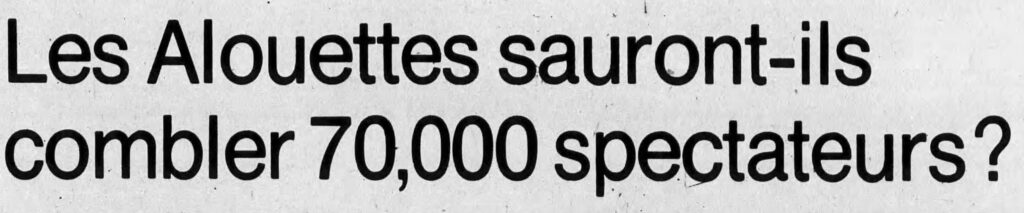
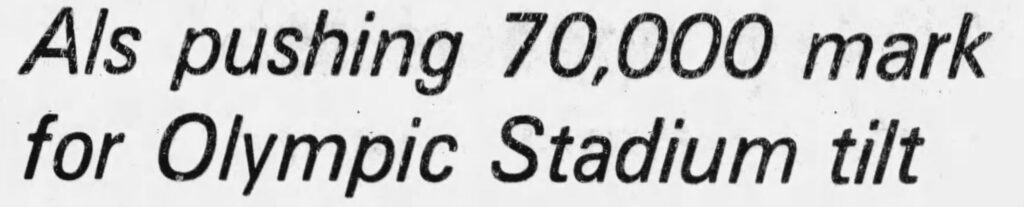
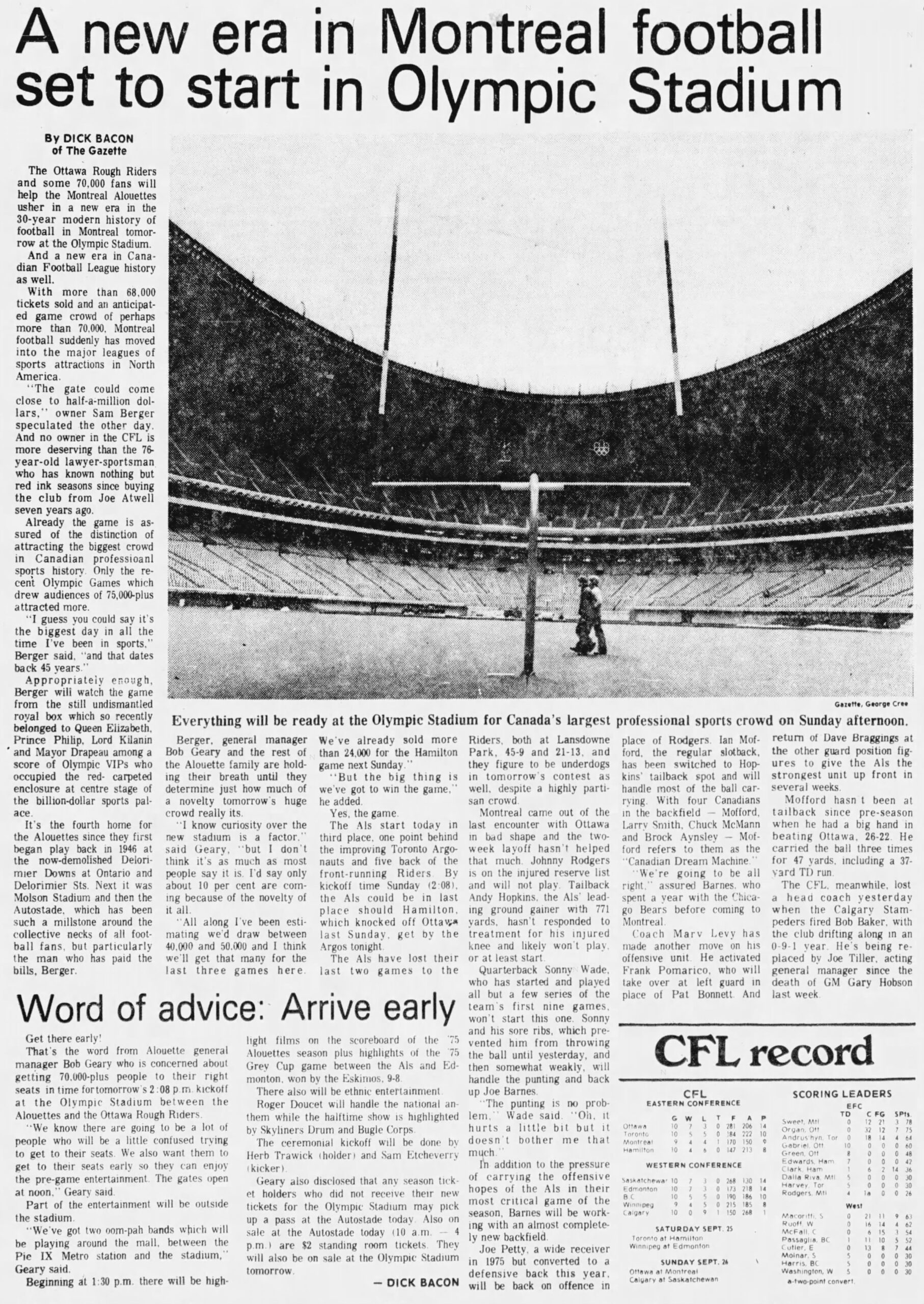
Midway through the 1976 CFL season, the Montreal Alouettes played their first game in their new home. After leaving behind the Autostade (that stadium likely warrants its own article), the Als hosted the Ottawa Rough Riders at the Olympic Stadium, the largest stadium ever built in Canada.
Bacon, Dick. “A new era in Montreal football set to start in Olympic Stadium.” Montreal Gazette, 25 September 1976, p. 11.
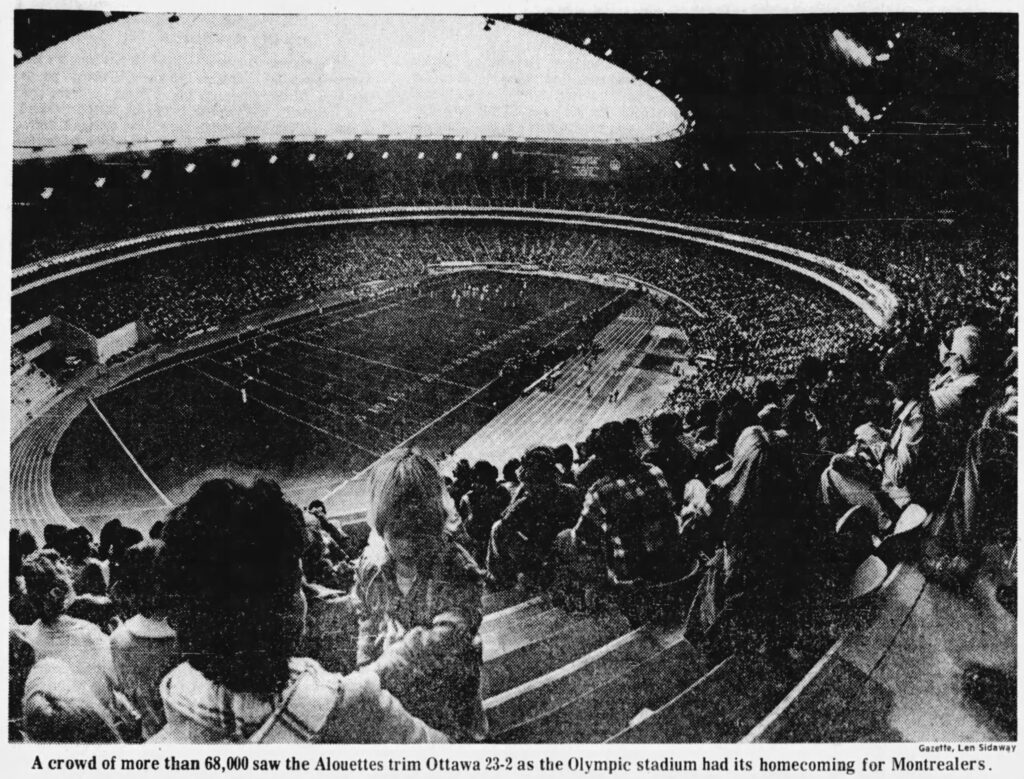
Post-Olympic fever was still gripping Montreal in the weeks leading up to the game. The Alouettes were expecting a record crowd to come see a .500 home side take on the East Division leaders from Ottawa. No doubt, many just wanted to catch a glimpse of the so-called billion-dollar sports palace. Without question, Olympic Stadium – affectionately known as the Big O or disparagingly known as the Big Owe – with its sheer size and modern-day amenities put other CFL stadiums to shame. In 1976, Edmonton’s Commonwealth Stadium was still a couple years away and the domed stadiums in Vancouver and Toronto came much later.
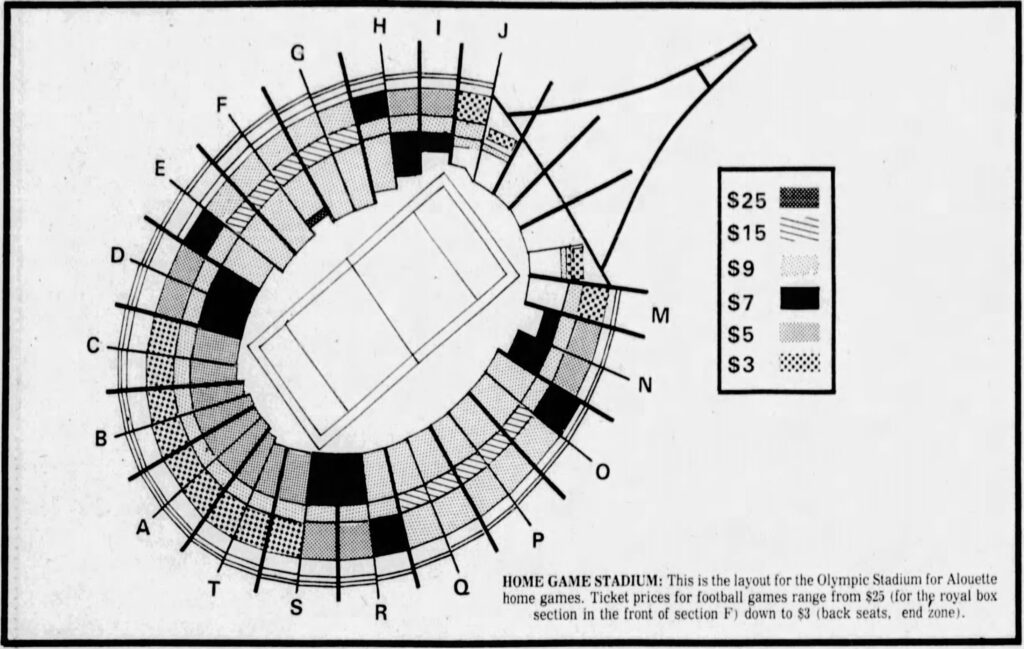
Olympic Stadium layout for football (Montreal Star)
The stadium was designed by Roger Taillibert, a French architect, and was the main stadium for the 1976 Summer Olympics in Montreal. It featured state-of-the-art scoreboards with video capabilities as well as modern artificial turf. Plus comfortable seats and corporate boxes. Of course, the promised “retractable” roof would have to wait.
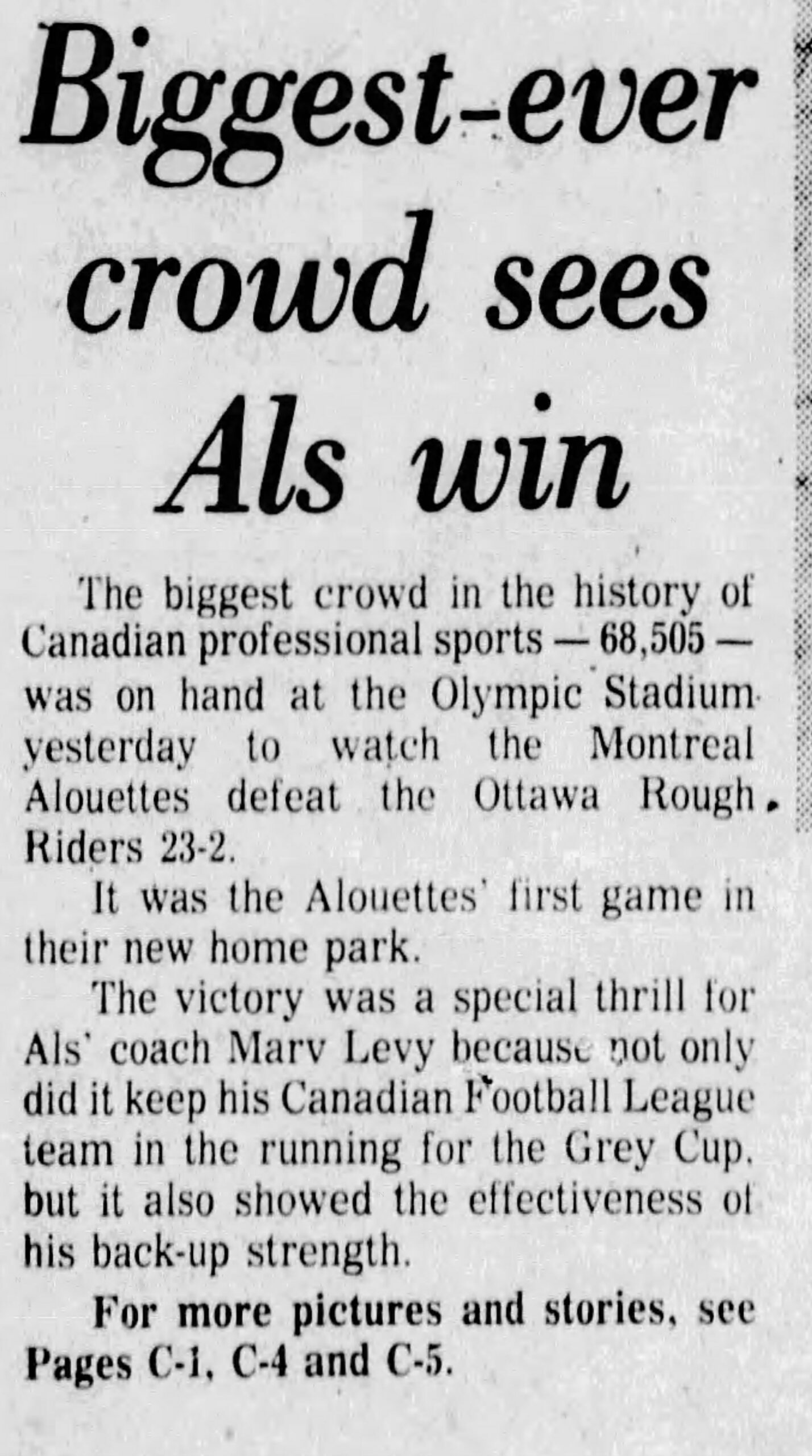
The Alouettes were the first permanent tenant for the Big O once the Olympics were over. On Sunday September 25, 1976, a record Canadian Football League crowd of 68,505 fans were on hand to see the first game. They were treated to a pre-game ceremony that included former Montreal quarterback Sam Etcheverry performing the ceremonial kickoff.
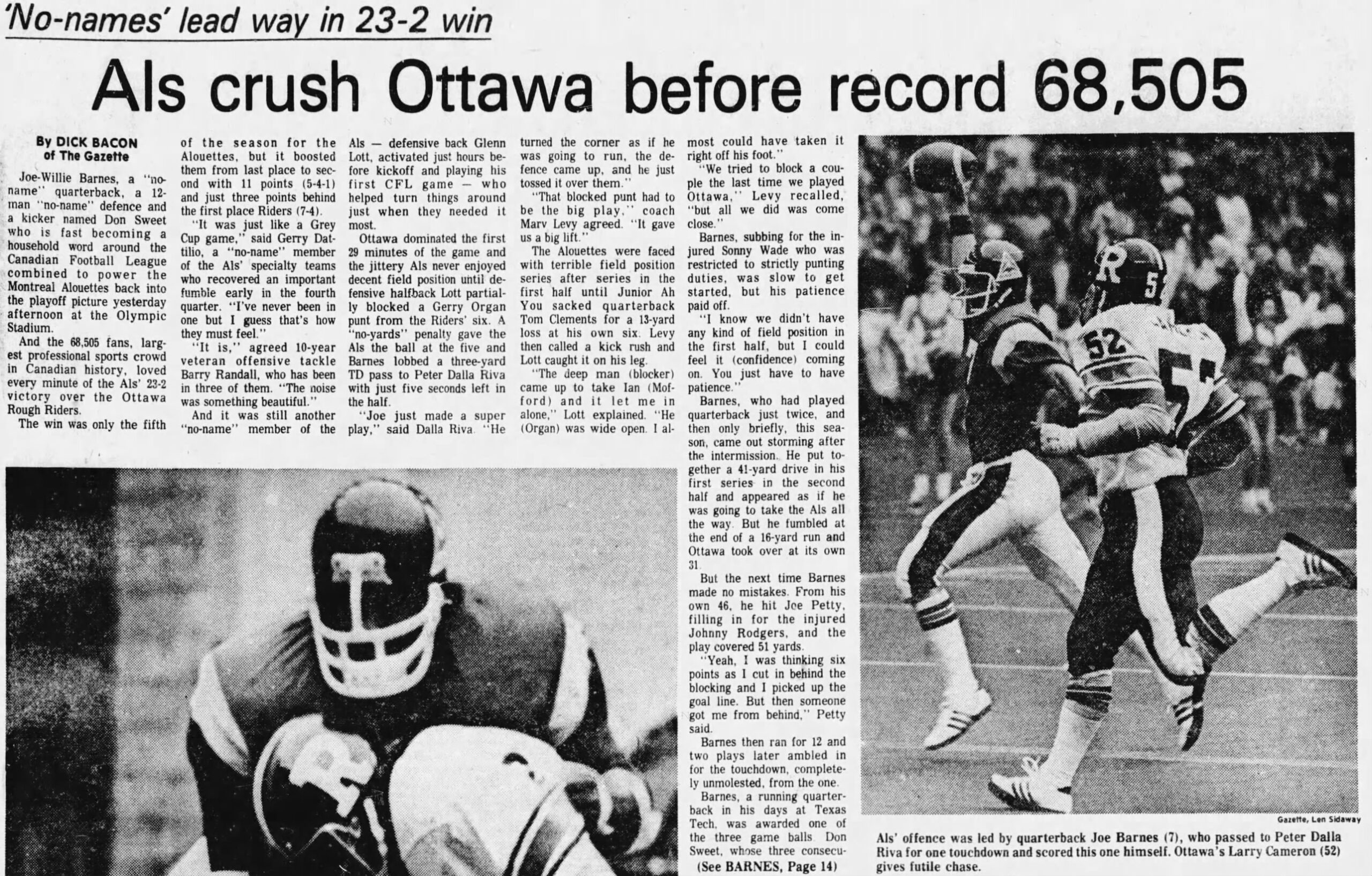
Bacon Dick, “Als crush Ottawa before record 68,505.” Montreal Gazette, 27 September 1976, p. 13.
Led by quarterback Joe Barnes and kicker Don Sweet, the Alouettes cruised to a 23-2 victory over the Rough Riders. The Alouettes’ win helped put Montreal back in the playoff hunt in the CFL East. The 1976 Alouettes were coached by the legendary Marv Levy. Levy understood the impact a large vocal crowd could have on the game.
“The crowd could be the 13th man on the field. If they’re a supportive crowd, it could be the start of a new era in fan enthusiasm and what it means to the team.” – Marv Levy
I’ve been to Olympic Stadium only once. That was for a Grey Cup game. When the place is packed – just like it was in the late 70s – it’s an awestriking experience. But the atmosphere diminishes exponentially the smaller the crowd.
Today, the Alouettes play their home games at the much more intimate (and much older) Percival Molson Memorial Stadium on the campus of McGill University. They haven’t played a football game at the Big O since 2012. But a new roof is being constructed, and there are hints of a further refurbishment down the road. Is it possible that the Alouettes will once again look at playing some if not all their games at Olympic Stadium in the future?
Perhaps the team can recapture some of that post-Olympic pride that helped them shatter attendance records. At the very least, it won’t be too long before the Grey Cup game returns to Montreal – and with that the roar of the crowd will once again reverberate throughout Olympic Stadium.
Montreal Gazette, 27 September 1976Montreal Star, 27 September 1976
For eons, the Canadian Football League published Media Guides or Fact Books for its teams. These little handbooks were meant to familiarize local journalists with the players and coaching staff of the team they were covering. They included biographies, statistics, records, and team histories.
Team media guides were also a great little souvenir for the savvy football fan. I have several in my own collection I like to peruse every now and then.
The CFL still produces them at least in electronic form. At least for some teams. I’m not sure if the league still offers print copies, though. It looks like they’ve met the same fate as game day programs and printed tickets, which is unfortunate.
Anyway, I thought what better way to spend the dog days of summer than by taking a look at some of these CFL media guides from the 1960s (or the late 1950s in a couple of cases). It was an exciting decade for the CFL and Canadian football.
Here are some photos of the media guides (front and back covers) for each CFL team from that era:
The above photos are courtesy of the good folks at the Canadian Football Research Society.
On July 1, 1980, a young man jogged onto the field at Lansdowne Park in Ottawa to perform the ceremonial kickoff prior to the CFL exhibition game between the Ottawa Rough Riders and the Saskatchewan Roughriders.
The crowd of almost 17,000 gave the 21-year-old a standing ovation. He wasn’t an ordinary 21-year-old by any stretch of the imagination. No, he was extraordinary in every sense of the word. He had one leg, having lost his other to cancer. Lansdowne Park was the latest stop on what he billed as his “Marathon of Hope” across Canada to raise money for cancer research. Of course, I’m talking about Terry Fox.
A great shot of Terry Fox performing the ceremonial kickoff on Canada Day 1980 while Gerry Organ of the Ottawa Rough Riders looks on. (Ottawa Citizen, 2 July 1980, p. 28.)
We Canadians are all familiar with Terry Fox, his story, and his legacy. I was only four years old (not even) at the time of the Marathon of Hope, but I do have some vague recollections of seeing coverage about it on TV. My Grandad met him while he was running through Halifax County in Nova Scotia and took a picture of him. I still have the photo.
But we forget some of the historic imagery that Terry’s marathon produced along the way. The kickoff at the CFL game is but one example. Here’s how Ottawa Rough Rider great Tony Gabriel remembers the day:
“I fondly remember meeting our young Canadian hero, Terry Fox, on July 1, 1980. He had begun his Marathon of Hope run across the nation and had reached Ottawa. Terry did our honorary kickoff that Canada Day, and I was fortunate as one of the captains for the Ottawa Rough Riders to get to shake his hand and wish him good luck in raising needed funds for Canadian cancer research.”
Terry Fox clearly made an impression on the CFL Hall of Famer. In 2020, Gabriel launched a petition to put Terry Fox on the $5 bank note. Late last year, the government announced that Terry Fox would indeed be featured on the new note. “Over the past 45 years, the Terry Fox Foundation has raised $950 million! I am so heartened it was announced and successfully assured this year that this continuing honour for Terry will happen in the near future by the Bank of Canada,” Gabriel proudly boasts.
An article in the Ottawa Citizen about Terry Fox’s stop in Ottawa during his Marathon of Hope. (Taber, Jane. “Ottawa cheers one-legged runner.” Ottawa Citizen, 2 July 1980, p. 2.)
After leaving Ottawa – but not before hanging out with Governor General Ed Schreyer and Prime Minister Pierre Trudeau – Terry continued west into Southern Ontario before heading up to Northern Ontario towards Thunder Bay. Here, he sadly announced that his cancer had returned, thus ending the Marathon of Hope. Still, he travelled a distance of 5,373 kilometres over the course of 143 days and raised millions towards his cause.
It’s been 45 years since Terry Fox captured our hearts and admiration. 45 years since the young man with one leg shared the field with some of the great CFL football stars of the day. 45 years since Terry Fox become a true Canadian legend.
And now, let’s relive what I believe is one of the most iconic moments in Canadian sports history…the Terry Fox kickoff:
Source:Government of Canada. Photo: Cpl Heather Tiffany
The colours red and black have long been associated with the city of Ottawa and its various football teams throughout the years. Pay a visit to Parliament Hill or to Rideau Hall, and you will see the Ceremonial Guards donning their traditional black and red uniforms. The Ottawa Football Club, founded in 1876, eventually adopted red and black (and white) as their team colours. This is the team that would become known as the Ottawa Rough Riders in October 1898.
The story behind the Rough Rider name is clouded in mystery. The “official” line is that Ottawa adopted the name Rough Riders as some sort of tribute to future U.S. President Teddy Roosevelt’s regiment (called the Rough Riders) in the Spanish-American War in 1898. But there is no mention of this connection in local newspapers at the time. Why would a football team in Ottawa be named after a regiment fighting a war that had absolutely nothing to do with Canada, anyway? It really doesn’t make much sense.
Another suggestion is that the name derives from the lumberjacks or log drivers who used to ride logs down the Ottawa River. Again, though, there isn’t any reference to lumberjacks or log drivers in Ottawa newspapers around the time the football team started using the name.
Perhaps the Ottawas (yes, they were called that, too) follow the same “rough rider” origins as the Saskatchewan Roughriders. The Regina Roughriders adopted the name in 1924, a reference to the trainers who broke wild horses in the west. In the 1960s and 1970s the Ottawa Rough Riders used a cowboy riding a bucking horse atop a football as their logo. And their mascot was a guy named Okee the Cowboy. So, who knows?
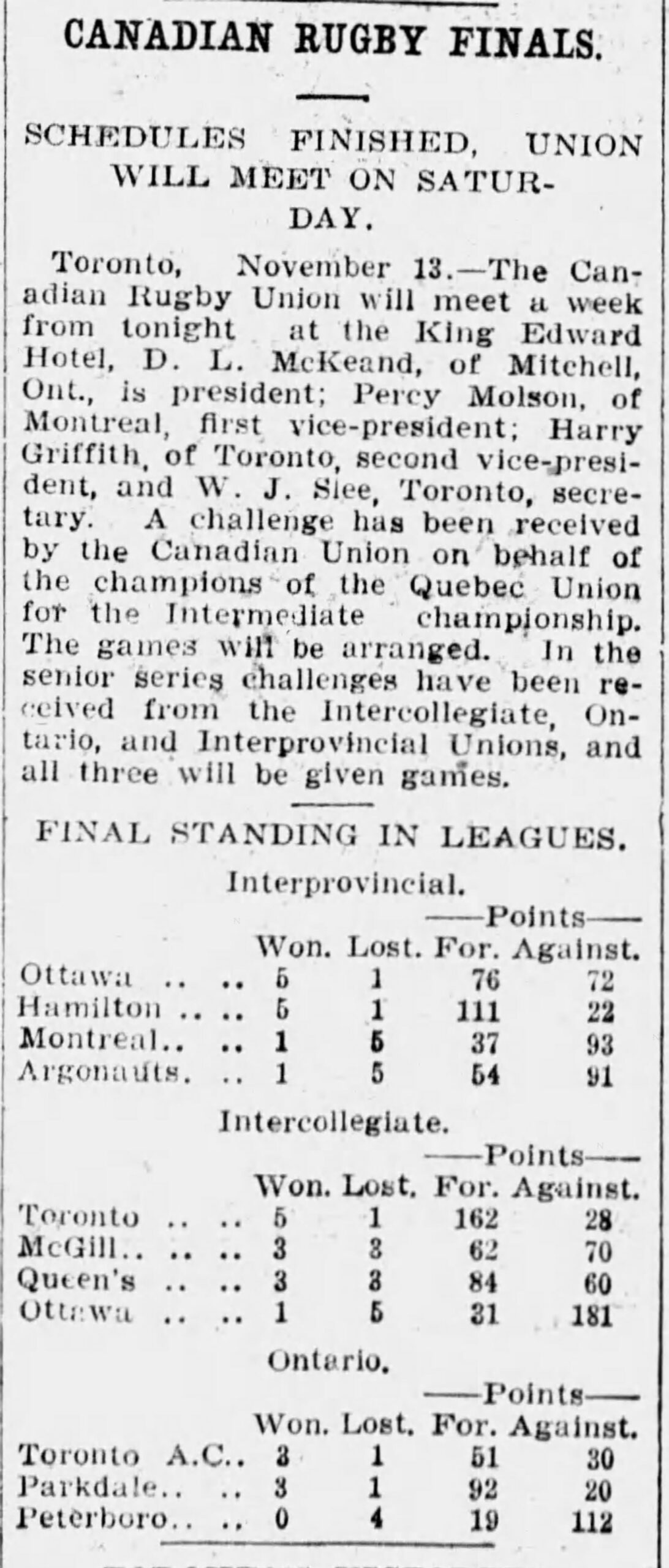
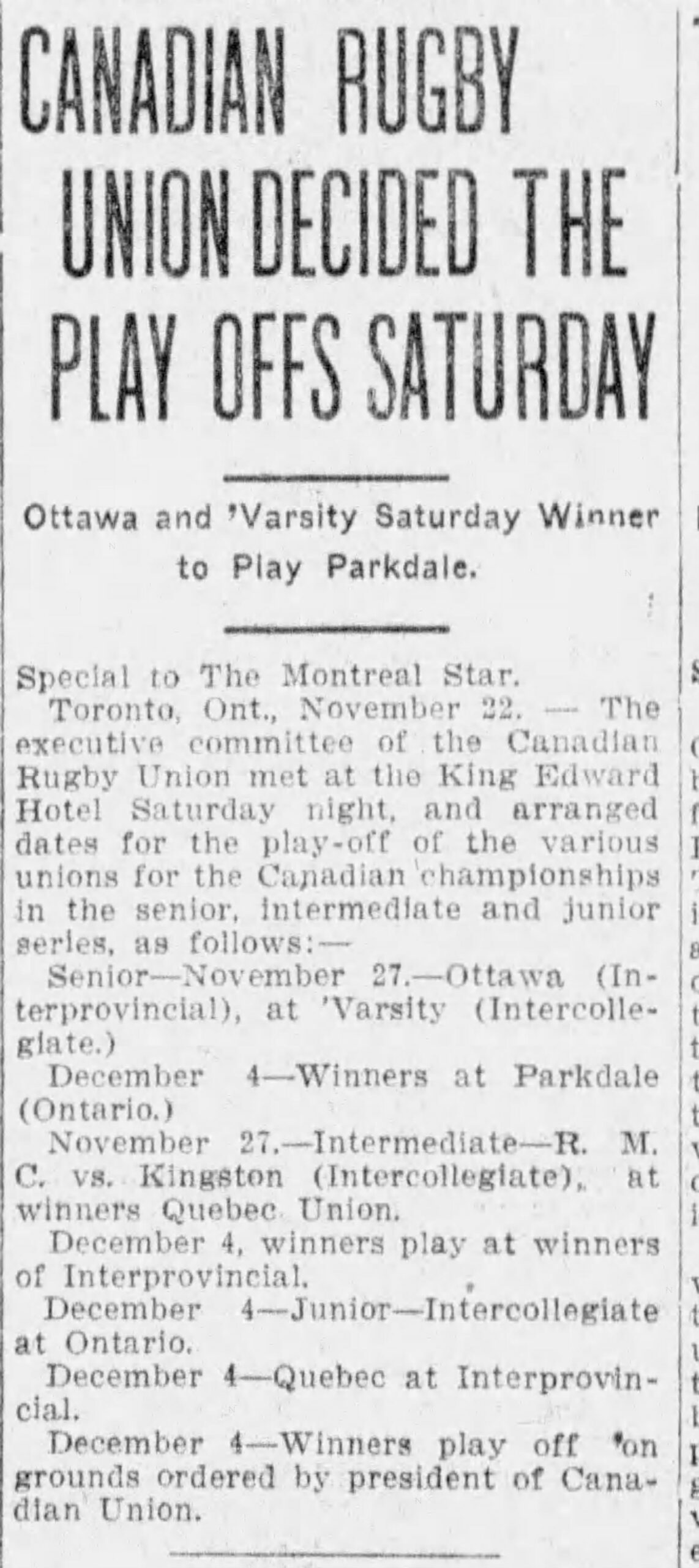
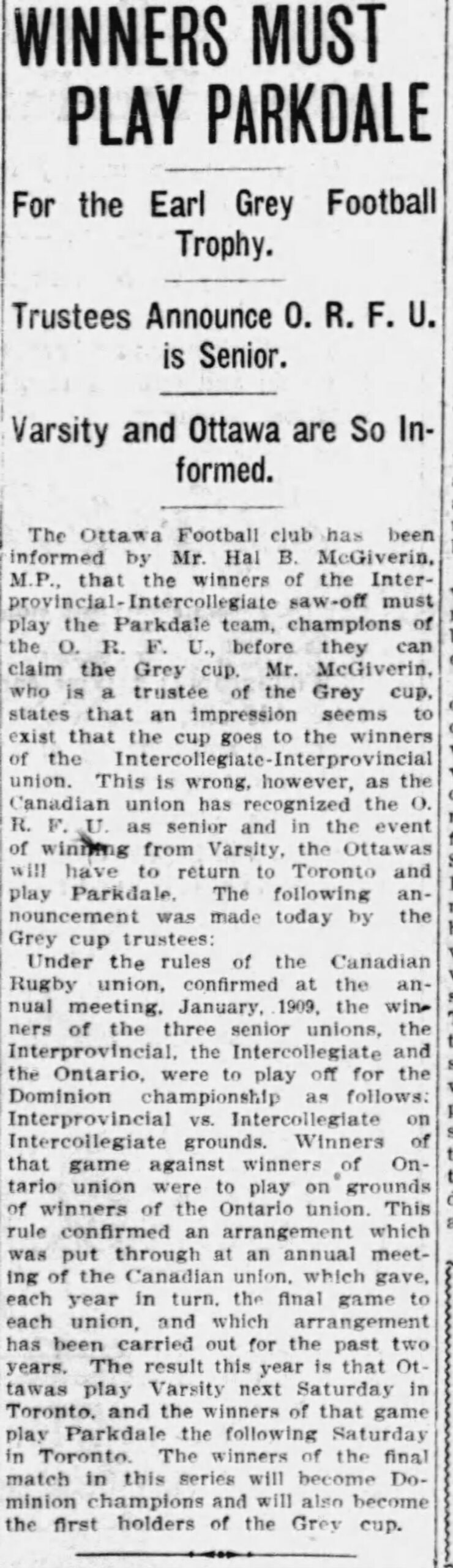
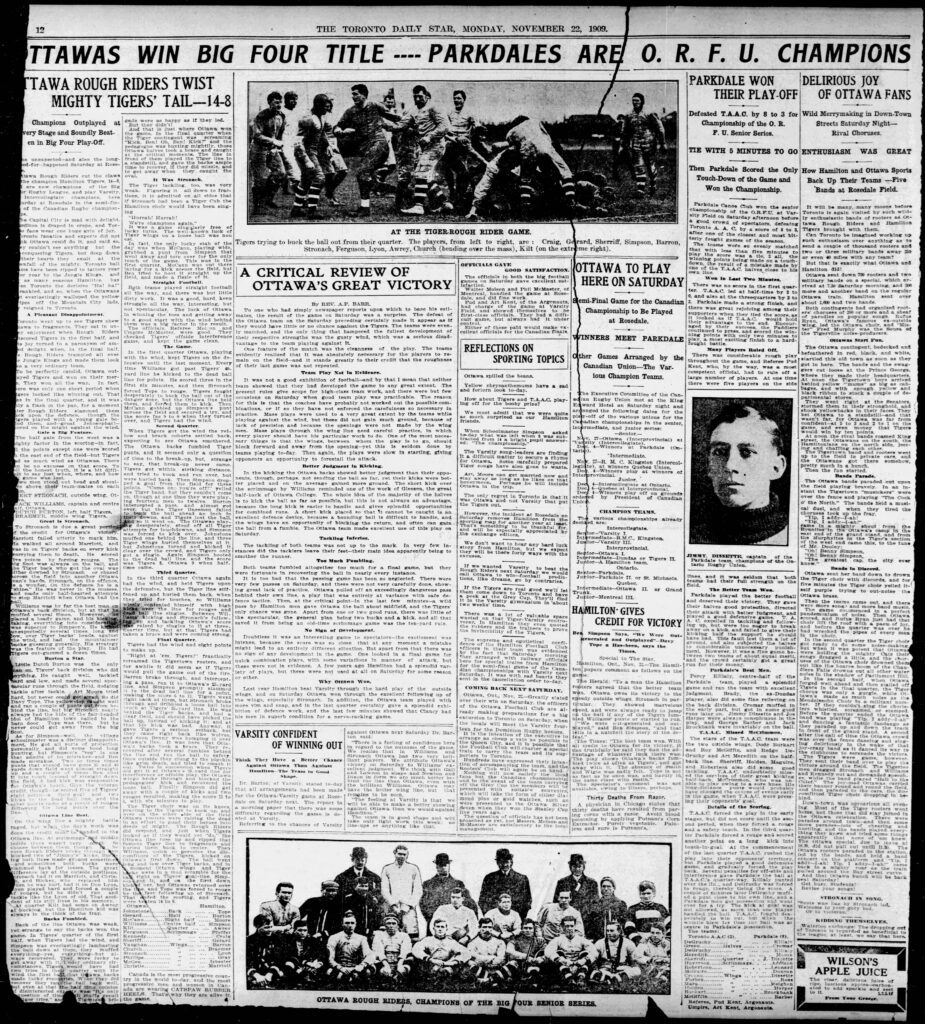
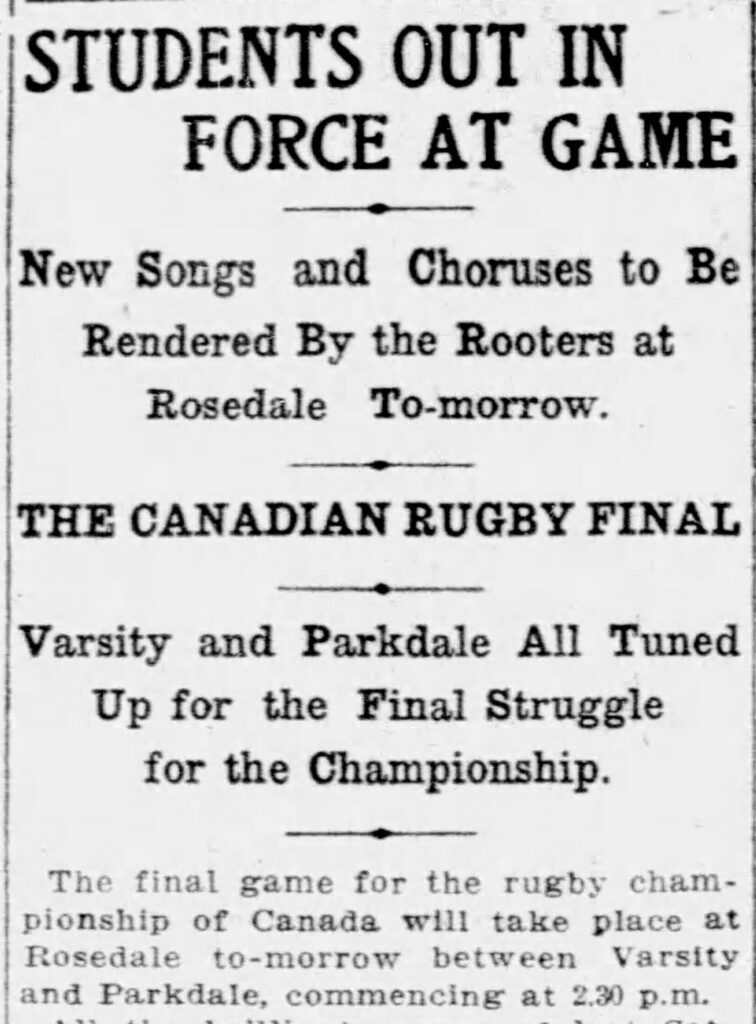
But there is strong evidence that the Rough Rider name given to Ottawa’s football team had nothing to do with a Teddy Roosevelt tribute or lumberjacks or horse-riding cowboys at all. Instead, the “rough rider” label was most likely used as an insult by a Hamilton journalist. See, in October 1898 the Hamilton Tigers and Ottawa Football Club were involved in an intense couple of games that would determine the champion of the Ontario Rugby Football Union. Ottawa had quite the reputation of being an aggressive or “rough” team. Some back-and-forth trash talk between journalists in Ottawa and Hamilton was almost as intense as the on-field rivalry. The Ottawa Journal accused the Hamilton press of maligning their team by calling them “thugs, “murderers, and “rough riders.”
Hamilton Spectator reporter C.A. Mitchell calls Ottawa football players “roughriders” (The Ottawa Citizen, 17 October 1898, p. 6.) Another Hamilton reporter refers to Ottawa as “Captain Kenney’s rough riders”. Kenney was the Ottawa captain. (“The Tigers at Work.” The Ottawa Journal, 19 October 1898, p. 6.)
Ultimately, The Ottawa Football Club embraced the insult and began wearing the Rough Rider moniker as a badge of honour. Literally. The team made up pins with the Rough Rider name and distributed them to fans travelling to Hamilton for the second game. It’s entirely possible that the team piggy backed on the “Roosevelt Rough Riders” that were in the news at the time, but the actual origins of football rough riders centred around their reputed rough style of play on the field.
A reference by Ottawa Citizen reporter to “Roosevelt Kenny” alluding to his hero status after the October 29 rematch between Ottawa and Hamilton. (“The Tiger Hunter’s Laugh.” The Hamilton Spectator, 1 November 1898, p. 4.)The Ottawa press accusing the Hamilton press of maligning the Ottawa Football Club by calling them “murderers,” “thugs,” and “rough riders.” (“Ottawa’s Position.” The Ottawa Journal, 31 October 1898, p. 6.)
Unfortunately, the Ottawa Rough Riders folded following the 1996 CFL season, ending a 120-year football tradition. In 2002, a new CFL team was founded called the Ottawa Renegades. The Renegades, too, adopted red and black as team colours. However, the Renegades met the same fate as the Rough Riders after playing only four seasons.
It wasn’t until 2014 that the Canadian Football League would return to the Nation’s Capital. There was certainly some support for the new team to be called the Rough Riders. However, Saskatchewan objected to it, and the name didn’t carry the same weight for younger football fans who were either too young or not even born yet to have any recollection of the old Ottawa Rough Riders.
In the lead up to the CFL’s return, fans were asked to vote online for the new team’s name. The options included the Rush, Nationals, Voyageurs, Raftsmen, and Redblacks. On June 8, 2013, the team announced that its new name would be the Ottawa REDBLACKS. The nickname is capitalized for marketing purposes. In French, the team is known as the Rouge et Noir.
The new name was meant with mixed reviews. Detractors suggested it was a made-up word while others pointed to the New Zealand All Blacks, that country’s national rugby team, as an example of a successful moniker named simply after team colours. Surely, Ottawa’s new team could be seen through the same lens.
In the end, football fans in Ottawa rallied around their new team. The Red and Black plays homage to the old Ottawa Rough Riders’ colours, the Ceremonial Guards, as well as the plaid jackets worn by the great lumberjacks of the area. The Ottawa REDBLACKS name sounds like a perfect solution, really. And it sure beats the Ottawa Murderers or Ottawa Thugs, doesn’t it?
A special thanks to Chris Sinclair and Ian Symes who pointed me in the right direction when it came to the origins behind the Ottawa Rough Riders name. Thanks, guys. – RF