Category: Western Interprovincial Football Union

  • Canada’s First National Commissioner of Football

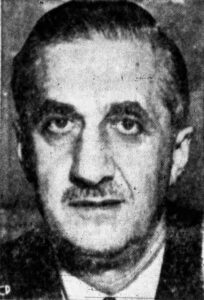
    As the CFL formally introduces Stewart Johnston as its new Commissioner this week, Canadian Football History looks back at the very first CFL Commissioner: Gerald Sydney Halter.

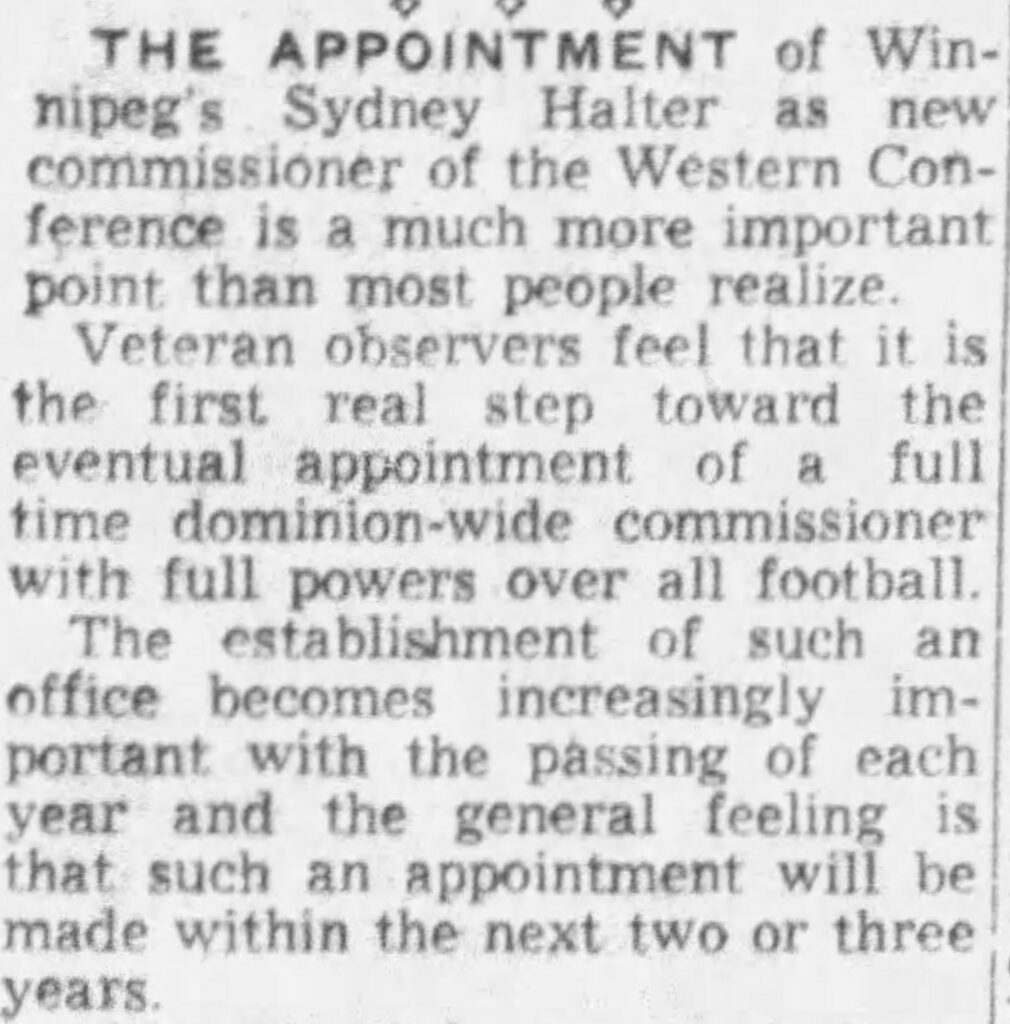
    Sydney Halter was born and raised in Winnipeg, Manitoba. He held various roles, including treasurer and president, in the Winnipeg Blue Bombers organization before being named the Commissioner of the Western Interprovincial Football Union in 1953.

    In 1956, he became the Registrar of the Canadian Football Council (CFC), a newly formed umbrella organization for both the WIFU and the eastern Interprovincial Rugby Football Union (the “Big Four”).

    Well regarded in football circles across the country, Sydney Halter was named “Canada’s first national commissioner of football” when the Canadian Football League was established by the CFC in 1958. By the way, I totally think the CFL should adopt “National Commissioner of Football” as the official job title for its top role.

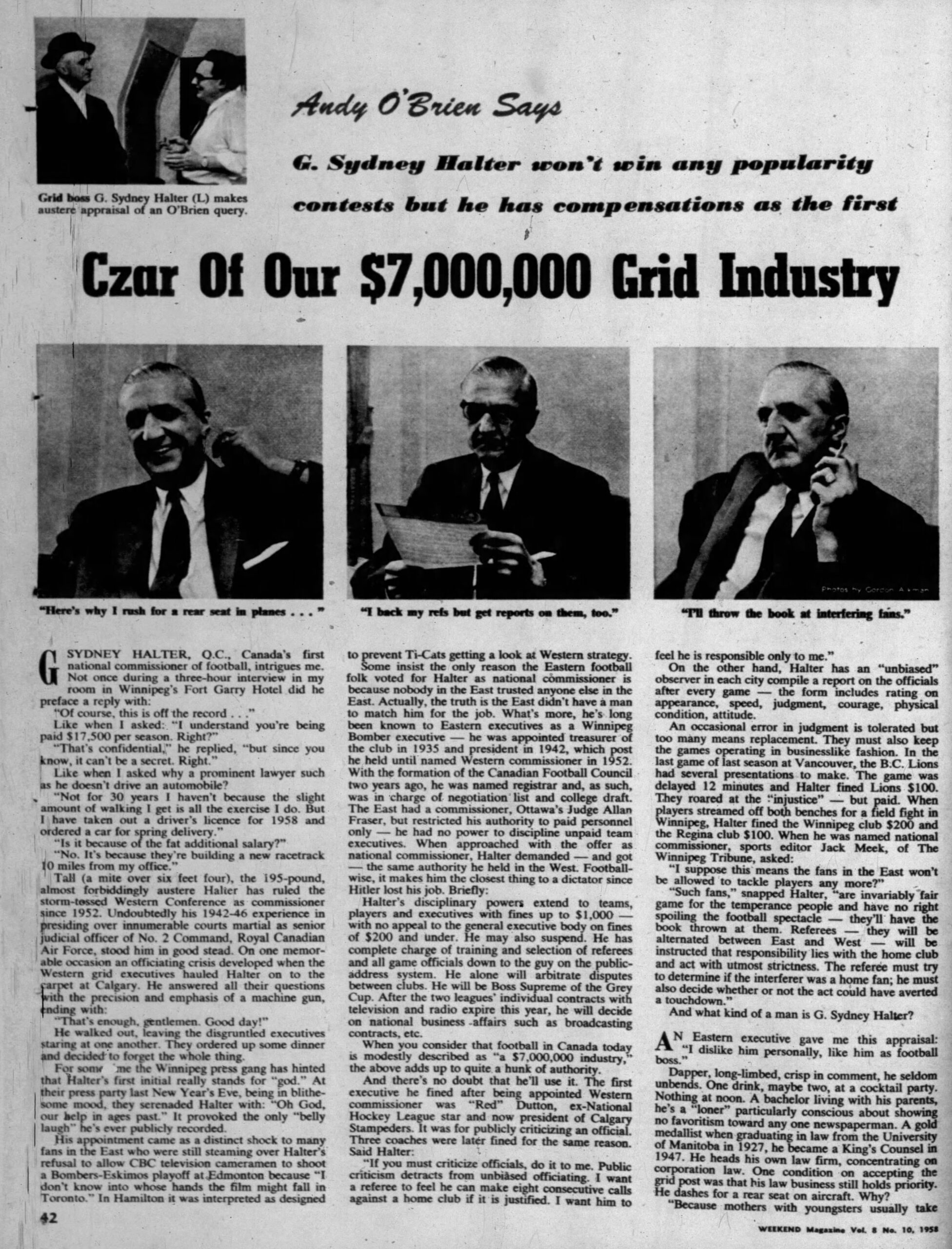
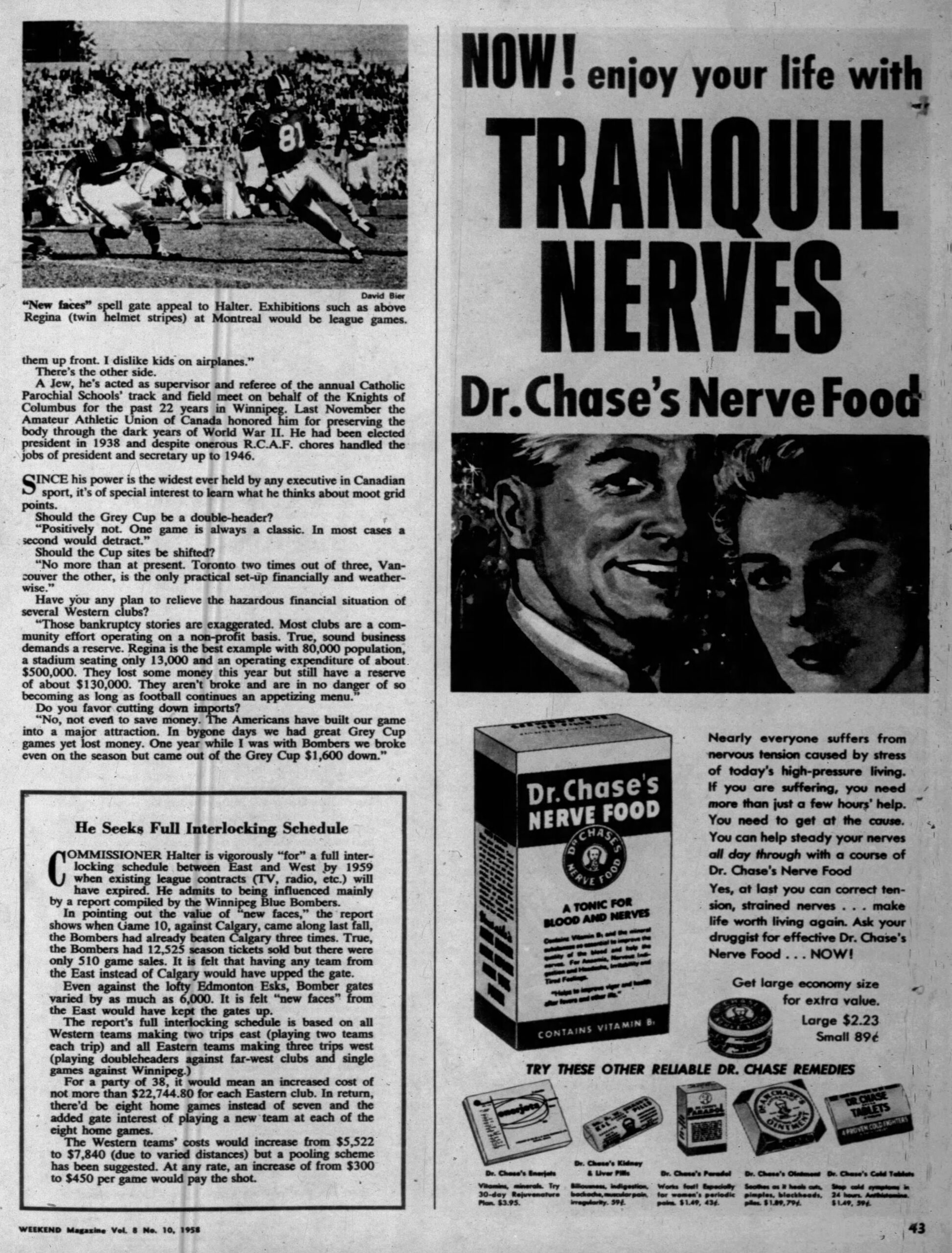
    Described as a chain-smoking bachelor or “loner” by some, Sydney Halter wielded quite a bit of power in his role as Canada’s professional football boss. The article below (click on them to enlarge) is lengthy but well worth the read. It portrays Halter as a straight shooter and touches on how he didn’t hesitate to deliver fines to players and teams – or fans who interfered in the game. Apparently, home fans tackling opposing players from scoring touchdowns was a thing. Yikes.

    O’Brien, Andy. “Czar of Our $7,000,000 Grid Industry.” The Hamilton Spectator, 8 March 1958, p. 90.
    O’Brien, Andy. “Czar of Our $7,000,000 Grid Industry.” The Hamilton Spectator, 8 March 1958, p. 91.

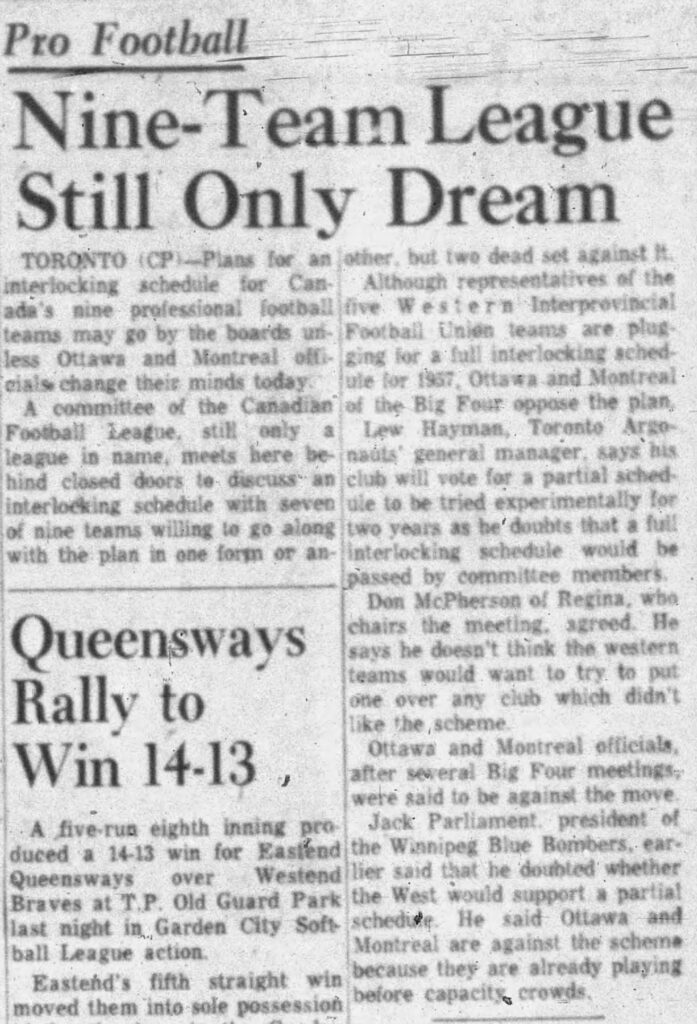
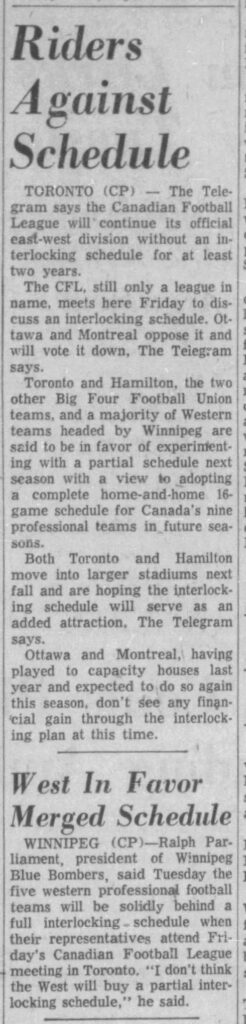
    Sydney Halter served as the CFL’s commissioner until 1966. He was an early advocate for an interlocking schedule between the East and the West. A lawyer by profession, he also served in the Royal Canadian Air Force and held leadership positions in other Canadian sporting organizations outside of football.

    Sydney Halter is a member of the Canadian Football Hall of Fame, inducted in 1966, as “the architect of the modern-day Canadian Football League.” He died in 1990. He was Jewish and was inducted posthumously into the International Jewish Sports Hall of Fame in 2005.

  • The Edmonton Elks 2.0

    This is the third of a series of posts that will explore the stories behind the names of the existing Canadian Football League teams. See the previous post on the Calgary Stampeders.


    Throughout the long history of Canadian football, there’s been very little controversy surrounding team nicknames. Sure, there was a time in the not too distant past where there was one team called the Rough Riders and another called the Roughriders. But, for the most part the country’s professional football club names have been a bit quirky sounding but certainly not eyebrow raising.

    The one exception to this rule is Edmonton.

    Football has been played in the Alberta capital since 1895. Just as it is today, the early Edmonton team’s main rival was Calgary. The story goes that a Calgary sportswriter took a jab at the Edmonton team by calling them “the Esquimaux” (the French translation of Eskimos) in reference to the rather cold northern Alberta climate. The Edmonton team embraced the insult and used the moniker for a number of years before adopting the Anglicized version of the word in 1910.

    The team was known as the Edmonton Elks in 1922, foreshadowing a name change that would come a century later, and played Queen’s University in the Grey Cup that year.

    The original Eskimo team folded in the 1920s. In 1938, the Edmonton Eskimos were reborn and played in the Western Interprovincial Football Union. However, this team too ceased operations due to the onset of the Second World War.

    It wasn’t until 1949 that the current Edmonton club returned to the WIFU. Once again Edmonton adopted the Eskimos moniker although there were some suggestions that the team be called the Oilers, the name later given to the city’s future professional hockey team.

    For the next seventy years, the Edmonton Eskimos represented Northern Alberta and were considered a model CFL franchise. They won three Grey Cups in a row in the 1950s and won five championships from 1978-1982, an astonishing feat no other team has been able to accomplish.

    However. over time a growing number of people voiced their concern over the use of the name “Eskimos.” Facing mounting public pressure, the team announced that it would be dropping the “Eskimos” name in July 2020.

    A year later, June 1, 2021, the team announced its new yet familiar name: the Edmonton Elks.

  • “Stampeders” New Football Name

    This is the second of a series of posts that will explore the stories behind the names of the existing Canadian Football League teams. Check out the previous post on the BC Lions.


    Conventional wisdom says that the Calgary Stampeders are named after the world famous Calgary Stampede rodeo. The Stampeders moniker has been used by numerous Calgary-based teams over the years in football, hockey, and baseball.

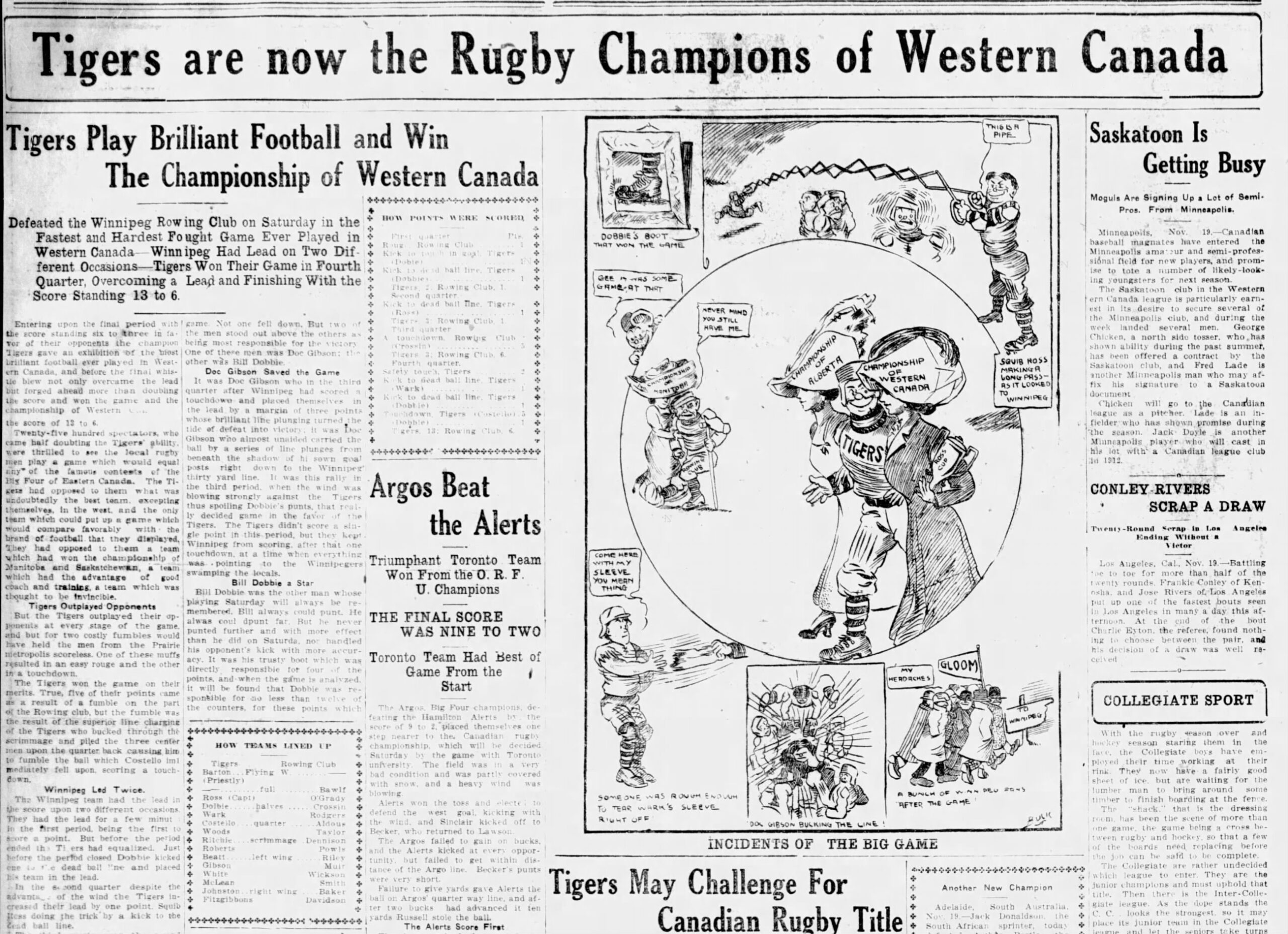
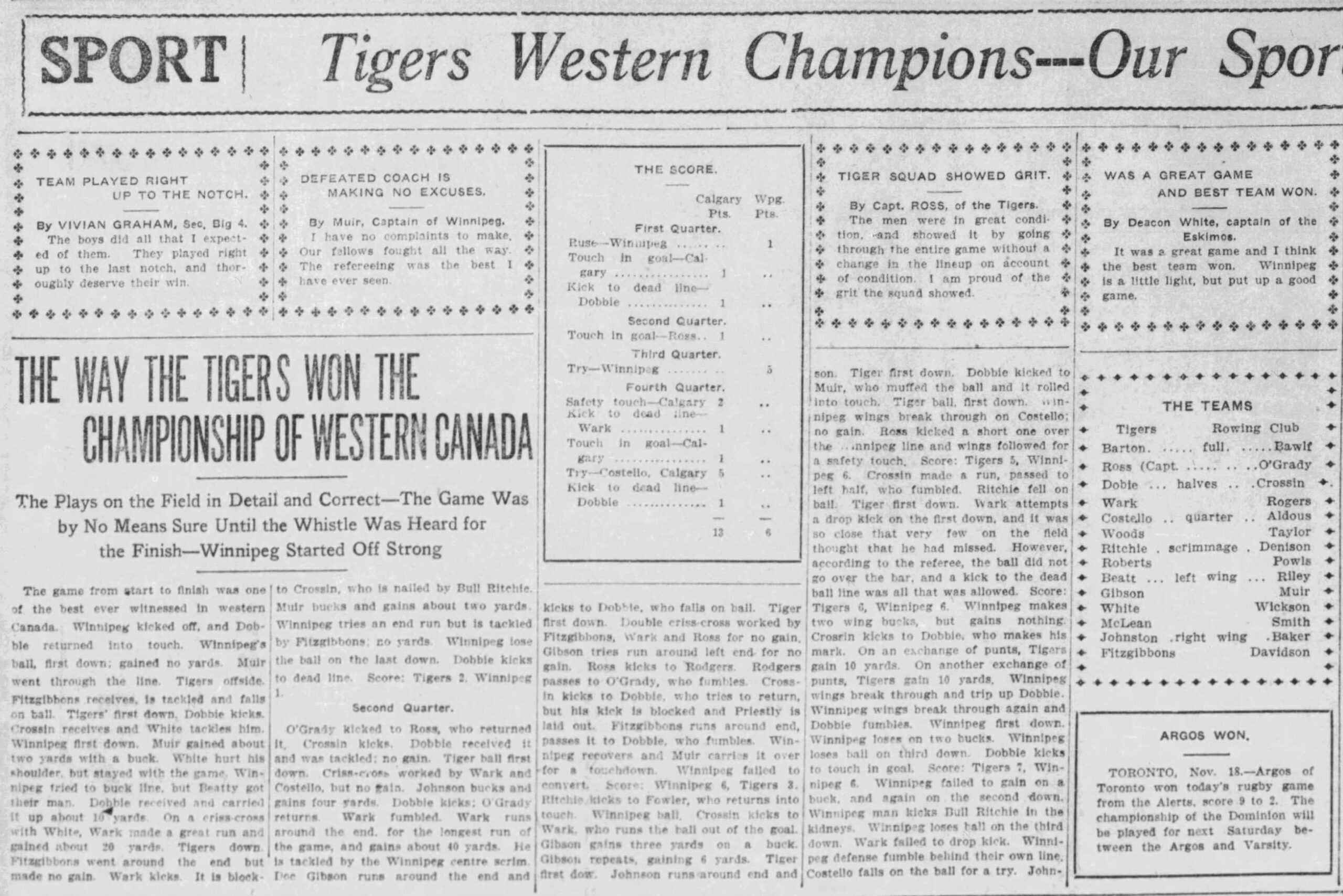
    In the first half of the 20th century, Calgary’s senior football teams included the Tigers, Canucks, Fiftieth Battalion, Altomahs, and Bronks.

    When the Second World War ended, senior football returned to Calgary after a five-year absence. The new club was founded on September 27, 1945 as a cooperative.

    Calgary joined Regina and Winnipeg in a condensed 1945 WIFU season. On October 11, the Calgary Herald reported that the new team would be called the “Stampeders” instead of the Bronks, Calgary’s former WIFU entry.

    One account indicates that the team was called the Stampeders to help advertise “Stampede Beer” produced by the Calgary Brewing and Malting Company (Source: A history of Football in Calgary, Canadian Football Research Society). As a new cooperative money was tight so any source of revenue would be welcomed.

    The newly christened Calgary Stampeders played their first game on October 20, 1945 at Mewata Stadium against the visiting Regina Roughriders.

  • “Lions” New Moniker of B.C.’s WIFU Team

    This is the first of a series of posts that will explore the stories behind the names of the existing Canadian Football League teams.


    In 1953, a group of Vancouver businessmen got the greenlight for an expansion team in the Western Interprovincial Football Union (WIFU). The new team would begin play the following year and play their home games at the new Empire Stadium. Annis Stukus of Toronto was hired to be the club’s first head coach.

    With all the pieces in place, it was time give the new club a team name. A name-the-team contest was held and generated over 15,000 entries. The leading contenders were Lions, Grizzlies, Totems, Loggers, Tyees, and Cougars.

    It ultimately came down to Lions and Grizzlies. The Grizzlies was the name of Vancouver’s earlier entry in the WIFU that played just one season before ceasing operations after the WIFU suspended play as a result of the Second World War.

    Art Mercer and the BC Lions name contest
    Source: The Province, 2 April 1953, page 12.

    Ultimately, a committee settled on the name Lions. Locally, “the Lions” is the name given to twin mountain peaks near Vancouver that are said to resemble mountain lions. So, it was a natural pick.

    The team adopted a mountain lion for its logo and orange and black uniforms, paying homage to another historic Vancouver team, the Meralomas. Annis Stukus wanted to ensure the football team represented the entire province and not just the city of Vancouver. Thus, the British Columbia Lions were born.

    Newspaper article about Lions being the new name of BC's football team
    Source: The Province, 2 April 1953, page 12.

  • Roaring B.C. Lions Surprise Mighty Blue Bombers

    BC Lions first game action (Vancouver Sun)
    Source: The Vancouver Sun, 30 August 1954, page 14.

    On August 28, 1954, the British Columbia Lions made their debut in the Western Interprovincial Football Union narrowly losing to the Winnipeg Blue Bombers 8-6 at Empire Stadium in Vancouver.

    Winnipeg halfback Tom Casey (#91) was a key player in the Bombers’ victory.

    The game attracted a crowd of 20,606.