When CFL Commissioner Stewart Johnston announced sweeping rule changes to the Canadian game last month, one modification that probably alarmed traditionalists the most was the change to the size of the CFL football field. In 2027, the field will shrink from 110 yards in length to 100 yards between the goal lines.
I can certainly sympathize with the “Save the 55” crowd. After all, we humans tend not to like change. Especially when it comes to changing something we cherish. But upon further review, it appears that 100-yard football fields are not new to Canadian football.
From the Rules of the Rugby Union Game of Football adopted by the Canadian Rugby Football Union, 14 September 1880
In fact, early Canadian football was played on 100 yard long fields. In 1880, the very first rule in the new Canadian Rugby Football Union rule book stated that “The Grounds shall be, as near as possible, 100 yards long by 50 yards broad.” Of course, it’s important to remember that the game around this time was more like rugby football than the gridiron game we are accustomed to today. But still, that’s a small field.
100 yard long field being adopted by the CRFU in November 1885. (Montreal Star, 14 November 1884)
100 yard long fields continued to be the norm for several years. While the 1884 CRFU Laws of the Game stated that the field of play should not exceed 110 yards in length, in 1885, the CRFU clarified that the field should be 100 yards long by 65 yards wide. It appears the 110 yard by 65 yard standard was finally widely adopted by the 1890s. That is the size of the field mentioned in the rules when the new Canadian Rugby Union was formed in 1891.
The 110 x 65 field we are accustomed to (taken from the Canadian Rugby Football Union Constitution and Laws of the Game published in 1884).
So, what’s the point of this discussion? Well, nothing really except to reiterate that Canadian football is not static. The rules and regulations of the game have been evolving since the beginning. And in the case of the 100 yard long field coming in 2027, it can be equally argued that rather than moving the CFL closer to the American game, we are instead taking Canadian football back to its early years.
Sources: Rules of the Rugby Union Game of Football adopted by the Canadian Rugby Football Union, 14 September 1880 Canadian Rugby Football Union Constitution and Laws of the Game, 1 July 1884 The Montreal Star, 14 November 1885
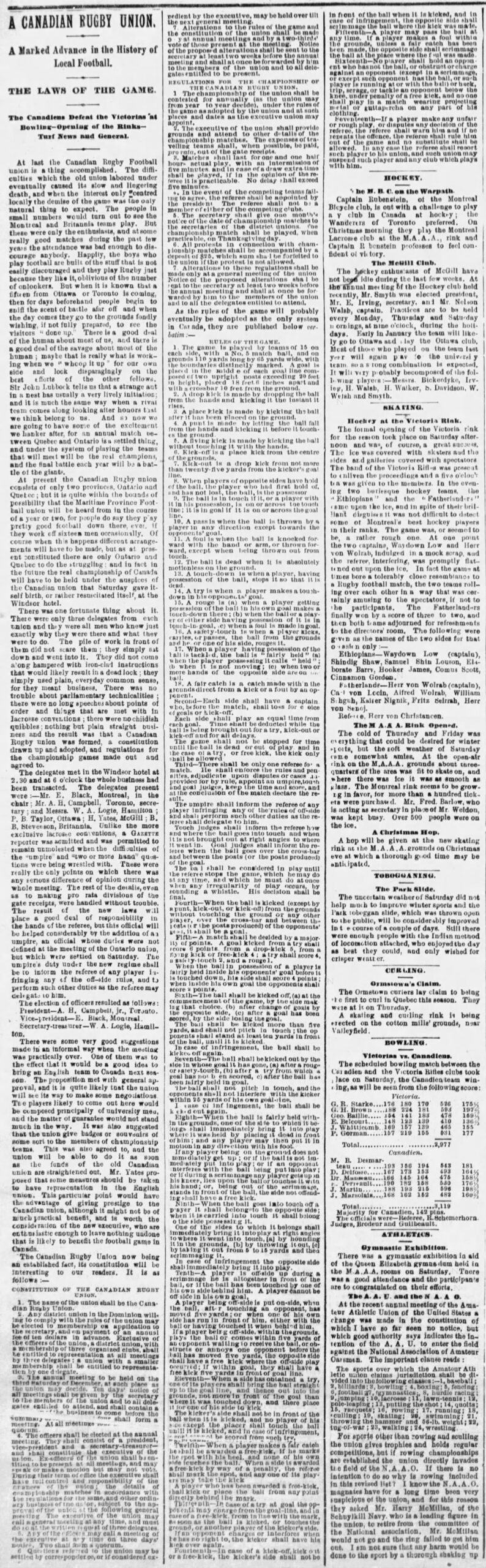
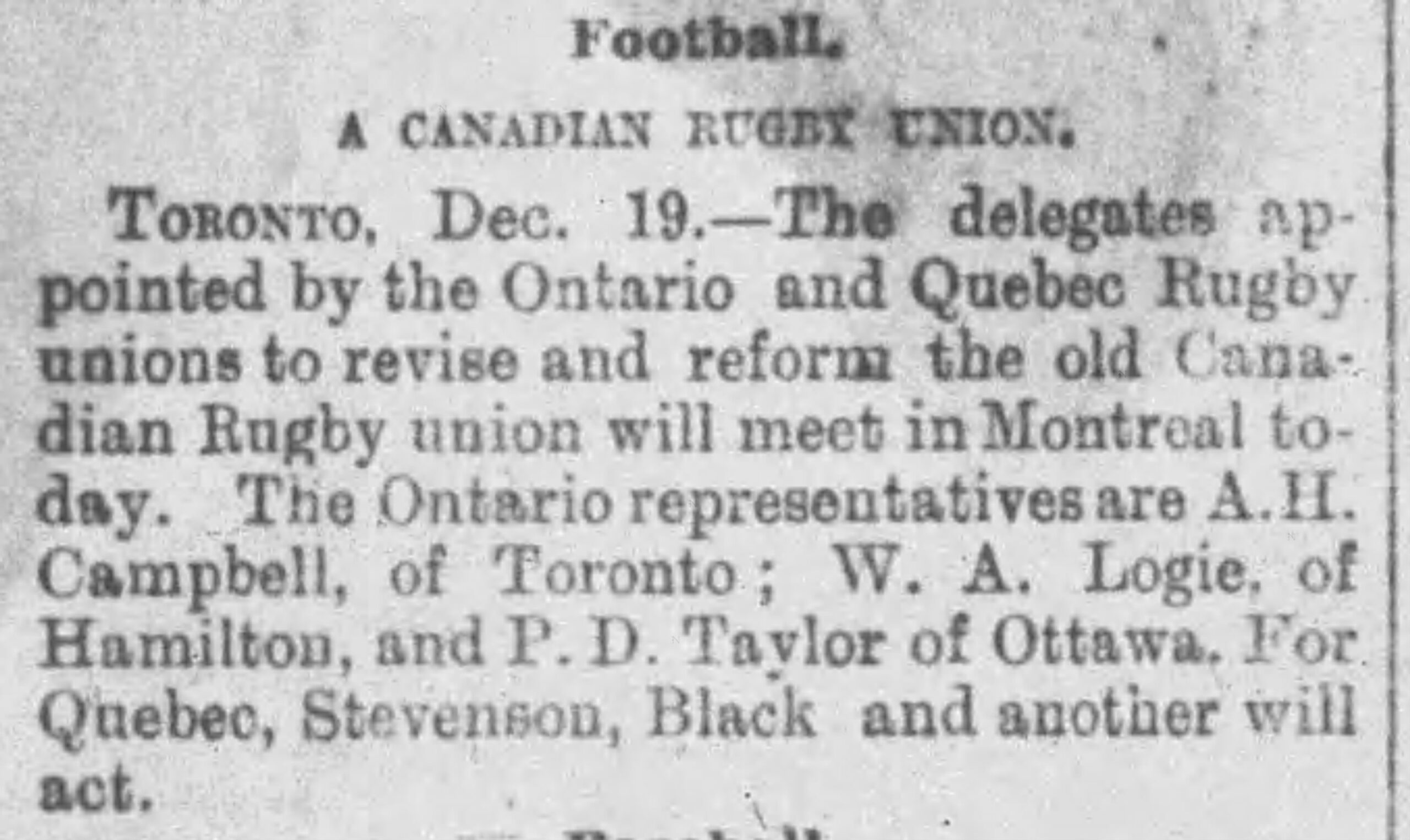
On December 19, 1891, football representatives from Ontario and Quebec met at the old Windsor Hotel in Montreal to launch (or more accurately relaunch) the Canadian Rugby Union. The new CRU replaced the unsuccessful Canadian Rugby Football Union that was actually formed a decade earlier.
The idea behind a new Canadian Rugby Union was for a properly run organization to oversee a common set of rules and hold a national championship game. From the onset, only teams in the Ontario and Quebec rugby football unions participated. This isn’t surprising considering much of western Canada was sparsely populated at the time. Interestingly, the Montreal Gazette mentions the potential future inclusion of clubs from the Maritimes. It seems the elusive Atlantic Canada team has been sought after much longer than we thought.
The Gazette published an article full of praise of the new entity and those involved in creating it. According to the article, the whole thing – rules, regulations, an executive team, and a constitution – were drawn up and adopted in less then five hours. Efficient.
Article in the Montreal Gazette summarizing the formation of the new Canadian Rugby Union (21 December 1891)
At the time, Canadian football was much closer to the game of rugby than to the gridiron game we enjoy today. The article discusses the idea of the new CRU joining the English union. I’m not sure if they’re talking about the England-based Rugby Football Union or the relatively new International Rugby Football Board which the RFU had itself just joined. The more favourable proposal was to encourage a rugby side from England to come to Canada to play games against the CRU. The CRU representatives also agreed to reward members of the championship team with badges and souvenirs. Can’t argue against that.
Over time, the Canadian Rugby Union would welcome leagues from the western provinces. The Grey Cup would become the CRU’s national championship in 1909. Canadian rugby slowly evolved into a unique brand of Canadian football with the adoption of changes such as the Burnside rules and the forward pass. The game became professional following the Second World War. And the Canadian Football League formed and seceded from the CRU in 1958.
After all this, the Canadian Rugby Union still remained the governing body of amateur football in Canada. In the 1960s the CRU was rebranded as the Canadian Amateur Football Association. Around the same time, a new organization called the Rugby Union of Canada was formed as the governing body of rugby union football in Canada. Alas, the final separation of rugby and Canadian football was complete. Each sport would now use its own nomenclature.
The original CRU/CAFA still plays a pivotal role in Canadian football. Today, it is known as Football Canada. It is still the national governing body of amateur Canadian football and is also responsible for the Canadian national teams that compete in international gridiron competitions.
Announcement in the Hamilton Spectator on December 19, 1891 about the Montreal meeting to launch the new Canadian Rugby Union.
Source:Government of Canada. Photo: Cpl Heather Tiffany
The colours red and black have long been associated with the city of Ottawa and its various football teams throughout the years. Pay a visit to Parliament Hill or to Rideau Hall, and you will see the Ceremonial Guards donning their traditional black and red uniforms. The Ottawa Football Club, founded in 1876, eventually adopted red and black (and white) as their team colours. This is the team that would become known as the Ottawa Rough Riders in October 1898.
The story behind the Rough Rider name is clouded in mystery. The “official” line is that Ottawa adopted the name Rough Riders as some sort of tribute to future U.S. President Teddy Roosevelt’s regiment (called the Rough Riders) in the Spanish-American War in 1898. But there is no mention of this connection in local newspapers at the time. Why would a football team in Ottawa be named after a regiment fighting a war that had absolutely nothing to do with Canada, anyway? It really doesn’t make much sense.
Another suggestion is that the name derives from the lumberjacks or log drivers who used to ride logs down the Ottawa River. Again, though, there isn’t any reference to lumberjacks or log drivers in Ottawa newspapers around the time the football team started using the name.
Perhaps the Ottawas (yes, they were called that, too) follow the same “rough rider” origins as the Saskatchewan Roughriders. The Regina Roughriders adopted the name in 1924, a reference to the trainers who broke wild horses in the west. In the 1960s and 1970s the Ottawa Rough Riders used a cowboy riding a bucking horse atop a football as their logo. And their mascot was a guy named Okee the Cowboy. So, who knows?
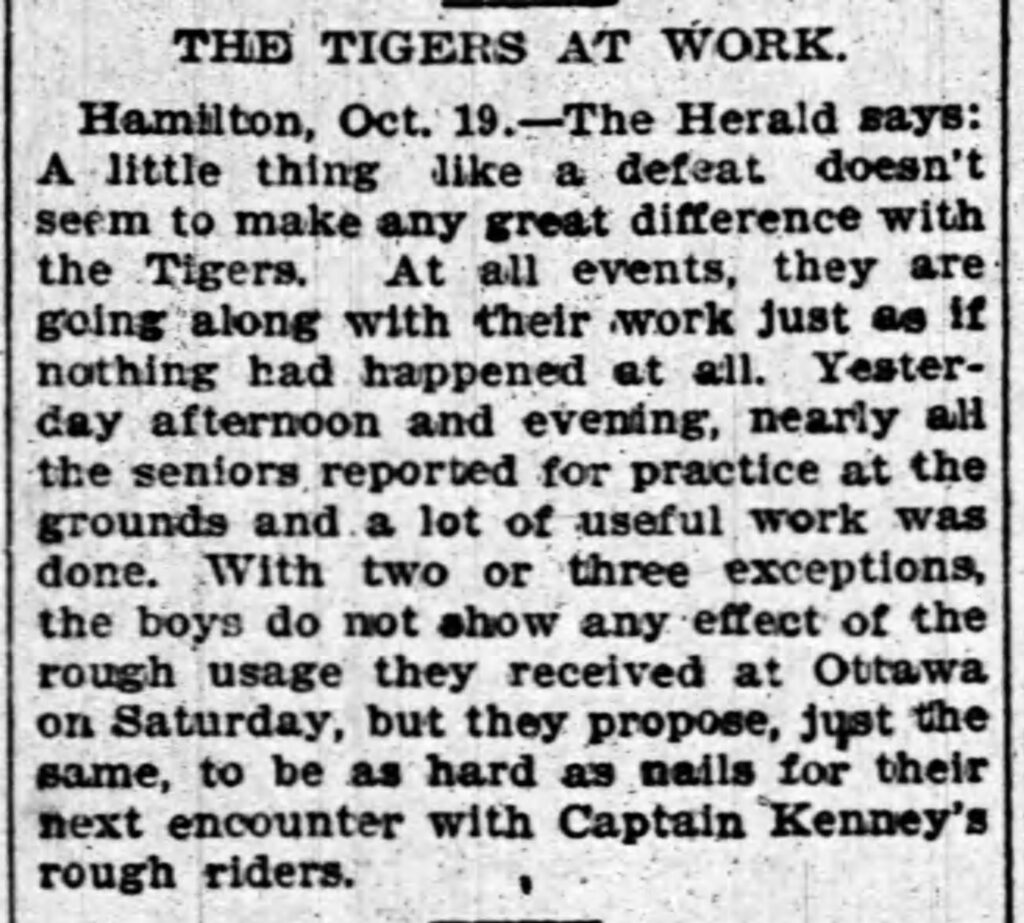
But there is strong evidence that the Rough Rider name given to Ottawa’s football team had nothing to do with a Teddy Roosevelt tribute or lumberjacks or horse-riding cowboys at all. Instead, the “rough rider” label was most likely used as an insult by a Hamilton journalist. See, in October 1898 the Hamilton Tigers and Ottawa Football Club were involved in an intense couple of games that would determine the champion of the Ontario Rugby Football Union. Ottawa had quite the reputation of being an aggressive or “rough” team. Some back-and-forth trash talk between journalists in Ottawa and Hamilton was almost as intense as the on-field rivalry. The Ottawa Journal accused the Hamilton press of maligning their team by calling them “thugs, “murderers, and “rough riders.”
Hamilton Spectator reporter C.A. Mitchell calls Ottawa football players “roughriders” (The Ottawa Citizen, 17 October 1898, p. 6.) Another Hamilton reporter refers to Ottawa as “Captain Kenney’s rough riders”. Kenney was the Ottawa captain. (“The Tigers at Work.” The Ottawa Journal, 19 October 1898, p. 6.)
Ultimately, The Ottawa Football Club embraced the insult and began wearing the Rough Rider moniker as a badge of honour. Literally. The team made up pins with the Rough Rider name and distributed them to fans travelling to Hamilton for the second game. It’s entirely possible that the team piggy backed on the “Roosevelt Rough Riders” that were in the news at the time, but the actual origins of football rough riders centred around their reputed rough style of play on the field.
A reference by Ottawa Citizen reporter to “Roosevelt Kenny” alluding to his hero status after the October 29 rematch between Ottawa and Hamilton. (“The Tiger Hunter’s Laugh.” The Hamilton Spectator, 1 November 1898, p. 4.)The Ottawa press accusing the Hamilton press of maligning the Ottawa Football Club by calling them “murderers,” “thugs,” and “rough riders.” (“Ottawa’s Position.” The Ottawa Journal, 31 October 1898, p. 6.)
Unfortunately, the Ottawa Rough Riders folded following the 1996 CFL season, ending a 120-year football tradition. In 2002, a new CFL team was founded called the Ottawa Renegades. The Renegades, too, adopted red and black as team colours. However, the Renegades met the same fate as the Rough Riders after playing only four seasons.
It wasn’t until 2014 that the Canadian Football League would return to the Nation’s Capital. There was certainly some support for the new team to be called the Rough Riders. However, Saskatchewan objected to it, and the name didn’t carry the same weight for younger football fans who were either too young or not even born yet to have any recollection of the old Ottawa Rough Riders.
In the lead up to the CFL’s return, fans were asked to vote online for the new team’s name. The options included the Rush, Nationals, Voyageurs, Raftsmen, and Redblacks. On June 8, 2013, the team announced that its new name would be the Ottawa REDBLACKS. The nickname is capitalized for marketing purposes. In French, the team is known as the Rouge et Noir.
The new name was meant with mixed reviews. Detractors suggested it was a made-up word while others pointed to the New Zealand All Blacks, that country’s national rugby team, as an example of a successful moniker named simply after team colours. Surely, Ottawa’s new team could be seen through the same lens.
In the end, football fans in Ottawa rallied around their new team. The Red and Black plays homage to the old Ottawa Rough Riders’ colours, the Ceremonial Guards, as well as the plaid jackets worn by the great lumberjacks of the area. The Ottawa REDBLACKS name sounds like a perfect solution, really. And it sure beats the Ottawa Murderers or Ottawa Thugs, doesn’t it?
A special thanks to Chris Sinclair and Ian Symes who pointed me in the right direction when it came to the origins behind the Ottawa Rough Riders name. Thanks, guys. – RF