Tag: 1920s in Canadian Football

  • Varsity Wins the Almost Forgotten Grey Cup

    In 1909, Governor General Earl Grey donated a trophy to be awarded to the amateur rugby football champions of Canada. The University of Toronto won the inaugural championship with a 26-6 win over Toronto Parkdale. Various teams in Toronto and Hamilton competed in the early Grey Cup contests before the game was put on hold after 1915 due to the First World War.

    The Grey Cup was then virtually forgotten. The trophy itself was locked away hidden in a storage vault. War has a way of resetting priorities, you see. After football resumed in Canada in 1919, there were growing organizational issues amongst some teams and disagreements amongst the rugby unions, climaxing in a decision by McGill University and Montreal to refuse to contest the Canadian Rugby Union playoffs. Alas, there was no Grey Cup in 1919, either.

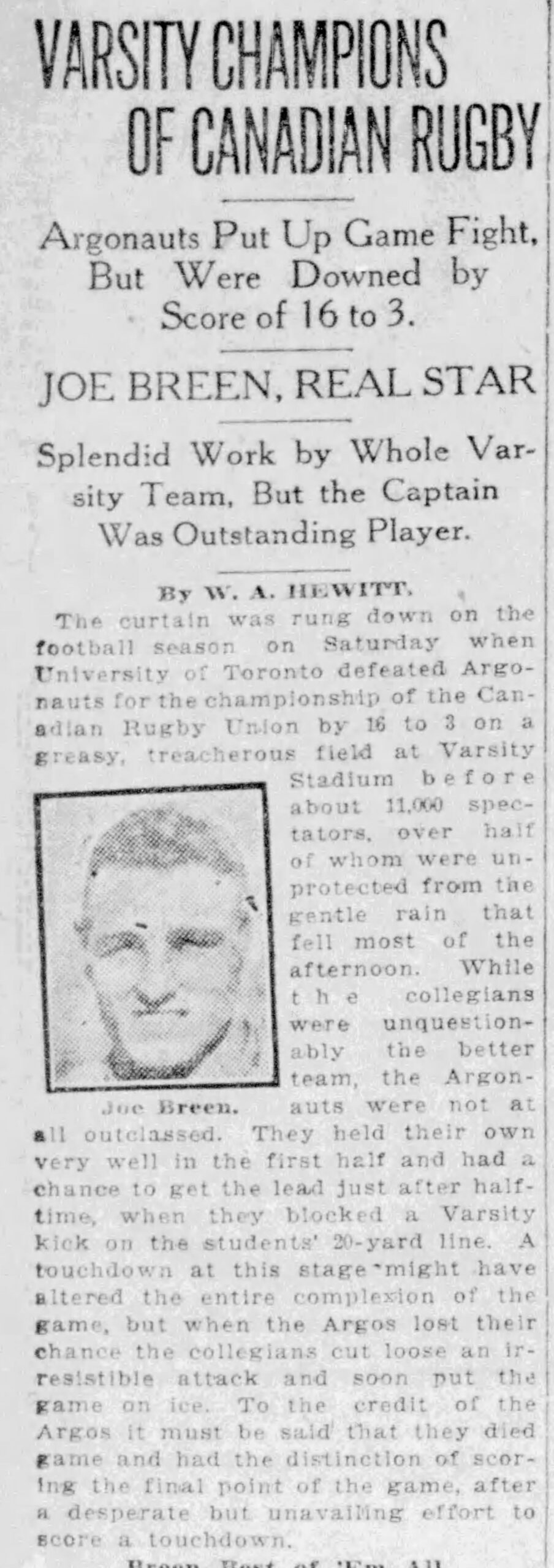
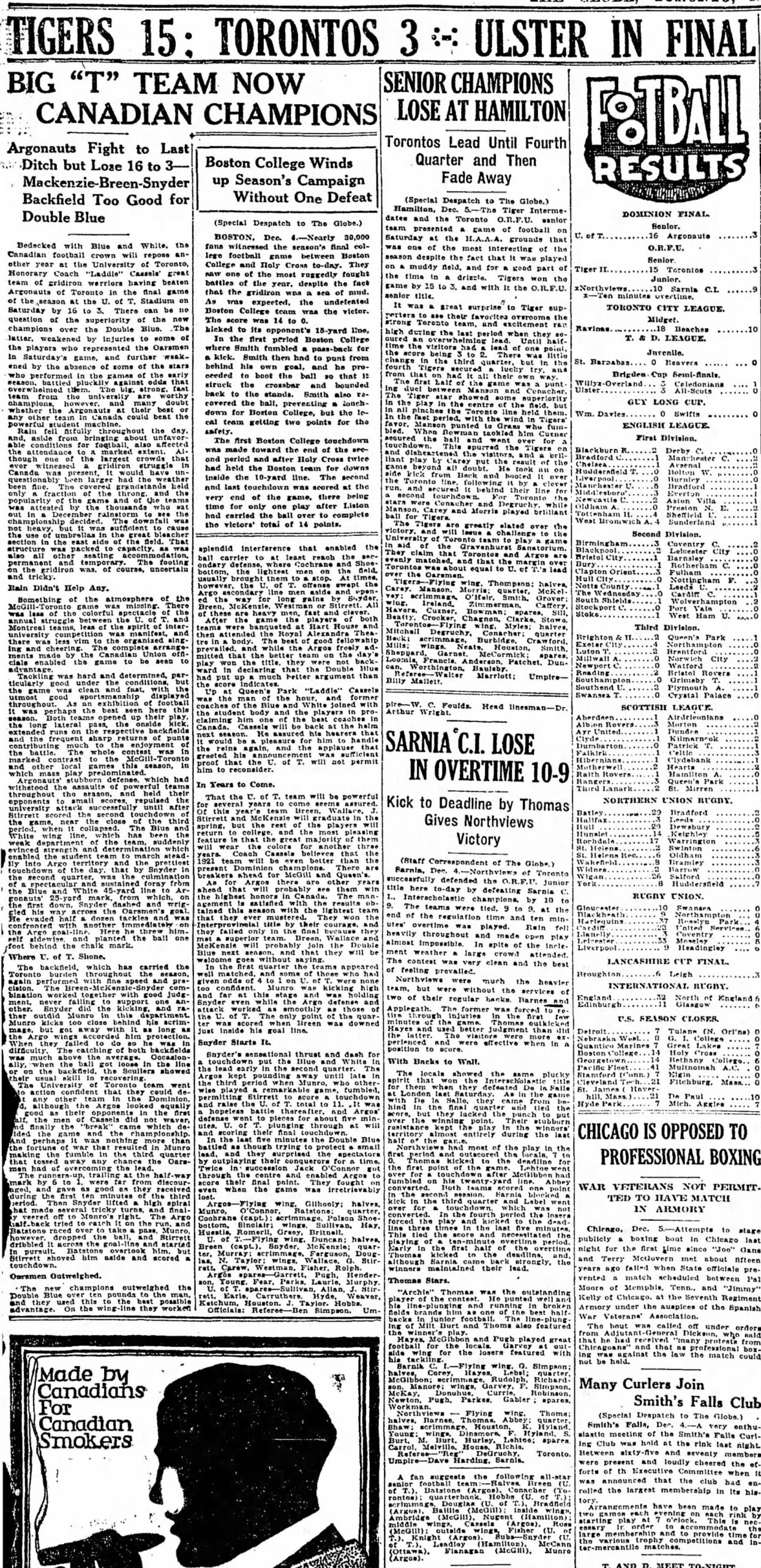
    Coverage of the 1920 Grey Cup in the Toronto Star on December 6, 1920.
    Coverage of the 1920 Grey Cup in the Toronto Star on December 6, 1920.

    But in 1920, the Grey Cup made its triumphant return. And a couple of familiar teams were back in the mix to win the big game. On Saturday, December 4, 1920, the University of Toronto played the Toronto Argonauts in the 8th edition of the Grey Cup. Played in less-than-ideal conditions (rain and mud!) at Toronto’s Varsity Stadium, Varsity’s Joe Breen was the star of the day, according to the Toronto Star, leading his team to a 16-3 victory over the Argonauts.

    Coverage of the 1920 Grey Cup in the Globe and Mail on December 6, 1920.
    Coverage of the 1920 Grey Cup in the Globe and Mail on December 6, 1920.

    This would be the University of Toronto’s fourth and final Grey Cup championship. At the time, Varsity was considered by many to be the best football team in the country. Their championship win cemented this sentiment.

    Despite being relegated to a dark memory hole just a few years prior, the Grey Cup was back. And perhaps that’s what mattered most.


    Sources:

    https://web.archive.org/web/20130820024400/http://cfl.ca/page/his_greycup_recap1920

    The Toronto Star, 6 December 1920

    The Globe and Mail, 6 December 1920

  • Saskatchewan Roughriders is Our Name

    Green is the Colour
    Football is the Game
    We’re all together and Winning is our aim
    So Cheer us on through the sun and rain
    Saskatchewan Roughriders is our name

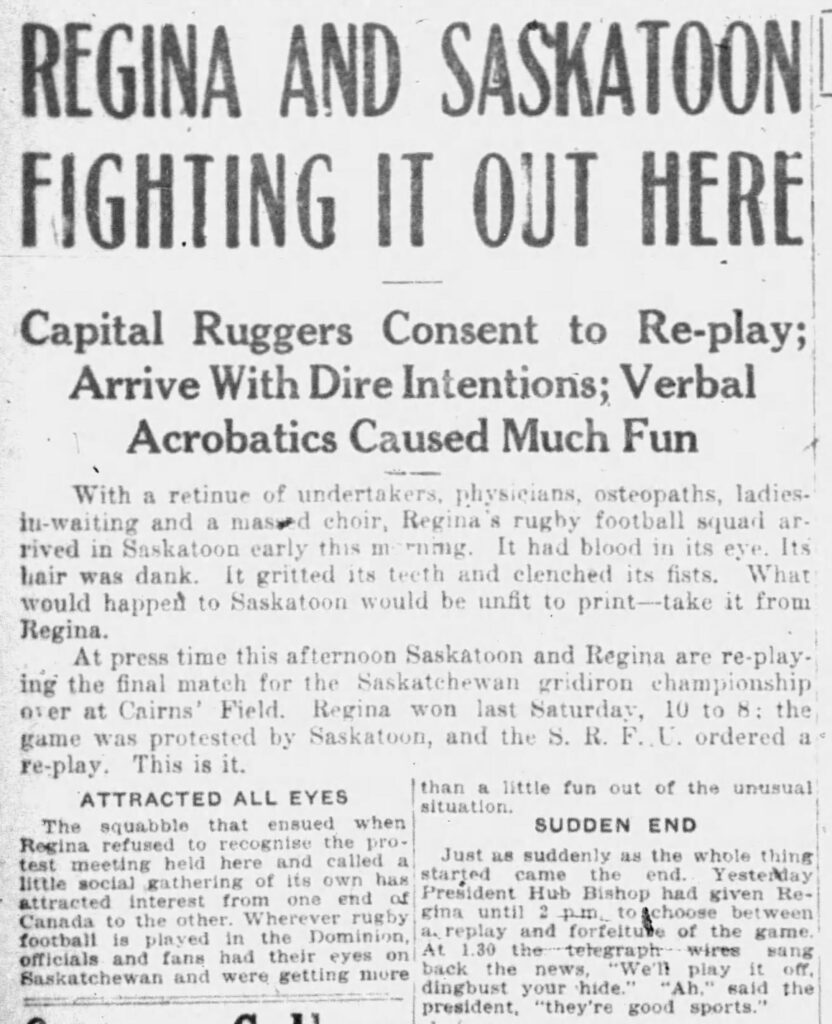
    It’s a familiar tune to many CFL football fans across the country. The chorus ends with the line, “Saskatchewan Roughriders is our name.” So, just when and why did Regina’s football team become the Roughriders? As you will see, it’s… well…a bit complicated.

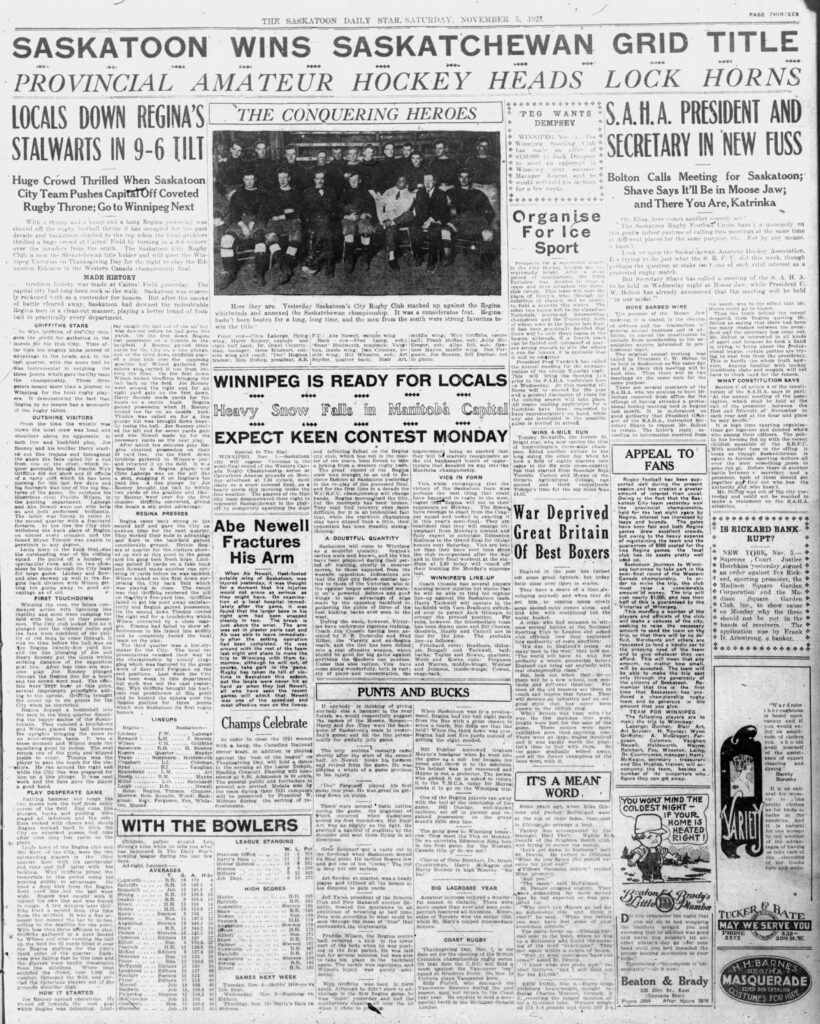
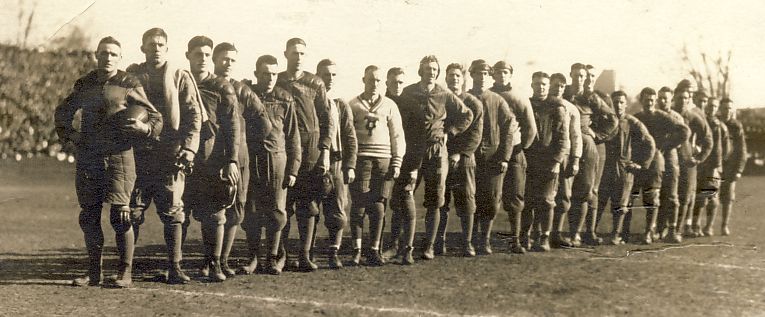
    The Regina Rugby Club was founded in 1910. They played in the Saskatchewan Rugby Football Union along with teams in Saskatoon and Moose Jaw. The SRFU joined the Alberta and Manitoba leagues to form the Western Canada Rugby Football Union in 1911.

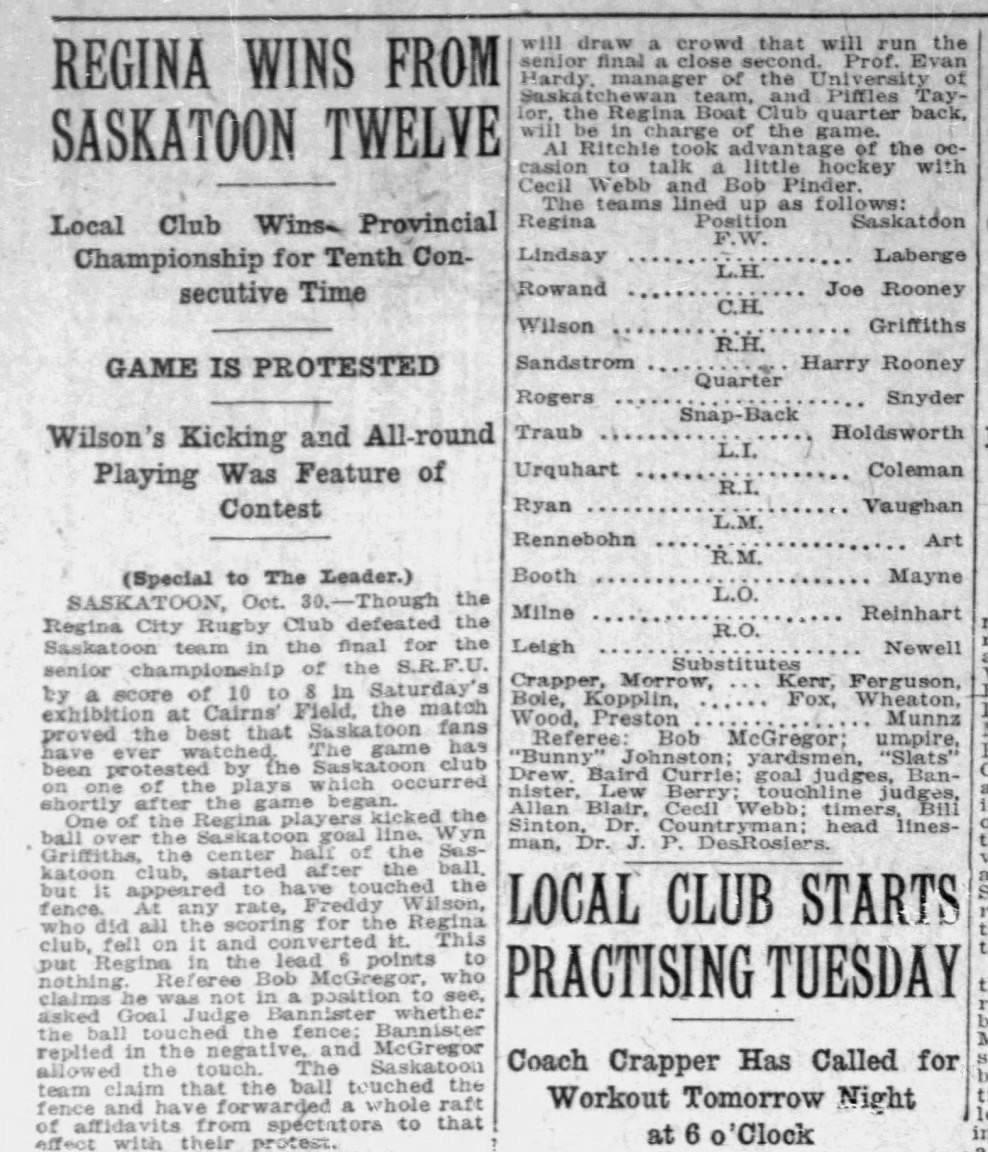
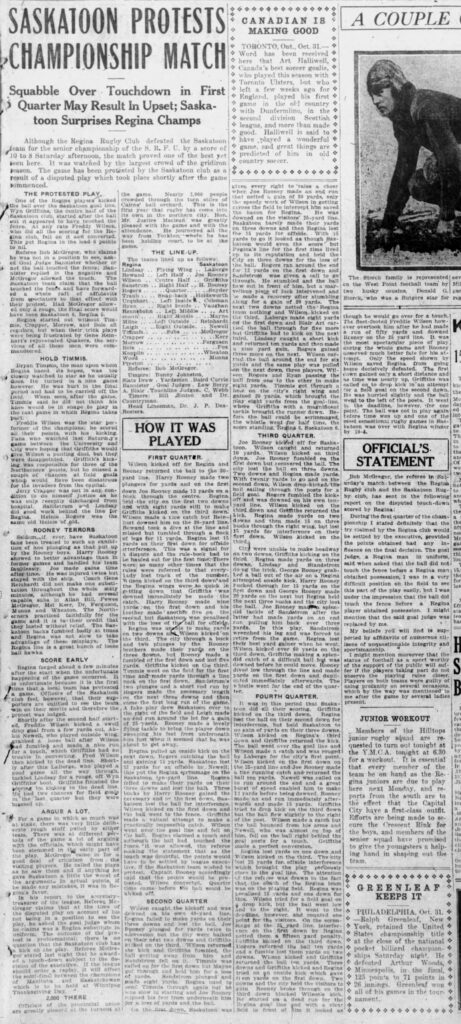
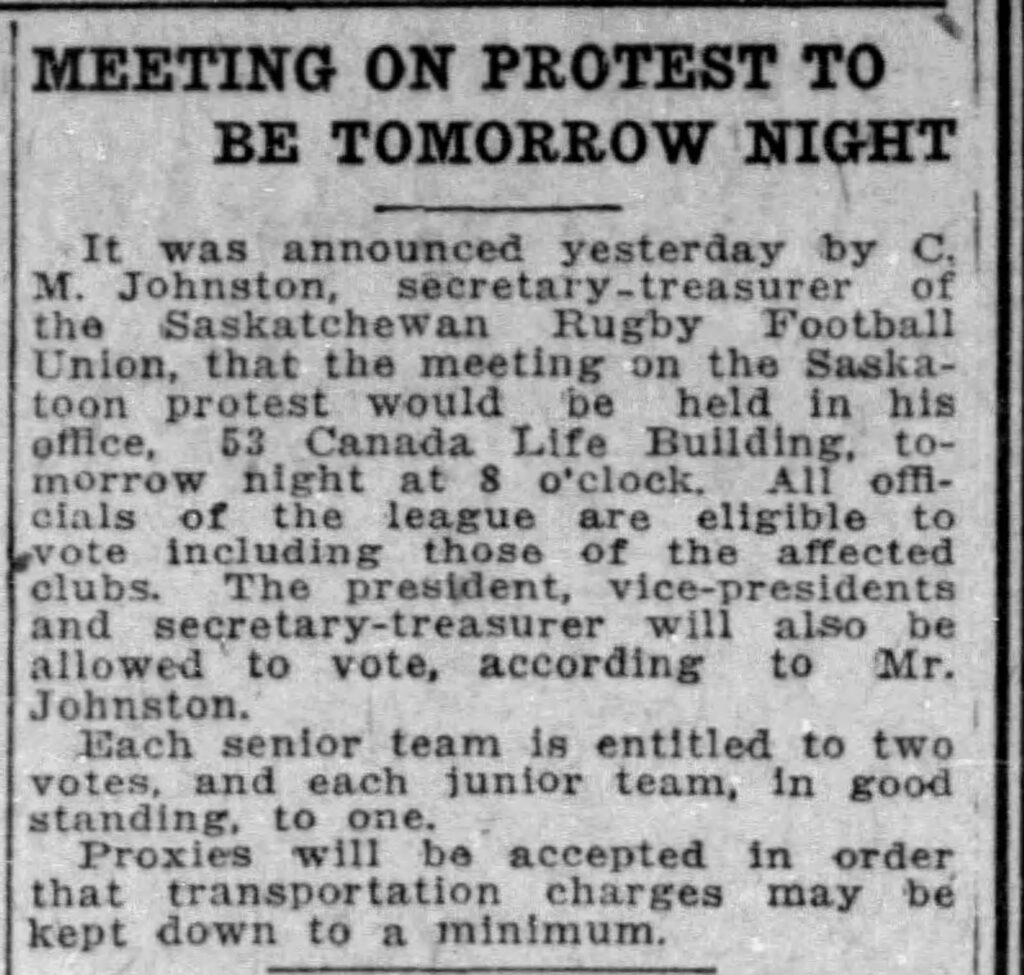
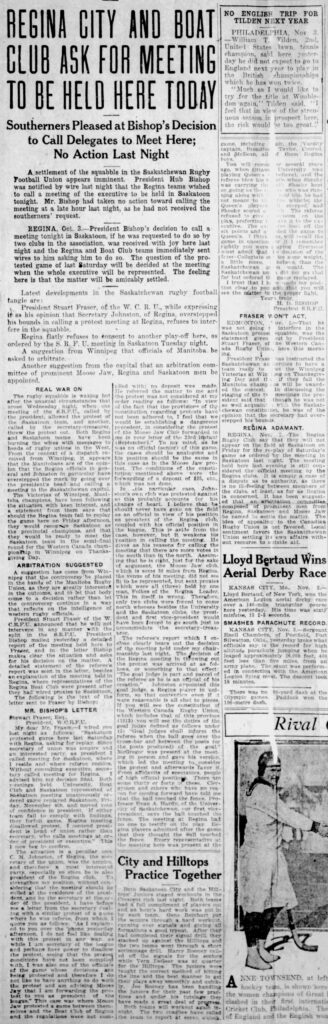
    As early as 1912, the Regina club was being called the Roughriders or Rough Riders. The August 31, 1915 edition of the Regina Leader references the Regina Rough Riders as they kick off the 1915 season.

    An early reference to the Regina Roughriders in the Saskatoon Daily Star in 1912
    An early reference to the Regina Roughriders (The Saskatoon Daily Star, 19 October 1912, page 22)
    Regina Rough Riders Lift Lid of 1915 Season in the Regina Leader
    Source: The Regina Leader, 31 August 1915, page 2 (via newspapers.com)

    The early Regina team had a question of identity not only when it came to the club name but also around deciding which team colours to use. The original colours of the Regina Rugby Club were purple and gold. Then, blue and white. Finally, they settled on red and black. In an alternative universe is there a team called the Saskatchewan RedBlacks?

    After 1915, the “Rough Riders” moniker seemed to fall out of favour. The local newspaper went back to referring to the team simply as the Regina Rugby Club. But, in 1924, according to official team history, the Regina Rugby Club formally became the Regina Roughriders. After the Second World War, the team became the Saskatchewan Roughriders to represent the entire province and eventually changed their team colours to the familiar green and white.

    Regina now Saskatchewan Roughriders article in the Winnipeg Tribune in 1946.
    Source: The Winnipeg Tribune, 3 June 1946, page 14 (via newspapers.com)

    So, what is a “Rough Rider” or “Roughrider” anyway? The most likely answer is that it is a reference to the trainers or “rough riders” who broke wild horses on the Prairies. There is a strong suggestion that the Roughrider name was chosen to pay homage to the “rough riders” of the North-West Mounted Police.

    An alternative theory is that the Roughriders were named after future United States president Teddy Roosevelt’s Rough Rider cavalry regiment in the Spanish-American War of 1898. However, it’s generally accepted that the Roosevelt/Rough Rider connection is associated more with the Ottawa Rough Riders who played in the East.

    Yes, this is where we need to mention that for a long period of time in Canadian football (up to 1996) there were two teams that shared the Rough Riders/Roughriders moniker, each with a distinct yet connected history. This anomoly probably deserves its own blog post at some point.

    There is good article about the “Roughriders” name written by Rob Vanstone posted last year on the Sasktchewan Roughriders’ website. Check it out here: https://www.riderville.com/2024/12/09/rob-vanstone-the-name-game-100-years-of-roughriders/

    So cheer us on through the sun and rain…Saskatchewan Roughriders is our name!


    This is the fourth of a series of posts that will explore the stories behind the names of the existing Canadian Football League teams. See the previous post on the Edmonton Elks.

  • The Edmonton Elks 2.0

    This is the third of a series of posts that will explore the stories behind the names of the existing Canadian Football League teams. See the previous post on the Calgary Stampeders.


    Throughout the long history of Canadian football, there’s been very little controversy surrounding team nicknames. Sure, there was a time in the not too distant past where there was one team called the Rough Riders and another called the Roughriders. But, for the most part the country’s professional football club names have been a bit quirky sounding but certainly not eyebrow raising.

    The one exception to this rule is Edmonton.

    Football has been played in the Alberta capital since 1895. Just as it is today, the early Edmonton team’s main rival was Calgary. The story goes that a Calgary sportswriter took a jab at the Edmonton team by calling them “the Esquimaux” (the French translation of Eskimos) in reference to the rather cold northern Alberta climate. The Edmonton team embraced the insult and used the moniker for a number of years before adopting the Anglicized version of the word in 1910.

    The team was known as the Edmonton Elks in 1922, foreshadowing a name change that would come a century later, and played Queen’s University in the Grey Cup that year.

    The original Eskimo team folded in the 1920s. In 1938, the Edmonton Eskimos were reborn and played in the Western Interprovincial Football Union. However, this team too ceased operations due to the onset of the Second World War.

    It wasn’t until 1949 that the current Edmonton club returned to the WIFU. Once again Edmonton adopted the Eskimos moniker although there were some suggestions that the team be called the Oilers, the name later given to the city’s future professional hockey team.

    For the next seventy years, the Edmonton Eskimos represented Northern Alberta and were considered a model CFL franchise. They won three Grey Cups in a row in the 1950s and won five championships from 1978-1982, an astonishing feat no other team has been able to accomplish.

    However. over time a growing number of people voiced their concern over the use of the name “Eskimos.” Facing mounting public pressure, the team announced that it would be dropping the “Eskimos” name in July 2020.

    A year later, June 1, 2021, the team announced its new yet familiar name: the Edmonton Elks.

  • The First Legal Forward Pass in Canadian Football

    It’s hard to imagine, but up until the 1920s the forward pass was an illegal play in Canadian football. Early Canadian football resembled the game of rugby more than the pass happy version of gridiron football we are accustomed to watching today.

    The forward pass, a staple offensive play in gridiron football, was first introduced in American football in 1906. Illegal and experimental forward passes were seen in the Canadian game over a decade later.

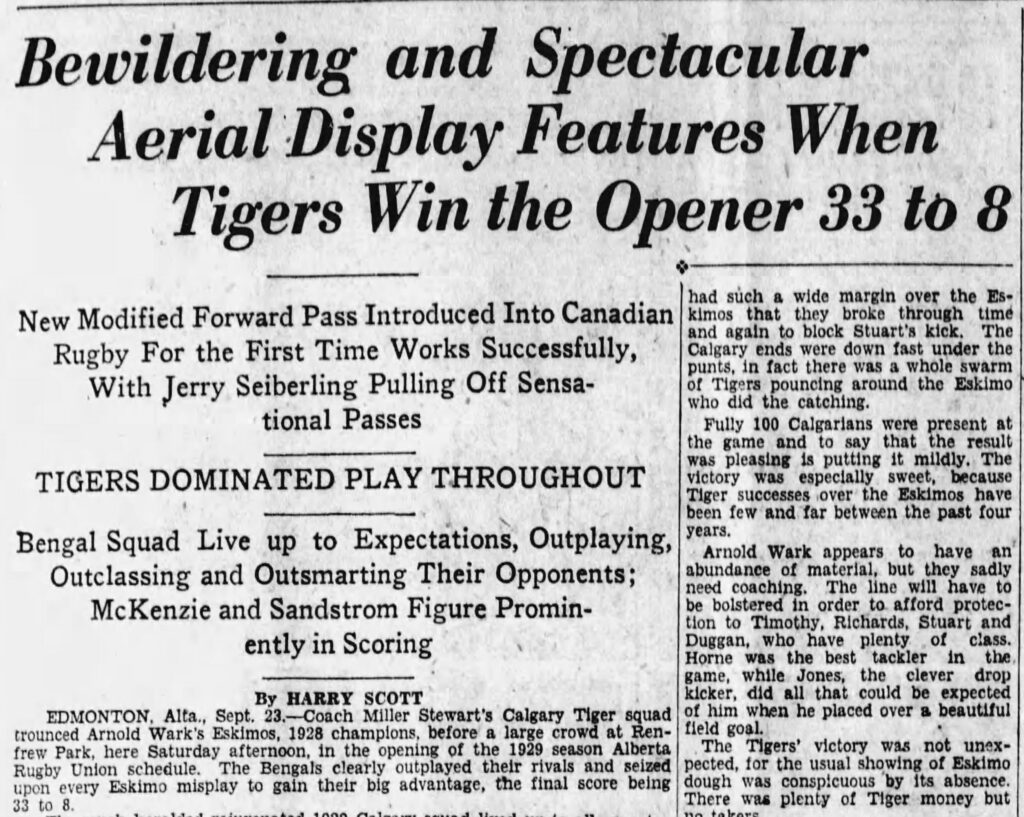
    It wasn’t until 1929 that the Canadian Rugby Union formally allowed the use of the forward pass. Eastern teams didn’t use it right away, however. The first official completed* forward pass in Canadian football was thrown on Saturday, September 21, 1929 in Edmonton in a game between the Edmonton Eskimos and the Calgary Tigers. Calgary player Gerry Seiberling (pictured below) threw the historic pass to Ralph Losie. Calgary won the game 33-8.

    Gerry Seiberling
    Source: The Calgary Herald, 23 September 1929, page 6.

    *The first legal attempted forward pass was actually thrown earlier in the day in a game in Winnipeg. The pass by Norm McLeod’s (St. John’s) was intercepted by Ronnie Gay (Tammany Tigers) in the first quarter of the game.

  • Queen’s Over Elks in 1922 Grey Cup

    On Saturday December 2, 1922, Queen’s University defeated the original Edmonton Elks 13-1 in the 10th Grey Cup game held at Richardson Stadium in Kingston, Ontario. In those days, the road to the national championship was a convoluted affair featuring playoffs between the champions of multiple leagues across the country. The Wikipedia article “1922 in Canadian football” does a good job illustrating the national playoff picture.

    Edmonton was the champion of the Alberta Rugby Football Union and had defeated Regina and Winnipeg to emerge as the western champion. Queen’s was the champion of the Intercollegiate Rugby Football Union, the conference featuring university teams, and emerged as the eastern representative after defeating the Toronto Argonauts.

    Click on the article below to read a detailed write up of the game that appeared in the Edmonton Bulletin the following Monday.