Tag: 1940s in Canadian Football

  • Alouette, gentille alouette, Alouette, je te plumerai.

    Concordes. Bulldogs. Hornets. Winged Wheelers. Indians. These are some of the names that have been used by Montreal’s football teams over the years. The Montreal Football Club was founded in 1872 and were a member of the Quebec Rugby Football Union. In 1907, Montreal joined Ottawa, Toronto, and Hamilton in forming the Interprovincial Rugby Football Union (IRFU), the precursor to the CFL’s East Division.

    The original Montreal Alouettes logo
    The original Montreal Alouettes logo
    (via sportslogos.net)

    When the IRFU (also known as the Big Four) returned to play in 1945 following the Second World War, Montreal’s team was called the Hornets. Unfortunately, for Montreal football fans, the Hornets finished in last place. The following year, Montreal’s IRFU entry was reorganized, and the Montreal Alouettes were born.

    “Montreal’s Football Entry Named Alouettes.” Ottawa Journal, 21 May 1946, p. 18.
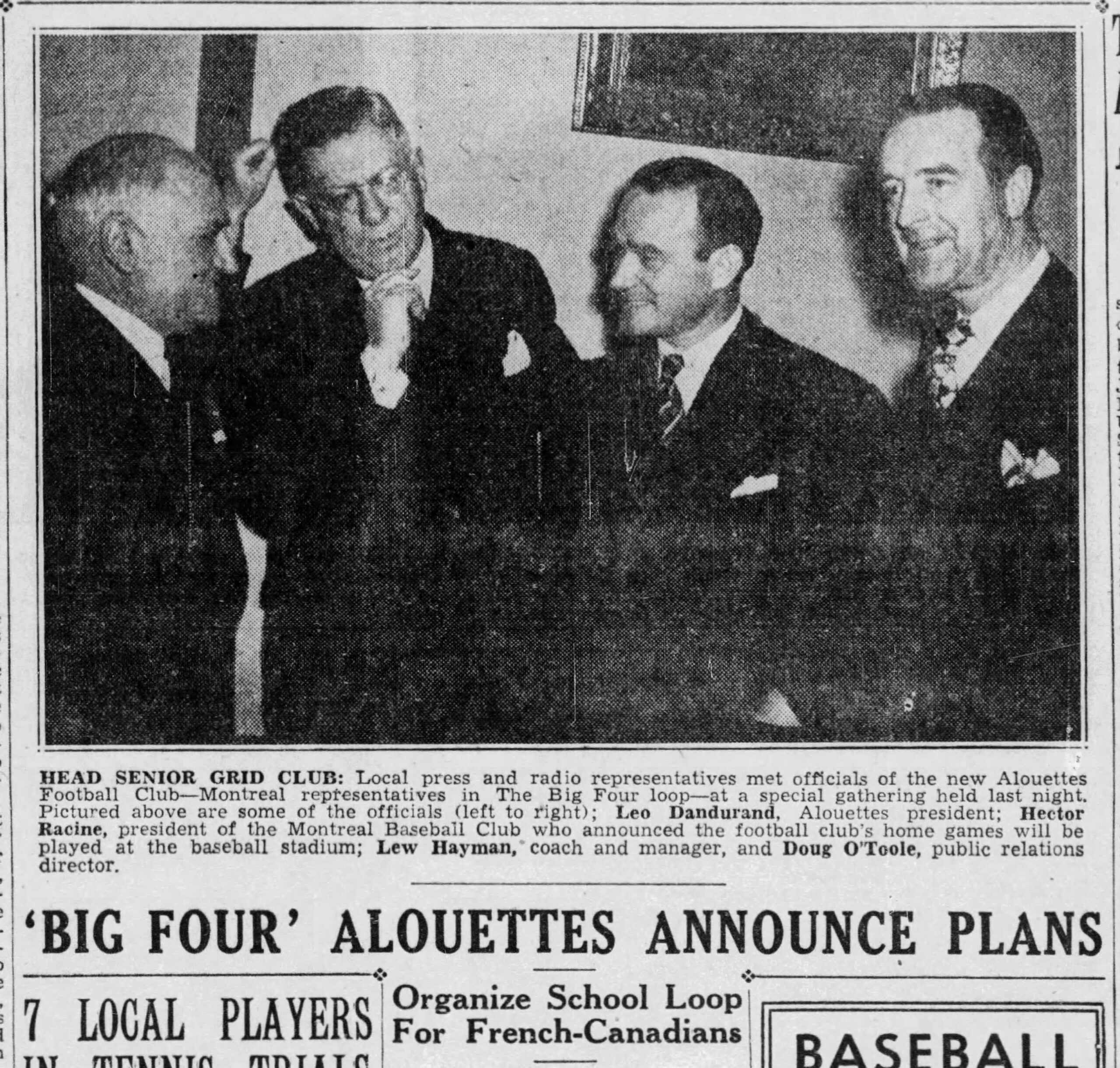
    Officials from the new Montreal Alouettes (Montreal Gazette, 21 May 1946, p. 16.)

    The Montreal Alouettes were founded by Leo Dandurand and Lew Hayman among others. Hayman had led the Toronto Argonauts to several Grey Cups, bringing instant credibility back to Montreal football.

    McGowan, Lloyd. “Take It From Hayman Grid Team a Lew-Lu.” Montreal Star, 21 May 1946, p. 24.

    According to the Alouettes’ website, Messrs. Dandurand and Hayman decided to name the new football club the Alouettes after hearing men singing the Quebecois children’s song Alouette. Alouette is the French word for lark. As in the bird. Now, any Canadian school-aged child can easily recognise the popular song. It is often used to teach English-speaking students the names of various body parts in French and in my humble opinion is one of the catchiest songs around.

    Check out the video below produced by the National Film Board of Canada in 1944. It features the Alouette song along with an animated paper cutout presentation by Norman McLaren and René Jodoin.

    There is a strong connection to the 425 Squadron of the Royal Canadian Air Force. This French-Canadian unit of the RCAF was active during the Second World War and was nicknamed the “Alouette Squadron.” Their motto? Je te plumerai, of course. It’s not surprising that Montreal adopted the Alouette moniker in honour of the Alouette Squadron following the conclusion of the war.

    The Als – the oft-used abbreviation – represented professional football in Montreal through to the early 1980s. Then, after an ownership controversy in 1982 the team folded only to be quickly replaced by a new franchise called the Montreal Concordes. After playing as the Concordes for four seasons, the team readopted the Alouettes name for 1986. Sadly, the renaissance was short lived as the Alouettes ceased operations on the eve of the 1987 CFL season.

    The Montreal Stallions

    In the early 1990s, the Canadian Football League added several teams in the United States as part of an American expansion plan. While most of the expansion teams struggled on and off the field, one major exception was the Baltimore Stallions.

    The Stallions were a dominant force and played in the Grey Cup in both years of their brief existence, winning the championship in 1995. The team also enjoyed great support from the fans in Baltimore and easily led the CFL in attendance. But in 1996 the National Football League announced it would return to Baltimore, causing the Stallions to look for new pastures.

    Ultimately, that new home was to be Montreal. In February 1996, the Stallions left Maryland for Quebec. While the team was initially referred to as the Montreal Stallions, it was generally assumed that the team would be rebranded. And it was obvious to all what that “new” name should be. Thus, after a nine-year absence in the CFL the Montreal Alouettes were back in business.

    “Montreal Alouettes back in business.” Hamilton Spectator, 29 February 1996, p. 29.

    This is the ninth of a series of posts that will explore the stories behind the names of the existing Canadian Football League teams. See the previous post on the Ottawa Redblacks.

  • Saskatchewan Roughriders is Our Name

    Green is the Colour
    Football is the Game
    We’re all together and Winning is our aim
    So Cheer us on through the sun and rain
    Saskatchewan Roughriders is our name

    It’s a familiar tune to many CFL football fans across the country. The chorus ends with the line, “Saskatchewan Roughriders is our name.” So, just when and why did Regina’s football team become the Roughriders? As you will see, it’s… well…a bit complicated.

    The Regina Rugby Club was founded in 1910. They played in the Saskatchewan Rugby Football Union along with teams in Saskatoon and Moose Jaw. The SRFU joined the Alberta and Manitoba leagues to form the Western Canada Rugby Football Union in 1911.

    As early as 1912, the Regina club was being called the Roughriders or Rough Riders. The August 31, 1915 edition of the Regina Leader references the Regina Rough Riders as they kick off the 1915 season.

    An early reference to the Regina Roughriders in the Saskatoon Daily Star in 1912
    An early reference to the Regina Roughriders (The Saskatoon Daily Star, 19 October 1912, page 22)
    Regina Rough Riders Lift Lid of 1915 Season in the Regina Leader
    Source: The Regina Leader, 31 August 1915, page 2 (via newspapers.com)

    The early Regina team had a question of identity not only when it came to the club name but also around deciding which team colours to use. The original colours of the Regina Rugby Club were purple and gold. Then, blue and white. Finally, they settled on red and black. In an alternative universe is there a team called the Saskatchewan RedBlacks?

    After 1915, the “Rough Riders” moniker seemed to fall out of favour. The local newspaper went back to referring to the team simply as the Regina Rugby Club. But, in 1924, according to official team history, the Regina Rugby Club formally became the Regina Roughriders. After the Second World War, the team became the Saskatchewan Roughriders to represent the entire province and eventually changed their team colours to the familiar green and white.

    Regina now Saskatchewan Roughriders article in the Winnipeg Tribune in 1946.
    Source: The Winnipeg Tribune, 3 June 1946, page 14 (via newspapers.com)

    So, what is a “Rough Rider” or “Roughrider” anyway? The most likely answer is that it is a reference to the trainers or “rough riders” who broke wild horses on the Prairies. There is a strong suggestion that the Roughrider name was chosen to pay homage to the “rough riders” of the North-West Mounted Police.

    An alternative theory is that the Roughriders were named after future United States president Teddy Roosevelt’s Rough Rider cavalry regiment in the Spanish-American War of 1898. However, it’s generally accepted that the Roosevelt/Rough Rider connection is associated more with the Ottawa Rough Riders who played in the East.

    Yes, this is where we need to mention that for a long period of time in Canadian football (up to 1996) there were two teams that shared the Rough Riders/Roughriders moniker, each with a distinct yet connected history. This anomoly probably deserves its own blog post at some point.

    There is good article about the “Roughriders” name written by Rob Vanstone posted last year on the Sasktchewan Roughriders’ website. Check it out here: https://www.riderville.com/2024/12/09/rob-vanstone-the-name-game-100-years-of-roughriders/

    So cheer us on through the sun and rain…Saskatchewan Roughriders is our name!


    This is the fourth of a series of posts that will explore the stories behind the names of the existing Canadian Football League teams. See the previous post on the Edmonton Elks.

  • The Edmonton Elks 2.0

    This is the third of a series of posts that will explore the stories behind the names of the existing Canadian Football League teams. See the previous post on the Calgary Stampeders.


    Throughout the long history of Canadian football, there’s been very little controversy surrounding team nicknames. Sure, there was a time in the not too distant past where there was one team called the Rough Riders and another called the Roughriders. But, for the most part the country’s professional football club names have been a bit quirky sounding but certainly not eyebrow raising.

    The one exception to this rule is Edmonton.

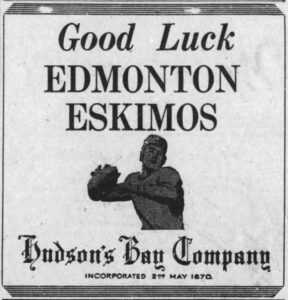
    Football has been played in the Alberta capital since 1895. Just as it is today, the early Edmonton team’s main rival was Calgary. The story goes that a Calgary sportswriter took a jab at the Edmonton team by calling them “the Esquimaux” (the French translation of Eskimos) in reference to the rather cold northern Alberta climate. The Edmonton team embraced the insult and used the moniker for a number of years before adopting the Anglicized version of the word in 1910.

    The team was known as the Edmonton Elks in 1922, foreshadowing a name change that would come a century later, and played Queen’s University in the Grey Cup that year.

    The original Eskimo team folded in the 1920s. In 1938, the Edmonton Eskimos were reborn and played in the Western Interprovincial Football Union. However, this team too ceased operations due to the onset of the Second World War.

    It wasn’t until 1949 that the current Edmonton club returned to the WIFU. Once again Edmonton adopted the Eskimos moniker although there were some suggestions that the team be called the Oilers, the name later given to the city’s future professional hockey team.

    For the next seventy years, the Edmonton Eskimos represented Northern Alberta and were considered a model CFL franchise. They won three Grey Cups in a row in the 1950s and won five championships from 1978-1982, an astonishing feat no other team has been able to accomplish.

    However. over time a growing number of people voiced their concern over the use of the name “Eskimos.” Facing mounting public pressure, the team announced that it would be dropping the “Eskimos” name in July 2020.

    A year later, June 1, 2021, the team announced its new yet familiar name: the Edmonton Elks.

  • “Stampeders” New Football Name

    This is the second of a series of posts that will explore the stories behind the names of the existing Canadian Football League teams. Check out the previous post on the BC Lions.


    Conventional wisdom says that the Calgary Stampeders are named after the world famous Calgary Stampede rodeo. The Stampeders moniker has been used by numerous Calgary-based teams over the years in football, hockey, and baseball.

    In the first half of the 20th century, Calgary’s senior football teams included the Tigers, Canucks, Fiftieth Battalion, Altomahs, and Bronks.

    When the Second World War ended, senior football returned to Calgary after a five-year absence. The new club was founded on September 27, 1945 as a cooperative.

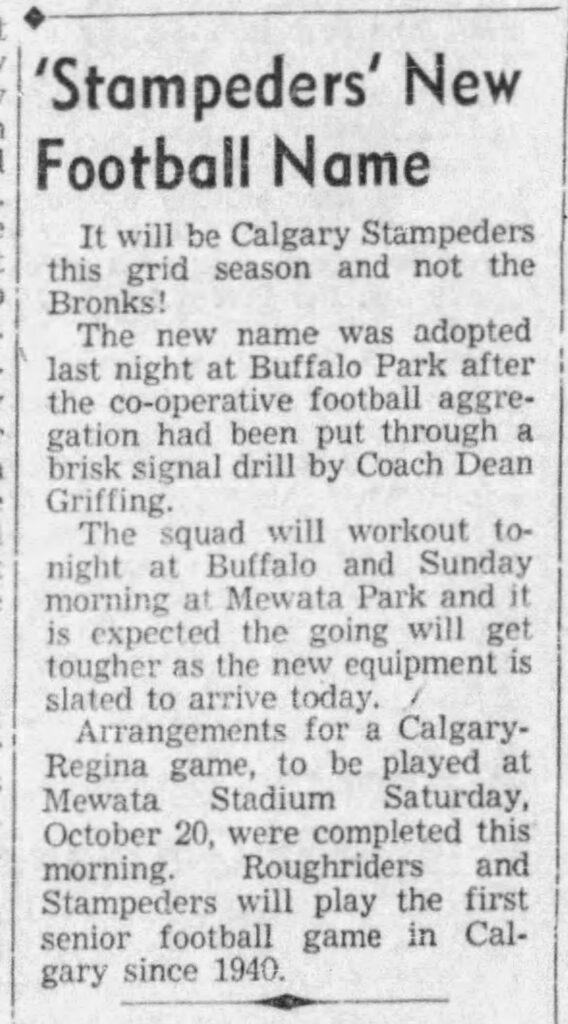
    Calgary joined Regina and Winnipeg in a condensed 1945 WIFU season. On October 11, the Calgary Herald reported that the new team would be called the “Stampeders” instead of the Bronks, Calgary’s former WIFU entry.

    One account indicates that the team was called the Stampeders to help advertise “Stampede Beer” produced by the Calgary Brewing and Malting Company (Source: A history of Football in Calgary, Canadian Football Research Society). As a new cooperative money was tight so any source of revenue would be welcomed.

    The newly christened Calgary Stampeders played their first game on October 20, 1945 at Mewata Stadium against the visiting Regina Roughriders.