Tag: 1960s in Canadian Football

  • The Vanier Cup Becomes Canada’s University Football Championship

    Universities in Canada have played football since…well…since football has been played in Canada. Teams from the University of Toronto, McGill University, and Queen’s University played what would become Canadian football long before the CFL and professional football ever took hold. In fact, university teams even competed for the Grey Cup in the early years.

    In the modern era of Canadian football but before 1965, universities across Canada would compete for regional championships such as the Yates Cup in Ontario. There was no national football championship for university or collegiate football. That changed in 1965.

    In 1965, a new national university football championship was established called the Canadian College Bowl. It’s important to remember that up until the 1960s the terms “university” and “college” were often used interchangeably. There were no community or vocational colleges (post-secondary non-degree awarding institutions) like what we have today. So, it was common to refer to university football as college football.

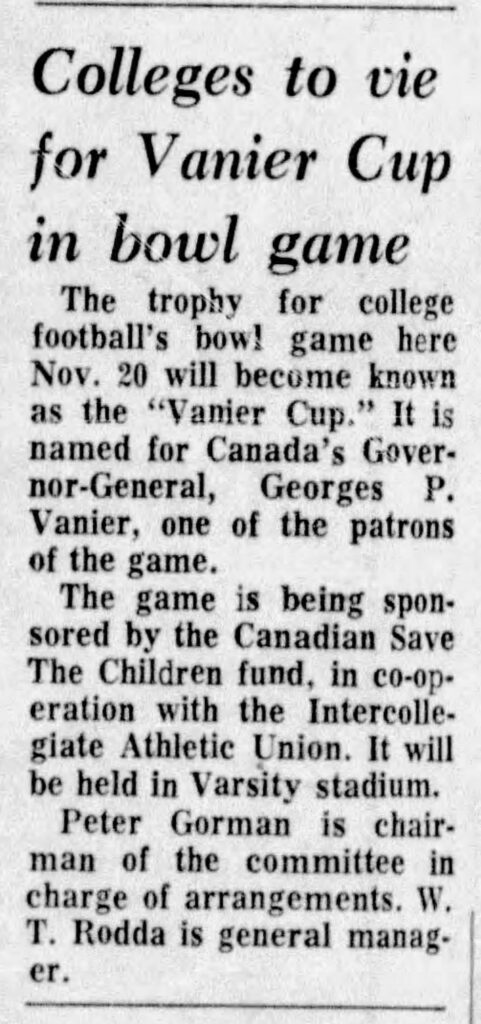
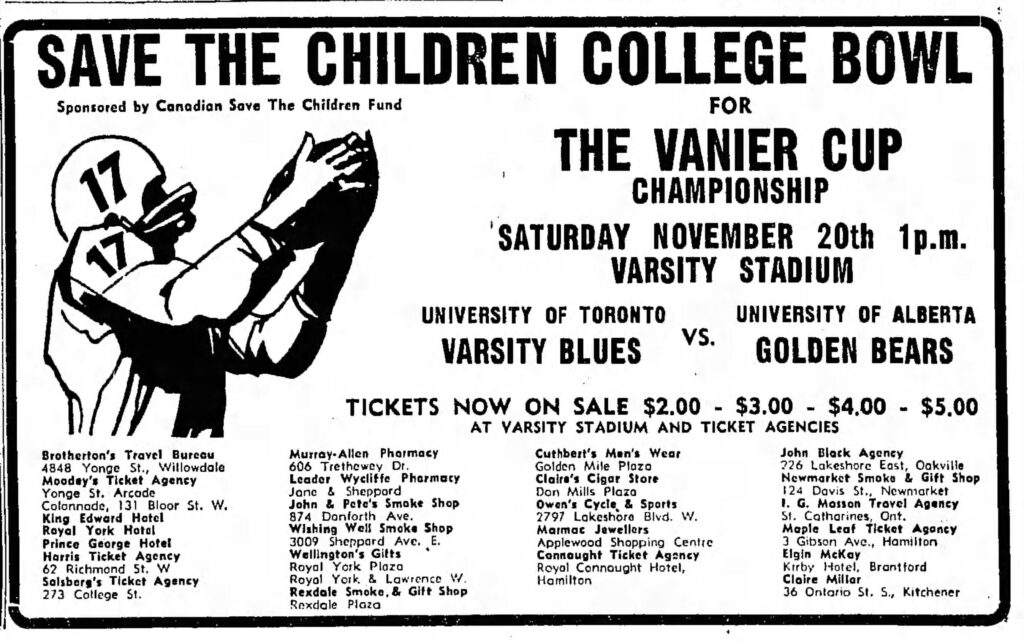
    The initial Canadian College Bowl was sponsored by the Save the Children Fund. In fact, the initial college bowl was partly set up to help raise money for the charity. A team of panellists selected the two teams – the University of Toronto Varsity Blues and the University of Alberta Golden Bears – that would compete for the first “national championship.” It wasn’t until 1967 that a national playoff system was held to determine the Canadian College Bowl contestants.

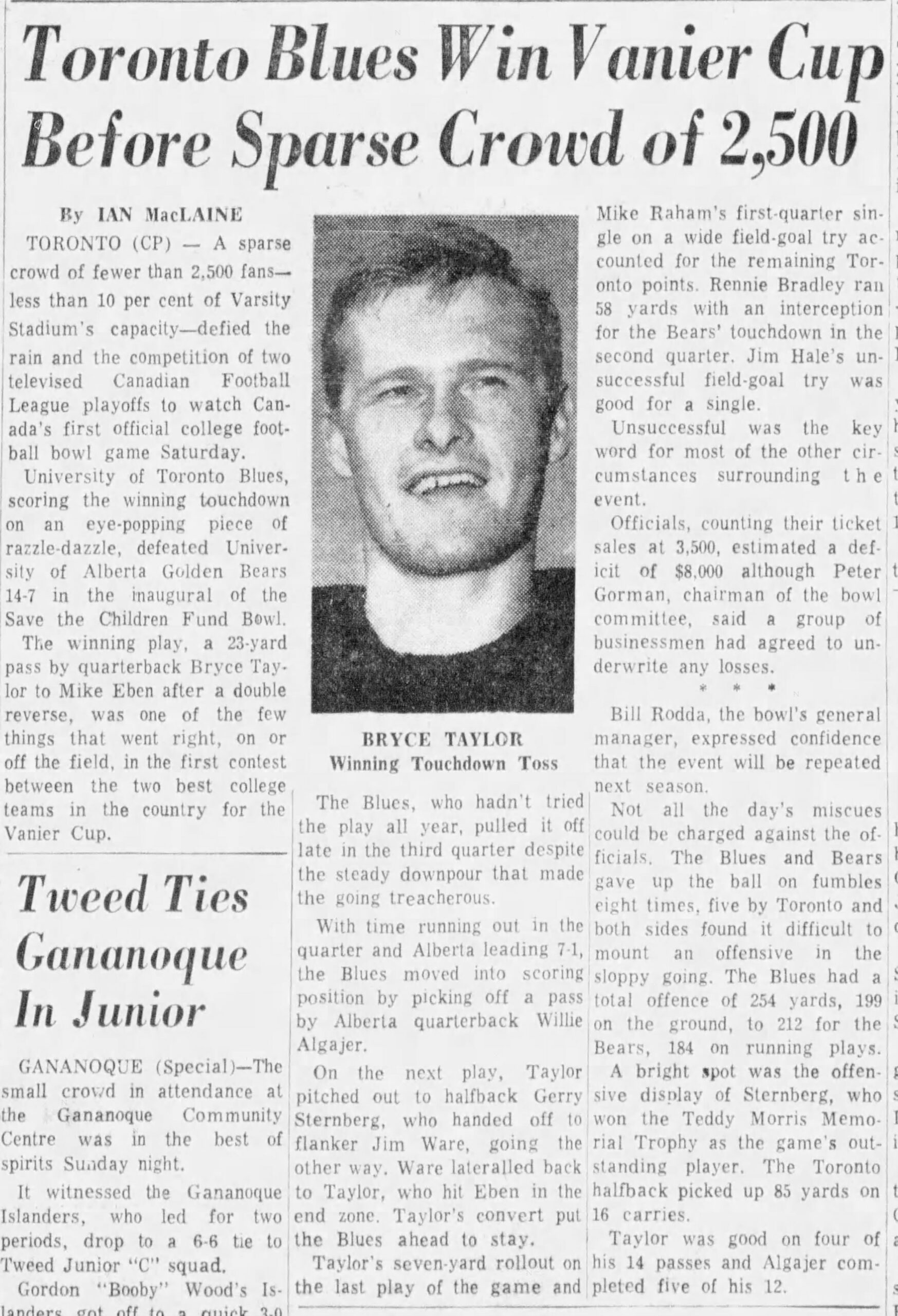
    Toronto Blues Win Vanier Cup 1965 CP Article
    Coverage of the first Canadian College Bowl in the Toronto Star

    On November 20, 1965, the Varsity Blues defeated the Golden Bears by a score of 14-7 in dismal conditions at Toronto’s Varsity Stadium. Less than 2500 fans braved the rain to come out to watch the inaugural championship. Not only did the weather keep the fans away, but the game was also largely overshadowed by the CFL playoffs that were being played and televised on the same day.

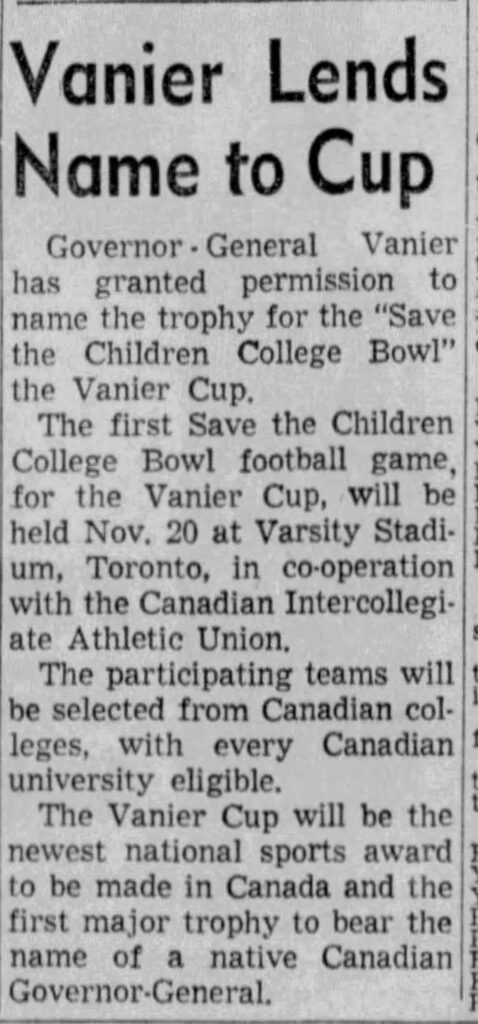
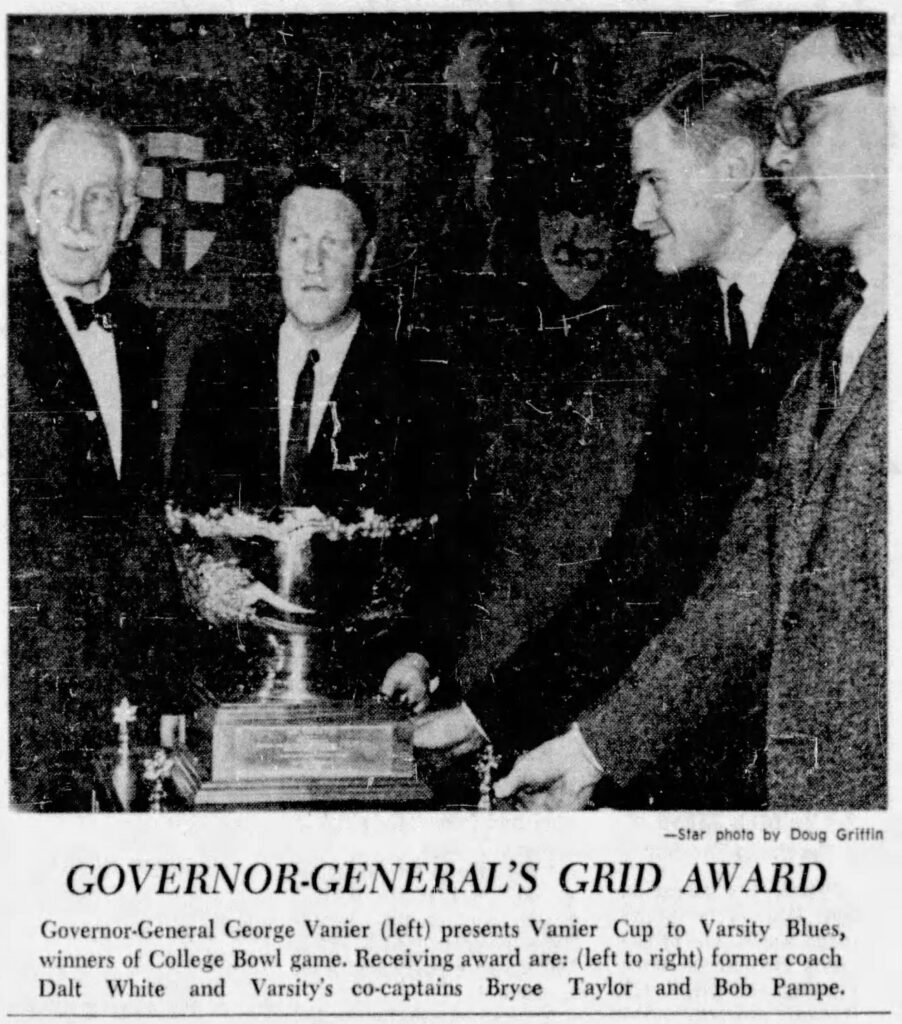
    Governor General Georges Vanier, an avid sports fan, lent his name to a trophy to be awarded to the winner of the Canadian College Bowl. Thus, the Vanier Cup was born. His Excellency himself presented the new trophy to the U of T at a banquet the following year.

    The Canadian College Bowl began to gain some traction in the years that followed. Like the pros, university teams now had a national championship to play for. Finally, in 1982, the name of the game was formally changed from the Canadian College Bowl to the Vanier Cup.

    Sources:
    Globe and Mail (17 November 1965)
    Kingston Whig Standard (22 November 1965)
    Toronto Star (2 September 1965)
    Toronto Star (16 March 1966)
    Vancouver Sun (2 September 1965)

  • Calgary Companies Celebrate the Opening of McMahon Stadium

    Last week’s post was about the construction of Calgary’s McMahon Stadium in just 103 days. The stadium replaced Mewata Stadium as the new home of the Calgary Stampeders.

    The first game played at McMahon Stadium featured the Stampeders hosting the Winnipeg Blue Bombers on August 15, 1960. On the day of the game, many Calgary-based companies took out ads in the Calgary Albertan and Calgary Herald newspapers to celebrate the opening of the new stadium. A lot of these firms were directly involved in the stadium’s construction.

    Below is an assortment of the advertisements. Do you see any companies you recognize?

    McMahon Stadium Ad 1960
  • Calgary’s McMahon Stadium Built in 103 Days

    McMahon Stadium turned 65 this month. It is one of just a few of the “old” CFL stadiums still in use. Most CFL teams are playing in either relatively new or refurbished facilities. But back in 1960, the new McMahon Stadium was hailed as one of the finest football stadiums in the country.

    Talk of building a new home for the Calgary Stampeders had been around for years. After some false starts and delays things finally got moving on March 15, 1960 when Stampeders President George McMahon unveiled plans for a new stadium to be constructed on land reserved for a future university campus.

    Construction began the following month. Most of the concrete and other materials used was pre-fabricated offsite, and with a crew of up to 200 a day working the site, it meant construction could be expedited. Plus, the weather cooperated greatly so there were no delays on that front. With solid project management, an efficient labour team, and a little bit of luck, the stadium was completed in just 103 days.

    Article about the McMahon Brothers of Calgary
    Article in the Calgary Albertan about George and Frank McMahon

    The total cost of McMahon Stadium came in at just over a million dollars. About a third of that was covered by George McMahon and his brother Frank. The McMahons were oil businessmen who were among the biggest boosters for the city of Calgary. They were respected and connected. It’s doubtful the stadium would’ve gotten built without their support. Not only did they put their own money into the project, but they were also the ones who arranged for its financing.

    The initial capacity of McMahon Stadium was about 20,000. But it was built with expansion in mind. Over the years more seats and corporate amenities were added. At the time it was opened it was suggested that capacity could one day reach as high as 70,000.
    The Stampeders opened McMahon Stadium on August 15, 1960 against the Winnipeg Blue Bombers. Unfortunately for Stampeders fans, the home side came up short losing 38-23.

    Article in the Calgary Herald comparing McMahon Stadium to other CFL stadiums.

    McMahon Stadium hosted the 1975 Grey Cup, the first to be played in Calgary on November 23rd of that year. Since then, the Grey Cup has been played there four more times and will once again host the championship in 2026.

    Arguably the biggest event held at McMahon Stadium was the Opening and Closing Ceremonies of the 1988 Winter Olympics.


    Burns and Dutton was the main contractor hired to construct McMahon Stadium. The firm was led by Mervin “Red” Dutton, who was a former president of the Stampeders. He bet George McMahon $1500 that the stadium wouldn’t be able to be completed in time for the Stampeders’ home opener. Well, his crew and subcontractors’ hard work cost him $1500. The stadium was completed on time. He lost the bet and ended up paying McMahon the $1500 in one-dollar bills.


    I sometimes wonder why the McMahon Stadium model can’t be replicated when it comes to construction and financing. Today’s stadiums easily cost north of $200 million (and that’s on the cheap side) and take years to build. But there’s something to be said about the so-called McMahon way. Just get building it. Get the barebones up and going and add the capacity and amenities over time. It may not be ideal, but at least you’ll have a stadium to play in. I’m talking to you, Halifax – or anywhere else for that matter.


    When McMahon Stadium opened, numerous companies (many of whom participated in its construction) ran ads in the Calgary newspapers praising the new facility. I’ll feature some of these in a subsequent post.


    Sources:

    The Calgary Albertan (August 15, 1960)

    The Calgary Herald (August 10 and 16, 1960)

    Fediverse Reactions
  • CFL Media Guides in the 1960s

    For eons, the Canadian Football League published Media Guides or Fact Books for its teams. These little handbooks were meant to familiarize local journalists with the players and coaching staff of the team they were covering. They included biographies, statistics, records, and team histories.

    Team media guides were also a great little souvenir for the savvy football fan. I have several in my own collection I like to peruse every now and then.

    The CFL still produces them at least in electronic form. At least for some teams. I’m not sure if the league still offers print copies, though. It looks like they’ve met the same fate as game day programs and printed tickets, which is unfortunate.

    Anyway, I thought what better way to spend the dog days of summer than by taking a look at some of these CFL media guides from the 1960s (or the late 1950s in a couple of cases). It was an exciting decade for the CFL and Canadian football.

    Here are some photos of the media guides (front and back covers) for each CFL team from that era:

    The above photos are courtesy of the good folks at the Canadian Football Research Society.

    Fediverse Reactions
  • Tiger-Cat Defence Strangles Roughriders

    “Tiger-Cat defence strangles Roughriders” read the headline in The Ottawa Citizen on Monday December 4, 1967. That pretty much sums up Hamilton’s 24-1 win over Saskatchewan in the 1967 Grey Cup game played a couple days earlier.

    1967 Grey Cup action (Ottawa Citizen)
    Source: The Ottawa Citizen, 4 December 1967, page 23.

    1967 – being Canada’s Centennial and all – featured the Grey Cup being played at Lansdowne Park in Ottawa. Tiger-Cats quarterback Joe Zuger (who recently passed away at the age of 84) scored a running touchdown, passed for a touched down, and kicked three singles, leading him to be named Grey Cup MVP.

    The Hamilton Tiger-Cats used this commemorative logo in 1967 to celebrate Canada’s Centennial. (courtesy SportsLogos.Net)