Tag: 1970s in Canadian Football

  • Marv Levy Named CFL’s 1974 Coach of the Year

    Recently, Marv Levy – a legend in both Canadian and American football – celebrated his 100th birthday. He was born on August 3, 1925 in Chicago, Illinois, USA.

    After several college and professional coaching gigs in the United States, Marv Levy headed north in 1973 to become the new head coach of the CFL’s Montreal Alouettes.

    In 1974, his second season at the helm in Montreal, Levy guided the Alouettes to a 9-5-2 regular season record to finish first in the Eastern Division. After knocking off Ottawa in the Eastern Final, Levy’s Alouettes defeated Edmonton 20-7 to win the Grey Cup.

    Levy’s quick success in the CFL earned him the 1974 Coach of the Year. He was presented with the Annis Stukus Trophy (the trophy awarded to the CFL’s top coach) by Mr. Annis Stukus himself on January 15, 1975 at league meetings in Edmonton.

    Article in the Edmonton Journal about Marv Levy being named the CFL's Coach of the Year in 1974.
    Annis Stukus presenting the Coach of Year trophy to Marv Levy as well as pictures of the CFL’s other eight head coaches.
    (Jones, Terry. “No surprises, Levy coach of the year.” The Edmonton Journal, 16 January 1975, p. 53.)

    Montreal and Edmonton met again in the Grey Cup in 1975. This time Edmonton came out on top. But in the 1977 Grey Cup, the Alouettes crushed Edmonton 41-6 on an icy turf at the Olympic Stadium.

    In his five years as head coach of the Montreal Alouettes, Marv Levy led the team to three Grey Cups, winning two of them. Not bad.

    In 1978, he returned to the United States to coach in the National Football League. His most successful run in the NFL was with the Buffalo Bills. Unfortunately, Levy’s regular season success in Buffalo didn’t translate into championships. His Bills failed to win a Super Bowl despite four straight appearances from 1990 to 1993.

    Marv Levy was inducted into the Pro Football Hall of Fame in 2001 and into the Canadian Football Hall of Fame in 2021. He is one of only two head coaches to have coached in both a Grey Cup and a Super Bowl, the other being Bud Grant.

    Here’s to Marv Levy, the Canadian Football League’s Coach of the Year in 1974, who can now add Centenarian to his long list of titles and accomplishments.

    Picture of Marv Levy published in the Montreal Gazette.
    A picture of Alouettes head coach Marv Levy published in the Montreal Gazette after winning the CFL’s 1974 coach of the year award.
  • Montreal Crushes Ottawa in Olympic Stadium Opener Before Record Crowd

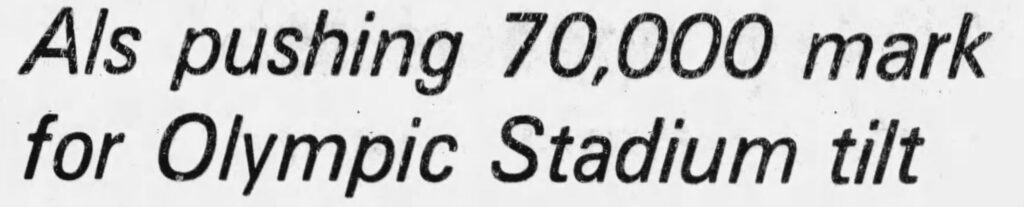
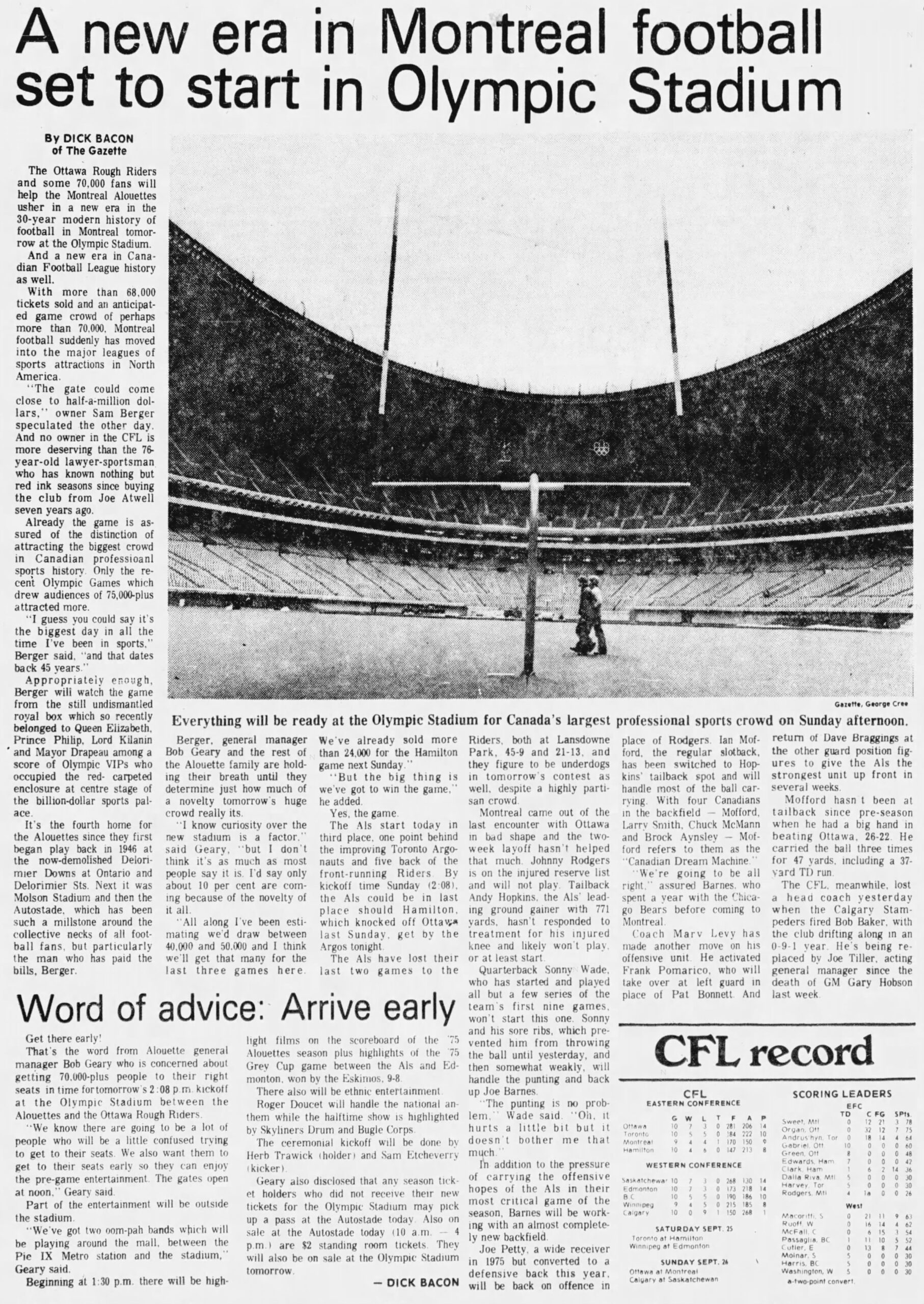
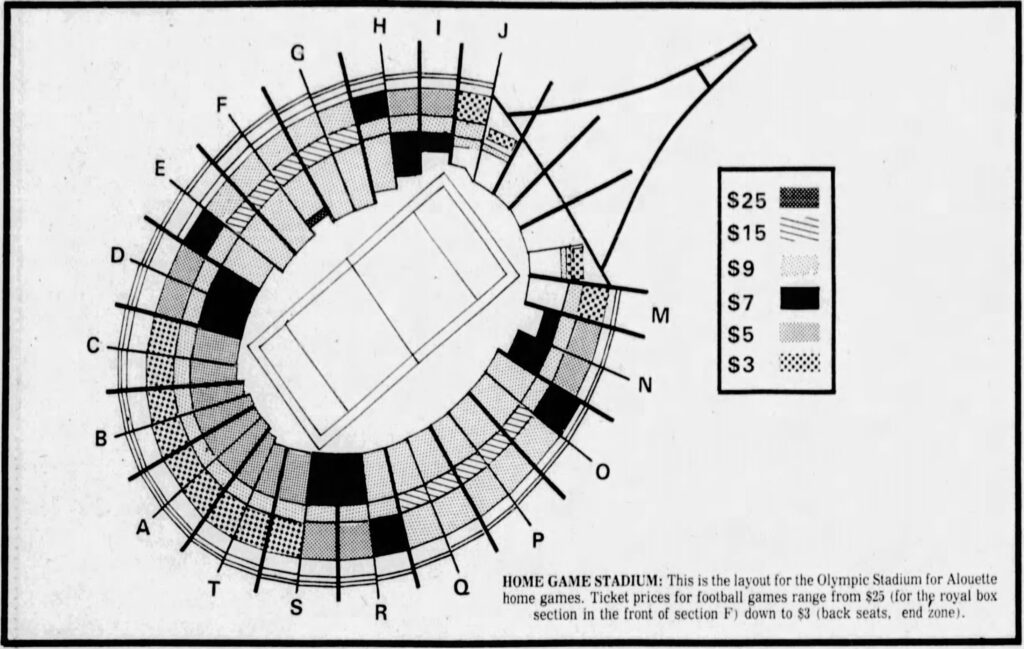
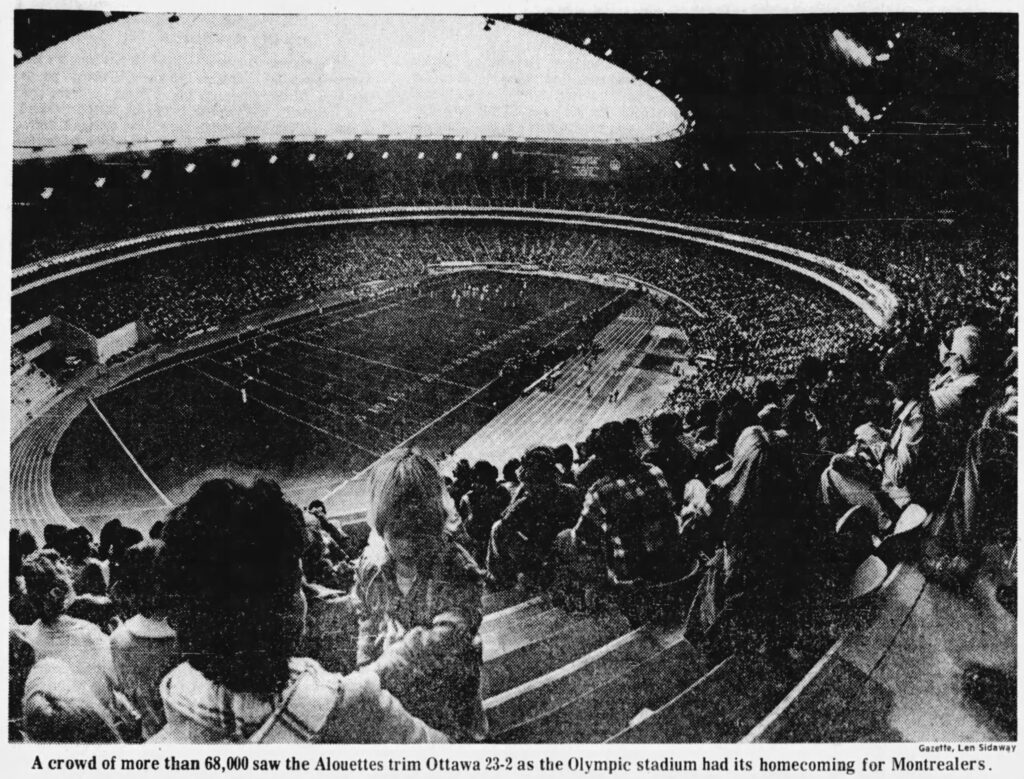
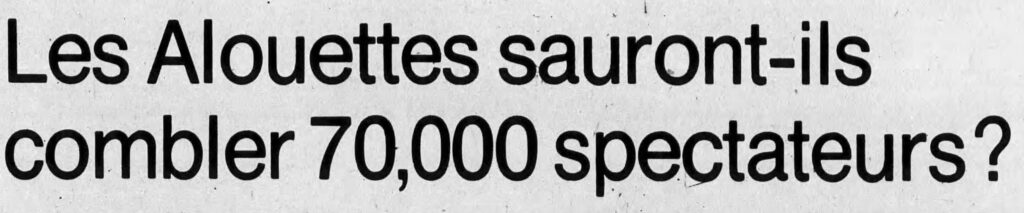
    Midway through the 1976 CFL season, the Montreal Alouettes played their first game in their new home. After leaving behind the Autostade (that stadium likely warrants its own article), the Als hosted the Ottawa Rough Riders at the Olympic Stadium, the largest stadium ever built in Canada.

    A new era in Montreal football set to start in Olympic Stadium
    Bacon, Dick. “A new era in Montreal football set to start in Olympic Stadium.” Montreal Gazette,
    25 September 1976, p. 11.

    Post-Olympic fever was still gripping Montreal in the weeks leading up to the game. The Alouettes were expecting a record crowd to come see a .500 home side take on the East Division leaders from Ottawa. No doubt, many just wanted to catch a glimpse of the so-called billion-dollar sports palace. Without question, Olympic Stadium – affectionately known as the Big O or disparagingly known as the Big Owe – with its sheer size and modern-day amenities put other CFL stadiums to shame. In 1976, Edmonton’s Commonwealth Stadium was still a couple years away and the domed stadiums in Vancouver and Toronto came much later.

    The stadium was designed by Roger Taillibert, a French architect, and was the main stadium for the 1976 Summer Olympics in Montreal. It featured state-of-the-art scoreboards with video capabilities as well as modern artificial turf. Plus comfortable seats and corporate boxes. Of course, the promised “retractable” roof would have to wait.

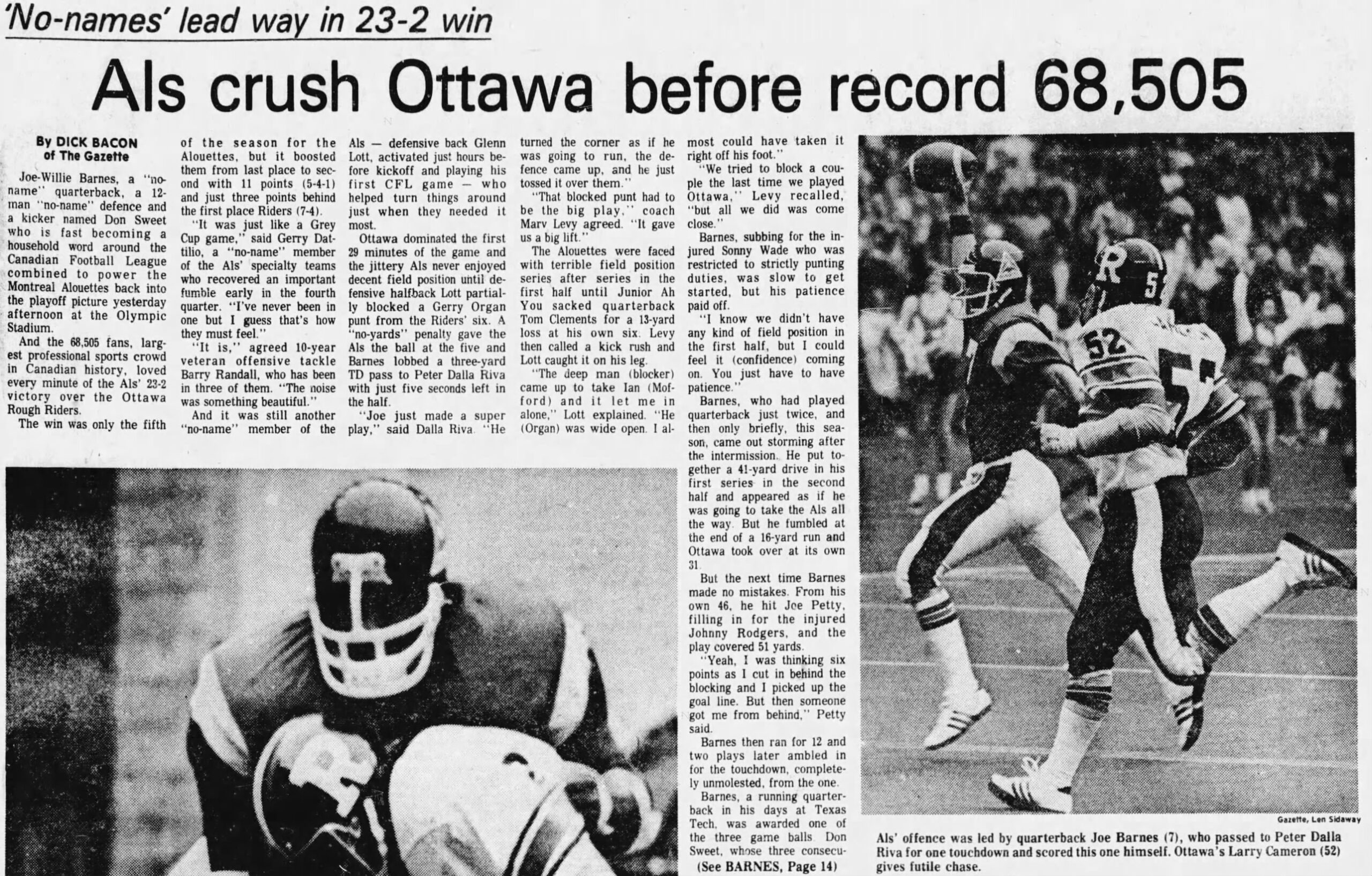
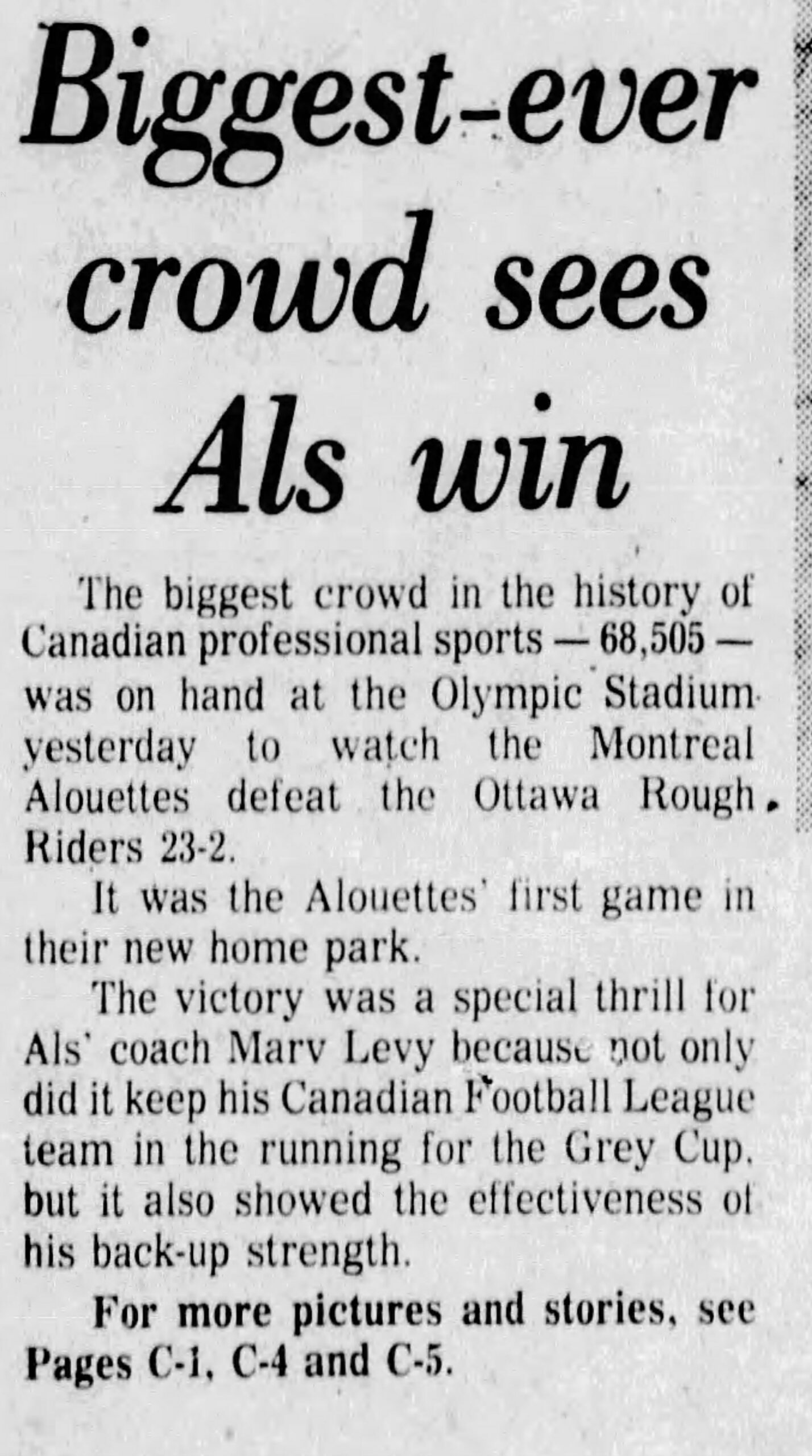
    The Alouettes were the first permanent tenant for the Big O once the Olympics were over. On Sunday September 25, 1976, a record Canadian Football League crowd of 68,505 fans were on hand to see the first game. They were treated to a pre-game ceremony that included former Montreal quarterback Sam Etcheverry performing the ceremonial kickoff.

    Als crush Ottawa before record 68,505
    Bacon Dick, “Als crush Ottawa before record 68,505.” Montreal Gazette, 27 September 1976, p. 13.

    Led by quarterback Joe Barnes and kicker Don Sweet, the Alouettes cruised to a 23-2 victory over the Rough Riders. The Alouettes’ win helped put Montreal back in the playoff hunt in the CFL East. The 1976 Alouettes were coached by the legendary Marv Levy. Levy understood the impact a large vocal crowd could have on the game.

    “The crowd could be the 13th man on the field. If they’re a supportive crowd, it could be the start of a new era in fan enthusiasm and what it means to the team.”
    – Marv Levy

    I’ve been to Olympic Stadium only once. That was for a Grey Cup game. When the place is packed – just like it was in the late 70s – it’s an awestriking experience. But the atmosphere diminishes exponentially the smaller the crowd.

    Today, the Alouettes play their home games at the much more intimate (and much older) Percival Molson Memorial Stadium on the campus of McGill University. They haven’t played a football game at the Big O since 2012. But a new roof is being constructed, and there are hints of a further refurbishment down the road.
    Is it possible that the Alouettes will once again look at playing some if not all their games at Olympic Stadium in the future?

    Perhaps the team can recapture some of that post-Olympic pride that helped them shatter attendance records. At the very least, it won’t be too long before the Grey Cup game returns to Montreal – and with that the roar of the crowd will once again reverberate throughout Olympic Stadium.

    Biggest CFL Crowd
    Montreal Star, 27 September 1976
  • Ron Lancaster Retires

    When I first started following CFL football in the early 1990s, Ron Lancaster was considered one of the best coaches in the game. His Edmonton Eskimos were consistently in the hunt for top spot in the West Division. Perennial Grey Cup contenders.

    But long before he was coaching Edmonton onto victory, he was a standout player – one of the best quarterbacks in the game – for the Saskatchewan Roughriders. He actually started his CFL career with the Ottawa Rough Riders in 1960. He and Russ Jackson were Ottawa’s quarterbacking duo. In 1963, he joined the Green Riders.

    Ron Lancaster, dubbed “the Little General,” played 16 seasons with Saskatchewan. Throughout his time quarterbacking the Roughriders, Saskatchewan played in five Grey Cup games, winning in 1966, the Riders’ first championship. In fact, Lancaster had only one losing season in all those years. Quite a remarkable feat.

    That one losing season turned out to be Lancaster’s last…1978. The Roughriders finished with a dismal 4-11-1 record and placed last in the West Division, missing the playoffs. At the age of 40, the Little General would call it quits.

    Ron Lancaster’s final game was on Sunday October 29, 1978 at Commonwealth Stadium in Edmonton. Coming off the bench in the fourth quarter, he led the Roughriders back from a six-point deficit to defeat Edmonton 36-26.

    Here’s how the Regina Leader-Post described Lancaster’s final game:

    Article in the Regina Leader-Post about Ron Lancaster's final CFL game.
    Hughes, Bob. “Lancaster legend comes to appropriate close.” Regina Leader-Post, 30 October 1978, p. 17.

    Within days of playing for the last time, Ron Lancaster formally announced his retirement. He was the CFL’s first player to pass for over 50,000 yards and was selected as the league’s most outstanding player twice (1970 and 1976).

    Photo montage of Ron Lancaster

    Post-Retirement

    Upon retiring as a player, Lancaster was immediately named Saskatchewan’s new head coach, replacing Walt Posadowski. Lancaster’s first head coaching gig wasn’t as successful as his playing career, however, and the Riders missed the playoffs both years Lancaster was at the helm.

    In 1981, he moved to the broadcast booth and became the colour commentator for the CFL on CBC. It was in 1991 that he returned to the sidelines as Edmonton’s head coach.

    In late 1997, we football fans in Hamilton rejoiced as the Little General came east and took over the coaching duties for the Tiger-Cats. In one year, he helped turn around the Ti-Cats, leading the team to the Grey Cup for the first time in almost a decade.

    Sadly, Ron Lancaster died in 2008 just shy of his 70th birthday. A member of the Canadian Football Hall of Fame (inducted in 1982), the Little General is easily one of the greatest to play, coach, and call the game.

  • The Maple Leaf Forever: An Evolution of the CFL Logo

    It’s been 60 years since Queen Elizabeth II proclaimed Canada’s national flag featuring the prominent red maple leaf. The maple leaf is arguably the most Canadian symbol of all and has been used to represent Canada since the 19th century.

    So, it’s not surprising that this quintessentially symbol of Canadiana has always been featured one way or another in the logo of the Canadian Football League.

    When the CFL was founded in the late 1950s, the fledging league’s logo was what one would expect from the period: an “official” looking crest-like emblem similar to what you would see on an old company letterhead.

    The original CFL logo

    In the 1970s, the league adopted a more modern logo – the classic red maple leaf with the CFL/LCF initials inside a football helmet. Perhaps the CFL took inspiration from the new flag in incorporating the maple leaf into a logo that would span the next three decades.

    Classic LCF helmet logo
    Classic CFL helmet logo

    At the turn of the millennium, the CFL adopted a new logo featuring a stylized slanted maple leaf meshed with a flying red football atop bolded CFL/LCF initials.

    CFL logo adopted in 2000s

    The current CFL logo has been in use since the 2016 season. The maple leaf is minimalized with the focus on an abstract image of a football featuring three hashmarks and the CFL/LCF initials being prominently displayed.

    Current LCF logo
    Current CFL logo

    As Canadians find themselves celebrating the anniversary of their national flag amidst a newfound sense of Canadian patriotism, you have to wonder what may be in store next for the CFL’s logo. Does the league stick with the relatively young status quo? Or, do new opportunities arise for the league to further embrace its Canadian identity and perhaps give more prominence to the maple leaf once again?

    (You can check out more CFL logos at SportsLogos.Net)

  • Northmen condemned by health minister

    Tariffs, protectionism, and the Manifest destiny are all the talk this week following the inauguration of U.S. President Donald Trump. Of course, Canada-United States relations is a centuries old subject that will likely always be a matter of discussion for Canadians.

    What the heck does this have to do with football? Well, any CFL fan over the age of forty will remember the league’s foray into the United States in the early 1990s. But, those a bit older will also recall the time when a new U.S.-based league was about to set up shop here in the Great White North.

    In 1973, the fledging World Football League was established, and the Toronto Northmen were going to be one of their flagship franchises. They were owned by John Bassett Jr., who just happened to be the son of Toronto Argonauts owner John Bassett Sr. Yes, there were plenty of accusations of conflict of interest.

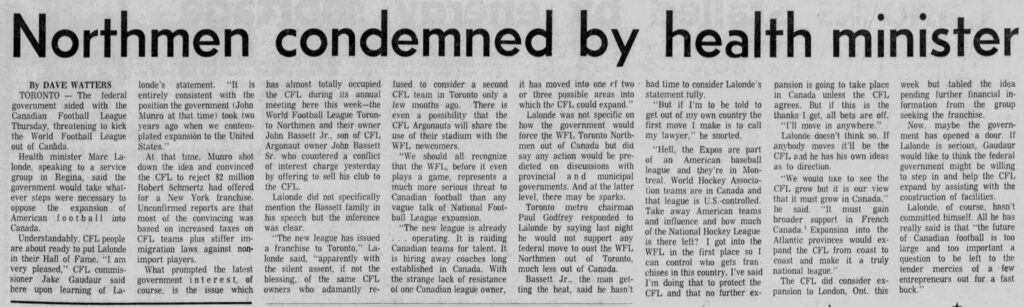
    Here is an article that appeared in the Vancouver Sun where the Minister of Health at the time Marc Lalonde denounced the new WFL and the Northmen.

    A foreign football league coming to Canada was perceived as a real threat to the CFL. And, maybe it was, but we will never truly know. In response, the federal government moved rather quickly. The Minister introduced the Canadian Football Act in Parliament. This act would have given a monopoly over professional football in Canada to the CFL.

    Toronto Northmen logo (SportsLogos.net)

    Seeing the writing on the wall, Bassett decided to move his Northmen to Memphis, Tennessee and rebrand them as the Southmen. The American gridiron invasion was halted.

    In the aftermath, the Canadian Football Act ultimately wasn’t passed into law. John Bassett Sr. sold the Argos. And, the World Football League played just two years before folding during its second season in 1975.