Tag: 1980s in Canadian Football

  • CFL Goes With Shorter End Zones

    The Johnston Rules are coming to Canadian football. Proponents argue they will open up the Canadian game and lead to more exciting touchdowns. Opponents grumble they represent creeping Americanization of our unique brand of football. Others shrug their shoulders and wonder what all the fuss is about. Wherever you land on this spectrum one thing is clear: CFL Commissioner Stewart Johnston has introduced sweeping changes to Canadian football.

    Now, there are plenty of places online to discuss (or vent about) these changes. But here at Canadian Football History, we focus on the past. One of the changes featured in the Johnston Rules is the shrinking of the field length and end zones. So, I thought it would be timely to revisit the last time the CFL modified its field dimensions.

    Once upon a time, the regulation Canadian football field was 110 yards long between the goal lines with two 25 yard end zones. If you watch older CFL games you will realize just how massive the end zones were. The extra deep end zones gave quarterbacks some good real estate to pass for touchdowns.

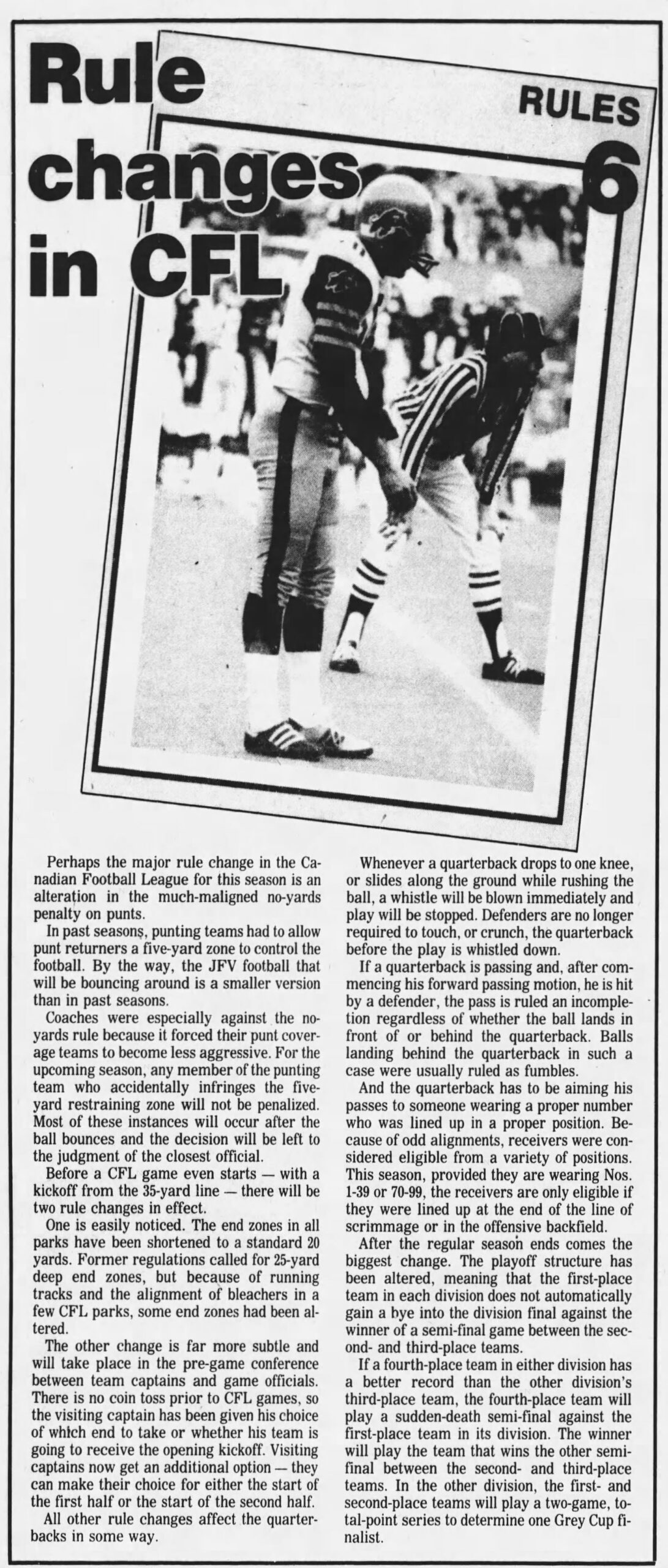
    CFL rule changes in 1986
    CFL rule changes, including shortening the end zones from 25 to 20 yards, in 1986. (Regina Leader-Post)

    Then in 1983, Vancouver opened BC Place Stadium, the first domed stadium in Canada. The 60,000-seat stadium was a state-of-the-art facility that rivalled Montreal’s Olympic Stadium in terms of capacity and amenities. The trouble was that a full-length Canadian football field wouldn’t fit in the new stadium. So, the BC Lions played on a field that had only 20 yard end zones.

    Other CFL stadiums couldn’t quite fit the full 25 yard end zones, either. So, they would clip the corners of the end zone and make do the best they could. Finally in 1986, the Canadian Football League officially adopted 20 yard end zones as the new standard.


    The CFL’s long end zones posed a problem during the league’s brief foray into the United States. Most American football stadiums could not accommodate the longer Canadian field, particularly the 20 yard end zones. So, we ended up with a mishmash of end zones in the CFL’s U.S.-based stadiums. Without question the worst set up was in Memphis where the end zones were only seven yards in length near the sidelines; at most they were less than 15 yards deep in the centre.


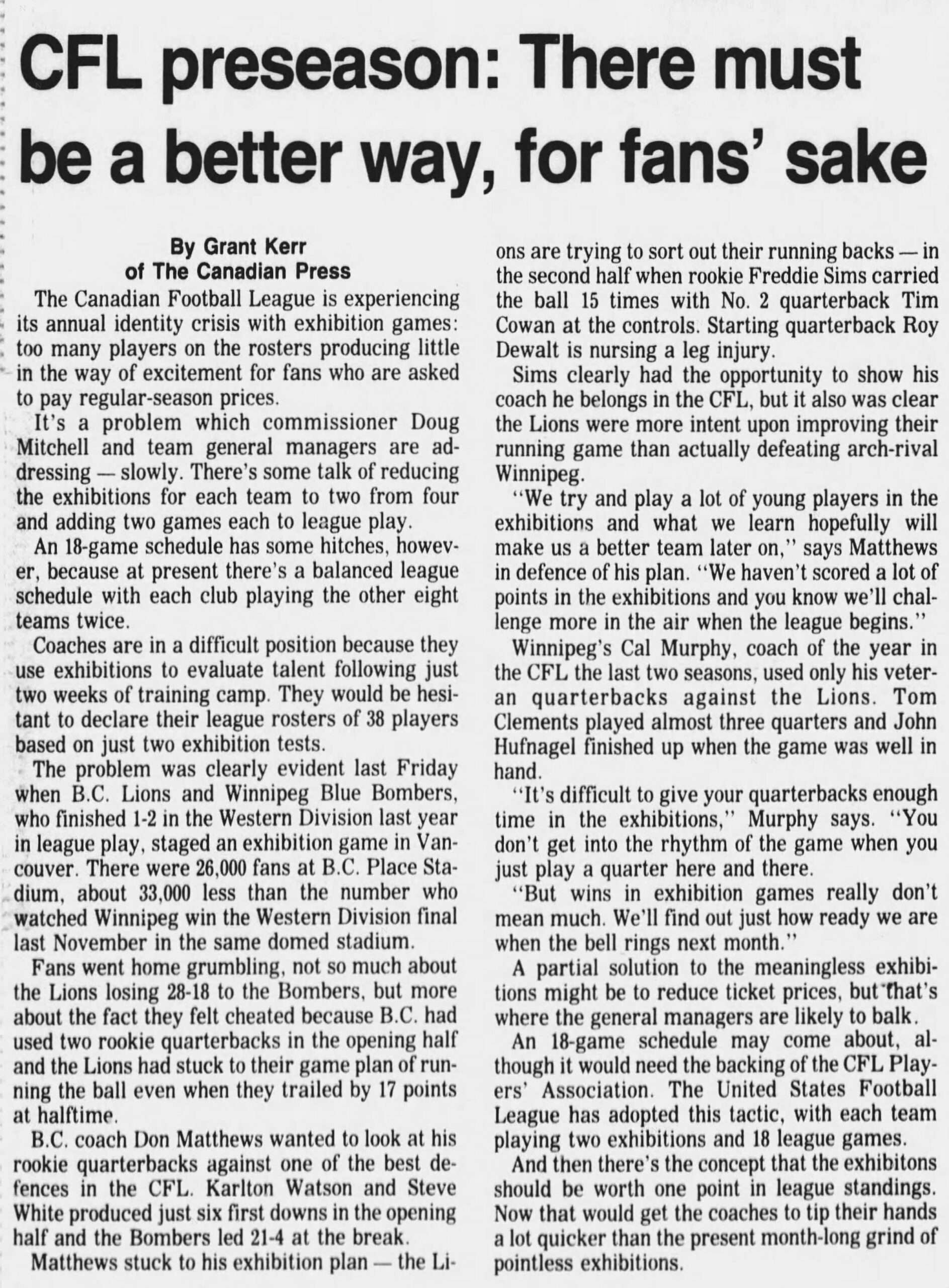
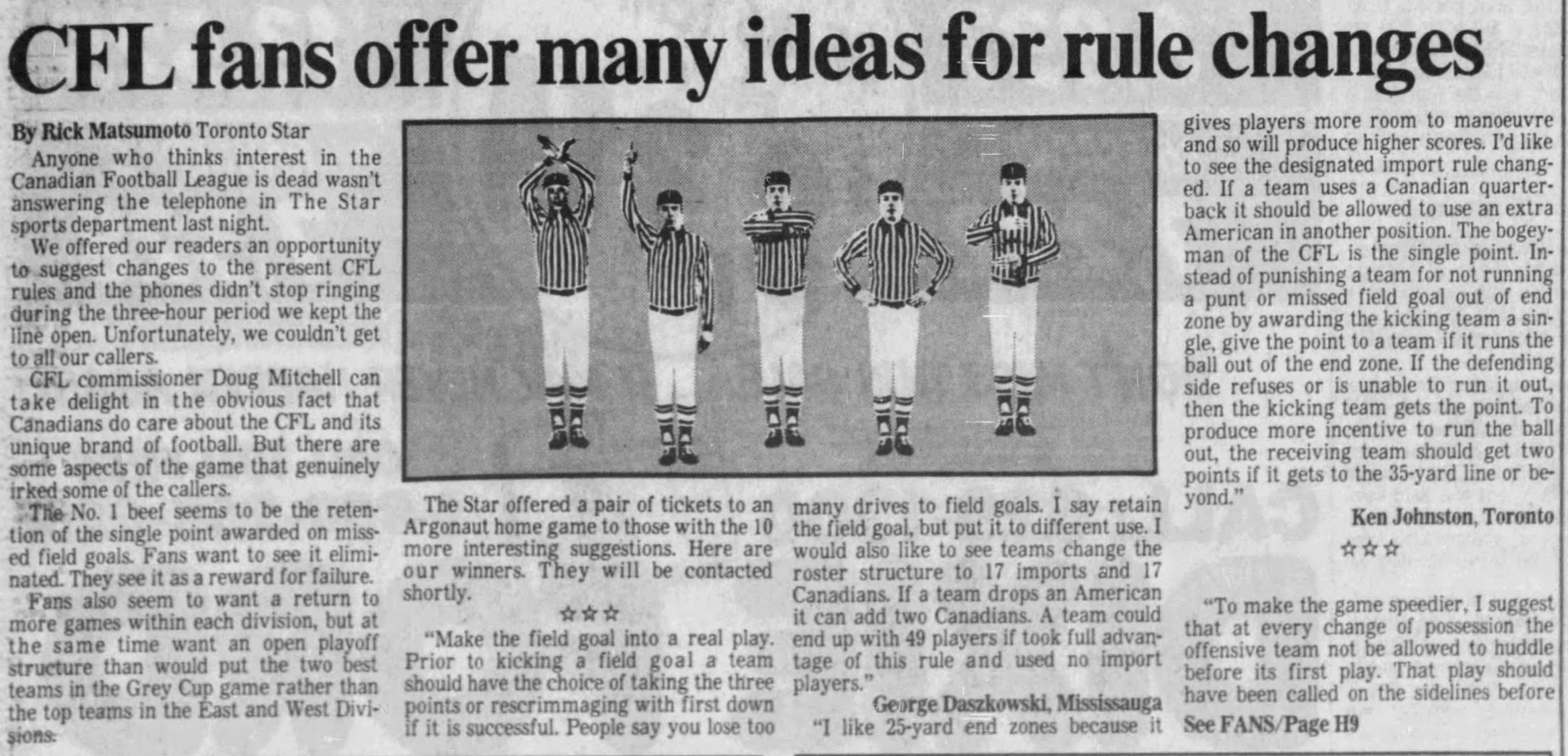
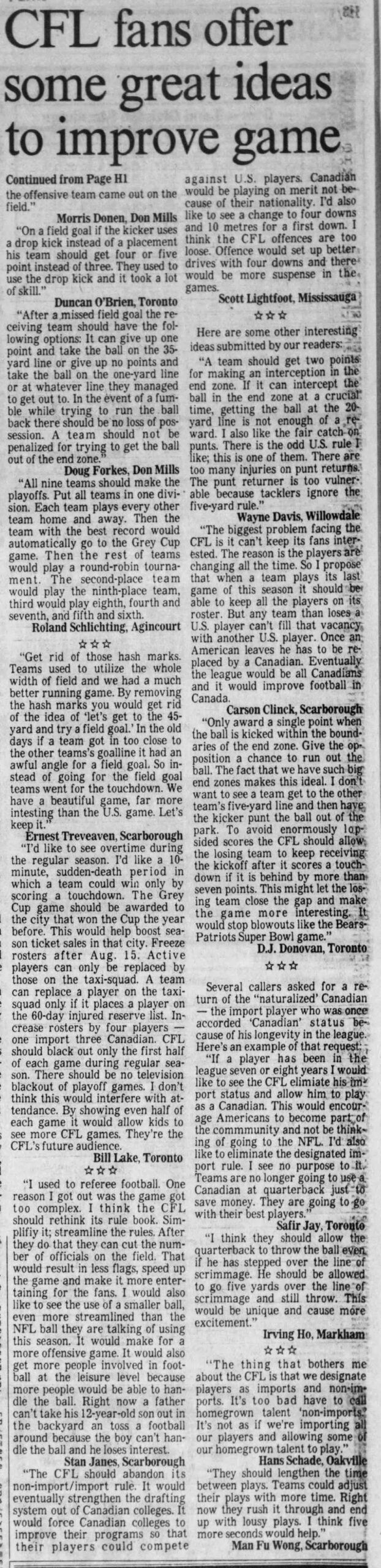
    Whenever a sports league makes a rule change – especially if it’s a significant one – there will no doubt ensue a passionate debate amongst the fanbase. That’s probably healthy in the grand scheme of things; after all, apathy is a very difficult thing to overcome. So, if people are talking and you are in the conversation, that means people care. This week was certainly no different. CFL fans have proven they are some of the most passionate sports fans around. I thought I’d end with a selection of fan suggestions for the CFL published in the Toronto Star in 1986.

    CFL fan suggestions in the Toronto Star
    CFL fan suggestions in the Toronto Star
    Rule changes suggested by CFL fans published in the Toronto Star.

    Sources:
    The Toronto Star (13 February 1986)
    The Regina Leader Post (24 June 1986)

    Fediverse Reactions
  • The Terry Fox Kickoff: 45 Years Later

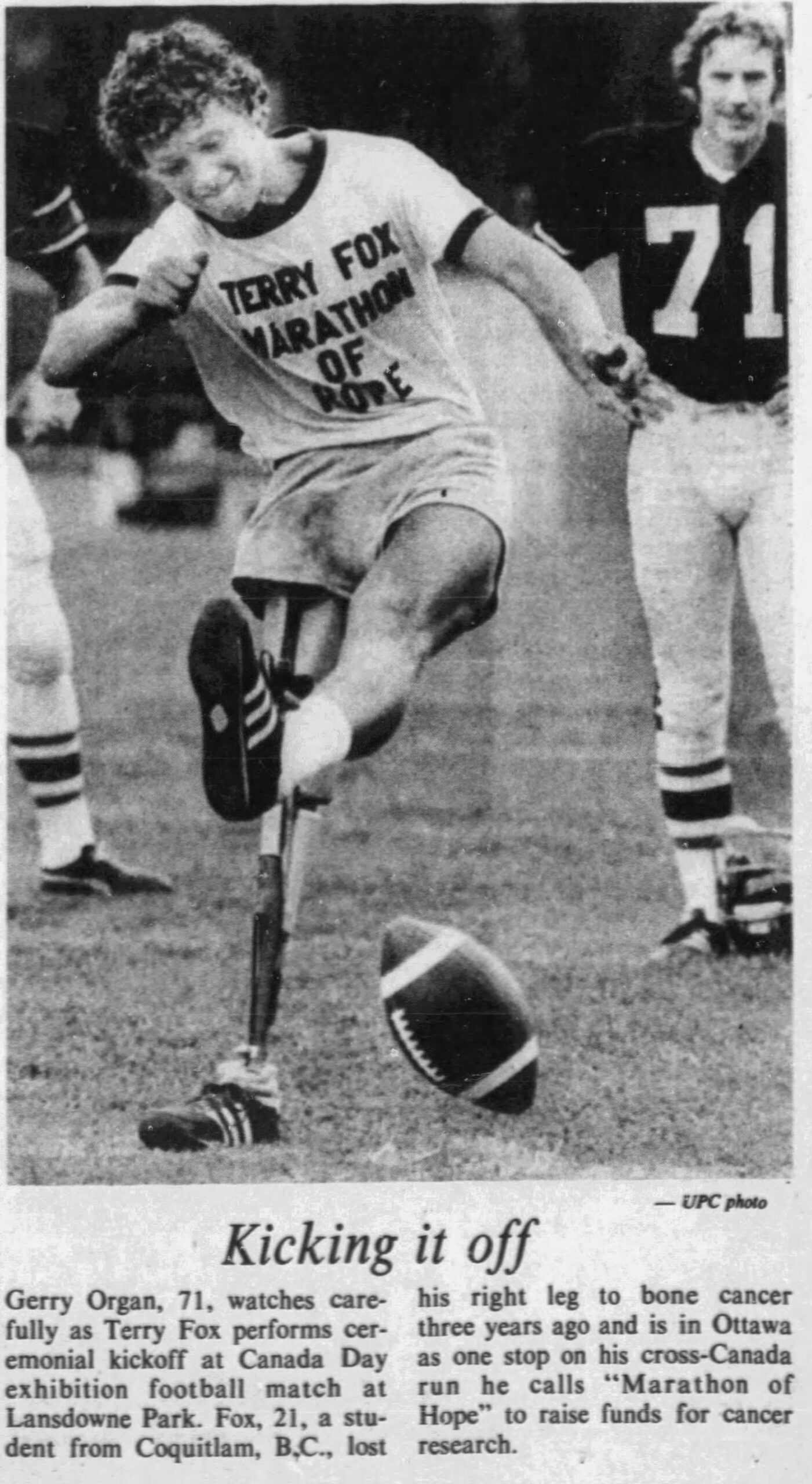
    On July 1, 1980, a young man jogged onto the field at Lansdowne Park in Ottawa to perform the ceremonial kickoff prior to the CFL exhibition game between the Ottawa Rough Riders and the Saskatchewan Roughriders.

    The crowd of almost 17,000 gave the 21-year-old a standing ovation. He wasn’t an ordinary 21-year-old by any stretch of the imagination. No, he was extraordinary in every sense of the word. He had one leg, having lost his other to cancer. Lansdowne Park was the latest stop on what he billed as his “Marathon of Hope” across Canada to raise money for cancer research. Of course, I’m talking about Terry Fox.

    A great shot of Terry Fox performing the ceremonial kickoff on Canada Day 1980 while Gerry Organ of the Ottawa Rough Riders looks on.
    (Ottawa Citizen, 2 July 1980, p. 28.)

    We Canadians are all familiar with Terry Fox, his story, and his legacy. I was only four years old (not even) at the time of the Marathon of Hope, but I do have some vague recollections of seeing coverage about it on TV. My Grandad met him while he was running through Halifax County in Nova Scotia and took a picture of him. I still have the photo.

    But we forget some of the historic imagery that Terry’s marathon produced along the way. The kickoff at the CFL game is but one example. Here’s how Ottawa Rough Rider great Tony Gabriel remembers the day:

    “I fondly remember meeting our young Canadian hero, Terry Fox, on July 1, 1980. He had begun his Marathon of Hope run across the nation and had reached Ottawa. Terry did our honorary kickoff that Canada Day, and I was fortunate as one of the captains for the Ottawa Rough Riders to get to shake his hand and wish him good luck in raising needed funds for Canadian cancer research.”

    Terry Fox clearly made an impression on the CFL Hall of Famer. In 2020, Gabriel launched a petition to put Terry Fox on the $5 bank note. Late last year, the government announced that Terry Fox would indeed be featured on the new note. “Over the past 45 years, the Terry Fox Foundation has raised $950 million! I am so heartened it was announced and successfully assured this year that this continuing honour for Terry will happen in the near future by the Bank of Canada,” Gabriel proudly boasts.

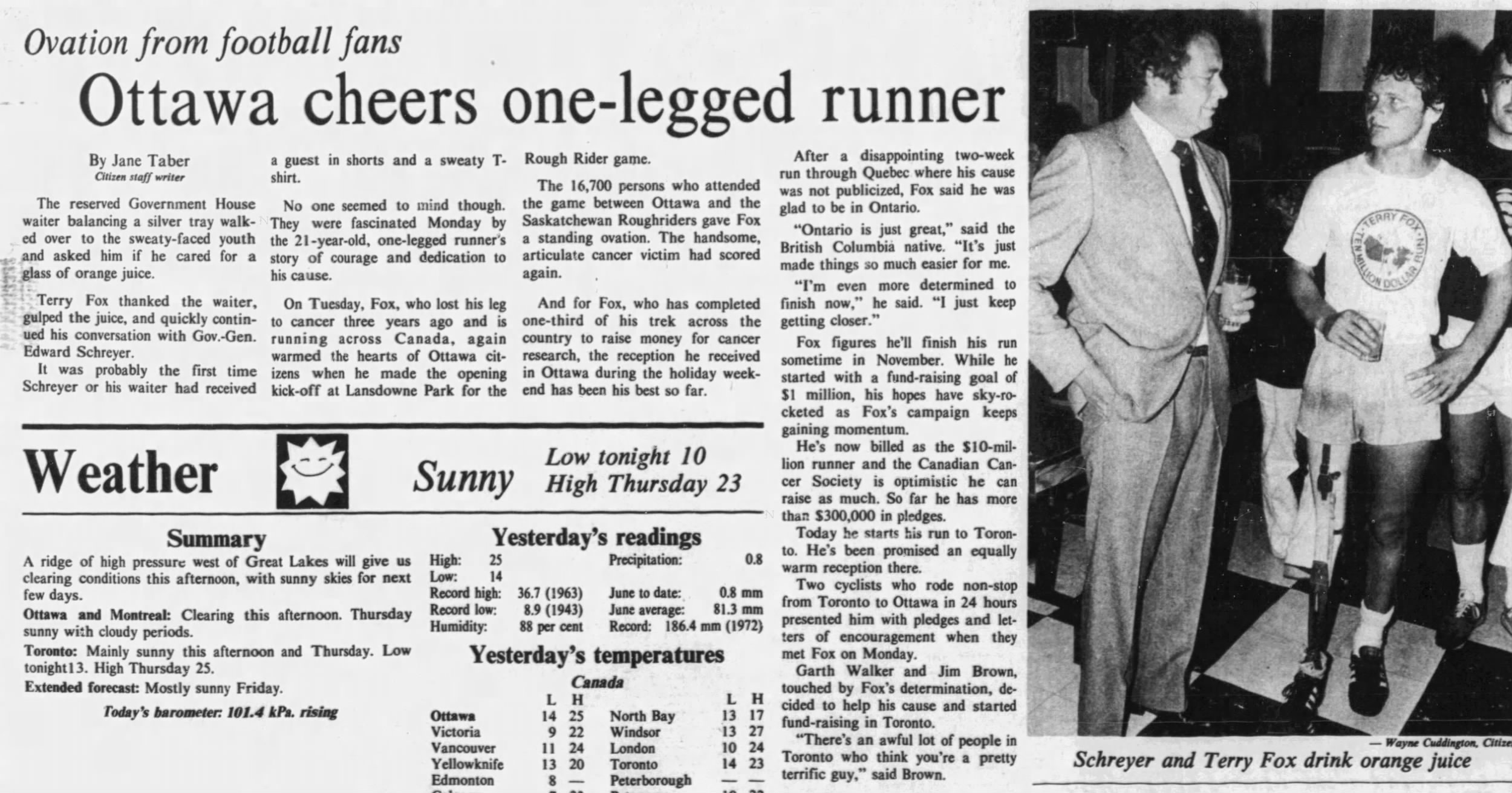
    An article in the Ottawa Citizen about Terry Fox’s stop in Ottawa during his Marathon of Hope.
    (Taber, Jane. “Ottawa cheers one-legged runner.” Ottawa Citizen, 2 July 1980, p. 2.)

    After leaving Ottawa – but not before hanging out with Governor General Ed Schreyer and Prime Minister Pierre Trudeau – Terry continued west into Southern Ontario before heading up to Northern Ontario towards Thunder Bay. Here, he sadly announced that his cancer had returned, thus ending the Marathon of Hope. Still, he travelled a distance of 5,373 kilometres over the course of 143 days and raised millions towards his cause.

    It’s been 45 years since Terry Fox captured our hearts and admiration. 45 years since the young man with one leg shared the field with some of the great CFL football stars of the day. 45 years since Terry Fox become a true Canadian legend.

    And now, let’s relive what I believe is one of the most iconic moments in Canadian sports history…the Terry Fox kickoff:


    Continue Terry Fox’s legacy. Join the Terry Fox Run or make a donation to the Terry Fox Foundation.

  • The CFL Scores in Saint John

    The Canadian Football League has long pined for a presence in Atlantic Canada. In fact, Halifax has been granted not one but two conditional expansion franchises, the emphasis on “conditional” as neither attempt materialized. When Moncton opened its new stadium in 2010 there was some chatter about the Hub City being a home for a future CFL team. While no expansion team has been forthcoming, Moncton has hosted three regular season CFL games. And of course, there have been regular season games played in Halifax and Acadia University in Wolfville, Nova Scotia, as well.

    “CFL Tickets Go On Sale May 1.” Saint John Times-Globe, 23 April 1986, p. 29.

    But the CFL actually made its debut in the Maritimes back 1986 when Saint John, New Brunswick hosted an exhibition game between the Montreal Alouettes and Winnipeg Blue Bombers. The game, played at the then newly constructed Canada Games Stadium, drew a crowd of over 11,000 fans who saw the Bombers down the Als 35-10.

    “10,000 Assured for CFL Game.” Saint John Telegraph-Journal and Evening Times-Globe, 6 June 1986, p. 31.

    It appears the game was designed to take the CFL on the road and expose the product to a new market rather than to test the waters for a prospective expansion site. In fact, CFL Commissioner Doug Mitchell seemed to go out his way to temper any expansion expectations. Still, New Brunswickers embraced the CFL and the players enjoyed the Atlantic hospitality.

    Munford, Bruce. “Thousands Flock to See Bombers Blast Montreal.” Saint John Evening Times-Globe, 9 June 1986, p. 15.

    The Bombers were quarterbacked by veteran Tom Clements, who had his way with the Montreal defence. A scary moment occurred early in the game when Montreal’s Nick Arakgi suffered a broken vertebrae when he was hit after reaching up high for an overthrown pass by Montreal quarterback Joe Barnes. He was taken to the hospital and ended up missing the entire 1986 CFL season.

    Saint John Mayor Elsie Wayne was ecstatic about having the CFL in her city. She presented Winnipeg head coach Cal Murphy with a trophy called the Saint John CFL Cup after the game.

    A Labatt’s ad sponsoring the CFL game in Saint John. (Saint John Telegraph-Journal, 6 June 1986, p. 71.)
    An ad promoting the CFL game in Saint John. (Saint John Telegraph-Journal, 6 June 1986, p. 72.)

    The CFL’s success in Saint John in 1986 prompted the league to return the following year for another exhibition game. This time, Montreal played the Hamilton Tiger-Cats. The Ti-Cats won 14-13 in what turned out to be the last game for the Montreal Alouettes who folded a couple weeks later.


    Kelly Ryback was the original “Buzz”, the mascot of the Winnipeg Blue Bombers. Here are his personal reflections of the event.

    The ’86 trip was a career and life highlight!

    I had never been to an ocean or feasted on lobster. I was on the advance team in Saint John Wednesday through Sunday.

    We stayed at the Hilton on the harbour, ate lobster, mussels, and frog legs several times. We were hosted by Labatt’s with summer student valets. One became a friend for life, still 39 years later.

    Meeting Mayor Elsie Wayne in her office was a hoot and she later hosted a fine reception where we were all presented with City of Saint John ties.

    The crowd of 12K+ was fantastic and it was a bright, sunny day.

    An absolutely incredible event.

    A souvenir t-shirt from the 1986 CFL game in Saint John and a City of Saint John tie.
    Photo provided by Kelly Ryback.