Today I want to talk about fields. Canadian football fields, that is. There is still a lot of chatter about the CFL’s decision to adjust its field size in 2027, adopting a 100-yard-long field with 15-yard end zones. Previously, I have written about early Canadian football being played on 100-yard fields in the past. And there have been exhibition games played on similar length fields such as the 1992 game in Portland, Oregon.
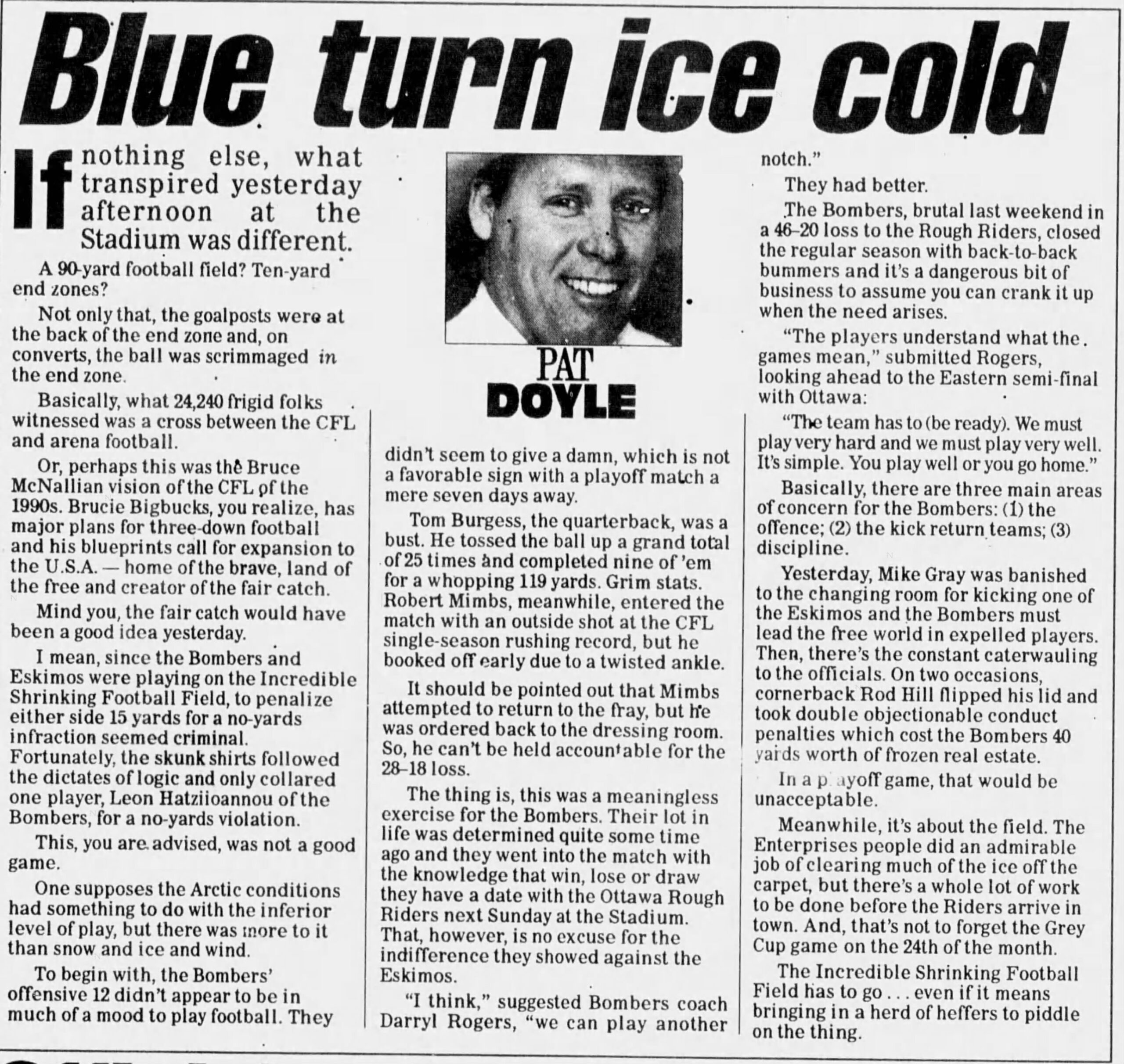
But what if I told you there was a CFL game played on a 90-yard-long field? Yes, 90 yards. And ten-yard end zones. Say what? This was no exhibition match, either; rather it was a regular season CFL game that counted in the standings. It happened on Sunday November 3, 1991 in Winnipeg for a game between the Blue Bombers and the Edmonton Eskimos.
Column by Pat Doyle in the Winnipeg Sun about the CFL game on a shortened field (4 November 1991).
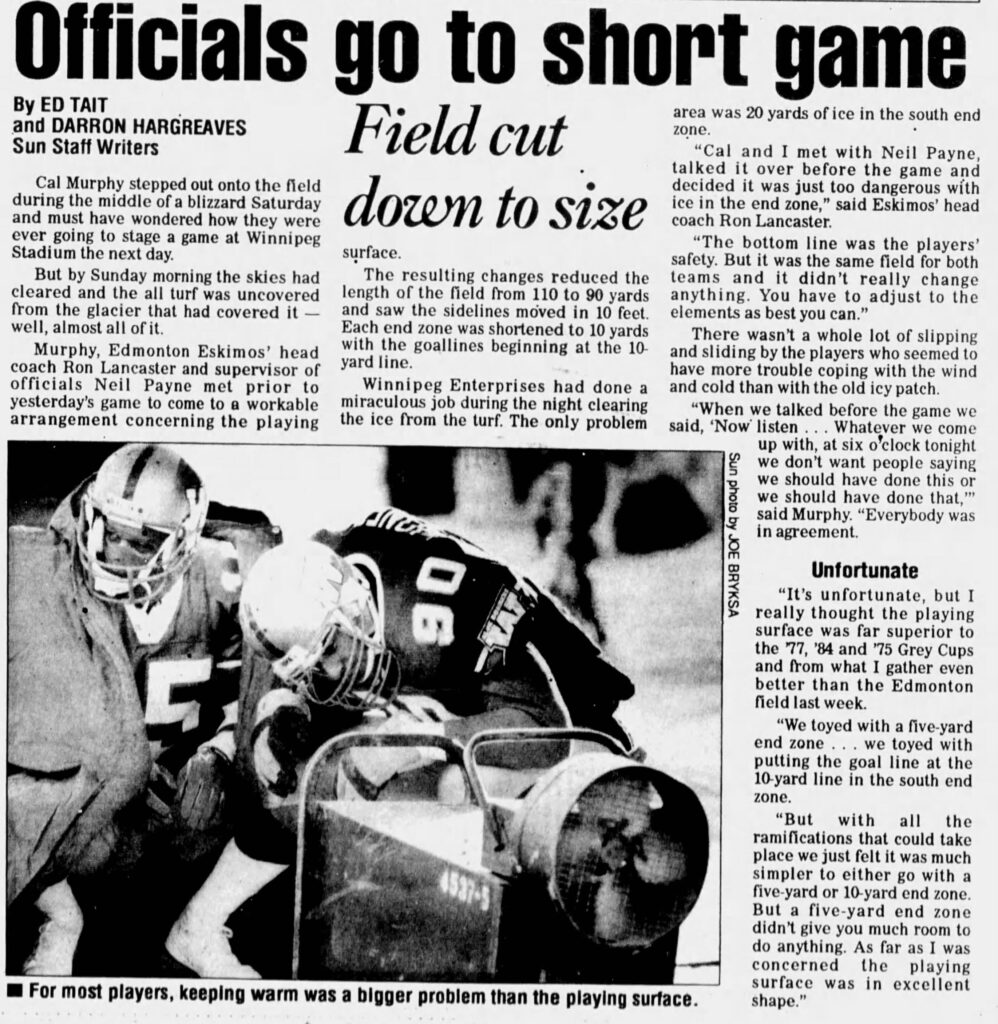
Thanks to a blizzard the previous day, the turf at Winnipeg Stadium was left covered in snow and ice. Although crews had worked diligently through the night, the field was still deemed too dangerous in the end zones and along the sidelines. So, a decision was made to modify the field dimensions in the name of player safety.
More coverage in the Winnipeg Sun by Ed Tait and Darron Hargreaves (4 November 1991).
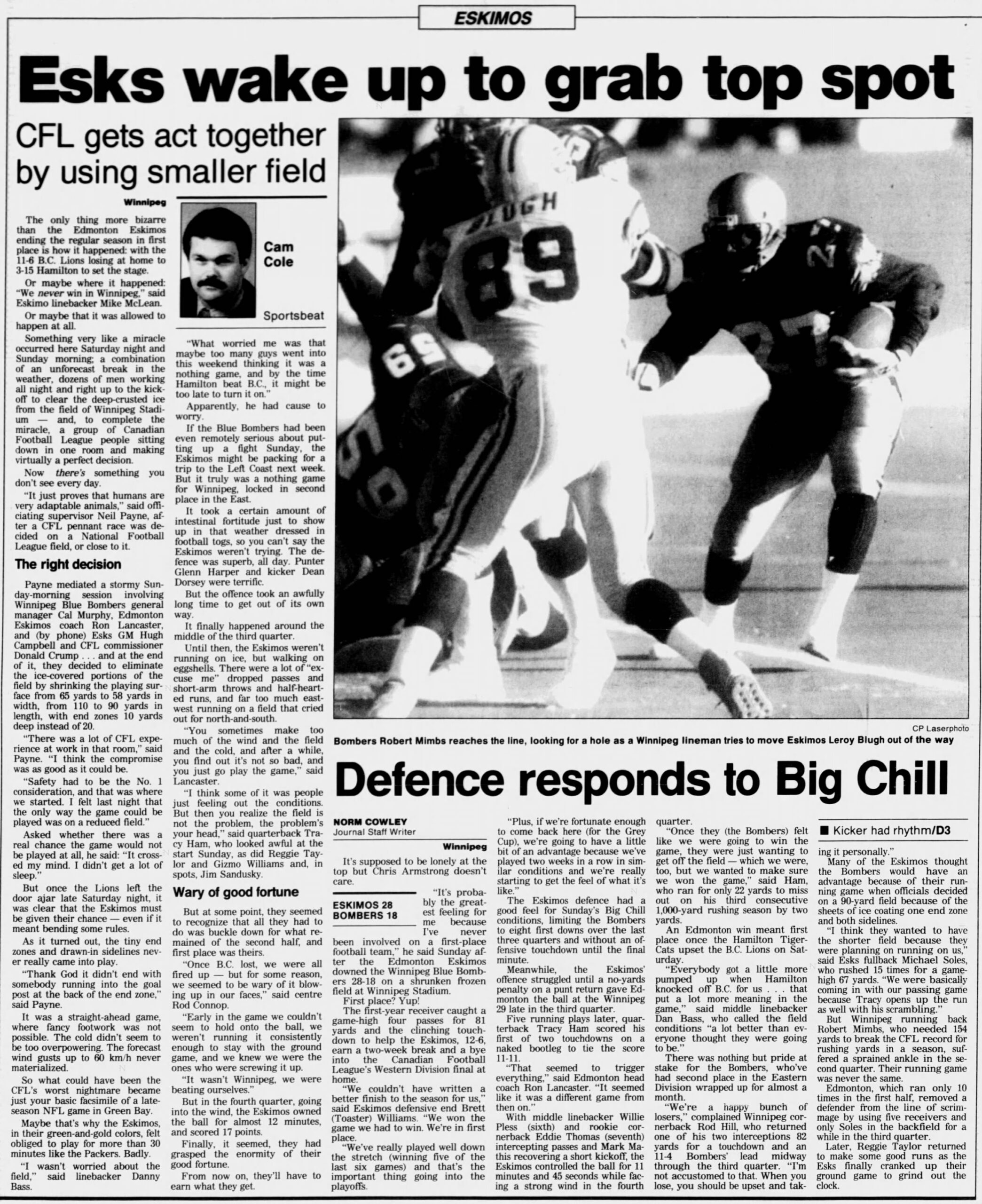
After consulting with the two teams, the CFL reduced the length of the playing surface to only 90 yards. End zones were reduced to ten yards. And the goal posts were placed in the back of the end zone. The width of the field was also reduced to just 58 yards. Ironically there were concerns players would run into the goal posts at the back of the end zones.
Article by Cam Cole in the Edmonton Journal about the shortened CFL field (4 November 1991).
Both Winnipeg and Edmonton made the best of the less-than-ideal situation, though. In the end, Edmonton emerged as victors, winning 28-18 to secure first placed in the Western Division.
So, as we football fans continue to debate the CFL’s pending field dimensions in 2027 let us remember the day the league played on a frozen shrunken field back in 1991.
Sources: Edmonton Journal, 4 November 1991 Ottawa Citizen, 4 November 1991 Winnipeg Sun, 4 November 1991
Previously I wrote about the lowest scoring game in Canadian Football League history. Yes, that 1-0 doozy back in 1966. But what about the CFL’s highest scoring game? Ever since I’ve been a fan, CFL offences have been known to really rack up the points. This was no truer than on September 1, 1990 when the Toronto Argonauts hosted the BC Lions.
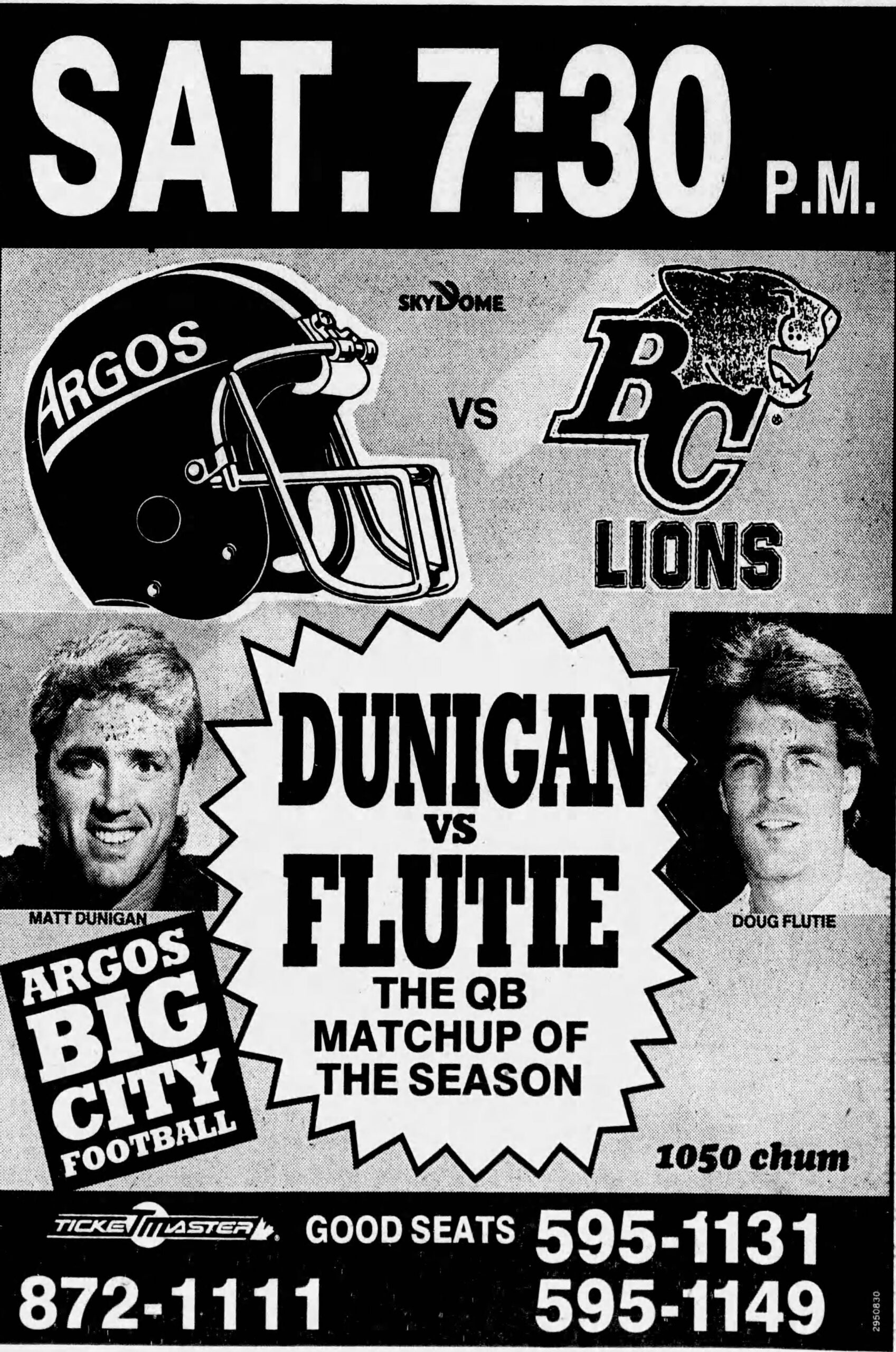
Advertisement in the Toronto Star promoting the Toronto-BC game. The quarterback matchup of the season didn’t materialize (Toronto Star, 30 August 1990).
To kick off the Labour Day weekend, the Argos hosted the Lions at the SkyDome. The Double Blue were led by quarterback Matt Dunigan who was making his first start after missing five games due to a leg injury. Dunigan had been traded to Toronto from BC earlier in the year, so he was playing against his former team.
Leading the BC offence was Doug Flutie, who was the league’s new marquee player in 1990. The Lions were owned by Murray Pezim at the time and were a team somewhat in disarray. A few days before the game Pezim had publicly threatened to fire both General Manager Joe Kapp and Head Coach Lary Kuharich.
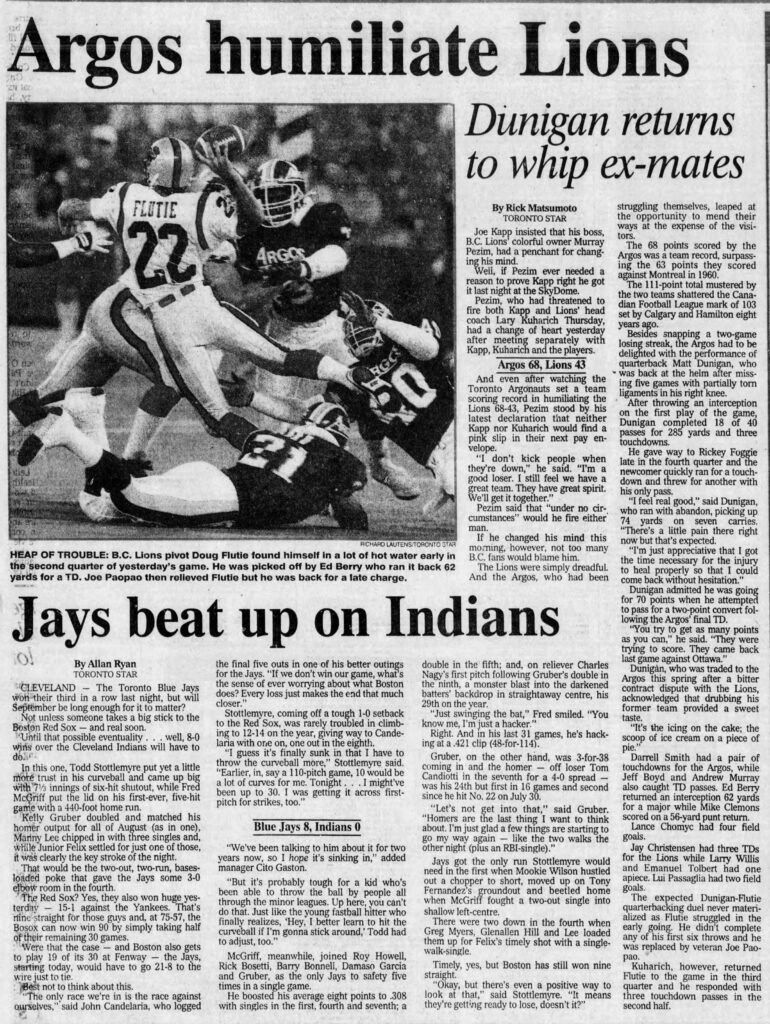
Toronto Star article by Rick Matsumoto about the Argos’ 68-43 win over BC (Toronto Star, 2 September 1990).
Dunigan struggled early (his first play was intercepted) but found his footing and ended up passing for 285 yards and three touchdowns. Receiver Darrel Smith scored two of those touchdowns. Other Toronto highlights included a 56-yard punt return for a touchdown by Michael “Pinball” Clemons and four field goals by kicker Lance Chomyc. Ricky Foggie, who had followed Dunigan from BC to Toronto, ran for a touchdown and passed for one, as well.
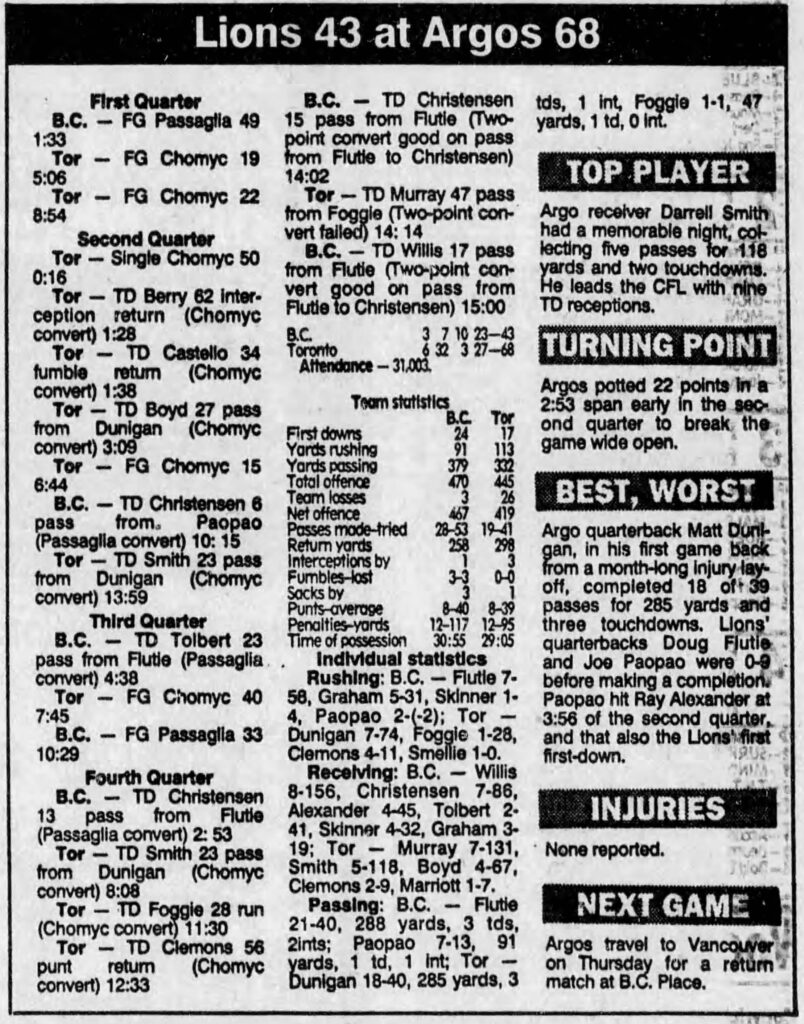
Game summary (Toronto Star, 2 September 1990).
By the end of the night Toronto put up a whopping 68 points. 22 of these points were scored within a three minute span in the second quarter, thanks largely to two BC turnovers. The 31,000 fans at the SkyDome who witnessed the wild shootout left happy.
The Lions, on the hand, struggled. Flutie went 0-6 in passing attempts and was replaced by veteran Joe Paopao. But in the second half, Flutie redeemed himself by passing for three touchdowns. Unfortunately, it wasn’t enough to catch the Argos. The Lions’ 43 points was still well short.
With the win, Toronto improved to 4-5 on the season. BC dropped to 2-6-1, last place in the Western division.
On July 14, 1994, fans attending the CFL game at Winnipeg Stadium were in for quite the night. In a rematch of the previous year’s Grey Cup, the Winnipeg Blue Bombers hosted the Edmonton Eskimos. Edmonton had beaten Winnipeg in that game and were the defending Grey Cup champions. No doubt the Winnipeg faithful were eager for revenge.
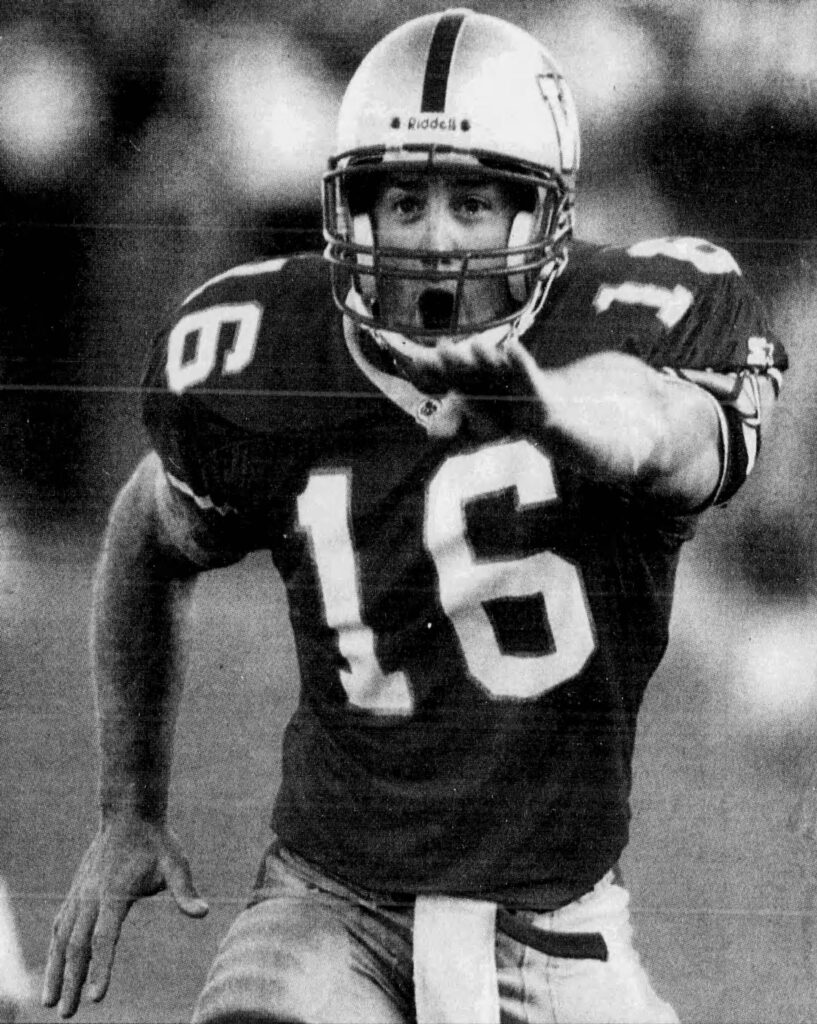
Winnipeg Quarterback Matt Dunigan (Winnipeg Sun)
The game featured two of the CFL’s best quarterbacks at the time. Edmonton’s offence was led by Damon Allen. Leading the charge for Winnipeg was Matt Dunigan. Two future hall of famers.
Dunigan’s go-to receiver on this night was clearly Alfred Jackson. Jackson, who previously played on defence, caught seven passes for 325 yards. He ended up scoring four touchdowns in the game. Winnipeg was up only 7-3 after the first quarter. It was during the second quarter when Dunigan and the Bombers really ramped up the aerial attack. Dunigan had already passed for over 300 yards by halftime. The dominance continued throughout the second half. After the final whistle, the game was over.
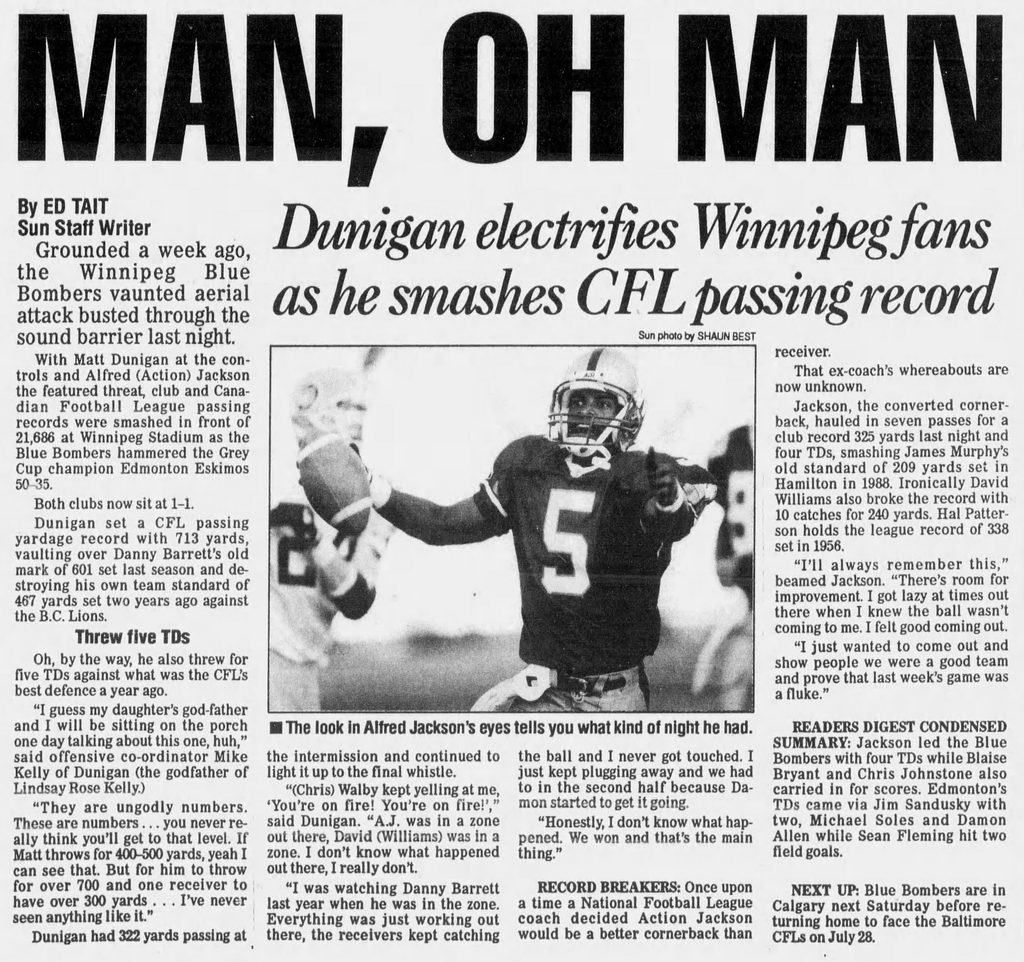
Account of the record-setting game by Ed Tait in the Winnipeg Sun.
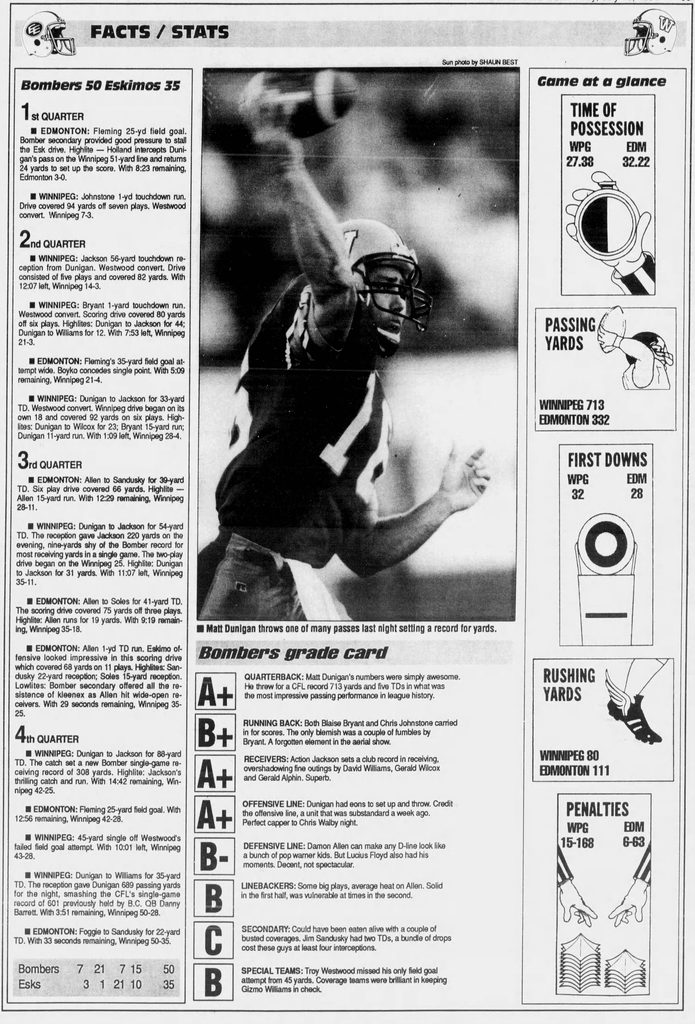
Final score. Winnipeg 50 Edmonton 35. And a new record. Matt Dunigan passed for 713 yards, breaking the CFL record for most yards passed in a single game and easily surpassing Danny Barrett’s 601-yard record set just one year earlier.
Game stats (Winnipeg vs. Edmonton) in the Winnipeg Sun.
Here are some of the quotes that appeared in the newspapers that help put the spectacular performance in perspective:
“That’s a lot of yards. Oh my, that’s a lot. That’s about as well as I’ve ever seen anyone play.” – Winnipeg Head Coach Cal Murphy
“That was impressive. When Matt is hot, he is dynamite.” – Edmonton Head Coach Ron Lancaster, a former quarterback himself
“Something happened out there. I don’t know what it was. They were catching everything. I was throwing everything. It just happened.” – Matt Dunigan
“They were ungodly numbers…I’ve never seen anything like that.” – Winnipeg Offensive Coordinator Mike Kelly
By the way, the record still stands.
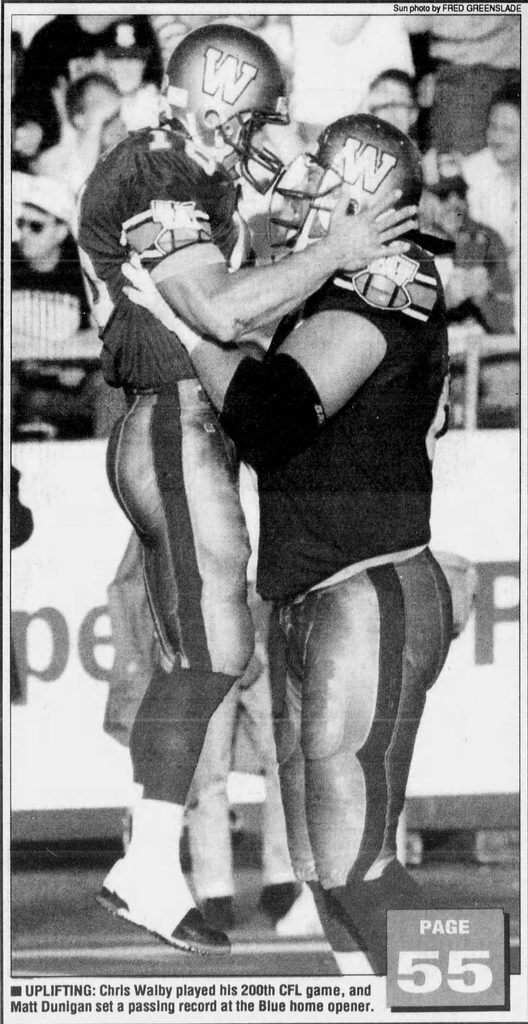
Fred Greenslade’s photo of Chris Walby picking up Matt Dunigan appeared on the front page of the Winnipeg Sun on July 15, 1994.
One of my favourite quarterbacks to play the game is Matt Dunigan. His style of play was so exciting to watch. The man played quarterback like a linebacker.
I was over the moon when he joined the Hamilton Tiger-Cats in 1996. After one particular game, we fans were invited onto the field to meet the players and get autographs.
Of course, I like everyone else made a beeline towards Dunigan. I was a tall, lanky first year university student. When I finally made it to the table where Dunigan was sitting, he looked up and remarked at my height. He then stood up and came to the other side of the table to stand next to me. Towering over him by several inches he looked up and said something along the lines of “that’s how I like my receivers.”
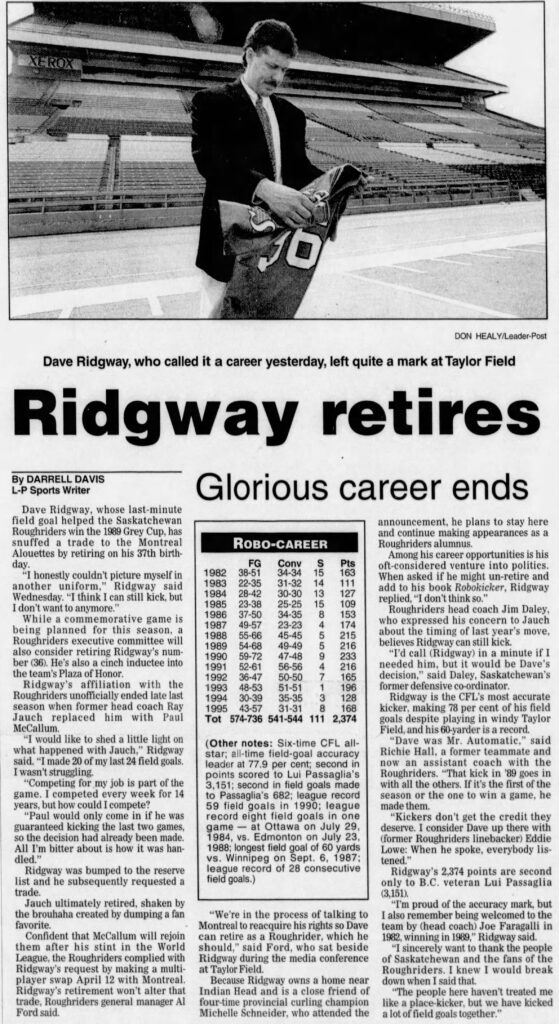
On April 24, 1996, one of the most prolific kickers to play the Canadian game announced his retirement. Dave Ridgway played every game throughout his 14-year career in the Canadian Football League with the Saskatchewan Roughriders. Born in England, his family came to Canada in the 1970s. Ridgway played college football at the University of Toledo. In 1981, he was drafted by the Montreal Alouettes but didn’t make the team. The following year he signed with Saskatchewan as a free agent.
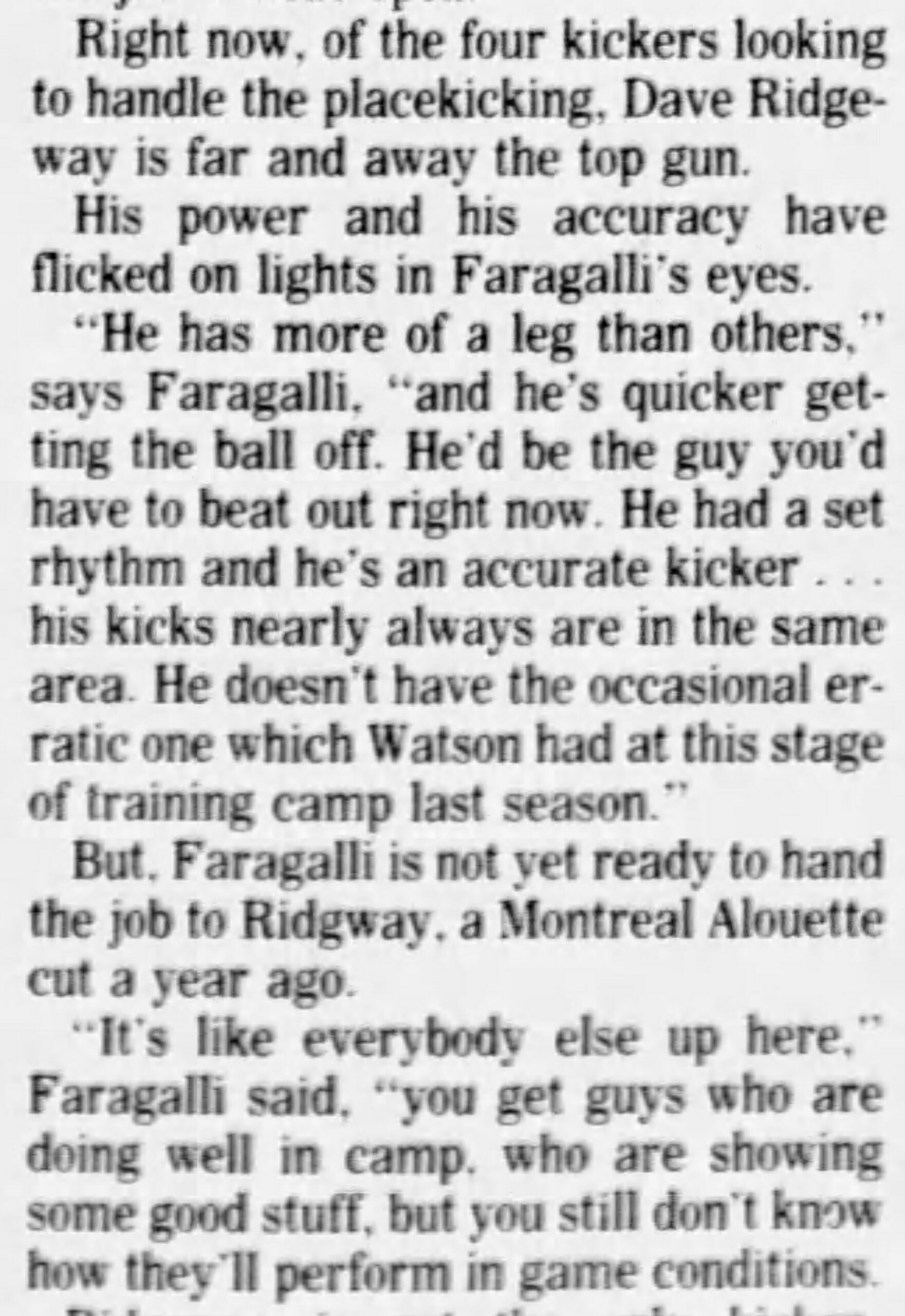
An account in the Regina Leader-Post of Saskatchewan head coach Joe Faragalli praising rookie kicker Dave Ridgway in 1982.
In 1987, he was traded to Edmonton then subsequently traded to Montreal. After the Alouettes folded prior to the season, the Roughriders once again signed him. Clearly, fate wanted Ridgway to be a Rider.
On September 6, 1987, Ridgway kicked a then record 60-yard field goal in the Labour Day weekend game against the Winipeg Blue Bombers. It was probably the second biggest field goal in his career; we’ll get to the biggest one shortly.
Playing a whopping 238 games in the CFL, Ridgway was known for his accuracy and ability to get the job done in clutch situations. He scored 574 field goals and a total of 2,374 points throughout his career. His 78% all-time field goal accuracy helped earn him the nickname “Robokicker.” This stat is even more remarkable when you consider the length of his playing career as well as the fact that half of those games were played at Taylor Field in Regina which was known for its often windy conditions.
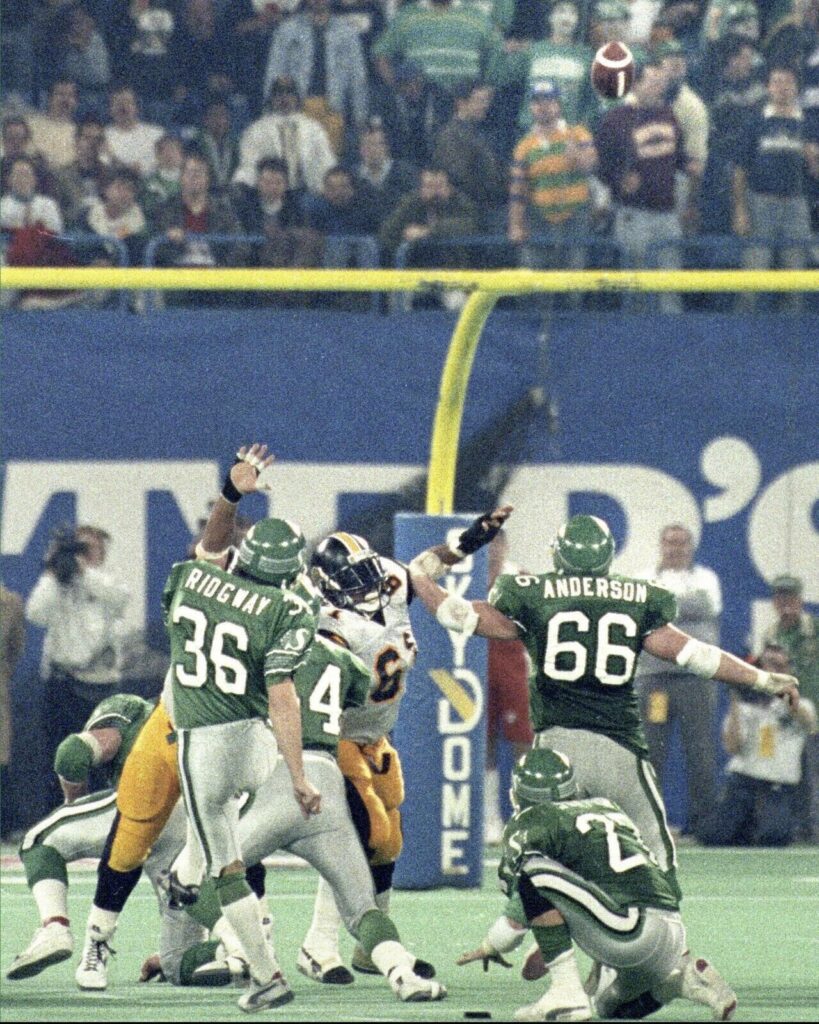
Dave Ridgway kicking the game winning field goal in the 1989 Grey Cup. (Photo: Canadian Football Research Society)
Now, let’s get to that biggest field goal. And this one’s tough to talk about as a Ti-Cat fan. But one must give credit where credit is due. In the dying seconds of the 1989 Grey Cup game versus Hamilton with the score tied at 40-40, Dave Ridgway booted a 35-yard field goal to win the game for the Riders. It was a dagger in the hearts of Tiger-Cat fans but a hard fought and well-deserved victory for Robokicker and the Green and White. The kick (or better known as “The Kick”) secured just the second Grey Cup championship for Saskatchewan.
Prior to the 1996 season, Dave Ridgway was traded to Montreal. But rather than continue his career with the Als, he opted to call it a day and announced his retirement on his 37th birthday.
Regina Leader-Post article by Darrell Davis about the glorious career of Dave Ridgway (25 April 1996)
I reached out to Rod Pedersen, the former longtime voice of the Roughriders, to share his thoughts and memories of one of the CFL’s best. Rod was just nine years old when Ridgway arrived in Regina. “I was living in Milestone, SK collecting Roughriders trading cards from the local RCMP detachment which would’ve included Ridgway’s rookie card. My Dad was a Rider season ticket holder and took us to the games,” he recalls.
Ridgway’s loyalty to the Roughriders was clearly evident. “Dave’s a smart guy and realized quickly that the place you want to play in the CFL is Saskatchewan. The Riders weren’t very good back then (they were in the midst of missing the playoffs 11 years in a row) but the fans’ love for the team was real, and the players knew something special was being built by Rider management,” Rod continues.
I asked if there are any particular plays or special moments that stand out for him. “Well, they call him “Robokicker” for a reason, so it was nice to know, as a Rider fan, that generally anytime Ridgway went out for a field goal, he was going to make it. I mean, it’s an incredibly difficult task but Dave made it look easy. That didn’t ease much of our anxiety when he lined up a 35-yard field goal to win the 1989 Grey Cup, but we should’ve known. Ridgway’s accuracy made “The Miss” in the 1992 Western Semi-Final all the more unbelievable, and it lives in Rider lore to this day. That was also the last game Bob Poley and Roger Aldag ever played. There wasn’t any one single Ridgway kick that stands out, other than ’89, but he holds all the major records like most field goals in a season (59), most field goals in a game (8), and the longest field goal streak in Rider history (28).”
Rod’s mention of “The Miss” is a gentle reminder that even legends can falter. I remember watching that game on TV and seeing Ridgway slip on the natural grass at Edmonton’s Commonwealth Stadium on the final play of the game, dashing any chance of a Saskatchewan game-winning field goal.
Was Dave Ridgeway one of the greatest Riders off all time? Rod thinks so. “I think all the records I listed tells you that he is. Having his #36 retired, going into the Canadian Football Hall of Fame in 2003, these things all point to his legacy. More than anything though, in my role with the Riders I got to be around Dave a lot, interview him multiple times, and he’s always first class and very obliging. That means more to me than all the records.”
So, here’s to the man who gave Rider fans something to cheer about (and a championship to boot!) for 14 seasons. Thirty years later, the records still stand. And the legend of Robokicker lives on.
At high school in the mid 1990s we were asked to use a new technology called the “World Wide Web” for a research project. Yours truly balked and wanted to stick with the tried-and-true volumes of Encyclopedia Britannica. I told my friend that I would give it a go but that the Internet was nothing more than a mere fad, something that would surely pass. Over thirty years later, here I am writing an article online publicly admitting that ridiculous prediction of mine.
I slowly came around to the web. The early web was an imperfect place full of imperfect homepages and websites. There were no algorithms, no ads, and no AI. Ah, serenity! Over time, I became fascinated with it, eager to “surf the web” and explore new things on the so-called information highway and to connect with others across Canada and around the world. The CFL’s presence on the World Wide Web played a large part in my gradual acceptance and adoption of this new technology. I was a new football fan, and I wanted to consume football content.
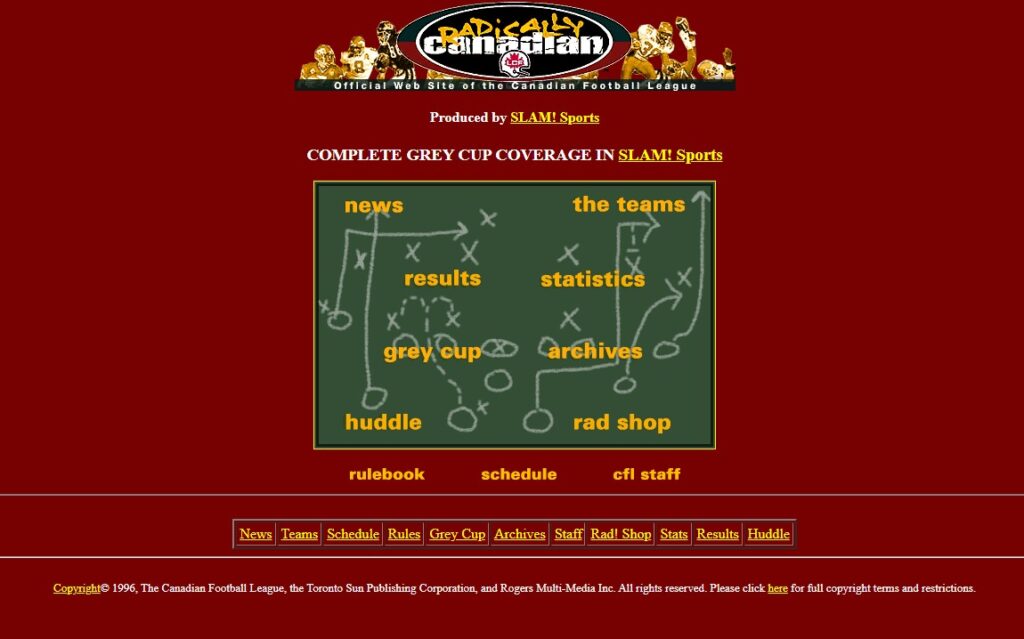
The CFL’s homepage in 1996
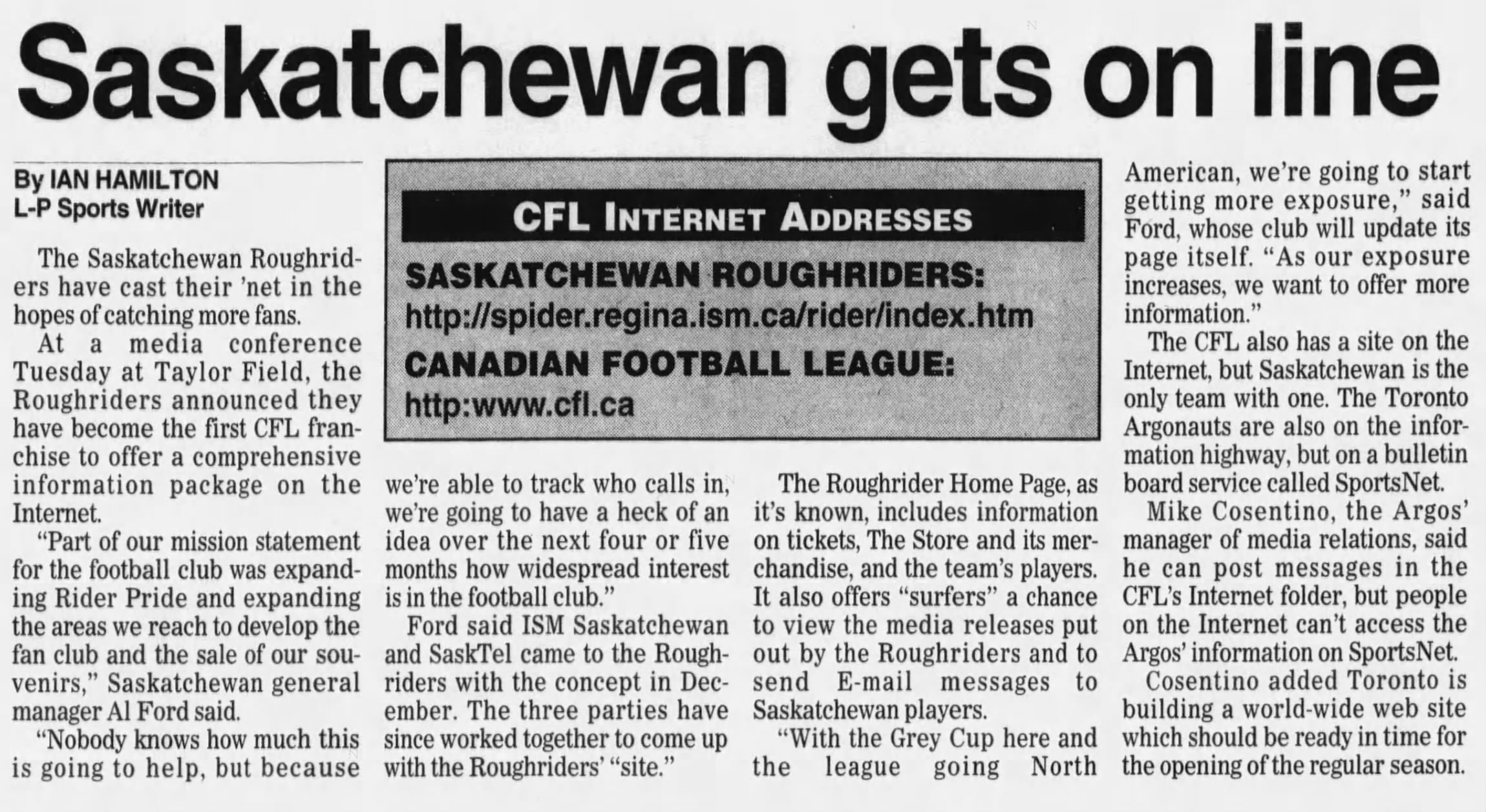
The Canadian Football Leagued launched its CFL.ca website just prior to the 1995 season. Like most websites of this era, it consisted largely of blocks of text with some limited graphics. Remember, people connected to the Internet via dial-up in those days. The site comprised simple static pages featuring team information, schedules, game scores, and statistics. The Saskatchewan Roughriders were the first team to launch an official website. The Riders went online in May of that year, a site that would eventually become riderville.com.
Article in the Regina Leader-Post about the Saskatchewan Roughriders becoming the first CFL team to have its own website (31 May 1995).
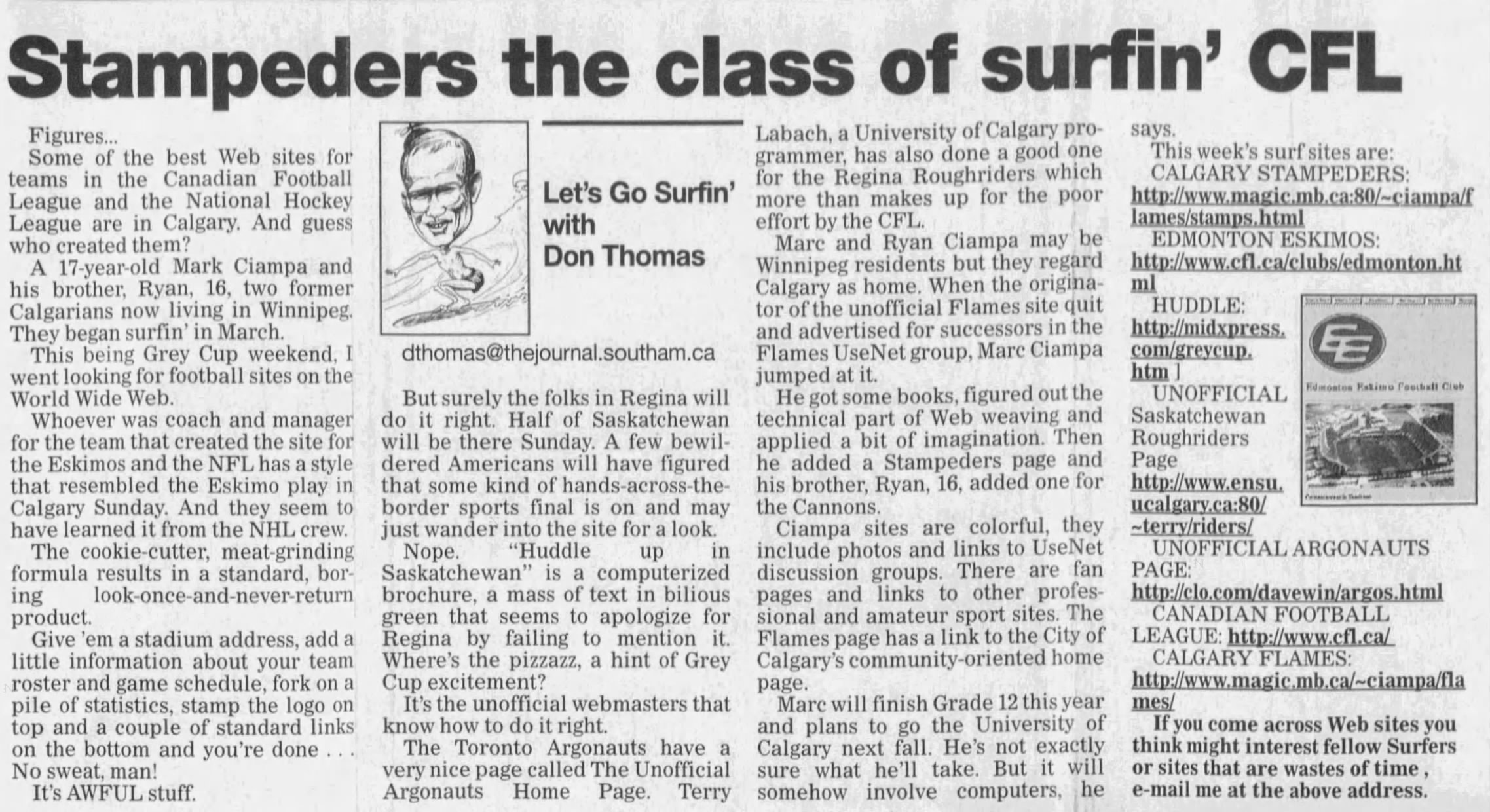
Several other teams had unofficial webpages, usually designed and maintained by computer hobbyists who happened to be fans of the team. For instance, the Calgary Stampeders’ website was designed by two teenaged brothers Mark and Ryan Ciampa. Often, these webpages had convoluted URLs that seem so awkward today but were not out of place in the 1990s.
Edmonton Journal article praising the Calgary Stampeders’ website designed by brothers Mark and Ryan Ciampa (16 Nov 1995)
In 1996, the CFL partnered with Slam Sports to launch a revamped website in line with its Radically Canadian marketing campaign. This site featured a hotspot graphic with links (a trendy web feature for the time) on the homepage and included an e-commerce store as well as the first online forum or message board for fans to connect and discuss the league. The forum was called the “Huddle.”
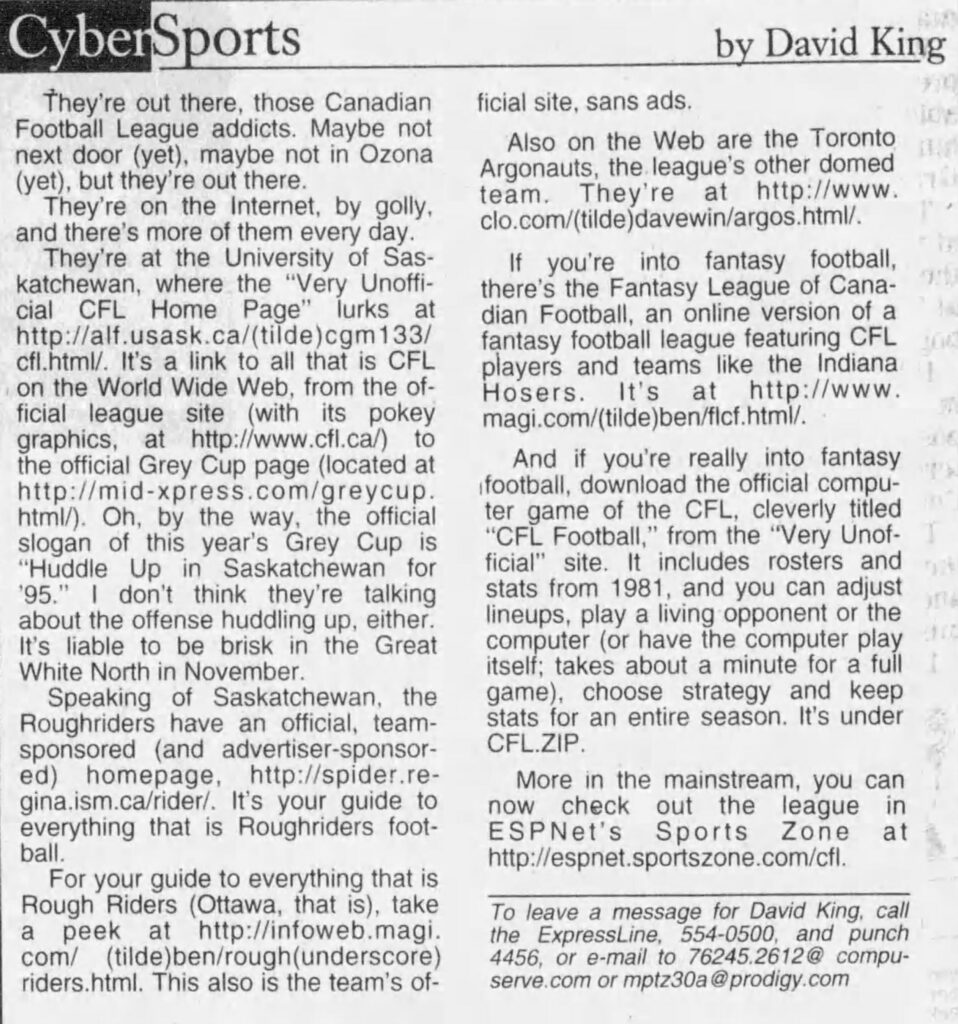
Column in the San Antonio Express about the early CFL websites (21 July 1995).
By 1998, all CFL teams had an official online presence although the sites had their own look and feel to them. In the 2000s – especially after Bob Young purchased the Hamilton Tiger-Cats in 2003 – the CFL began to incorporate a consistent theme for all CFL websites. Young’s MRX company eventually took over the design and management of CFL.ca and team sites. This led to the launch of the CFL.ca Network in 2009, with a focus on video content and social links. The Web 2.0 era had arrived. All CFL and partner websites were now under one umbrella.
Call it nostalgia, I guess. But there’s something special about looking back at the early CFL websites. It takes me back to a simpler time when I first became a CFL fan.
So, if you are a football fan who grew up in the early web era and want to relive it or if you simply want to explore these retro CFL websites, here’s your opportunity. Keep scrolling and happy surfing.
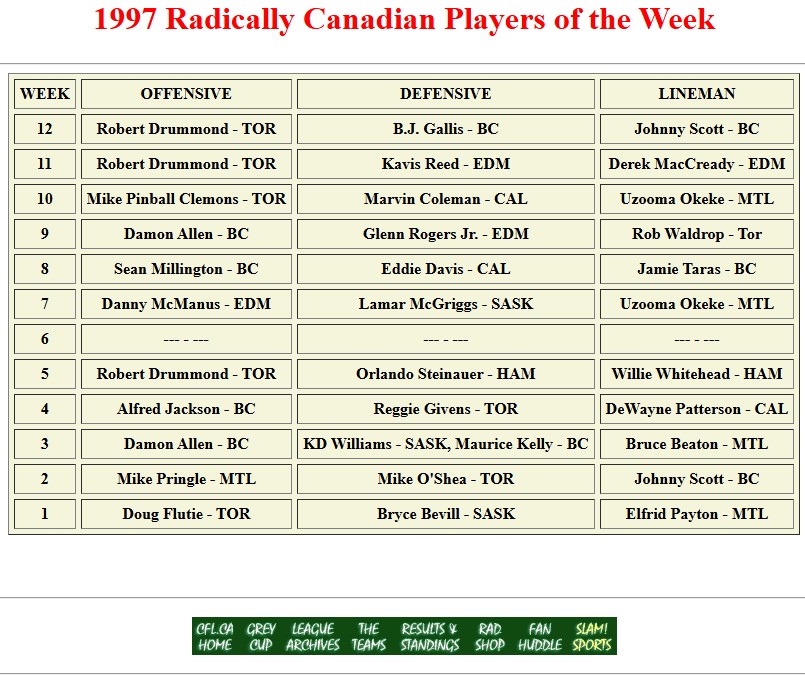
Here is the type of content you could expect to see on the CFL’s early website. A simple table with text.
The first website for the Hamilton Tiger-Cats used the domain www.tigercats.on.ca and included a virtual Roar Store.
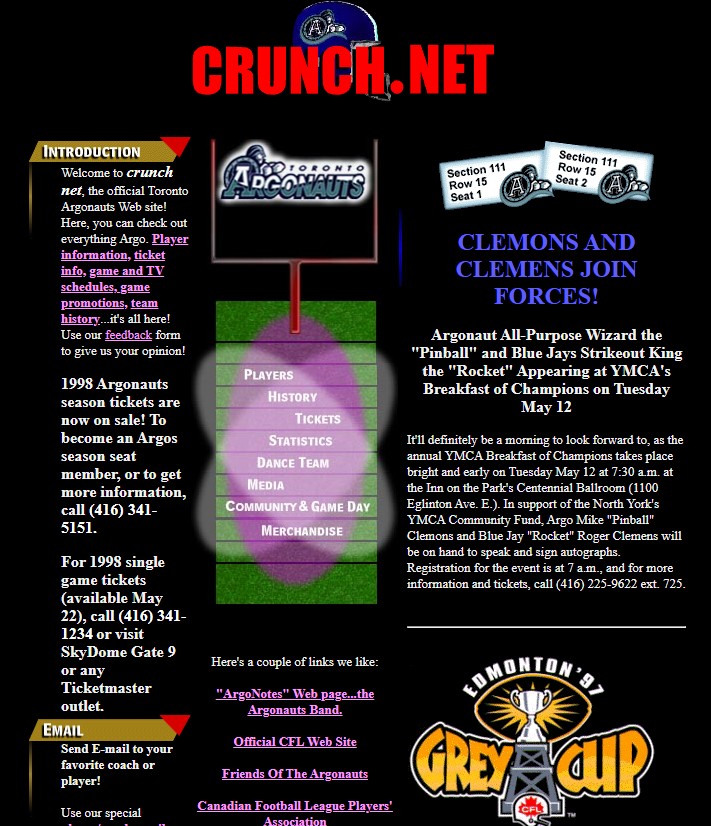
The Toronto Argonauts’ official website in 1997 was crunch.net and reflects the look and feel of websites in the mid 1990s.
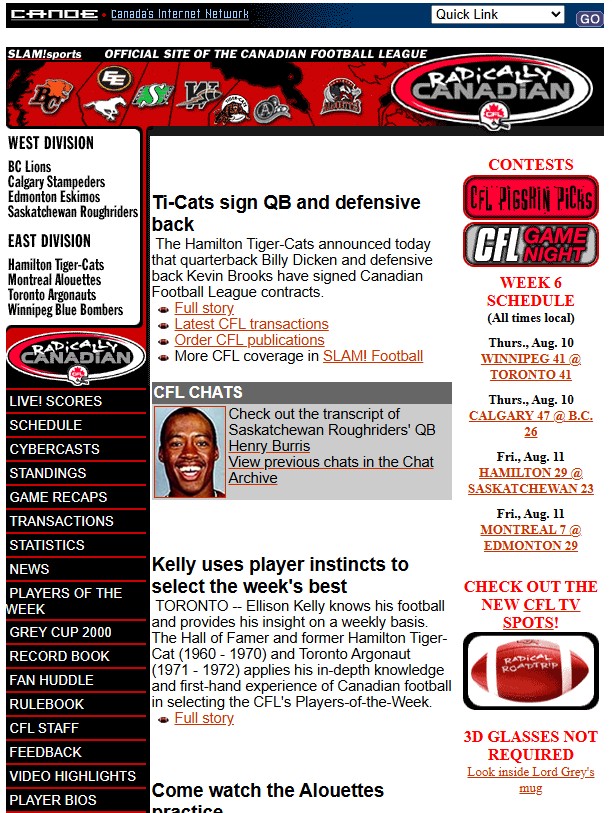
By 2000, the CFL website was a little more polished and included content such as video that more web surfers could view thanks to faster internet connections.
Now, for the really fun part…check out the Internet Archive’s Wayback Machine: https://web.archive.org/ Enter the cfl.ca URL into the search box and you will have the opportunity to play around with the old CFL websites from the 1990s and 2000s. You can try the URLs of your favourite team, as well. Keep in mind that some of the content may not load and some of the links may not work. But it should give you an idea of what surfing the CFL website was like in the “early” days.
Sources: The Edmonton Journal, 16 November 1995 The Regina Leader-Post, 31 May 1995 The San Antonio Express, 21 July 1995