Tag: Calgary Stampeders

  • Sacramento Falls in Love with the CFL

    That was the headline in my hometown’s newspaper, the Hamilton Spectator, after the CFL’s debut in Sacramento, California. I became a CFL fan in the early 1990s. It was a tumultuous time for the Canadian Football League. Some teams across the country were on the verge of collapse. Several others were struggling to stay afloat. Against this backdrop, the CFL opted to add teams in the United States. The benefits of U.S. expansion were two-fold. First, expansion fees could bring in some much-needed cash in the short term. Second, a bigger North American wide football league could open up even greater revenue (i.e., an American TV deal) long term.

    An article in the Hamilton Spectator about Sacramento embracing the CFL.
    (Morris, Jim. “Sacramento falls in love with the CFL.” The Hamilton Spectator, 19 July 1993, p. 16.)

    The first American team to join the CFL was the Sacramento Gold Miners in 1993. There was also supposed to be a team in San Antonio, Texas, as well, but it was kiboshed before playing a single down. So, the 1993 CFL season featured nine teams with the addition of the California capital.

    The Gold Miners were spearheaded by Fred Anderson, a Sacramento businessman, who had owned the Sacramento Surge of the World League of American Football, a developmental spring league for the National Football League. The WLAF ceased operations in 1992. There was considerable overlap between the Surge and the Gold Miners. The teams’ colours were similar, and many former Surge players and personnel were brought into the Gold Miners’ organization. Kay Stephenson reprised his role as Sacramento’s head coach, having coached the Surge to the 1992 WLAF championship.

    Because of U.S. labour laws, the Gold Miners were not required to have any Canadian players on their roster. Instead, they played with an all-American lineup. Some suggested this gave Sacramento a unique advantage over their Canadian counterparts. Yet, the team did struggle as an expansion team while adapting to the Canadian game.

    The Gold Miners played their home games at Hornet Field on the campus of Sacramento State university. It was a rather bare bones stadium comprising temporary bleachers and portable washrooms. Nevertheless, the stage was set for a historic debut of Canadian football in northern California.


    July 17, 1993

    The Gold Miners and Stampeders about to go head to head in Sacramento
    Voet, Gary. “Today’s Game at a Glance.” The Sacramento Bee, 17 July 1993, p. 21)

    The Sacramento Gold Miners opened the 1993 season with a two-game road trip, losing both games in Ottawa and Hamilton. Their first home game was played on Saturday July 17th against the Calgary Stampeders, the defending Grey Cup champions, led by marquee quarterback Doug Flutie.

    Marking the field at Hornet Field in Sacramento prior to the CFL’s debut (The Sacramento Bee)

    A crowd of 20,082 filed into Hornet Field that night to see a great offensive display of football. Flutie and Sacramento quarterback David Archer lit up the scoreboard in what was truly a wild west shootout. You couldn’t have asked for a more exciting game to introduce Sacramento fans to the CFL.  Ultimately, the Stampeders came out on top 38-36. The Gold Miners dropped to 0-3.

    Coverage of the historic first CFL game in Sacramento from a Sacramento perspective.
    (Voet, Gary. “Miners lose a shootout to Calgary.” The Sacramento Bee, 18 July 1993, p. 25.)

    Sacramento finished their inaugural season with a 6-12 record, last place in the West Division. They were somewhat better the following year but still missed the playoffs in a competitive West division. Unfortunately, the Gold Miners would leave Sacramento following the 1994 season. After failing to secure a new stadium or upgrades to Hornet Field, Fred Anderson relocated the Gold Miners to the then-still-new Alamodome in San Antonio in 1995 where they became known as the Texans. In 1996, the CFL ended its American expansion experiment and returned to being an all-Canadian league.

    I reached out to award-winning journalist Bob Graswich, who was a columnist for the Sacramento Bee during the Gold Miners’ CFL run. His column praising the Canadian game resonated with me because it was exactly how I felt (and still do!) about the CFL when compared to the big bad NFL. Reading that sentiment from an American writer helps validate my position.

    Graswich told me the CFL was a “breath of fresh air” for Sacramento. “It was an exciting game, designed for the fans.” An antithesis of the NFL. He speaks very highly of Fred Anderson, saying he was somebody that was difficult not to like. Fred was a Sacramentan through and through, and he reluctantly moved the team only after he ran out of options. Graswich, who visited Anderson before his death, said Fred was truly disappointed that he couldn’t make the CFL work in Sacramento.

    A column by Bob Graswich praising the CFL. Sums up my thoughts perfectly.
    (Graswich, R.E., “Thanks, Fred: You’ve givenus a better game.” The Sacramento Bee, 18 July 1993, p. 23.)

    Fred Anderson was no doubt the most committed of the U.S. team owners. Perhaps under different circumstances and in a different time, things could’ve worked out better. Ironically, years later Sacramento State upgraded Hornet Field and renamed the field in Anderson’s honour – a fitting legacy for a man who did so much for football in Sacramento.

    Perhaps it was the novelty factor. Perhaps it was the name and logo, which I really liked. Whatever the reason, I purchased a Sacramento Gold Miners t-shirt. It was one of my favourites, and I still have it. Well, my daughter actually took it and still wears it to school. How’s that for vintage CFL USA cool?

    It didn’t last long. But football fans in Sacramento enjoyed it while they had it. For a brief period over thirty years ago, Sacramento indeed fell in love with the CFL.


    I remember watching this game on television. My family had just returned from a summer road trip to northern Ontario and Ottawa. We made it home just in the nick of time to catch the game on CBC. I really felt like I was watching the beginning of something big. Seeing Americans embrace Canadian football seemed so satisfying to me at the time. It still does, really.

    Back home in Calgary, Tom Elder was also watching this game with excitement. Tom has an extensive library of old CFL games on his Calgary Stampeders Classics YouTube channel . You can watch the historic Calgary-Sacramento game below. Please consider contributing to Tom’s project if you can. It takes a considerable amount of time, resources, and effort to help preserve some of these great CFL memories.

  • Remembering My First CFL Game

    We all remember the “firsts” of things. Like the first day of school or a first date. We know the first person to do this or that. Or something that happens for the first time in history. You get the picture. Today I want to take a stroll down memory lane and remember a first for me: my very first CFL game.

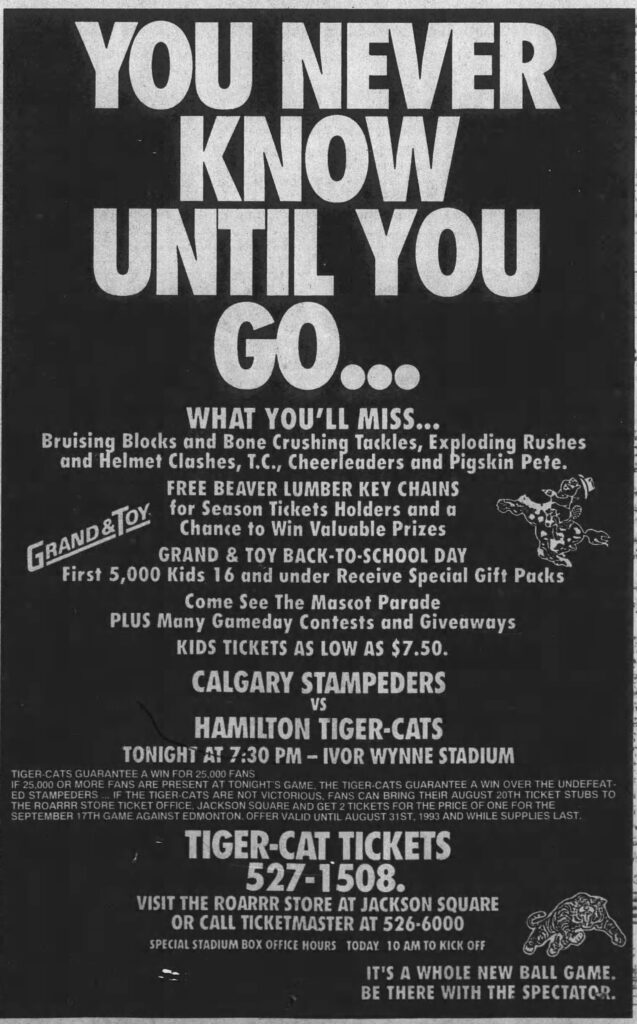
    An advertisement for the Hamilton-Calgary game (Hamilton Spectator, 20 August 1993, p. 19.)

    It’s August 1993. Summer holidays are winding down. The effects of recession are still wreaking havoc in Hamilton. And the Tiger-Cats are in a whole lot of trouble. Against this backdrop, I attended my very first Canadian Football League game.

    However bleak the situation was heading into the game on August 20, 1993, yours truly was about to have the time of his life. My brother and I had been talking about going to a Ti-Cat game for some time, but we were both students and didn’t have much money. There was a lot of media focus on this particular game but for all the wrong reasons. Quite frankly, there was a real risk of the team going under if fans didn’t turn out in droves for the game. So, it was now or never for us. Our Nan ended up giving us money to purchase tickets. We were off to watch CFL football at old Ivor Wynne Stadium.

    “You Never Know Until You Go advertisement.” Hamilton Spectator, 20 August 1993, p. 17.

    Hamilton was 3-3 going into this game. Not bad and good enough for second place in a weak East Division. The opponent that night was the mighty Calgary Stampeders, the class of the CFL, led by quarterback Doug Flutie. Hamilton had their own crop of talented players, too: receiver Earl Winfield, defensive end Tim Cofield, and a rookie linebacker named Michael O’Shea to name a few.

    I remember walking into Ivor Wynne Stadium and being instantly engulfed by the game day excitement. Vendors selling popcorn. Programs for sale. The smell of concession food. We bought a pop that came in a plastic souvenir cup featuring an imprinted image of Ivor Wynne Stadium and then made our way up the stairs and got into our seats (Section 7 in the north stands as I recall) to watch the players warming up. “Seats” is rather generous; they were simply benches – backless and not at all comfortable. But that was okay.15-year-old me could handle that just fine.

    I was blown away by the sheer size of the field. Watching CFL football on TV really doesn’t do the field size any justice. Being able to panoramically view the whole field and stadium is still something that excites me. The starting lineups for both teams were introduced. The PA announcer was Bill Stirrup, who was one of the best. The crowd playfully jeered the visitors and applauded each Tiger-Cat when their name was announced. The national anthem was sung, the coin toss was held, and a man wearing a bowler hat named Pigskin Pete led the crowd into the famous Oskee Wee Wee cheer. It was time for kick-off.

    Unfortunately for us Ti-Cat fans it didn’t start off well at all. Calgary quickly scored…twice. Within three minutes, the Stampeders had two touchdowns and were up 14-0. Calgary continued to dominate and extended their lead to 21-0 only halfway through the opening quarter. Yikes. Around this time, I remember a couple arriving late to their seats only to look at the scoreboard and shake their heads in utter disappointment.

    I forget what the halftime entertainment was or if there even was any. In those days they often had contests that were kind of fun like the “ball in the booth” where a fan used a giant sling shot to try and put a ball into the CHML radio broadcast booth that sat atop the south stands.

    The Tiger-Cats managed to put up a measly 12 points in the first half. Defence ruled the game for both sides in the second half. Hamilton was shut out and Calgary only managed a single and a field goal. But Calgary had built up such a large early lead that it didn’t matter. Final score: Calgary 31 Hamilton 12.

    The Tiger-Cats dropped to 3-4. Hamilton ultimately finished the 1993 season with a dismal 6-12 record. There were 19,402 fans in attendance at Ivor Wynne that night. A little less than the team had wanted but certainly better than the sub-16,000 crowds the previous two games produced. In other words, there was a glimmer of hope.

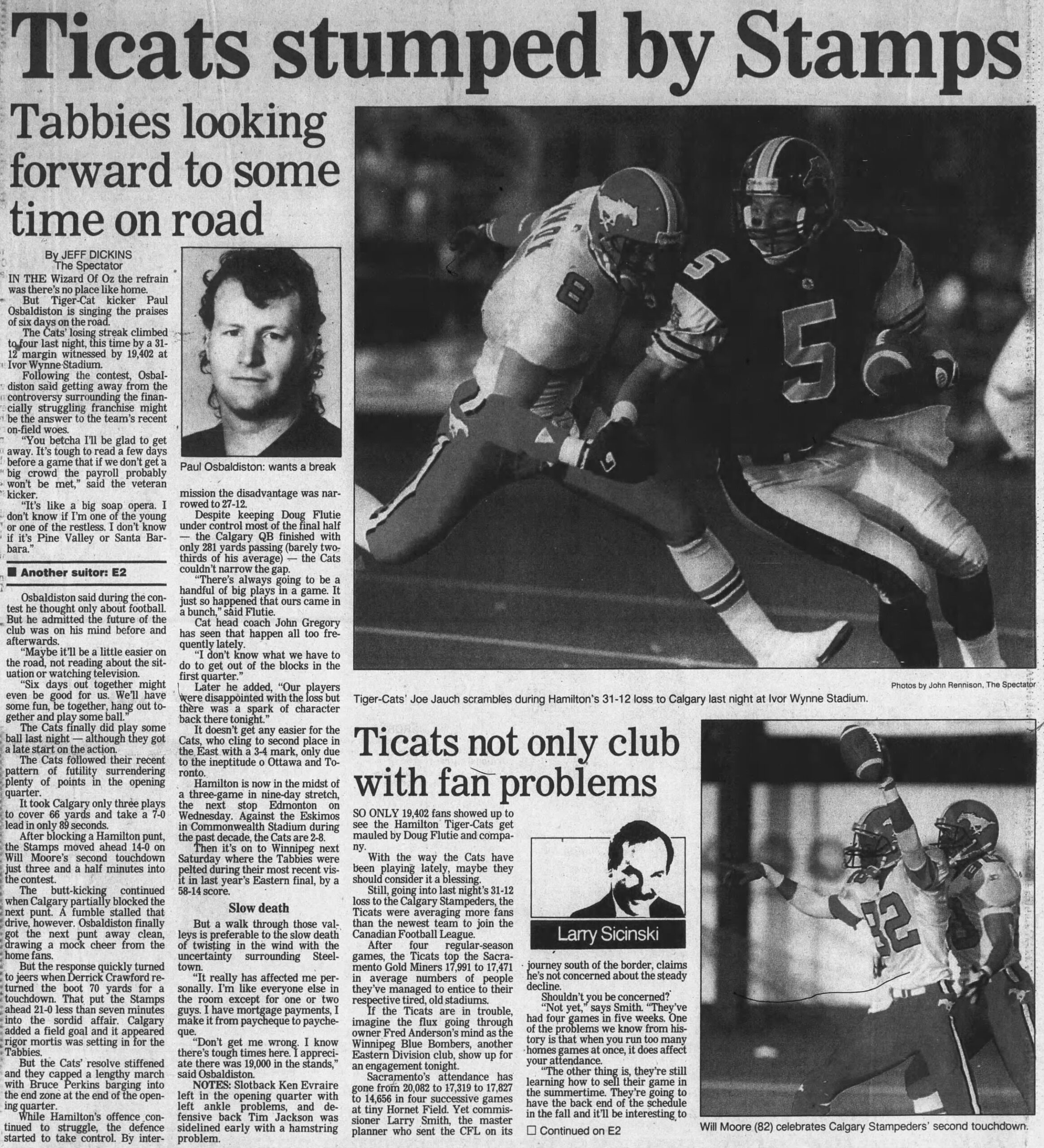
    Dickens, Jeff. “TiCats stumped by Stamps.” Hamilton Spectator, 21 August 1993, p. 39.

    Fans exited the stadium with mixed emotions. Many were fuming over the home team’s poor play. Others mused aloud whether they had just seen the last of the Tiger-Cats. Dejection. Anger. Sadness.

    For me though it was different, and I kind of felt a bit guilty. Sure, the Ti-Cats just got clobbered. But I had finally got to see my first CFL game in person. I was still excited. I was also hooked. And I wanted more. As luck would have it the next home game was going to be against the archrival Toronto Argonauts in the so-called Labour Day Classic. My brother and I certainly didn’t want to miss that. We would have to use our charm on our Nan again and score tickets.

    32 years later I look back at some of the great football games I’ve had the good fortune of attending. I’ve seen some memorable classics and have witnessed some truly iconic moments in Canadian football. The game on August 20, 1993, was definitely not one of those. For all intents and purposes, it was a dud. A stinker. But for me it represented something big and something special. It was a first for me. My first football game. And that was the day I became firmly entrenched as a life-long fan of the Hamilton Tiger-Cats and the CFL.


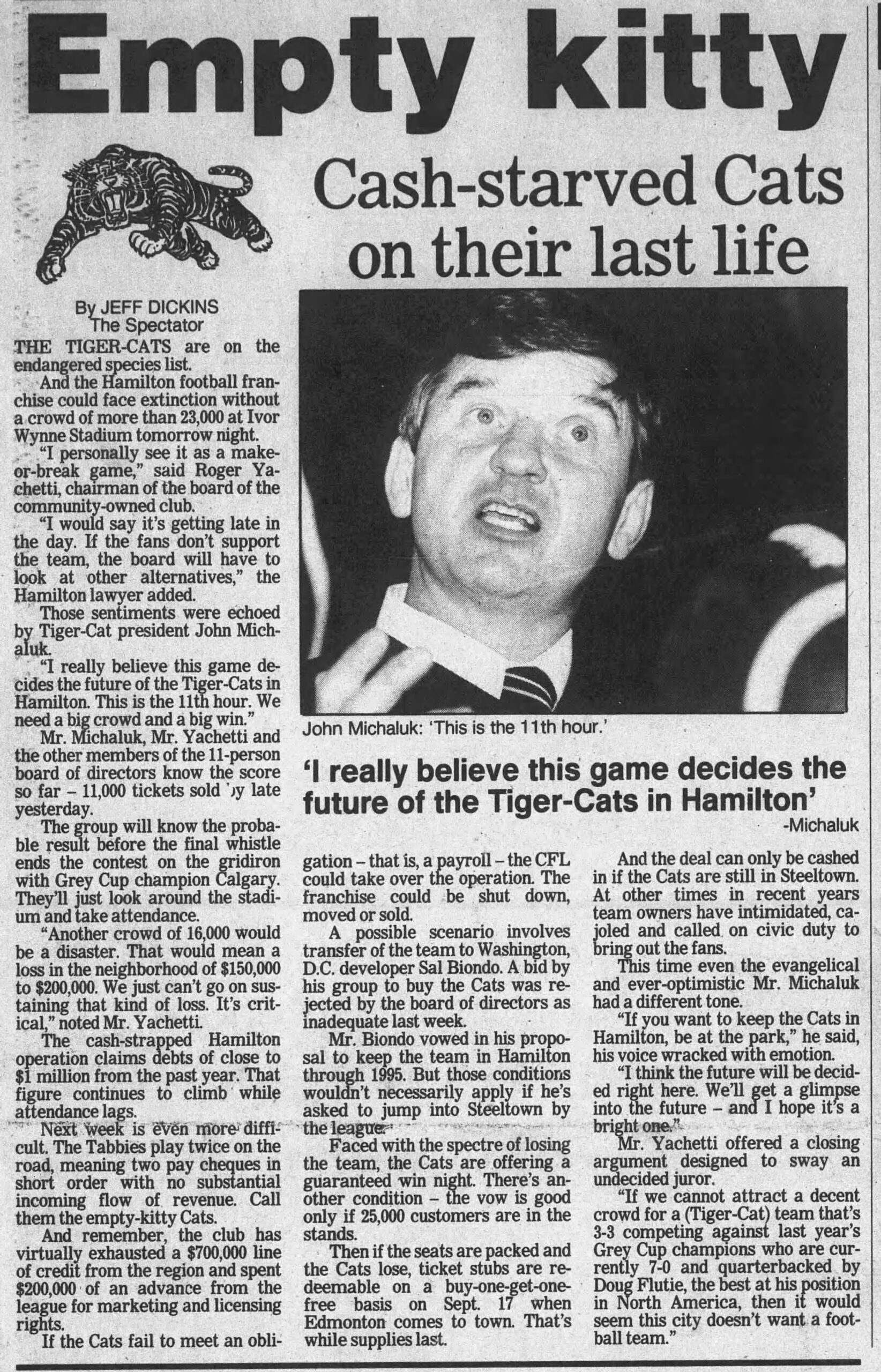
    This is the article in the Spectator that really prompted my brother and me to attend our first Tiger-Cat game in 1993. We would become season ticket holders in 1995.

    Dickens, Jeff. “Empty Kitty.” Hamilton Spectator, 189 August 1993, p. 1.
  • “Stampeders” New Football Name

    This is the second of a series of posts that will explore the stories behind the names of the existing Canadian Football League teams. Check out the previous post on the BC Lions.


    Conventional wisdom says that the Calgary Stampeders are named after the world famous Calgary Stampede rodeo. The Stampeders moniker has been used by numerous Calgary-based teams over the years in football, hockey, and baseball.

    In the first half of the 20th century, Calgary’s senior football teams included the Tigers, Canucks, Fiftieth Battalion, Altomahs, and Bronks.

    When the Second World War ended, senior football returned to Calgary after a five-year absence. The new club was founded on September 27, 1945 as a cooperative.

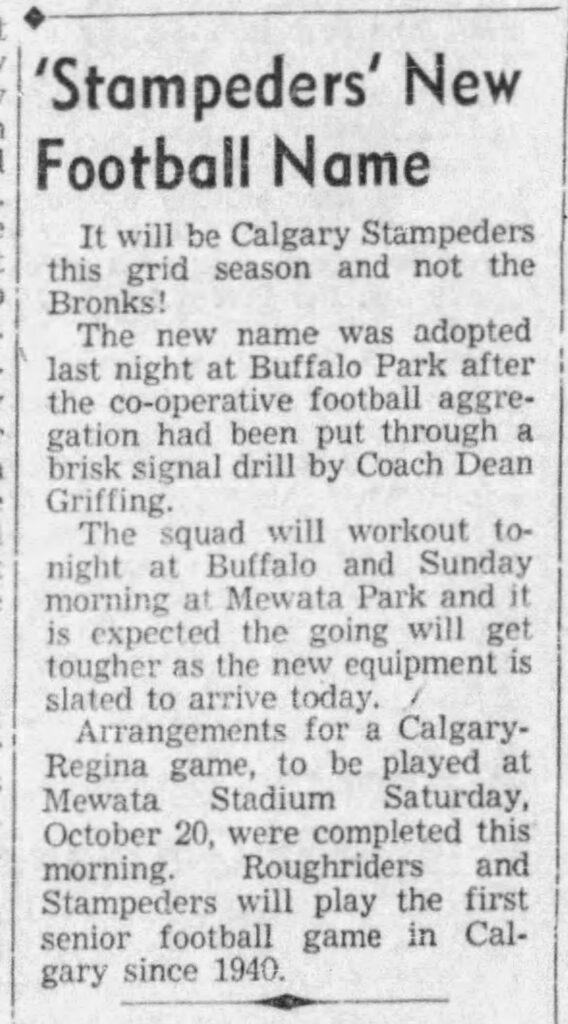
    Calgary joined Regina and Winnipeg in a condensed 1945 WIFU season. On October 11, the Calgary Herald reported that the new team would be called the “Stampeders” instead of the Bronks, Calgary’s former WIFU entry.

    One account indicates that the team was called the Stampeders to help advertise “Stampede Beer” produced by the Calgary Brewing and Malting Company (Source: A history of Football in Calgary, Canadian Football Research Society). As a new cooperative money was tight so any source of revenue would be welcomed.

    The newly christened Calgary Stampeders played their first game on October 20, 1945 at Mewata Stadium against the visiting Regina Roughriders.