Tag: Canadian Football League

  • Canada’s First National Commissioner of Football

    As the CFL formally introduces Stewart Johnston as its new Commissioner this week, Canadian Football History looks back at the very first CFL Commissioner: Gerald Sydney Halter.
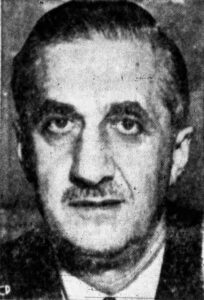
    Sydney Halter was born and raised in Winnipeg, Manitoba. He held various roles, including treasurer and president, in the Winnipeg Blue Bombers organization before being named the Commissioner of the Western Interprovincial Football Union in 1953.
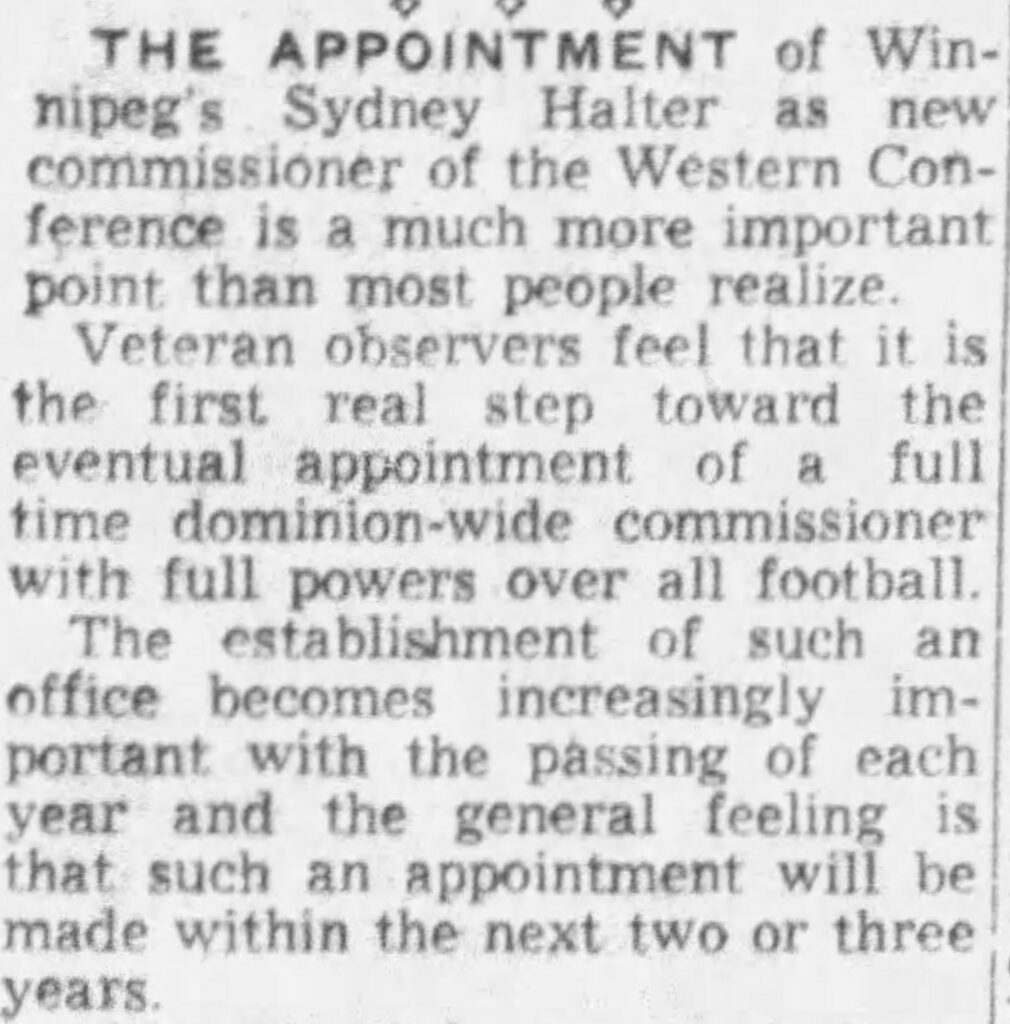
    In 1956, he became the Registrar of the Canadian Football Council (CFC), a newly formed umbrella organization for both the WIFU and the eastern Interprovincial Rugby Football Union (the “Big Four”).

    Well regarded in football circles across the country, Sydney Halter was named “Canada’s first national commissioner of football” when the Canadian Football League was established by the CFC in 1958. By the way, I totally think the CFL should adopt “National Commissioner of Football” as the official job title for its top role.

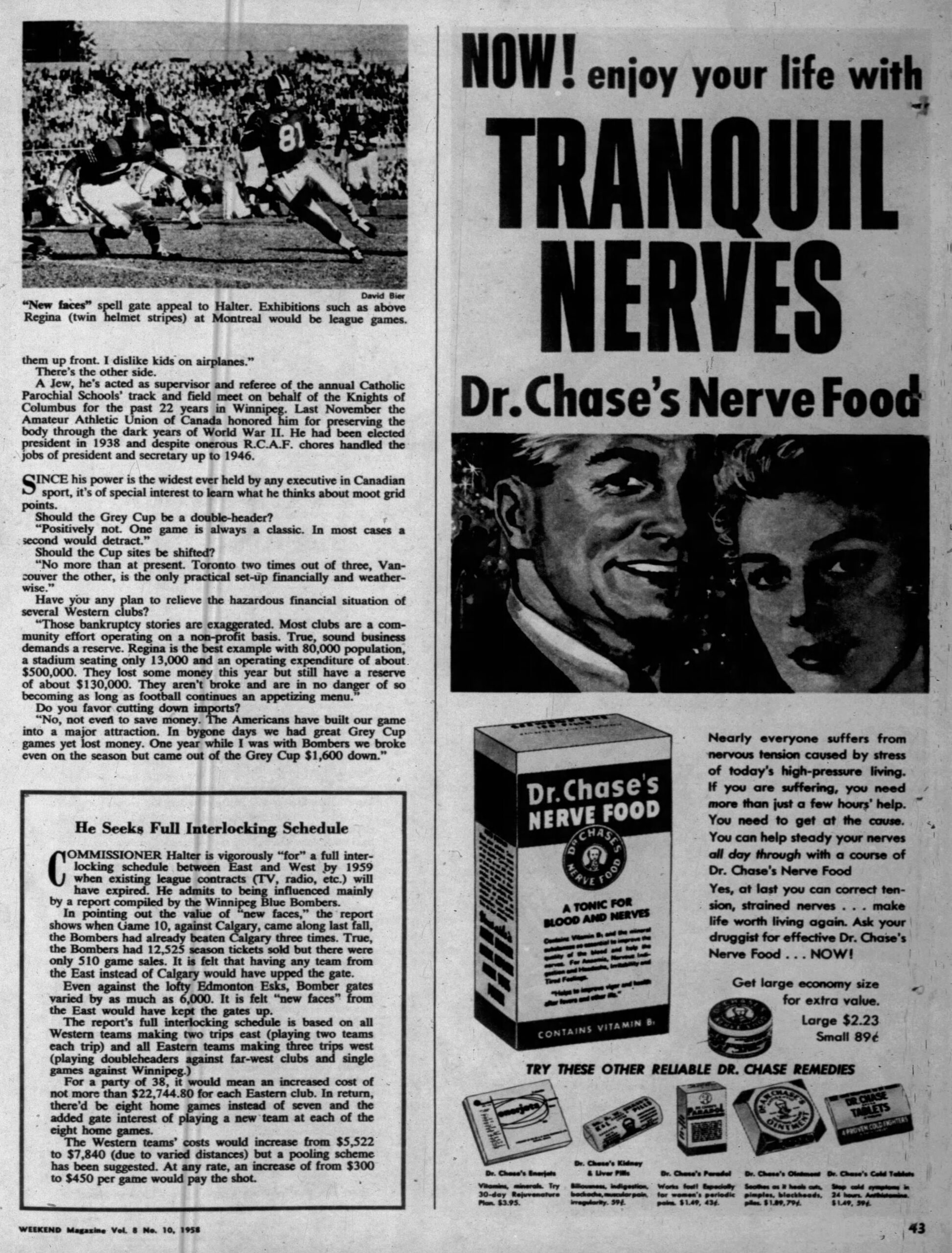
    Described as a chain-smoking bachelor or “loner” by some, Sydney Halter wielded quite a bit of power in his role as Canada’s professional football boss. The article below (click on them to enlarge) is lengthy but well worth the read. It portrays Halter as a straight shooter and touches on how he didn’t hesitate to deliver fines to players and teams – or fans who interfered in the game. Apparently, home fans tackling opposing players from scoring touchdowns was a thing. Yikes.
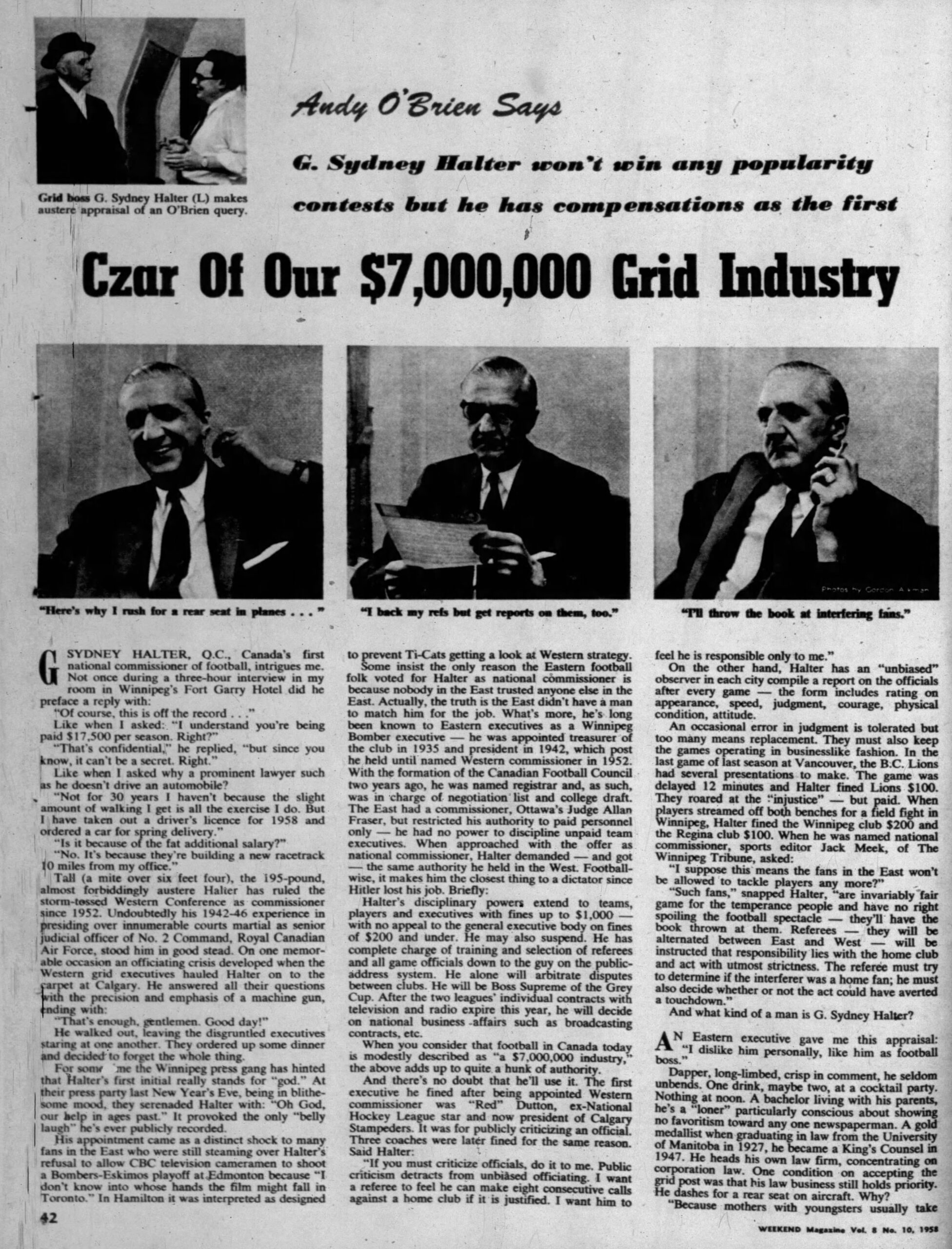
    O’Brien, Andy. “Czar of Our $7,000,000 Grid Industry.” The Hamilton Spectator, 8 March 1958, p. 90.
    O’Brien, Andy. “Czar of Our $7,000,000 Grid Industry.” The Hamilton Spectator, 8 March 1958, p. 91.

    Sydney Halter served as the CFL’s commissioner until 1966. He was an early advocate for an interlocking schedule between the East and the West. A lawyer by profession, he also served in the Royal Canadian Air Force and held leadership positions in other Canadian sporting organizations outside of football.

    Sydney Halter is a member of the Canadian Football Hall of Fame, inducted in 1966, as “the architect of the modern-day Canadian Football League.” He died in 1990. He was Jewish and was inducted posthumously into the International Jewish Sports Hall of Fame in 2005.

  • Remembering the Radically Canadian Marketing Campaign

    In 1996, the Canadian Football League was faced with a dilemma. Having just ended a three-year run of having teams based in the United States, the CFL was retreating north and returning with an all-Canadian lineup. The Baltimore Stallions, the defending Grey Cup champions, relocated to Montreal to become the reborn Alouettes. How could the CFL create an opportunity out of its failed American expansion experiment?

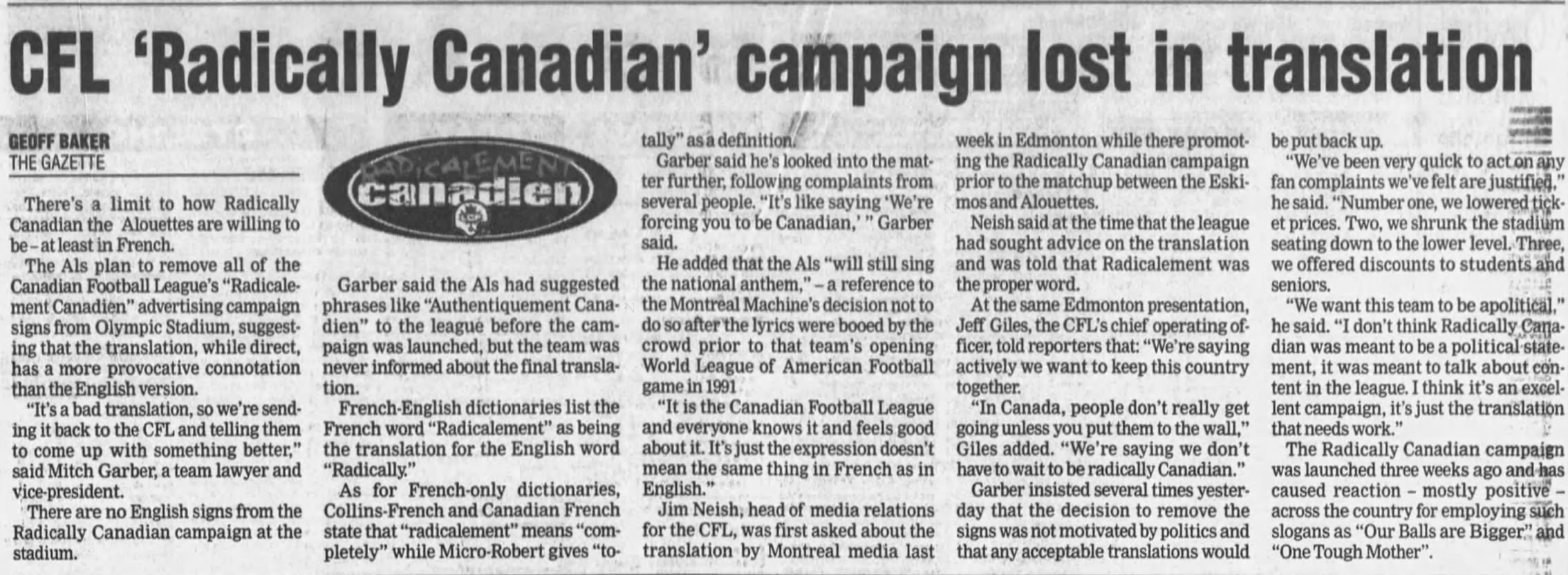
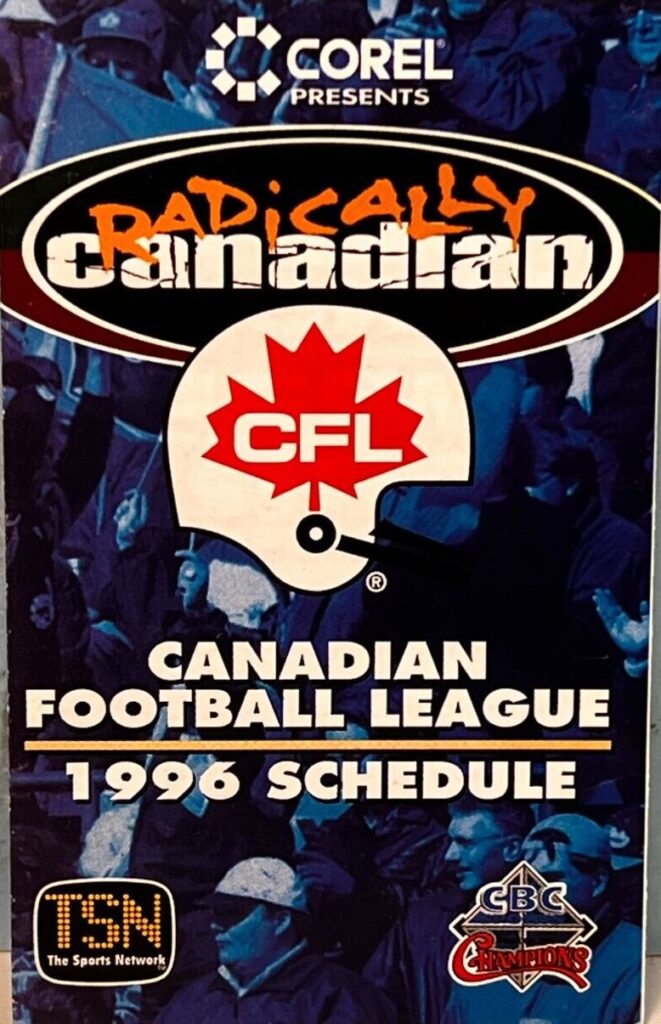
    Go radical. That’s how. As the season was about to kick off, the CFL launched a national “Radically Canadian” marketing campaign that was both patriotic and quite edgy. While “Radically Canadian” instilled a sense of Canadian swagger that was rather rare, the campaign also included slogans such as “We Play By Our Rules”, “It’s Called a Rouge, Get the Point?”, “One Tough Mother”, and the famous “Our Balls Are Bigger.”

    1996 CFL Schedule with the Radically Canadian Logo
    The 1996 CFL schedule featuring the Radically Canadian logo
    (source: Canadian Football Research Society)

    The Radically Canadian logo appeared on the league’s website, publications, and promotional materials. Fans could purchase t-shirts, hats, and sweatshirts from the online “Rad Shop.” There was even a Radically Canadian dance CD produced. You can find these items for sale secondhand on a number of online sites.

    Of course, the campaign wasn’t without controversy. Some found the “Our Balls Are Bigger” and “One Tough Mother” references too risqué.  Some teams didn’t carry merchandise with the slogans for fear of offending customers. And, “Radically Canadian” didn’t translate well into French, causing fears its use could potentially stoke English-French tensions that were running high in the mid 1990s.

    Source: Montreal Gazette, 13 July 1996, page 63 (newspapers.com)

    But, in the end “Radically Canadian” represented a serious effort and investment by an old league looking to reinvigorate itself and broaden its appeal to a younger Canadian fanbase it would need to cultivate for the future. As a marketer and fan, this author gives the campaign a thumbs up. It’s been almost thirty years since the CFL introduced this marketing campaign. Given the current environment, one has to wonder if now just might be a good time to dust off the old “Our Balls Are Bigger” merchandise and once again be “Radically Canadian.”

  • The Maple Leaf Forever: An Evolution of the CFL Logo

    It’s been 60 years since Queen Elizabeth II proclaimed Canada’s national flag featuring the prominent red maple leaf. The maple leaf is arguably the most Canadian symbol of all and has been used to represent Canada since the 19th century.

    So, it’s not surprising that this quintessentially symbol of Canadiana has always been featured one way or another in the logo of the Canadian Football League.

    When the CFL was founded in the late 1950s, the fledging league’s logo was what one would expect from the period: an “official” looking crest-like emblem similar to what you would see on an old company letterhead.

    The original CFL logo

    In the 1970s, the league adopted a more modern logo – the classic red maple leaf with the CFL/LCF initials inside a football helmet. Perhaps the CFL took inspiration from the new flag in incorporating the maple leaf into a logo that would span the next three decades.

    Classic LCF helmet logo
    Classic CFL helmet logo

    At the turn of the millennium, the CFL adopted a new logo featuring a stylized slanted maple leaf meshed with a flying red football atop bolded CFL/LCF initials.

    CFL logo adopted in 2000s

    The current CFL logo has been in use since the 2016 season. The maple leaf is minimalized with the focus on an abstract image of a football featuring three hashmarks and the CFL/LCF initials being prominently displayed.

    Current LCF logo
    Current CFL logo

    As Canadians find themselves celebrating the anniversary of their national flag amidst a newfound sense of Canadian patriotism, you have to wonder what may be in store next for the CFL’s logo. Does the league stick with the relatively young status quo? Or, do new opportunities arise for the league to further embrace its Canadian identity and perhaps give more prominence to the maple leaf once again?

    (You can check out more CFL logos at SportsLogos.Net)

  • The Very First CFL Schedule

    Happy New Year. As football fans across the country (im)patiently await the release of the 2025 CFL schedule, let’s go back in time to the very first CFL season schedule in 1958.

    In 1956, the eastern (IRFU) and western (WIFU) professional football leagues in Canada formed an umbrella organization called the Canadian Football Council. Two years later on January 19, 1958, the CFC was renamed the Canadian Football League.

    The inaugural CFL season kicked off on Thursday August 14, 1958 in Winnipeg with the Blue Bombers hosting the Edmonton Eskimos. Winnipeg won 29-21.

    For the first few CFL seasons eastern and western teams did not play one another. All regular season games were against teams in their respective conferences; interconference games didn’t occur until 1961. The only time the east played the west was in the Grey Cup.

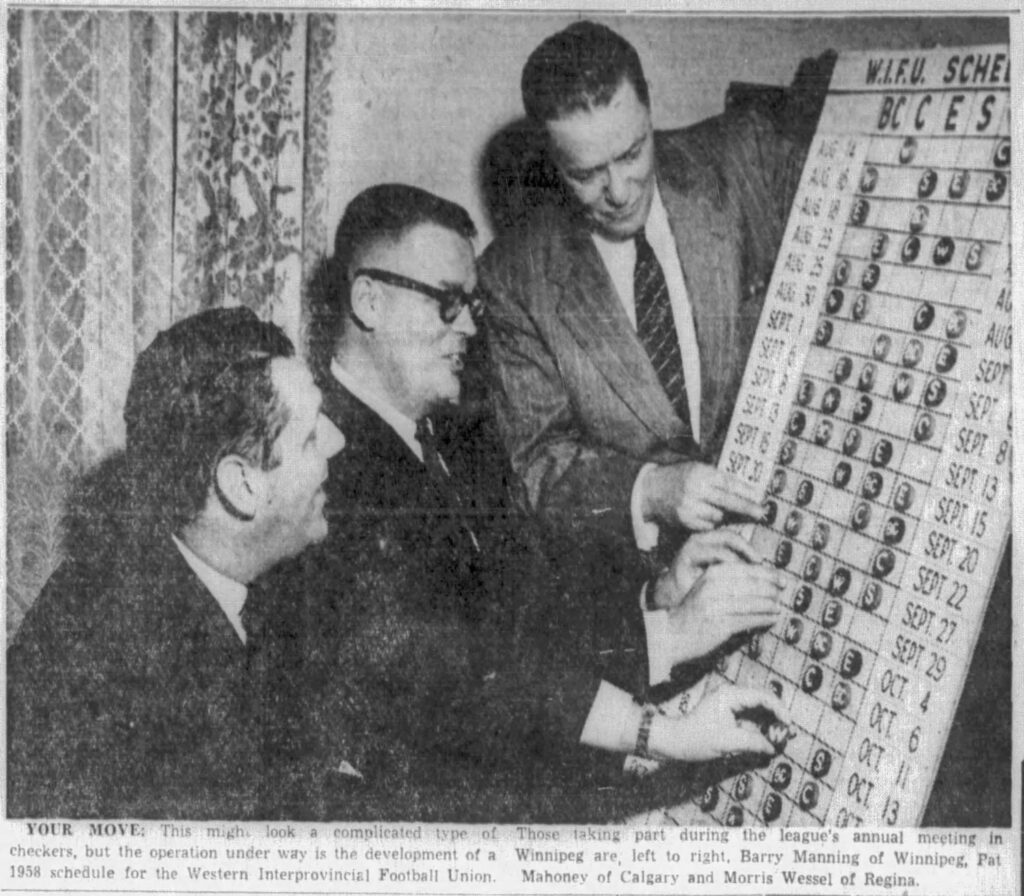
    WIFU schedule makers in 1958
    Early CFL schedule makers putting together the 1958 WIFU schedule. (Source: The Regina Leader Post, 20 January 1958, page 19.)

    A quick glance tells the tale of a gruelling schedule in 1958. Eastern teams played 14 games while their western counterparts played 16. All games were played within a short 12-week schedule kicking off in August. This meant western teams often played two games within two or three days. Ouch.

    CFLdb Statistics, an excellent online resource that is equally fun and informative, provides the full 1958 Canadian Football League schedule here: https://stats.cfldb.ca/league/cfl/schedule/1958/. Check it out and see how your favourite team did that year.

    And now, back to waiting on the 2025 CFL schedule…