Tag: Canadian Rugby Union

  • Getting Ready for the Grey Cup’s TV Debut

    It’s September 1952 and a new technology – black and white television – is taking the country and much of the world by storm. The Canadian Broadcasting Corporation (CBC) entered the TV business with two flagship stations: CBFT in Montreal and CBLT in Toronto.
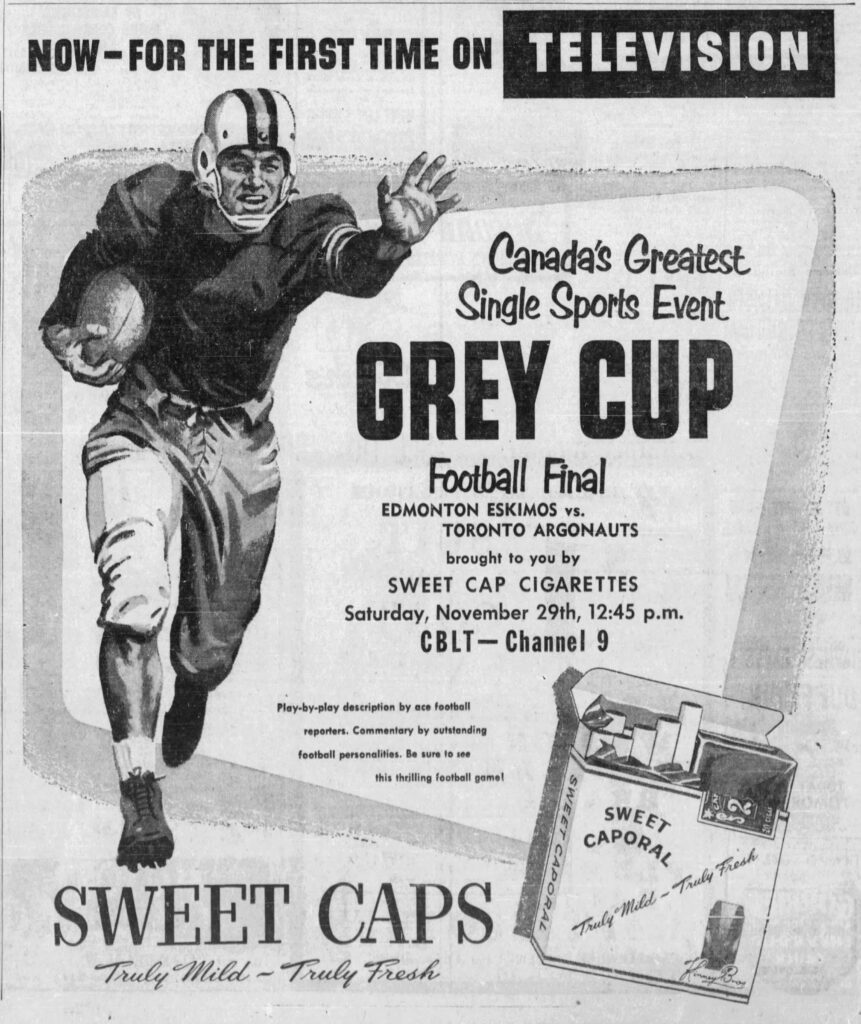
    The decision was soon made to broadcast the upcoming Grey Cup game on CBLT. The Canadian Rugby Union championship was scheduled for Saturday November 29th at Varsity Stadium in Toronto.
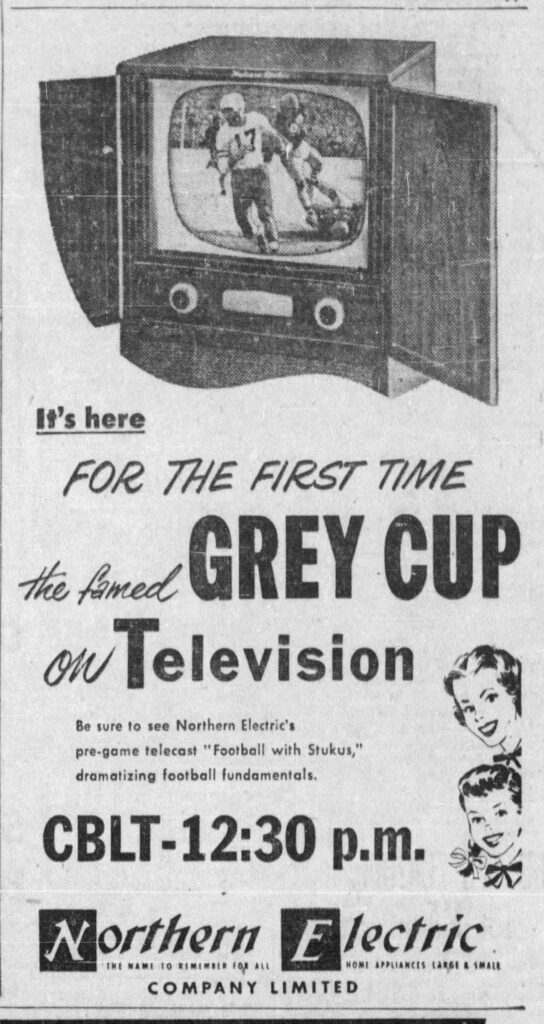
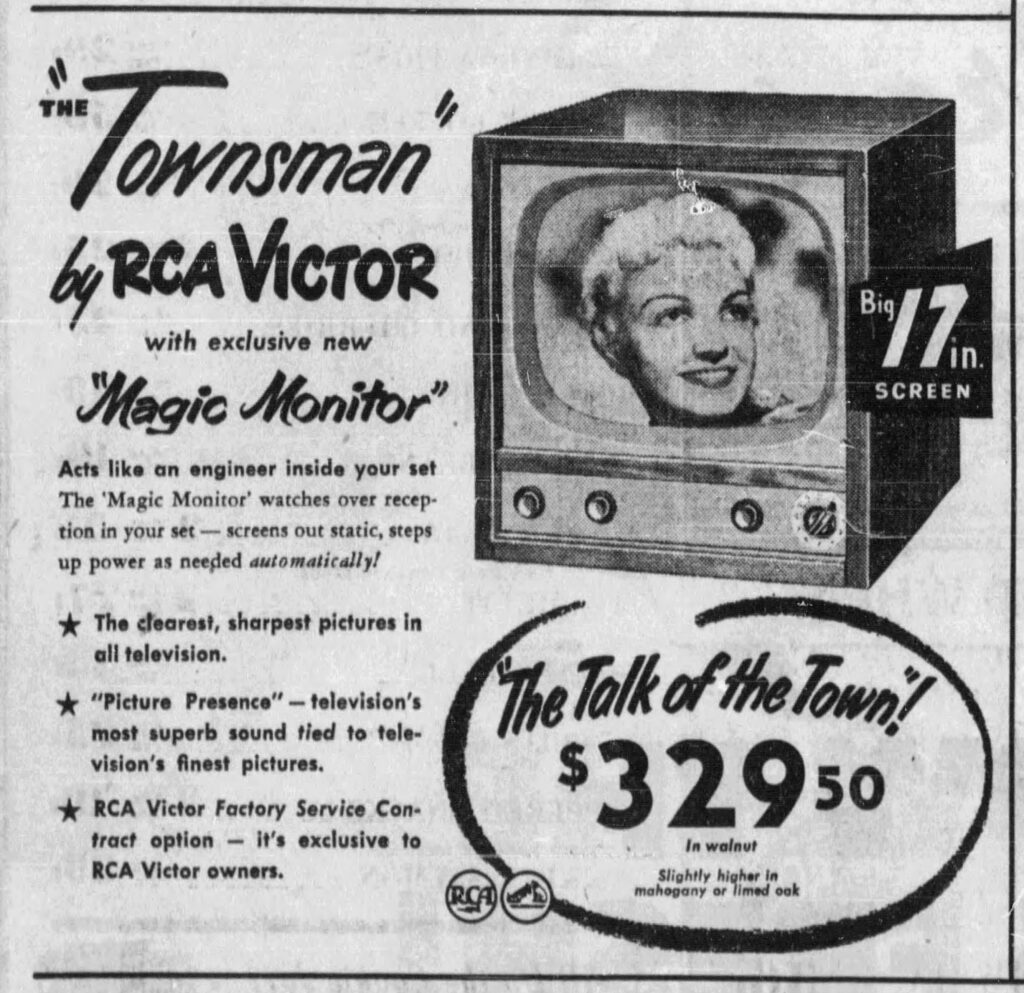
    The novelty factor of the new technology coupled with the popularity of the hometown Toronto Argonauts, who were playing in the championship, helped drive sales for television sets in Toronto. Several ads selling TVs appeared in local newspapers. These didn’t come cheap, but vendors were more than happy to set up affordable payment plans for excited football fans.
    While the Grey Cup game itself was the first Canadian football game ever televised, broadcast crews did a practice run a few days before in the playoff game between the Argonauts and the Sarnia Imperials of the Ontario Rugby Football Union. In those days, the ORFU still challenged for the Grey Cup. The Toronto-Sarnia Grey Cup semi-final game at Varsity Stadium was used as the dress rehearsal for the big game. The 1952 Grey Cup commentators Norm Marshall and Larry O’Brien were actually chosen after an audition for the roles was held during the Sarnia game.

    Notes about the TV practice run done during the Grey Cup semi-final between Toronto and Sarnia (Toronto Star, 27 November 1952)

    Pubs in and around Toronto with television sets were packed on the day of the game. Meanwhile, in nearby Hamilton, Westinghouse set up several TVs so that employees and friends could watch the game. The broadcast even included a short pre-game show hosted by Annis Stukus.

    In the end, the Argonauts defeated Edmonton by a score of 21-11 in front not only record crowd at Varsity Stadium but also tens of thousands of television viewers in the Toronto area. A new era for the Grey Cup and for Canadian television was here.


    Sources:

    Patskou, Paul. “The First Televised Grey Cup Game.” Canadian Football Research Society. Accessed October 28, 2025. https://www.canadianfootballresearch.ca/the-first-televised-grey-cup-game/.

    The Toronto Star, 27 November 1952

  • 100 Yard Fields in Early Canadian Football

    When CFL Commissioner Stewart Johnston announced sweeping rule changes to the Canadian game last month, one modification that probably alarmed traditionalists the most was the change to the size of the CFL football field. In 2027, the field will shrink from 110 yards in length to 100 yards between the goal lines.

    I can certainly sympathize with the “Save the 55” crowd. After all, we humans tend not to like change. Especially when it comes to changing something we cherish. But upon further review, it appears that 100-yard football fields are not new to Canadian football.

    In fact, early Canadian football was played on 100 yard long fields. In 1880, the very first rule in the new Canadian Rugby Football Union rule book stated that “The Grounds shall be, as near as possible, 100 yards long by 50 yards broad.” Of course, it’s important to remember that the game around this time was more like rugby football than the gridiron game we are accustomed to today. But still, that’s a small field.

    100 yard long fields continued to be the norm for several years. While the 1884 CRFU Laws of the Game stated that the field of play should not exceed 110 yards in length, in 1885, the CRFU clarified that the field should be 100 yards long by 65 yards wide.
    It appears the 110 yard by 65 yard standard was finally widely adopted by the 1890s. That is the size of the field mentioned in the rules when the new Canadian Rugby Union was formed in 1891.

    So, what’s the point of this discussion? Well, nothing really except to reiterate that Canadian football is not static. The rules and regulations of the game have been evolving since the beginning. And in the case of the 100 yard long field coming in 2027, it can be equally argued that rather than moving the CFL closer to the American game, we are instead taking Canadian football back to its early years.


    Sources:
    Rules of the Rugby Union Game of Football adopted by the Canadian Rugby Football Union, 14 September 1880
    Canadian Rugby Football Union Constitution and Laws of the Game, 1 July 1884
    The Montreal Star, 14 November 1885

  • The Founding of the Canadian Rugby Union

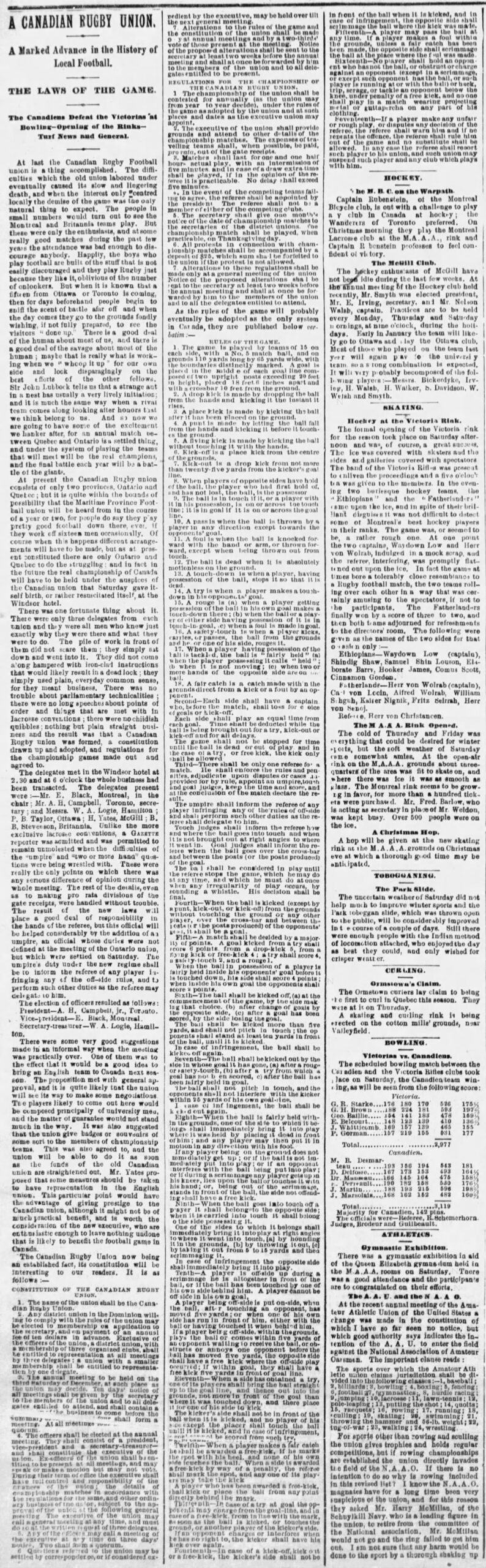
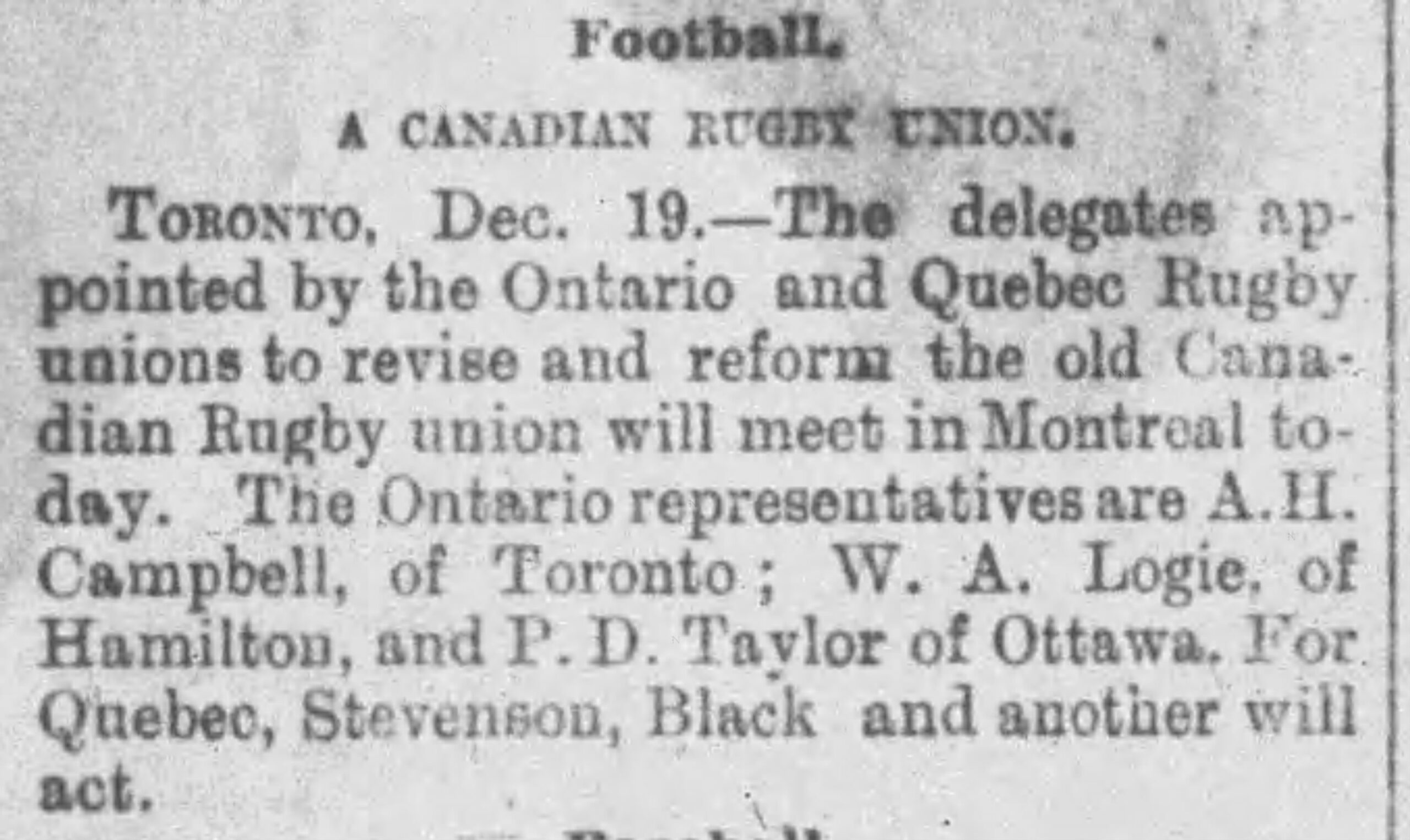
    On December 19, 1891, football representatives from Ontario and Quebec met at the old Windsor Hotel in Montreal to launch (or more accurately relaunch) the Canadian Rugby Union. The new CRU replaced the unsuccessful Canadian Rugby Football Union that was actually formed a decade earlier.

    The idea behind a new Canadian Rugby Union was for a properly run organization to oversee a common set of rules and hold a national championship game. From the onset, only teams in the Ontario and Quebec rugby football unions participated. This isn’t surprising considering much of western Canada was sparsely populated at the time. Interestingly, the Montreal Gazette mentions the potential future inclusion of clubs from the Maritimes. It seems the elusive Atlantic Canada team has been sought after much longer than we thought.

    The Gazette published an article full of praise of the new entity and those involved in creating it. According to the article, the whole thing – rules, regulations, an executive team, and a constitution – were drawn up and adopted in less then five hours. Efficient.

    Article in the Montreal Gazette about the formation of the Canadian Rugby Union
    Article in the Montreal Gazette summarizing the formation of the new Canadian Rugby Union (21 December 1891)

    At the time, Canadian football was much closer to the game of rugby than to the gridiron game we enjoy today. The article discusses the idea of the new CRU joining the English union. I’m not sure if they’re talking about the England-based Rugby Football Union or the relatively new International Rugby Football Board which the RFU had itself just joined. The more favourable proposal was to encourage a rugby side from England to come to Canada to play games against the CRU. The CRU representatives also agreed to reward members of the championship team with badges and souvenirs. Can’t argue against that.

    Over time, the Canadian Rugby Union would welcome leagues from the western provinces. The Grey Cup would become the CRU’s national championship in 1909. Canadian rugby slowly evolved into a unique brand of Canadian football with the adoption of changes such as the Burnside rules and the forward pass. The game became professional following the Second World War. And the Canadian Football League formed and seceded from the CRU in 1958.

    After all this, the Canadian Rugby Union still remained the governing body of amateur football in Canada. In the 1960s the CRU was rebranded as the Canadian Amateur Football Association. Around the same time, a new organization called the Rugby Union of Canada was formed as the governing body of rugby union football in Canada. Alas, the final separation of rugby and Canadian football was complete. Each sport would now use its own nomenclature.

    The original CRU/CAFA still plays a pivotal role in Canadian football. Today, it is known as Football Canada. It is still the national governing body of amateur Canadian football and is also responsible for the Canadian national teams that compete in international gridiron competitions.

    Spec article about Meeting to form the new Canadian Rugby Union
    Announcement in the Hamilton Spectator on December 19, 1891 about the Montreal meeting to launch the new Canadian Rugby Union.