Tag: CFL

  • Advertisements for CFL Football at BC Place Stadium in 1983

    My background is in sales and marketing. That’s what I studied at university, and that’s been my career for the last 25+ years. Coincidently, I discovered my interest in marketing around the same time I started following CFL football. That was back in Grade 10. As a marketer who likes history and nostalgia, I like looking back at vintage and retro advertising. So, I thought let’s do a blog post on some old advertisements for the CFL.

    To set the tone. The year is 1983, and the new BC Place Stadium has just been built in Vancouver. The 59,000-seat stadium is the first domed stadium in Canada. New beginnings for the B.C. Lions.

    Here are some advertisements for the B.C. Lions and CFL football that appeared in Vancouver newspapers throughout the year.

    Advertisement for BC Lions season tickets in the Province, 12 June 1983.
    Advertisement for BC Lions season tickets in the Province, 12 June 1983.

    The first game at BC Place Stadium was a pre-season match between the Lions and the Calgary Stampeders. The game featured a kick-off concert by The Guess Who.

    Advertisement for the BC Lions' first game at BC Place Stadium, an exhibition game vs. the Calgary Stampeders (Vancouver Sun, 16 June 1983).
    Advertisement for the BC Lions’ first game at BC Place Stadium, an exhibition game vs. the Calgary Stampeders (Vancouver Sun, 16 June 1983).

    The Lions hosted the Saskatchewan Roughriders in their regular season home opener at BC Place. The game was sponsored by Rothman’s and you could win a “magnificent Eskimo carving.” A different era when tobacco advertising was quite common.

    Advertisement for the BC Lions' regular season home opener at BC Place Stadium (Vancouver Sun, 23 July 1983).
    Advertisement for the BC Lions’ regular season home opener at BC Place Stadium (Vancouver Sun, 23 July 1983).

    A&B Sound, a former electronics retailer, was a corporate sponsor of the B.C. Lions. They ran the promotion below.

    A&B promo ad in the Province (30 June 1983).
    A&B promo ad in the Province (30 June 1983).

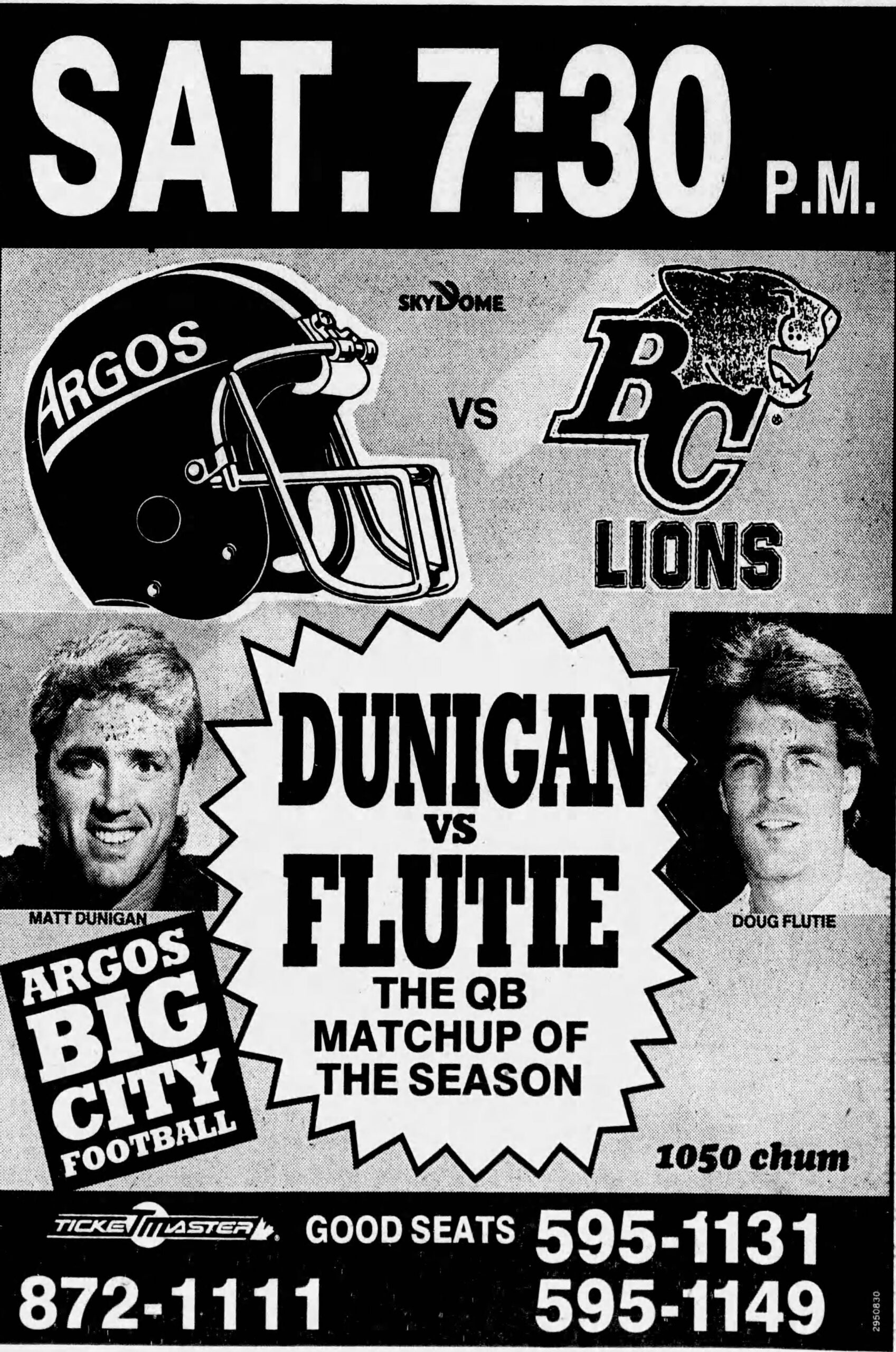
    The two best teams in the CFL in 1983 squared off on September 10th. A Grey Cup preview.

    Advertisement for the big game between BC and Toronto (Vancouver Sun, 8 September 1983).
    Advertisement for the big game between BC and Toronto (Vancouver Sun, 8 September 1983).

    A purchase of a Sony radio or Walkman also got you into the big game between the Lions and Argos.

    Promo ad (The Province, 9 September 1983)
    Promo ad (The Province, 9 September 1983)

    The SuperValu grocery chain ran a ticket promotion, as well. Customers could get a coupon for a free Lions ticket when purchasing a $9 ticket.

    SuperValu BC Lions ticket promo ad
    SuperValu BC Lions ticket promo ad.

    The B.C.Lions hosted the Western Final on November 20th versus Winnipeg. Season ticket holders, as expected, had first dibs. The tickets cost between $10 and $19.

    Ad for Western Final tickets (The Province, 30 October 1983).
    Ad for Western Final tickets (The Province, 30 October 1983).

    Player’s was another tobacco sponsor at the time. Here’s an ad promoting Grey Cup Week and the first Grey Cup to be played indoors at BC Place Stadium. Remember to heed the health advice given and avoid inhaling when smoking your cigarette.

    Grey Cup advertisement in The Province (24 November 1983).
    Grey Cup advertisement in The Province (24 November 1983).

    There weren’t any official Grey Cup tickets ads in Vancouver papers leading up to the big game because the game was virtually sold out well in advance. This article talks about the scarcity of Grey Cup tickets and how they were allocated across the CFL.

    Article in the Vancouver Sun about the availability and distribution of Grey Cup tickets (29 October 1983).
    Article in the Vancouver Sun about the availability and distribution of Grey Cup tickets (29 October 1983).

    So, if you didn’t have tickets, yet, your only option was the scalpers and resellers. The classifieds were full of ads like these. You could try John on Monday morning.

    Grey Cup tickets Classifieds ads
    Grey Cup tickets Classifieds ads

    The Grey Cup wasn’t the final game played in 1983. On December 3, the CFL and CFLPA staged an all-star game at BC Place Stadium.

    Advertisement for the 1983 CFL-CFLPA All-Star Game (Vancouver Sun, 2 December 1983).
    Advertisement for the 1983 CFL-CFLPA All-Star Game (Vancouver Sun, 2 December 1983).

    Sources:
    The Province, 12 June 1983
    The Province, 9 September 1983
    The Province, 30 October 1983
    The Province, 24 November 1983
    Vancouver Sun, 16 June 1983
    Vancouver Sun, 23 July 1983
    Vancouver Sun, 8 September 1983
    Vancouver Sun, 29 October 1983
    Vancouver Sun, 2 November 1983
    Vancouver Sun, 12 November 1983
    Vancouver Sun, 23 November 1983
    Vancouver Sun, 2 December 1983

    Fediverse Reactions
  • Tiger-Cats Spoil Argos’ SkyDome Opener

    In the aftermath of the 1982 Grey Cup, which was played in a rainstorm at Exhibition Stadium, football fans in Toronto were clamouring for an indoor stadium. They got their wish when the new SkyDome hosted the 1989 CFL season opener on July 12, 1989. No more football in the rain, wind, or snow. Fans could now enjoy the game in a climate-controlled environment. Yet, the spectacular venue’s fully retractable roof meant fans could still enjoy outdoor football when the weather permitted. It was the best of both worlds.

    Ad for the CFL opener at SkyDome
    Advertisement in the Toronto Star for the first CFL game at SkyDome.

    I remember when the SkyDome was built and marvelled at seeing it when driving through downtown Toronto. It really was a sight to behold. The first time I was inside it was for Wrestlemania VI in 1990. Twelve-year-old me was absolutely awestruck.

    OK, back to football. The SkyDome was touted a lifeline to the Toronto Argonauts and the entire the Canadian Football League. Surely, North America’s newest multi-million dollar major league stadium would be able to attract a whole new generation of fans to the CFL. The novelty factor alone was expected to bring in over 40,000 fans on opening night.

    Article in the Toronto Star touting the SkyDome as a saviour for the CFL
    Article in the Toronto Star touting the SkyDome as a saviour for the CFL
    Article in the Toronto Star touting the SkyDome as a saviour for the CFL.

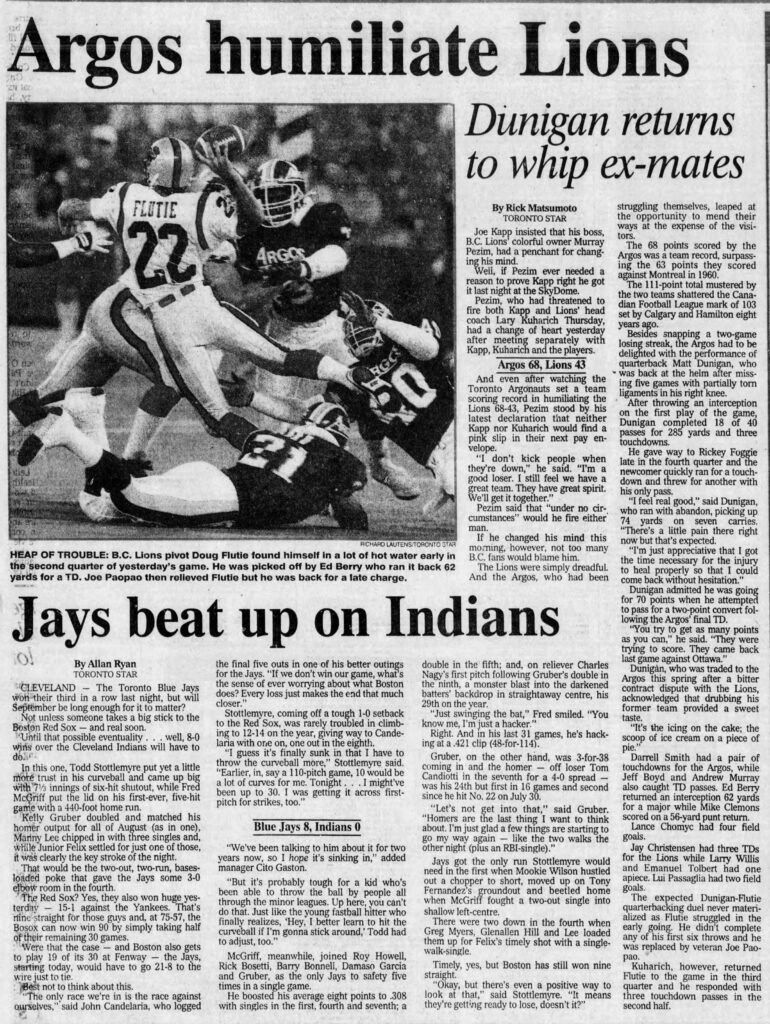
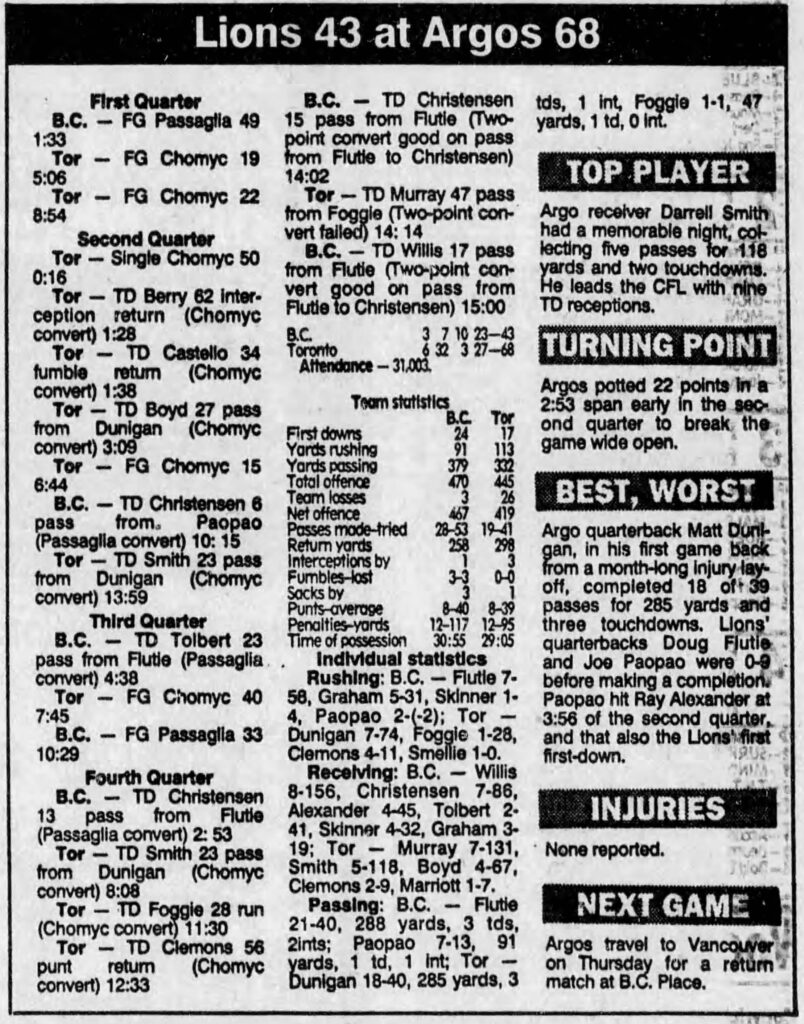
    Unfortunately for the Argos, the home opener turnout fell a bit short of expectations. Mind you, a still solid crowd (especially by today’s standards) of 32,527 was on hand to watch the historic game between the Argonauts and the rival Hamilton Tiger-Cats. Equally unfortunate for Toronto football fans, the Argos ended up on the losing end of scoreboard at SkyDome’s football christening.

    Led by quarterback Gilbert Renfroe, Toronto’s offence sputtered and managed to put up just 15 points. The Tiger-Cats scored two fourth quarter touchdowns – one a pass completion by rookie running back Derrick McAdoo and one an interception return by defensive back Sonny Gordon.

    The Tiger-Cats stole the show and won the game by a score of 25-14.

    Coverage in the Toronto Sun of the opening CFL game at SkyDome.
    Coverage in the Toronto Sun of the opening CFL game at SkyDome.
    Coverage in the Toronto Sun of the opening CFL game at SkyDome.

    The Argos did get a good bump in attendance in 1989 largely because of their new stadium. A crowd of over 54,000 attended the Grey Cup held at SkyDome that year. I do find it rather interesting how playing in a large, multipurpose, domed stadium went from being a huge positive with so much potential to more or less an albatross around the Argos within a couple of decades. Ironically, the Argonauts ultimately returned to the CNE grounds in 2016 when they moved into the smaller outdoor BMO Field.


    Sources:
    The Toronto Star, 12 July 1989
    The Toronto Sun, 13 July 1989

    Fediverse Reactions
  • Canadian Football’s Quirky Playoffs, Part III: Manitoba’s Unbalanced Schedule and Weighted Points System in 1906

    This is the third part of an ongoing series of articles looking back at some of Canadian football’s quirky playoff formats. Today, we’re going to go west and examine a rather peculiar set up for the 1906 season of the Manitoba Rugby Football Union.

    The MRFU was founded in 1892 and included a number of teams over the years. In 1906, four teams competed in the league’s senior competition: the Winnipeg Rugby Football Club (known as the Winnipegs), the St. John’s Rugby Football Club, the Winnipeg Rowing Club, and the Brandon Football Club.

    Financial constraints led to an unbalanced schedule. For instance, Brandon – being the only team from outside of Winnipeg – was allowed to play just four games. On the other hand, St. John’s and the Rowing Club were scheduled to play five games each. The Winnipegs were originally scheduled to play six games.

    To compensate for the unbalanced schedule, the MRFU devised a somewhat complicated but rather ingenious points system to provide some equity in the standings. Teams could receive a total of 30 points maximum on the season (if they won all their games). A value for a team’s win would be weighted depending on how many games they were to play. The formula used was 30 divided by the number of games played. In summary, Brandon would receive 7-1/2 points for each win (30 divided by four games played), St. John’s and the Rowing Club would receive 6 points for a win (30 divided by five games played), and a Winnipeg win would be worth five points (30 divided by six games played).

    Here is how the Winnipeg Tribune explained the schedule and points system:

    1906 MRFU schedule and points system explained in the Winnipeg Tribune (14 September 1906).
    Winnipeg Tribune (14 September 1906)

    The team with the most points in the standings was determined the champion. The Winnipegs picked up one win but lost two games and defaulted three of their remaining games after pulling out of the competition, finishing with a 1-5 record and five points.

    Here is the article published in the Winnipeg Tribune about the Winnipeg Rugby Football Club ceasing operations during the 1906 MRFU season:

    Article in the Winnipeg Tribune about the Winnipegs ceasing operations (19 October 1906).
    Winnipeg Tribune (19 October 1906)

    The top two teams – Winnipeg Rowing Club and Brandon – squared off on Sunday October 28th in a game that ultimately determined the championship. The “Oarsmen” (as the rowing club was nicknamed) defeated Brandon by a score of 20-1. The win gave the Winnipeg Rowing Club an undefeated 4-0 record and 24 points in the standings. Brandon ended the season 3-1 with 22-1/2 points.

    Article in the Winnipeg Tribune about Winnipeg Rowing Club winning the 1906 MRFU championship (29 October 1906).
    Winnipeg Tribune (19 October 1906)

    The Rowing Club had one more game to play versus St. John’s, but the game was cancelled as it had no meaning in the standings, the Oarsmen having already earned the highest number of points to win the 1906 MRFU championship.

    Of course, the MRFU wasn’t a member of the Canadian Rugby Union, so the Manitoba champion wasn’t eligible to compete in any playoff for the Dominion championship.


    Sources:
    Winnipeg Tribune (14 September 1906)
    Winnipeg Tribune (19 October 1906)
    Winnipeg Tribune (29 October 1906)

    Fediverse Reactions
  • Alouettes Beat the Rough Riders 1-0 in Lowest Scoring Game in CFL History

    Most football fans like a lot of scoring. You really can’t beat seeing two teams going back and forth and lighting up the scoreboard. Of course, a good defensive matchup can still make for some entertaining football now and then. But back in 1966, a game between Montreal and Ottawa redefined the meaning of a defensive battle.

    On October 30, 1966, the Montreal Alouettes defeated the Ottawa Rough Riders by a score of 1-0. No, that’s not a typo. The lone score in this affair came by way of a rouge.

    Article in the Montreal Gazette about the Alouettes beating Ottawa 1-0 (31 October 1966)
    Article in the Montreal Gazette about the Alouettes beating Ottawa 1-0 (31 October 1966).

    It was the last game of the regular season for both teams, and the game didn’t have any significance when it came to the standings. The Rough Riders had already locked up first place in the CFL’s Eastern Football Conference. And, win or lose, Montreal was going to finish third.

    The game, played before about 12,000 fans who braved the cold at Montreal’s Molson Stadium, produced a total offence of just 386 yards collectively. Montreal’s offence came mostly from their ground game with 165 yards rushing. Of note, Montreal running back Don Lisbon surpassed over 1000 yards on the season during this game. On the other hand, most of Ottawa’s offence was produced in the air by star quarterback Russ Jackson, who passed for 132 yards.

    Montreal Star photo of Alouettes' Don Lisbon vs. Ottawa (1966)
    Montreal Star (31 October 1966)

    With the game scoreless, it wasn’t until late in the fourth quarter that Montreal kicked the single point. A rouge from a missed 36-yard field goal attempt by Peter Kempf. It was the lowest scoring game in CFL history and, thankfully, the record still stands.

    Montreal-Ottawa Game Summary in the Montreal Gazette (31 October 1966).
    Montreal-Ottawa Game Summary in the Montreal Gazette (31 October 1966).

    Interestingly, it is suggested that the game tied a previous Canadian football record set in 1948 or 1949 when Winnipeg supposedly defeated Calgary 1-0. But I can’t find any reference to this WIFU game in newspapers or historical statistics. I suspect it was a reporting error in the Montreal Gazette article above that contributed to this incorrect notion.


    Sources:
    Montreal Gazette, 31 October 1966
    Montreal Star, 31 October 1966

    Fediverse Reactions
  • Canadian Football’s Quirky Playoffs, Part II: No Dominion Championship in 1885, An All-Star Game Instead

    This is the second in an ongoing series of articles looking back at some of Canadian football’s rather quirky playoff systems used over the years. A previous article examined how tie schedules and challenge cups were used on the road to the first Dominion championship game organized by the Canadian Rugby Football Union in 1884.

    News of the Canadian Rugby Football Union's new Inter-provincial Rugby Match. (Hamilton Spectator)
    News of the Canadian Rugby Football Union’s new Inter-provincial Rugby Match. (Hamilton Spectator)

    It’s now a new year, and Canadian football is still finding its footing so to speak. Good or bad pun? And the CRFU held is second Dominion championship. Sort of. Not really.

    But first, imagine this completely theorical scenario. The Montreal Alouettes and the Saskatchewan Roughriders win the East and West divisions respectively. But instead of the Als and Riders squaring off in the Grey Cup, the culminating game features a team of eastern all-stars playing a team of western all-stars instead. Sound silly? Well, this theorical scenario is how the Canadian football playoffs looked in 1885.

    Like the previous year, the Ontario Rugby Football Union and the Quebec Rugby Football Union both used a tie schedule format. To recap, a tie in this context is simply a pairing of teams. Rather than a balanced schedule with standings, teams were paired up and competed in a knock-out style tournament. The Kingston Daily News featured the tie schedule for the ORFU. Have a look to see how the system worked:

    1885 ORFU Tie Schedule in the Kingston Daily News
    1885 ORFU Tie Schedule in the Kingston Daily News

    In 1885, the ORFU had two separate divisions, one for college teams and one for the city clubs. The winner of each division met for the Ontario Challenge Cup. In Quebec, there were only four teams – Montreal, Britannia, McGill, and Lennoxville – that competed for the Quebec Challenge Cup.

    On January 30, 1885, the CRFU voted to hold an Inter-Provincial Rugby Match comprising players from Ontario and Quebec, selected by their respective unions. This new annual all-star game wasn’t actually intended to replace the Dominion championship, though. But fate had other ideas for 1885.

    Ontario players selected for the 1885 Inter-provincial Rugby Match, Ottawa defeated London in the ORFU city division. (Hamilton Spectator)
    Ontario players selected for the 1885 Inter-provincial Rugby Match, Ottawa defeated London in the ORFU city division. (Hamilton Spectator)

    On October 25th, Ottawa dominated London 38-0 in Toronto to win the Ontario city division. On October 31st, Ottawa College defeated the University of Toronto by a score of 19-2 to win the college division. A week later Ottawa College defeated Ottawa City 21-0 in an all-Ottawa affair to win the Ontario Challenge Cup.

    Ottawa College defeats University of Toronto to win the ORFU college division in 1885. 
(Montreal Gazette)
    Ottawa College defeats University of Toronto to win the ORFU college division in 1885.
    (Montreal Gazette)

    Meanwhile in Quebec, Montreal was once again that province’s dominant team. In a match to decide the winner of the Quebec Challenge Cup on October 10th, Montreal defeated rival Britannia by “two goals and several minor points to one touch.” (Montreal Gazette, 10 October 1885)

    Montreal vs. Britannia in the Quebec Challenge Cup in 1885 (Montreal Gazette)
    Montreal vs. Britannia in the Quebec Challenge Cup in 1885 (Montreal Gazette)

    So, the stage was set for Ottawa College to travel to Montreal to play the Quebec champion in what would be the second Dominion championship. Except, it didn’t happen. In 1885, Montreal was engulfed in a smallpox epidemic. Public health concerns prompted a reluctant Ottawa College to forgo the trip to Montreal. Instead, suggestions were made for Montreal to travel to Ottawa and play the championship there.

    Letter from "Sport" accusing the Montreal Football Club of "funking.
    Letter from “Sport” accusing the Montreal Football Club of “funking.

    There was a rather testy exchange in the Montreal Gazette between a writer from Ottawa named “Sport” and Mr. R. Stirling, the secretary of the Montreal Football Club. “Sport” accused Montreal of “funking.” That’s old British slang for backing out because of fear. Stirling refuted the accusation and explained that logistics and costs simply made the proposal impractical. So that was the end of that. There was no Dominion championship game played in 1885.

    Response to "Sport" from Mr. R. Stirling of the Montreal Football Club.
    Response to “Sport” from Mr. R. Stirling of the Montreal Football Club.

    Instead, we were left with the first Inter-Provincial Rugby Match as being the pinnacle of the 1885 football season in Canada. Played on November 12th, which was Thanksgiving Day, in Toronto the Quebec all-stars scored 3 points over their Ontario counterparts. Because the rules of the day stated that a majority of 4 points were needed for a victory, the game was declared a draw.

    Quebec players selected for the 1885 Inter-provincial Rugby Match. (Montreal Gazette)
    Quebec players selected for the 1885 Inter-provincial Rugby Match. (Montreal Gazette)

    Check out the Montreal Gazette’s great summary of this game, as well as other games (including a soccer game) played on Thanksgiving Day in 1885.

    Coverage of the 1885 Interprovincial Rugby Match plus other football games in Montreal Gazette.
    Coverage of the 1885 Interprovincial Rugby Match plus other football games in Montreal Gazette.

    So, in short…no Dominion championship. An all-star game ending in a draw instead. And some good old mudslinging in the press. That was the Canadian football playoff picture in 1885.


    Sources:
    Canadian Football History Key Historical Milestones and Dates -1861-1889 by Robert Sproule
    Hamilton Spectator, 31 January 1885
    Hamilton Spectator, 26 October 1885
    Kingston Daily News, 13 June 1885
    Montreal Gazette, 12 October 1885
    Montreal Gazette, 3 November 1885
    Montreal Gazette, 4 November 1885
    Montreal Gazette, 14 November 1885
    Montreal Gazette, 16 November 1885
    Montreal Gazette, 18 November 1885

    Fediverse Reactions