For eons, the Canadian Football League published Media Guides or Fact Books for its teams. These little handbooks were meant to familiarize local journalists with the players and coaching staff of the team they were covering. They included biographies, statistics, records, and team histories.
Team media guides were also a great little souvenir for the savvy football fan. I have several in my own collection I like to peruse every now and then.
The CFL still produces them at least in electronic form. At least for some teams. I’m not sure if the league still offers print copies, though. It looks like they’ve met the same fate as game day programs and printed tickets, which is unfortunate.
Anyway, I thought what better way to spend the dog days of summer than by taking a look at some of these CFL media guides from the 1960s (or the late 1950s in a couple of cases). It was an exciting decade for the CFL and Canadian football.
Here are some photos of the media guides (front and back covers) for each CFL team from that era:
The above photos are courtesy of the good folks at the Canadian Football Research Society.
When I first started following CFL football in the early 1990s, Ron Lancaster was considered one of the best coaches in the game. His Edmonton Eskimos were consistently in the hunt for top spot in the West Division. Perennial Grey Cup contenders.
But long before he was coaching Edmonton onto victory, he was a standout player – one of the best quarterbacks in the game – for the Saskatchewan Roughriders. He actually started his CFL career with the Ottawa Rough Riders in 1960. He and Russ Jackson were Ottawa’s quarterbacking duo. In 1963, he joined the Green Riders.
Ron Lancaster, dubbed “the Little General,” played 16 seasons with Saskatchewan. Throughout his time quarterbacking the Roughriders, Saskatchewan played in five Grey Cup games, winning in 1966, the Riders’ first championship. In fact, Lancaster had only one losing season in all those years. Quite a remarkable feat.
That one losing season turned out to be Lancaster’s last…1978. The Roughriders finished with a dismal 4-11-1 record and placed last in the West Division, missing the playoffs. At the age of 40, the Little General would call it quits.
Ron Lancaster’s final game was on Sunday October 29, 1978 at Commonwealth Stadium in Edmonton. Coming off the bench in the fourth quarter, he led the Roughriders back from a six-point deficit to defeat Edmonton 36-26.
Here’s how the Regina Leader-Post described Lancaster’s final game:
Hughes, Bob. “Lancaster legend comes to appropriate close.” Regina Leader-Post, 30 October 1978, p. 17.
Within days of playing for the last time, Ron Lancaster formally announced his retirement. He was the CFL’s first player to pass for over 50,000 yards and was selected as the league’s most outstanding player twice (1970 and 1976).
Post-Retirement
Upon retiring as a player, Lancaster was immediately named Saskatchewan’s new head coach, replacing Walt Posadowski. Lancaster’s first head coaching gig wasn’t as successful as his playing career, however, and the Riders missed the playoffs both years Lancaster was at the helm.
In 1981, he moved to the broadcast booth and became the colour commentator for the CFL on CBC. It was in 1991 that he returned to the sidelines as Edmonton’s head coach.
In late 1997, we football fans in Hamilton rejoiced as the Little General came east and took over the coaching duties for the Tiger-Cats. In one year, he helped turn around the Ti-Cats, leading the team to the Grey Cup for the first time in almost a decade.
Sadly, Ron Lancaster died in 2008 just shy of his 70th birthday. A member of the Canadian Football Hall of Fame (inducted in 1982), the Little General is easily one of the greatest to play, coach, and call the game.
Throughout the long history of Canadian football, there’s been very little controversy surrounding team nicknames. Sure, there was a time in the not too distant past where there was one team called the Rough Riders and another called the Roughriders. But, for the most part the country’s professional football club names have been a bit quirky sounding but certainly not eyebrow raising.
The one exception to this rule is Edmonton.
Football has been played in the Alberta capital since 1895. Just as it is today, the early Edmonton team’s main rival was Calgary. The story goes that a Calgary sportswriter took a jab at the Edmonton team by calling them “the Esquimaux” (the French translation of Eskimos) in reference to the rather cold northern Alberta climate. The Edmonton team embraced the insult and used the moniker for a number of years before adopting the Anglicized version of the word in 1910.
The team was known as the Edmonton Elks in 1922, foreshadowing a name change that would come a century later, and played Queen’s University in the Grey Cup that year.
The original Eskimo team folded in the 1920s. In 1938, the Edmonton Eskimos were reborn and played in the Western Interprovincial Football Union. However, this team too ceased operations due to the onset of the Second World War.
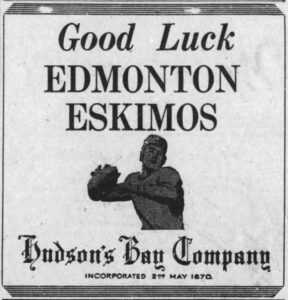
An ad taken out by Hudson’s Bay Company cheering on the new Edmonton Eskimos (source: Edmonton Journal, 3 September 1949, page 18.
It wasn’t until 1949 that the current Edmonton club returned to the WIFU. Once again Edmonton adopted the Eskimos moniker although there were some suggestions that the team be called the Oilers, the name later given to the city’s future professional hockey team.
For the next seventy years, the Edmonton Eskimos represented Northern Alberta and were considered a model CFL franchise. They won three Grey Cups in a row in the 1950s and won five championships from 1978-1982, an astonishing feat no other team has been able to accomplish.
However. over time a growing number of people voiced their concern over the use of the name “Eskimos.” Facing mounting public pressure, the team announced that it would be dropping the “Eskimos” name in July 2020.
A year later, June 1, 2021, the team announced its new yet familiar name: the Edmonton Elks.
The current Edmonton Elks primary logo (sportslogos.net)
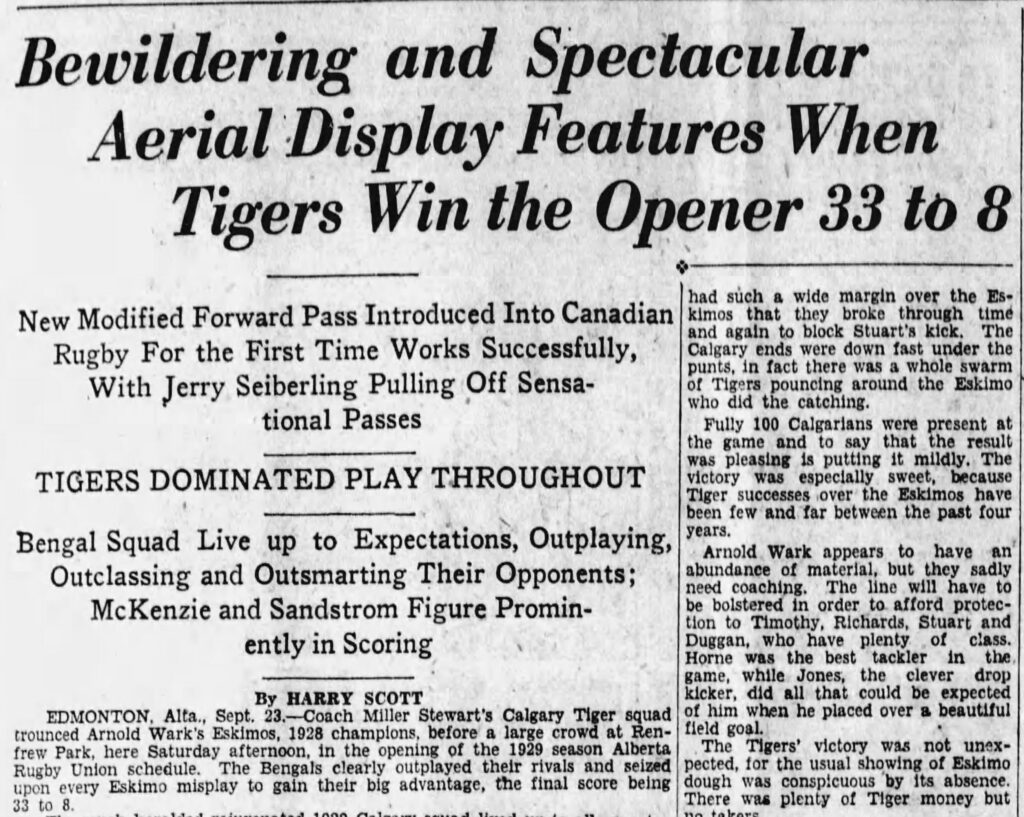
An account of the forward pass. Source: The Calgary Albertan, 23 September 1929, page 6
It’s hard to imagine, but up until the 1920s the forward pass was an illegal play in Canadian football. Early Canadian football resembled the game of rugby more than the pass happy version of gridiron football we are accustomed to watching today.
The forward pass, a staple offensive play in gridiron football, was first introduced in American football in 1906. Illegal and experimental forward passes were seen in the Canadian game over a decade later.
It wasn’t until 1929 that the Canadian Rugby Union formally allowed the use of the forward pass. Eastern teams didn’t use it right away, however. The first official completed* forward pass in Canadian football was thrown on Saturday, September 21, 1929 in Edmonton in a game between the Edmonton Eskimos and the Calgary Tigers. Calgary player Gerry Seiberling (pictured below) threw the historic pass to Ralph Losie. Calgary won the game 33-8.
Source: The Calgary Herald, 23 September 1929, page 6.
*The first legal attempted forward pass was actually thrown earlier in the day in a game in Winnipeg. The pass by Norm McLeod’s (St. John’s) was intercepted by Ronnie Gay (Tammany Tigers) in the first quarter of the game.