In the aftermath of the 1982 Grey Cup, which was played in a rainstorm at Exhibition Stadium, football fans in Toronto were clamouring for an indoor stadium. They got their wish when the new SkyDome hosted the 1989 CFL season opener on July 12, 1989. No more football in the rain, wind, or snow. Fans could now enjoy the game in a climate-controlled environment. Yet, the spectacular venue’s fully retractable roof meant fans could still enjoy outdoor football when the weather permitted. It was the best of both worlds.
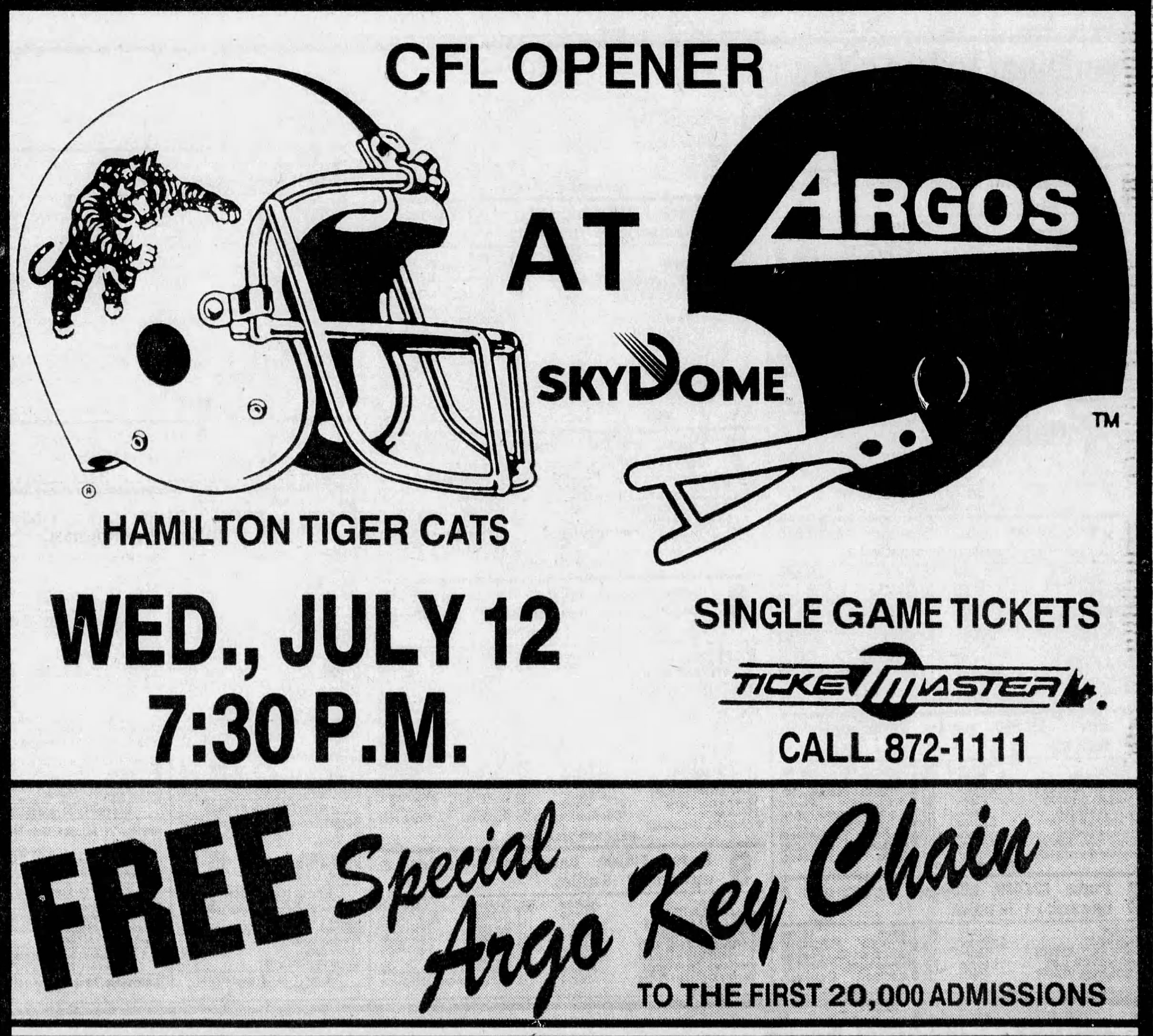
Advertisement in the Toronto Star for the first CFL game at SkyDome.
I remember when the SkyDome was built and marvelled at seeing it when driving through downtown Toronto. It really was a sight to behold. The first time I was inside it was for Wrestlemania VI in 1990. Twelve-year-old me was absolutely awestruck.
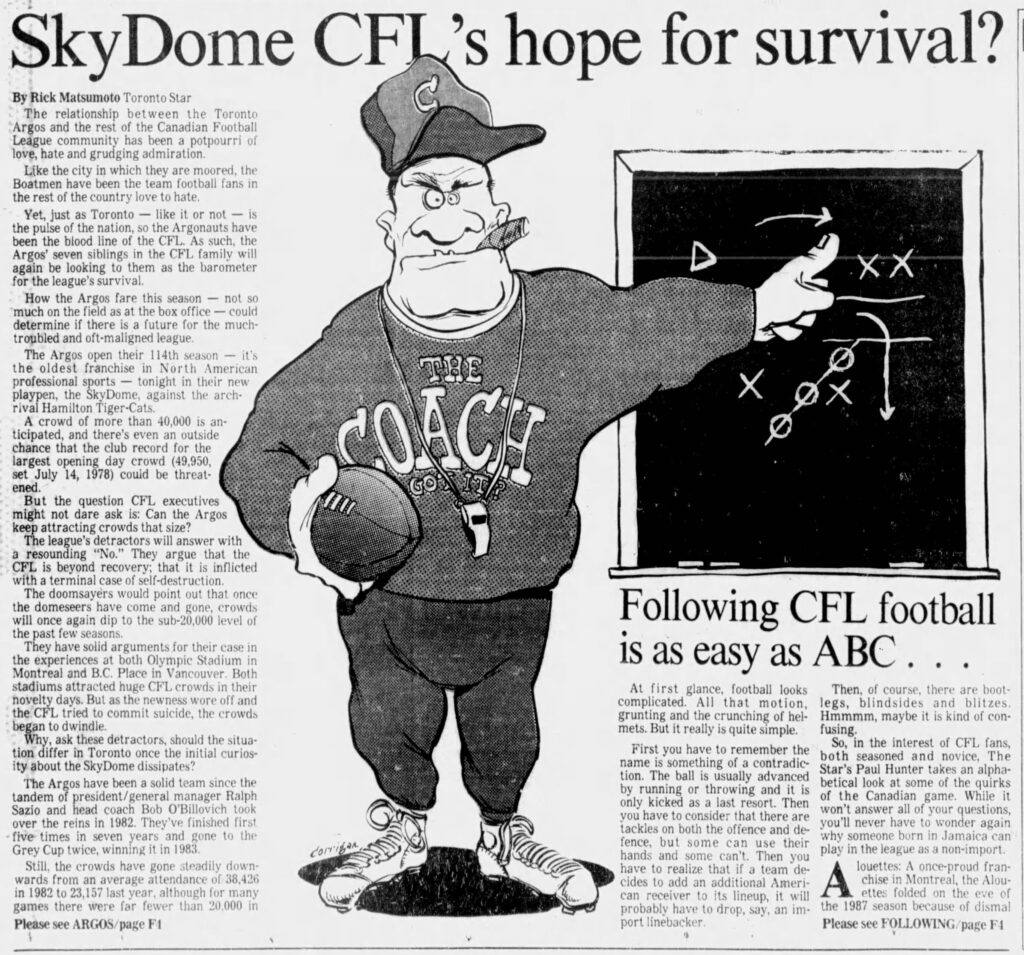
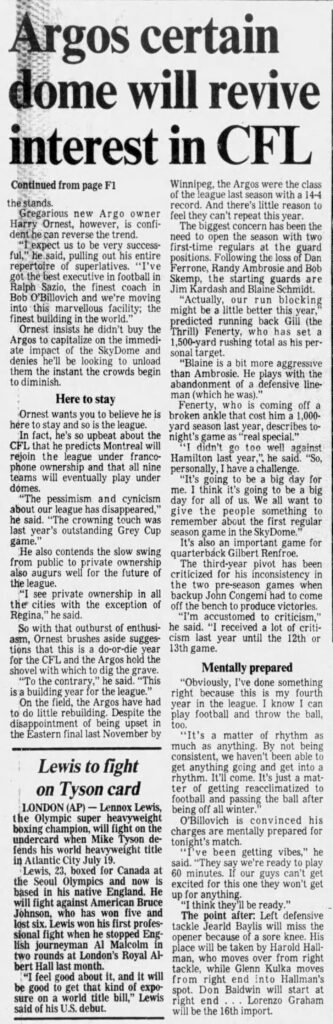
OK, back to football. The SkyDome was touted a lifeline to the Toronto Argonauts and the entire the Canadian Football League. Surely, North America’s newest multi-million dollar major league stadium would be able to attract a whole new generation of fans to the CFL. The novelty factor alone was expected to bring in over 40,000 fans on opening night.
Article in the Toronto Star touting the SkyDome as a saviour for the CFL.
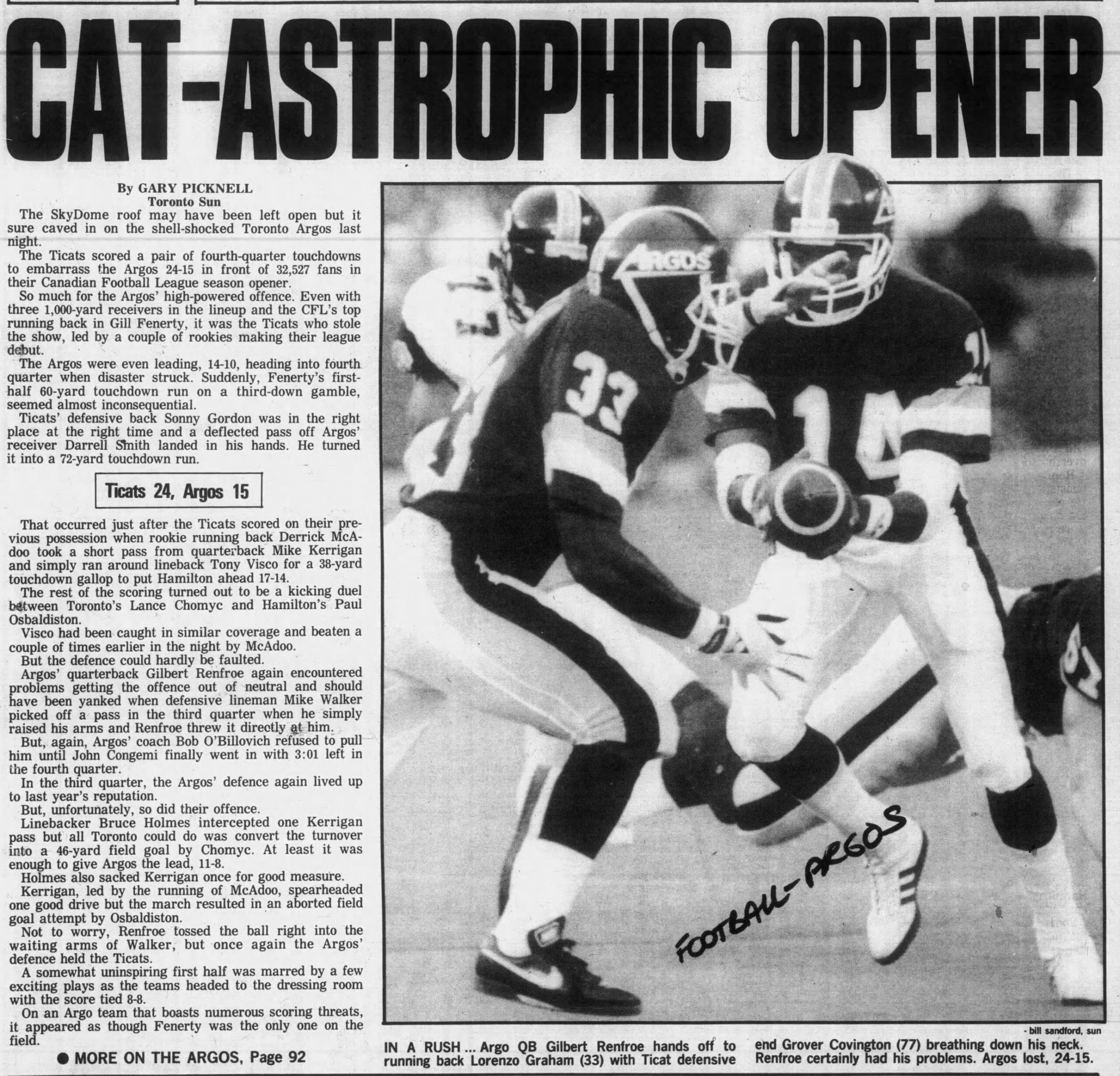
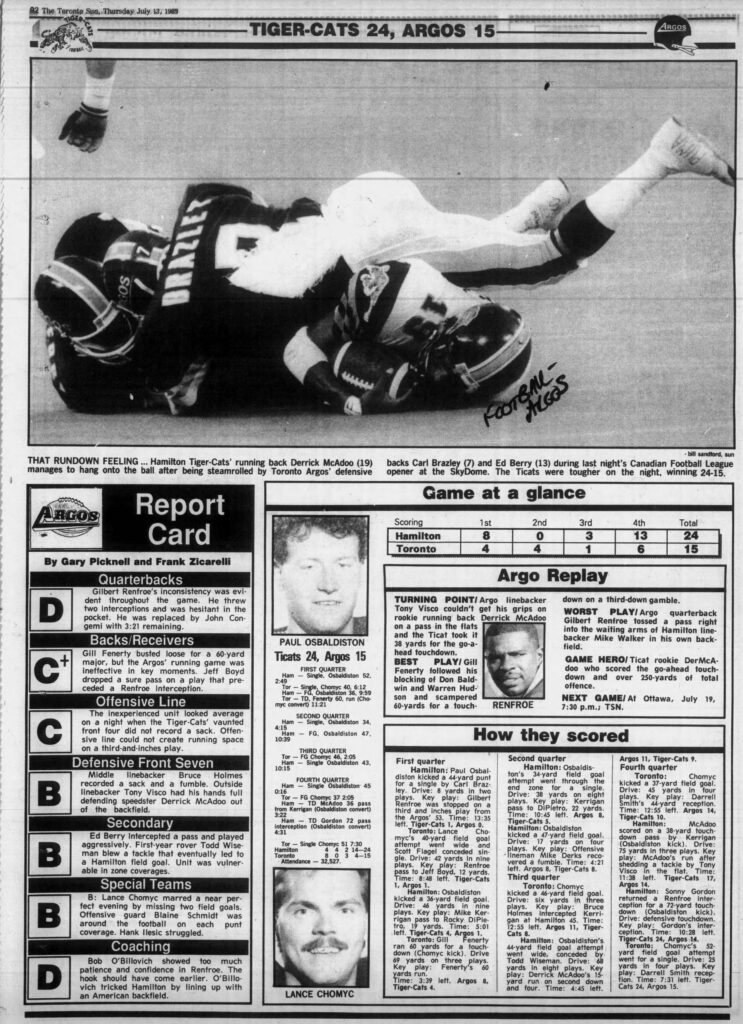
Unfortunately for the Argos, the home opener turnout fell a bit short of expectations. Mind you, a still solid crowd (especially by today’s standards) of 32,527 was on hand to watch the historic game between the Argonauts and the rival Hamilton Tiger-Cats. Equally unfortunate for Toronto football fans, the Argos ended up on the losing end of scoreboard at SkyDome’s football christening.
Led by quarterback Gilbert Renfroe, Toronto’s offence sputtered and managed to put up just 15 points. The Tiger-Cats scored two fourth quarter touchdowns – one a pass completion by rookie running back Derrick McAdoo and one an interception return by defensive back Sonny Gordon.
The Tiger-Cats stole the show and won the game by a score of 25-14.
Coverage in the Toronto Sun of the opening CFL game at SkyDome.
The Argos did get a good bump in attendance in 1989 largely because of their new stadium. A crowd of over 54,000 attended the Grey Cup held at SkyDome that year. I do find it rather interesting how playing in a large, multipurpose, domed stadium went from being a huge positive with so much potential to more or less an albatross around the Argos within a couple of decades. Ironically, the Argonauts ultimately returned to the CNE grounds in 2016 when they moved into the smaller outdoor BMO Field.
Sources: The Toronto Star, 12 July 1989 The Toronto Sun, 13 July 1989
In the Spring of 1948, the Hamilton Tigers shocked the Canadian football world when they announced their withdrawal from the Interprovincial Rugby Football Union. A founding member of the league also known as the Big Four, the Tigers traced their roots back to 1869. They were undoubtedly the face of Hamilton football.
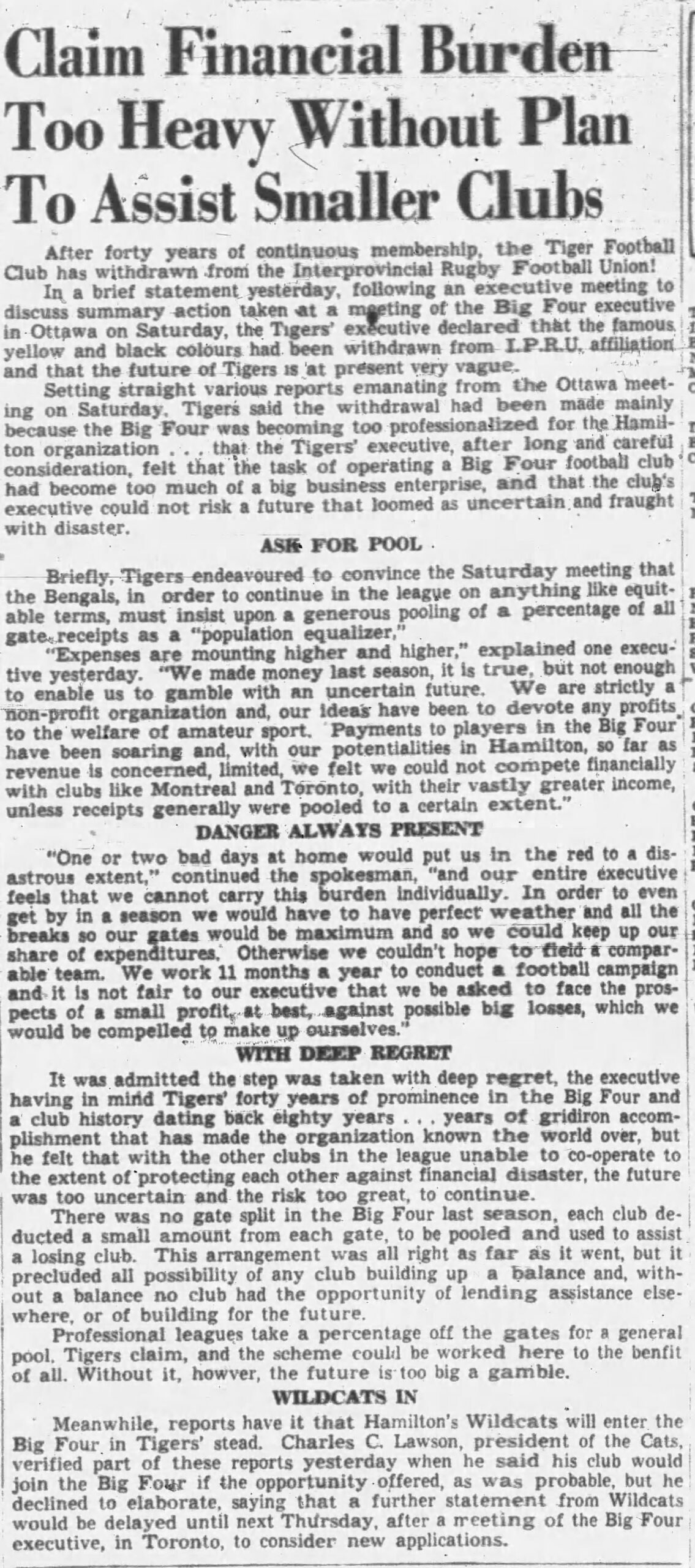
Hamilton Spectator article about the Tigers’ leaving the IRFU (22 March 1948).
Like other teams in the IRFU, the Tigers temporarily disbanded during the Second World War. However, the Ontario Rugby Football Union, one of the other three major football leagues at the time, carried on. Hamilton had a team in the ORFU, as well – the Hamilton Wildcats. The Wildcats helped fill the void for Hamilton football fans in the absence of the Tigers.
Once the war ended and a sense or normalcy returned, the IRFU resumed operations. Suddenly, Hamilton had not one but two top tier football teams to root for. But sometimes more is not necessarily merrier.
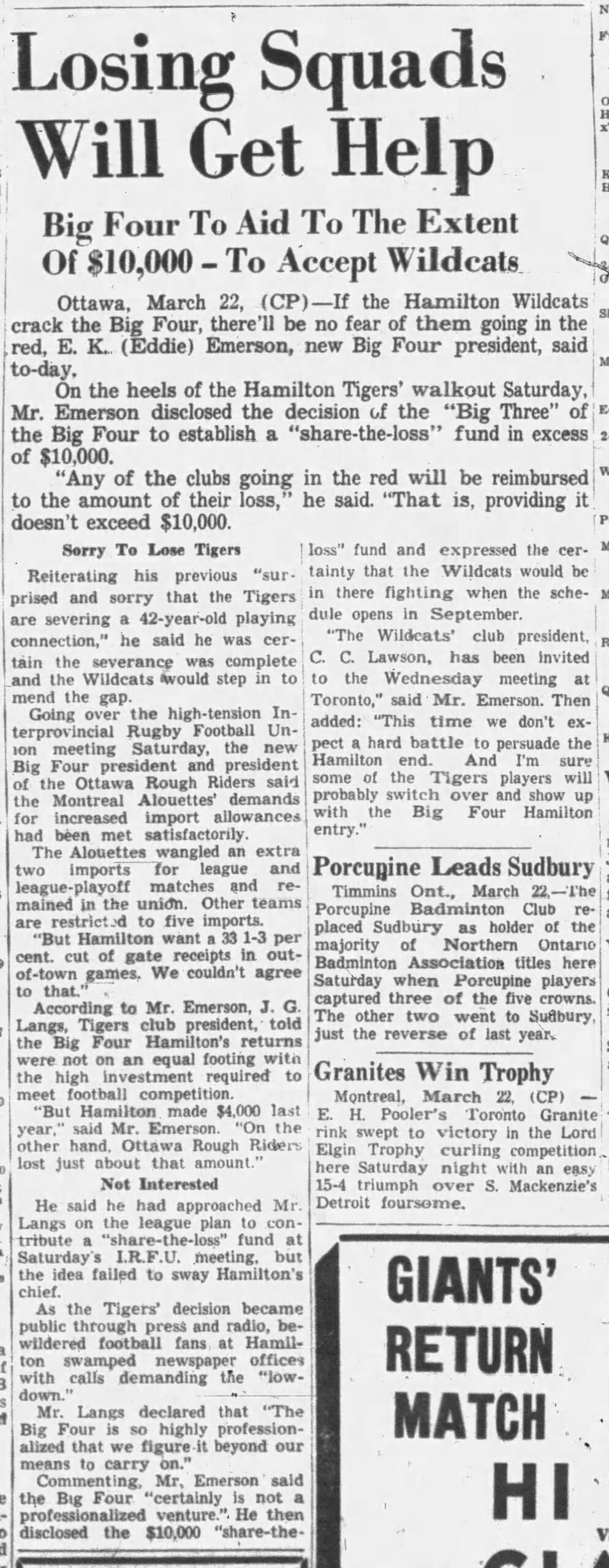
Faced with competition from the ORFU’s Wildcats and being at odds with fellow IRFU clubs when it came to revenue sharing, the Tigers found themselves in a precarious financial position. The team did make money but had a harder time competing against the larger clubs in Toronto and Montreal. The Tigers advocated for a scheme that would have IRFU teams split revenue by giving the visiting team up to a third of game day receipts. The other IRFU teams rejected the idea and instead offered up a $10,000 “share the loss” fund that would, in effect, reimburse teams operating in the red up to $10,000.
The IRFU’s “share the loss” scheme to assist smaller clubs (Hamilton Spectator, 22 March 1948)
The Tigers and IRFU found themselves at a stalemate. At an IRFU meeting held at the Chateau Laurier in Ottawa on Saturday March 20, 1948, the Tigers announced they were quitting the Big Four. Tigers President J.G. Langs suggested the IRFU was becoming too professional and that the rising costs of competing couldn’t be offset without a more generous revenue sharing model. The Tigers’ abrupt withdrawal set off a chain reaction that would create some rather interesting drama in the days ahead.
Almost immediately, reports began to circulate that the Wildcats would join the IRFU as Hamilton’s Big Four replacement team. At the time, they were arguably the best team in the ORFU and felt a jump to the IRFU would be a seamless transition. (Unfortunately, they struggled in the IRFU and won only a single game in their two seasons of play in that league.)
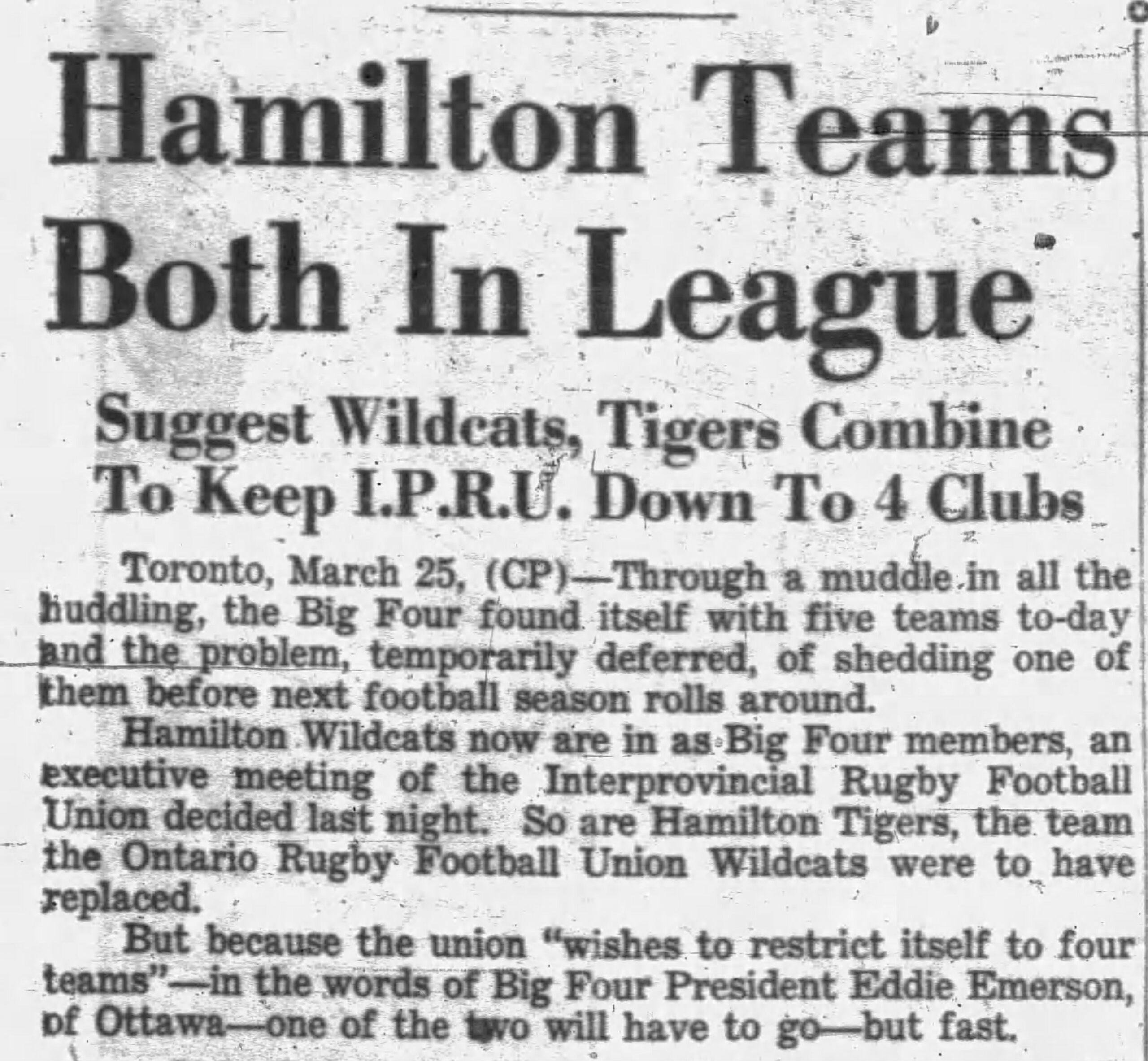
IRFU officials met again in Toronto to formally admit the Wildcats into the Big Four. Faced with mounting pressure from Hamilton fans, the Tigers withdrew their withdrawal and insisted on staying in the Big Four circuit. Their re-entry was approved. However, in a seemingly comedy of errors, it turns out that the IRFU had already admitted the Wildcats previously when the Tigers originally quit. So, the Big Four now had five teams, two in Hamilton.
Two Hamilton teams in the Big Four?
Although there were rumours of admitting a sixth team (likely Toronto Balmy Beach) to create a “Big Six” the IRFU executive team insisted on maintaining a four-team loop. They were adamant that one of the Hamilton teams had to go.
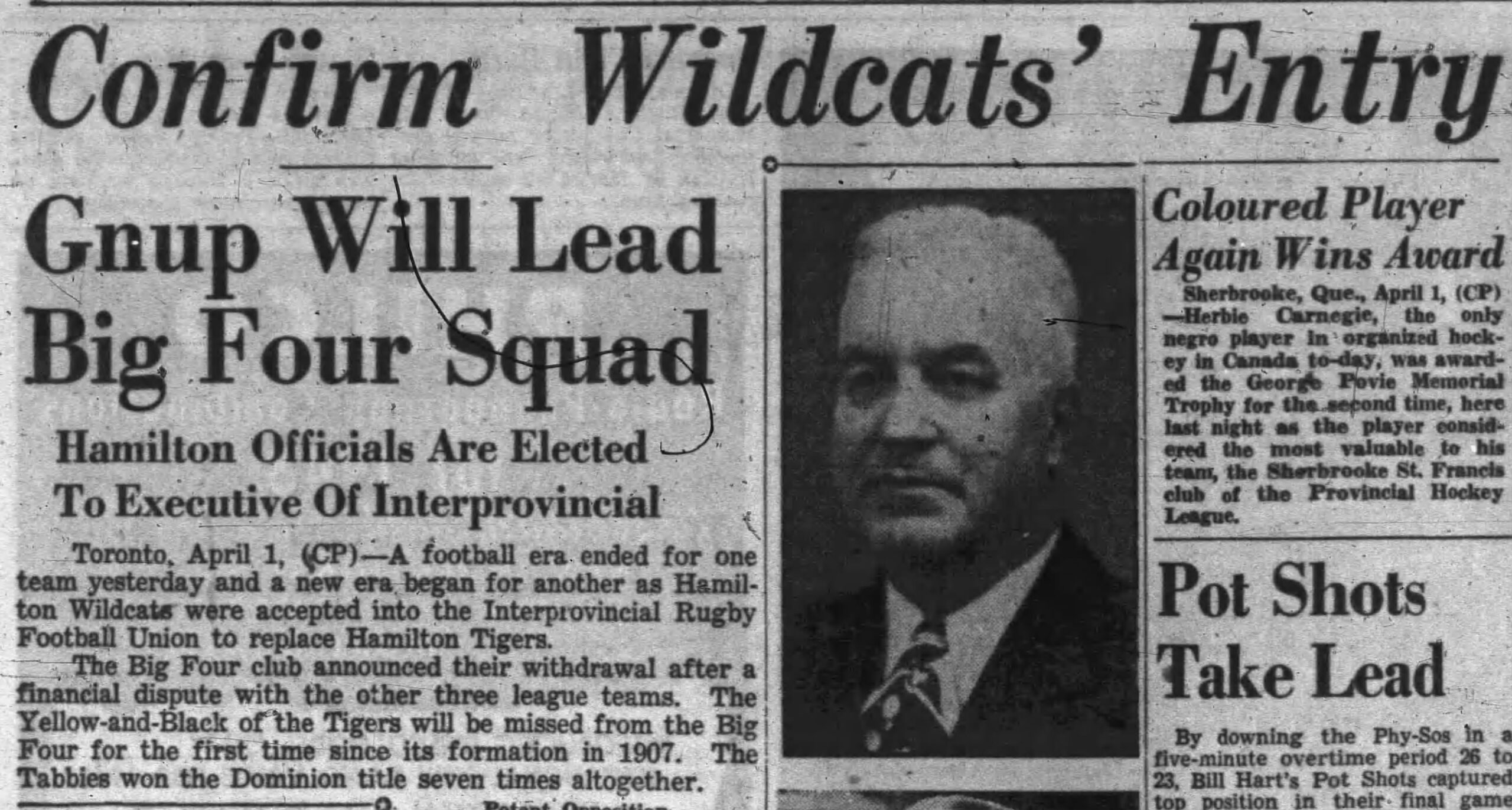
Hamilton Wildcats were finally confirmed into the IRFU (Hamilton Spectator, 1 April 1948).
IRFU president Eddie Emerson was tasked with finding a solution. The “ideal” solution, it appeared, was for the Wildcats and Tigers to unite as one team in the Big Four. But the notion was nixed by both teams. In the lead up to what could have been one of the more dramatic football meetings the country has ever seen, the Tigers announced that they would no longer seek to stay in the IRFU, saving a potential showdown with football executives. Eddie Emerson was surely relieved. Instead, the Tigers would take the Wildcats’ place in the ORFU.
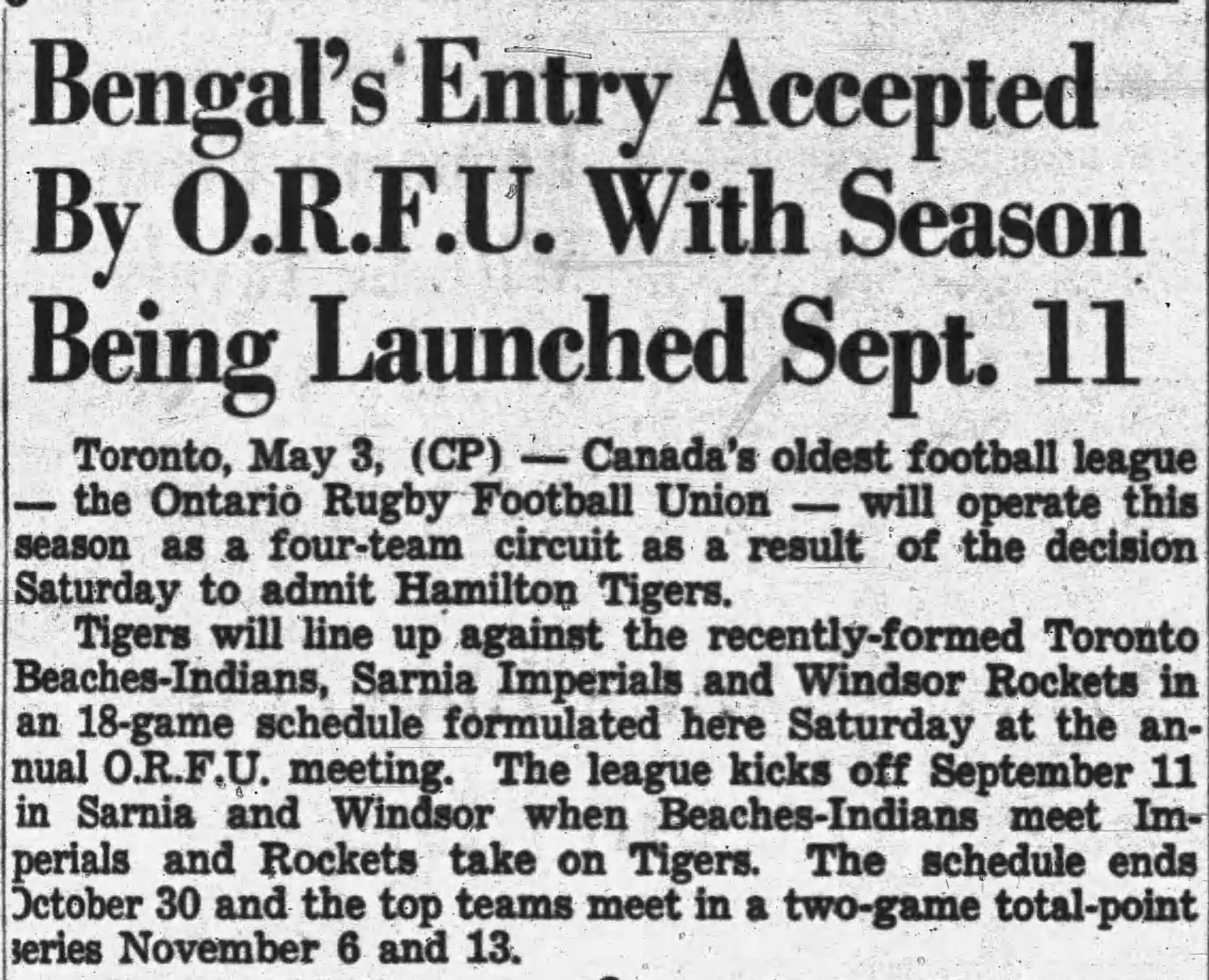
Hamilton Tigers joined the ORFU for the 1948 season (Hamilton Spectator, 3 May 1948)
So, for two seasons – 1948 and 1949 – the Wildcats and Tigers played football in their new respective leagues. As mentioned earlier, the Wildcats struggled significantly in the Big Four. The Tigers fared better, at least on the field, finishing in first place in the ORFU. Off the field was another matter altogether. It was abundantly clear that Hamilton just couldn’t support two football teams in the increasingly professional era. As financial losses mounted, a group of Hamilton citizens revisited the idea of merging the two teams. In 1950, the original “ideal” solution was finally realised – the Tigers and Wildcats amalgamated and became the Hamilton Tiger-Cats.
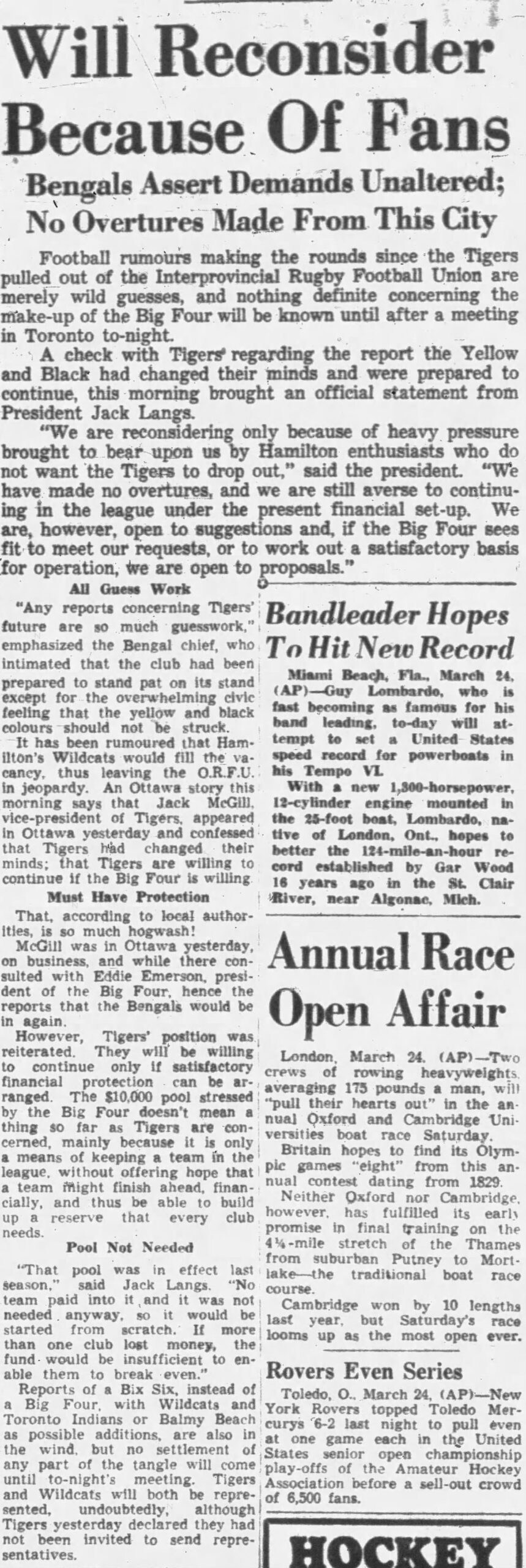
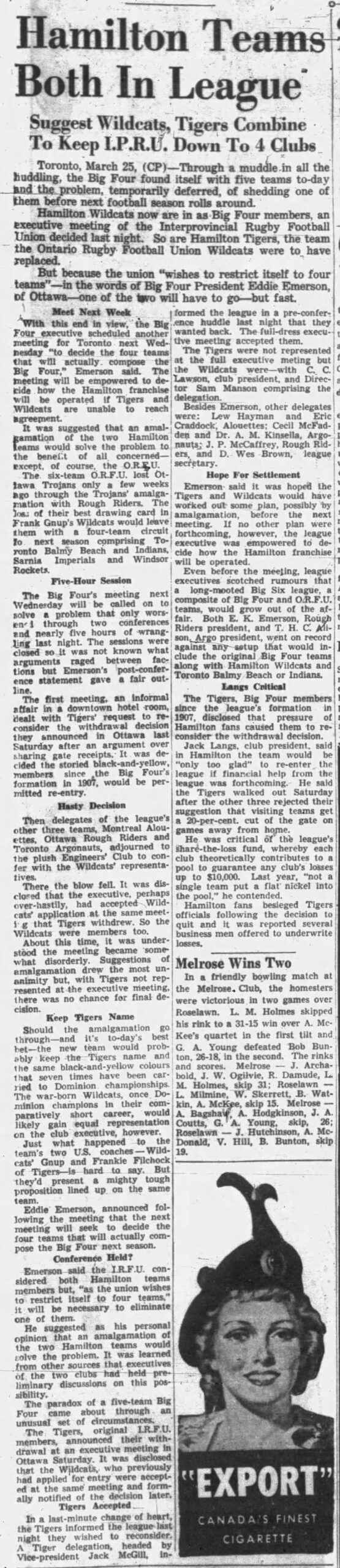
Articles in the Hamilton Spectator about the Tigers wanting to stay in the IRFU and the the meetings that ended with both Hamilton teams briefly being in the Big Four.
Sources: The Hamilton Spectator, 22 March 1948 The Hamilton Spectator, 24 March 1948 The Hamilton Spectator, 25 March 1948 The Hamilton Spectator, 1 April 1948 The Ottawa Citizen, 31 March 1948
For eons, the Canadian Football League published Media Guides or Fact Books for its teams. These little handbooks were meant to familiarize local journalists with the players and coaching staff of the team they were covering. They included biographies, statistics, records, and team histories.
Team media guides were also a great little souvenir for the savvy football fan. I have several in my own collection I like to peruse every now and then.
The CFL still produces them at least in electronic form. At least for some teams. I’m not sure if the league still offers print copies, though. It looks like they’ve met the same fate as game day programs and printed tickets, which is unfortunate.
Anyway, I thought what better way to spend the dog days of summer than by taking a look at some of these CFL media guides from the 1960s (or the late 1950s in a couple of cases). It was an exciting decade for the CFL and Canadian football.
Here are some photos of the media guides (front and back covers) for each CFL team from that era:
The above photos are courtesy of the good folks at the Canadian Football Research Society.
When I first started following CFL football in the early 1990s, Ron Lancaster was considered one of the best coaches in the game. His Edmonton Eskimos were consistently in the hunt for top spot in the West Division. Perennial Grey Cup contenders.
But long before he was coaching Edmonton onto victory, he was a standout player – one of the best quarterbacks in the game – for the Saskatchewan Roughriders. He actually started his CFL career with the Ottawa Rough Riders in 1960. He and Russ Jackson were Ottawa’s quarterbacking duo. In 1963, he joined the Green Riders.
Ron Lancaster, dubbed “the Little General,” played 16 seasons with Saskatchewan. Throughout his time quarterbacking the Roughriders, Saskatchewan played in five Grey Cup games, winning in 1966, the Riders’ first championship. In fact, Lancaster had only one losing season in all those years. Quite a remarkable feat.
That one losing season turned out to be Lancaster’s last…1978. The Roughriders finished with a dismal 4-11-1 record and placed last in the West Division, missing the playoffs. At the age of 40, the Little General would call it quits.
Ron Lancaster’s final game was on Sunday October 29, 1978 at Commonwealth Stadium in Edmonton. Coming off the bench in the fourth quarter, he led the Roughriders back from a six-point deficit to defeat Edmonton 36-26.
Here’s how the Regina Leader-Post described Lancaster’s final game:
Hughes, Bob. “Lancaster legend comes to appropriate close.” Regina Leader-Post, 30 October 1978, p. 17.
Within days of playing for the last time, Ron Lancaster formally announced his retirement. He was the CFL’s first player to pass for over 50,000 yards and was selected as the league’s most outstanding player twice (1970 and 1976).
Post-Retirement
Upon retiring as a player, Lancaster was immediately named Saskatchewan’s new head coach, replacing Walt Posadowski. Lancaster’s first head coaching gig wasn’t as successful as his playing career, however, and the Riders missed the playoffs both years Lancaster was at the helm.
In 1981, he moved to the broadcast booth and became the colour commentator for the CFL on CBC. It was in 1991 that he returned to the sidelines as Edmonton’s head coach.
In late 1997, we football fans in Hamilton rejoiced as the Little General came east and took over the coaching duties for the Tiger-Cats. In one year, he helped turn around the Ti-Cats, leading the team to the Grey Cup for the first time in almost a decade.
Sadly, Ron Lancaster died in 2008 just shy of his 70th birthday. A member of the Canadian Football Hall of Fame (inducted in 1982), the Little General is easily one of the greatest to play, coach, and call the game.
A close game always makes for good entertainment for us football fans. We enjoy the back-and-forth battle and the inevitable drama that ultimately decides the final score. But sometimes the game is anything but close. That was the case on October 20, 1956 when the Montreal Alouettes cruised to an 82-14 victory over the Hamilton Tiger-Cats.
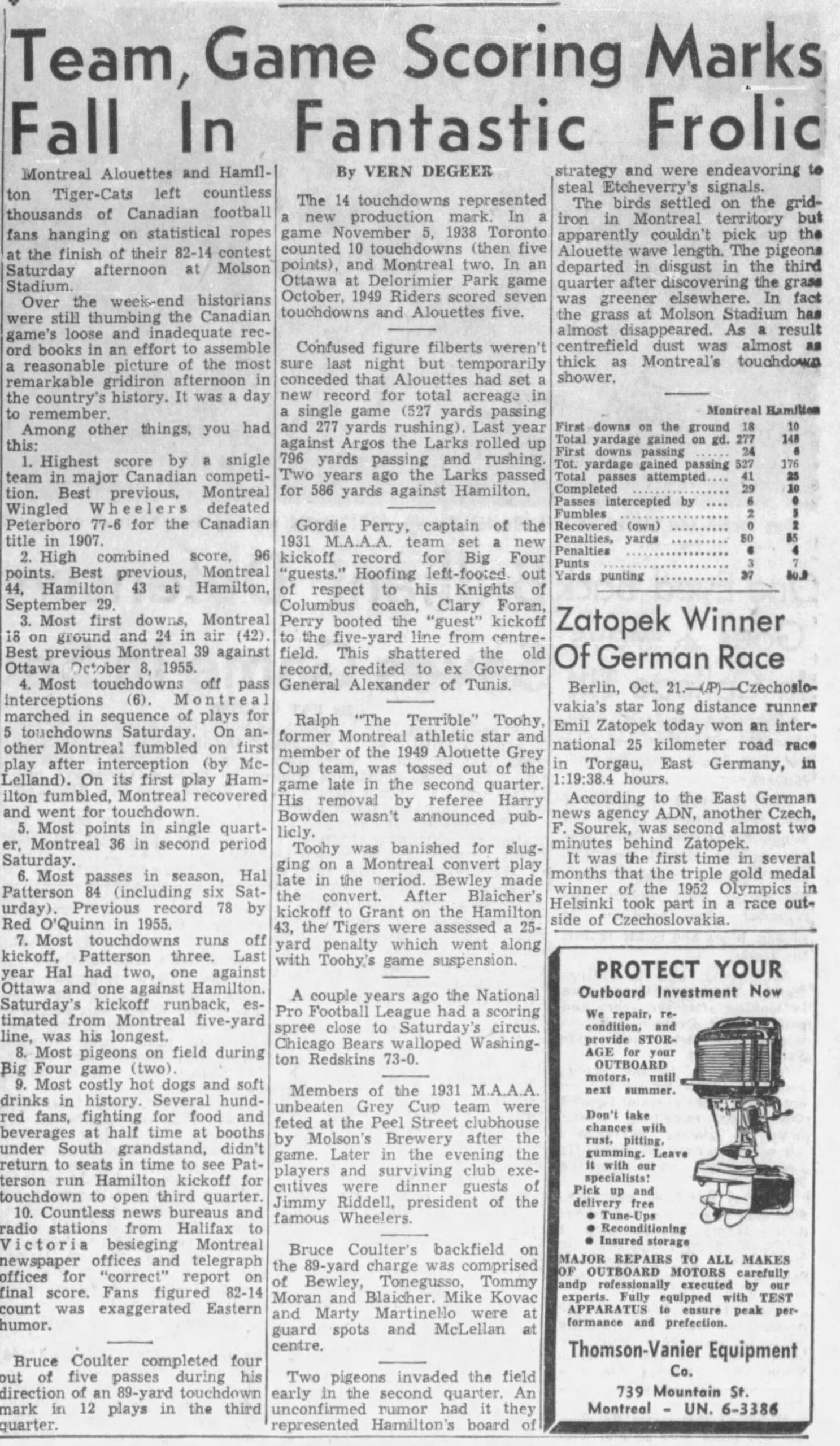
The headline in the Montreal Gazette tells the story.
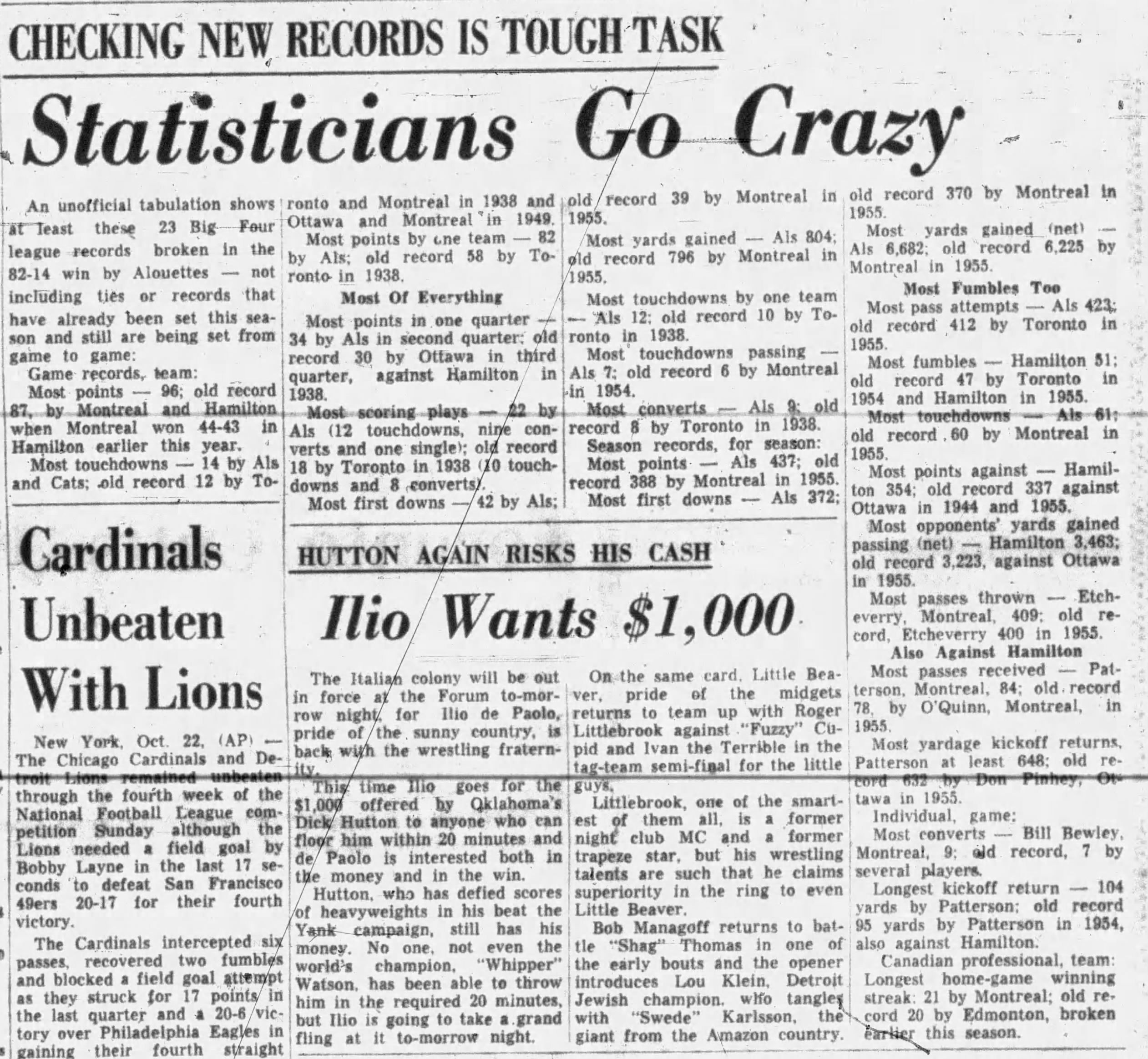
The crowd at Molson Stadium witnessed history in the making that Saturday afternoon with the Alouettes breaking a couple dozen IRFU/Big Four records. Newspapers in both Hamilton and Montreal remarked how the game kept the statisticians busy.
A recap of records broken as outlined in the Montreal Gazette. (Degeer, Vern. “Team, Game Scoring Marks Fall in Fantastic Frolic.” Montreal Gazette, 22 October 1956, p. 25.)The Hamilton Spectator’s recap of records broken. (“Statisticians Go Crazy.” Hamilton Spectator, 22 October 1956, p. 17.)
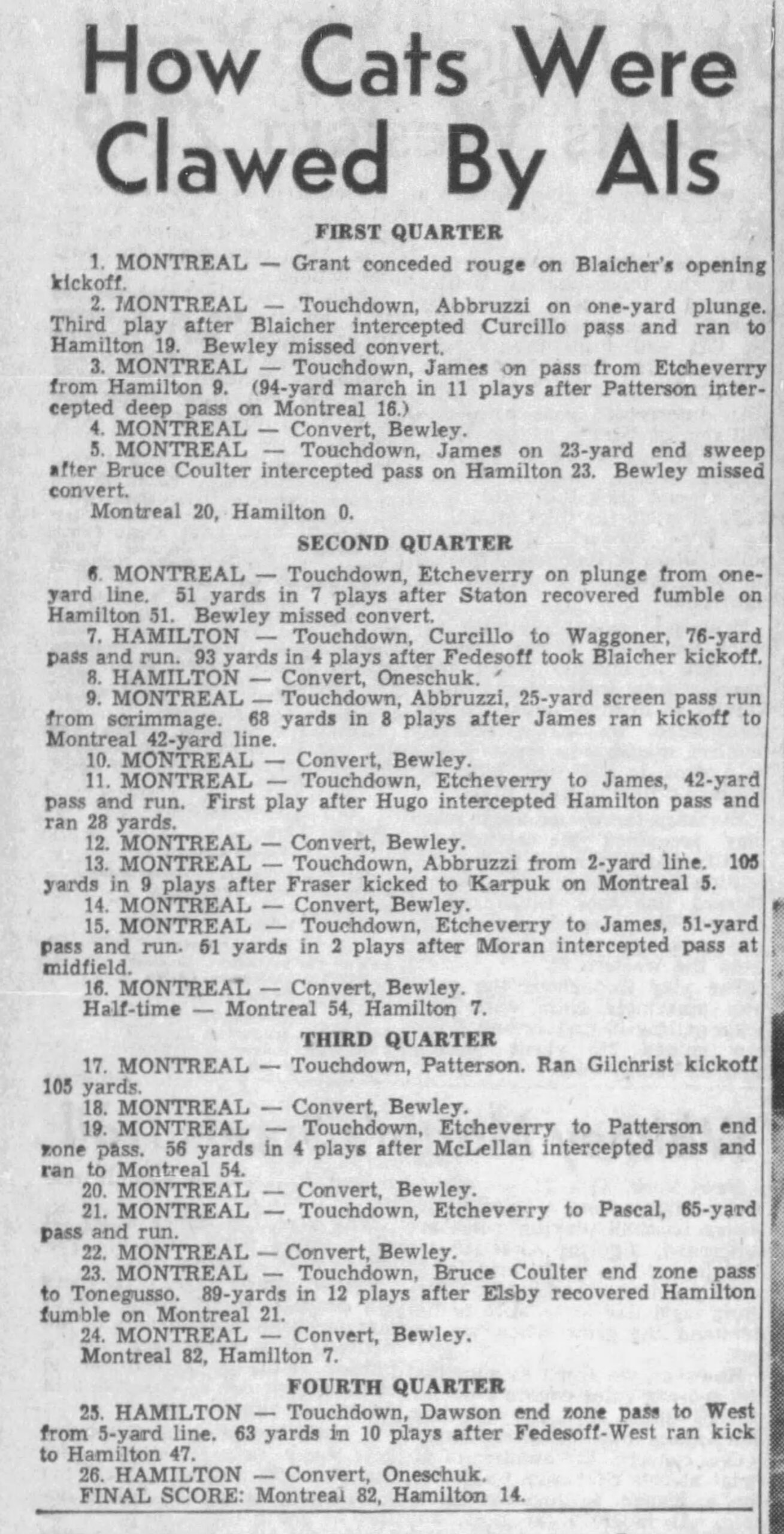
Montreal’s opening kickoff by Johnny Blaicher sailed through the Hamilton endzone to put the Alouettes up 1-0 from the get-go. What followed can only be described as good old fashion Canadian walloping.
Led by quarterback Sam “The Rifle” Etcheverry, Montreal scored an incredible 12 touchdowns. Yes, twelve! The Alouettes were up 20-0 after the first quarter and went into halftime with a commanding 54-7 lead. I certainly wouldn’t’ve wanted to be in the Hamilton dressing room at the half.
Montreal players who scored touchdowns in the record-setting game. Future Alabama Governor Fob James scored four touchdowns for the Alouettes.
Unfortunately for the Ti-Cats the second half wasn’t any better. Montreal’s Hal Patterson returned Hamilton’s kickoff to start the third quarter a record-breaking 104 yards for a touchdown. Talk about going from bad to worse. Having his way with the Tiger-Cat defence all afternoon, the Rifle might’ve put the Als over the 100-point mark had he stayed in the entire game. His favourite target Fob James, who years later would become the Governor of Alabama, scored four majors for the Alouettes.
The Hamilton Spectator didn’t mince words. (Miller, Ivan. “Alouettes Re-write Record Book in Wild Game.” Hamilton Spectator, 22 October 1956, p. 16.)
With the astounding lopsided victory, Montreal clinched first place in the Big Four conference. The two teams would meet again the following month in a two-game total-point series for the IRFU final. Montreal came out on top, winning by a 78-62 combined score, but would lose to the Edmonton Eskimos in the 1956 Grey Cup game.
The 82-14 score set on October 20, 1956 still stands today as the largest margin of victory in a game played in the modern era of Canadian football.