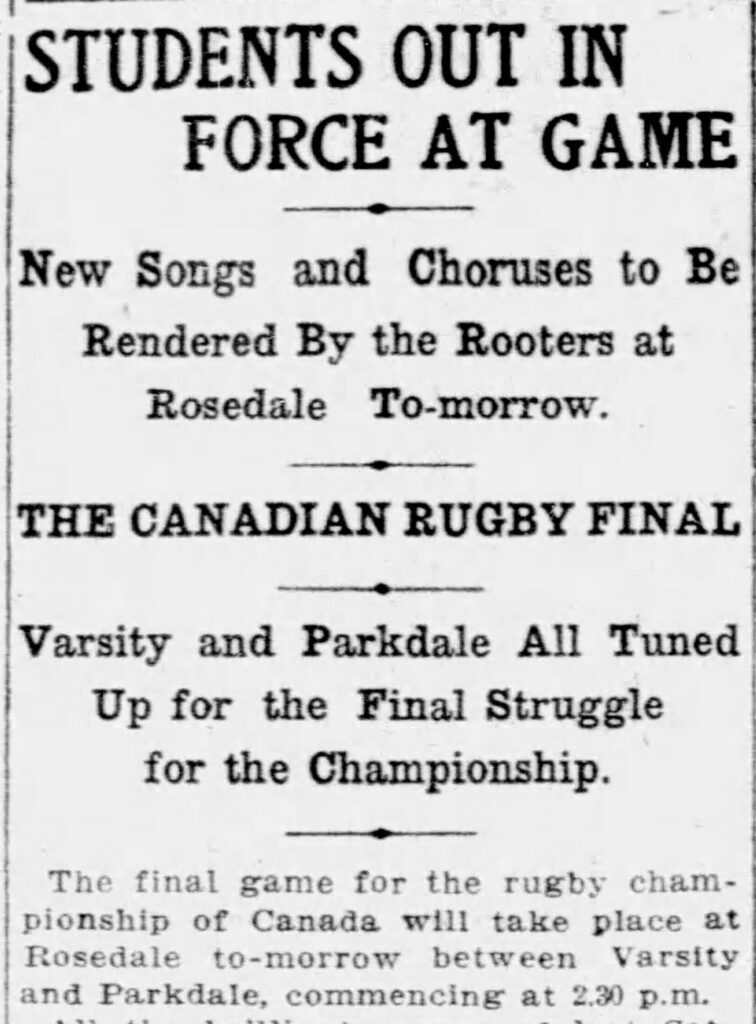
1909 was a special year in Canadian football. That’s the year when Earl Grey, who was serving as the Governor General of Canada, donated a trophy to be awarded to Canada’s amateur rugby football champion. Of course, this trophy as well as the championship game itself would become known as the Grey Cup. Only teams affiliated with the Canadian Rugby Union were eligible to compete for the new Grey Cup championship. So that meant no western clubs could challenge for the trophy.
Canadian football at the time was still an amateur affair, with senior football being the top level of play (above intermediate and junior). It was initially (mis)understood that the Grey Cup would be given to the winner of the Interprovincial Rugby Football Union (which was formed two years earlier) and Intercollegiate union game. But the CRU ruled a third league – the Ontario Rugby Football Union – was also a senior union and had the right to compete for the Grey Cup, as well.
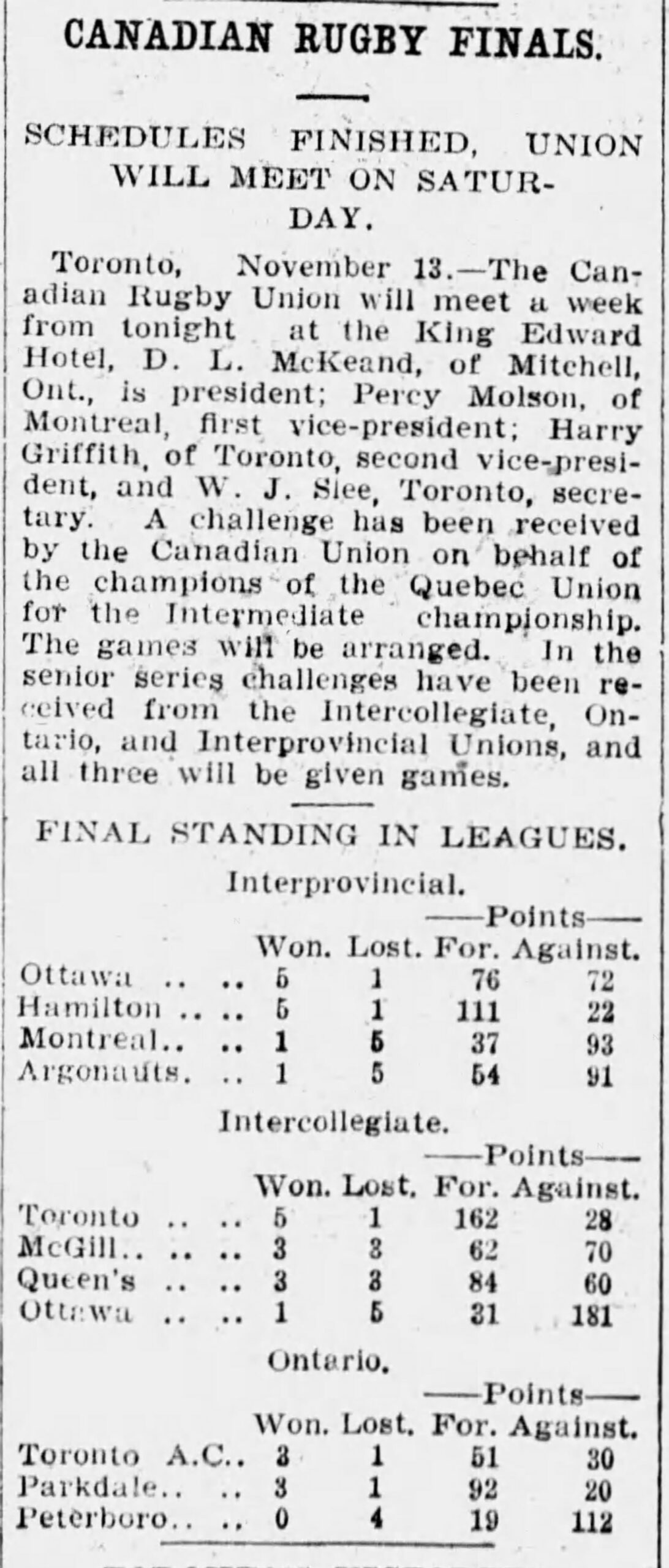
The Montreal Gazette published the final standings for 1909 in all three senior leagues of the Canadian Rugby Union:
Montreal Gazette, 15 November 1909
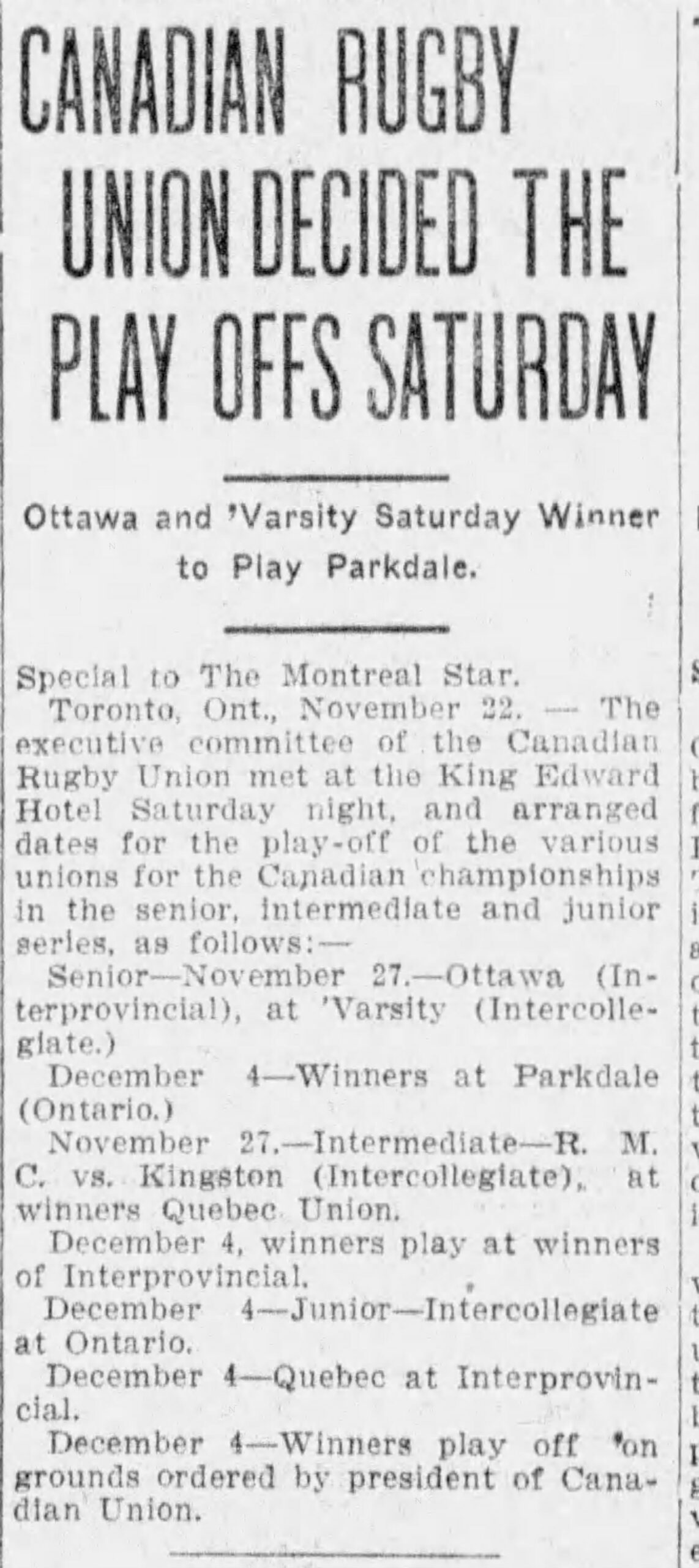
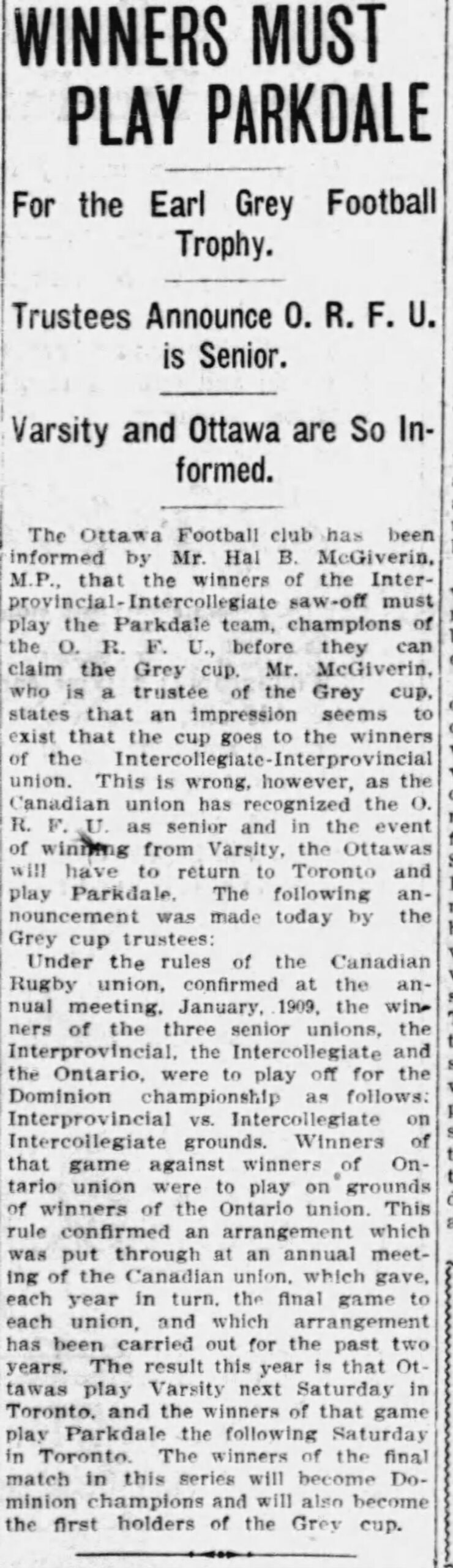
The Canadian Rugby Union had previously established a rotational playoff system where the champion of each union would alternately receive a bye to and host the Dominion championship. Since the new Grey Cup was now the Dominion championship, the CRU simply extended this arrangement. For 1909, it was the ORFU’s year to host; so, the winner of the ORFU final would host the first-ever Grey Cup.
Montreal Star, 22 November 1909Ottawa Citizen, 25 November 1909
On November 20th, Toronto Parkdale won the ORFU championship with an 8-3 win over the Toronto Amateur Athletic Club, securing their berth in the Grey Cup. On the same day, the Ottawa Rough Riders defeated the Hamilton Tigers 14-8 to win the IRFU championship.
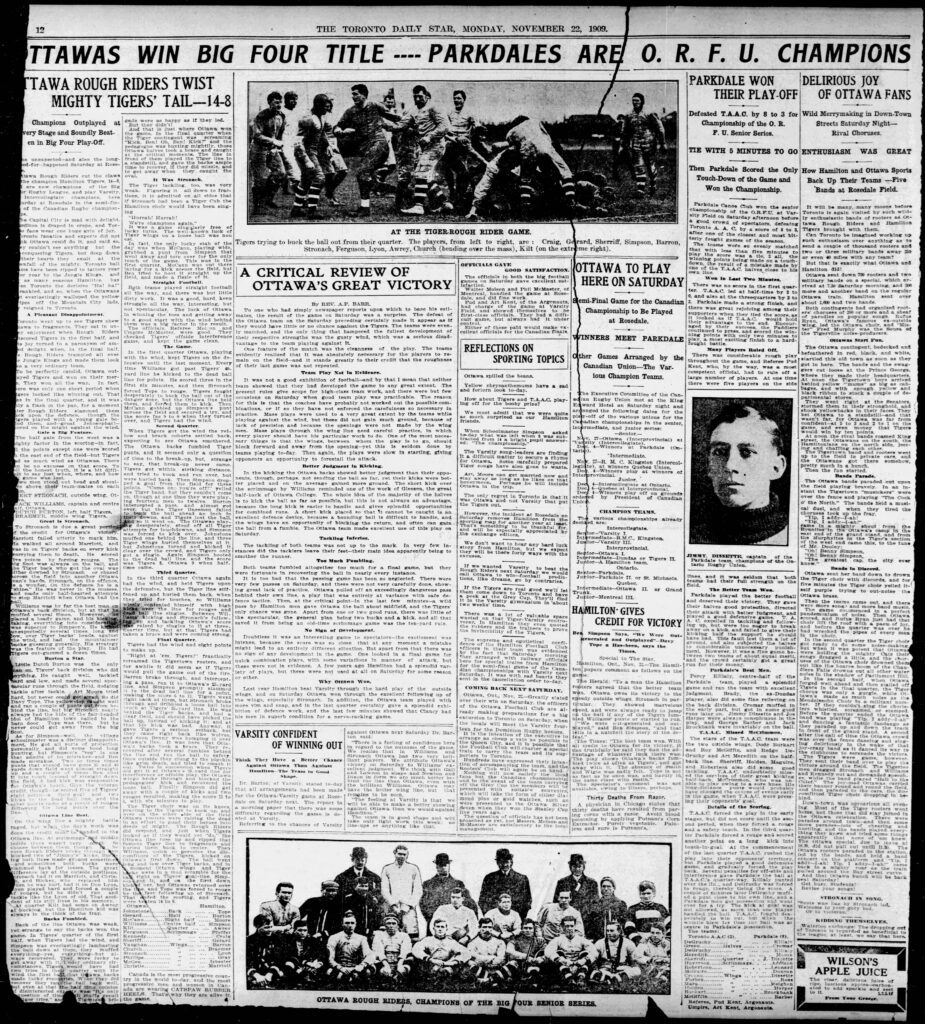
Below is some excellent coverage in the Toronto Star of the IRFU and ORFU playoffs.
Toronto Star, 22 November 1909
On November 27th, the Rough Riders travelled to Toronto to play the University of Toronto in the Interprovincial-Intercollegiate final. Varsity won handily by a score of 31 to 7, setting up a Varsity vs. Parkdale all-Toronto final for the Grey Cup.
Sources: Montreal Gazette, 15 November 1909 Montreal Star, 22 November 1909 Ottawa Citizen, 25 November 1909 Toronto Star, 22 November 1909 Toronto Star, 6 December 1909
Source:Government of Canada. Photo: Cpl Heather Tiffany
The colours red and black have long been associated with the city of Ottawa and its various football teams throughout the years. Pay a visit to Parliament Hill or to Rideau Hall, and you will see the Ceremonial Guards donning their traditional black and red uniforms. The Ottawa Football Club, founded in 1876, eventually adopted red and black (and white) as their team colours. This is the team that would become known as the Ottawa Rough Riders in October 1898.
The story behind the Rough Rider name is clouded in mystery. The “official” line is that Ottawa adopted the name Rough Riders as some sort of tribute to future U.S. President Teddy Roosevelt’s regiment (called the Rough Riders) in the Spanish-American War in 1898. But there is no mention of this connection in local newspapers at the time. Why would a football team in Ottawa be named after a regiment fighting a war that had absolutely nothing to do with Canada, anyway? It really doesn’t make much sense.
Another suggestion is that the name derives from the lumberjacks or log drivers who used to ride logs down the Ottawa River. Again, though, there isn’t any reference to lumberjacks or log drivers in Ottawa newspapers around the time the football team started using the name.
Perhaps the Ottawas (yes, they were called that, too) follow the same “rough rider” origins as the Saskatchewan Roughriders. The Regina Roughriders adopted the name in 1924, a reference to the trainers who broke wild horses in the west. In the 1960s and 1970s the Ottawa Rough Riders used a cowboy riding a bucking horse atop a football as their logo. And their mascot was a guy named Okee the Cowboy. So, who knows?
But there is strong evidence that the Rough Rider name given to Ottawa’s football team had nothing to do with a Teddy Roosevelt tribute or lumberjacks or horse-riding cowboys at all. Instead, the “rough rider” label was most likely used as an insult by a Hamilton journalist. See, in October 1898 the Hamilton Tigers and Ottawa Football Club were involved in an intense couple of games that would determine the champion of the Ontario Rugby Football Union. Ottawa had quite the reputation of being an aggressive or “rough” team. Some back-and-forth trash talk between journalists in Ottawa and Hamilton was almost as intense as the on-field rivalry. The Ottawa Journal accused the Hamilton press of maligning their team by calling them “thugs, “murderers, and “rough riders.”
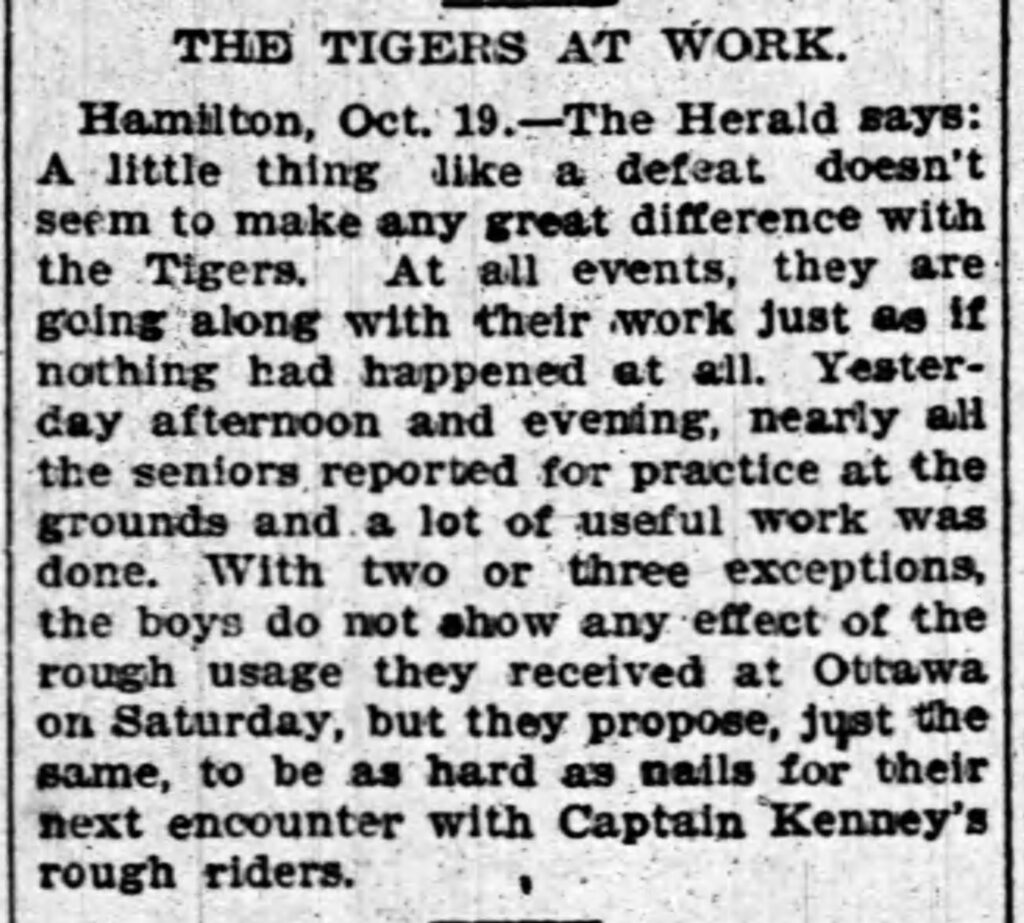
Hamilton Spectator reporter C.A. Mitchell calls Ottawa football players “roughriders” (The Ottawa Citizen, 17 October 1898, p. 6.) Another Hamilton reporter refers to Ottawa as “Captain Kenney’s rough riders”. Kenney was the Ottawa captain. (“The Tigers at Work.” The Ottawa Journal, 19 October 1898, p. 6.)
Ultimately, The Ottawa Football Club embraced the insult and began wearing the Rough Rider moniker as a badge of honour. Literally. The team made up pins with the Rough Rider name and distributed them to fans travelling to Hamilton for the second game. It’s entirely possible that the team piggy backed on the “Roosevelt Rough Riders” that were in the news at the time, but the actual origins of football rough riders centred around their reputed rough style of play on the field.
A reference by Ottawa Citizen reporter to “Roosevelt Kenny” alluding to his hero status after the October 29 rematch between Ottawa and Hamilton. (“The Tiger Hunter’s Laugh.” The Hamilton Spectator, 1 November 1898, p. 4.)The Ottawa press accusing the Hamilton press of maligning the Ottawa Football Club by calling them “murderers,” “thugs,” and “rough riders.” (“Ottawa’s Position.” The Ottawa Journal, 31 October 1898, p. 6.)
Unfortunately, the Ottawa Rough Riders folded following the 1996 CFL season, ending a 120-year football tradition. In 2002, a new CFL team was founded called the Ottawa Renegades. The Renegades, too, adopted red and black as team colours. However, the Renegades met the same fate as the Rough Riders after playing only four seasons.
It wasn’t until 2014 that the Canadian Football League would return to the Nation’s Capital. There was certainly some support for the new team to be called the Rough Riders. However, Saskatchewan objected to it, and the name didn’t carry the same weight for younger football fans who were either too young or not even born yet to have any recollection of the old Ottawa Rough Riders.
In the lead up to the CFL’s return, fans were asked to vote online for the new team’s name. The options included the Rush, Nationals, Voyageurs, Raftsmen, and Redblacks. On June 8, 2013, the team announced that its new name would be the Ottawa REDBLACKS. The nickname is capitalized for marketing purposes. In French, the team is known as the Rouge et Noir.
The new name was meant with mixed reviews. Detractors suggested it was a made-up word while others pointed to the New Zealand All Blacks, that country’s national rugby team, as an example of a successful moniker named simply after team colours. Surely, Ottawa’s new team could be seen through the same lens.
In the end, football fans in Ottawa rallied around their new team. The Red and Black plays homage to the old Ottawa Rough Riders’ colours, the Ceremonial Guards, as well as the plaid jackets worn by the great lumberjacks of the area. The Ottawa REDBLACKS name sounds like a perfect solution, really. And it sure beats the Ottawa Murderers or Ottawa Thugs, doesn’t it?
A special thanks to Chris Sinclair and Ian Symes who pointed me in the right direction when it came to the origins behind the Ottawa Rough Riders name. Thanks, guys. – RF
Depending on the criteria chosen and who you ask (relax, Argo fans!) the city of Hamilton boasts Canada’s oldest football club. The Hamilton Foot Ball Club was founded on November 3, 1869. Yes, they spelled football with two words back then. The team played in the Ontario Rugby Football Union from 1893 to 1906 before joining the new Interprovincial Rugby Football Union in 1907.
A news article announcing the founding of the Hamilton Foot Ball Club (The Hamilton Spectator, 4 November 1869, p 2.)
The team wore black and orange and later black and yellow uniforms and were known as the Tigers. It was this Tigers team that played in the second Grey Cup in 1910.
In 1941, the Tigers suspended play as a result of the Second World War. The IRFU itself shut down a year later. To fill the void, the Hamilton Wildcats were formed and played in the ORFU, winning the Grey Cup in 1943. Due to the high number of air force personnel playing for the team, the club was known as the Flying Wildcats during the war years.
After the war ended, the IRFU and the Hamilton Tigers resumed play. Unfortunately, the Hamilton market couldn’t support two football teams. Both the Tigers and the Wildcats found themselves competing for business and facing financial challenges. After a dispute with the IRFU, the Tigers and Wildcats actually swapped leagues for a couple of seasons with the Tigers playing in the ORFU and the Wildcats joining the IRFU in 1948.
“Merger of Wildcats, Tigers, Completed.” The Hamilton Spectator, 31 January 1950, p 24.
Finally, a group of Hamilton citizens pushed for the amalgamation of the Tigers and Wildcats. It was clear that Hamilton could sustain only one team, especially with the growing professionalization of the game of football.
Thus, in 1950, the Hamilton Tigers and the Hamilton Wildcats merged into one club and became the Hamilton Tiger-Cats.
The 1950 amalgamated Hamilton Tiger-Cats (photo courtesy of the Canadian Football Research Society)
Here’s an interesting snippet of some facts about the 1910 Grey Cup final held in Hamilton, including the team rosters for the Hamilton Tigers and the University of Toronto.
Source: The Hamilton Spectator, November 25, 1910, page 12
Source: The Hamilton Spectator, November 25, 1910, page 12
The above article appeared in the Hamilton Spectator on the eve of the 2nd Grey Cup. The Hamilton Tigers were preparing to host the University of Toronto at the A.A.A. Grounds in Hamilton.
Note the new cheer being introduced: O-S-K-E-W-A-W-A W-H-I-S-K-E-We-We H-O-L-Y M-A-K-I-N-A-W T-I-G-E-R-S E-A-T E-M R-A-W W-O-W!
A variation of the Oskee Wee Wee cheer is still performed at Hamilton Tiger-Cat games today.