Tag: Montreal Alouettes

  • The CFL Scores in Saint John

    The Canadian Football League has long pined for a presence in Atlantic Canada. In fact, Halifax has been granted not one but two conditional expansion franchises, the emphasis on “conditional” as neither attempt materialized. When Moncton opened its new stadium in 2010 there was some chatter about the Hub City being a home for a future CFL team. While no expansion team has been forthcoming, Moncton has hosted three regular season CFL games. And of course, there have been regular season games played in Halifax and Acadia University in Wolfville, Nova Scotia, as well.

    “CFL Tickets Go On Sale May 1.” Saint John Times-Globe, 23 April 1986, p. 29.

    But the CFL actually made its debut in the Maritimes back 1986 when Saint John, New Brunswick hosted an exhibition game between the Montreal Alouettes and Winnipeg Blue Bombers. The game, played at the then newly constructed Canada Games Stadium, drew a crowd of over 11,000 fans who saw the Bombers down the Als 35-10.

    “10,000 Assured for CFL Game.” Saint John Telegraph-Journal and Evening Times-Globe, 6 June 1986, p. 31.

    It appears the game was designed to take the CFL on the road and expose the product to a new market rather than to test the waters for a prospective expansion site. In fact, CFL Commissioner Doug Mitchell seemed to go out his way to temper any expansion expectations. Still, New Brunswickers embraced the CFL and the players enjoyed the Atlantic hospitality.

    Munford, Bruce. “Thousands Flock to See Bombers Blast Montreal.” Saint John Evening Times-Globe, 9 June 1986, p. 15.

    The Bombers were quarterbacked by veteran Tom Clements, who had his way with the Montreal defence. A scary moment occurred early in the game when Montreal’s Nick Arakgi suffered a broken vertebrae when he was hit after reaching up high for an overthrown pass by Montreal quarterback Joe Barnes. He was taken to the hospital and ended up missing the entire 1986 CFL season.

    Saint John Mayor Elsie Wayne was ecstatic about having the CFL in her city. She presented Winnipeg head coach Cal Murphy with a trophy called the Saint John CFL Cup after the game.

    A Labatt’s ad sponsoring the CFL game in Saint John. (Saint John Telegraph-Journal, 6 June 1986, p. 71.)
    An ad promoting the CFL game in Saint John. (Saint John Telegraph-Journal, 6 June 1986, p. 72.)

    The CFL’s success in Saint John in 1986 prompted the league to return the following year for another exhibition game. This time, Montreal played the Hamilton Tiger-Cats. The Ti-Cats won 14-13 in what turned out to be the last game for the Montreal Alouettes who folded a couple weeks later.


    Kelly Ryback was the original “Buzz”, the mascot of the Winnipeg Blue Bombers. Here are his personal reflections of the event.

    The ’86 trip was a career and life highlight!

    I had never been to an ocean or feasted on lobster. I was on the advance team in Saint John Wednesday through Sunday.

    We stayed at the Hilton on the harbour, ate lobster, mussels, and frog legs several times. We were hosted by Labatt’s with summer student valets. One became a friend for life, still 39 years later.

    Meeting Mayor Elsie Wayne in her office was a hoot and she later hosted a fine reception where we were all presented with City of Saint John ties.

    The crowd of 12K+ was fantastic and it was a bright, sunny day.

    An absolutely incredible event.

    A souvenir t-shirt from the 1986 CFL game in Saint John and a City of Saint John tie.
    Photo provided by Kelly Ryback.
  • Alouette, gentille alouette, Alouette, je te plumerai.

    Concordes. Bulldogs. Hornets. Winged Wheelers. Indians. These are some of the names that have been used by Montreal’s football teams over the years. The Montreal Football Club was founded in 1872 and were a member of the Quebec Rugby Football Union. In 1907, Montreal joined Ottawa, Toronto, and Hamilton in forming the Interprovincial Rugby Football Union (IRFU), the precursor to the CFL’s East Division.

    The original Montreal Alouettes logo
    The original Montreal Alouettes logo
    (via sportslogos.net)

    When the IRFU (also known as the Big Four) returned to play in 1945 following the Second World War, Montreal’s team was called the Hornets. Unfortunately, for Montreal football fans, the Hornets finished in last place. The following year, Montreal’s IRFU entry was reorganized, and the Montreal Alouettes were born.

    “Montreal’s Football Entry Named Alouettes.” Ottawa Journal, 21 May 1946, p. 18.
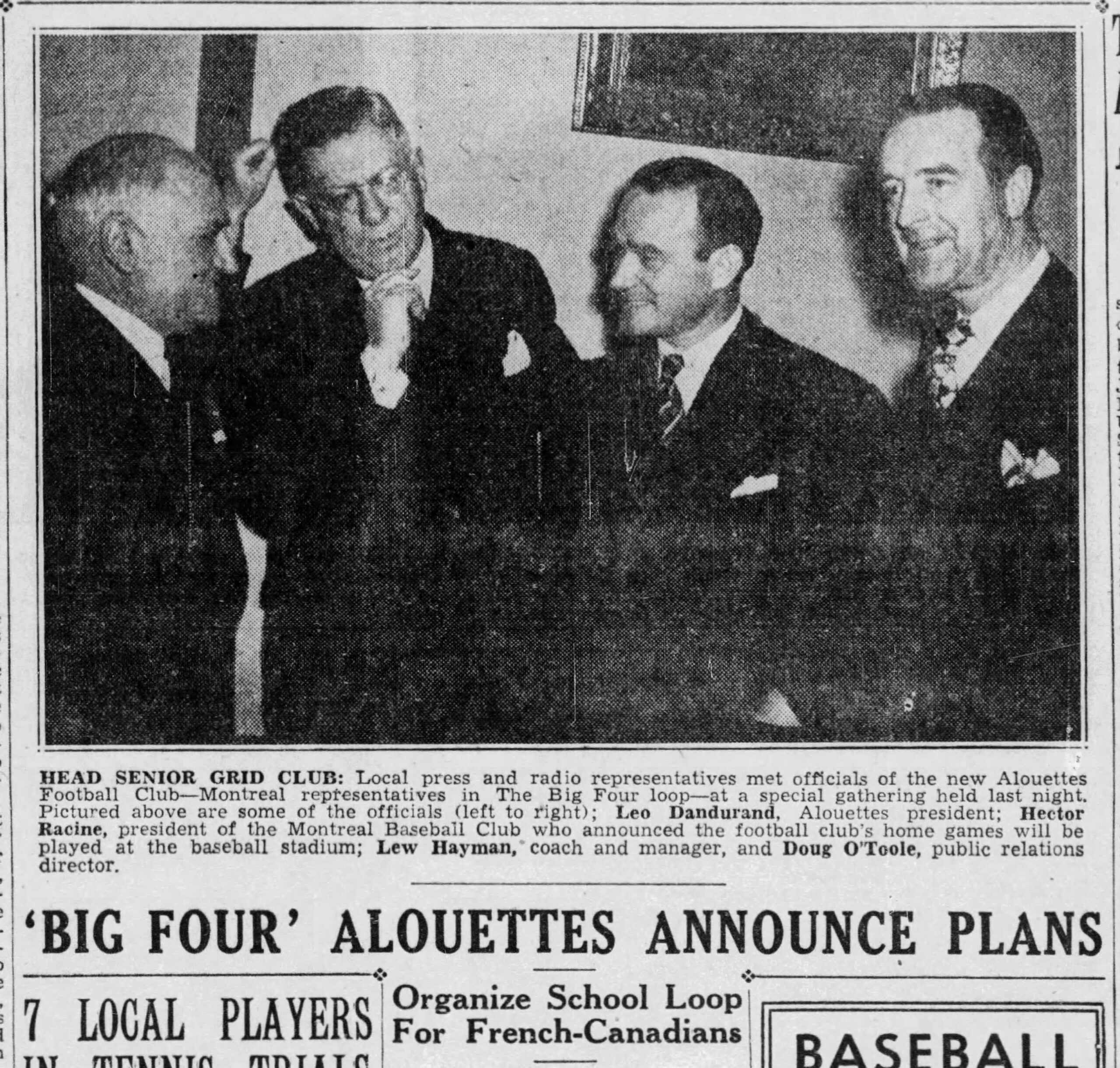
    Officials from the new Montreal Alouettes (Montreal Gazette, 21 May 1946, p. 16.)

    The Montreal Alouettes were founded by Leo Dandurand and Lew Hayman among others. Hayman had led the Toronto Argonauts to several Grey Cups, bringing instant credibility back to Montreal football.

    McGowan, Lloyd. “Take It From Hayman Grid Team a Lew-Lu.” Montreal Star, 21 May 1946, p. 24.

    According to the Alouettes’ website, Messrs. Dandurand and Hayman decided to name the new football club the Alouettes after hearing men singing the Quebecois children’s song Alouette. Alouette is the French word for lark. As in the bird. Now, any Canadian school-aged child can easily recognise the popular song. It is often used to teach English-speaking students the names of various body parts in French and in my humble opinion is one of the catchiest songs around.

    Check out the video below produced by the National Film Board of Canada in 1944. It features the Alouette song along with an animated paper cutout presentation by Norman McLaren and René Jodoin.

    There is a strong connection to the 425 Squadron of the Royal Canadian Air Force. This French-Canadian unit of the RCAF was active during the Second World War and was nicknamed the “Alouette Squadron.” Their motto? Je te plumerai, of course. It’s not surprising that Montreal adopted the Alouette moniker in honour of the Alouette Squadron following the conclusion of the war.

    The Als – the oft-used abbreviation – represented professional football in Montreal through to the early 1980s. Then, after an ownership controversy in 1982 the team folded only to be quickly replaced by a new franchise called the Montreal Concordes. After playing as the Concordes for four seasons, the team readopted the Alouettes name for 1986. Sadly, the renaissance was short lived as the Alouettes ceased operations on the eve of the 1987 CFL season.

    The Montreal Stallions

    In the early 1990s, the Canadian Football League added several teams in the United States as part of an American expansion plan. While most of the expansion teams struggled on and off the field, one major exception was the Baltimore Stallions.

    The Stallions were a dominant force and played in the Grey Cup in both years of their brief existence, winning the championship in 1995. The team also enjoyed great support from the fans in Baltimore and easily led the CFL in attendance. But in 1996 the National Football League announced it would return to Baltimore, causing the Stallions to look for new pastures.

    Ultimately, that new home was to be Montreal. In February 1996, the Stallions left Maryland for Quebec. While the team was initially referred to as the Montreal Stallions, it was generally assumed that the team would be rebranded. And it was obvious to all what that “new” name should be. Thus, after a nine-year absence in the CFL the Montreal Alouettes were back in business.

    “Montreal Alouettes back in business.” Hamilton Spectator, 29 February 1996, p. 29.

    This is the ninth of a series of posts that will explore the stories behind the names of the existing Canadian Football League teams. See the previous post on the Ottawa Redblacks.

  • The First Canadian Football Drafts

    It’s Draft Day in the Canadian Football League. Today is the day when the CFL’s nine teams divvy up the incoming top Canadian players. It’s done in an orderly fashion through a number of rounds to allow for competitive fairness and to encourage parity.

    In the early days of Canadian football, players tended to be locally based so there was really no need for a draft. Even as the game became more professional, teams selected players based on territorial rights.

    In 1952, the Interprovincial Rugby Football Union (IRFU) aka the Big Four experimented with a draft. The draft allowed the four teams (Hamilton, Toronto, Ottawa, and Montreal) to name players who would then be off limits to the other clubs unless an agreement could be reached between the teams.

    In 1953, the Big Four draft became more formalized. The draft was limited to forty Canadian players from five universities: McGill, Queen’s, the University of Toronto, McMaster, and the University of Western Ontario.

    The Montreal Alouettes selected Doug McNichol, a defensive lineman, from the University of Western Ontario in the first pick overall.

    It wasn’t until 1956 that a Canada-wide draft was held.