It’s September 1952 and a new technology – black and white television – is taking the country and much of the world by storm. The Canadian Broadcasting Corporation (CBC) entered the TV business with two flagship stations: CBFT in Montreal and CBLT in Toronto.
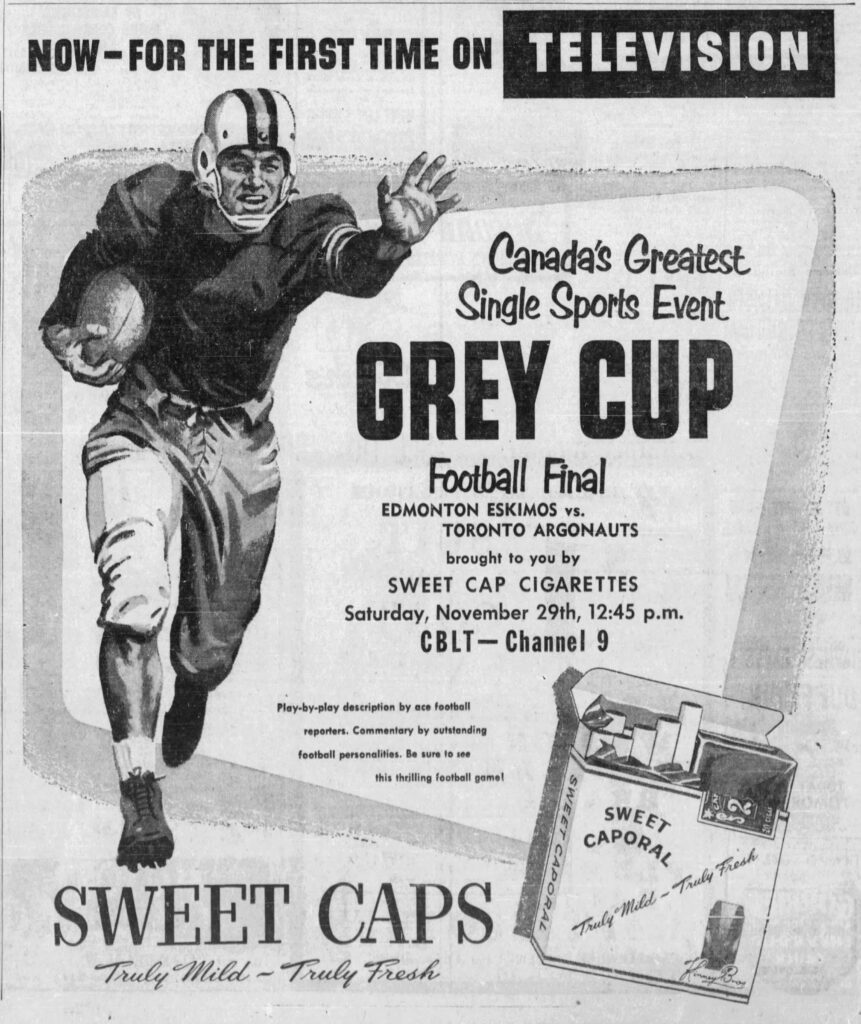
Grey Cup Advertisement for Sweet Caps cigarettes in the Toronto Star (27 November 1952)
The decision was soon made to broadcast the upcoming Grey Cup game on CBLT. The Canadian Rugby Union championship was scheduled for Saturday November 29th at Varsity Stadium in Toronto.
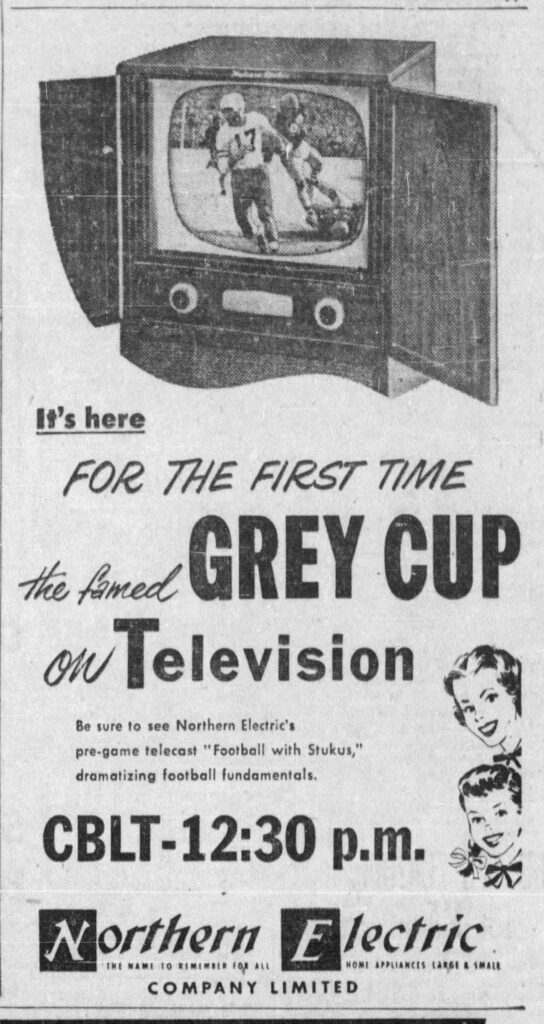
Grey Cup Advertisement by Northern Electric in the Toronto Star (27 November 1952)
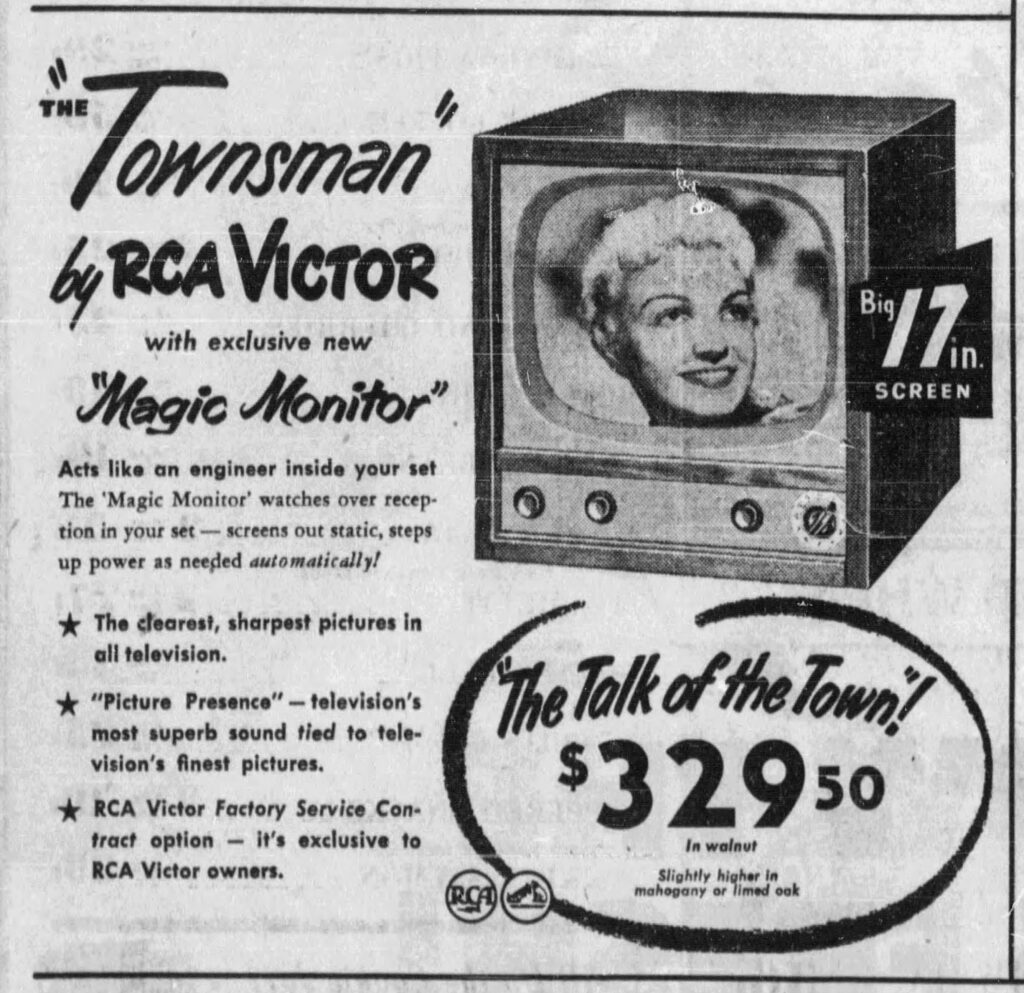
The novelty factor of the new technology coupled with the popularity of the hometown Toronto Argonauts, who were playing in the championship, helped drive sales for television sets in Toronto. Several ads selling TVs appeared in local newspapers. These didn’t come cheap, but vendors were more than happy to set up affordable payment plans for excited football fans.
Ads promoting TV sales
While the Grey Cup game itself was the first Canadian football game ever televised, broadcast crews did a practice run a few days before in the playoff game between the Argonauts and the Sarnia Imperials of the Ontario Rugby Football Union. In those days, the ORFU still challenged for the Grey Cup. The Toronto-Sarnia Grey Cup semi-final game at Varsity Stadium was used as the dress rehearsal for the big game. The 1952 Grey Cup commentators Norm Marshall and Larry O’Brien were actually chosen after an audition for the roles was held during the Sarnia game.
Notes about the TV practice run done during the Grey Cup semi-final between Toronto and Sarnia (Toronto Star, 27 November 1952)
Pubs in and around Toronto with television sets were packed on the day of the game. Meanwhile, in nearby Hamilton, Westinghouse set up several TVs so that employees and friends could watch the game. The broadcast even included a short pre-game show hosted by Annis Stukus.
In the end, the Argonauts defeated Edmonton by a score of 21-11 in front not only record crowd at Varsity Stadium but also tens of thousands of television viewers in the Toronto area. A new era for the Grey Cup and for Canadian television was here.
An observer today would simply shrug his shoulders after reading the contents. “What’s the big deal?” he would ask. But around the turn of the 20th century the Burnside Rules would revolutionize Canadian football. Named after Thrift Burnside, who captained the University of Toronto varsity football team, the so-called Burnside Rules helped transform Canadian football from a rugby-style game to the modern gridiron game we recognize today.
Proponents of the Burnside Rules promoted the idea that they made the game more open, more exciting, and easier to follow. Opponents argued they changed the very essence of Canadian football and risked the Americanization of the game. In hindsight, both sides were probably right.
So, what the heck were the Burnside Rules anyway? And how did they change the game of Canadian football so much? Let’s take a quick look.
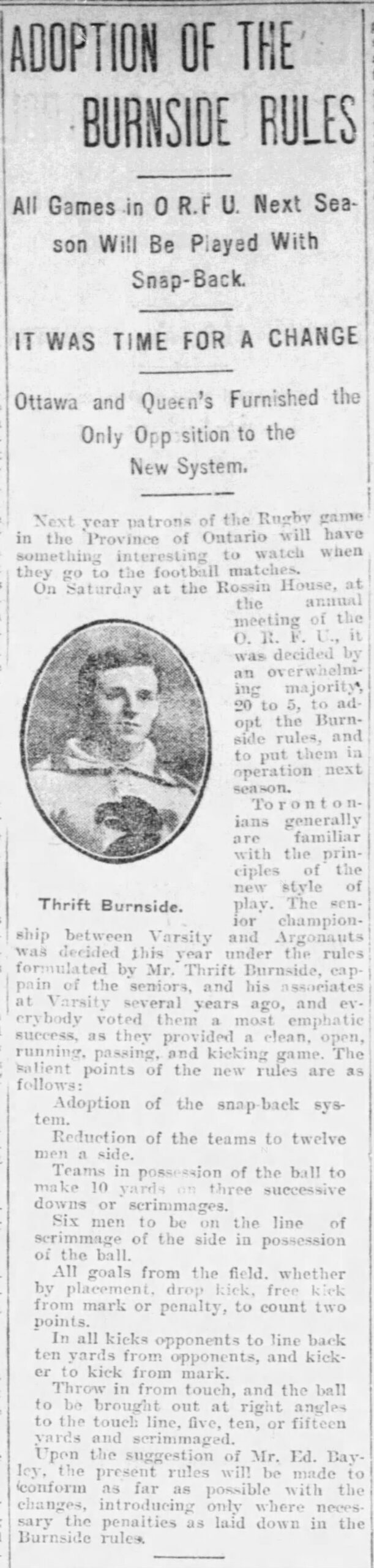
Perhaps the biggest difference in Mr. Burnside’s rules compared to traditional Canadian rugby at the time was the introduction of the downs system. The team with possession would now have three chances (or downs) to advance the ball ten yards. The other significant difference was adoption of the snap-back formation. Instead of a rugby scrum where players heeled the ball backwards, the offence would now line up along a fixed line of scrimmage and have the centre player on the line “snap back” the ball. Both the downs system and the snap-back formation were already being used in American football at the time.
Other rule changes included the reduction of the number of players from fifteen to twelve, scrimmaging instead of throw-ins from the sideline, and capping the number of players on the line of scrimmage at six. They also made some minor kicking and scoring adjustments.
A Fine Exposition of New Rugby
The first use the Burnside Rules was the first game of the Toronto city championship between the University of Toronto and the Toronto Argonauts on November 15, 1902. The rules received rave reviews from the Toronto Star, which hailed the game a “fine exposition of new rugby.”
Praising the Burnside Rules that were used in the Varsity-Argonauts game. (“Fine Exposition of New Rugby.” Toronto Star, 17 November 1902, p. 10.)
Still, the Burnside Rules were considered so radical by purists that their adoption divided clubs and unions and threatened to wreak havoc on Canadian football. On December 13, 1902, the Ontario Rugby Football Union formally adopted the Burnside Rules for the 1903 season. The Canadian Rugby Union and its other unions refused to adopt them initially. This led to the three CRU unions in Ontario and Quebec to play by three different sets of rules.
Article in the Toronto Star explaining the Burnside Rules after being adopted by the ORFU. (“Adoption of the Burnside Rules.” Toronto Star, 15 December 1902, p. 10.)
By the way, the Quebec Rugby Football Union probably had the most radical rule of all. While it didn’t adopt the snap-back formation it did implement its own version of a downs system. Basically, teams had to gain at least five yards on their third down, regardless of yards gained on the previous first or second down.
Comparing the three sets of rules in Canadian football for 1903 (Toronto Star, 22 December 1902, p. 9.)
Ottawa Opposed the Burnside Rules
The Ottawa Rough Riders lead the opposition to the ORFU’s adoption of the Burnside Rules. A column appearing in the Ottawa Citizen made abundantly clear Ottawa’s stance on the new rules and took to personally attacking Thrift Burnside. Such was the passion and divisiveness surrounding these sweeping changes.
A column in the Ottawa Citizen critical of Thrift Burnside and his rules. (Ottawa Citizen, 16 December 1902, p. 6.)
After unsuccessfully trying to convince the CRU to adopt the Burnside Rules, the ORFU opted to switch back to CRU rugby-style football in 1906. But in the years ahead, the down system and snap-back formation were eventually adopted across the country.
By the 1920s Canadian football had evolved and started to resemble the game we play and watch today. The Burnside Rules played a pivotal role in this evolution. By incorporating popular aspects of American football into the traditional Canadian game, the ORFU’s early adoption of the Burnside Rules helped shape the future of Canadian football.
More praise of the Burnside Rules by the Toronto Star. (Toronto Star, 17 November 1902, p. 10.)
Source:Government of Canada. Photo: Cpl Heather Tiffany
The colours red and black have long been associated with the city of Ottawa and its various football teams throughout the years. Pay a visit to Parliament Hill or to Rideau Hall, and you will see the Ceremonial Guards donning their traditional black and red uniforms. The Ottawa Football Club, founded in 1876, eventually adopted red and black (and white) as their team colours. This is the team that would become known as the Ottawa Rough Riders in October 1898.
The story behind the Rough Rider name is clouded in mystery. The “official” line is that Ottawa adopted the name Rough Riders as some sort of tribute to future U.S. President Teddy Roosevelt’s regiment (called the Rough Riders) in the Spanish-American War in 1898. But there is no mention of this connection in local newspapers at the time. Why would a football team in Ottawa be named after a regiment fighting a war that had absolutely nothing to do with Canada, anyway? It really doesn’t make much sense.
Another suggestion is that the name derives from the lumberjacks or log drivers who used to ride logs down the Ottawa River. Again, though, there isn’t any reference to lumberjacks or log drivers in Ottawa newspapers around the time the football team started using the name.
Perhaps the Ottawas (yes, they were called that, too) follow the same “rough rider” origins as the Saskatchewan Roughriders. The Regina Roughriders adopted the name in 1924, a reference to the trainers who broke wild horses in the west. In the 1960s and 1970s the Ottawa Rough Riders used a cowboy riding a bucking horse atop a football as their logo. And their mascot was a guy named Okee the Cowboy. So, who knows?
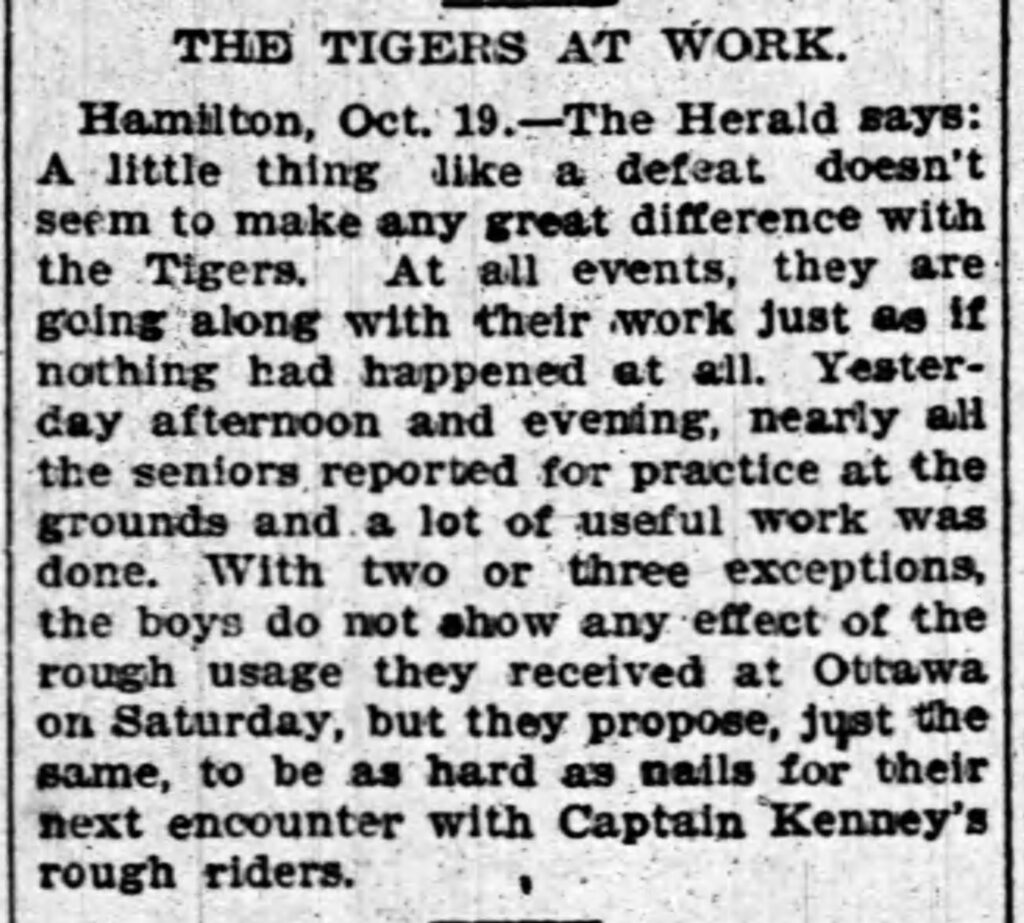
But there is strong evidence that the Rough Rider name given to Ottawa’s football team had nothing to do with a Teddy Roosevelt tribute or lumberjacks or horse-riding cowboys at all. Instead, the “rough rider” label was most likely used as an insult by a Hamilton journalist. See, in October 1898 the Hamilton Tigers and Ottawa Football Club were involved in an intense couple of games that would determine the champion of the Ontario Rugby Football Union. Ottawa had quite the reputation of being an aggressive or “rough” team. Some back-and-forth trash talk between journalists in Ottawa and Hamilton was almost as intense as the on-field rivalry. The Ottawa Journal accused the Hamilton press of maligning their team by calling them “thugs, “murderers, and “rough riders.”
Hamilton Spectator reporter C.A. Mitchell calls Ottawa football players “roughriders” (The Ottawa Citizen, 17 October 1898, p. 6.) Another Hamilton reporter refers to Ottawa as “Captain Kenney’s rough riders”. Kenney was the Ottawa captain. (“The Tigers at Work.” The Ottawa Journal, 19 October 1898, p. 6.)
Ultimately, The Ottawa Football Club embraced the insult and began wearing the Rough Rider moniker as a badge of honour. Literally. The team made up pins with the Rough Rider name and distributed them to fans travelling to Hamilton for the second game. It’s entirely possible that the team piggy backed on the “Roosevelt Rough Riders” that were in the news at the time, but the actual origins of football rough riders centred around their reputed rough style of play on the field.
A reference by Ottawa Citizen reporter to “Roosevelt Kenny” alluding to his hero status after the October 29 rematch between Ottawa and Hamilton. (“The Tiger Hunter’s Laugh.” The Hamilton Spectator, 1 November 1898, p. 4.)The Ottawa press accusing the Hamilton press of maligning the Ottawa Football Club by calling them “murderers,” “thugs,” and “rough riders.” (“Ottawa’s Position.” The Ottawa Journal, 31 October 1898, p. 6.)
Unfortunately, the Ottawa Rough Riders folded following the 1996 CFL season, ending a 120-year football tradition. In 2002, a new CFL team was founded called the Ottawa Renegades. The Renegades, too, adopted red and black as team colours. However, the Renegades met the same fate as the Rough Riders after playing only four seasons.
It wasn’t until 2014 that the Canadian Football League would return to the Nation’s Capital. There was certainly some support for the new team to be called the Rough Riders. However, Saskatchewan objected to it, and the name didn’t carry the same weight for younger football fans who were either too young or not even born yet to have any recollection of the old Ottawa Rough Riders.
In the lead up to the CFL’s return, fans were asked to vote online for the new team’s name. The options included the Rush, Nationals, Voyageurs, Raftsmen, and Redblacks. On June 8, 2013, the team announced that its new name would be the Ottawa REDBLACKS. The nickname is capitalized for marketing purposes. In French, the team is known as the Rouge et Noir.
The new name was meant with mixed reviews. Detractors suggested it was a made-up word while others pointed to the New Zealand All Blacks, that country’s national rugby team, as an example of a successful moniker named simply after team colours. Surely, Ottawa’s new team could be seen through the same lens.
In the end, football fans in Ottawa rallied around their new team. The Red and Black plays homage to the old Ottawa Rough Riders’ colours, the Ceremonial Guards, as well as the plaid jackets worn by the great lumberjacks of the area. The Ottawa REDBLACKS name sounds like a perfect solution, really. And it sure beats the Ottawa Murderers or Ottawa Thugs, doesn’t it?
A special thanks to Chris Sinclair and Ian Symes who pointed me in the right direction when it came to the origins behind the Ottawa Rough Riders name. Thanks, guys. – RF