Tag: Sacramento Gold Miners

  • CFL Adds More American Teams

    After the Sacramento Gold Miners joined the Canadian Football League in 1993 and despite some scepticism and opposition, the league sought to grow its footprint in the United States with additional teams in 1994 and 1995. Here is a look back at some of the CFL’s other American-based teams.

    Las Vegas Posse

    Las Vegas Posse rides into the CFL (Sacramento Bee article )
    Article in the Sacramento Bee about the unveiling of the Gold Miners’ new rival – the Las Vegas Posse.

    The CFL’s second U.S. team was the Las Vegas Posse. Owner Nick Mileti, who had a strong sports background, was awarded the expansion franchise in July 1994. They were officially branded the Posse in December of that year. Interesting trivia: the runner up name was the Mounties.

    Las Vegas had a unique ownership model in that they were a publicly traded corporation, with Mileti as the largest shareholder. That said, the Posse were the least successful of the American expansion teams. Not only did the team have to compete in a crowded entertainment environment, but their stadium was located far from the downtown, meaning fans had to make quite the trek to catch a game – often in intense heat. Attendance was dismal and games with fewer than 10,000 fans were the norm.
    One bright spot for the Posse, though, was their quarterback. A young Anthony Calvillo made his CFL debut with Las Vegas. He would go on to have a stellar career with the Montreal Alouettes.

    Baltimore CFL Colts / Stallions
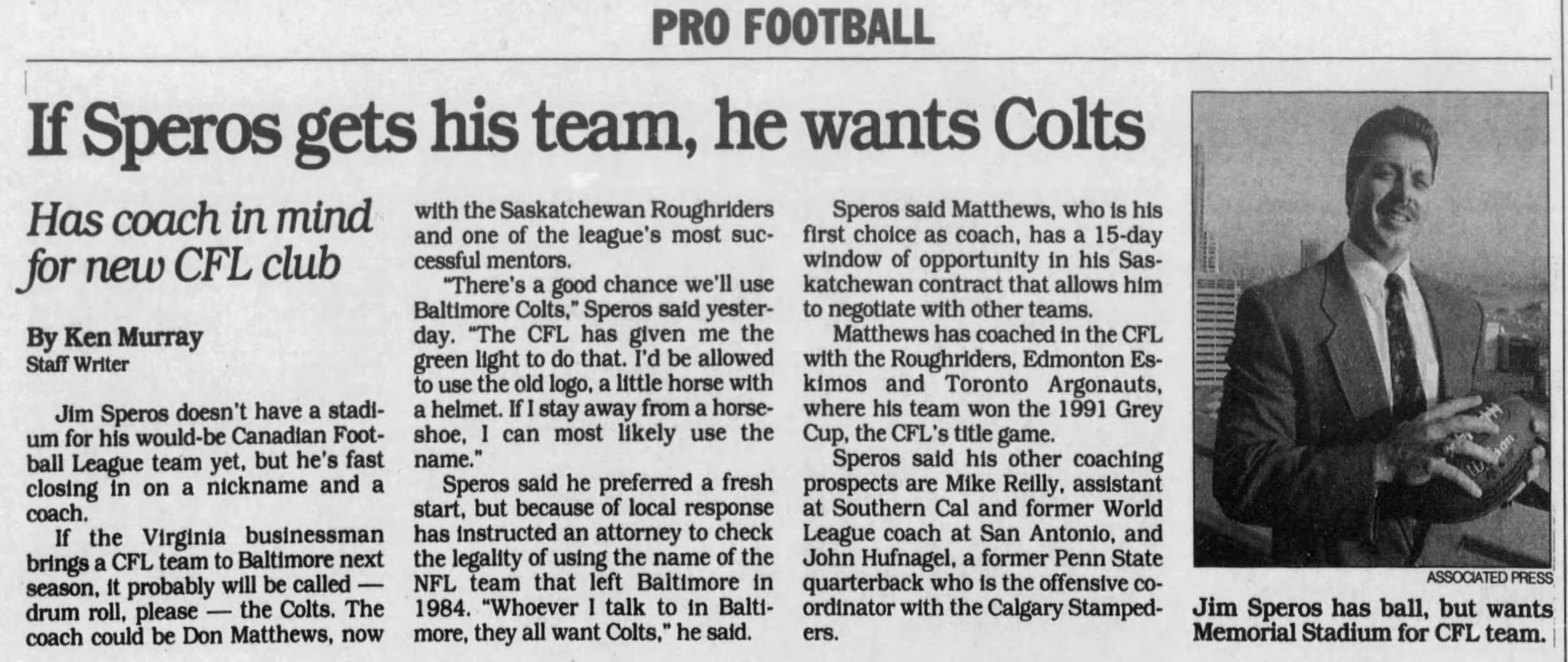
    If Speros gets his team, he wants Colts (Baltimore Sun article)
    Baltimore Sun article about naming Baltimore’s prospective CFL team the “Colts,”

    When the National Football League rejected an expansion franchise for Baltimore, attention turned to the expanding Canadian Football League. Owner Jim Speros originally wanted to call his team the Baltimore Colts and help tap into the nostalgia associated with that brand. When the NFL threatened legal action, a compromise as suggested for the team to be known as the Baltimore CFL Colts. When that, too, was rejected the team simply played as the Baltimore Football Club and was often referred to as the Baltimore CFLers.

    Baltimore was an instant success both on and off the field. Football fans were angry at the NFL plus there was a baseball strike in 1994, the year the CFL Colts – sorry CFLers – took the field. Baltimore routinely attracted crowds of around 40,000 to Memorial Stadium.

    Head coach Don Matthews knew the Canadian game well and stocked his team with experienced CFL players such as quarterback Tracy Ham and defensive lineman Jearld Baylis. Baltimore finished their inaugural season with a 12-6 record, second place in the East Division. They went onto to play BC in the Grey Cup. Not bad for an expansion franchise.

    In 1995, the team was finally given a new name – the Stallions. Again, the team was a powerhouse on the field, easily winning first place in the South Division. The Stallions went on to beat Calgary in the Grey Cup that year, becoming the first and only American team to win the Grey Cup.

    It was this team that relocated to Montreal in 1996 to become the reincarnated Montreal Alouettes.

    Shreveport Pirates

    Ad for Shreveport Pirates tickets (Shreveport Times)
    Advertisement in the Shreveport Times for Shreveport Pirates season tickets.

    The Pirates joined the CFL in 1994. They were owned by Bernie Glieberman, who was the previous owner of the Ottawa Rough Riders. He sold the Rough Riders and was granted an expansion franchise for Shreveport, Louisiana.

    Coached by Forrest Gregg, the Pirates struggled on the field and started their inaugural season with 14 straight losses. They ended up with a league-worst 3-15 record. In their second season, Shreveport finished with five wins and 13 losses. Despite their poor performance, the team enjoyed pretty good support amongst local fans and the business community. The team played at Independence Stadium.

    San Antonio Texans

    Miners? That's Texans to you (San Antonio Express News article)
    From Gold Miners to Texans (San Antonio Express News).

    Originally, a team in San Antonio (also to be called the Texans) was supposed to join the CFL in 1993 with Sacramento. However, the team folded only two weeks after it was granted. Ironically, the Sacramento Gold Miners themselves relocated to San Antonio for the 1995 season after owner Fred Anderson couldn’t secure stadium upgrades in the California capital.

    The team was renamed the Texans and finally had some success on the field, finishing second place in the South Division with a 12-6 record. The Texans played at the Alamodome, one of the few stadiums in the United States that could easily accommodate Canadian football field dimensions.

    Birmingham Barracudas

    Birmingham Barracudas season ticker ad (Birmingham News)
    Advertisement in the Birmingham News promoting season tickets for the Birmingham Barracudas.

    The CFL awarded Birmingham an expansion franchise in January 1995. Owned by Art Williams and coached by Jack Pardee, the team was unveiled as the Birmingham Barracudas on March 14, 1995. Future Hall of Fame quarterback Matt Dunnigan joined the team, leading them to a 10-8 record, third place in the South Division.

    Birmingham attracted good crowds to Legion Field early in the season. Their home opener versus Hamilton had over 31,000 fans in attendance. But by the time U.S. college football started up, attendance dropped dramatically. Williams sold the team after the 1995 season to a group that expressed interest in moving it to Shreveport for 1996.

    Memphis Mad Dogs
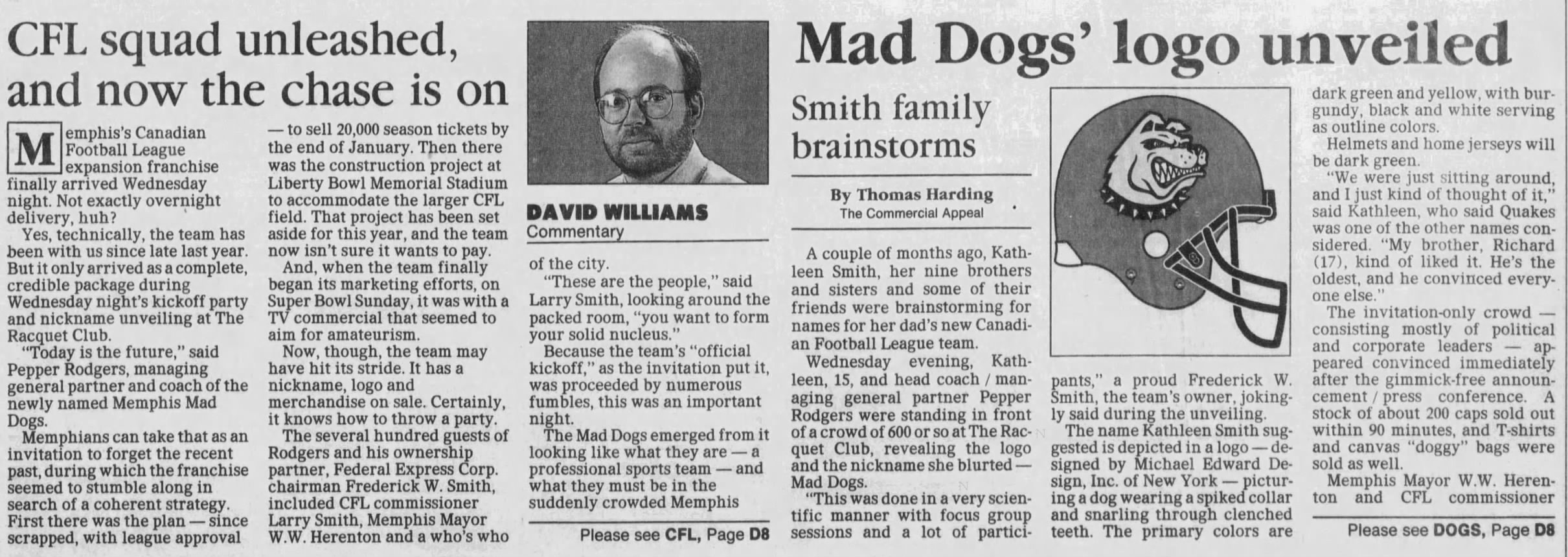
    Memphis Mad Dogs article (Memphis Commercial Appeal)
    Coverage of the Memphis’ new CFL team, the Mad Dogs, in the Memphis Commercial Appeal.

    Memphis was another case where an NFL expansion rejection created a pivot to the CFL. Fred Smith, the owner of FedEx, spearheaded the team that was called the Mad Dogs. They were coached by Pepper Rodgers and tried to replicate what Baltimore had done by bringing in experienced CFL players including Damon Allen as their quarterback.

    The Mad Dogs finished the season with a 9-9 record, fourth place in the South Division, and missed the playoffs in their one year in play.

    Memphis played at the Liberty Bowl Memorial Stadium, which could not accommodate the larger Canadian football field. As such, the end zones in Memphis were only seven yards deep at the sidelines. To make matters worse, the end zones were Astroturf while the rest of the field was natural grass.

    The CFL ended its American expansion following the 1995 season. In 1996, the league reverted to its original all-Canadian lineup.


    Sources:

    Baltimore Sun, 16 December 1993
    Birmingham News, 16 March 1995
    Sacramento Bee, 11 December 1993
    San Antonio Express-News, 14 March 1995
    Shreveport Times, 6 April 1994

  • The CFL Expands to the USA

    When I first started following CFL football in the early 1990s, two issues dominated the league: struggling Canadian franchises and U.S. expansion. They kind of went hand in hand, the idea being that an injection of American money and new markets would help stabilize the existing Canadian teams. The ultimate goal was for the CFL to grow in popularity and take its rightful place as a major North American sports league.

    Of course, things don’t always go according to plan. As we kick off a new year here at Canadian Football History, we’re going to look back at the CFL’s brief foray south of the border. It’s been 30 years since the so-called CFL USA experiment ended.

    Whatever your views on the idea of American teams playing in the Canadian Football League are, one thing is certain. U.S. expansion at the time did breathe some new life into an 8-team league that was otherwise in dire straits. New teams. New colours. New players. And some expansion fees to boot. I still have a Sacramento Gold Miners t-shirt I bought. They were my favourite U.S.-based CFL team and had a great name and logo, in my opinion.

    So, let’s set the stage for this endeavour, shall we?

    Talk of CFL expansion to the United States was nothing new. The subject came up frequently over the years. The CFL staged an exhibition game in Portland, Oregon in June 1992 to test the waters. By most accounts the game was a success. But the expansion idea really picked up steam following the demise of the World League of American Football in 1992. Cities that had teams in that league were front and centre when it came to potential CFL markets.

    Larry Smith, the newly appointed CFL commissioner in 1992, became the face of CFL expansion to the U.S. He had the untenable job of selling expansion to would-be American investors, nervous Canadian team governors, and sceptical players and fans. And there was plenty of sceptism.

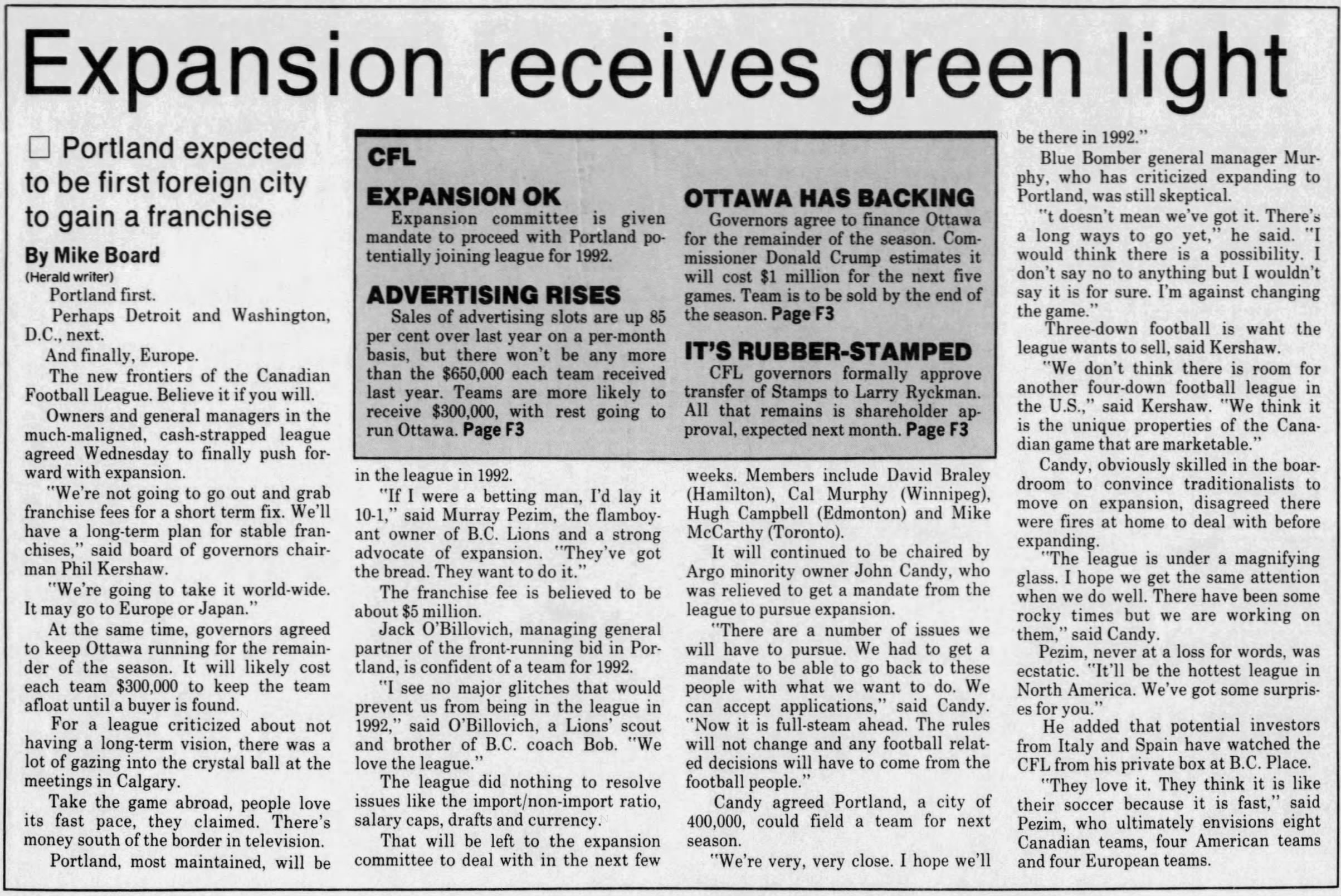
    Expansion receives green light (Calgary Herald)
    Article by Mike Board in the Calgary Herald (3 October 1991) about the CFL greenlighting U.S. expansion with hints of future expansion into Europe or Japan.

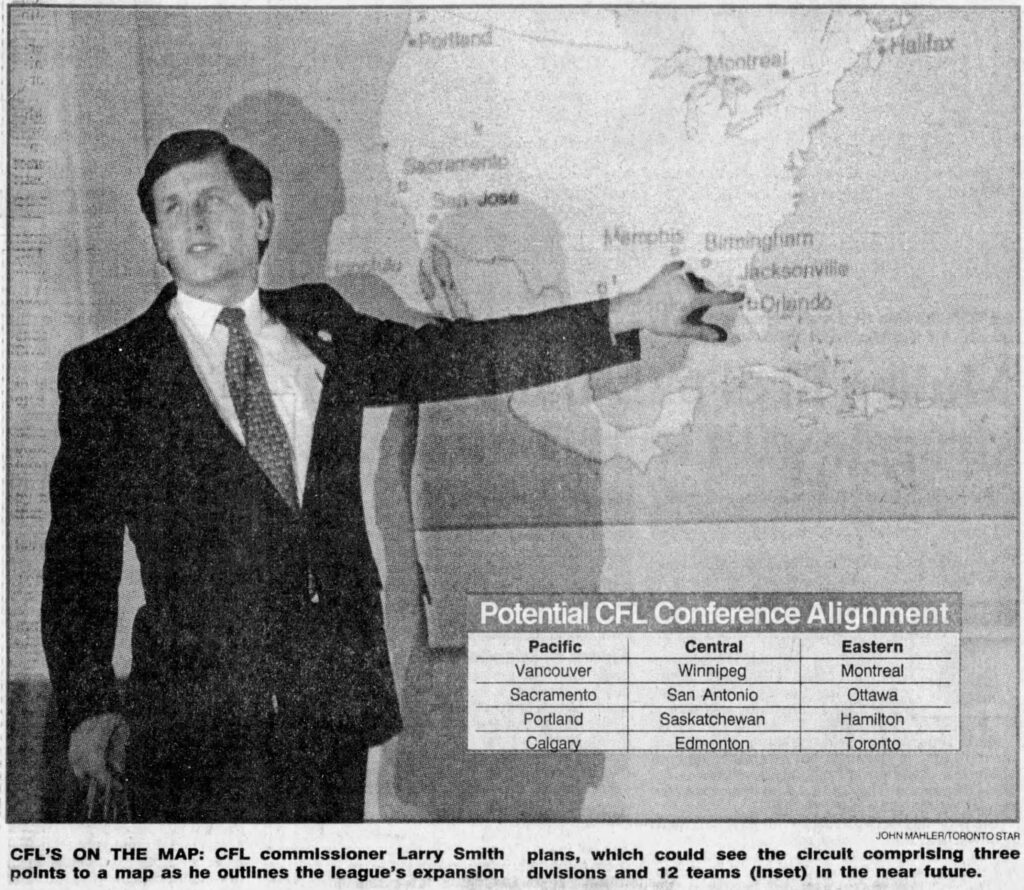
    An initial focus on cities close to the Canada-U.S. border (e.g., Portland, Detroit, etc.) was soon abandoned. Late in 1992, Smith presented a map showing prospective CFL expansion sites. While Montreal and Halifax were included, the rest of the map showed mid-sized U.S. markets such as Sacramento, San Antonio, and Orlando. Honolulu, Hawaii was even on the map. Ironically, several of the eventual U.S.-based teams were never on this map, including the most successful franchise in Baltimore.

    While the i’s still had to be dotted and the t’s crossed, plans were afoot for four new teams to join the CFL for the 1993 season. These included Portland, Sacramento, San Antonio, and Montreal. The league’s twelve teams were be divided into a new three division alignment. I’m not sure if it was ever explained how the playoffs would work under this structure.

    CFL expands its vision article in the Montreal Gazette.
    Ian MacDonald in the Montreal Gazette (13 November 1992) writing about the CFL’s expansion plans with new teams Montreal, Portland, Sacramento, and San Antonio.

    However, shortly after CFL’s plans were made public the backtracking began. Portland, which was always considered the frontrunner for U.S. expansion, backed out. As did Montreal. It would come down to just the Sacramento Gold Miners and the San Antonio Texans joining the CFL for 1993. They were formally welcomed into the CFL on January 12, 1993.

    The Gold Miners were owned by Fred Anderson and in many ways were a reincarnation of the Sacramento Surge of the WLAF. Fred Anderson was a genuinely seen as a nice guy who truly believed in the CFL’s potential in California. He seemed to have the capital and the commitment as well as local fan and media support. His biggest obstacle was a suitable stadium. The Gold Miners would play at Hornet Field on the campus of Sacramento State university, a stadium comprising mostly temporary bleachers and portable washrooms. Not an ideal facility for a fledging professional football team by any stretch of the imagination.

    On the other hand, San Antonio was to play in the brand new 65,000-seat Alamodome, a state-of-the-art indoor stadium that was one of the few American stadiums that could accommodate the larger Canadian football field. The Texans were owned by Larry Benson who, like Fred Anderson, had previously owned the city’s former WLAF franchise. Fun fact. The WLAF team in San Antonio was called the Riders. Now, imagine a scenario where the San Antonio Riders, along with the Saskatchewan Roughriders and the Ottawa Rough Riders (Ottawa’s team at the time), played together. That could’ve been quite fun to watch.

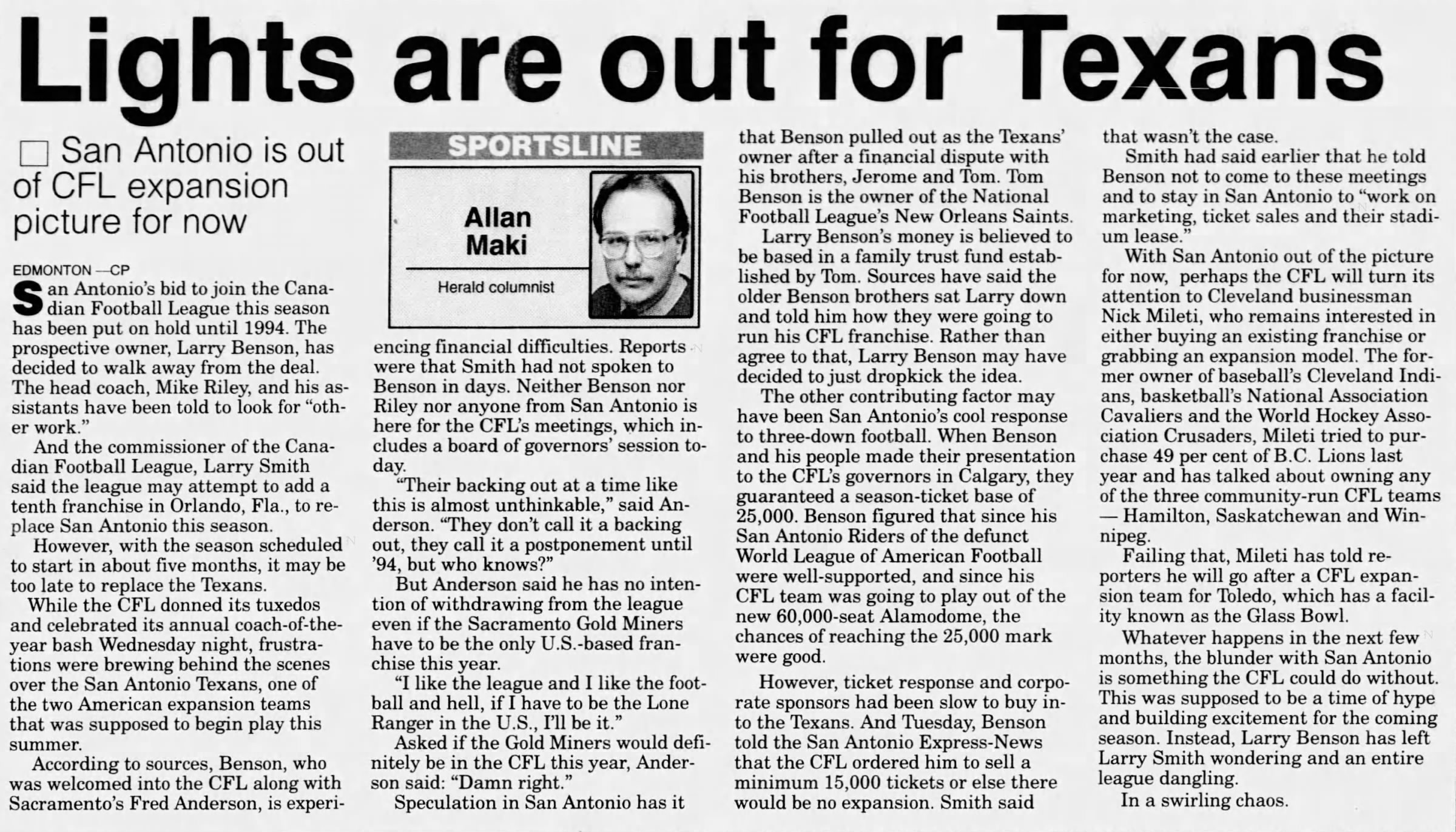
    Lights are out for the Texans
    Article in the Calgary Herald about the demise of the San Antonio Texans CFL expansion franchise.

    Alas, Benson pulled out two weeks later. Was it cold feet or lack of money or something else? Whatever the case, there would be no CFL football in Texas in 1993.

    In the end, it was only Sacramento left standing from the original four expansion teams. The Gold Miners played in the West Division and kicked off their season with a two-game road trip in Ottawa and Hamilton. The Gold Miners home opener at Hornet Field was played on July 17, 1993, against the Calgary Stampeders.
    Amongst the uncertainty and despite the hiccups, CFL expansion to the United States was here at last.


    Sources:
    The Calgary Herald, 3 October 1992
    The Calgary Herald, 28 January 1993
    The Montreal Gazette , 13 November 1992
    The Toronto Star, 13 November 1992

    Fediverse Reactions
  • Sacramento Falls in Love with the CFL

    That was the headline in my hometown’s newspaper, the Hamilton Spectator, after the CFL’s debut in Sacramento, California. I became a CFL fan in the early 1990s. It was a tumultuous time for the Canadian Football League. Some teams across the country were on the verge of collapse. Several others were struggling to stay afloat. Against this backdrop, the CFL opted to add teams in the United States. The benefits of U.S. expansion were two-fold. First, expansion fees could bring in some much-needed cash in the short term. Second, a bigger North American wide football league could open up even greater revenue (i.e., an American TV deal) long term.

    An article in the Hamilton Spectator about Sacramento embracing the CFL.
    (Morris, Jim. “Sacramento falls in love with the CFL.” The Hamilton Spectator, 19 July 1993, p. 16.)

    The first American team to join the CFL was the Sacramento Gold Miners in 1993. There was also supposed to be a team in San Antonio, Texas, as well, but it was kiboshed before playing a single down. So, the 1993 CFL season featured nine teams with the addition of the California capital.

    The Gold Miners were spearheaded by Fred Anderson, a Sacramento businessman, who had owned the Sacramento Surge of the World League of American Football, a developmental spring league for the National Football League. The WLAF ceased operations in 1992. There was considerable overlap between the Surge and the Gold Miners. The teams’ colours were similar, and many former Surge players and personnel were brought into the Gold Miners’ organization. Kay Stephenson reprised his role as Sacramento’s head coach, having coached the Surge to the 1992 WLAF championship.

    Because of U.S. labour laws, the Gold Miners were not required to have any Canadian players on their roster. Instead, they played with an all-American lineup. Some suggested this gave Sacramento a unique advantage over their Canadian counterparts. Yet, the team did struggle as an expansion team while adapting to the Canadian game.

    The Gold Miners played their home games at Hornet Field on the campus of Sacramento State university. It was a rather bare bones stadium comprising temporary bleachers and portable washrooms. Nevertheless, the stage was set for a historic debut of Canadian football in northern California.


    July 17, 1993

    The Gold Miners and Stampeders about to go head to head in Sacramento
    Voet, Gary. “Today’s Game at a Glance.” The Sacramento Bee, 17 July 1993, p. 21)

    The Sacramento Gold Miners opened the 1993 season with a two-game road trip, losing both games in Ottawa and Hamilton. Their first home game was played on Saturday July 17th against the Calgary Stampeders, the defending Grey Cup champions, led by marquee quarterback Doug Flutie.

    Marking the field at Hornet Field in Sacramento prior to the CFL’s debut (The Sacramento Bee)

    A crowd of 20,082 filed into Hornet Field that night to see a great offensive display of football. Flutie and Sacramento quarterback David Archer lit up the scoreboard in what was truly a wild west shootout. You couldn’t have asked for a more exciting game to introduce Sacramento fans to the CFL.  Ultimately, the Stampeders came out on top 38-36. The Gold Miners dropped to 0-3.

    Coverage of the historic first CFL game in Sacramento from a Sacramento perspective.
    (Voet, Gary. “Miners lose a shootout to Calgary.” The Sacramento Bee, 18 July 1993, p. 25.)

    Sacramento finished their inaugural season with a 6-12 record, last place in the West Division. They were somewhat better the following year but still missed the playoffs in a competitive West division. Unfortunately, the Gold Miners would leave Sacramento following the 1994 season. After failing to secure a new stadium or upgrades to Hornet Field, Fred Anderson relocated the Gold Miners to the then-still-new Alamodome in San Antonio in 1995 where they became known as the Texans. In 1996, the CFL ended its American expansion experiment and returned to being an all-Canadian league.

    I reached out to award-winning journalist Bob Graswich, who was a columnist for the Sacramento Bee during the Gold Miners’ CFL run. His column praising the Canadian game resonated with me because it was exactly how I felt (and still do!) about the CFL when compared to the big bad NFL. Reading that sentiment from an American writer helps validate my position.

    Graswich told me the CFL was a “breath of fresh air” for Sacramento. “It was an exciting game, designed for the fans.” An antithesis of the NFL. He speaks very highly of Fred Anderson, saying he was somebody that was difficult not to like. Fred was a Sacramentan through and through, and he reluctantly moved the team only after he ran out of options. Graswich, who visited Anderson before his death, said Fred was truly disappointed that he couldn’t make the CFL work in Sacramento.

    A column by Bob Graswich praising the CFL. Sums up my thoughts perfectly.
    (Graswich, R.E., “Thanks, Fred: You’ve givenus a better game.” The Sacramento Bee, 18 July 1993, p. 23.)

    Fred Anderson was no doubt the most committed of the U.S. team owners. Perhaps under different circumstances and in a different time, things could’ve worked out better. Ironically, years later Sacramento State upgraded Hornet Field and renamed the field in Anderson’s honour – a fitting legacy for a man who did so much for football in Sacramento.

    Perhaps it was the novelty factor. Perhaps it was the name and logo, which I really liked. Whatever the reason, I purchased a Sacramento Gold Miners t-shirt. It was one of my favourites, and I still have it. Well, my daughter actually took it and still wears it to school. How’s that for vintage CFL USA cool?

    It didn’t last long. But football fans in Sacramento enjoyed it while they had it. For a brief period over thirty years ago, Sacramento indeed fell in love with the CFL.


    I remember watching this game on television. My family had just returned from a summer road trip to northern Ontario and Ottawa. We made it home just in the nick of time to catch the game on CBC. I really felt like I was watching the beginning of something big. Seeing Americans embrace Canadian football seemed so satisfying to me at the time. It still does, really.

    Back home in Calgary, Tom Elder was also watching this game with excitement. Tom has an extensive library of old CFL games on his Calgary Stampeders Classics YouTube channel . You can watch the historic Calgary-Sacramento game below. Please consider contributing to Tom’s project if you can. It takes a considerable amount of time, resources, and effort to help preserve some of these great CFL memories.

  • Sacramento Gold Miners in a Wild West Shoot Out

    Ad for the Sacramento Gold Miners' home opener
    Source: The Sacramento Bee, 17 July 1993, page 17.

    In 1993, the CFL expanded into the United States with the addition of the Sacramento Gold Miners. Here is an ad that appeared in the Sacramento Bee hyping the Gold Miners’ home opener at Hornet Field vs. the Calgary Stampeders.

    The ad features a comparison of Sacramento quarterback David Archer to Calgary quarterback Doug Flutie.

    Calgary won the game 38-36 in front of a crowd of 20,082.