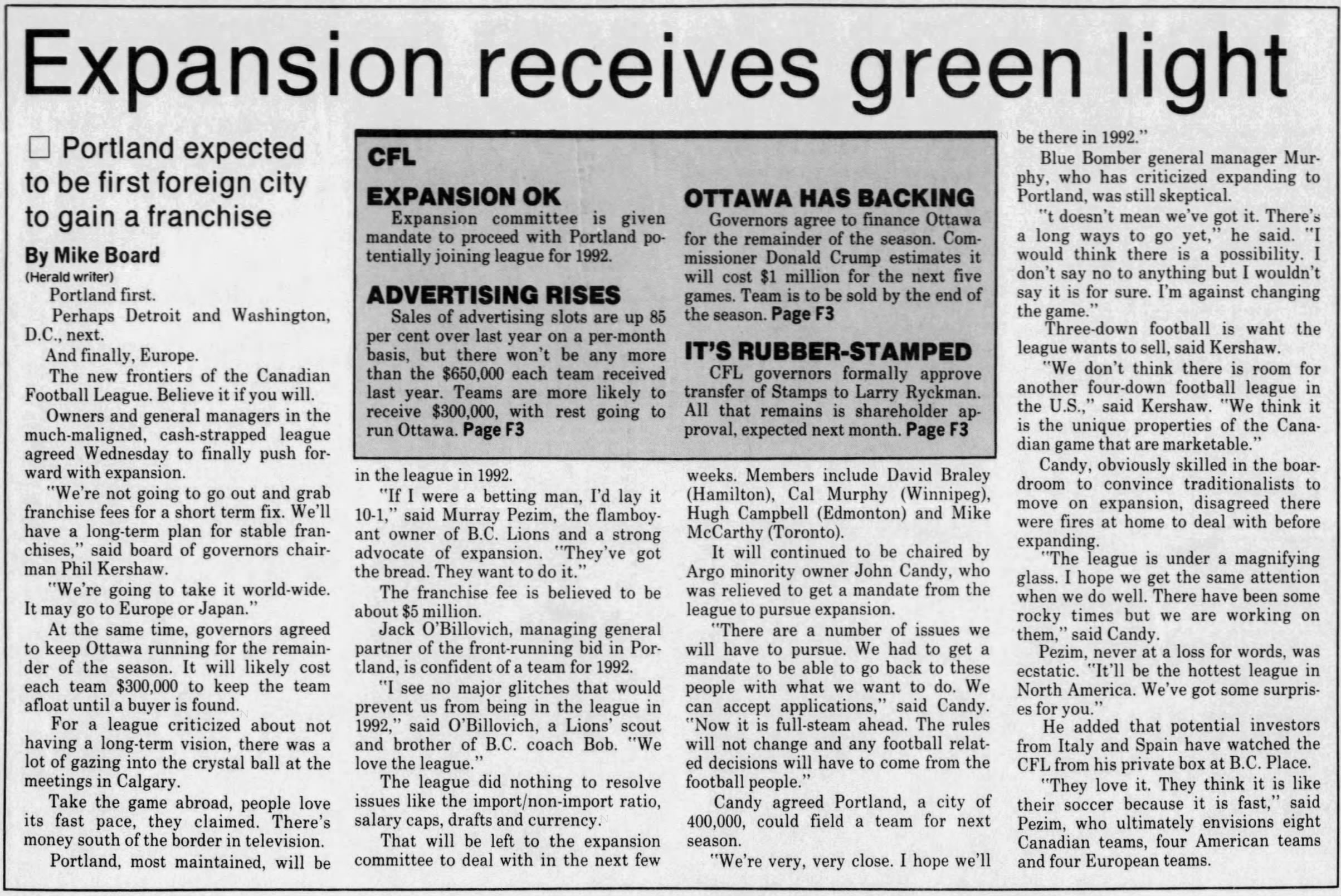
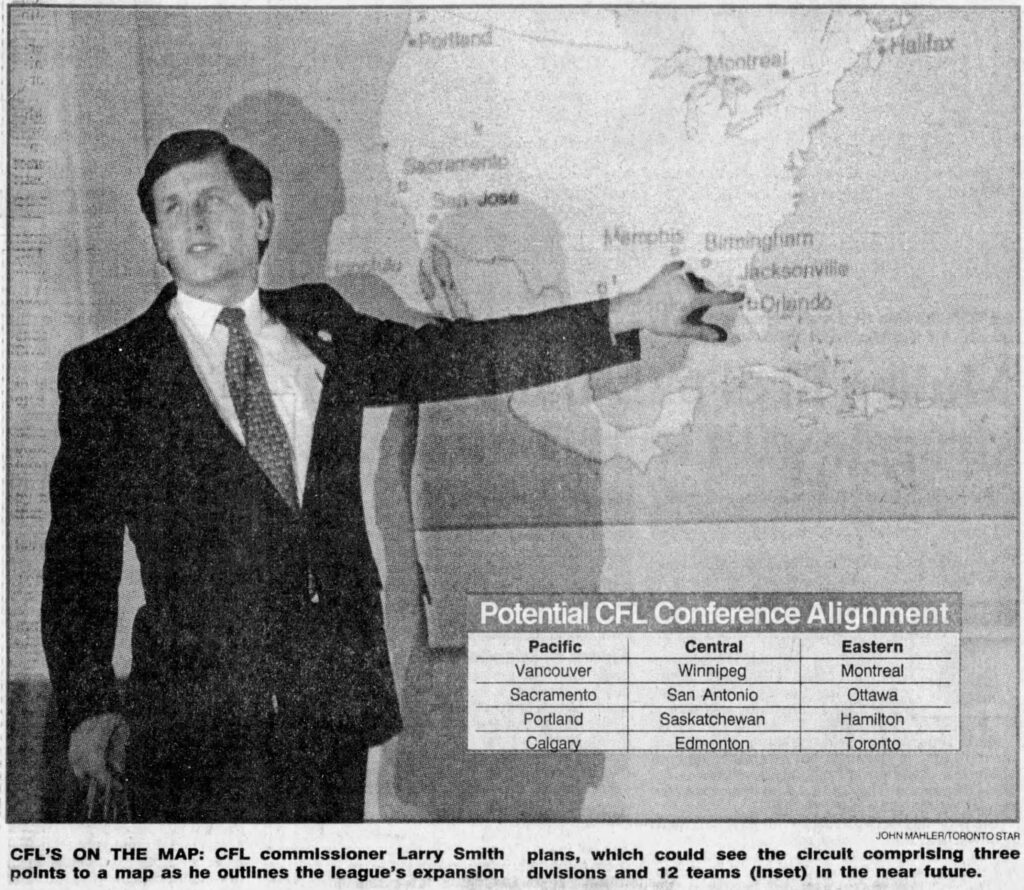
After the Sacramento Gold Miners joined the Canadian Football League in 1993 and despite some scepticism and opposition, the league sought to grow its footprint in the United States with additional teams in 1994 and 1995. Here is a look back at some of the CFL’s other American-based teams.
Las Vegas Posse

The CFL’s second U.S. team was the Las Vegas Posse. Owner Nick Mileti, who had a strong sports background, was awarded the expansion franchise in July 1994. They were officially branded the Posse in December of that year. Interesting trivia: the runner up name was the Mounties.
Las Vegas had a unique ownership model in that they were a publicly traded corporation, with Mileti as the largest shareholder. That said, the Posse were the least successful of the American expansion teams. Not only did the team have to compete in a crowded entertainment environment, but their stadium was located far from the downtown, meaning fans had to make quite the trek to catch a game – often in intense heat. Attendance was dismal and games with fewer than 10,000 fans were the norm.
One bright spot for the Posse, though, was their quarterback. A young Anthony Calvillo made his CFL debut with Las Vegas. He would go on to have a stellar career with the Montreal Alouettes.
Baltimore CFL Colts / Stallions
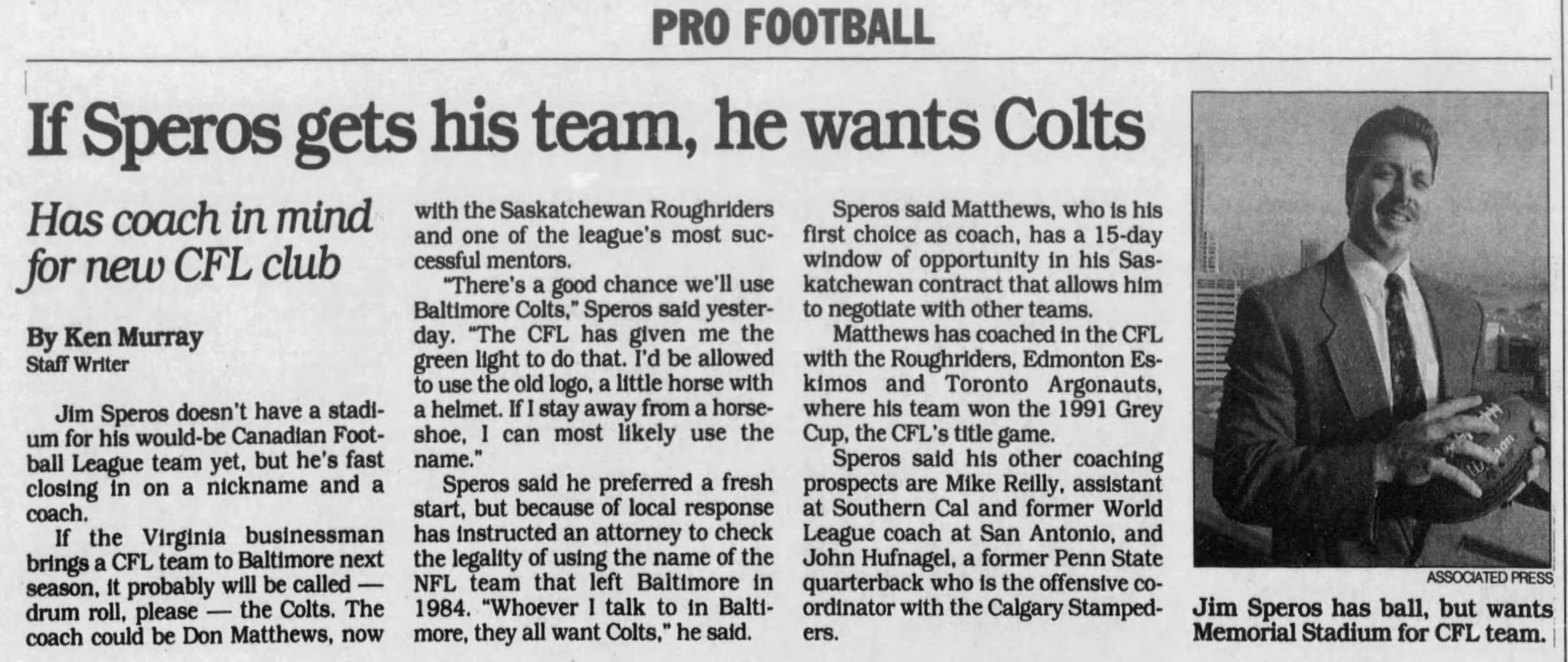
When the National Football League rejected an expansion franchise for Baltimore, attention turned to the expanding Canadian Football League. Owner Jim Speros originally wanted to call his team the Baltimore Colts and help tap into the nostalgia associated with that brand. When the NFL threatened legal action, a compromise as suggested for the team to be known as the Baltimore CFL Colts. When that, too, was rejected the team simply played as the Baltimore Football Club and was often referred to as the Baltimore CFLers.
Baltimore was an instant success both on and off the field. Football fans were angry at the NFL plus there was a baseball strike in 1994, the year the CFL Colts – sorry CFLers – took the field. Baltimore routinely attracted crowds of around 40,000 to Memorial Stadium.
Head coach Don Matthews knew the Canadian game well and stocked his team with experienced CFL players such as quarterback Tracy Ham and defensive lineman Jearld Baylis. Baltimore finished their inaugural season with a 12-6 record, second place in the East Division. They went onto to play BC in the Grey Cup. Not bad for an expansion franchise.
In 1995, the team was finally given a new name – the Stallions. Again, the team was a powerhouse on the field, easily winning first place in the South Division. The Stallions went on to beat Calgary in the Grey Cup that year, becoming the first and only American team to win the Grey Cup.
It was this team that relocated to Montreal in 1996 to become the reincarnated Montreal Alouettes.
Shreveport Pirates

The Pirates joined the CFL in 1994. They were owned by Bernie Glieberman, who was the previous owner of the Ottawa Rough Riders. He sold the Rough Riders and was granted an expansion franchise for Shreveport, Louisiana.
Coached by Forrest Gregg, the Pirates struggled on the field and started their inaugural season with 14 straight losses. They ended up with a league-worst 3-15 record. In their second season, Shreveport finished with five wins and 13 losses. Despite their poor performance, the team enjoyed pretty good support amongst local fans and the business community. The team played at Independence Stadium.
San Antonio Texans

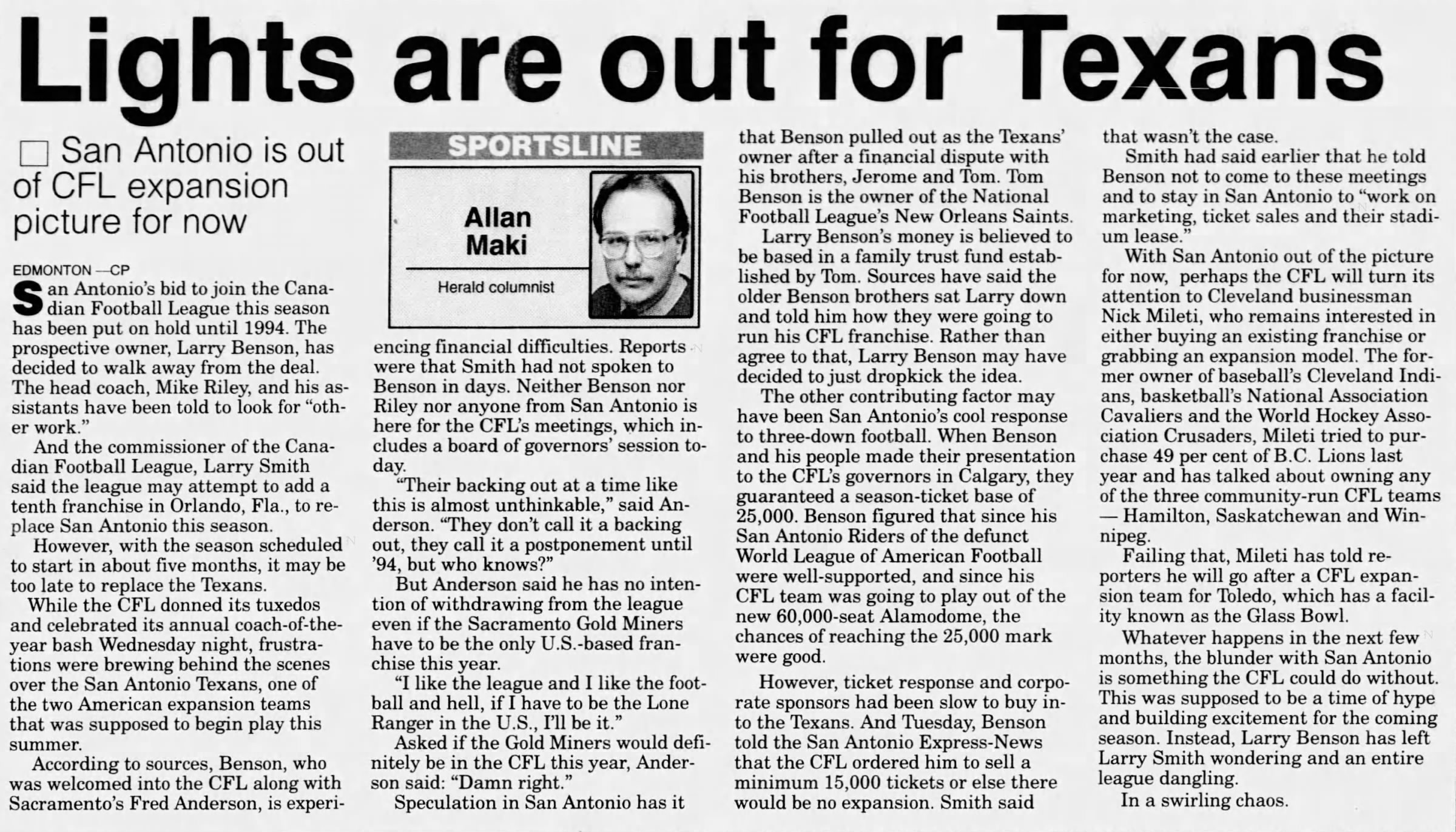
Originally, a team in San Antonio (also to be called the Texans) was supposed to join the CFL in 1993 with Sacramento. However, the team folded only two weeks after it was granted. Ironically, the Sacramento Gold Miners themselves relocated to San Antonio for the 1995 season after owner Fred Anderson couldn’t secure stadium upgrades in the California capital.
The team was renamed the Texans and finally had some success on the field, finishing second place in the South Division with a 12-6 record. The Texans played at the Alamodome, one of the few stadiums in the United States that could easily accommodate Canadian football field dimensions.
Birmingham Barracudas

The CFL awarded Birmingham an expansion franchise in January 1995. Owned by Art Williams and coached by Jack Pardee, the team was unveiled as the Birmingham Barracudas on March 14, 1995. Future Hall of Fame quarterback Matt Dunnigan joined the team, leading them to a 10-8 record, third place in the South Division.
Birmingham attracted good crowds to Legion Field early in the season. Their home opener versus Hamilton had over 31,000 fans in attendance. But by the time U.S. college football started up, attendance dropped dramatically. Williams sold the team after the 1995 season to a group that expressed interest in moving it to Shreveport for 1996.
Memphis Mad Dogs
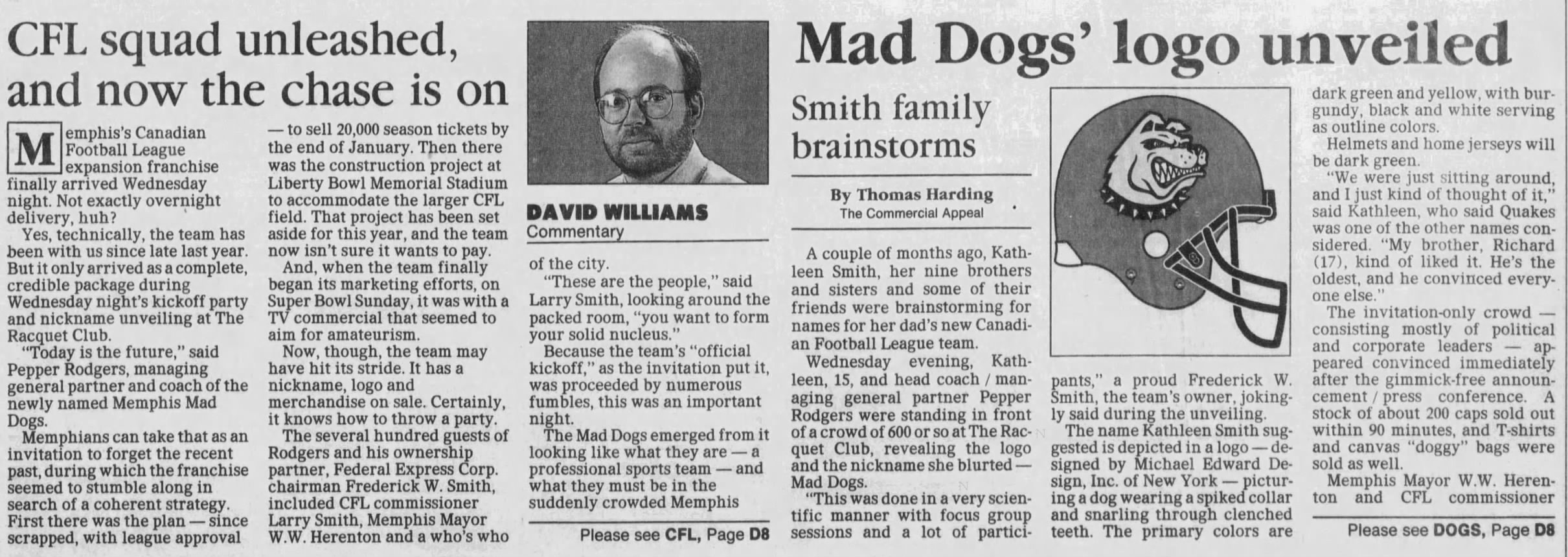
Memphis was another case where an NFL expansion rejection created a pivot to the CFL. Fred Smith, the owner of FedEx, spearheaded the team that was called the Mad Dogs. They were coached by Pepper Rodgers and tried to replicate what Baltimore had done by bringing in experienced CFL players including Damon Allen as their quarterback.
The Mad Dogs finished the season with a 9-9 record, fourth place in the South Division, and missed the playoffs in their one year in play.
Memphis played at the Liberty Bowl Memorial Stadium, which could not accommodate the larger Canadian football field. As such, the end zones in Memphis were only seven yards deep at the sidelines. To make matters worse, the end zones were Astroturf while the rest of the field was natural grass.
The CFL ended its American expansion following the 1995 season. In 1996, the league reverted to its original all-Canadian lineup.
Sources:
Baltimore Sun, 16 December 1993
Birmingham News, 16 March 1995
Sacramento Bee, 11 December 1993
San Antonio Express-News, 14 March 1995
Shreveport Times, 6 April 1994