Tag: Toronto Argonauts

  • Varsity Wins the Almost Forgotten Grey Cup

    In 1909, Governor General Earl Grey donated a trophy to be awarded to the amateur rugby football champions of Canada. The University of Toronto won the inaugural championship with a 26-6 win over Toronto Parkdale. Various teams in Toronto and Hamilton competed in the early Grey Cup contests before the game was put on hold after 1915 due to the First World War.

    The Grey Cup was then virtually forgotten. The trophy itself was locked away hidden in a storage vault. War has a way of resetting priorities, you see. After football resumed in Canada in 1919, there were growing organizational issues amongst some teams and disagreements amongst the rugby unions, climaxing in a decision by McGill University and Montreal to refuse to contest the Canadian Rugby Union playoffs. Alas, there was no Grey Cup in 1919, either.

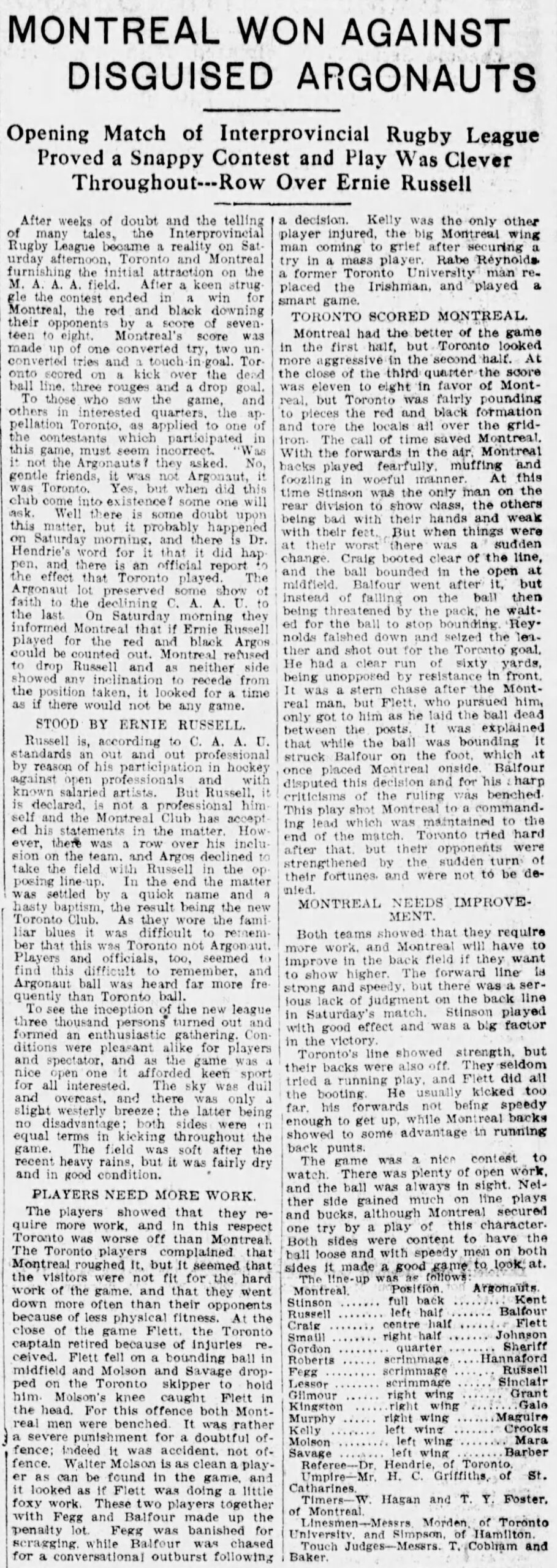
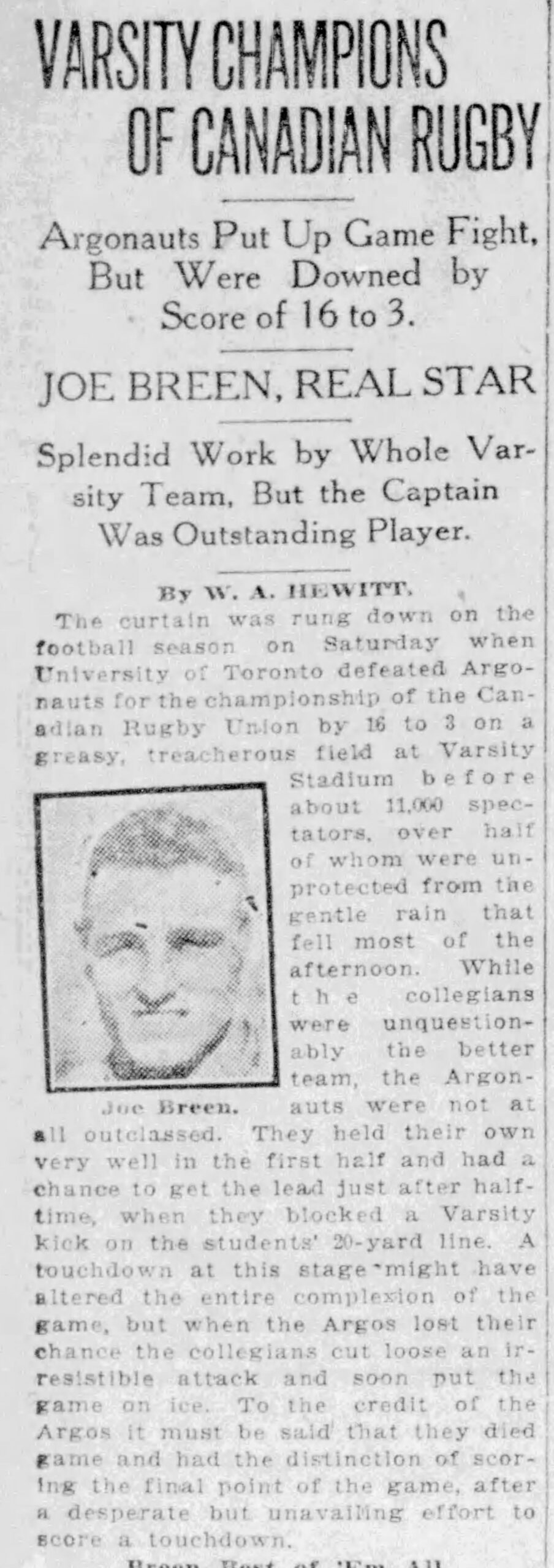
    Coverage of the 1920 Grey Cup in the Toronto Star on December 6, 1920.
    Coverage of the 1920 Grey Cup in the Toronto Star on December 6, 1920.

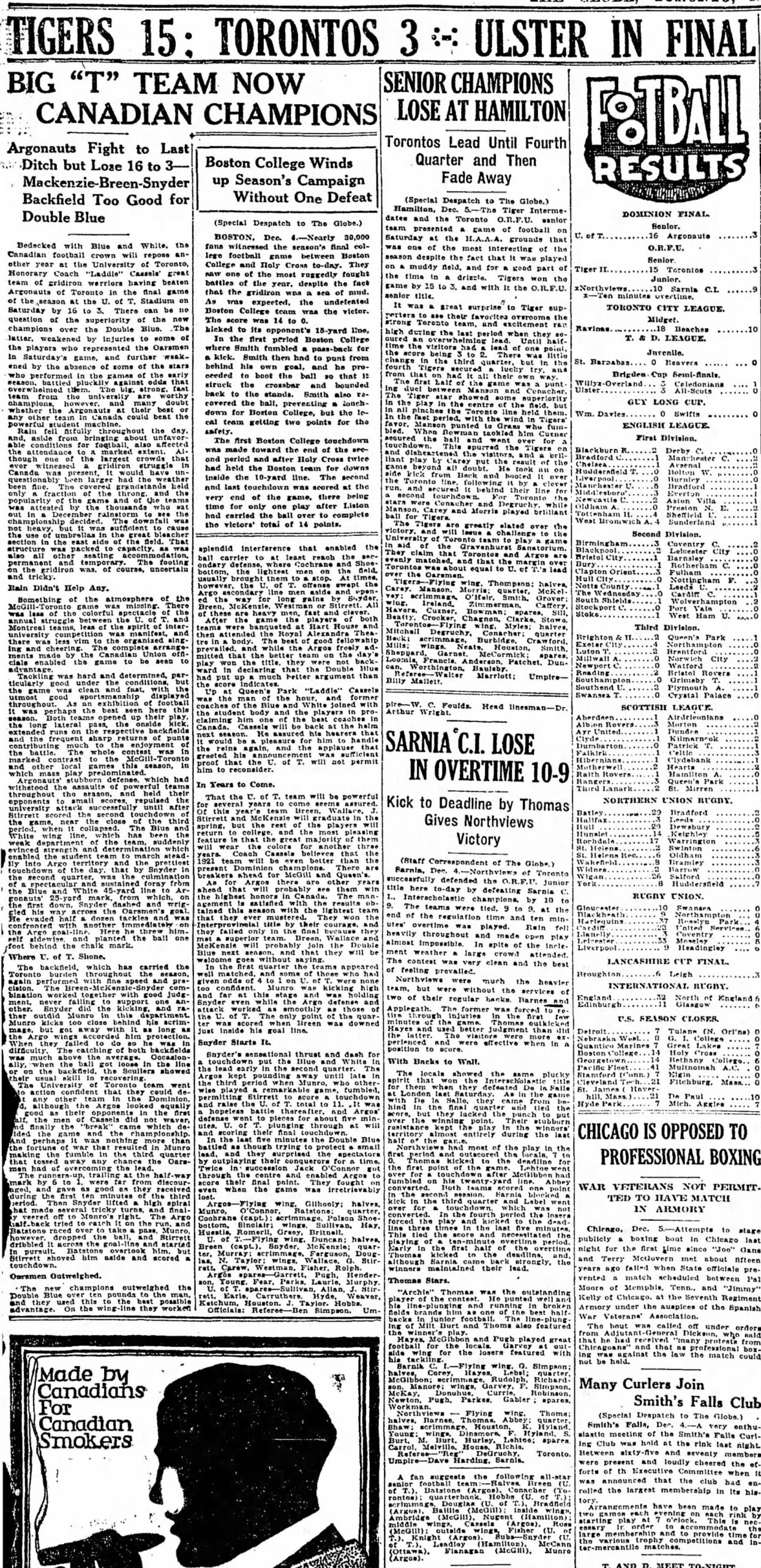
    But in 1920, the Grey Cup made its triumphant return. And a couple of familiar teams were back in the mix to win the big game. On Saturday, December 4, 1920, the University of Toronto played the Toronto Argonauts in the 8th edition of the Grey Cup. Played in less-than-ideal conditions (rain and mud!) at Toronto’s Varsity Stadium, Varsity’s Joe Breen was the star of the day, according to the Toronto Star, leading his team to a 16-3 victory over the Argonauts.

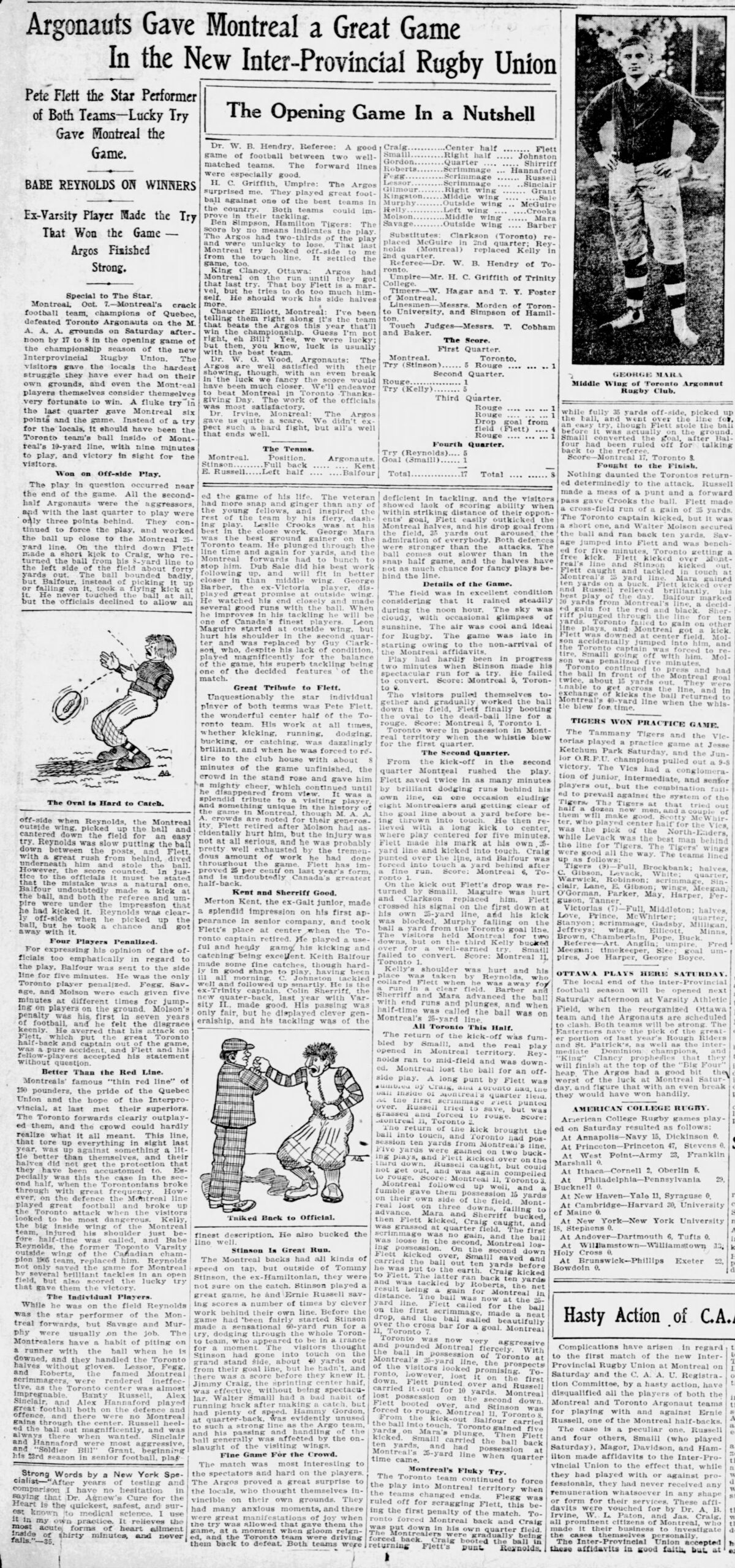
    Coverage of the 1920 Grey Cup in the Globe and Mail on December 6, 1920.
    Coverage of the 1920 Grey Cup in the Globe and Mail on December 6, 1920.

    This would be the University of Toronto’s fourth and final Grey Cup championship. At the time, Varsity was considered by many to be the best football team in the country. Their championship win cemented this sentiment.

    Despite being relegated to a dark memory hole just a few years prior, the Grey Cup was back. And perhaps that’s what mattered most.


    Sources:

    https://web.archive.org/web/20130820024400/http://cfl.ca/page/his_greycup_recap1920

    The Toronto Star, 6 December 1920

    The Globe and Mail, 6 December 1920

  • Getting Ready for the Grey Cup’s TV Debut

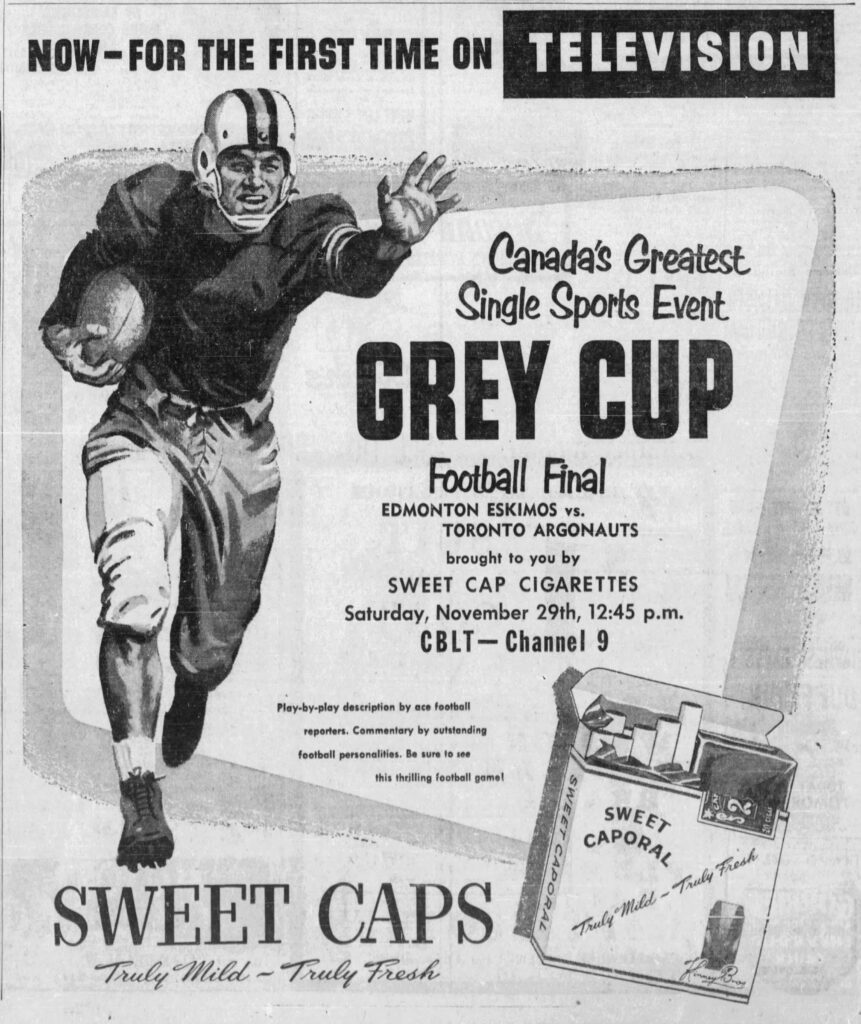
    It’s September 1952 and a new technology – black and white television – is taking the country and much of the world by storm. The Canadian Broadcasting Corporation (CBC) entered the TV business with two flagship stations: CBFT in Montreal and CBLT in Toronto.

    The decision was soon made to broadcast the upcoming Grey Cup game on CBLT. The Canadian Rugby Union championship was scheduled for Saturday November 29th at Varsity Stadium in Toronto.

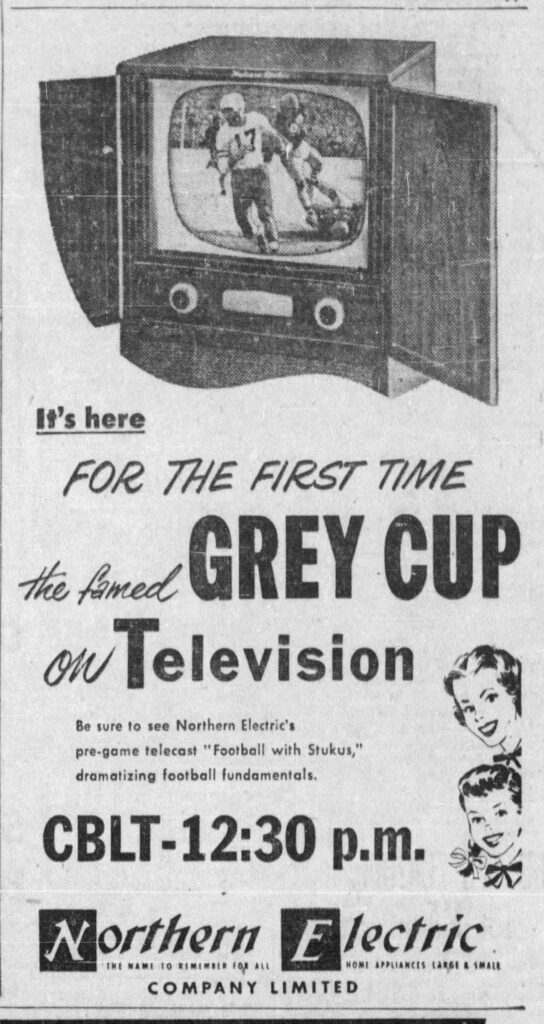
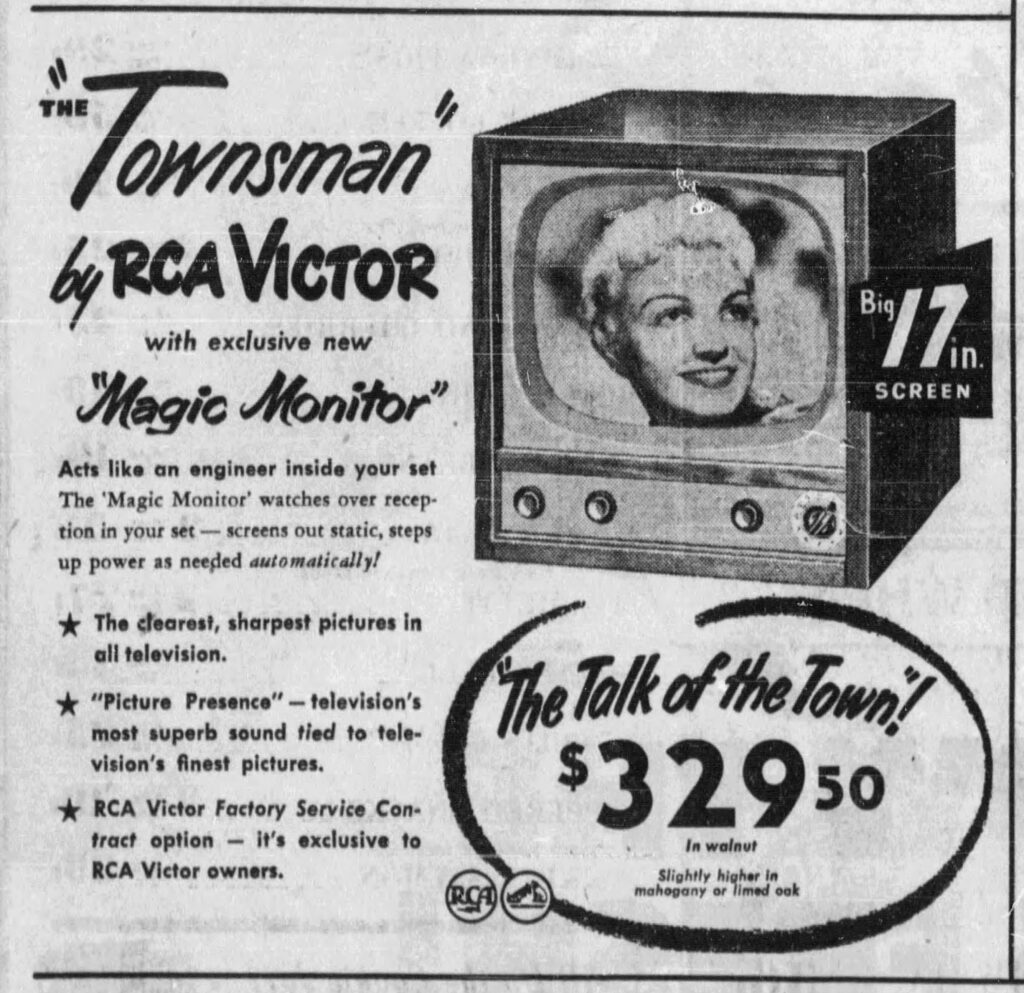
    The novelty factor of the new technology coupled with the popularity of the hometown Toronto Argonauts, who were playing in the championship, helped drive sales for television sets in Toronto. Several ads selling TVs appeared in local newspapers. These didn’t come cheap, but vendors were more than happy to set up affordable payment plans for excited football fans.

    While the Grey Cup game itself was the first Canadian football game ever televised, broadcast crews did a practice run a few days before in the playoff game between the Argonauts and the Sarnia Imperials of the Ontario Rugby Football Union. In those days, the ORFU still challenged for the Grey Cup. The Toronto-Sarnia Grey Cup semi-final game at Varsity Stadium was used as the dress rehearsal for the big game. The 1952 Grey Cup commentators Norm Marshall and Larry O’Brien were actually chosen after an audition for the roles was held during the Sarnia game.

    Notes about the TV practice run done during the Grey Cup semi-final between Toronto and Sarnia (Toronto Star, 27 November 1952)

    Pubs in and around Toronto with television sets were packed on the day of the game. Meanwhile, in nearby Hamilton, Westinghouse set up several TVs so that employees and friends could watch the game. The broadcast even included a short pre-game show hosted by Annis Stukus.

    In the end, the Argonauts defeated Edmonton by a score of 21-11 in front not only record crowd at Varsity Stadium but also tens of thousands of television viewers in the Toronto area. A new era for the Grey Cup and for Canadian television was here.


    Sources:

    Patskou, Paul. “The First Televised Grey Cup Game.” Canadian Football Research Society. Accessed October 28, 2025. https://www.canadianfootballresearch.ca/the-first-televised-grey-cup-game/.

    The Toronto Star, 27 November 1952

  • Portland Hosts Fast Break CFL Football, Precursor to CFL USA Expansion

    In 1992, the Canadian Football League was looking to grow. Larry Smith was appointed the CFL’s new commissioner with a mandate to expand the CFL. Of course, Montreal and Halifax were high on Smith’s list of potential sites. But so, too, were several cities south of the border. One of these cities was Portland, Oregon.

    Located in the northwestern United States, Portland was a mid-sized city with a suitable stadium and a credible ownership group with the needed capital to both pay for and operate an expansion franchise. It was close enough to the border so that something “Canadian” didn’t sound too foreign. Heck, it was almost as if it could be a natural rival for the BC Lions. Paul Allen, the owner of the Portland Trail Blazers basketball team, was the man hoping to bring the CFL to Oregon.

    CFL Portland game article in the Oregonian newspaper (1992)

    To test the Portland market, the CFL played an exhibition game on Thursday, June 25, 1992 at Civic Stadium. The game was a rematch of the 1991 Grey Cup between the Toronto Argonauts and the Calgary Stampeders. The Argos had Raghib “the Rocket” Ismail as their marquee player. Calgary had the recently acquired future Hall of Famer Doug Flutie as their new quarterback. The stage was set for a great exhibition of Canadian football for the American fans featuring the CFL’s two biggest stars.

    In the lead up to the exhibition game, the Portland media seemed quite eager to welcome the CFL to town. Ads ran in the Oregonian newspaper promoting “fast-break,” “high flying” and “wide open” CFL football. Unsurprisingly, the Rocket was heavily promoted. Even the Trail Blazers’ Jerome Kersey was featured in advertising for the game.

    A decent crowd of 15,362 fans turned out on a hot Thursday night to watch the game. All in all, reviews were positive despite a rather lacklustre game. Calgary won 20-1. Yes, Americans got to see a Canadian rouge scored. In the end, though, no CFL expansion team came to Portland. Instead, Sacramento was awarded the CFL’s first U.S.-based expansion team. After a few years the CFL’s foray into the United States was over. Despite lots of talk and speculation, the CFL-in-Portland story was limited to a single exhibition game only.

    CFL gets warm welcome in Portland article in the Oregonian newspaper (1992)

    100 yard long fields are included in the Johnston Rules announced by CFL Commissioner Stewart Johnston recently. The 1992 exhibition game in Portland was the last time the CFL played on a field that was 100 yards in length. The standard CFL field didn’t fit at Portland Civic Stadium without heavy modifications, so the game was played on an American length football field that included ten-yard end zones. Have a look at the screen shots below to get a taste of what Canadian football on 100 yards will (sort of) look like in the future.


    You can watch the Toronto-Calgary exhibition game in Portland on the CFL Classics YouTube channel. The game was televised nationally on TSN.


    Sources:
    The Oregonian, 2 May 1992
    The Oregonian, 26 June 1992

    Fediverse Reactions
  • The Toronto Argonauts Sign the Rocket

    Imagine this. The suits in the NFL are getting ready for their star-studded college draft. Everyone is talking about who’s going to be picked. Who’s going to make it to the big time. Fortune and fame await the lucky group of the chosen few. Then, news breaks that the projected number one pick overall has just signed a record deal with a team from Canada.

    It might sound far fetched today, but this is exactly what happened in 1991. To truly appreciate the impact of this event you have to first understand where the CFL was in the early 90s. It was a league in some serious economic trouble. That’s putting it mildly. Attendance was in decline. Teams were losing money. Owners were walking away from their teams. The Montreal franchise had already folded. Plus, Canada was in the midst of a nasty recession not to mention a national unity crisis. These were depressing times.

    Nevertheless, in February 1991 the CFL’s flagship franchise, the Toronto Argonauts, were purchased by the trio of businessman Bruce McNall, hockey star Wayne Gretzky, and actor John Candy. McNall et al saw an opportunity in growing Canadian football not just in Toronto but in the United States, as well. With some, let’s say, investment the game could be revitalized in Toronto and a lucrative U.S. market would eat up Canadian football like American apple pie.

    That investment was a 21-year-old wide receiver out of Notre Dame college named Raghib “the Rocket” Ismail. Ismail had a stellar college football career and was considered to be the cream of the crop in the 1991 NFL Draft happening in April of that year. The Dallas Cowboys were expected to draft him as the first pick overall.

    According to Paul Woods, who authored the book Year of the Rocket, Bruce McNall tasked then Argo General Manager Mike McCarthy to “think big.” McCarthy responded that there’d be nothing bigger than signing the Rocket. Sign the most recognizable college football star in America and lure him to Canada. That would put Toronto and the CFL on the radar. That would be a worthwhile investment indeed.

    Bruce McNall Tries to Buy a Rocket to Fire Up his Argonauts article in the LA Times
    A publicity stunt?
    Oates, Bob. “Bruce McNall Tries to Buy a Rocket to Fire Up his Argonauts.” Los Angeles Times, 5 April 1991, p. 375.

    NFL executives initially dismissed McNall’s interest in the Rocket as a mere publicity stunt. Surely, he wouldn’t actually open his wallet to make such a move. Or would he?

    On April 20, 1991, McNall, who also owned the National Hockey League’s Los Angeles Kings, invited Raghib Ismail to a Stanley Cup playoff game at the Great Western Forum in Los Angeles. It was here that the Rocket officially signed the contract with the Toronto Argonauts.

    A heads up was given to some Toronto media to allow them time to travel to California, and a press conference was held in Los Angeles to announce that Raghib “the Rocket” Ismail had signed a record $18 million contract with the CFL’s Toronto Argonauts. The deal made Ismail the highest paid professional football player at the time at $4.5 million dollars a year – half a million more than Joe Montana of the San Francisco 49ers.

    How Rocket Ismail's salary compares with others
    Ismail’s salary compared to others (Toronto Star)

    The next day, the Rocket was flown to Toronto to be formally introduced as the newest member of the Boatmen. News of the Rocket’s signing sent shockwaves throughout North America. NFL brass were stunned. The signing garnered front page coverage in the New York Times and USA Today. A new era was here. The CFL was about to step into the future more confident than ever. And the Rocket was going to be the face of that future.

    Front page of the Toronto Star announcing the Argos' signing of the Rocket
    The Rocket Signing made front pages news across North America including the Toronto Star.

    The Argonauts enjoyed success on and off the field in 1991. They finished in first place in the East Division with a 13-5 record and averaged 37,000 fans per game at the new SkyDome. Road games brought out the crowds, as well. Rocketmania had swept the nation. The Argos defeated Winnipeg 42-3 in the Eastern Final before 50,380 fans before going on to beat the Calgary Stampeders in the 1991 Grey Cup. Ismail himself ended the season with 64 receptions for 1300 yards receiving and nine touchdowns.

    The following season, the Argos struggled and went from first to worst, missing the playoffs with a 6-12 record. To make matters worse McNall was experiencing financial and legal problems. The magic was short-lived, it seemed. 1992 was becoming a bit of a nightmare. Ismail left the Argos and the CFL at the end of the season. Just like that, the Rocket era was over.

    I asked Paul Woods if it could ever happen today. Could the CFL lure a number one NFL draft pick now? “No chance,” he says. The salary gap is just too wide now between the CFL and the NFL. It really was too wide in 1991. The economics just don’t make sense. The Rocket’s signing was a “one time thing never to be repeated,” he says.

    He definitely believes that the Rocket’s signing was one of the “top ten” moments in all of Argonaut history. While he doesn’t quite credit the signing as saving the CFL per se, he does say it got the league thinking bigger and jolted it out of its traditional mom and pop mentality. “It injected optimism and excitement into the Argos and the CFL and gave them tons of attention.”

    Yes, the Rocket’s stay in Toronto was short. But the hype surrounding that signing is still something to behold almost 35 years later.


    Year of the Rocket by Paul Woods is available through Sutherland House, an independent Toronto-based publishing house.

    Year of the Rocket Cover
  • CFL Media Guides in the 1960s

    For eons, the Canadian Football League published Media Guides or Fact Books for its teams. These little handbooks were meant to familiarize local journalists with the players and coaching staff of the team they were covering. They included biographies, statistics, records, and team histories.

    Team media guides were also a great little souvenir for the savvy football fan. I have several in my own collection I like to peruse every now and then.

    The CFL still produces them at least in electronic form. At least for some teams. I’m not sure if the league still offers print copies, though. It looks like they’ve met the same fate as game day programs and printed tickets, which is unfortunate.

    Anyway, I thought what better way to spend the dog days of summer than by taking a look at some of these CFL media guides from the 1960s (or the late 1950s in a couple of cases). It was an exciting decade for the CFL and Canadian football.

    Here are some photos of the media guides (front and back covers) for each CFL team from that era:

    The above photos are courtesy of the good folks at the Canadian Football Research Society.

    Fediverse Reactions