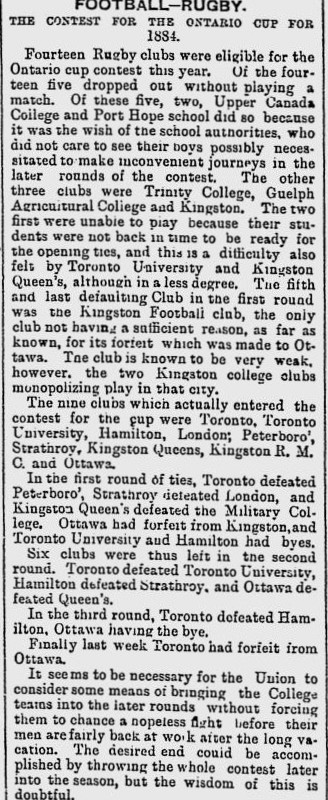
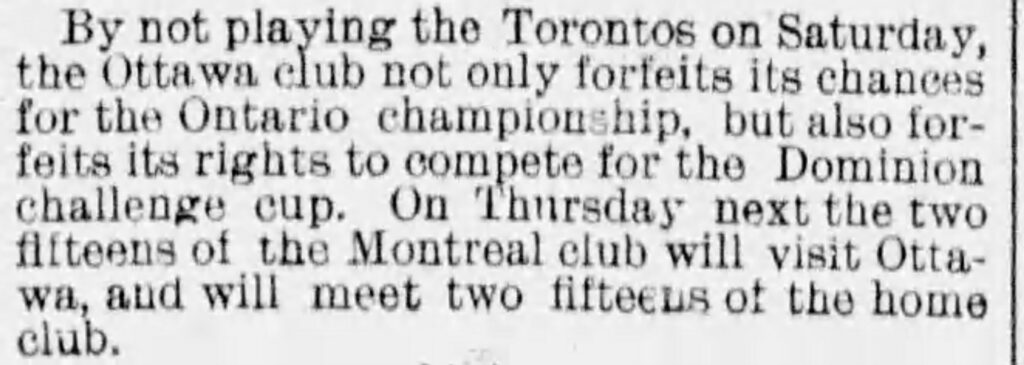
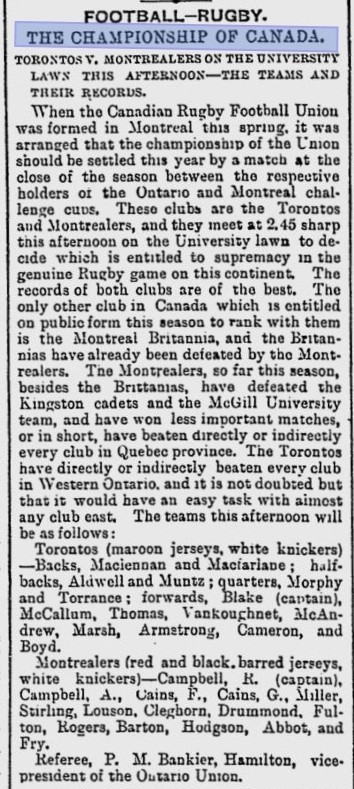
A previous article examined how tie schedules and challenge cups were used on the road to the first Dominion championship game organized by the Canadian Rugby Football Union in 1884.
It’s now a new year, and Canadian football is still finding its footing so to speak. Good or bad pun? And the CRFU held is second Dominion championship. Sort of. Not really.
But first, imagine this completely theorical scenario. The Montreal Alouettes and the Saskatchewan Roughriders win the East and West divisions respectively. But instead of the Als and Riders squaring off in the Grey Cup, the culminating game features a team of eastern all-stars playing a team of western all-stars instead. Sound silly? Well, this theorical scenario is how the Canadian football playoffs looked in 1885.
Like the previous year, the Ontario Rugby Football Union and the Quebec Rugby Football Union both used a tie schedule format. To recap, a tie in this context is simply a pairing of teams. Rather than a balanced schedule with standings, teams were paired up and competed in a knock-out style tournament. The Kingston Daily News featured the tie schedule for the ORFU. Have a look to see how the system worked:
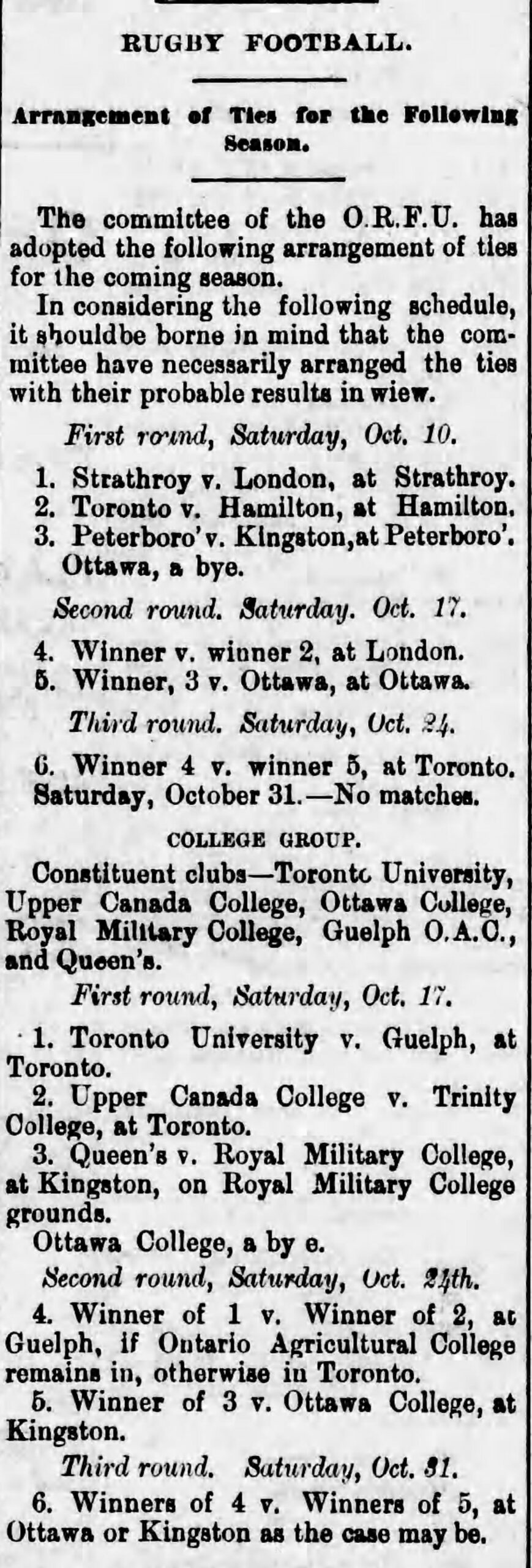
In 1885, the ORFU had two separate divisions, one for college teams and one for the city clubs. The winner of each division met for the Ontario Challenge Cup. In Quebec, there were only four teams – Montreal, Britannia, McGill, and Lennoxville – that competed for the Quebec Challenge Cup.
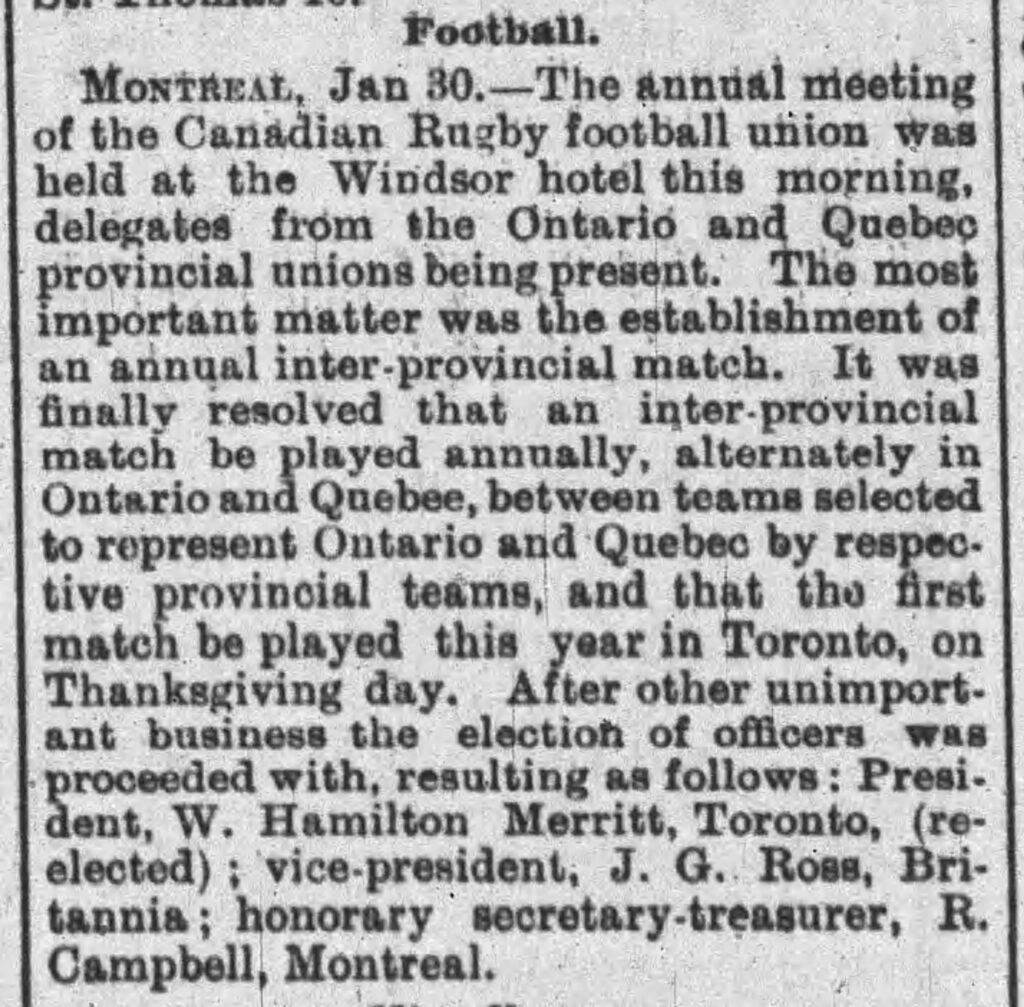
On January 30, 1885, the CRFU voted to hold an Inter-Provincial Rugby Match comprising players from Ontario and Quebec, selected by their respective unions. This new annual all-star game wasn’t actually intended to replace the Dominion championship, though. But fate had other ideas for 1885.
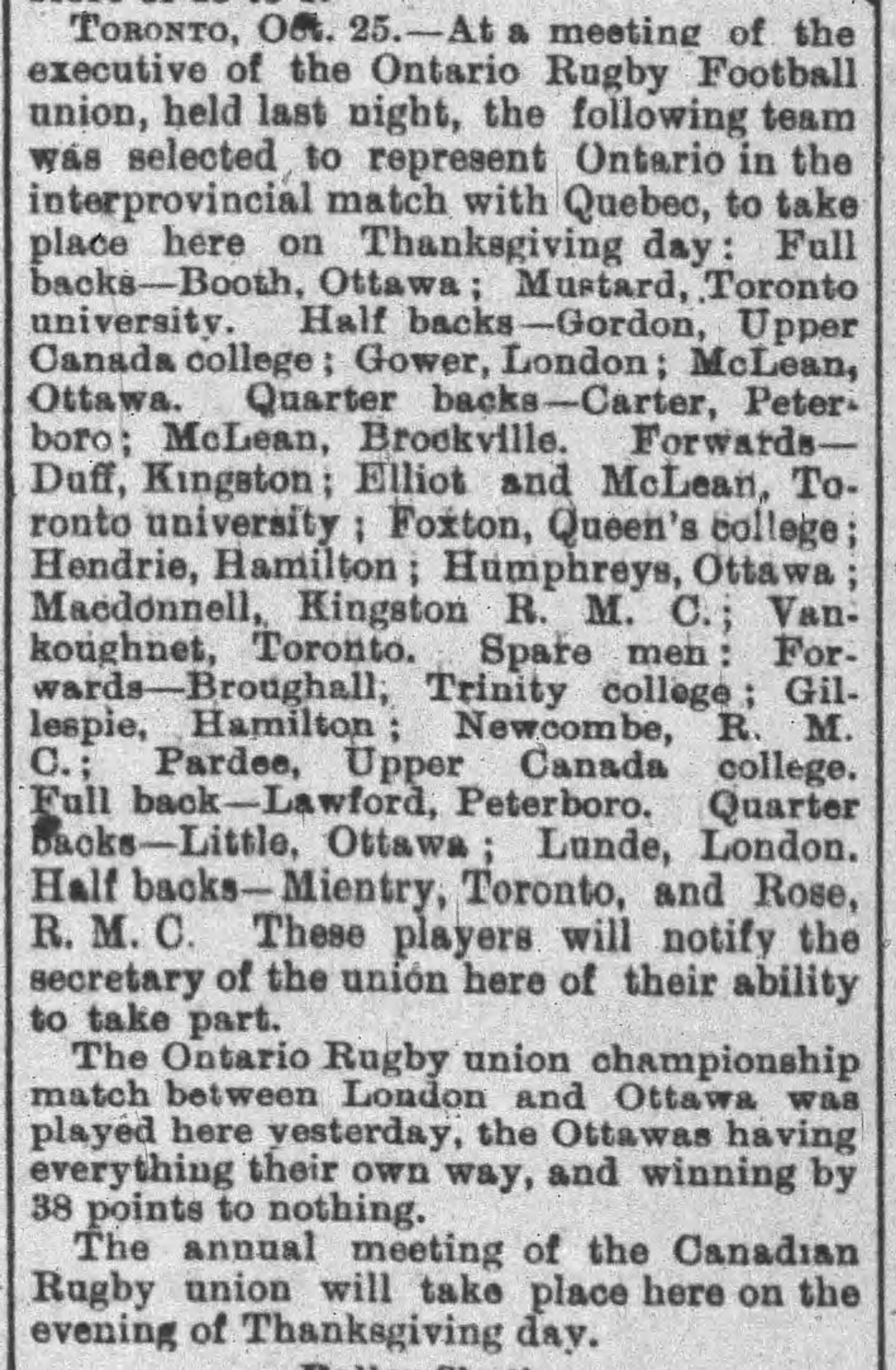
On October 25th, Ottawa dominated London 38-0 in Toronto to win the Ontario city division. On October 31st, Ottawa College defeated the University of Toronto by a score of 19-2 to win the college division. A week later Ottawa College defeated Ottawa City 21-0 in an all-Ottawa affair to win the Ontario Challenge Cup.
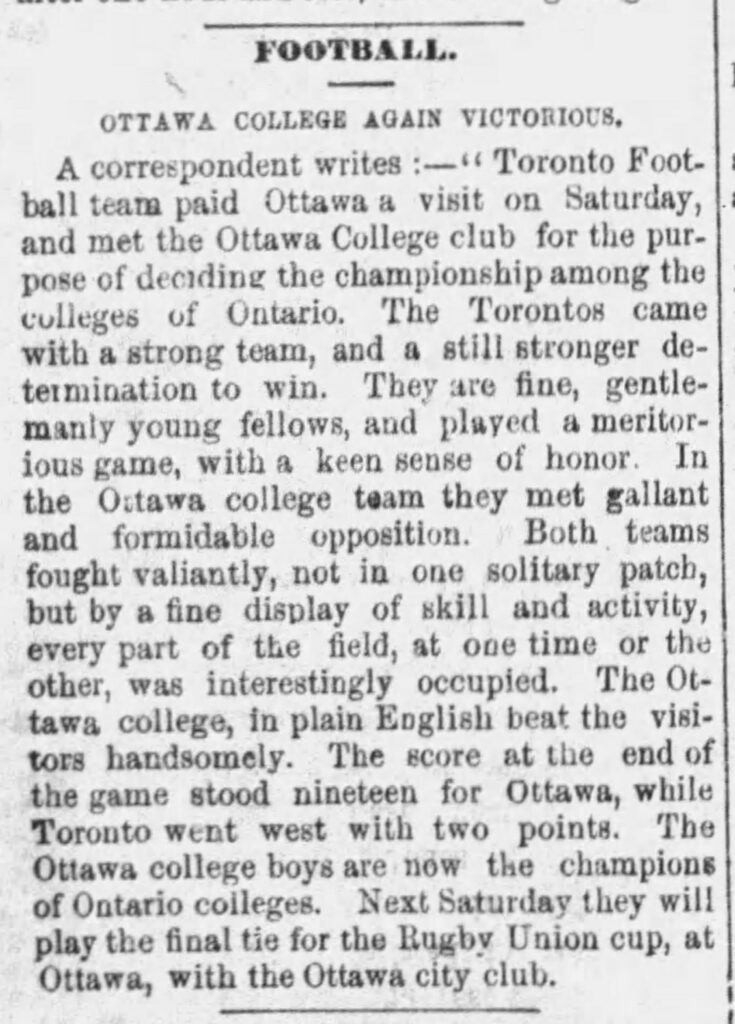
(Montreal Gazette)
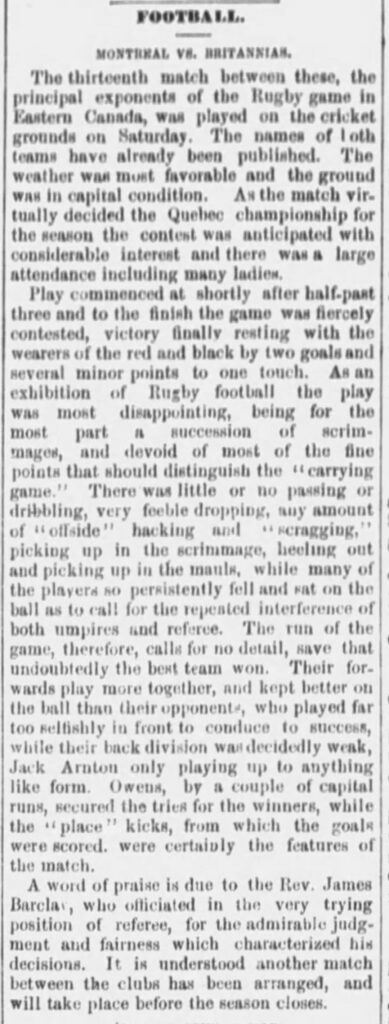
Meanwhile in Quebec, Montreal was once again that province’s dominant team. In a match to decide the winner of the Quebec Challenge Cup on October 10th, Montreal defeated rival Britannia by “two goals and several minor points to one touch.” (Montreal Gazette, 10 October 1885)
So, the stage was set for Ottawa College to travel to Montreal to play the Quebec champion in what would be the second Dominion championship. Except, it didn’t happen. In 1885, Montreal was engulfed in a smallpox epidemic. Public health concerns prompted a reluctant Ottawa College to forgo the trip to Montreal. Instead, suggestions were made for Montreal to travel to Ottawa and play the championship there.
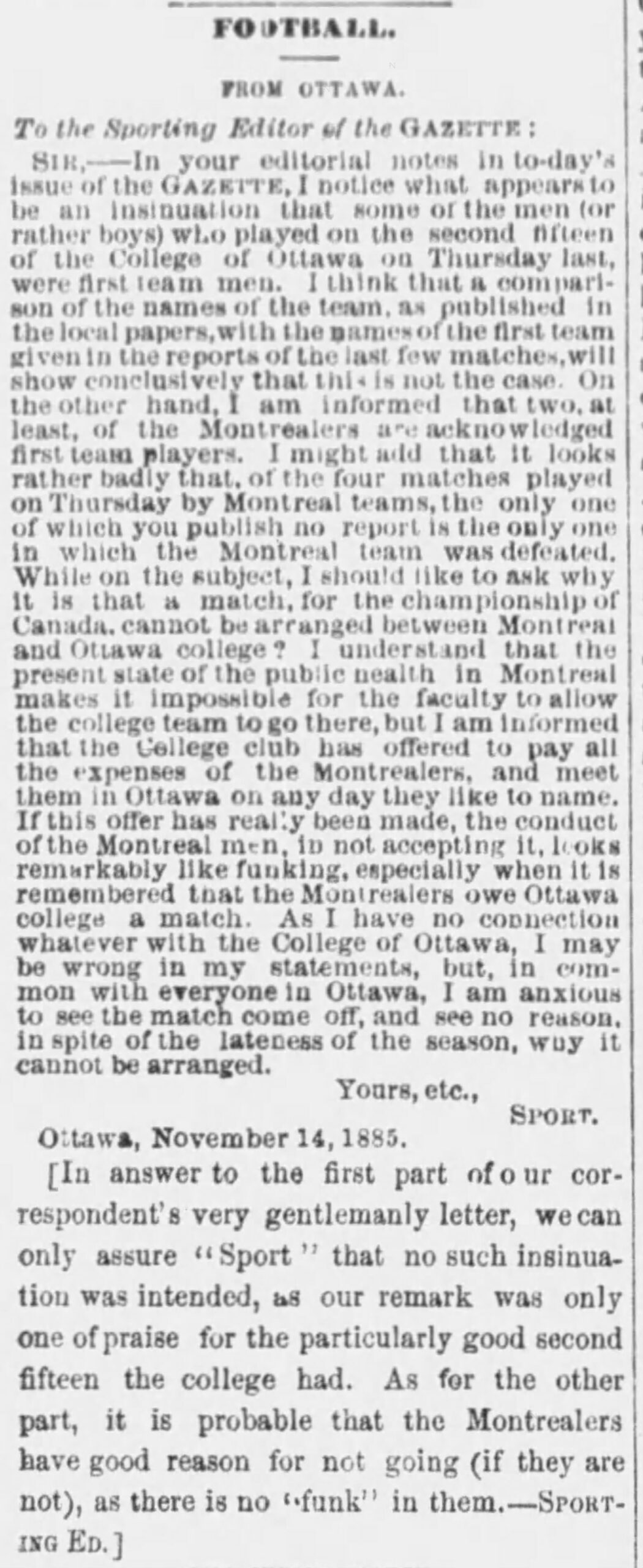
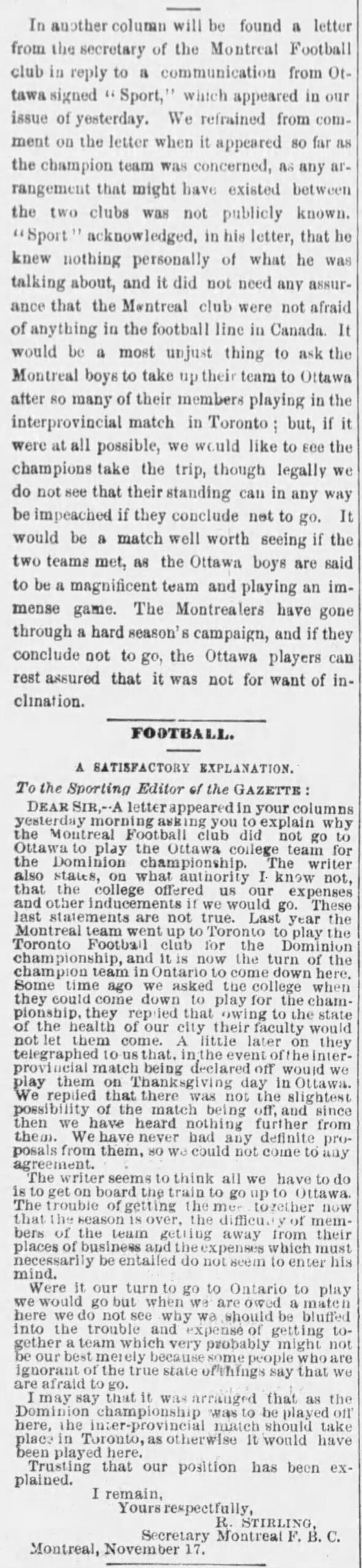
There was a rather testy exchange in the Montreal Gazette between a writer from Ottawa named “Sport” and Mr. R. Stirling, the secretary of the Montreal Football Club. “Sport” accused Montreal of “funking.” That’s old British slang for backing out because of fear. Stirling refuted the accusation and explained that logistics and costs simply made the proposal impractical. So that was the end of that. There was no Dominion championship game played in 1885.
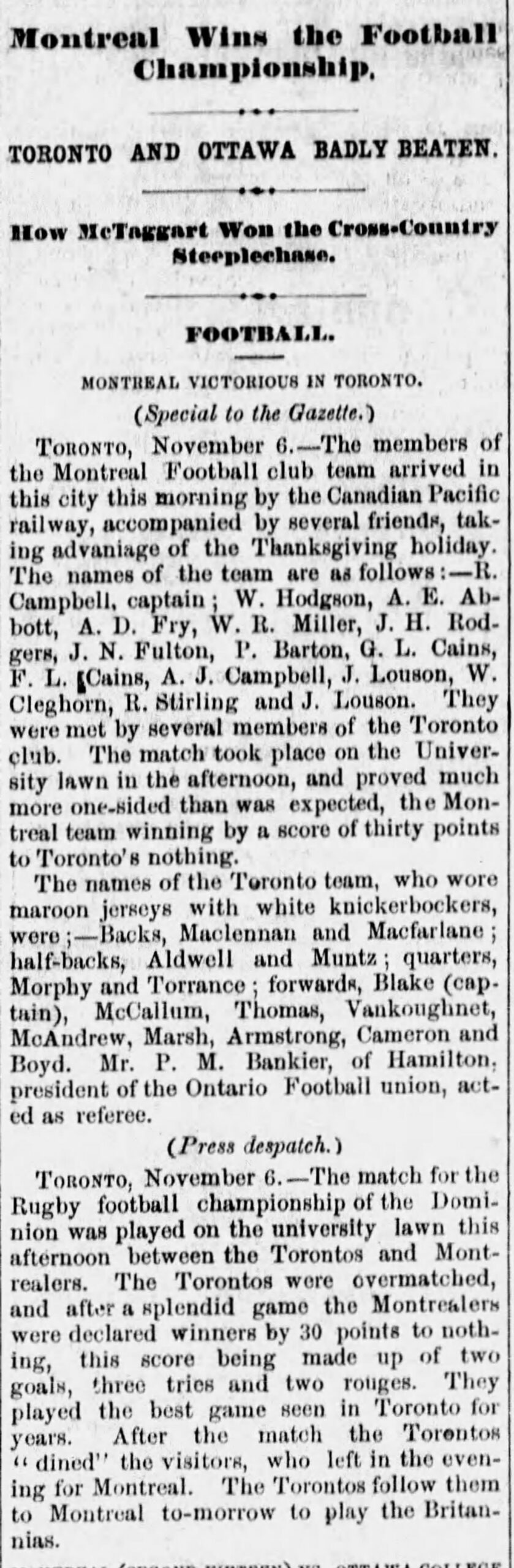
Instead, we were left with the first Inter-Provincial Rugby Match as being the pinnacle of the 1885 football season in Canada. Played on November 12th, which was Thanksgiving Day, in Toronto the Quebec all-stars scored 3 points over their Ontario counterparts. Because the rules of the day stated that a majority of 4 points were needed for a victory, the game was declared a draw.
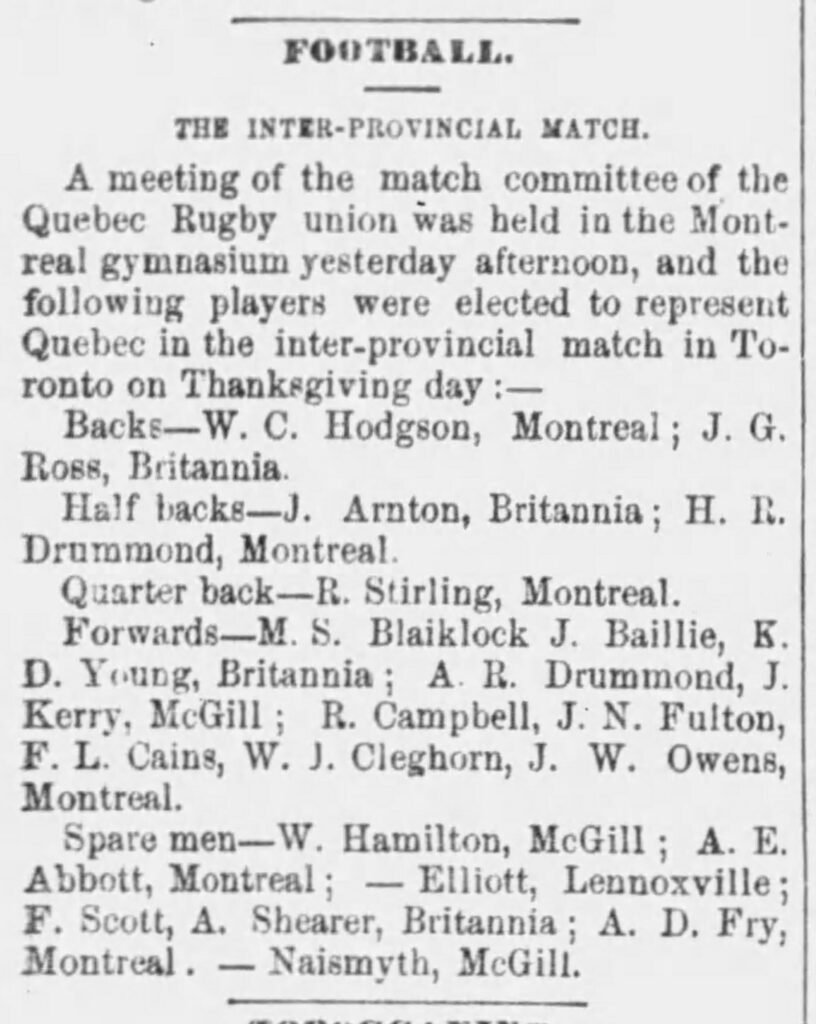
Check out the Montreal Gazette’s great summary of this game, as well as other games (including a soccer game) played on Thanksgiving Day in 1885.
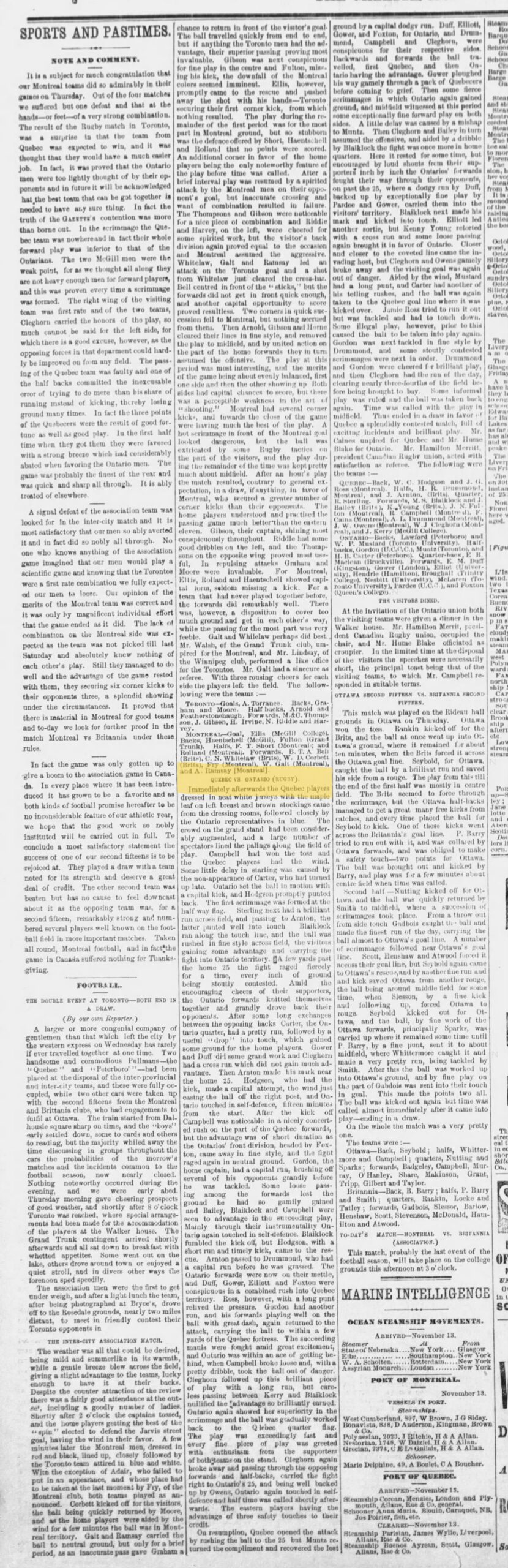
So, in short…no Dominion championship. An all-star game ending in a draw instead. And some good old mudslinging in the press. That was the Canadian football playoff picture in 1885.
Sources:
Canadian Football History Key Historical Milestones and Dates -1861-1889 by Robert Sproule
Hamilton Spectator, 31 January 1885
Hamilton Spectator, 26 October 1885
Kingston Daily News, 13 June 1885
Montreal Gazette, 12 October 1885
Montreal Gazette, 3 November 1885
Montreal Gazette, 4 November 1885
Montreal Gazette, 14 November 1885
Montreal Gazette, 16 November 1885
Montreal Gazette, 18 November 1885