On Friday February 2, 1996, the Canadian Football League officially ended its American expansion efforts. During the CFL’s annual winter meetings, the league announced that the Birmingham Barracudas, Memphis Mad Dogs, San Antonio Texans, and Shreveport Pirates were ceasing operations. And the Baltimore Stallions, having just won the Grey Cup a few months earlier, were relocating to Montreal.
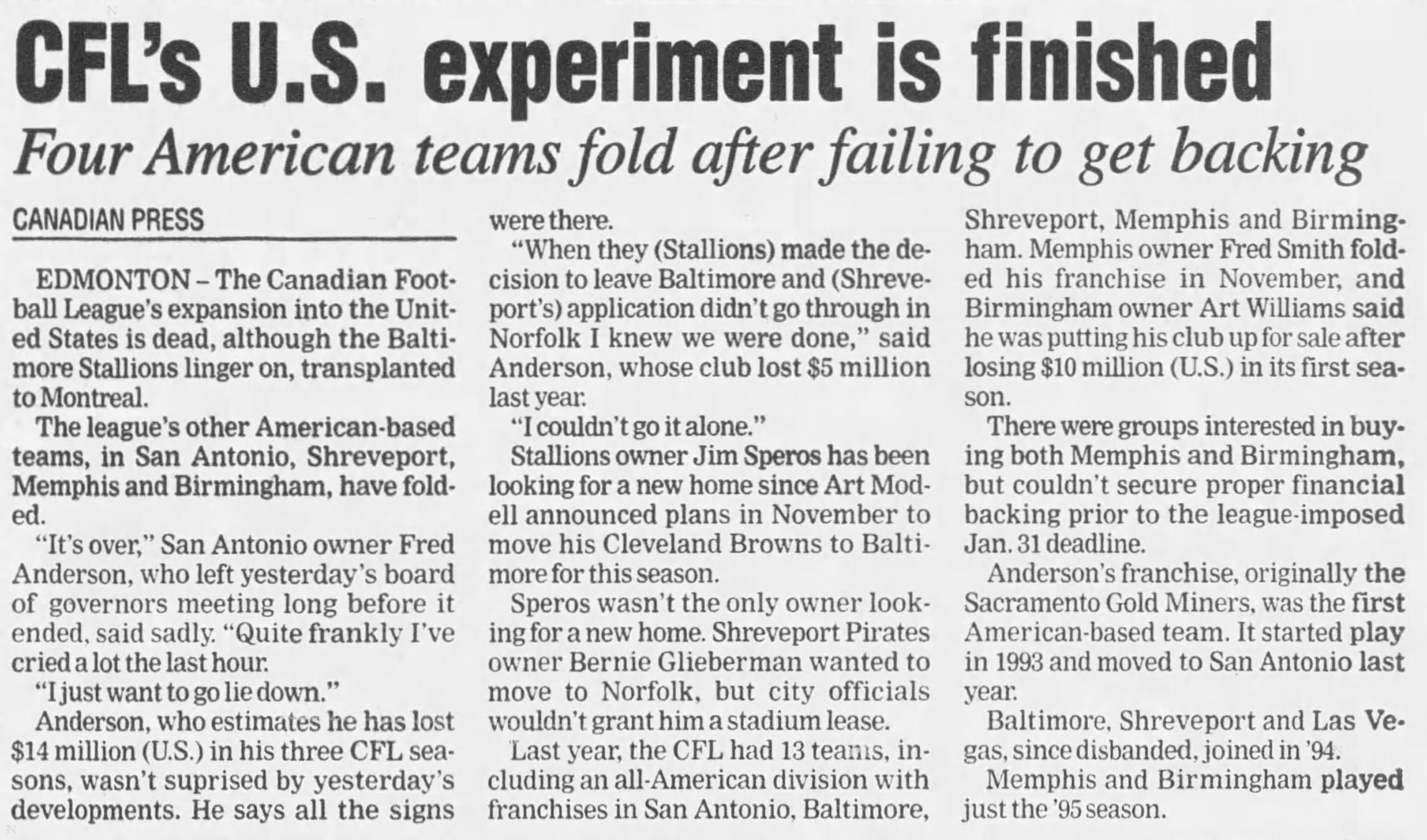
Canadian Press article on the end of CFL U.S. expansion.
It was game over for the CFL’s grand vision of becoming a North American-wide professional sports league. The promised windfall of expansion fees and the hope of a multimillion-dollar U.S. television deal (all in American dollars to boot) never materialized. I suppose the only silver lining was that U.S. expansion had thrown the CFL a lifeline. For a few years, there was some new blood and some new interest generated. Personally, I enjoyed watching the American teams come to Ivor Wynne Stadium to play the Tiger-Cats. It was sure better than watching the Ti-Cats play the Rough Riders and Argos four times. It added variety and a bit of intrigue.
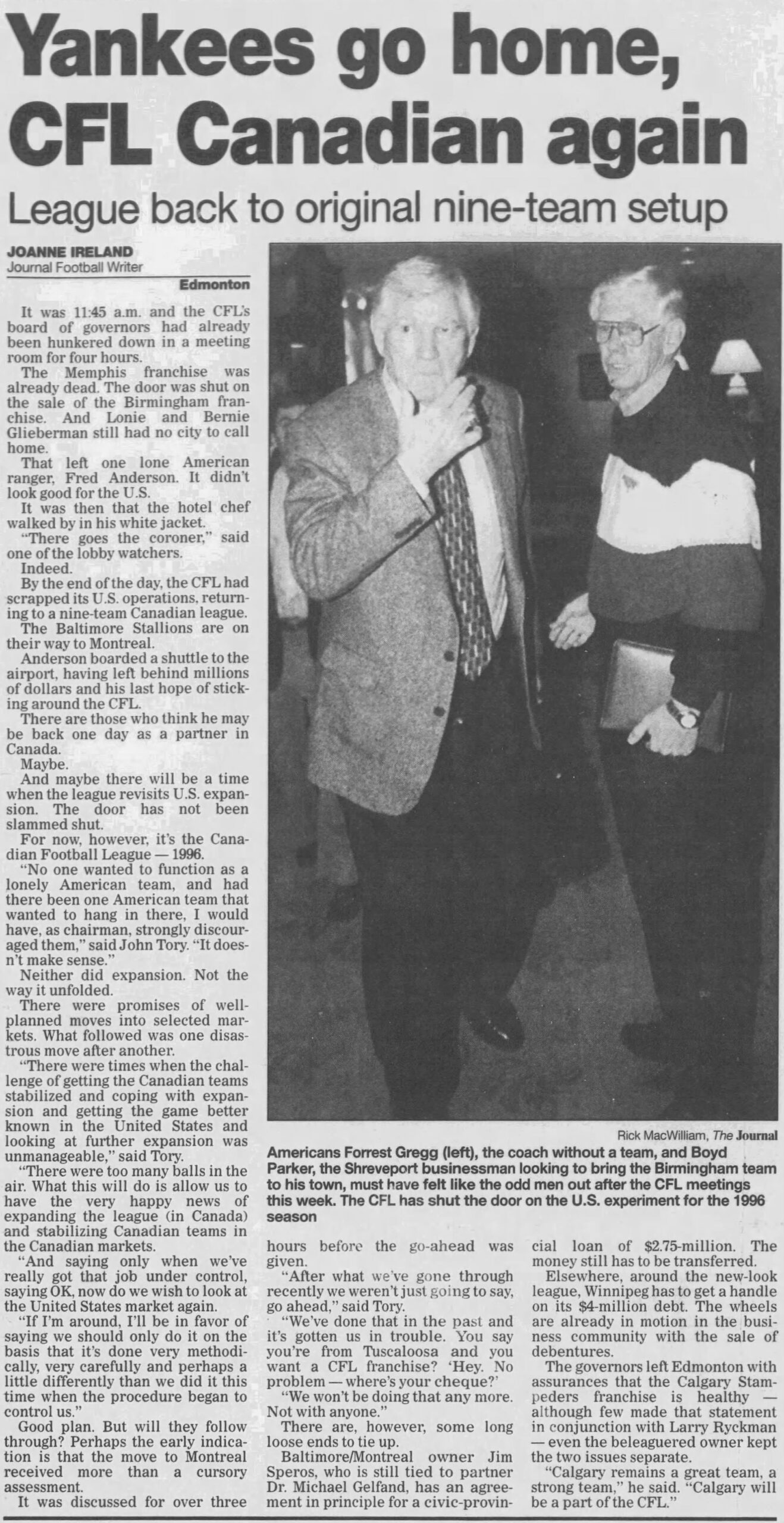
The take in the Edmonton Journal (3 February 1996).
The writing was on the wall for the CFL’s demise in America once the National Football League announced it was returning to Baltimore. That move ultimately spelt the end for the Stallions in Baltimore. The other chips began to fall.
The Pirates attempted to relocate to Virginia but were unable to secure a stadium lease. A new group tried to purchase the Barracudas and move them to Shreveport, where the CFL enjoyed at least modest support, but were rejected by the CFL. Memphis, despite having one of the wealthiest owners in Fred Smith of FedEx fame, was dead in the water. The Stallions, having run out of options in Maryland, considered a move to Houston, Texas. When they decided to move to Montreal instead, that left the San Antonio Texans as the lone U.S.-based team remaining. “It’s over!” admitted a dejected Fred Anderson, the Texans’ owner. With no other team south of the border, he wasn’t going to go it alone whether he wanted to or not. The CFL was done with its American clubs.
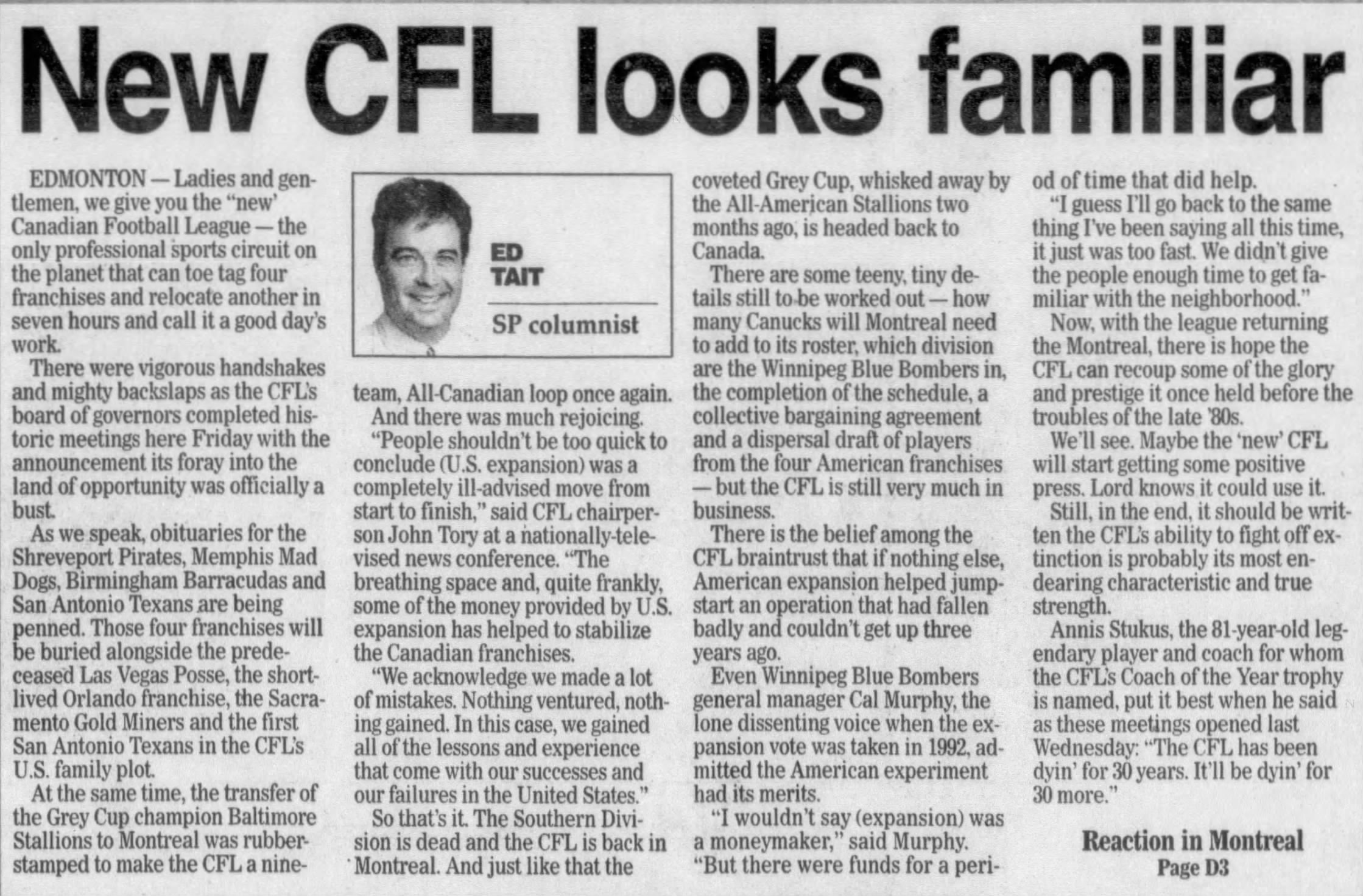
Ed Tait’s column about the new, old CFL (Saskatoon Star Phoenix, 3 February 1996).
The CFL didn’t close the door permanently on future U.S. expansion and hinted that American teams could possibly return to the league in 1997. But most agreed that was unlikely and that the CFL was going to stick with its new, old all-Canadian lineup.
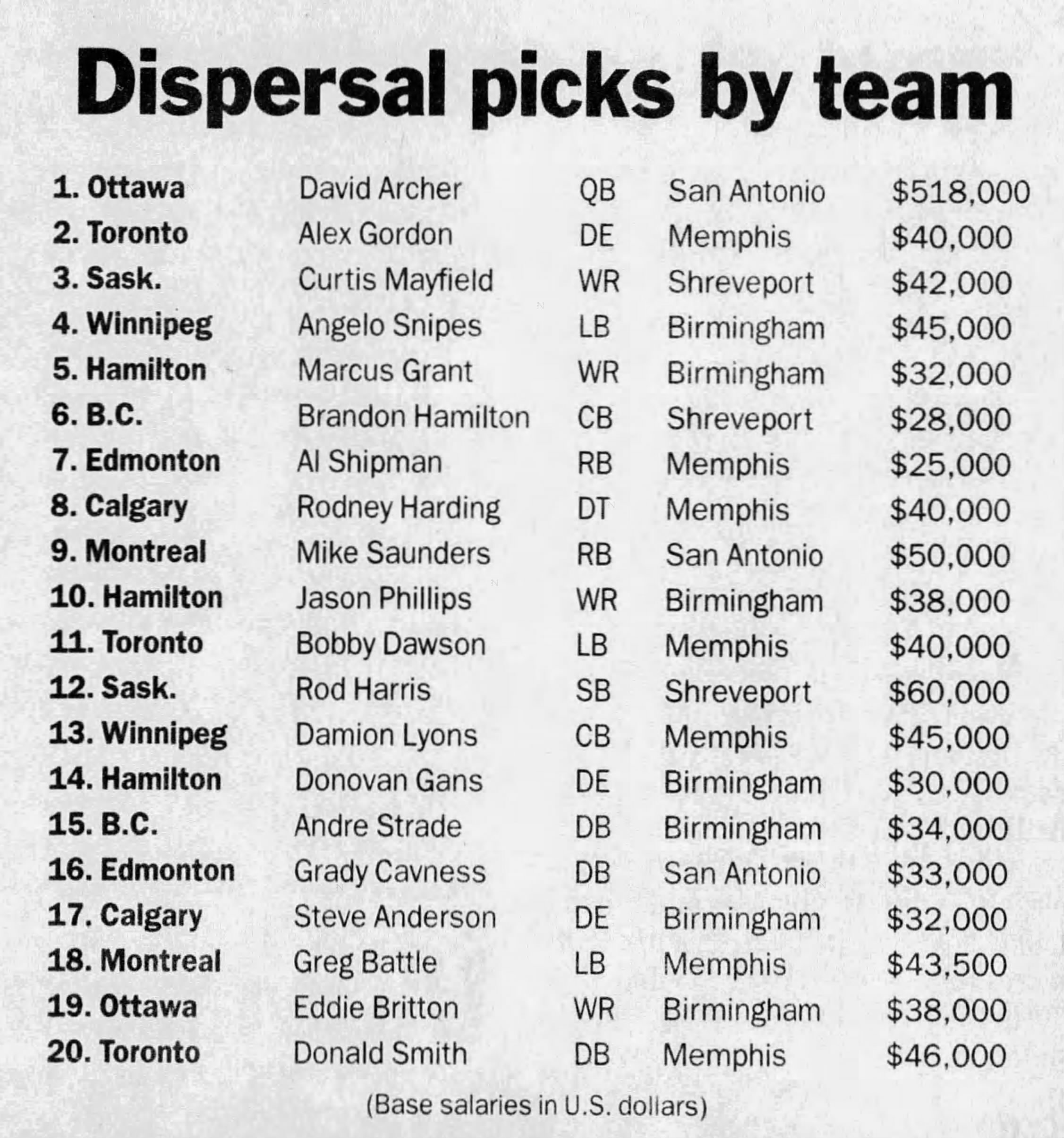
The players signed to the now folded American teams were put into a dispersal draft and divvied up amongst the nine Canadian teams. San Antonio’s quarterback David Archer was chosen first overall by Ottawa. A special expansion draft was held as well to help stock the reincarnated Montreal Alouettes with Canadian players.
Top 20 players chosen in the dispersal draft held (Ottawa Citizen, 8 March 1996)
The 1996 CFL season kicked off on June 23 in Regina. Four days later, the first CFL game played in Montreal in almost a decade saw the Toronto Argonauts defeat the Alouettes 27-24.
With the CFL’s exit from the U.S., the league launched a bold new marketing campaign highlighting its Canadian roots and unique brand of football. The American dream was no more. The CFL entered its Radically Canadian era.
Sources:
Edmonton Journal, 3 February 1996 Montreal Gazette, 3 February 1996 Ottawa Citizen, 8 March 1996 Saskatoon Star Phoenix, 3 February 1996
Article in the Sacramento Bee about the unveiling of the Gold Miners’ new rival – the Las Vegas Posse.
The CFL’s second U.S. team was the Las Vegas Posse. Owner Nick Mileti, who had a strong sports background, was awarded the expansion franchise in July 1994. They were officially branded the Posse in December of that year. Interesting trivia: the runner up name was the Mounties.
Las Vegas had a unique ownership model in that they were a publicly traded corporation, with Mileti as the largest shareholder. That said, the Posse were the least successful of the American expansion teams. Not only did the team have to compete in a crowded entertainment environment, but their stadium was located far from the downtown, meaning fans had to make quite the trek to catch a game – often in intense heat. Attendance was dismal and games with fewer than 10,000 fans were the norm. One bright spot for the Posse, though, was their quarterback. A young Anthony Calvillo made his CFL debut with Las Vegas. He would go on to have a stellar career with the Montreal Alouettes.
Baltimore CFL Colts / Stallions
Baltimore Sun article about naming Baltimore’s prospective CFL team the “Colts,”
When the National Football League rejected an expansion franchise for Baltimore, attention turned to the expanding Canadian Football League. Owner Jim Speros originally wanted to call his team the Baltimore Colts and help tap into the nostalgia associated with that brand. When the NFL threatened legal action, a compromise as suggested for the team to be known as the Baltimore CFL Colts. When that, too, was rejected the team simply played as the Baltimore Football Club and was often referred to as the Baltimore CFLers.
Baltimore was an instant success both on and off the field. Football fans were angry at the NFL plus there was a baseball strike in 1994, the year the CFL Colts – sorry CFLers – took the field. Baltimore routinely attracted crowds of around 40,000 to Memorial Stadium.
Head coach Don Matthews knew the Canadian game well and stocked his team with experienced CFL players such as quarterback Tracy Ham and defensive lineman Jearld Baylis. Baltimore finished their inaugural season with a 12-6 record, second place in the East Division. They went onto to play BC in the Grey Cup. Not bad for an expansion franchise.
In 1995, the team was finally given a new name – the Stallions. Again, the team was a powerhouse on the field, easily winning first place in the South Division. The Stallions went on to beat Calgary in the Grey Cup that year, becoming the first and only American team to win the Grey Cup.
It was this team that relocated to Montreal in 1996 to become the reincarnated Montreal Alouettes.
Shreveport Pirates
Advertisement in the Shreveport Times for Shreveport Pirates season tickets.
The Pirates joined the CFL in 1994. They were owned by Bernie Glieberman, who was the previous owner of the Ottawa Rough Riders. He sold the Rough Riders and was granted an expansion franchise for Shreveport, Louisiana.
Coached by Forrest Gregg, the Pirates struggled on the field and started their inaugural season with 14 straight losses. They ended up with a league-worst 3-15 record. In their second season, Shreveport finished with five wins and 13 losses. Despite their poor performance, the team enjoyed pretty good support amongst local fans and the business community. The team played at Independence Stadium.
San Antonio Texans
From Gold Miners to Texans (San Antonio Express News).
Originally, a team in San Antonio (also to be called the Texans) was supposed to join the CFL in 1993 with Sacramento. However, the team folded only two weeks after it was granted. Ironically, the Sacramento Gold Miners themselves relocated to San Antonio for the 1995 season after owner Fred Anderson couldn’t secure stadium upgrades in the California capital.
The team was renamed the Texans and finally had some success on the field, finishing second place in the South Division with a 12-6 record. The Texans played at the Alamodome, one of the few stadiums in the United States that could easily accommodate Canadian football field dimensions.
Birmingham Barracudas
Advertisement in the Birmingham News promoting season tickets for the Birmingham Barracudas.
The CFL awarded Birmingham an expansion franchise in January 1995. Owned by Art Williams and coached by Jack Pardee, the team was unveiled as the Birmingham Barracudas on March 14, 1995. Future Hall of Fame quarterback Matt Dunnigan joined the team, leading them to a 10-8 record, third place in the South Division.
Birmingham attracted good crowds to Legion Field early in the season. Their home opener versus Hamilton had over 31,000 fans in attendance. But by the time U.S. college football started up, attendance dropped dramatically. Williams sold the team after the 1995 season to a group that expressed interest in moving it to Shreveport for 1996.
Memphis Mad Dogs
Coverage of the Memphis’ new CFL team, the Mad Dogs, in the Memphis Commercial Appeal.
Memphis was another case where an NFL expansion rejection created a pivot to the CFL. Fred Smith, the owner of FedEx, spearheaded the team that was called the Mad Dogs. They were coached by Pepper Rodgers and tried to replicate what Baltimore had done by bringing in experienced CFL players including Damon Allen as their quarterback.
The Mad Dogs finished the season with a 9-9 record, fourth place in the South Division, and missed the playoffs in their one year in play.
Memphis played at the Liberty Bowl Memorial Stadium, which could not accommodate the larger Canadian football field. As such, the end zones in Memphis were only seven yards deep at the sidelines. To make matters worse, the end zones were Astroturf while the rest of the field was natural grass.
The CFL ended its American expansion following the 1995 season. In 1996, the league reverted to its original all-Canadian lineup.
Sources:
Baltimore Sun, 16 December 1993 Birmingham News, 16 March 1995 Sacramento Bee, 11 December 1993 San Antonio Express-News, 14 March 1995 Shreveport Times, 6 April 1994
When the Canadian Football League rolled out American expansion in the early 1990s, support for the idea was far from unanimous. Yes, proponents argued that U.S. expansion was the way forward to grow the league and to help stabilize the struggling Canadian teams. But detractors countered that the CFL simply stood too much to lose in the process.
Traditional CFL fans – many who had supported their teams for decades – feared the CFL would gradually lose its identity and uniqueness as more American teams came onboard. Canadian players felt threatened that they would ultimately lose their jobs once it became evident that the league’s import ratio could not be enforced in the United States due to American labour law. Add in some sceptical media and tepid team governors and it became quite apparent that this was going to take some serious convincing by Larry Smith, the CFL commissioner at the time, who was tasked with implementing the league’s expansion plan.
Perhaps the greatest opposition to CFL expansion to the United States came out of Winnipeg. Looking back, it appears the Manitoba capital was ground zero for opposition to American expansion. I had a great chat with Ed Tait on this subject. Ed was the beat reporter for the Winnipeg Sun covering the Blue Bombers at the time. He recalls how Winnipeg took a bit of heat for being against expansion.
Ed Tait’s piece in the Winnipeg Sun (November 12, 1992) along with other CFL expansion tidbits.
“Cal Murphy (Winnipeg GM and head coach) and Bruce Robinson (Blue Bombers president) were against it,” Ed recalls. “Cal Murphy being a Canadian certainly influenced his opposition, for sure.”
“I remember an article in one of the Toronto newspapers that basically called the Bomber organization a bunch of dinosaurs stuck in the past and unwilling to embrace change.” Winnipeg responded by selling t-shirts with the slogan Dinosaurs play hard rock football.
Winnipeg’s politicians even got into the debate. Winnipeg South Centre MP Lloyd Axworthy, who would later serve as a Minister of the Crown in Jean Chrétien’s government, introduced a Private Member’s Bill in the House of Commons to block the CFL from expanding to the U.S., raising the ire of Larry Smith.
Canadian Press article about Winnipeg MP Lloyd Axworthy anti-expansion bill.
In the end, though, the CFL’s Board of Governors approved the addition of Sacramento and San Antonio by a vote of 7-1. Yes, Winnipeg was the lone dissenter.
Ed Tait shared with me some of his memories of covering the Winnipeg Blue Bombers during the CFL USA era. He was in the room at the Coach of the Year dinner in Edmonton in January 1993 when San Antonio backed out just two weeks after being admitted. “We were all there to celebrate,” he recalls “Then we get the news that San Antonio isn’t going to happen. Larry Smith literally ducked out through the kitchen to avoid giving any interviews.” Talk about a rocky start.
Wild is the word he uses to describe the expansion experience. “They were definitely fun road trips. I kind of marvelled at covering a Bombers game in places like Shreveport, Louisiana and Birmingham, Alabama and Las Vegas,” he said.
The game in Las Vegas is notorious for drawing such a dismal crowd. Only 2,350 fans came out to Sam Boyd Stadium to watch the Las Vegas Posse host the Blue Bombers. And about a third of them were from Winnipeg who came down for the game. Yikes.
Ed shares the commonly held view that the CFL expanded out of desperation and didn’t do its homework on choosing expansion markets. “It made the league a bit of a laughing stock,” he admits. That said, Ed made a habit of collecting various memorabilia of the U.S.-based teams. No doubt, he recognized that the expansion experiment wouldn’t last and that the merchandise would be something unique to hold on to.
Perhaps my favourite story he shared was his experience in Shreveport. Apparently, Shreveport had a pretty high homicide rate. On the ride to the stadium, when he asked the taxi driver if it was true that most people there carried handguns for protection, the driver nonchalantly raised the console cover to show a loaded .45 handgun. Guess that answered that question.
Ed told me that the most memorable Grey Cup that he covered as a journalist was the 1994 game in Vancouver between the BC Lions and Baltimore. That was the first time an American team played in the Grey Cup. “The whole us vs. them made this Grey Cup very special,” he says. And just last year at the 2025 Grey Cup in Winnipeg, several fans from Baltimore were there proudly waving their Stallions flags, representatives from a short-lived and bygone era.
Some thirty plus years later, there are no American teams in the CFL. Sure, the topic of U.S. expansion comes up now and then. I guess we’ll have to wait and see if it ever gains any momentum again. But for now, I think it’s safe to say that the lone dissenters, the so-called dinosaurs in Winnipeg were right all along.
Special shoutout to Ed Tait, who is now the Senior Writer/Reporter for the Winnipeg Blue Bombers, for taking the time to share his thoughts and memories with me. Thanks Ed.
Sources: The Winnipeg Sun, 12 November 1992 The Ottawa Citizen, 29 November 1992
When I first started following CFL football in the early 1990s, two issues dominated the league: struggling Canadian franchises and U.S. expansion. They kind of went hand in hand, the idea being that an injection of American money and new markets would help stabilize the existing Canadian teams. The ultimate goal was for the CFL to grow in popularity and take its rightful place as a major North American sports league.
Of course, things don’t always go according to plan. As we kick off a new year here at Canadian Football History, we’re going to look back at the CFL’s brief foray south of the border. It’s been 30 years since the so-called CFL USA experiment ended.
Whatever your views on the idea of American teams playing in the Canadian Football League are, one thing is certain. U.S. expansion at the time did breathe some new life into an 8-team league that was otherwise in dire straits. New teams. New colours. New players. And some expansion fees to boot. I still have a Sacramento Gold Miners t-shirt I bought. They were my favourite U.S.-based CFL team and had a great name and logo, in my opinion.
So, let’s set the stage for this endeavour, shall we?
Talk of CFL expansion to the United States was nothing new. The subject came up frequently over the years. The CFL staged an exhibition game in Portland, Oregon in June 1992 to test the waters. By most accounts the game was a success. But the expansion idea really picked up steam following the demise of the World League of American Football in 1992. Cities that had teams in that league were front and centre when it came to potential CFL markets.
Larry Smith, the newly appointed CFL commissioner in 1992, became the face of CFL expansion to the U.S. He had the untenable job of selling expansion to would-be American investors, nervous Canadian team governors, and sceptical players and fans. And there was plenty of sceptism.
Article by Mike Board in the Calgary Herald (3 October 1991) about the CFL greenlighting U.S. expansion with hints of future expansion into Europe or Japan.
An initial focus on cities close to the Canada-U.S. border (e.g., Portland, Detroit, etc.) was soon abandoned. Late in 1992, Smith presented a map showing prospective CFL expansion sites. While Montreal and Halifax were included, the rest of the map showed mid-sized U.S. markets such as Sacramento, San Antonio, and Orlando. Honolulu, Hawaii was even on the map. Ironically, several of the eventual U.S.-based teams were never on this map, including the most successful franchise in Baltimore.
Larry Smith’s expansion map (Toronto Star, 13 November 1992)
While the i’s still had to be dotted and the t’s crossed, plans were afoot for four new teams to join the CFL for the 1993 season. These included Portland, Sacramento, San Antonio, and Montreal. The league’s twelve teams were be divided into a new three division alignment. I’m not sure if it was ever explained how the playoffs would work under this structure.
Ian MacDonald in the Montreal Gazette (13 November 1992) writing about the CFL’s expansion plans with new teams Montreal, Portland, Sacramento, and San Antonio.
However, shortly after CFL’s plans were made public the backtracking began. Portland, which was always considered the frontrunner for U.S. expansion, backed out. As did Montreal. It would come down to just the Sacramento Gold Miners and the San Antonio Texans joining the CFL for 1993. They were formally welcomed into the CFL on January 12, 1993.
CFL Commissioner Larry Smith (centre) with Fred Anderson and Larry Benson. (CP Photo)
The Gold Miners were owned by Fred Anderson and in many ways were a reincarnation of the Sacramento Surge of the WLAF. Fred Anderson was a genuinely seen as a nice guy who truly believed in the CFL’s potential in California. He seemed to have the capital and the commitment as well as local fan and media support. His biggest obstacle was a suitable stadium. The Gold Miners would play at Hornet Field on the campus of Sacramento State university, a stadium comprising mostly temporary bleachers and portable washrooms. Not an ideal facility for a fledging professional football team by any stretch of the imagination.
On the other hand, San Antonio was to play in the brand new 65,000-seat Alamodome, a state-of-the-art indoor stadium that was one of the few American stadiums that could accommodate the larger Canadian football field. The Texans were owned by Larry Benson who, like Fred Anderson, had previously owned the city’s former WLAF franchise. Fun fact. The WLAF team in San Antonio was called the Riders. Now, imagine a scenario where the San Antonio Riders, along with the Saskatchewan Roughriders and the Ottawa Rough Riders (Ottawa’s team at the time), played together. That could’ve been quite fun to watch.
Article in the Calgary Herald about the demise of the San Antonio Texans CFL expansion franchise.
Alas, Benson pulled out two weeks later. Was it cold feet or lack of money or something else? Whatever the case, there would be no CFL football in Texas in 1993.
In the end, it was only Sacramento left standing from the original four expansion teams. The Gold Miners played in the West Division and kicked off their season with a two-game road trip in Ottawa and Hamilton. The Gold Miners home opener at Hornet Field was played on July 17, 1993, against the Calgary Stampeders. Amongst the uncertainty and despite the hiccups, CFL expansion to the United States was here at last.
Sources: The Calgary Herald, 3 October 1992 The Calgary Herald, 28 January 1993 The Montreal Gazette , 13 November 1992 The Toronto Star, 13 November 1992
When CFL Commissioner Stewart Johnston announced sweeping rule changes to the Canadian game last month, one modification that probably alarmed traditionalists the most was the change to the size of the CFL football field. In 2027, the field will shrink from 110 yards in length to 100 yards between the goal lines.
I can certainly sympathize with the “Save the 55” crowd. After all, we humans tend not to like change. Especially when it comes to changing something we cherish. But upon further review, it appears that 100-yard football fields are not new to Canadian football.
From the Rules of the Rugby Union Game of Football adopted by the Canadian Rugby Football Union, 14 September 1880
In fact, early Canadian football was played on 100 yard long fields. In 1880, the very first rule in the new Canadian Rugby Football Union rule book stated that “The Grounds shall be, as near as possible, 100 yards long by 50 yards broad.” Of course, it’s important to remember that the game around this time was more like rugby football than the gridiron game we are accustomed to today. But still, that’s a small field.
100 yard long field being adopted by the CRFU in November 1885. (Montreal Star, 14 November 1884)
100 yard long fields continued to be the norm for several years. While the 1884 CRFU Laws of the Game stated that the field of play should not exceed 110 yards in length, in 1885, the CRFU clarified that the field should be 100 yards long by 65 yards wide. It appears the 110 yard by 65 yard standard was finally widely adopted by the 1890s. That is the size of the field mentioned in the rules when the new Canadian Rugby Union was formed in 1891.
The 110 x 65 field we are accustomed to (taken from the Canadian Rugby Football Union Constitution and Laws of the Game published in 1884).
So, what’s the point of this discussion? Well, nothing really except to reiterate that Canadian football is not static. The rules and regulations of the game have been evolving since the beginning. And in the case of the 100 yard long field coming in 2027, it can be equally argued that rather than moving the CFL closer to the American game, we are instead taking Canadian football back to its early years.
Sources: Rules of the Rugby Union Game of Football adopted by the Canadian Rugby Football Union, 14 September 1880 Canadian Rugby Football Union Constitution and Laws of the Game, 1 July 1884 The Montreal Star, 14 November 1885