For eons, the Canadian Football League published Media Guides or Fact Books for its teams. These little handbooks were meant to familiarize local journalists with the players and coaching staff of the team they were covering. They included biographies, statistics, records, and team histories.
Team media guides were also a great little souvenir for the savvy football fan. I have several in my own collection I like to peruse every now and then.
The CFL still produces them at least in electronic form. At least for some teams. I’m not sure if the league still offers print copies, though. It looks like they’ve met the same fate as game day programs and printed tickets, which is unfortunate.
Anyway, I thought what better way to spend the dog days of summer than by taking a look at some of these CFL media guides from the 1960s (or the late 1950s in a couple of cases). It was an exciting decade for the CFL and Canadian football.
Here are some photos of the media guides (front and back covers) for each CFL team from that era:
The above photos are courtesy of the good folks at the Canadian Football Research Society.
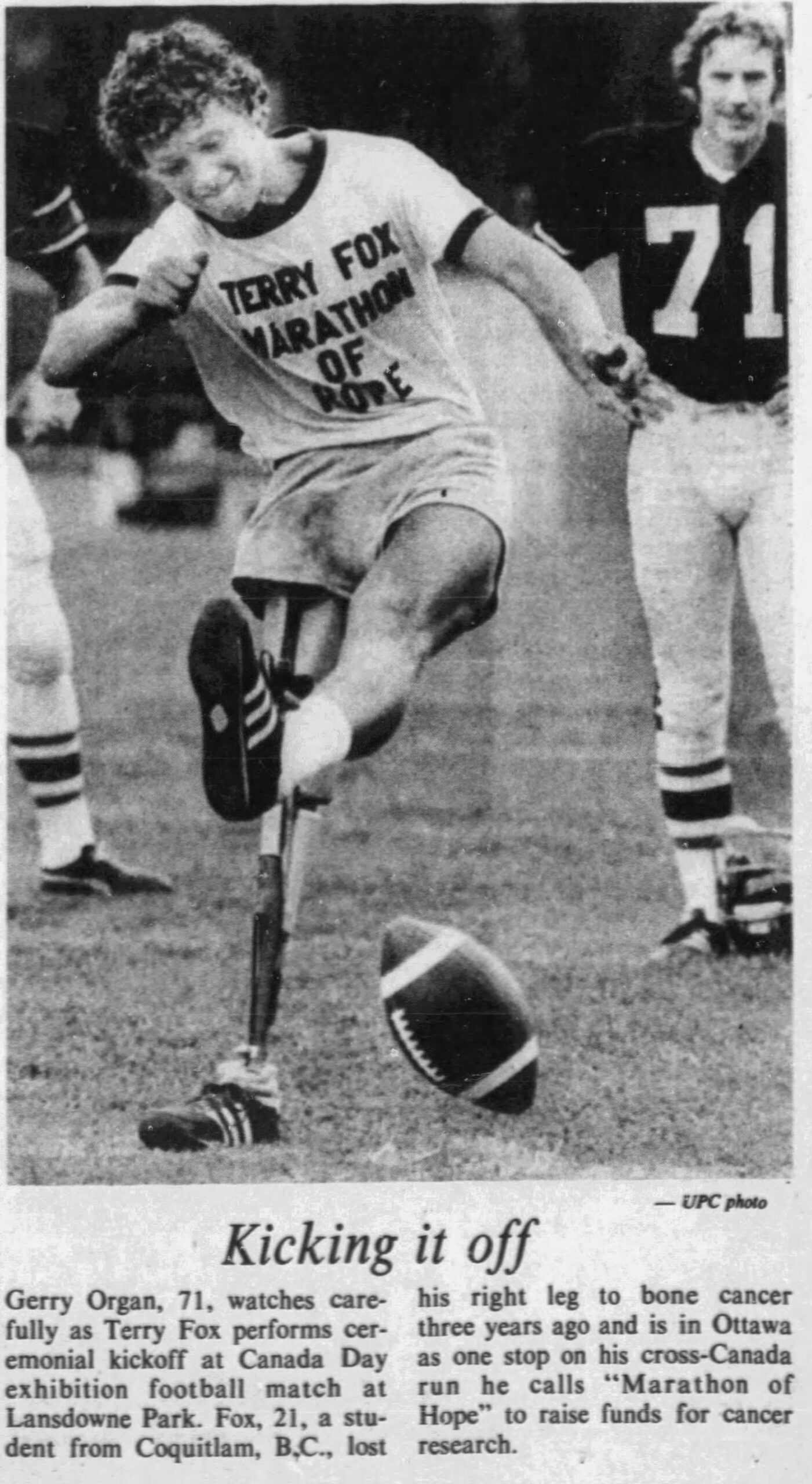
On July 1, 1980, a young man jogged onto the field at Lansdowne Park in Ottawa to perform the ceremonial kickoff prior to the CFL exhibition game between the Ottawa Rough Riders and the Saskatchewan Roughriders.
The crowd of almost 17,000 gave the 21-year-old a standing ovation. He wasn’t an ordinary 21-year-old by any stretch of the imagination. No, he was extraordinary in every sense of the word. He had one leg, having lost his other to cancer. Lansdowne Park was the latest stop on what he billed as his “Marathon of Hope” across Canada to raise money for cancer research. Of course, I’m talking about Terry Fox.
A great shot of Terry Fox performing the ceremonial kickoff on Canada Day 1980 while Gerry Organ of the Ottawa Rough Riders looks on. (Ottawa Citizen, 2 July 1980, p. 28.)
We Canadians are all familiar with Terry Fox, his story, and his legacy. I was only four years old (not even) at the time of the Marathon of Hope, but I do have some vague recollections of seeing coverage about it on TV. My Grandad met him while he was running through Halifax County in Nova Scotia and took a picture of him. I still have the photo.
But we forget some of the historic imagery that Terry’s marathon produced along the way. The kickoff at the CFL game is but one example. Here’s how Ottawa Rough Rider great Tony Gabriel remembers the day:
“I fondly remember meeting our young Canadian hero, Terry Fox, on July 1, 1980. He had begun his Marathon of Hope run across the nation and had reached Ottawa. Terry did our honorary kickoff that Canada Day, and I was fortunate as one of the captains for the Ottawa Rough Riders to get to shake his hand and wish him good luck in raising needed funds for Canadian cancer research.”
Terry Fox clearly made an impression on the CFL Hall of Famer. In 2020, Gabriel launched a petition to put Terry Fox on the $5 bank note. Late last year, the government announced that Terry Fox would indeed be featured on the new note. “Over the past 45 years, the Terry Fox Foundation has raised $950 million! I am so heartened it was announced and successfully assured this year that this continuing honour for Terry will happen in the near future by the Bank of Canada,” Gabriel proudly boasts.
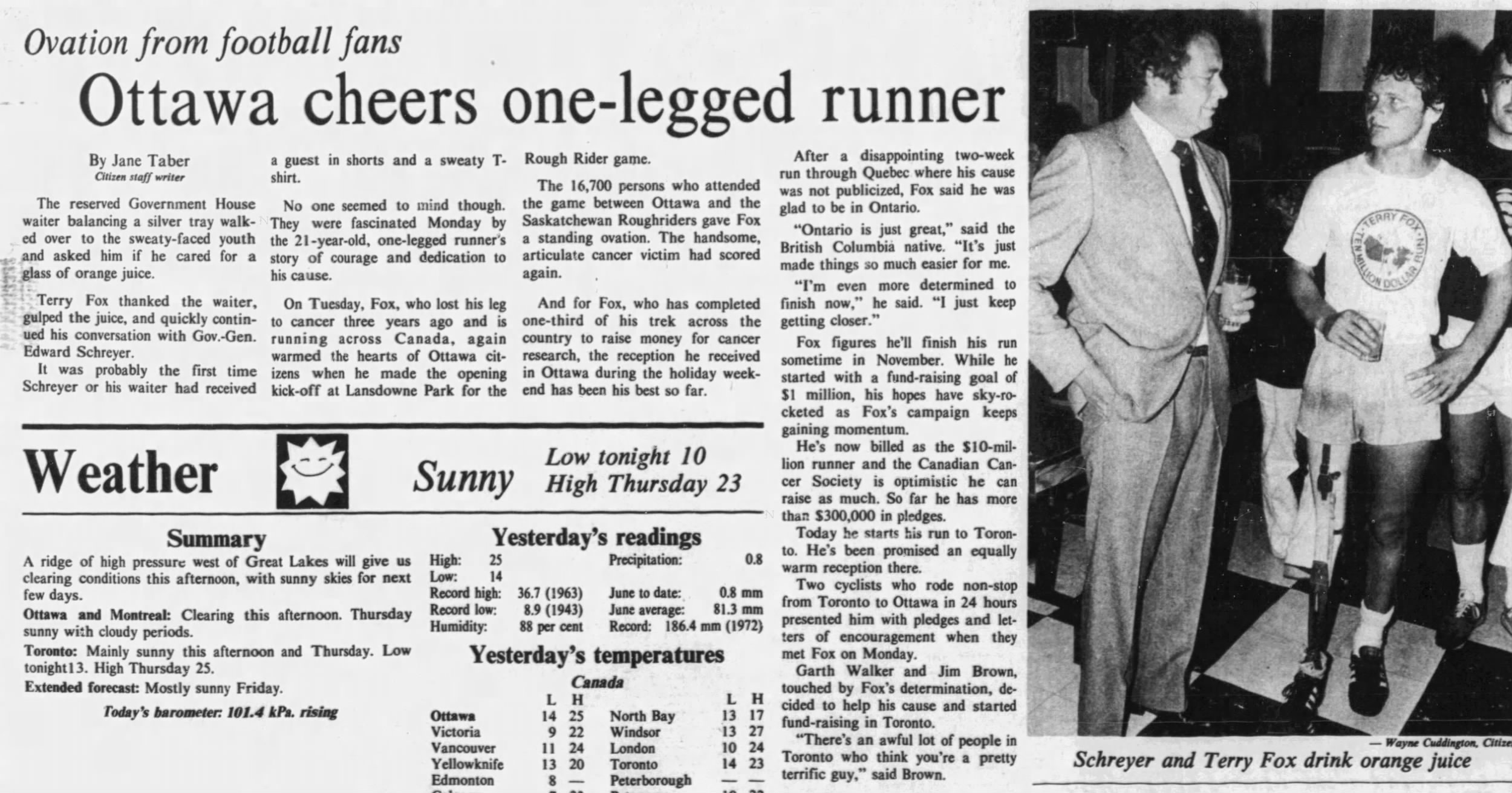
An article in the Ottawa Citizen about Terry Fox’s stop in Ottawa during his Marathon of Hope. (Taber, Jane. “Ottawa cheers one-legged runner.” Ottawa Citizen, 2 July 1980, p. 2.)
After leaving Ottawa – but not before hanging out with Governor General Ed Schreyer and Prime Minister Pierre Trudeau – Terry continued west into Southern Ontario before heading up to Northern Ontario towards Thunder Bay. Here, he sadly announced that his cancer had returned, thus ending the Marathon of Hope. Still, he travelled a distance of 5,373 kilometres over the course of 143 days and raised millions towards his cause.
It’s been 45 years since Terry Fox captured our hearts and admiration. 45 years since the young man with one leg shared the field with some of the great CFL football stars of the day. 45 years since Terry Fox become a true Canadian legend.
And now, let’s relive what I believe is one of the most iconic moments in Canadian sports history…the Terry Fox kickoff:
That was the headline in my hometown’s newspaper, the Hamilton Spectator, after the CFL’s debut in Sacramento, California. I became a CFL fan in the early 1990s. It was a tumultuous time for the Canadian Football League. Some teams across the country were on the verge of collapse. Several others were struggling to stay afloat. Against this backdrop, the CFL opted to add teams in the United States. The benefits of U.S. expansion were two-fold. First, expansion fees could bring in some much-needed cash in the short term. Second, a bigger North American wide football league could open up even greater revenue (i.e., an American TV deal) long term.
An article in the Hamilton Spectator about Sacramento embracing the CFL. (Morris, Jim. “Sacramento falls in love with the CFL.” The Hamilton Spectator, 19 July 1993, p. 16.)
The first American team to join the CFL was the Sacramento Gold Miners in 1993. There was also supposed to be a team in San Antonio, Texas, as well, but it was kiboshed before playing a single down. So, the 1993 CFL season featured nine teams with the addition of the California capital.
The Gold Miners were spearheaded by Fred Anderson, a Sacramento businessman, who had owned the Sacramento Surge of the World League of American Football, a developmental spring league for the National Football League. The WLAF ceased operations in 1992. There was considerable overlap between the Surge and the Gold Miners. The teams’ colours were similar, and many former Surge players and personnel were brought into the Gold Miners’ organization. Kay Stephenson reprised his role as Sacramento’s head coach, having coached the Surge to the 1992 WLAF championship.
Because of U.S. labour laws, the Gold Miners were not required to have any Canadian players on their roster. Instead, they played with an all-American lineup. Some suggested this gave Sacramento a unique advantage over their Canadian counterparts. Yet, the team did struggle as an expansion team while adapting to the Canadian game.
The Gold Miners played their home games at Hornet Field on the campus of Sacramento State university. It was a rather bare bones stadium comprising temporary bleachers and portable washrooms. Nevertheless, the stage was set for a historic debut of Canadian football in northern California.
July 17, 1993
The Gold Miners and Stampeders about to go head to head in Sacramento Voet, Gary. “Today’s Game at a Glance.” The Sacramento Bee, 17 July 1993, p. 21)
The Sacramento Gold Miners opened the 1993 season with a two-game road trip, losing both games in Ottawa and Hamilton. Their first home game was played on Saturday July 17th against the Calgary Stampeders, the defending Grey Cup champions, led by marquee quarterback Doug Flutie.
Marking the field at Hornet Field in Sacramento prior to the CFL’s debut (The Sacramento Bee)
A crowd of 20,082 filed into Hornet Field that night to see a great offensive display of football. Flutie and Sacramento quarterback David Archer lit up the scoreboard in what was truly a wild west shootout. You couldn’t have asked for a more exciting game to introduce Sacramento fans to the CFL. Ultimately, the Stampeders came out on top 38-36. The Gold Miners dropped to 0-3.
Coverage of the historic first CFL game in Sacramento from a Sacramento perspective. (Voet, Gary. “Miners lose a shootout to Calgary.” The Sacramento Bee, 18 July 1993, p. 25.)
Sacramento finished their inaugural season with a 6-12 record, last place in the West Division. They were somewhat better the following year but still missed the playoffs in a competitive West division. Unfortunately, the Gold Miners would leave Sacramento following the 1994 season. After failing to secure a new stadium or upgrades to Hornet Field, Fred Anderson relocated the Gold Miners to the then-still-new Alamodome in San Antonio in 1995 where they became known as the Texans. In 1996, the CFL ended its American expansion experiment and returned to being an all-Canadian league.
I reached out to award-winning journalist Bob Graswich, who was a columnist for the Sacramento Bee during the Gold Miners’ CFL run. His column praising the Canadian game resonated with me because it was exactly how I felt (and still do!) about the CFL when compared to the big bad NFL. Reading that sentiment from an American writer helps validate my position.
Graswich told me the CFL was a “breath of fresh air” for Sacramento. “It was an exciting game, designed for the fans.” An antithesis of the NFL. He speaks very highly of Fred Anderson, saying he was somebody that was difficult not to like. Fred was a Sacramentan through and through, and he reluctantly moved the team only after he ran out of options. Graswich, who visited Anderson before his death, said Fred was truly disappointed that he couldn’t make the CFL work in Sacramento.
A column by Bob Graswich praising the CFL. Sums up my thoughts perfectly. (Graswich, R.E., “Thanks, Fred: You’ve givenus a better game.” The Sacramento Bee, 18 July 1993, p. 23.)
Fred Anderson was no doubt the most committed of the U.S. team owners. Perhaps under different circumstances and in a different time, things could’ve worked out better. Ironically, years later Sacramento State upgraded Hornet Field and renamed the field in Anderson’s honour – a fitting legacy for a man who did so much for football in Sacramento.
Perhaps it was the novelty factor. Perhaps it was the name and logo, which I really liked. Whatever the reason, I purchased a Sacramento Gold Miners t-shirt. It was one of my favourites, and I still have it. Well, my daughter actually took it and still wears it to school. How’s that for vintage CFL USA cool?
It didn’t last long. But football fans in Sacramento enjoyed it while they had it. For a brief period over thirty years ago, Sacramento indeed fell in love with the CFL.
I remember watching this game on television. My family had just returned from a summer road trip to northern Ontario and Ottawa. We made it home just in the nick of time to catch the game on CBC. I really felt like I was watching the beginning of something big. Seeing Americans embrace Canadian football seemed so satisfying to me at the time. It still does, really.
Back home in Calgary, Tom Elder was also watching this game with excitement. Tom has an extensive library of old CFL games on his Calgary Stampeders Classics YouTube channel . You can watch the historic Calgary-Sacramento game below. Please consider contributing to Tom’s project if you can. It takes a considerable amount of time, resources, and effort to help preserve some of these great CFL memories.
The Canadian Football League has long pined for a presence in Atlantic Canada. In fact, Halifax has been granted not one but two conditional expansion franchises, the emphasis on “conditional” as neither attempt materialized. When Moncton opened its new stadium in 2010 there was some chatter about the Hub City being a home for a future CFL team. While no expansion team has been forthcoming, Moncton has hosted three regular season CFL games. And of course, there have been regular season games played in Halifax and Acadia University in Wolfville, Nova Scotia, as well.
“CFL Tickets Go On Sale May 1.” Saint John Times-Globe, 23 April 1986, p. 29.
But the CFL actually made its debut in the Maritimes back 1986 when Saint John, New Brunswick hosted an exhibition game between the Montreal Alouettes and Winnipeg Blue Bombers. The game, played at the then newly constructed Canada Games Stadium, drew a crowd of over 11,000 fans who saw the Bombers down the Als 35-10.
“10,000 Assured for CFL Game.” Saint John Telegraph-Journal and Evening Times-Globe, 6 June 1986, p. 31.
It appears the game was designed to take the CFL on the road and expose the product to a new market rather than to test the waters for a prospective expansion site. In fact, CFL Commissioner Doug Mitchell seemed to go out his way to temper any expansion expectations. Still, New Brunswickers embraced the CFL and the players enjoyed the Atlantic hospitality.
Munford, Bruce. “Thousands Flock to See Bombers Blast Montreal.” Saint John Evening Times-Globe, 9 June 1986, p. 15.
The Bombers were quarterbacked by veteran Tom Clements, who had his way with the Montreal defence. A scary moment occurred early in the game when Montreal’s Nick Arakgi suffered a broken vertebrae when he was hit after reaching up high for an overthrown pass by Montreal quarterback Joe Barnes. He was taken to the hospital and ended up missing the entire 1986 CFL season.
Saint John Mayor Elsie Wayne was ecstatic about having the CFL in her city. She presented Winnipeg head coach Cal Murphy with a trophy called the Saint John CFL Cup after the game.
A Labatt’s ad sponsoring the CFL game in Saint John. (Saint John Telegraph-Journal, 6 June 1986, p. 71.)An ad promoting the CFL game in Saint John. (Saint John Telegraph-Journal, 6 June 1986, p. 72.)
The CFL’s success in Saint John in 1986 prompted the league to return the following year for another exhibition game. This time, Montreal played the Hamilton Tiger-Cats. The Ti-Cats won 14-13 in what turned out to be the last game for the Montreal Alouettes who folded a couple weeks later.
Kelly Ryback was the original “Buzz”, the mascot of the Winnipeg Blue Bombers. Here are his personal reflections of the event.
The ’86 trip was a career and life highlight!
I had never been to an ocean or feasted on lobster. I was on the advance team in Saint John Wednesday through Sunday.
We stayed at the Hilton on the harbour, ate lobster, mussels, and frog legs several times. We were hosted by Labatt’s with summer student valets. One became a friend for life, still 39 years later.
Meeting Mayor Elsie Wayne in her office was a hoot and she later hosted a fine reception where we were all presented with City of Saint John ties.
The crowd of 12K+ was fantastic and it was a bright, sunny day.
An absolutely incredible event.
A souvenir t-shirt from the 1986 CFL game in Saint John and a City of Saint John tie. Photo provided by Kelly Ryback.
As the CFL formally introduces Stewart Johnston as its new Commissioner this week, Canadian Football History looks back at the very first CFL Commissioner: Gerald Sydney Halter.
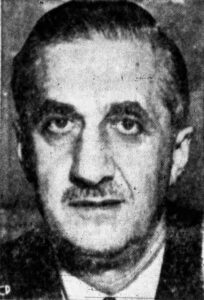
G. Sydney Halter, the CFL’s First Commissioner
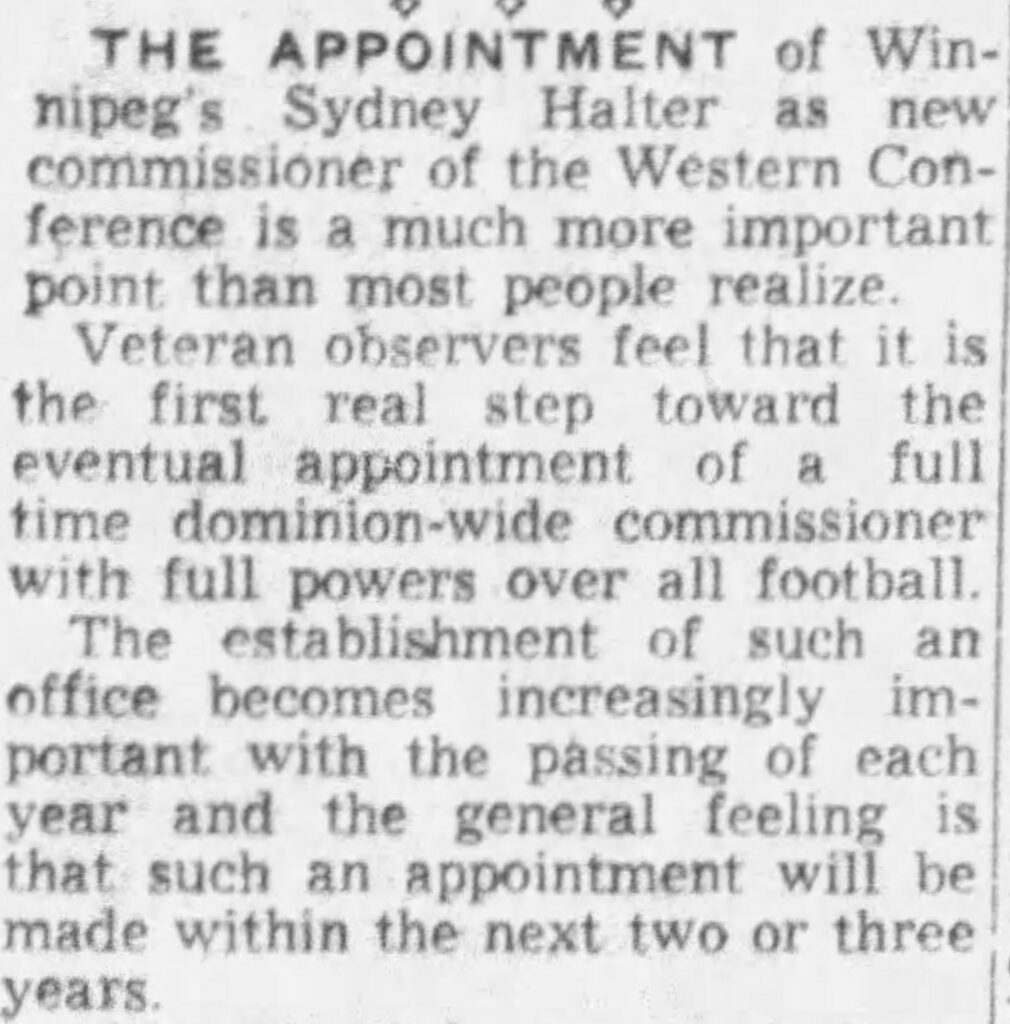
Sydney Halter was born and raised in Winnipeg, Manitoba. He held various roles, including treasurer and president, in the Winnipeg Blue Bombers organization before being named the Commissioner of the Western Interprovincial Football Union in 1953.
“Appointment of Sydney Halter.” The Calgary Herald, 31 March 1953, p. 25.
In 1956, he became the Registrar of the Canadian Football Council (CFC), a newly formed umbrella organization for both the WIFU and the eastern Interprovincial Rugby Football Union (the “Big Four”).
Well regarded in football circles across the country, Sydney Halter was named “Canada’s first national commissioner of football” when the Canadian Football League was established by the CFC in 1958. By the way, I totally think the CFL should adopt “National Commissioner of Football” as the official job title for its top role.
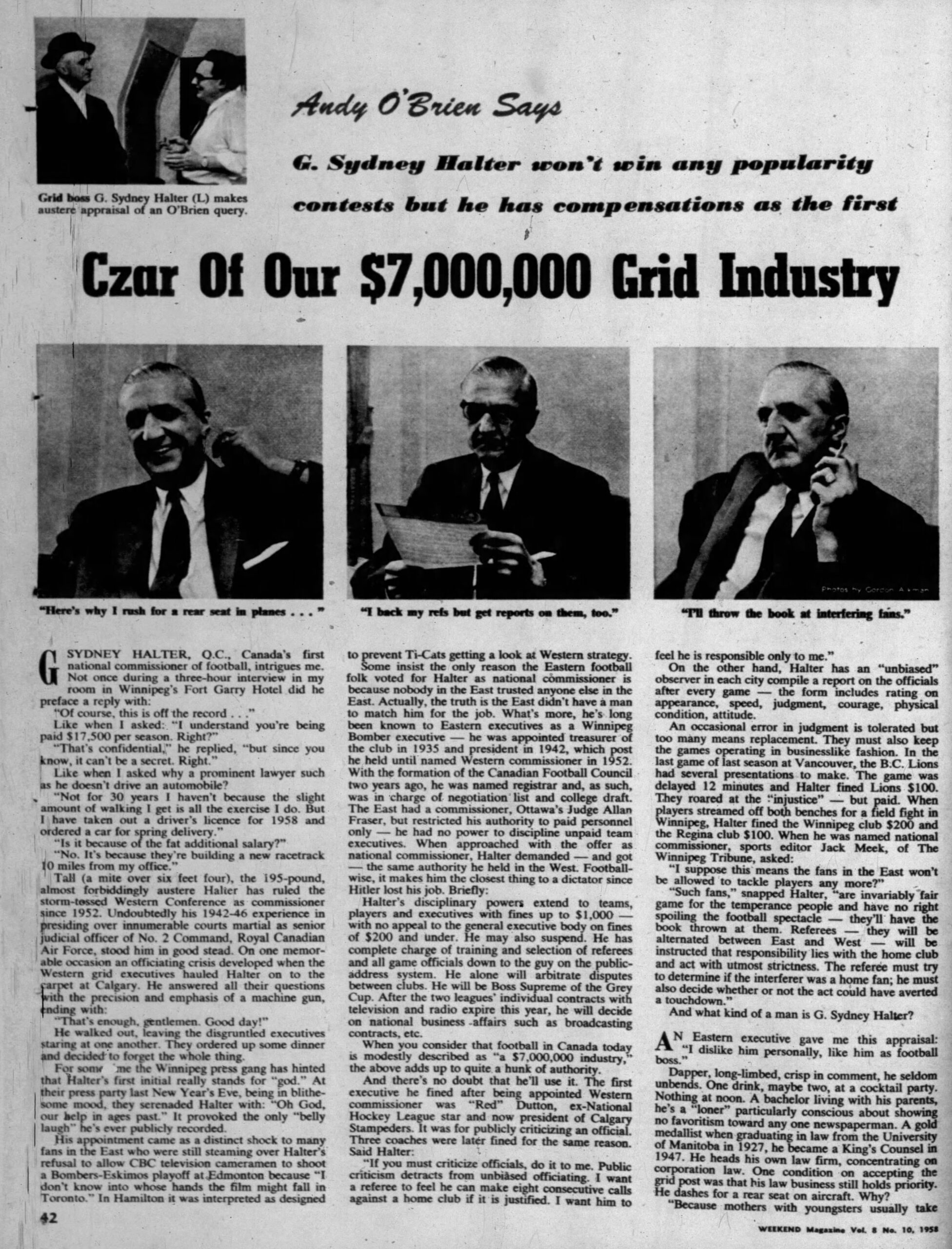
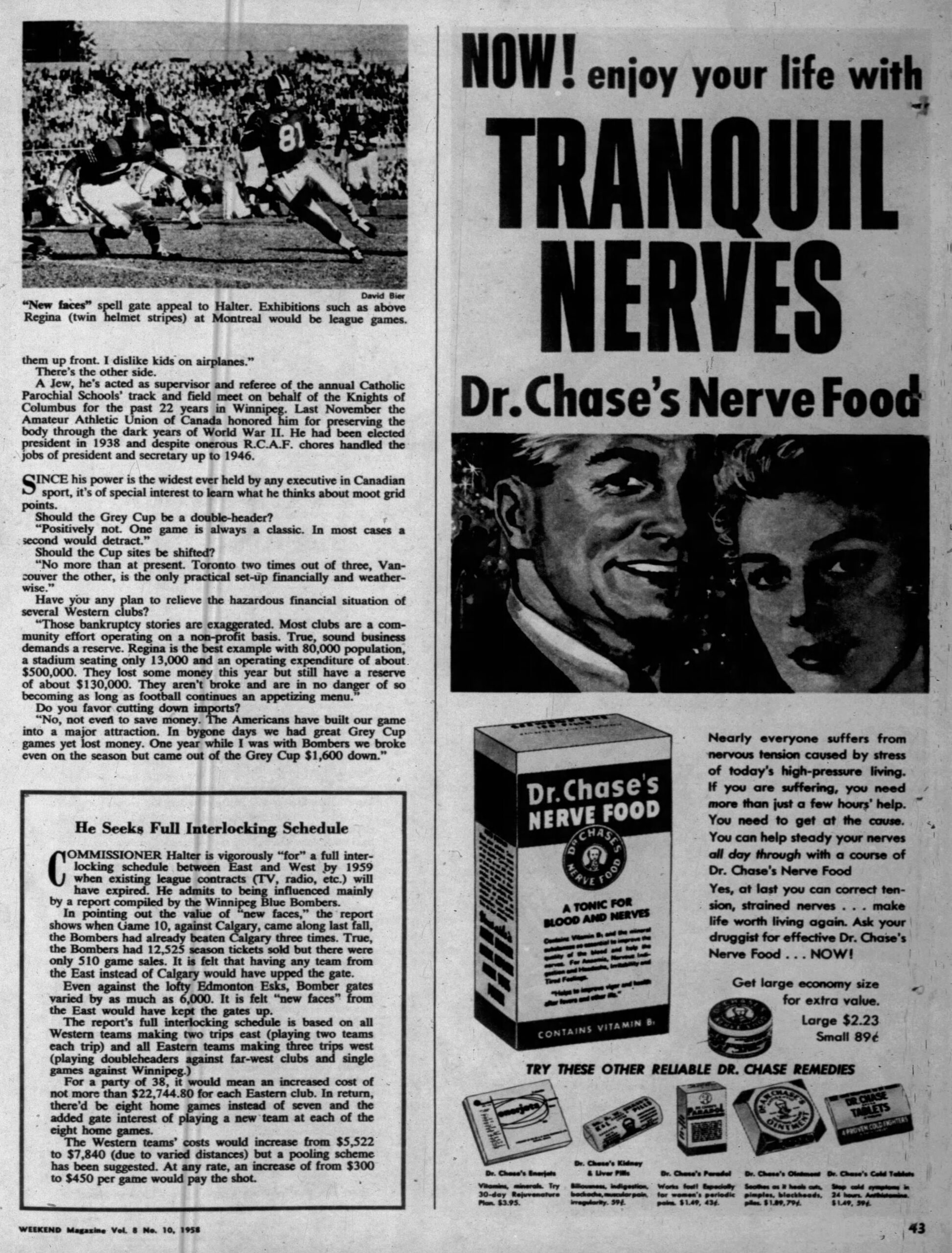
Described as a chain-smoking bachelor or “loner” by some, Sydney Halter wielded quite a bit of power in his role as Canada’s professional football boss. The article below (click on them to enlarge) is lengthy but well worth the read. It portrays Halter as a straight shooter and touches on how he didn’t hesitate to deliver fines to players and teams – or fans who interfered in the game. Apparently, home fans tackling opposing players from scoring touchdowns was a thing. Yikes.
O’Brien, Andy. “Czar of Our $7,000,000 Grid Industry.” The Hamilton Spectator, 8 March 1958, p. 90.O’Brien, Andy. “Czar of Our $7,000,000 Grid Industry.” The Hamilton Spectator, 8 March 1958, p. 91.
Sydney Halter served as the CFL’s commissioner until 1966. He was an early advocate for an interlocking schedule between the East and the West. A lawyer by profession, he also served in the Royal Canadian Air Force and held leadership positions in other Canadian sporting organizations outside of football.