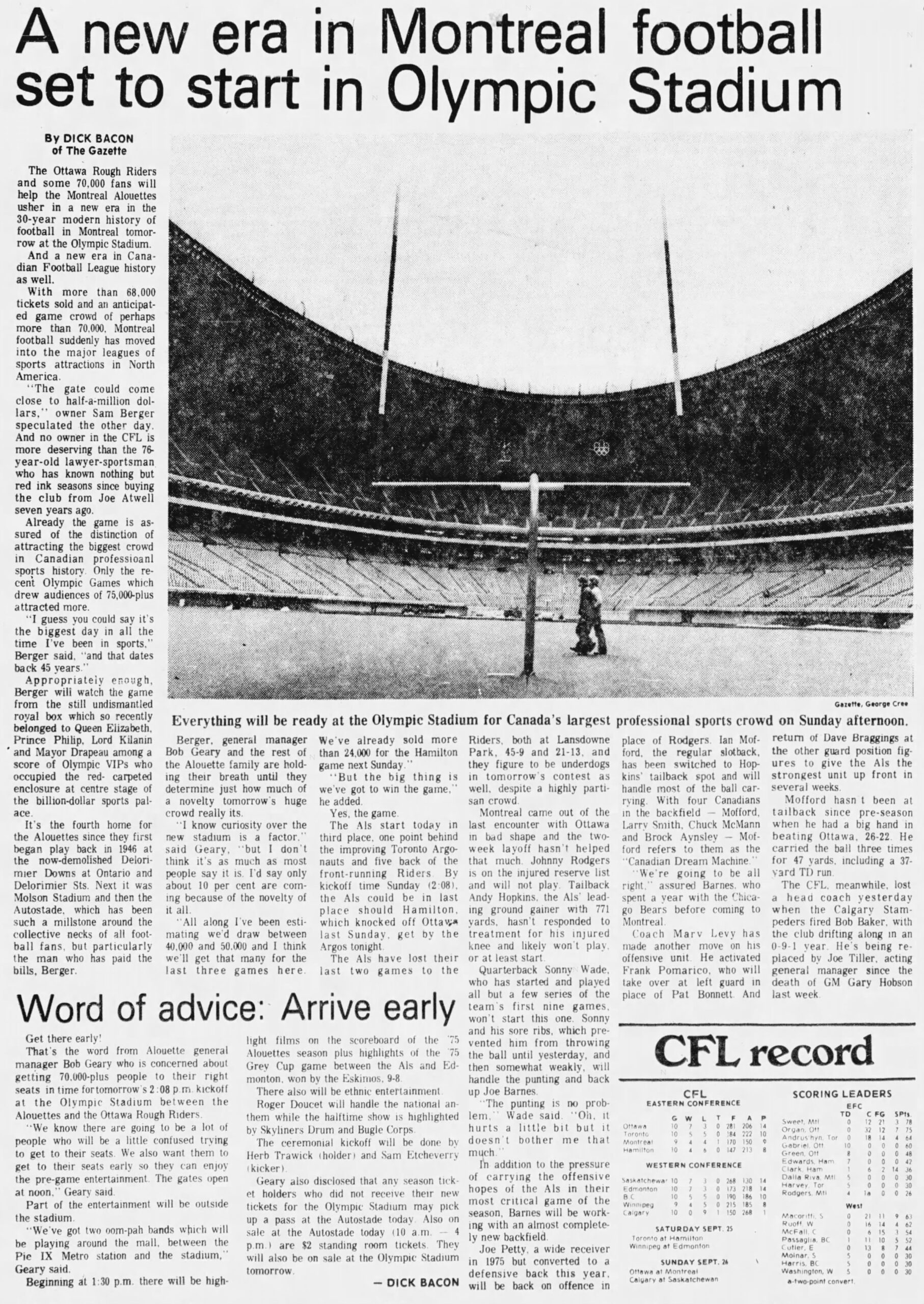
Midway through the 1976 CFL season, the Montreal Alouettes played their first game in their new home. After leaving behind the Autostade (that stadium likely warrants its own article), the Als hosted the Ottawa Rough Riders at the Olympic Stadium, the largest stadium ever built in Canada.
Bacon, Dick. “A new era in Montreal football set to start in Olympic Stadium.” Montreal Gazette, 25 September 1976, p. 11.
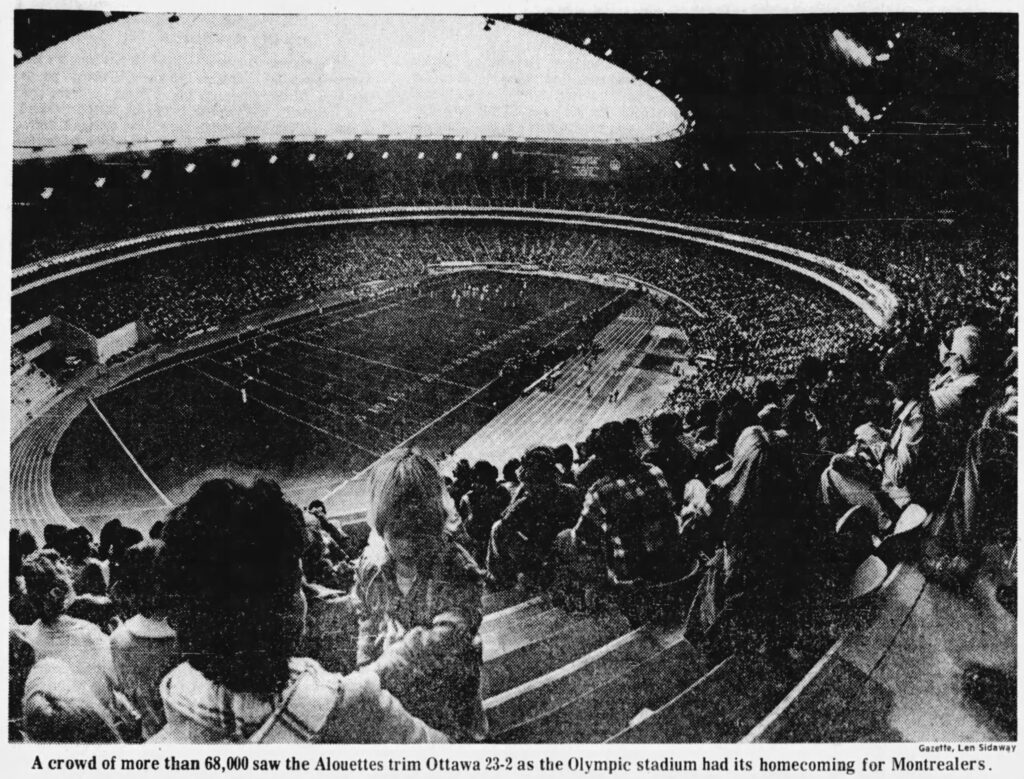
Post-Olympic fever was still gripping Montreal in the weeks leading up to the game. The Alouettes were expecting a record crowd to come see a .500 home side take on the East Division leaders from Ottawa. No doubt, many just wanted to catch a glimpse of the so-called billion-dollar sports palace. Without question, Olympic Stadium – affectionately known as the Big O or disparagingly known as the Big Owe – with its sheer size and modern-day amenities put other CFL stadiums to shame. In 1976, Edmonton’s Commonwealth Stadium was still a couple years away and the domed stadiums in Vancouver and Toronto came much later.
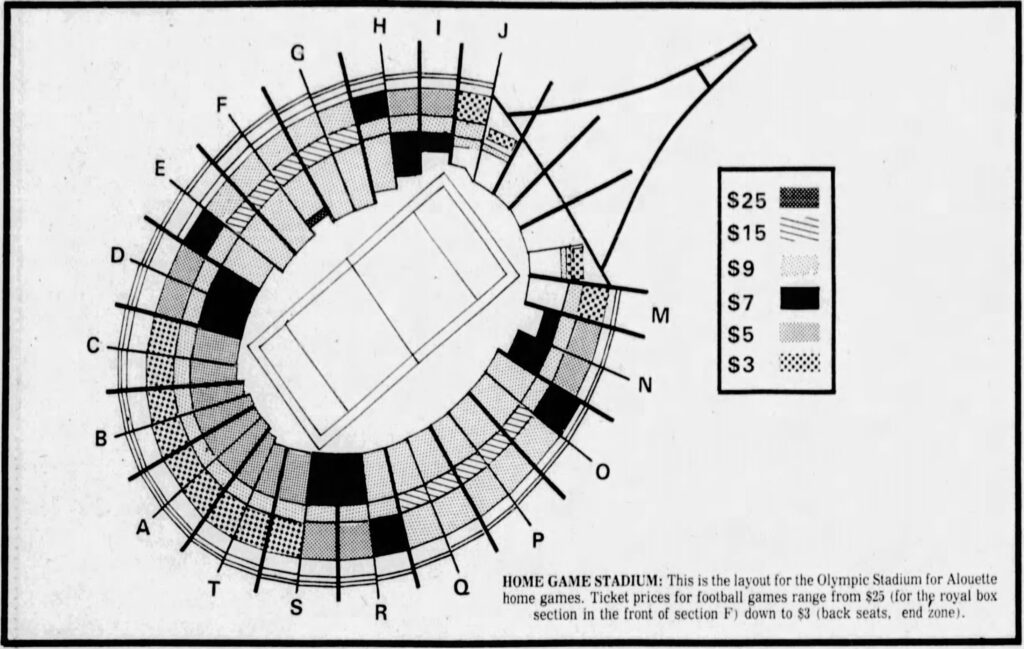
Olympic Stadium layout for football (Montreal Star)
The stadium was designed by Roger Taillibert, a French architect, and was the main stadium for the 1976 Summer Olympics in Montreal. It featured state-of-the-art scoreboards with video capabilities as well as modern artificial turf. Plus comfortable seats and corporate boxes. Of course, the promised “retractable” roof would have to wait.
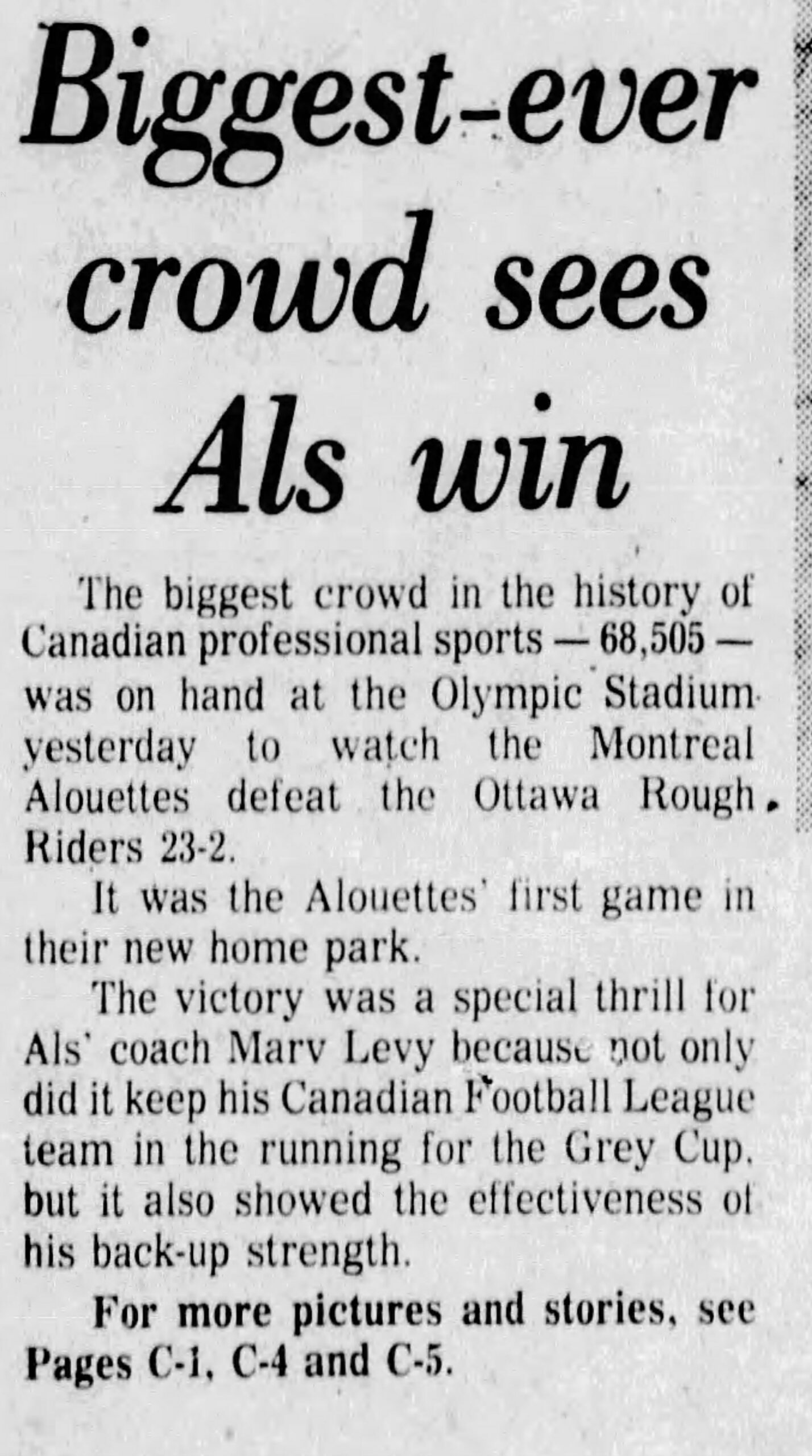
The Alouettes were the first permanent tenant for the Big O once the Olympics were over. On Sunday September 25, 1976, a record Canadian Football League crowd of 68,505 fans were on hand to see the first game. They were treated to a pre-game ceremony that included former Montreal quarterback Sam Etcheverry performing the ceremonial kickoff.
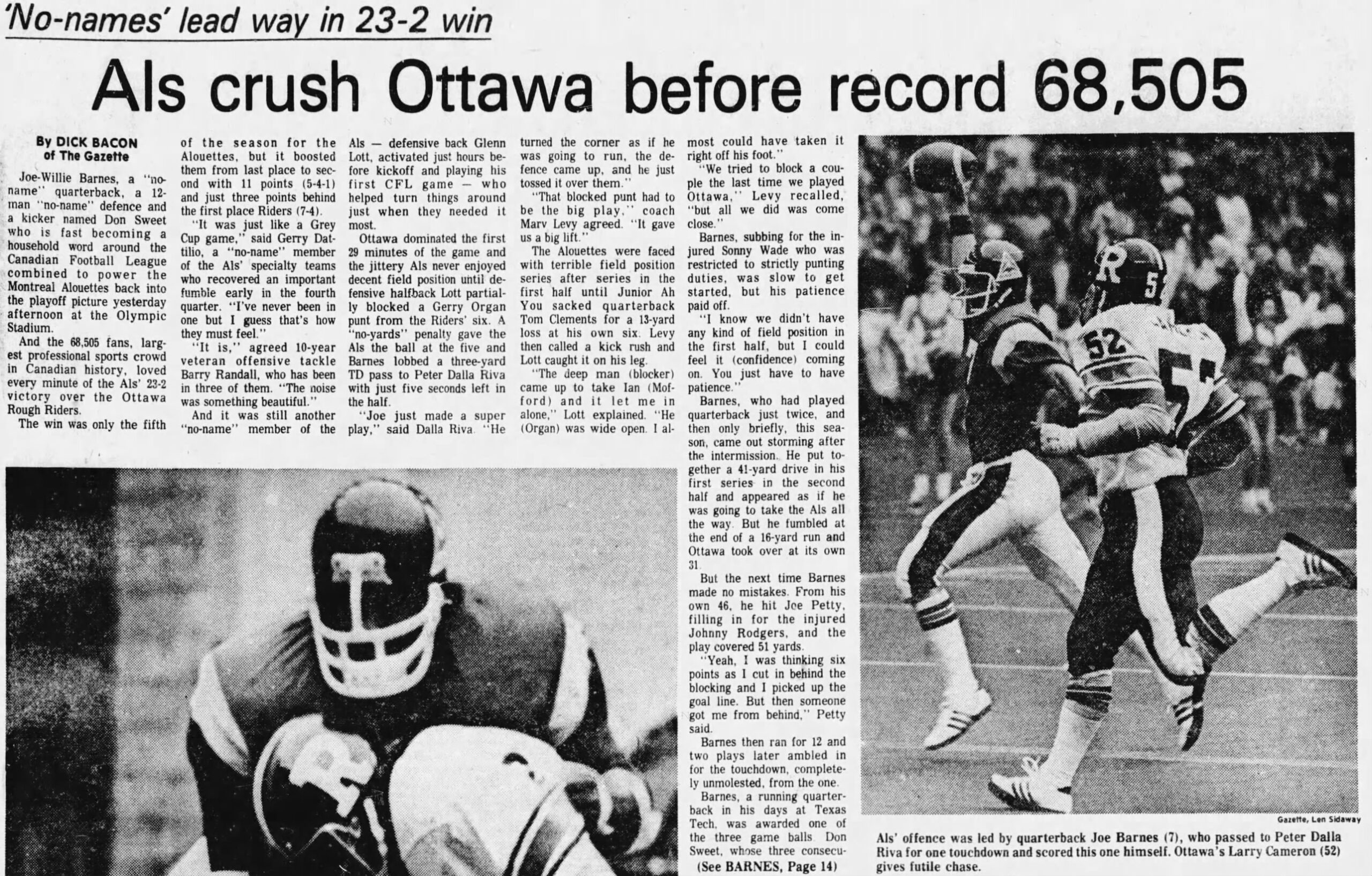
Bacon Dick, “Als crush Ottawa before record 68,505.” Montreal Gazette, 27 September 1976, p. 13.
Led by quarterback Joe Barnes and kicker Don Sweet, the Alouettes cruised to a 23-2 victory over the Rough Riders. The Alouettes’ win helped put Montreal back in the playoff hunt in the CFL East. The 1976 Alouettes were coached by the legendary Marv Levy. Levy understood the impact a large vocal crowd could have on the game.
“The crowd could be the 13th man on the field. If they’re a supportive crowd, it could be the start of a new era in fan enthusiasm and what it means to the team.” – Marv Levy
I’ve been to Olympic Stadium only once. That was for a Grey Cup game. When the place is packed – just like it was in the late 70s – it’s an awestriking experience. But the atmosphere diminishes exponentially the smaller the crowd.
Today, the Alouettes play their home games at the much more intimate (and much older) Percival Molson Memorial Stadium on the campus of McGill University. They haven’t played a football game at the Big O since 2012. But a new roof is being constructed, and there are hints of a further refurbishment down the road. Is it possible that the Alouettes will once again look at playing some if not all their games at Olympic Stadium in the future?
Perhaps the team can recapture some of that post-Olympic pride that helped them shatter attendance records. At the very least, it won’t be too long before the Grey Cup game returns to Montreal – and with that the roar of the crowd will once again reverberate throughout Olympic Stadium.
Montreal Gazette, 27 September 1976Montreal Star, 27 September 1976
For eons, the Canadian Football League published Media Guides or Fact Books for its teams. These little handbooks were meant to familiarize local journalists with the players and coaching staff of the team they were covering. They included biographies, statistics, records, and team histories.
Team media guides were also a great little souvenir for the savvy football fan. I have several in my own collection I like to peruse every now and then.
The CFL still produces them at least in electronic form. At least for some teams. I’m not sure if the league still offers print copies, though. It looks like they’ve met the same fate as game day programs and printed tickets, which is unfortunate.
Anyway, I thought what better way to spend the dog days of summer than by taking a look at some of these CFL media guides from the 1960s (or the late 1950s in a couple of cases). It was an exciting decade for the CFL and Canadian football.
Here are some photos of the media guides (front and back covers) for each CFL team from that era:
The above photos are courtesy of the good folks at the Canadian Football Research Society.
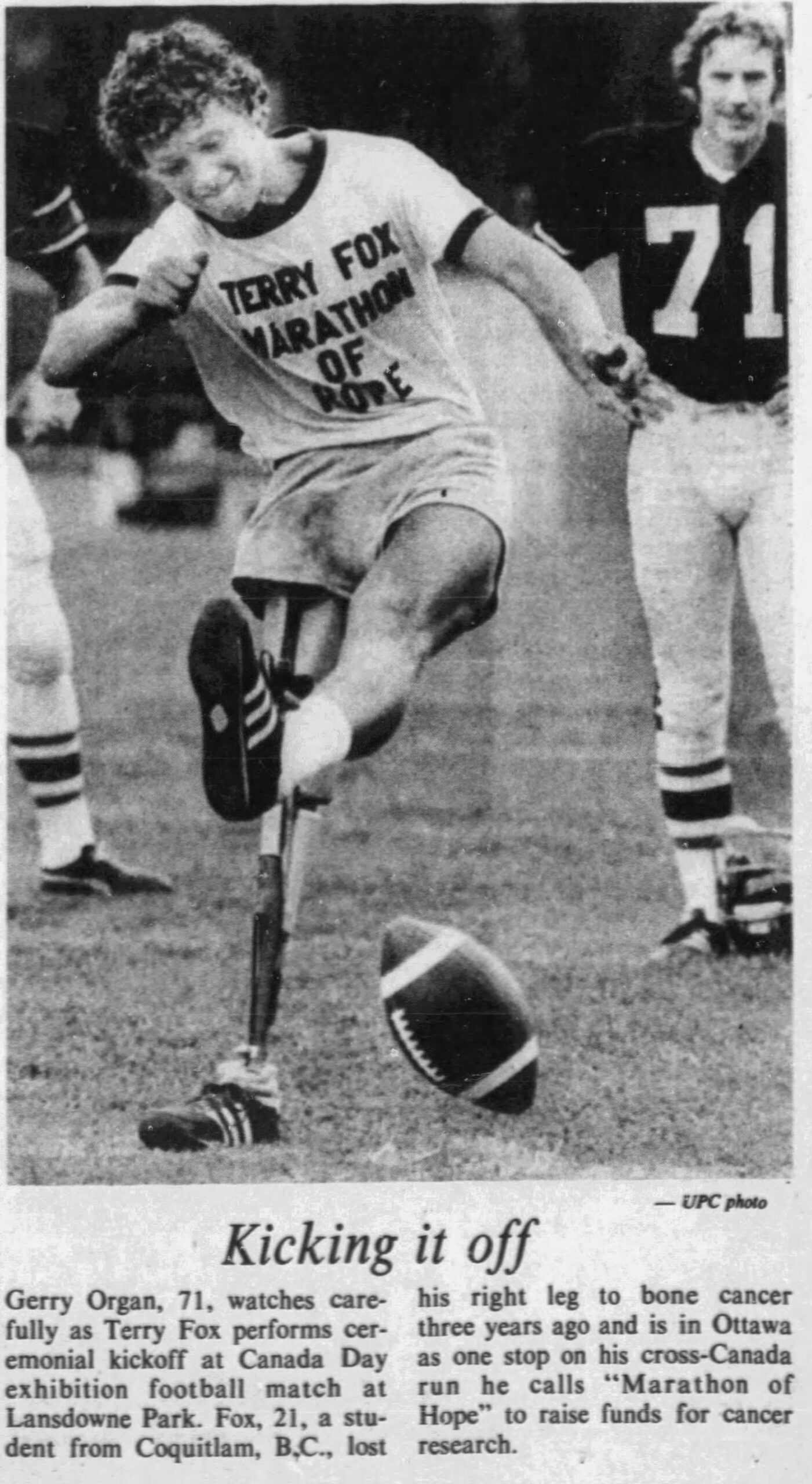
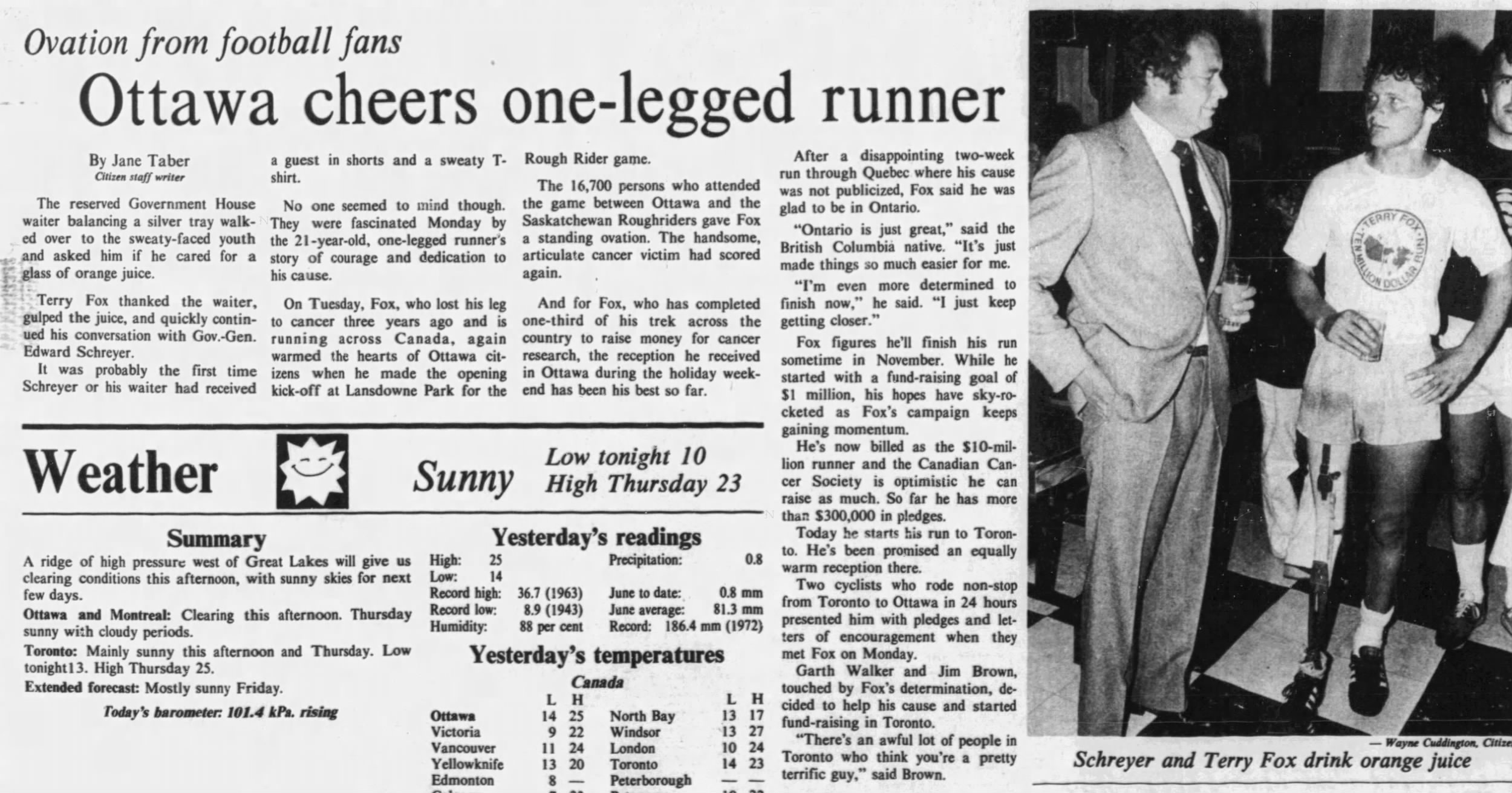
On July 1, 1980, a young man jogged onto the field at Lansdowne Park in Ottawa to perform the ceremonial kickoff prior to the CFL exhibition game between the Ottawa Rough Riders and the Saskatchewan Roughriders.
The crowd of almost 17,000 gave the 21-year-old a standing ovation. He wasn’t an ordinary 21-year-old by any stretch of the imagination. No, he was extraordinary in every sense of the word. He had one leg, having lost his other to cancer. Lansdowne Park was the latest stop on what he billed as his “Marathon of Hope” across Canada to raise money for cancer research. Of course, I’m talking about Terry Fox.
A great shot of Terry Fox performing the ceremonial kickoff on Canada Day 1980 while Gerry Organ of the Ottawa Rough Riders looks on. (Ottawa Citizen, 2 July 1980, p. 28.)
We Canadians are all familiar with Terry Fox, his story, and his legacy. I was only four years old (not even) at the time of the Marathon of Hope, but I do have some vague recollections of seeing coverage about it on TV. My Grandad met him while he was running through Halifax County in Nova Scotia and took a picture of him. I still have the photo.
But we forget some of the historic imagery that Terry’s marathon produced along the way. The kickoff at the CFL game is but one example. Here’s how Ottawa Rough Rider great Tony Gabriel remembers the day:
“I fondly remember meeting our young Canadian hero, Terry Fox, on July 1, 1980. He had begun his Marathon of Hope run across the nation and had reached Ottawa. Terry did our honorary kickoff that Canada Day, and I was fortunate as one of the captains for the Ottawa Rough Riders to get to shake his hand and wish him good luck in raising needed funds for Canadian cancer research.”
Terry Fox clearly made an impression on the CFL Hall of Famer. In 2020, Gabriel launched a petition to put Terry Fox on the $5 bank note. Late last year, the government announced that Terry Fox would indeed be featured on the new note. “Over the past 45 years, the Terry Fox Foundation has raised $950 million! I am so heartened it was announced and successfully assured this year that this continuing honour for Terry will happen in the near future by the Bank of Canada,” Gabriel proudly boasts.
An article in the Ottawa Citizen about Terry Fox’s stop in Ottawa during his Marathon of Hope. (Taber, Jane. “Ottawa cheers one-legged runner.” Ottawa Citizen, 2 July 1980, p. 2.)
After leaving Ottawa – but not before hanging out with Governor General Ed Schreyer and Prime Minister Pierre Trudeau – Terry continued west into Southern Ontario before heading up to Northern Ontario towards Thunder Bay. Here, he sadly announced that his cancer had returned, thus ending the Marathon of Hope. Still, he travelled a distance of 5,373 kilometres over the course of 143 days and raised millions towards his cause.
It’s been 45 years since Terry Fox captured our hearts and admiration. 45 years since the young man with one leg shared the field with some of the great CFL football stars of the day. 45 years since Terry Fox become a true Canadian legend.
And now, let’s relive what I believe is one of the most iconic moments in Canadian sports history…the Terry Fox kickoff:
That was the headline in my hometown’s newspaper, the Hamilton Spectator, after the CFL’s debut in Sacramento, California. I became a CFL fan in the early 1990s. It was a tumultuous time for the Canadian Football League. Some teams across the country were on the verge of collapse. Several others were struggling to stay afloat. Against this backdrop, the CFL opted to add teams in the United States. The benefits of U.S. expansion were two-fold. First, expansion fees could bring in some much-needed cash in the short term. Second, a bigger North American wide football league could open up even greater revenue (i.e., an American TV deal) long term.
An article in the Hamilton Spectator about Sacramento embracing the CFL. (Morris, Jim. “Sacramento falls in love with the CFL.” The Hamilton Spectator, 19 July 1993, p. 16.)
The first American team to join the CFL was the Sacramento Gold Miners in 1993. There was also supposed to be a team in San Antonio, Texas, as well, but it was kiboshed before playing a single down. So, the 1993 CFL season featured nine teams with the addition of the California capital.
The Gold Miners were spearheaded by Fred Anderson, a Sacramento businessman, who had owned the Sacramento Surge of the World League of American Football, a developmental spring league for the National Football League. The WLAF ceased operations in 1992. There was considerable overlap between the Surge and the Gold Miners. The teams’ colours were similar, and many former Surge players and personnel were brought into the Gold Miners’ organization. Kay Stephenson reprised his role as Sacramento’s head coach, having coached the Surge to the 1992 WLAF championship.
Because of U.S. labour laws, the Gold Miners were not required to have any Canadian players on their roster. Instead, they played with an all-American lineup. Some suggested this gave Sacramento a unique advantage over their Canadian counterparts. Yet, the team did struggle as an expansion team while adapting to the Canadian game.
The Gold Miners played their home games at Hornet Field on the campus of Sacramento State university. It was a rather bare bones stadium comprising temporary bleachers and portable washrooms. Nevertheless, the stage was set for a historic debut of Canadian football in northern California.
July 17, 1993
The Gold Miners and Stampeders about to go head to head in Sacramento Voet, Gary. “Today’s Game at a Glance.” The Sacramento Bee, 17 July 1993, p. 21)
The Sacramento Gold Miners opened the 1993 season with a two-game road trip, losing both games in Ottawa and Hamilton. Their first home game was played on Saturday July 17th against the Calgary Stampeders, the defending Grey Cup champions, led by marquee quarterback Doug Flutie.
Marking the field at Hornet Field in Sacramento prior to the CFL’s debut (The Sacramento Bee)
A crowd of 20,082 filed into Hornet Field that night to see a great offensive display of football. Flutie and Sacramento quarterback David Archer lit up the scoreboard in what was truly a wild west shootout. You couldn’t have asked for a more exciting game to introduce Sacramento fans to the CFL. Ultimately, the Stampeders came out on top 38-36. The Gold Miners dropped to 0-3.
Coverage of the historic first CFL game in Sacramento from a Sacramento perspective. (Voet, Gary. “Miners lose a shootout to Calgary.” The Sacramento Bee, 18 July 1993, p. 25.)
Sacramento finished their inaugural season with a 6-12 record, last place in the West Division. They were somewhat better the following year but still missed the playoffs in a competitive West division. Unfortunately, the Gold Miners would leave Sacramento following the 1994 season. After failing to secure a new stadium or upgrades to Hornet Field, Fred Anderson relocated the Gold Miners to the then-still-new Alamodome in San Antonio in 1995 where they became known as the Texans. In 1996, the CFL ended its American expansion experiment and returned to being an all-Canadian league.
I reached out to award-winning journalist Bob Graswich, who was a columnist for the Sacramento Bee during the Gold Miners’ CFL run. His column praising the Canadian game resonated with me because it was exactly how I felt (and still do!) about the CFL when compared to the big bad NFL. Reading that sentiment from an American writer helps validate my position.
Graswich told me the CFL was a “breath of fresh air” for Sacramento. “It was an exciting game, designed for the fans.” An antithesis of the NFL. He speaks very highly of Fred Anderson, saying he was somebody that was difficult not to like. Fred was a Sacramentan through and through, and he reluctantly moved the team only after he ran out of options. Graswich, who visited Anderson before his death, said Fred was truly disappointed that he couldn’t make the CFL work in Sacramento.
A column by Bob Graswich praising the CFL. Sums up my thoughts perfectly. (Graswich, R.E., “Thanks, Fred: You’ve givenus a better game.” The Sacramento Bee, 18 July 1993, p. 23.)
Fred Anderson was no doubt the most committed of the U.S. team owners. Perhaps under different circumstances and in a different time, things could’ve worked out better. Ironically, years later Sacramento State upgraded Hornet Field and renamed the field in Anderson’s honour – a fitting legacy for a man who did so much for football in Sacramento.
Perhaps it was the novelty factor. Perhaps it was the name and logo, which I really liked. Whatever the reason, I purchased a Sacramento Gold Miners t-shirt. It was one of my favourites, and I still have it. Well, my daughter actually took it and still wears it to school. How’s that for vintage CFL USA cool?
It didn’t last long. But football fans in Sacramento enjoyed it while they had it. For a brief period over thirty years ago, Sacramento indeed fell in love with the CFL.
I remember watching this game on television. My family had just returned from a summer road trip to northern Ontario and Ottawa. We made it home just in the nick of time to catch the game on CBC. I really felt like I was watching the beginning of something big. Seeing Americans embrace Canadian football seemed so satisfying to me at the time. It still does, really.
Back home in Calgary, Tom Elder was also watching this game with excitement. Tom has an extensive library of old CFL games on his Calgary Stampeders Classics YouTube channel . You can watch the historic Calgary-Sacramento game below. Please consider contributing to Tom’s project if you can. It takes a considerable amount of time, resources, and effort to help preserve some of these great CFL memories.
We all remember the “firsts” of things. Like the first day of school or a first date. We know the first person to do this or that. Or something that happens for the first time in history. You get the picture. Today I want to take a stroll down memory lane and remember a first for me: my very first CFL game.
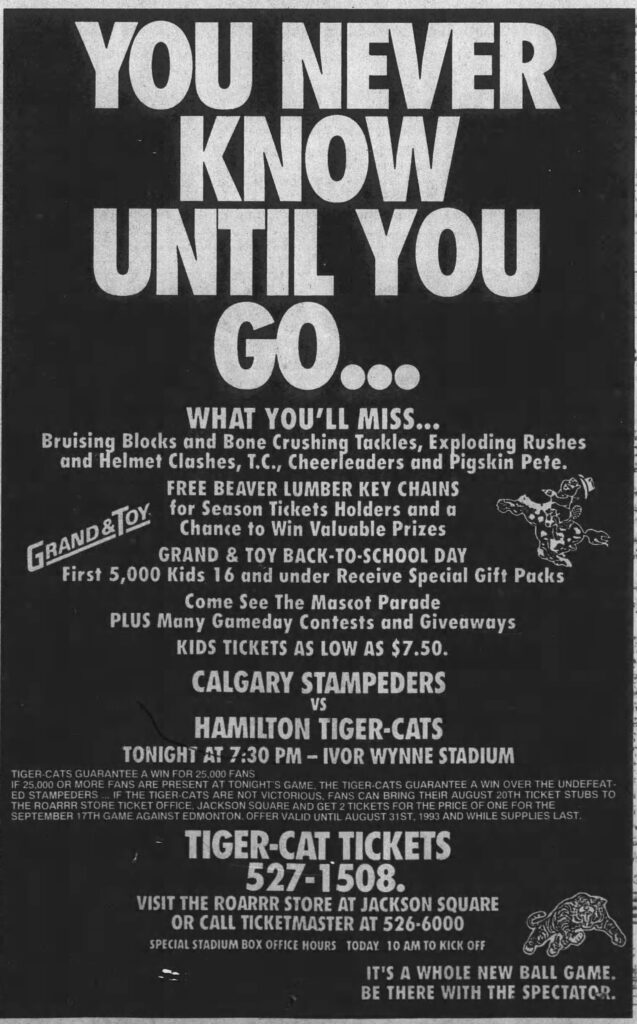
An advertisement for the Hamilton-Calgary game (Hamilton Spectator, 20 August 1993, p. 19.)
It’s August 1993. Summer holidays are winding down. The effects of recession are still wreaking havoc in Hamilton. And the Tiger-Cats are in a whole lot of trouble. Against this backdrop, I attended my very first Canadian Football League game.
However bleak the situation was heading into the game on August 20, 1993, yours truly was about to have the time of his life. My brother and I had been talking about going to a Ti-Cat game for some time, but we were both students and didn’t have much money. There was a lot of media focus on this particular game but for all the wrong reasons. Quite frankly, there was a real risk of the team going under if fans didn’t turn out in droves for the game. So, it was now or never for us. Our Nan ended up giving us money to purchase tickets. We were off to watch CFL football at old Ivor Wynne Stadium.
“You Never Know Until You Go advertisement.” Hamilton Spectator, 20 August 1993, p. 17.
Hamilton was 3-3 going into this game. Not bad and good enough for second place in a weak East Division. The opponent that night was the mighty Calgary Stampeders, the class of the CFL, led by quarterback Doug Flutie. Hamilton had their own crop of talented players, too: receiver Earl Winfield, defensive end Tim Cofield, and a rookie linebacker named Michael O’Shea to name a few.
I remember walking into Ivor Wynne Stadium and being instantly engulfed by the game day excitement. Vendors selling popcorn. Programs for sale. The smell of concession food. We bought a pop that came in a plastic souvenir cup featuring an imprinted image of Ivor Wynne Stadium and then made our way up the stairs and got into our seats (Section 7 in the north stands as I recall) to watch the players warming up. “Seats” is rather generous; they were simply benches – backless and not at all comfortable. But that was okay.15-year-old me could handle that just fine.
I was blown away by the sheer size of the field. Watching CFL football on TV really doesn’t do the field size any justice. Being able to panoramically view the whole field and stadium is still something that excites me. The starting lineups for both teams were introduced. The PA announcer was Bill Stirrup, who was one of the best. The crowd playfully jeered the visitors and applauded each Tiger-Cat when their name was announced. The national anthem was sung, the coin toss was held, and a man wearing a bowler hat named Pigskin Pete led the crowd into the famous Oskee Wee Wee cheer. It was time for kick-off.
Unfortunately for us Ti-Cat fans it didn’t start off well at all. Calgary quickly scored…twice. Within three minutes, the Stampeders had two touchdowns and were up 14-0. Calgary continued to dominate and extended their lead to 21-0 only halfway through the opening quarter. Yikes. Around this time, I remember a couple arriving late to their seats only to look at the scoreboard and shake their heads in utter disappointment.
I forget what the halftime entertainment was or if there even was any. In those days they often had contests that were kind of fun like the “ball in the booth” where a fan used a giant sling shot to try and put a ball into the CHML radio broadcast booth that sat atop the south stands.
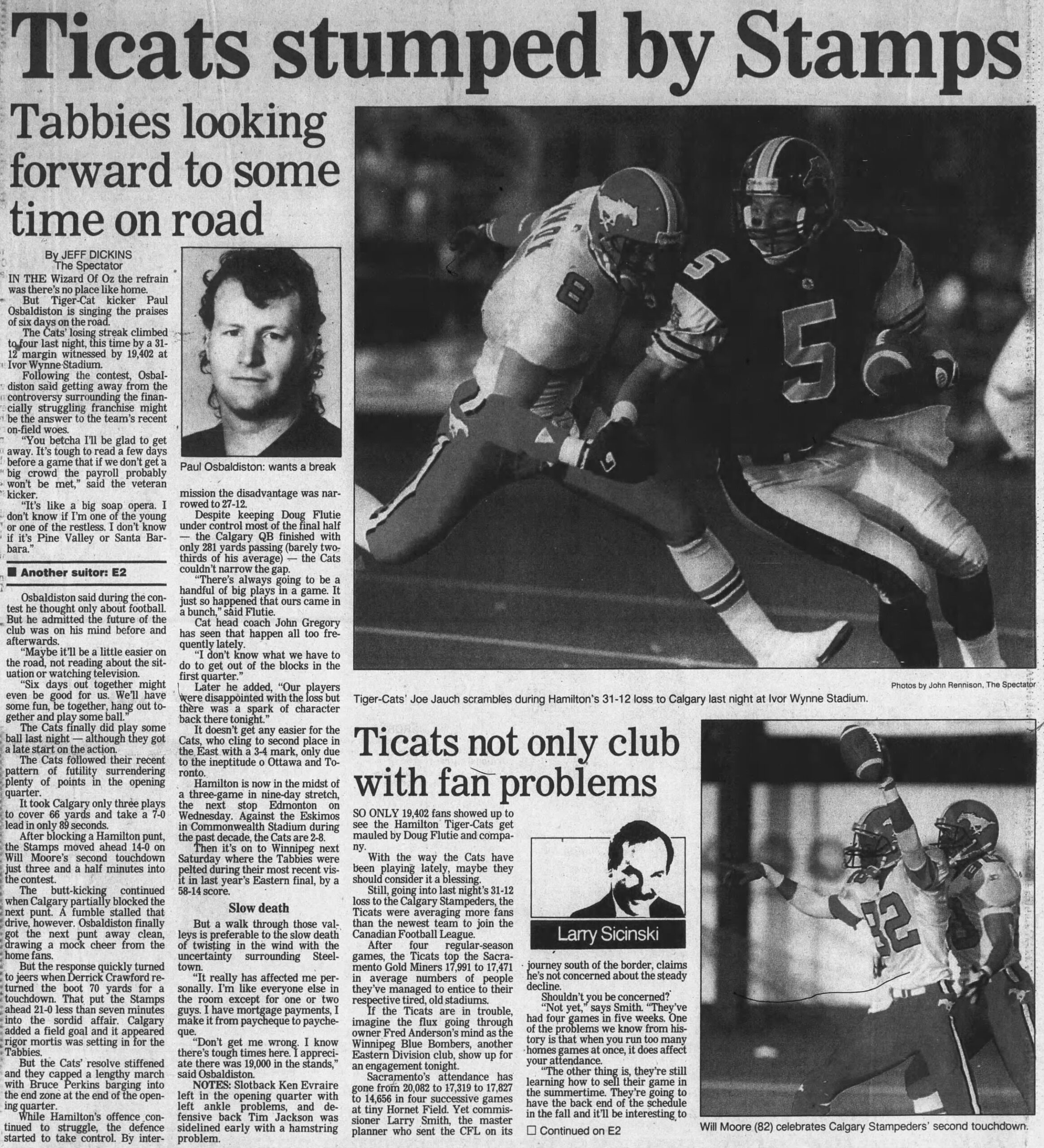
The Tiger-Cats managed to put up a measly 12 points in the first half. Defence ruled the game for both sides in the second half. Hamilton was shut out and Calgary only managed a single and a field goal. But Calgary had built up such a large early lead that it didn’t matter. Final score: Calgary 31 Hamilton 12.
The Tiger-Cats dropped to 3-4. Hamilton ultimately finished the 1993 season with a dismal 6-12 record. There were 19,402 fans in attendance at Ivor Wynne that night. A little less than the team had wanted but certainly better than the sub-16,000 crowds the previous two games produced. In other words, there was a glimmer of hope.
Dickens, Jeff. “TiCats stumped by Stamps.” Hamilton Spectator, 21 August 1993, p. 39.
Fans exited the stadium with mixed emotions. Many were fuming over the home team’s poor play. Others mused aloud whether they had just seen the last of the Tiger-Cats. Dejection. Anger. Sadness.
For me though it was different, and I kind of felt a bit guilty. Sure, the Ti-Cats just got clobbered. But I had finally got to see my first CFL game in person. I was still excited. I was also hooked. And I wanted more. As luck would have it the next home game was going to be against the archrival Toronto Argonauts in the so-called Labour Day Classic. My brother and I certainly didn’t want to miss that. We would have to use our charm on our Nan again and score tickets.
32 years later I look back at some of the great football games I’ve had the good fortune of attending. I’ve seen some memorable classics and have witnessed some truly iconic moments in Canadian football. The game on August 20, 1993, was definitely not one of those. For all intents and purposes, it was a dud. A stinker. But for me it represented something big and something special. It was a first for me. My first football game. And that was the day I became firmly entrenched as a life-long fan of the Hamilton Tiger-Cats and the CFL.
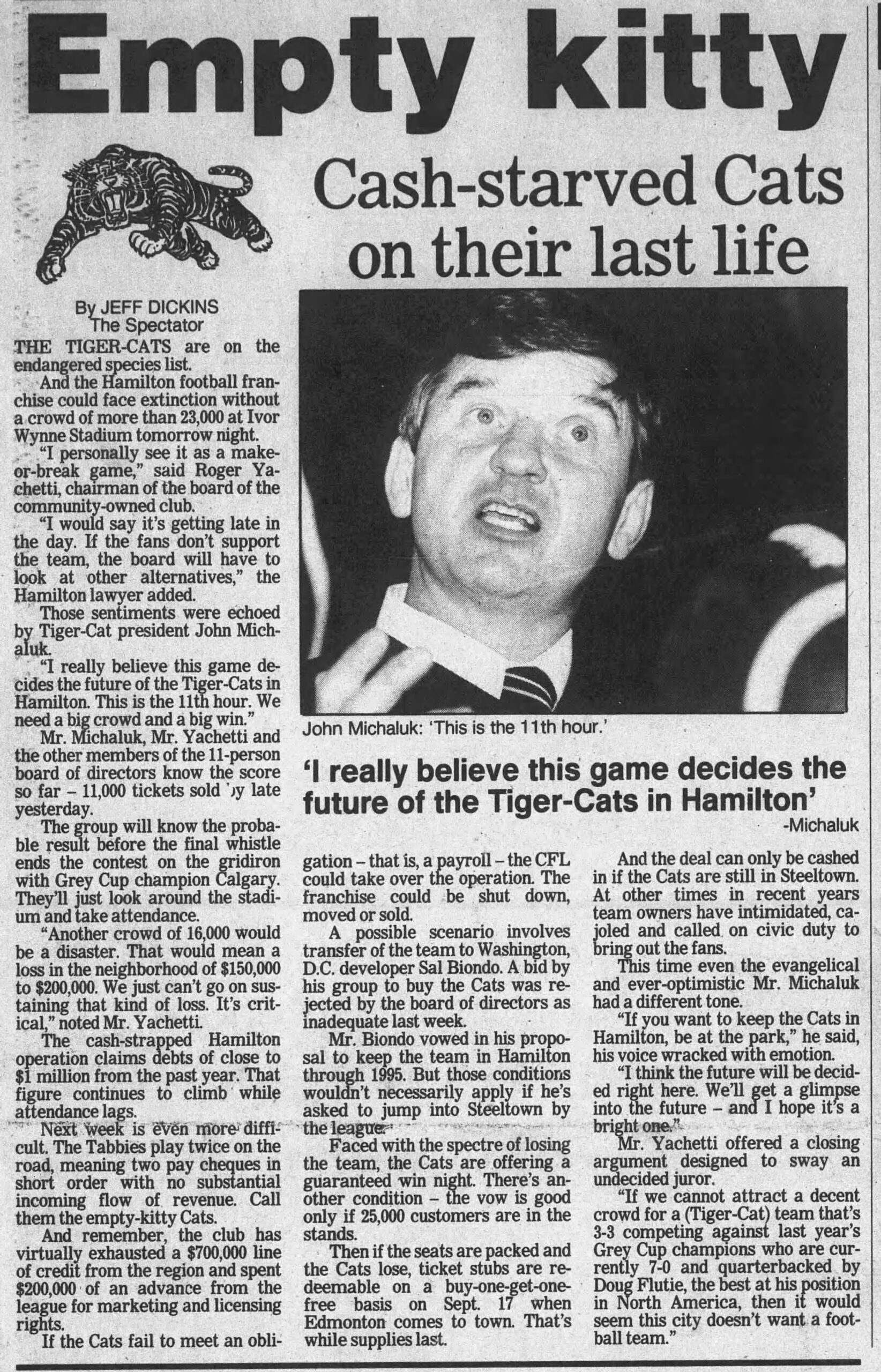
This is the article in the Spectator that really prompted my brother and me to attend our first Tiger-Cat game in 1993. We would become season ticket holders in 1995.
Dickens, Jeff. “Empty Kitty.” Hamilton Spectator, 189 August 1993, p. 1.