In the 1950s, the Shriners organization sponsored an East-West all-star game featuring the best players of Canadian football. The game was played the week after the Grey Cup between all-stars from the Interprovincial Rugby Football Union (IRFU) and the Western Interprovincial Football Union (WIFU). The first such game was played on December 3, 1955, at Varsity Stadium in Toronto.
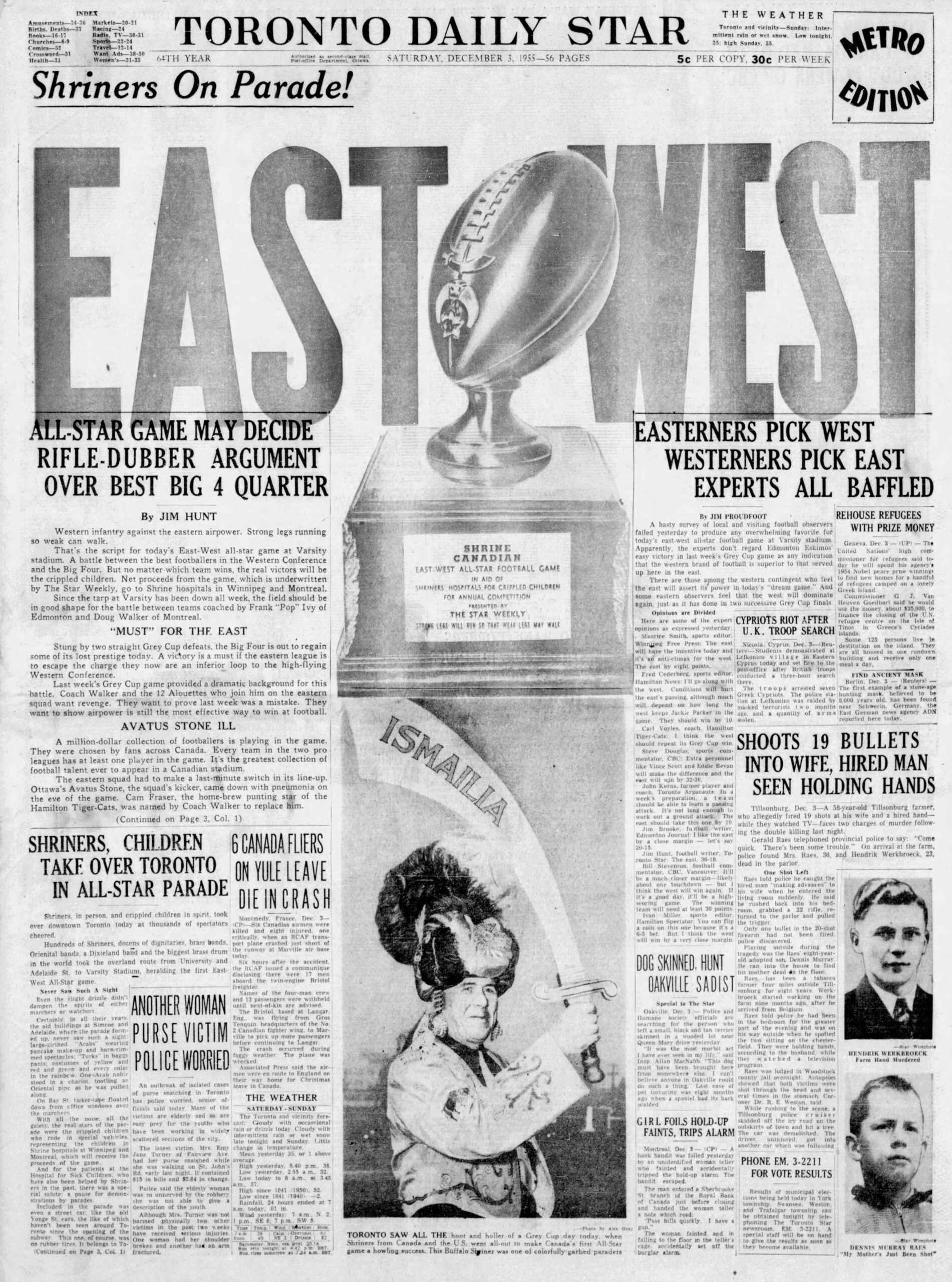
Front page of the Toronto Star on December 3, 1955 previewing the first-ever East-West game.
There was much anticipation in the lead up to the game. Edmonton had just beaten Montreal handily in the Grey Cup the previous week. It was the second year in a row that the west had prevailed in the national championship. So, bragging rights were up for grabs between the IRFU (aka the Big Four) and WIFU when it came which union was the superior football league in Canada.
A crowd of over 15,000 braved the rain to watch the top names in Canadian football – chosen by the fans – compete in a defensive battle. Playing in muddy conditions at Varsity, the players put on an exciting performance despite the game ending in a 6-6 tie.
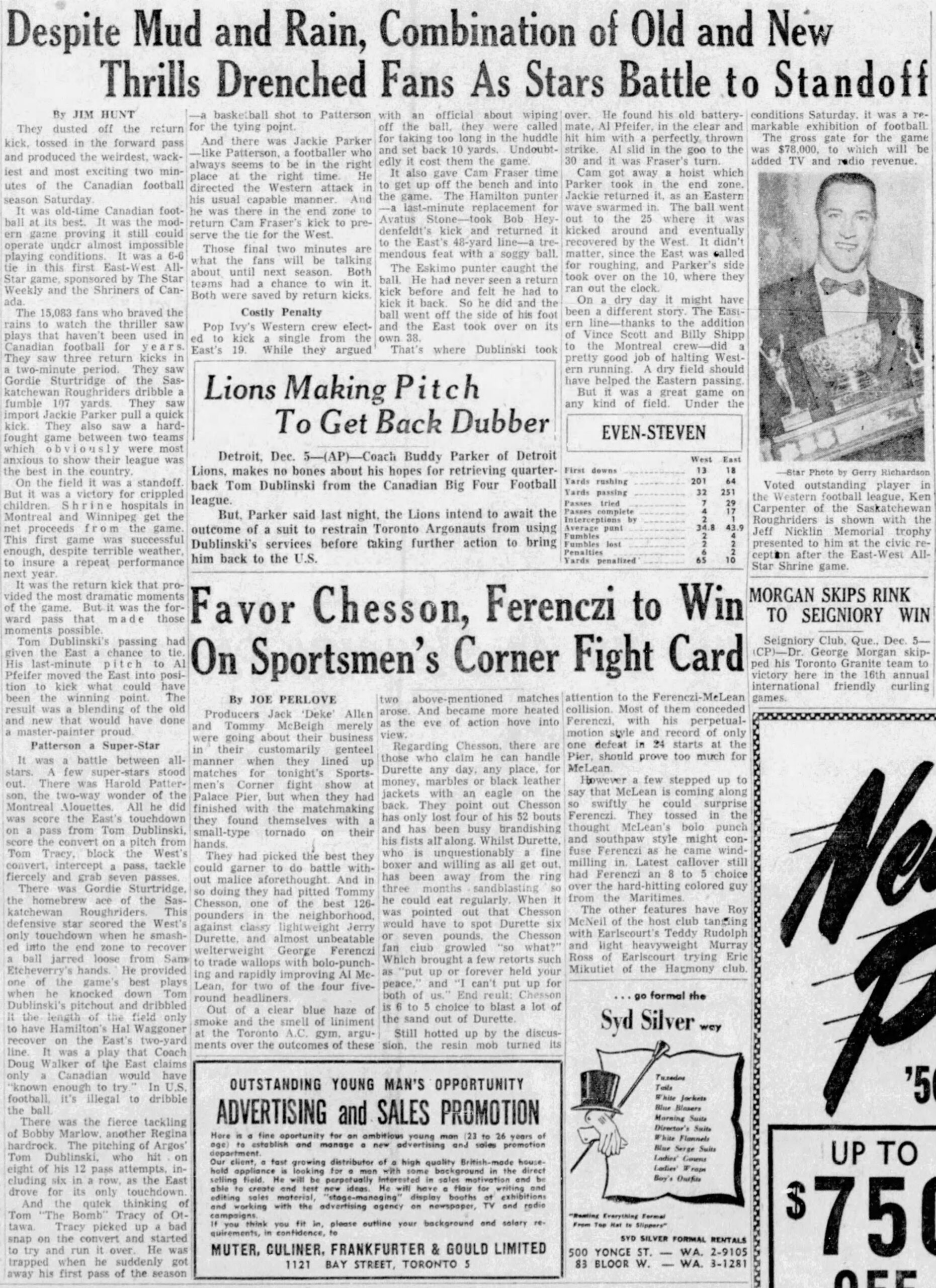
Jim Hunt’s account of the 1955 East-West game in the Toronto Star (December 5, 1955).
An account of the game by legendary reporter Jim Hunt in the Toronto Star summed it up perfectly:
They dusted off the return kick, tossed in the forward pass and produced the weirdest, wackiest and most exciting two minutes of the Canadian football season Saturday.
It was old-time Canadian football at its best. It was the comeback game proving it still could operate under almost impossible playing conditions. It was a 6-6 tie in this first East-West All-Star game, sponsored by The Star Weekly and the Shriners of Canada.
The 15,083 fans who braved the rains to watch the thriller saw plays that haven’t been used in Canadian football for years. They saw three return kicks in a two-minute period. They saw Gordie Sturtridge of the Saskatchewan Roughriders dribble a fumble 107 yards. They saw import Jackie Parker play a quick kick.
They also saw a hard-fought game between two teams which obviously were more anxious to show their league was the best in the country.
I’m reminded by the commentary for this game that despite horrible weather, awful field conditions, and a seemingly ho-hum 6-6 score, football can still be very exciting during defensive stalemates when there’s a meaningful game to play. You don’t always have to light up the scoreboard to provide entertaining football. By the way, how neat is it read Jim Hunt’s work from early in his lengthy career?
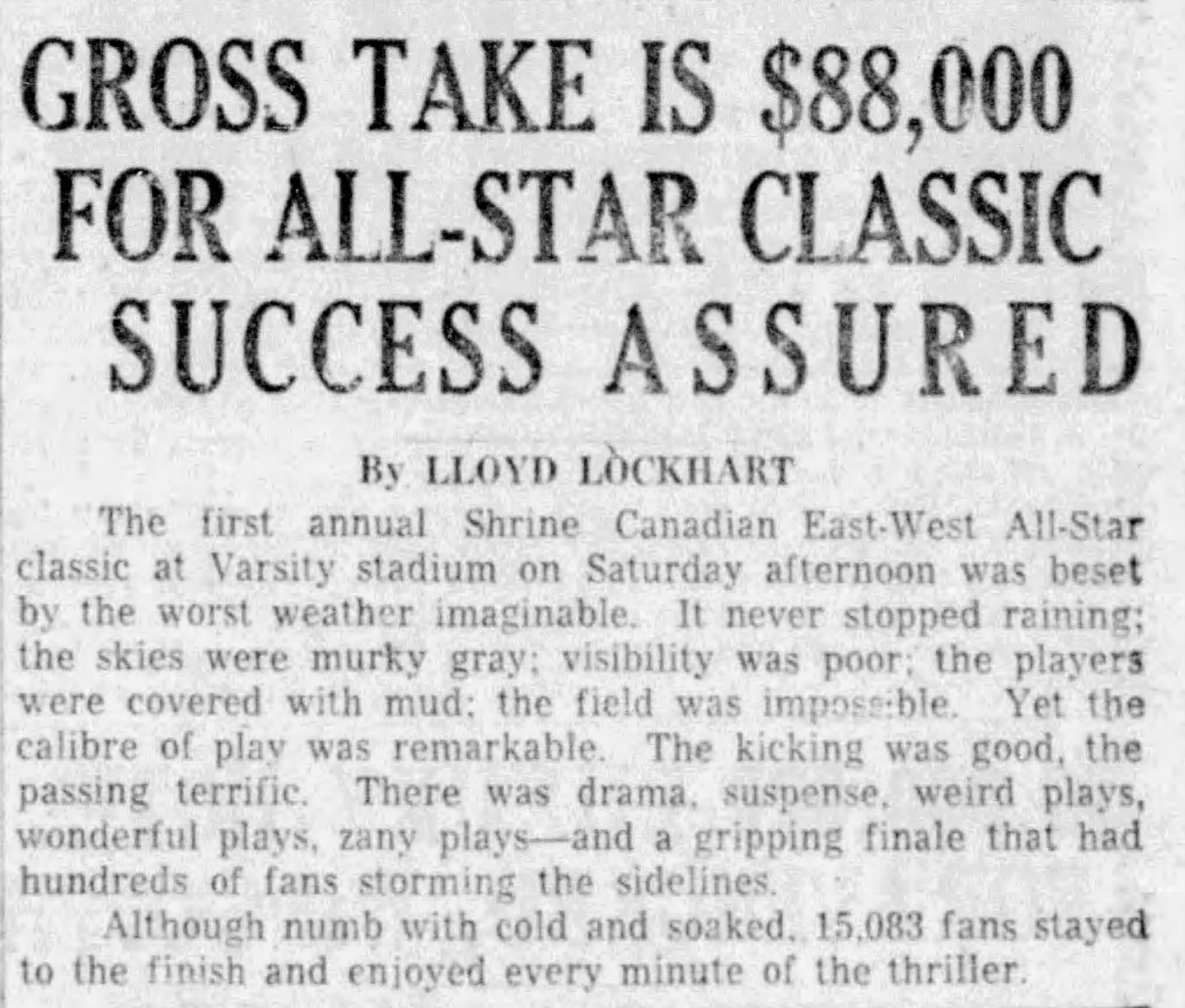
The inaugural East-West game grossed $88,000. Net proceeds from the game were given to the Shriners’ children’s hospitals in Montreal and Winnipeg. The event was deemed a smashing success and would return the following year.
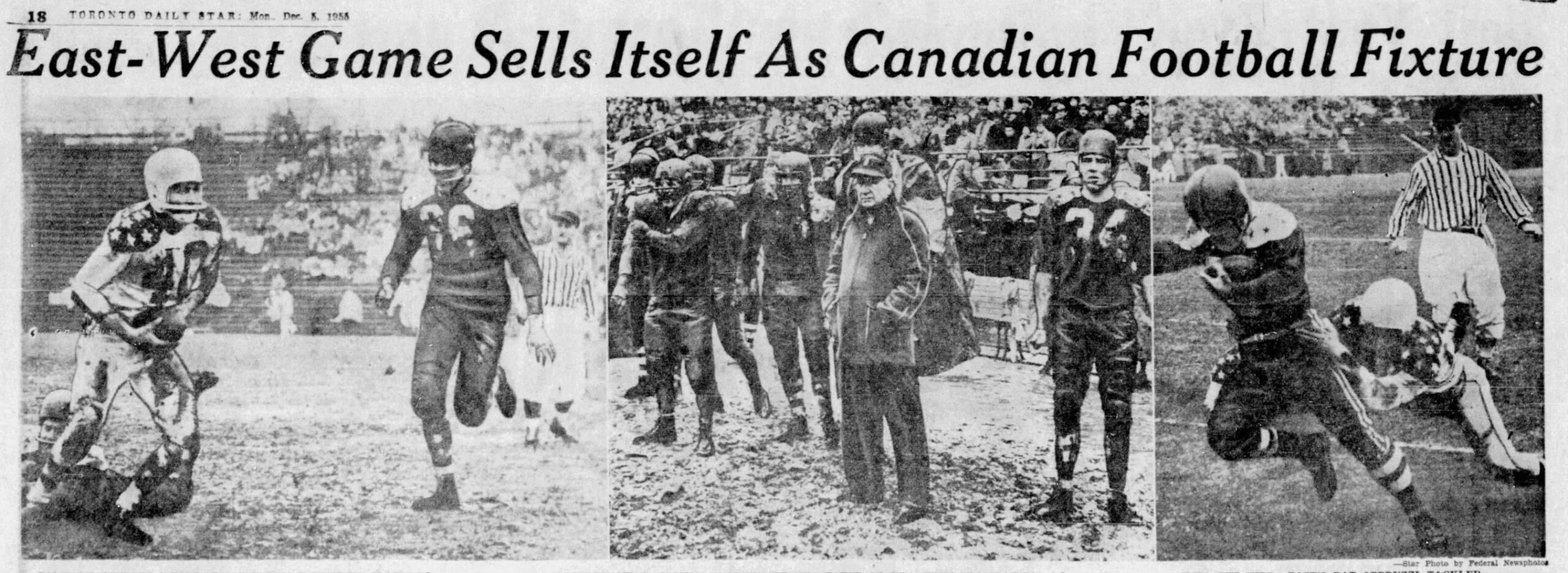
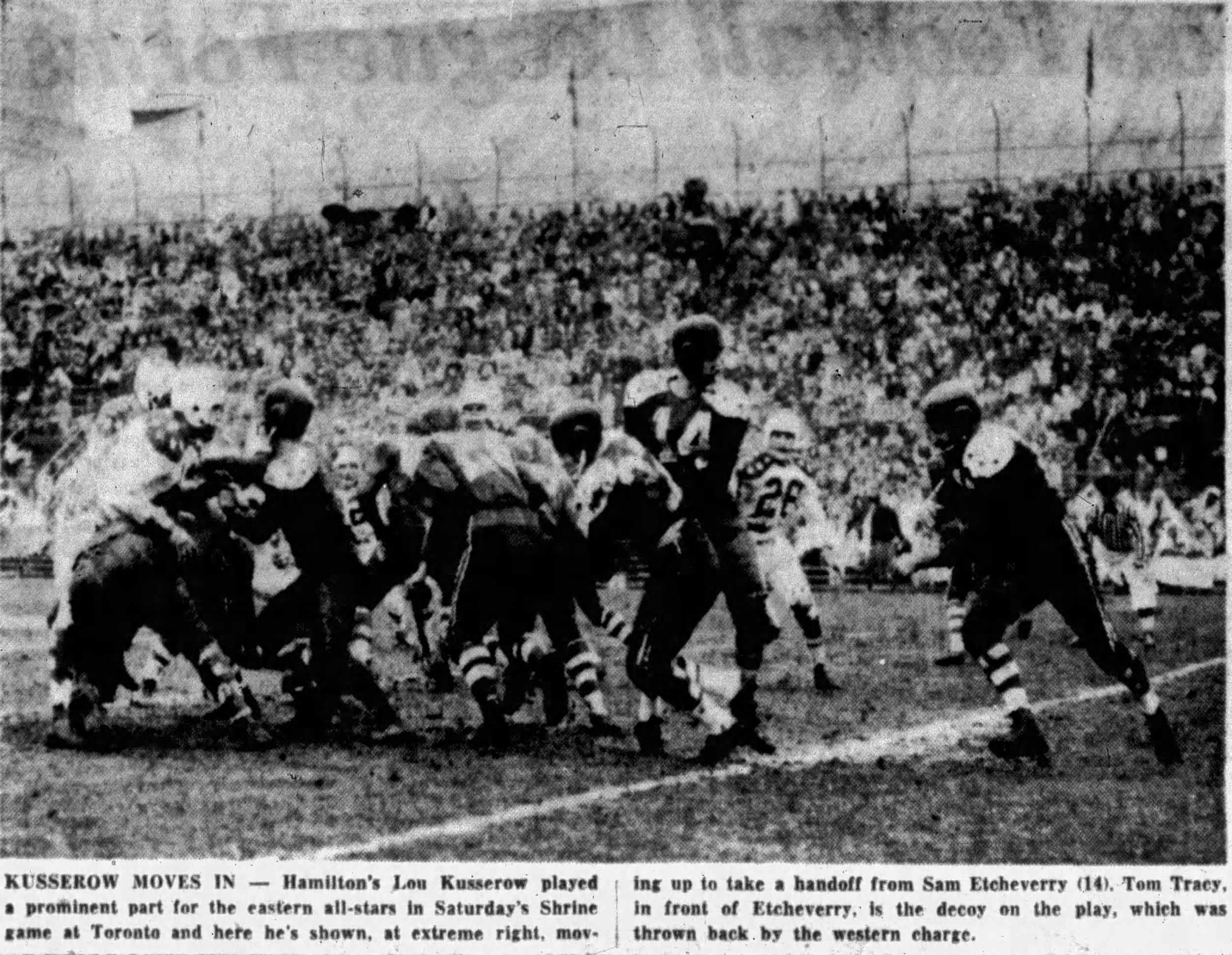
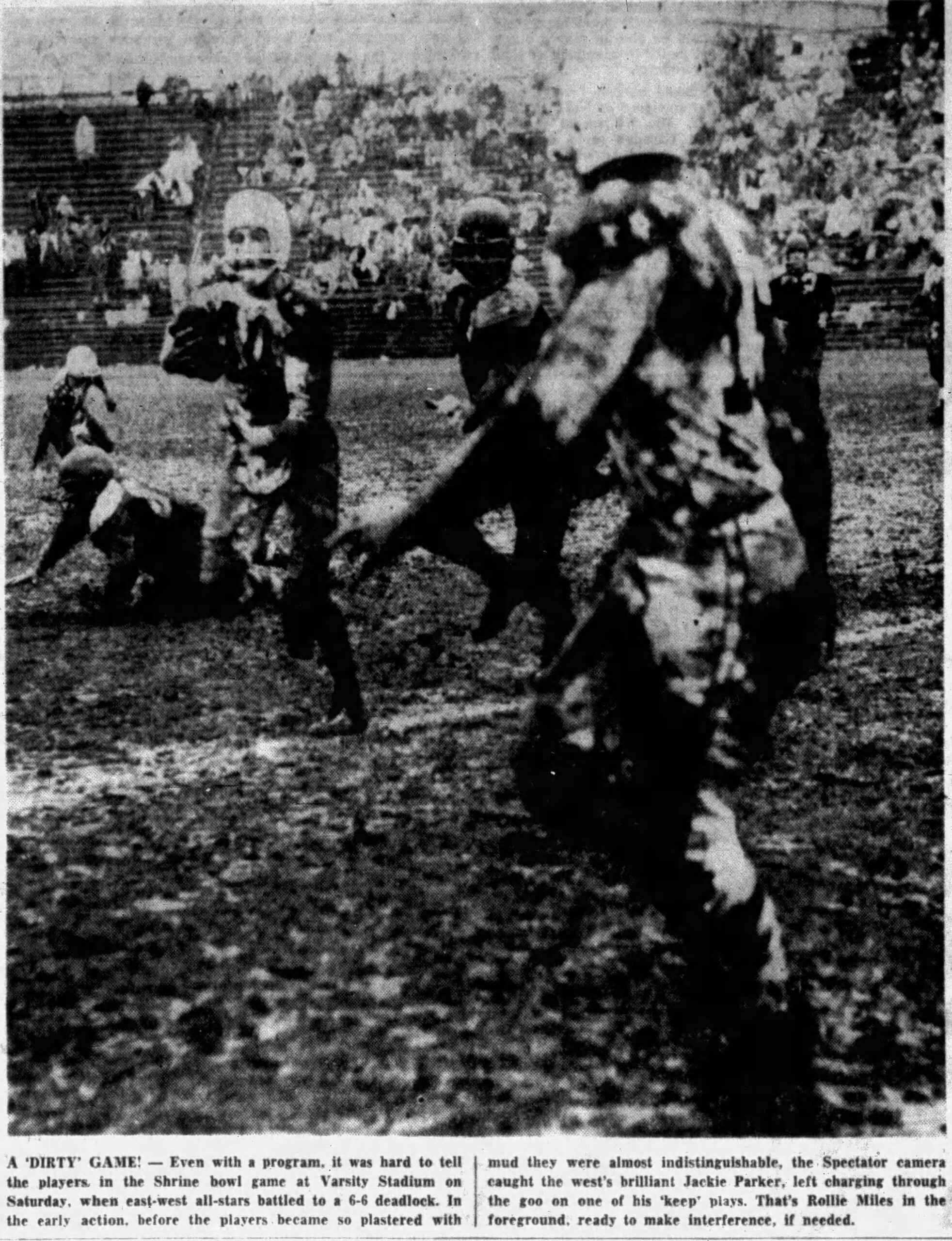
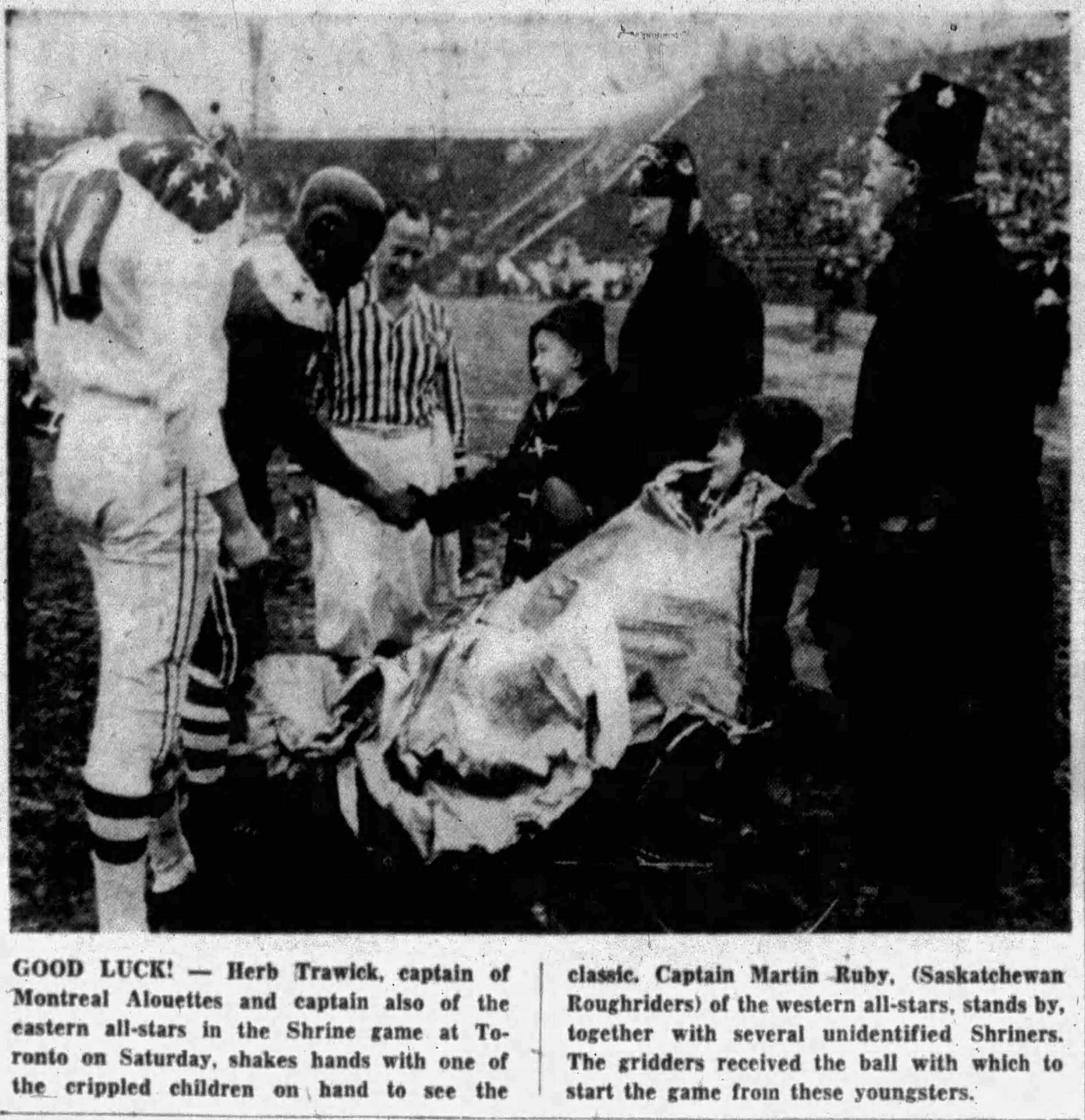
Some photos of the action, as published in the Toronto Star and Hamilton Spectator:
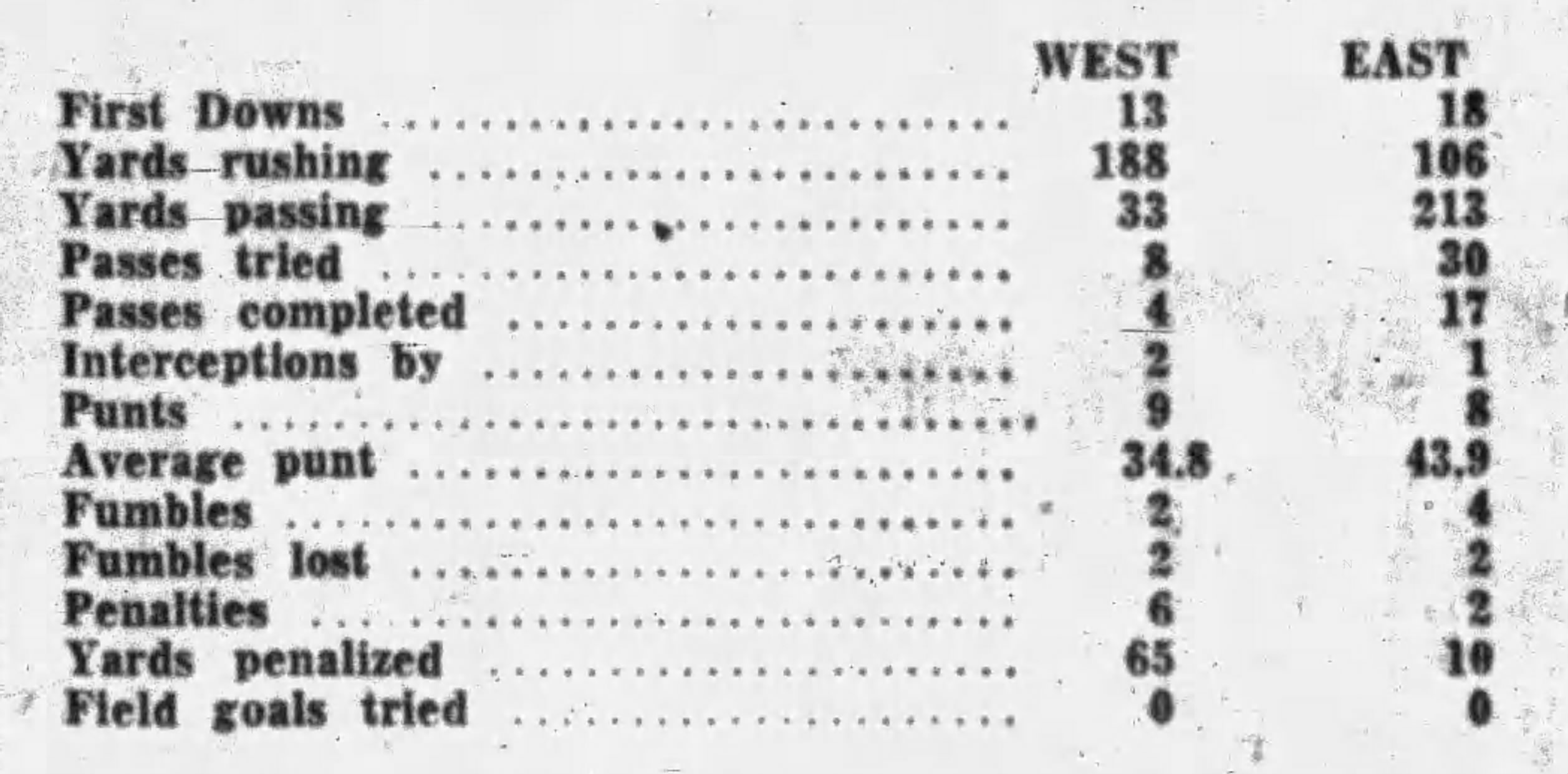
Final stats:
Sources:
Hamilton Spectator, 5 December 1955 Toronto Star, 3 December 1955 Toronto Star, 5 December 1955
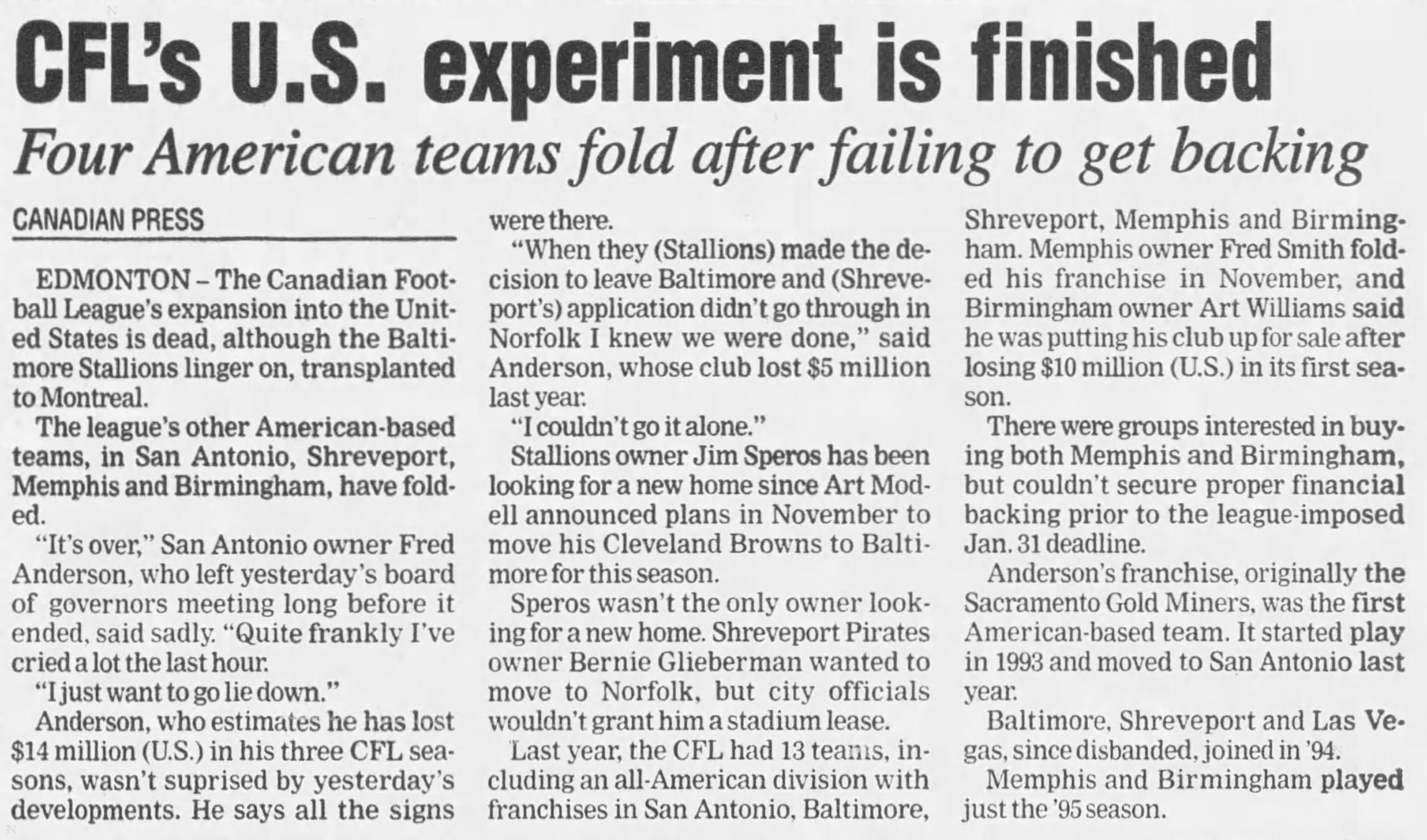
On Friday February 2, 1996, the Canadian Football League officially ended its American expansion efforts. During the CFL’s annual winter meetings, the league announced that the Birmingham Barracudas, Memphis Mad Dogs, San Antonio Texans, and Shreveport Pirates were ceasing operations. And the Baltimore Stallions, having just won the Grey Cup a few months earlier, were relocating to Montreal.
Canadian Press article on the end of CFL U.S. expansion.
It was game over for the CFL’s grand vision of becoming a North American-wide professional sports league. The promised windfall of expansion fees and the hope of a multimillion-dollar U.S. television deal (all in American dollars to boot) never materialized. I suppose the only silver lining was that U.S. expansion had thrown the CFL a lifeline. For a few years, there was some new blood and some new interest generated. Personally, I enjoyed watching the American teams come to Ivor Wynne Stadium to play the Tiger-Cats. It was sure better than watching the Ti-Cats play the Rough Riders and Argos four times. It added variety and a bit of intrigue.
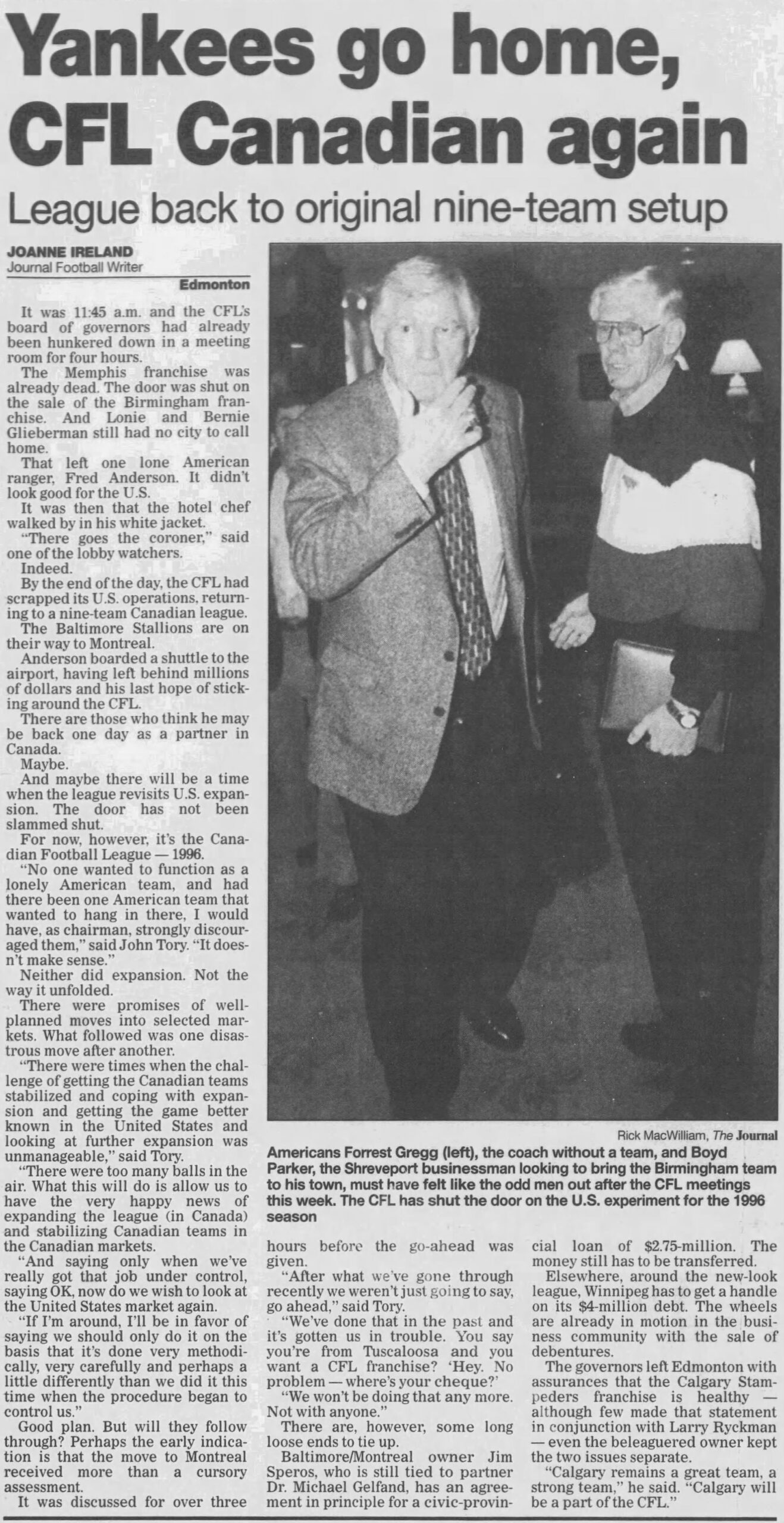
The take in the Edmonton Journal (3 February 1996).
The writing was on the wall for the CFL’s demise in America once the National Football League announced it was returning to Baltimore. That move ultimately spelt the end for the Stallions in Baltimore. The other chips began to fall.
The Pirates attempted to relocate to Virginia but were unable to secure a stadium lease. A new group tried to purchase the Barracudas and move them to Shreveport, where the CFL enjoyed at least modest support, but were rejected by the CFL. Memphis, despite having one of the wealthiest owners in Fred Smith of FedEx fame, was dead in the water. The Stallions, having run out of options in Maryland, considered a move to Houston, Texas. When they decided to move to Montreal instead, that left the San Antonio Texans as the lone U.S.-based team remaining. “It’s over!” admitted a dejected Fred Anderson, the Texans’ owner. With no other team south of the border, he wasn’t going to go it alone whether he wanted to or not. The CFL was done with its American clubs.
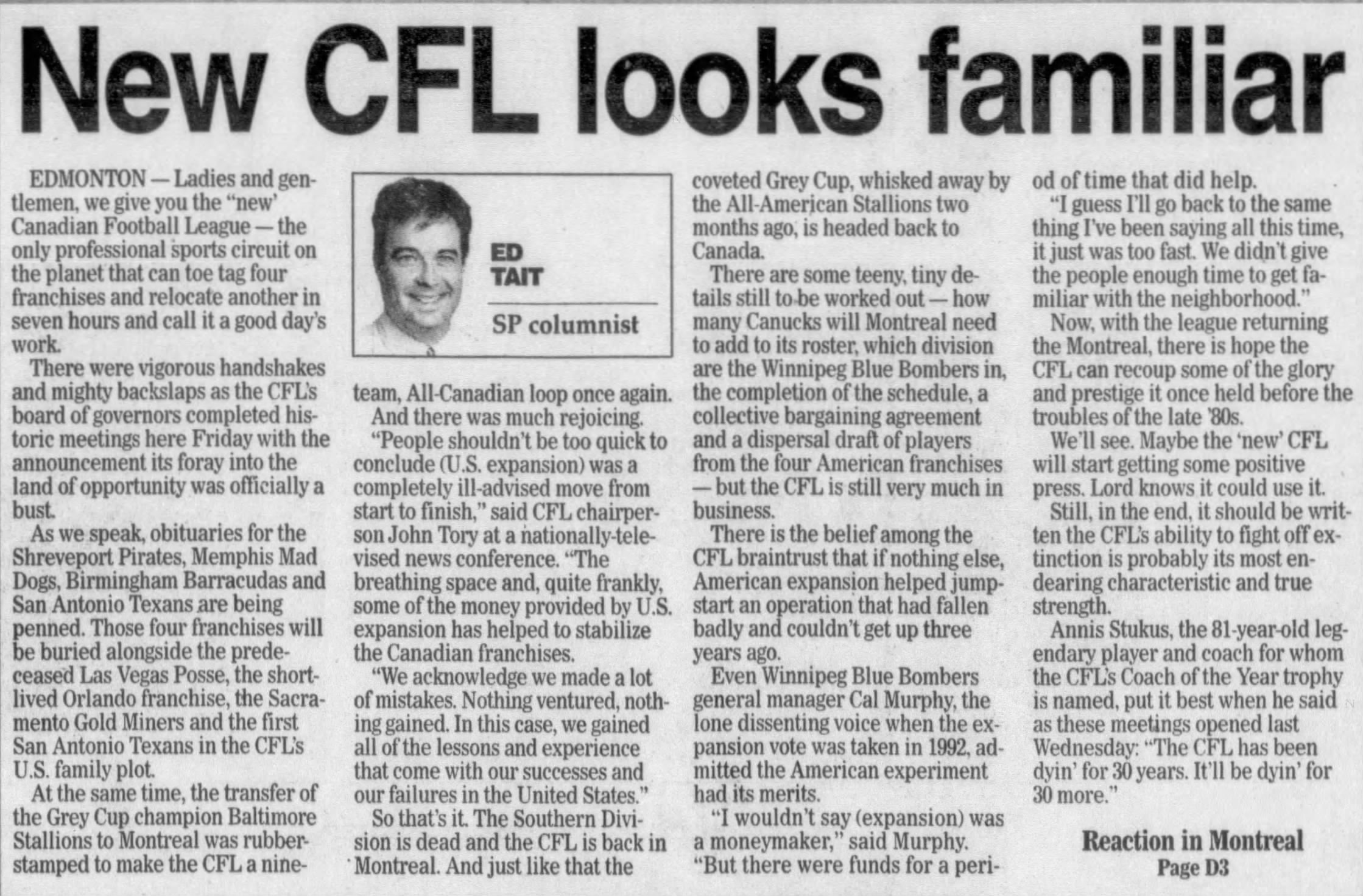
Ed Tait’s column about the new, old CFL (Saskatoon Star Phoenix, 3 February 1996).
The CFL didn’t close the door permanently on future U.S. expansion and hinted that American teams could possibly return to the league in 1997. But most agreed that was unlikely and that the CFL was going to stick with its new, old all-Canadian lineup.
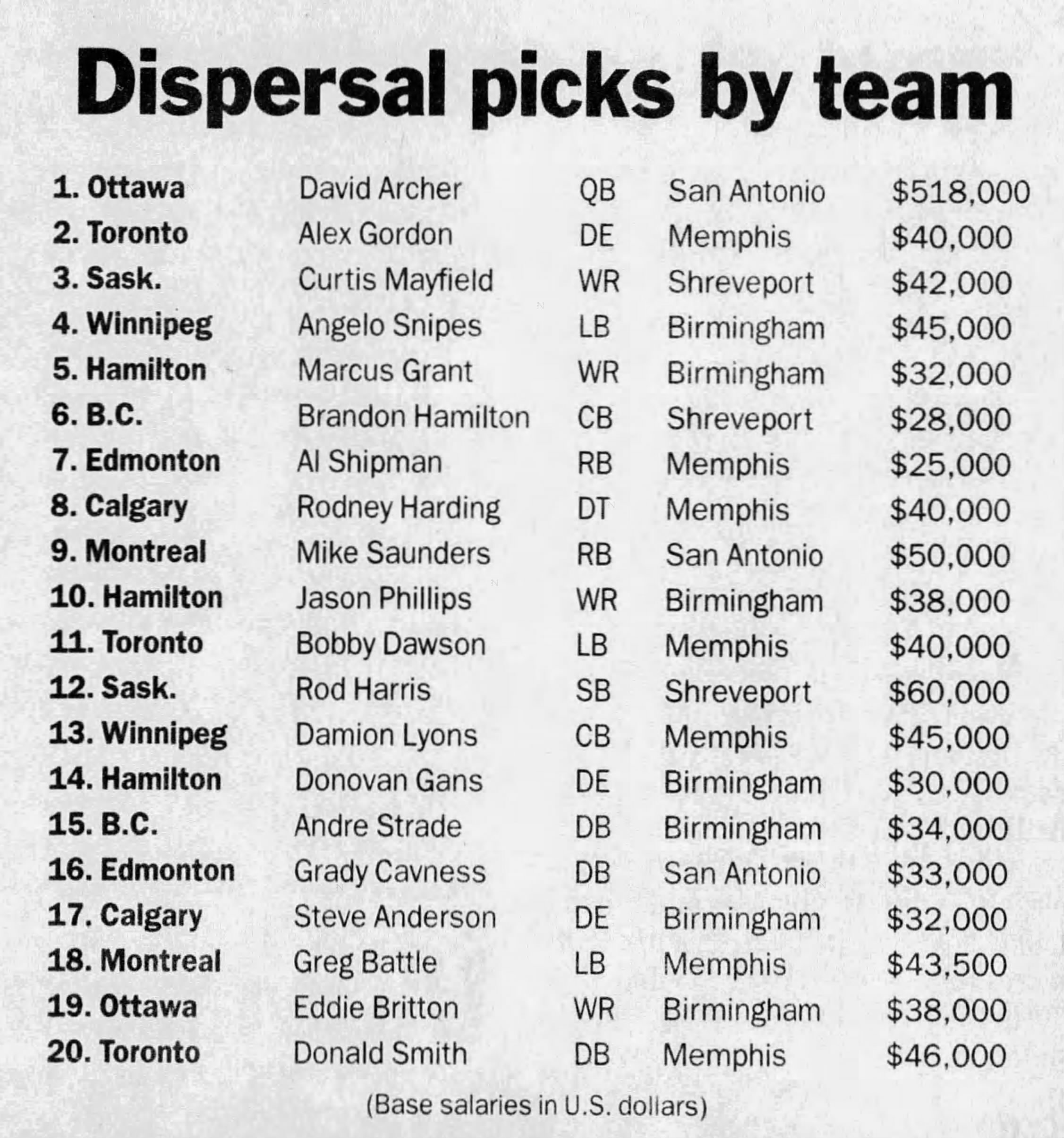
The players signed to the now folded American teams were put into a dispersal draft and divvied up amongst the nine Canadian teams. San Antonio’s quarterback David Archer was chosen first overall by Ottawa. A special expansion draft was held as well to help stock the reincarnated Montreal Alouettes with Canadian players.
Top 20 players chosen in the dispersal draft held (Ottawa Citizen, 8 March 1996)
The 1996 CFL season kicked off on June 23 in Regina. Four days later, the first CFL game played in Montreal in almost a decade saw the Toronto Argonauts defeat the Alouettes 27-24.
With the CFL’s exit from the U.S., the league launched a bold new marketing campaign highlighting its Canadian roots and unique brand of football. The American dream was no more. The CFL entered its Radically Canadian era.
Sources:
Edmonton Journal, 3 February 1996 Montreal Gazette, 3 February 1996 Ottawa Citizen, 8 March 1996 Saskatoon Star Phoenix, 3 February 1996
Of all the U.S. cities that the CFL awarded teams to as part of its American expansion in the 1990s, Shreveport had to be the most obscure choice. Whereas the other cities had teams in the defunct World League of American Football (e.g., Sacramento, San Antonio, and Birmingham) or were brought onboard after failed NFL expansion efforts (e.g., Baltimore and Memphis), Shreveport seems so random when you think about it.
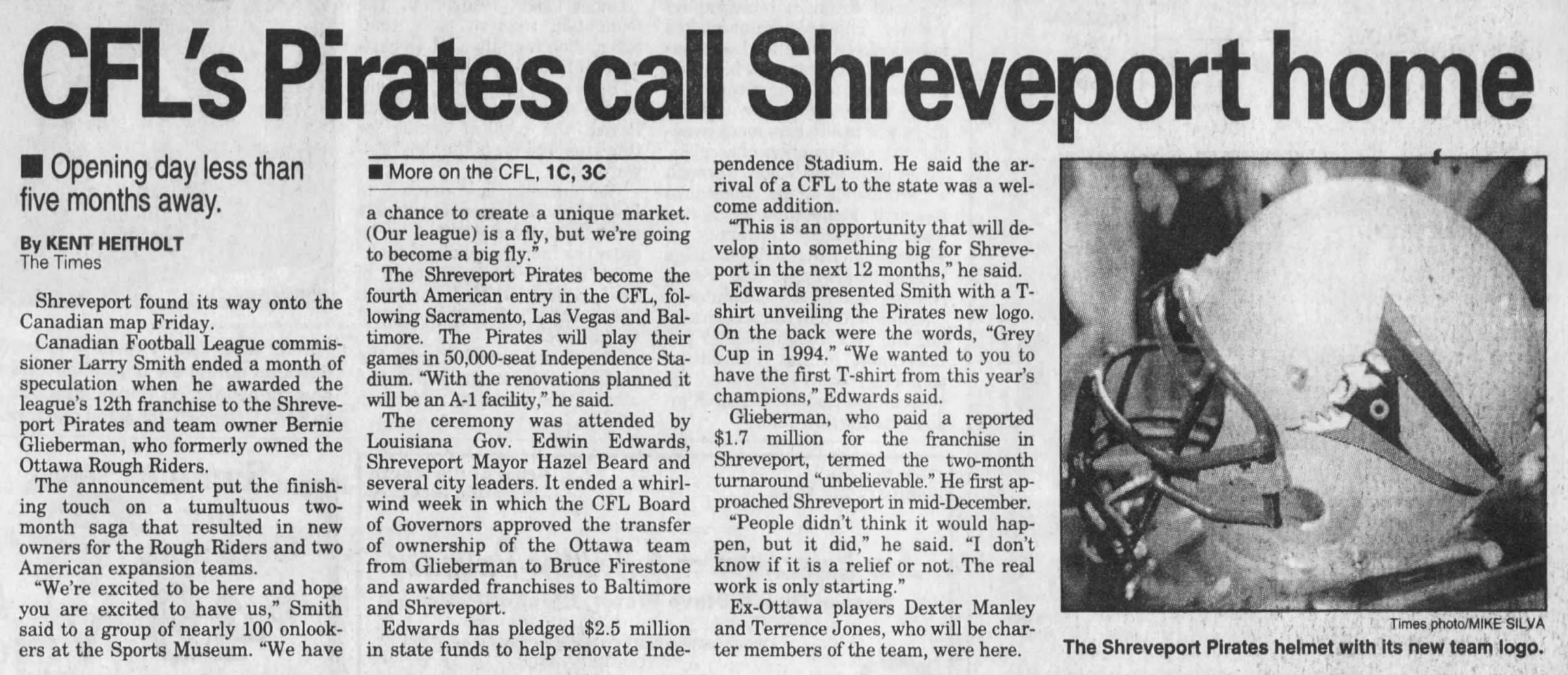
Articles by Shreveport Times sports writer Kent Heitholt about the CFL coming to Shreveport.
I suspect most Canadians had never heard of Shreveport, Louisiana until the CFL set up shop down there. But for two years the CFL put Shreveport on the map – at least for us Canadians. And you know what? The city seemed to really embrace the Canadian brand of football. In fact, I would argue that Shreveport was the most successful U.S.-based CFL team outside of Baltimore. At least from a business perspective.
So, how the heck did Shreveport land a CFL team in the first place? Well, the Shreveport story actually starts in Ottawa. In 1991, Bernie Glieberman, a Detroit-based real estate developer, purchased the struggling Ottawa Rough Riders. His son Lonie oversaw the day-to-day operations as team president. It seemed like an uphill battle, though, and the Gliebermans found themselves at odds with Ottawa’s city council, an impatient fanbase, and a sceptical local media. They threatened to move the team. But rather than relocating the Rough Riders, the CFL arranged for them to be sold to local interests while granting the Gliebermans an expansion franchise in the United States.
CFL makes it official with the Shreveport Pirates (front page of Shreveport Times, 19 February 1994).
Why Shreveport? I asked that question directly to Lonie Glieberman. Hearing his rationale for the Shreveport market almost makes me think the CFL should go back there. OK. Maybe that’s a bit of a stretch. But Lonie speaks highly of Shreveport. “Shreveport was a football town. We had hardcore fans. We were important. The Mayor and city council supported us,” Lonie says. The fans supported the CFL, too. They had over 12,000 season ticket holders and averaged about 17,000 fans per game, which is not bad considering the team’s poor on-field performance. “It was more than some of the teams in Canada,” Lonie points out. One of the main reasons Shreveport was chosen was the favourable rent agreement for Independence Stadium. The city charged Glieberman only $2500 per game to play at the 40,000-seat stadium.
Steve Effler worked in corporate sales and stadium operations for the Pirates. He, too, couldn’t say enough good things about the Shreveport market when I spoke to him. “We were the big fish in a small pond. People supported us and we were everywhere in the media,” he said. I can attest to that. A quick browse through the local Shreveport newspapers paints a picture of solid media penetration for the Pirates.
I was a bit surprised that Steve still follows the CFL. It turns out he was actually a CFL fan long before expansion and considers the job he had in Shreveport a dream come true. You can definitely tell he likes the CFL, and he possesses volumes of Pirates-related content. His YouTube channel has game day coverage and includes a must-see music video called “Pirate Ball.”
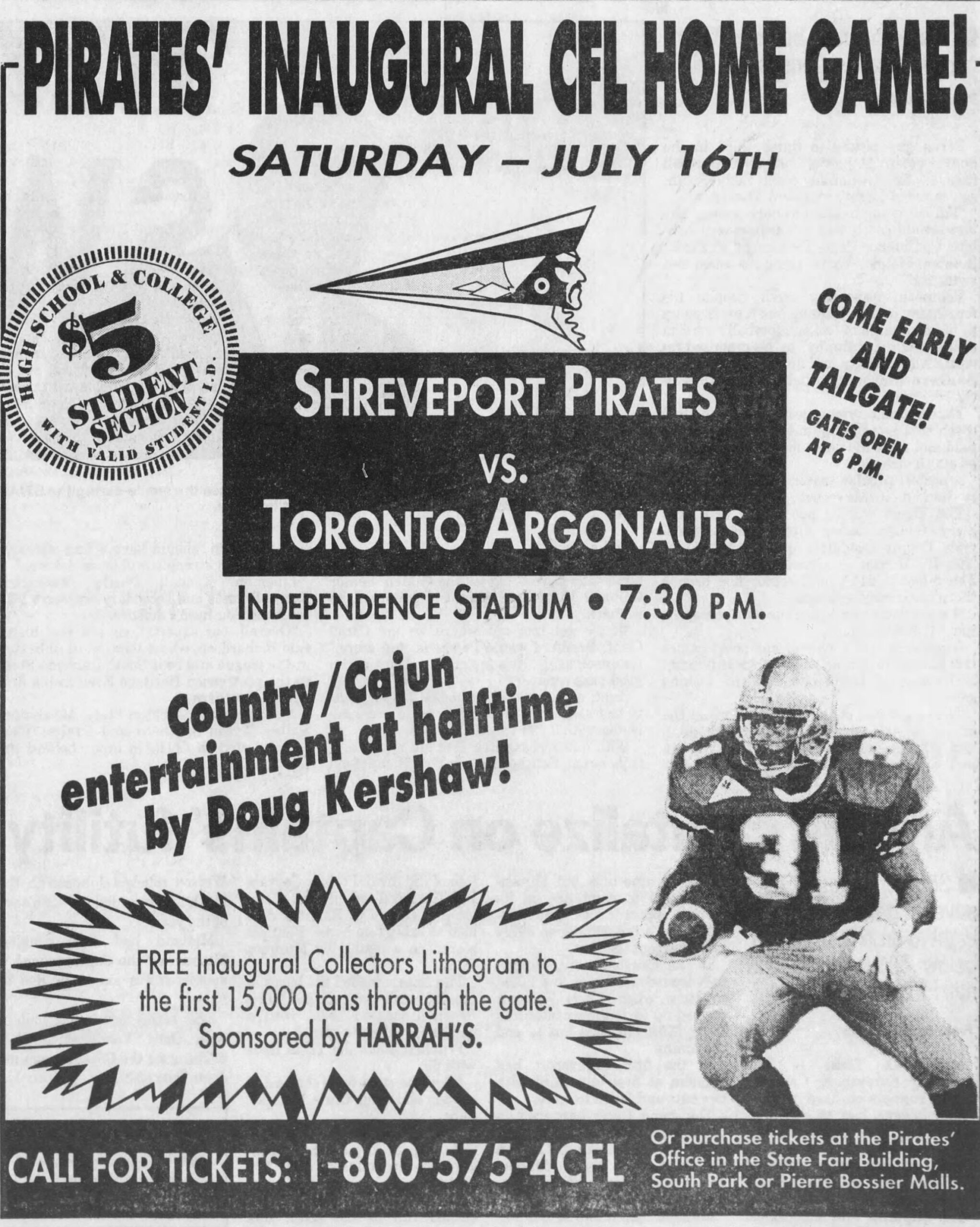
Shreveport Pirates advertisement for home opener vs. Toronto.
Shreveport’s soon-to-be CFL team was officially branded as the Pirates on January 21, 1994. Lonie says he and his high school friend decided on the name. The runner up nickname was the Jackrabbits. “We were kind of limited by what we could do with Jackrabbits but you can do a lot with Pirates,” he said. The team logo was unveiled about four weeks later when CFL Commissioner Larry Smith formally welcomed Shreveport into the fold. And while Lonie wasn’t entirely sold on the Pirates logo, he was a huge fan of the team uniforms. “We had the best the uniform in the CFL, the best uniform in all of football besides maybe the Raiders,” he boasted. Pirate Ball was now a thing.
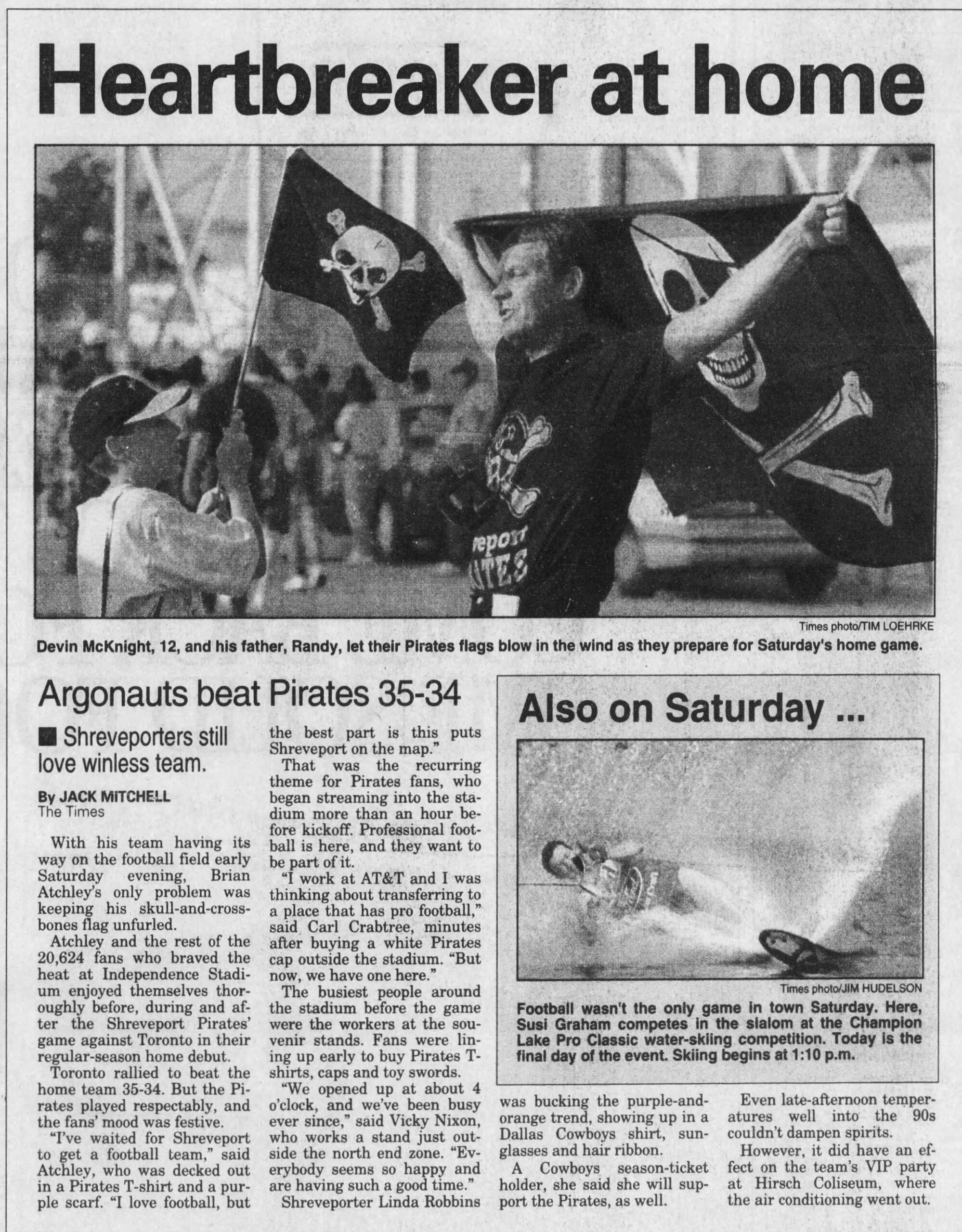
Shreveport Times article about the Shreveport Pirates’ home opener loss to the Toronto Argonauts (17 July 1994).
The Pirates got off to a rather rocky start in training camp. Head coach John Huard was abruptly fired and was replaced by Forrest Gregg. The home opener at Independence Stadium saw the Pirates lose to the Toronto Argonauts by a score of 35-34. A respectable crowd of 20,624 attended the game.
Shreveport Times photo of Forrest Greg and Uzo Oke celebrating the Shreveport Pirates’ first win (17 October 1994).
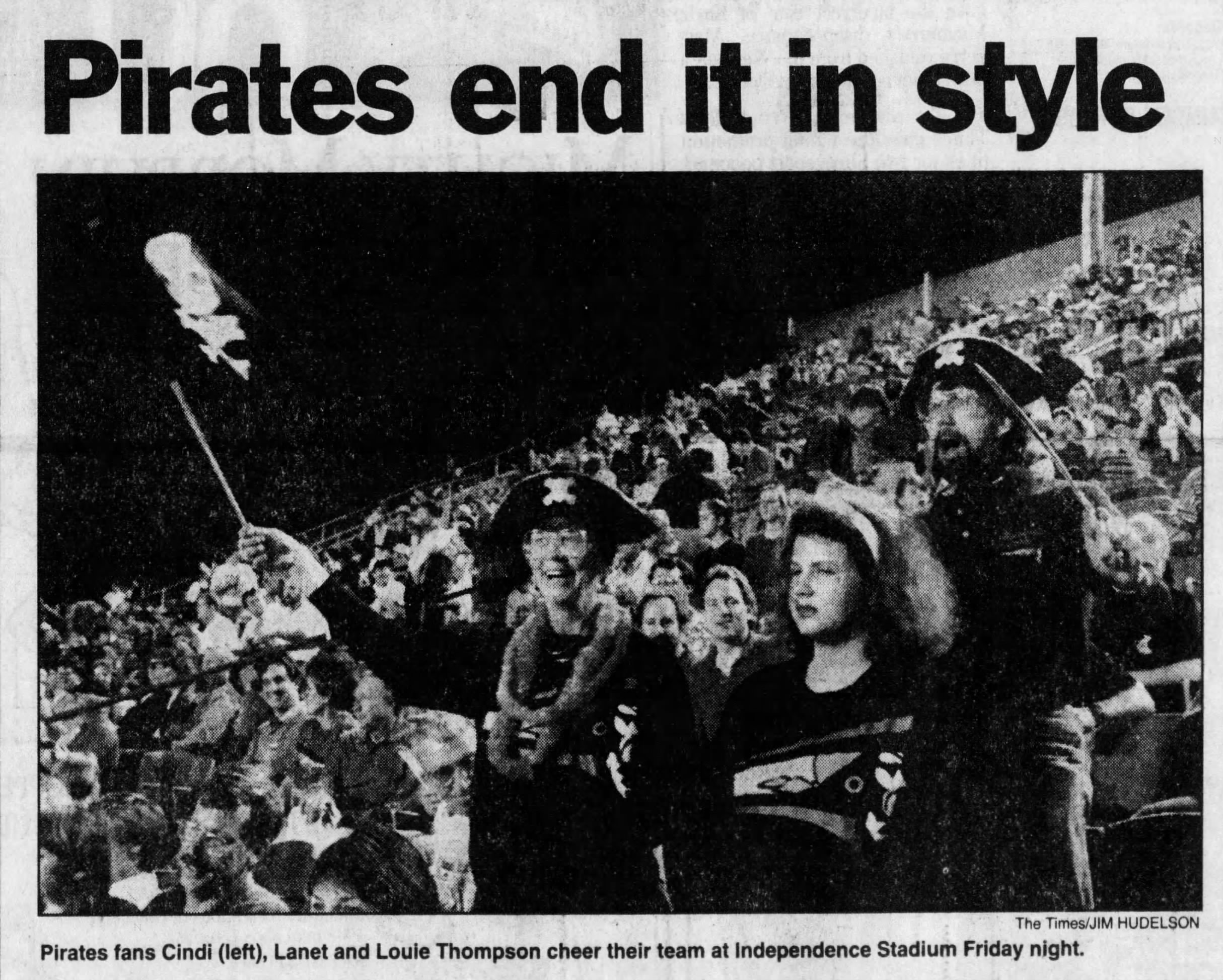
The Pirates sat in last place in the East Division throughout their inaugural season. They had a dismal 0-14 record before finally picking up their first win during a torrential rainstorm over Sacramento. They managed to pick up two more victories to end the season with a 3-15 record. Their final game of the season resulted in a 28-24 win over the Ottawa Rough Riders before a huge crowd of 32,011 at Independence Stadium. Lonie relished that one, no doubt.
Articles in the Shreveport Times about the Pirates’ season finale win over Ottawa.
The Pirates were back for their second season in 1995. They still struggled on the field, finishing in last place in the South Division (a five-team division comprising the CFL’s American clubs) with a 5-13 record.
And then, it was over. In February 1996, the CFL ended its American expansion. The Shreveport Pirates, along with the other U.S.-based teams, ceased operations.
A lot can be said about CFL expansion to the U.S. Some thirty years later the subject can still stir emotions and generate a good debate. I’ll tell you this, though. I don’t believe you will find a bigger booster for the CFL in the U.S. than Lonie Glieberman. In contrast with some of the other American owners, he had no interest in changing the name of the league or the rules.
“No one in Shreveport complained about the rules,” he said. “The Canadian rules were not a problem. In Shreveport, the heat was a problem…not the rules.” He adds that CFL brand was respected, had legitimacy and credibility. “I told Larry Smith that changing the name or the rules was the stupidest thing I ever heard of.” You can’t get any more pro-CFL than that.
I have no doubts that the Gliebermans truly had a passion for the Canadian Football League and wanted nothing more for expansion to work. Unfortunately, it didn’t. But Lonie is adamant that the CFL’s expansion into the U.S. could have ultimately panned out had time been on their side.
“In the end expansion didn’t fail. We just never gave it enough time,” he concluded.
Sources: Shreveport Times, 22 January 1994 Shreveport Times, 19 February 1994 Shreveport Pirates, 15 July 1994 Shreveport Pirates, 17 July 1994 Shreveport Times, 17 October 1994 Shreveport Times, 5 November 1994
Doug Phillips was just five years old when his father took him to his first football game at Memorial Stadium in Baltimore, Maryland. He got to see the Johnny Unitas, the legendary quarterback of the old Baltimore Colts NFL team. Sadly, the Colts left for Indianapolis in 1984, leaving the city of Baltimore without professional football for a decade.
After being spurned by the NFL for an expansion franchise twice, Baltimore turned its attention to the Canadian Football League. In 1994, Baltimore was granted a CFL team, a team that would be a smashing success on and off the field.
Doug was delighted to welcome the CFL. He (and many others in Baltimore) were livid at the NFL for not only allowing their team to leave but also denying them the opportunity to rejoin the league. Add in a baseball strike in 1994, and the perfect storm was created for Baltimore sports fans to embrace something new. Baltimore was ready to welcome their new football team – albeit a team that played a different kind of football than they were used to and against teams from places like Saskatchewan and Winnipeg instead of New York and Miami.
The team was unveiled as the Baltimore Colts. When the NFL initially pushed back on the moniker saying it would create confusion, the team added “CFL” to its name to become the Baltimore CFL Colts. “I was elated they were called the Baltimore CFL Colts as were thousands in Baltimore. Of course, the NFL ruined that as well,” says Doug. The NFL filed a court injunction to prevent any use of the name Colts by the CFL team.
Doug attended every preseason and regular season game at Memorial Stadium. The first preseason game in Baltimore in 1994 against Winnipeg was played in “typical Maryland weather for the time…hot and humid,” he recalls. The CFL game was different, of course. “It was wild trying to figure out the rules.”
Baltimore CFL fans were known to travel well. I remember seeing many Baltimore fans at Ivor Wynne Stadium when they played the Tiger-Cats. Turns out Doug was at the game, too. He also made the trip to Toronto to see Baltimore’s CFL debut. He recalls an amusing moment when an Argo fan at the SkyDome was yelling that the “Colts” name belonged to Indianapolis. “I said, well let’s call them the Baltimore Roughriders and you’ll have three teams with the same name. Yeah I was aware of the Roughriders and the Rough Riders…just American humour.”
Baltimore fans at Ivor Wynne Stadium in Hamilton. Photo: Doug Phillips
I asked him if he had a favourite player. Always a tough question, I suppose. “I cannot designate a favourite. The team was all over Baltimore at various functions and rallies. They were so kind to all the fans,” he tells me before listing off some great names. “My favourites if I had to single some out were Tracy Ham, Iggy (Donald Igwebuike) in ’94, Carlos Huerto in ’95, Mike Pringle, Shar Pourdonesh, Neil “Big Country” Forte, and Elfrid Payton.”
Doug was a member of a group called the Special Teamers. They were a fan support group for the team. After Baltimore won the Grey Cup in 1995, owner Jim Speros allowed a few of the Special Teamers to actually take the Grey Cup trophy home for a few days. Doug proudly shared with me photos of him and the Grey Cup.
Doug Phillips and the Grey Cup. Photo: Doug PhillipsDoug Phillips and his mother with the Grey Cup. Photo: Doug Phillips
Doug told me another story that I found absolutely fascinating. In 1975, his father bought him and his mother season tickets for the Baltimore Colts. The Colts started off 1-4. On November 2nd of that year in a game against Cleveland a fan (after a few beers) got up and started spelling C-O-L-T-S by contorting his body to fit the letters. His name was Len Burrier and he became a Baltimore legend known as The Big Wheel.
Len Burrier did the cheers until the Colts moved to Indianapolis. But in 1994 he started the cheer up again and performed the famous C-O-L-T-S at CFL games. If you watch vintage CFL games played in Baltimore you will hear the C-O-L-T-S cheer amongst the crowd at Memorial Stadium. In 1995, once the team was officially branded as the Stallions, Burrier lead the Baltimore crowd into an S-T-A-L-L-I-O-N-S cheer.
When the Hamilton Tiger-Cats travelled to Baltimore, Doug reached out to Ti-Cat fans and set up a tailgate party for them. It was here that he introduced Len “The Big Wheel” Burrier to Paul Weiler, who at the time played Pigskin Pete, the iconic Hamilton cheerleader who led Tiger-Cat fans in the famous Oskee Wee Wee cheer. It was a meeting of two cheerleading legends.
Pigskin Pete (Paul Weiler) and the Big Wheel (Len Burrier) at a tailgate party in Baltimore. Photo: Doug Phillips
It’s been over thirty years since the CFL Colts/Stallions came and went. “There are a number of folks that remember the Stallions fondly. Sadly, over time it will be a footnote,” he admits. But for those two years, the CFL was embraced by the good people of Baltimore. I am glad the CFL gave them their football fix even if was too brief. And I’m glad football fans like Doug Phillips were able to experience something special and be a part of Canadian football history.
Thanks, Doug, for sharing your story.
Do you have your own CFL story (e.g., your first game, meeting a player, a Grey Cup memory, etc.) you would like to share? If so, please reach out.
Article in the Sacramento Bee about the unveiling of the Gold Miners’ new rival – the Las Vegas Posse.
The CFL’s second U.S. team was the Las Vegas Posse. Owner Nick Mileti, who had a strong sports background, was awarded the expansion franchise in July 1994. They were officially branded the Posse in December of that year. Interesting trivia: the runner up name was the Mounties.
Las Vegas had a unique ownership model in that they were a publicly traded corporation, with Mileti as the largest shareholder. That said, the Posse were the least successful of the American expansion teams. Not only did the team have to compete in a crowded entertainment environment, but their stadium was located far from the downtown, meaning fans had to make quite the trek to catch a game – often in intense heat. Attendance was dismal and games with fewer than 10,000 fans were the norm. One bright spot for the Posse, though, was their quarterback. A young Anthony Calvillo made his CFL debut with Las Vegas. He would go on to have a stellar career with the Montreal Alouettes.
Baltimore CFL Colts / Stallions
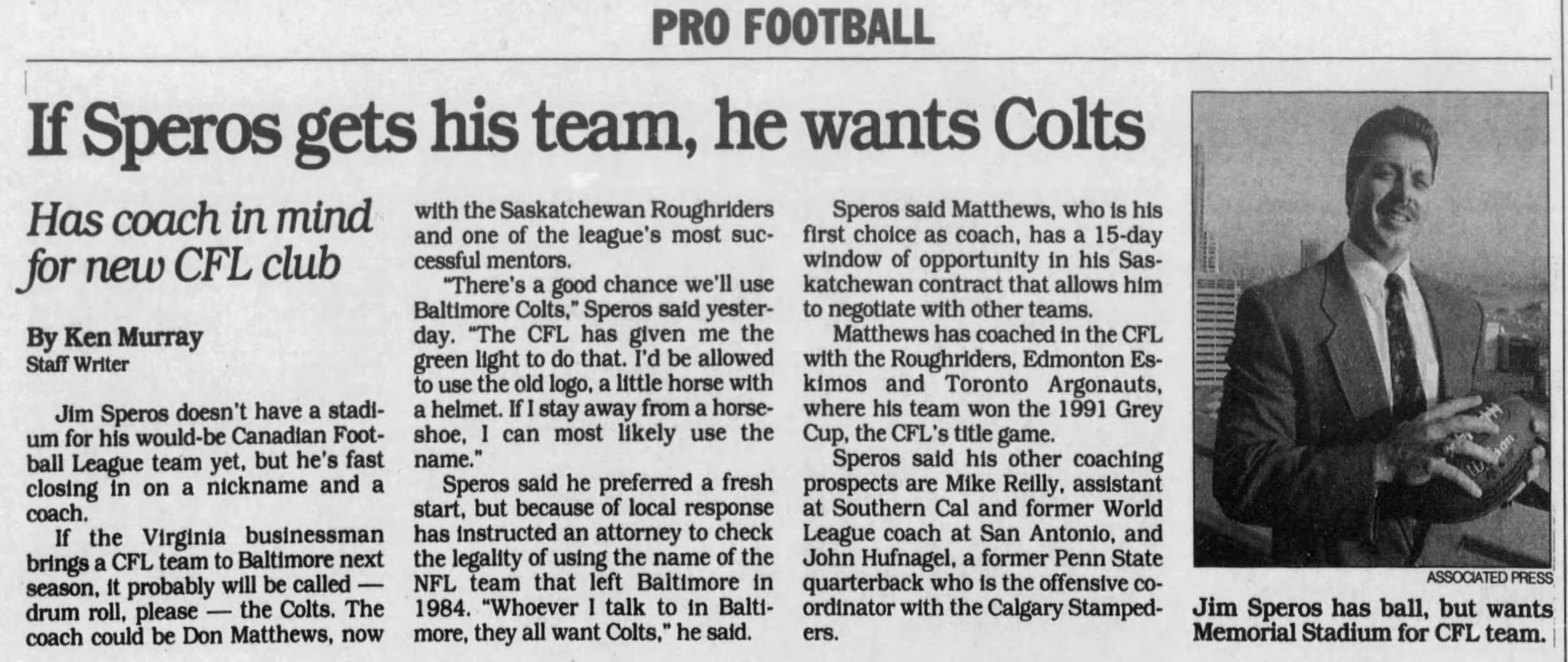
Baltimore Sun article about naming Baltimore’s prospective CFL team the “Colts,”
When the National Football League rejected an expansion franchise for Baltimore, attention turned to the expanding Canadian Football League. Owner Jim Speros originally wanted to call his team the Baltimore Colts and help tap into the nostalgia associated with that brand. When the NFL threatened legal action, a compromise as suggested for the team to be known as the Baltimore CFL Colts. When that, too, was rejected the team simply played as the Baltimore Football Club and was often referred to as the Baltimore CFLers.
Baltimore was an instant success both on and off the field. Football fans were angry at the NFL plus there was a baseball strike in 1994, the year the CFL Colts – sorry CFLers – took the field. Baltimore routinely attracted crowds of around 40,000 to Memorial Stadium.
Head coach Don Matthews knew the Canadian game well and stocked his team with experienced CFL players such as quarterback Tracy Ham and defensive lineman Jearld Baylis. Baltimore finished their inaugural season with a 12-6 record, second place in the East Division. They went onto to play BC in the Grey Cup. Not bad for an expansion franchise.
In 1995, the team was finally given a new name – the Stallions. Again, the team was a powerhouse on the field, easily winning first place in the South Division. The Stallions went on to beat Calgary in the Grey Cup that year, becoming the first and only American team to win the Grey Cup.
It was this team that relocated to Montreal in 1996 to become the reincarnated Montreal Alouettes.
Shreveport Pirates
Advertisement in the Shreveport Times for Shreveport Pirates season tickets.
The Pirates joined the CFL in 1994. They were owned by Bernie Glieberman, who was the previous owner of the Ottawa Rough Riders. He sold the Rough Riders and was granted an expansion franchise for Shreveport, Louisiana.
Coached by Forrest Gregg, the Pirates struggled on the field and started their inaugural season with 14 straight losses. They ended up with a league-worst 3-15 record. In their second season, Shreveport finished with five wins and 13 losses. Despite their poor performance, the team enjoyed pretty good support amongst local fans and the business community. The team played at Independence Stadium.
San Antonio Texans
From Gold Miners to Texans (San Antonio Express News).
Originally, a team in San Antonio (also to be called the Texans) was supposed to join the CFL in 1993 with Sacramento. However, the team folded only two weeks after it was granted. Ironically, the Sacramento Gold Miners themselves relocated to San Antonio for the 1995 season after owner Fred Anderson couldn’t secure stadium upgrades in the California capital.
The team was renamed the Texans and finally had some success on the field, finishing second place in the South Division with a 12-6 record. The Texans played at the Alamodome, one of the few stadiums in the United States that could easily accommodate Canadian football field dimensions.
Birmingham Barracudas
Advertisement in the Birmingham News promoting season tickets for the Birmingham Barracudas.
The CFL awarded Birmingham an expansion franchise in January 1995. Owned by Art Williams and coached by Jack Pardee, the team was unveiled as the Birmingham Barracudas on March 14, 1995. Future Hall of Fame quarterback Matt Dunnigan joined the team, leading them to a 10-8 record, third place in the South Division.
Birmingham attracted good crowds to Legion Field early in the season. Their home opener versus Hamilton had over 31,000 fans in attendance. But by the time U.S. college football started up, attendance dropped dramatically. Williams sold the team after the 1995 season to a group that expressed interest in moving it to Shreveport for 1996.
Memphis Mad Dogs
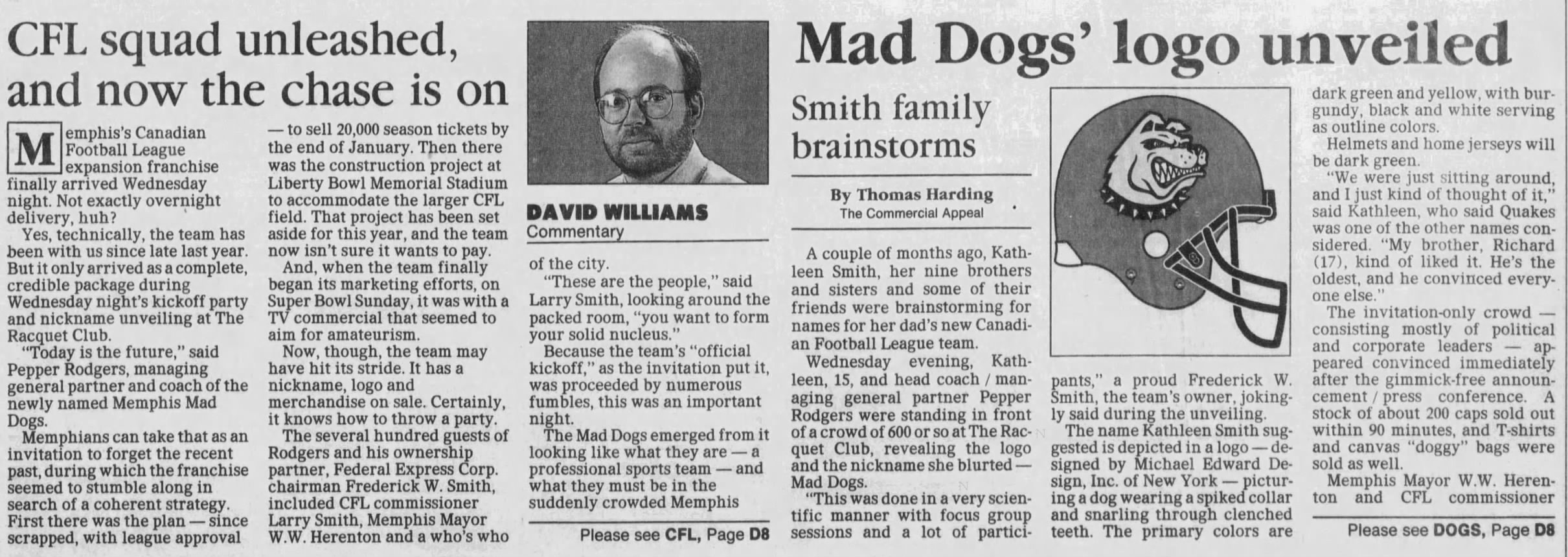
Coverage of the Memphis’ new CFL team, the Mad Dogs, in the Memphis Commercial Appeal.
Memphis was another case where an NFL expansion rejection created a pivot to the CFL. Fred Smith, the owner of FedEx, spearheaded the team that was called the Mad Dogs. They were coached by Pepper Rodgers and tried to replicate what Baltimore had done by bringing in experienced CFL players including Damon Allen as their quarterback.
The Mad Dogs finished the season with a 9-9 record, fourth place in the South Division, and missed the playoffs in their one year in play.
Memphis played at the Liberty Bowl Memorial Stadium, which could not accommodate the larger Canadian football field. As such, the end zones in Memphis were only seven yards deep at the sidelines. To make matters worse, the end zones were Astroturf while the rest of the field was natural grass.
The CFL ended its American expansion following the 1995 season. In 1996, the league reverted to its original all-Canadian lineup.
Sources:
Baltimore Sun, 16 December 1993 Birmingham News, 16 March 1995 Sacramento Bee, 11 December 1993 San Antonio Express-News, 14 March 1995 Shreveport Times, 6 April 1994