Category: Canadian Football League

  • The CFL Expands to the USA

    When I first started following CFL football in the early 1990s, two issues dominated the league: struggling Canadian franchises and U.S. expansion. They kind of went hand in hand, the idea being that an injection of American money and new markets would help stabilize the existing Canadian teams. The ultimate goal was for the CFL to grow in popularity and take its rightful place as a major North American sports league.

    Of course, things don’t always go according to plan. As we kick off a new year here at Canadian Football History, we’re going to look back at the CFL’s brief foray south of the border. It’s been 30 years since the so-called CFL USA experiment ended.

    Whatever your views on the idea of American teams playing in the Canadian Football League are, one thing is certain. U.S. expansion at the time did breathe some new life into an 8-team league that was otherwise in dire straits. New teams. New colours. New players. And some expansion fees to boot. I still have a Sacramento Gold Miners t-shirt I bought. They were my favourite U.S.-based CFL team and had a great name and logo, in my opinion.

    So, let’s set the stage for this endeavour, shall we?

    Talk of CFL expansion to the United States was nothing new. The subject came up frequently over the years. The CFL staged an exhibition game in Portland, Oregon in June 1992 to test the waters. By most accounts the game was a success. But the expansion idea really picked up steam following the demise of the World League of American Football in 1992. Cities that had teams in that league were front and centre when it came to potential CFL markets.

    Larry Smith, the newly appointed CFL commissioner in 1992, became the face of CFL expansion to the U.S. He had the untenable job of selling expansion to would-be American investors, nervous Canadian team governors, and sceptical players and fans. And there was plenty of sceptism.

    Expansion receives green light (Calgary Herald)
    Article by Mike Board in the Calgary Herald (3 October 1991) about the CFL greenlighting U.S. expansion with hints of future expansion into Europe or Japan.

    An initial focus on cities close to the Canada-U.S. border (e.g., Portland, Detroit, etc.) was soon abandoned. Late in 1992, Smith presented a map showing prospective CFL expansion sites. While Montreal and Halifax were included, the rest of the map showed mid-sized U.S. markets such as Sacramento, San Antonio, and Orlando. Honolulu, Hawaii was even on the map. Ironically, several of the eventual U.S.-based teams were never on this map, including the most successful franchise in Baltimore.

    While the i’s still had to be dotted and the t’s crossed, plans were afoot for four new teams to join the CFL for the 1993 season. These included Portland, Sacramento, San Antonio, and Montreal. The league’s twelve teams were be divided into a new three division alignment. I’m not sure if it was ever explained how the playoffs would work under this structure.

    CFL expands its vision article in the Montreal Gazette.
    Ian MacDonald in the Montreal Gazette (13 November 1992) writing about the CFL’s expansion plans with new teams Montreal, Portland, Sacramento, and San Antonio.

    However, shortly after CFL’s plans were made public the backtracking began. Portland, which was always considered the frontrunner for U.S. expansion, backed out. As did Montreal. It would come down to just the Sacramento Gold Miners and the San Antonio Texans joining the CFL for 1993. They were formally welcomed into the CFL on January 12, 1993.

    The Gold Miners were owned by Fred Anderson and in many ways were a reincarnation of the Sacramento Surge of the WLAF. Fred Anderson was a genuinely seen as a nice guy who truly believed in the CFL’s potential in California. He seemed to have the capital and the commitment as well as local fan and media support. His biggest obstacle was a suitable stadium. The Gold Miners would play at Hornet Field on the campus of Sacramento State university, a stadium comprising mostly temporary bleachers and portable washrooms. Not an ideal facility for a fledging professional football team by any stretch of the imagination.

    On the other hand, San Antonio was to play in the brand new 65,000-seat Alamodome, a state-of-the-art indoor stadium that was one of the few American stadiums that could accommodate the larger Canadian football field. The Texans were owned by Larry Benson who, like Fred Anderson, had previously owned the city’s former WLAF franchise. Fun fact. The WLAF team in San Antonio was called the Riders. Now, imagine a scenario where the San Antonio Riders, along with the Saskatchewan Roughriders and the Ottawa Rough Riders (Ottawa’s team at the time), played together. That could’ve been quite fun to watch.

    Lights are out for the Texans
    Article in the Calgary Herald about the demise of the San Antonio Texans CFL expansion franchise.

    Alas, Benson pulled out two weeks later. Was it cold feet or lack of money or something else? Whatever the case, there would be no CFL football in Texas in 1993.

    In the end, it was only Sacramento left standing from the original four expansion teams. The Gold Miners played in the West Division and kicked off their season with a two-game road trip in Ottawa and Hamilton. The Gold Miners home opener at Hornet Field was played on July 17, 1993, against the Calgary Stampeders.
    Amongst the uncertainty and despite the hiccups, CFL expansion to the United States was here at last.


    Sources:
    The Calgary Herald, 3 October 1992
    The Calgary Herald, 28 January 1993
    The Montreal Gazette , 13 November 1992
    The Toronto Star, 13 November 1992

    Fediverse Reactions
  • 100 Yard Fields in Early Canadian Football

    When CFL Commissioner Stewart Johnston announced sweeping rule changes to the Canadian game last month, one modification that probably alarmed traditionalists the most was the change to the size of the CFL football field. In 2027, the field will shrink from 110 yards in length to 100 yards between the goal lines.

    I can certainly sympathize with the “Save the 55” crowd. After all, we humans tend not to like change. Especially when it comes to changing something we cherish. But upon further review, it appears that 100-yard football fields are not new to Canadian football.

    In fact, early Canadian football was played on 100 yard long fields. In 1880, the very first rule in the new Canadian Rugby Football Union rule book stated that “The Grounds shall be, as near as possible, 100 yards long by 50 yards broad.” Of course, it’s important to remember that the game around this time was more like rugby football than the gridiron game we are accustomed to today. But still, that’s a small field.

    100 yard long fields continued to be the norm for several years. While the 1884 CRFU Laws of the Game stated that the field of play should not exceed 110 yards in length, in 1885, the CRFU clarified that the field should be 100 yards long by 65 yards wide.
    It appears the 110 yard by 65 yard standard was finally widely adopted by the 1890s. That is the size of the field mentioned in the rules when the new Canadian Rugby Union was formed in 1891.

    So, what’s the point of this discussion? Well, nothing really except to reiterate that Canadian football is not static. The rules and regulations of the game have been evolving since the beginning. And in the case of the 100 yard long field coming in 2027, it can be equally argued that rather than moving the CFL closer to the American game, we are instead taking Canadian football back to its early years.


    Sources:
    Rules of the Rugby Union Game of Football adopted by the Canadian Rugby Football Union, 14 September 1880
    Canadian Rugby Football Union Constitution and Laws of the Game, 1 July 1884
    The Montreal Star, 14 November 1885

  • Portland Hosts Fast Break CFL Football, Precursor to CFL USA Expansion

    In 1992, the Canadian Football League was looking to grow. Larry Smith was appointed the CFL’s new commissioner with a mandate to expand the CFL. Of course, Montreal and Halifax were high on Smith’s list of potential sites. But so, too, were several cities south of the border. One of these cities was Portland, Oregon.

    Located in the northwestern United States, Portland was a mid-sized city with a suitable stadium and a credible ownership group with the needed capital to both pay for and operate an expansion franchise. It was close enough to the border so that something “Canadian” didn’t sound too foreign. Heck, it was almost as if it could be a natural rival for the BC Lions. Paul Allen, the owner of the Portland Trail Blazers basketball team, was the man hoping to bring the CFL to Oregon.

    CFL Portland game article in the Oregonian newspaper (1992)

    To test the Portland market, the CFL played an exhibition game on Thursday, June 25, 1992 at Civic Stadium. The game was a rematch of the 1991 Grey Cup between the Toronto Argonauts and the Calgary Stampeders. The Argos had Raghib “the Rocket” Ismail as their marquee player. Calgary had the recently acquired future Hall of Famer Doug Flutie as their new quarterback. The stage was set for a great exhibition of Canadian football for the American fans featuring the CFL’s two biggest stars.

    In the lead up to the exhibition game, the Portland media seemed quite eager to welcome the CFL to town. Ads ran in the Oregonian newspaper promoting “fast-break,” “high flying” and “wide open” CFL football. Unsurprisingly, the Rocket was heavily promoted. Even the Trail Blazers’ Jerome Kersey was featured in advertising for the game.

    A decent crowd of 15,362 fans turned out on a hot Thursday night to watch the game. All in all, reviews were positive despite a rather lacklustre game. Calgary won 20-1. Yes, Americans got to see a Canadian rouge scored. In the end, though, no CFL expansion team came to Portland. Instead, Sacramento was awarded the CFL’s first U.S.-based expansion team. After a few years the CFL’s foray into the United States was over. Despite lots of talk and speculation, the CFL-in-Portland story was limited to a single exhibition game only.

    CFL gets warm welcome in Portland article in the Oregonian newspaper (1992)

    100 yard long fields are included in the Johnston Rules announced by CFL Commissioner Stewart Johnston recently. The 1992 exhibition game in Portland was the last time the CFL played on a field that was 100 yards in length. The standard CFL field didn’t fit at Portland Civic Stadium without heavy modifications, so the game was played on an American length football field that included ten-yard end zones. Have a look at the screen shots below to get a taste of what Canadian football on 100 yards will (sort of) look like in the future.


    You can watch the Toronto-Calgary exhibition game in Portland on the CFL Classics YouTube channel. The game was televised nationally on TSN.


    Sources:
    The Oregonian, 2 May 1992
    The Oregonian, 26 June 1992

    Fediverse Reactions
  • CFL Goes With Shorter End Zones

    The Johnston Rules are coming to Canadian football. Proponents argue they will open up the Canadian game and lead to more exciting touchdowns. Opponents grumble they represent creeping Americanization of our unique brand of football. Others shrug their shoulders and wonder what all the fuss is about. Wherever you land on this spectrum one thing is clear: CFL Commissioner Stewart Johnston has introduced sweeping changes to Canadian football.

    Now, there are plenty of places online to discuss (or vent about) these changes. But here at Canadian Football History, we focus on the past. One of the changes featured in the Johnston Rules is the shrinking of the field length and end zones. So, I thought it would be timely to revisit the last time the CFL modified its field dimensions.

    Once upon a time, the regulation Canadian football field was 110 yards long between the goal lines with two 25 yard end zones. If you watch older CFL games you will realize just how massive the end zones were. The extra deep end zones gave quarterbacks some good real estate to pass for touchdowns.

    CFL rule changes in 1986
    CFL rule changes, including shortening the end zones from 25 to 20 yards, in 1986. (Regina Leader-Post)

    Then in 1983, Vancouver opened BC Place Stadium, the first domed stadium in Canada. The 60,000-seat stadium was a state-of-the-art facility that rivalled Montreal’s Olympic Stadium in terms of capacity and amenities. The trouble was that a full-length Canadian football field wouldn’t fit in the new stadium. So, the BC Lions played on a field that had only 20 yard end zones.

    Other CFL stadiums couldn’t quite fit the full 25 yard end zones, either. So, they would clip the corners of the end zone and make do the best they could. Finally in 1986, the Canadian Football League officially adopted 20 yard end zones as the new standard.


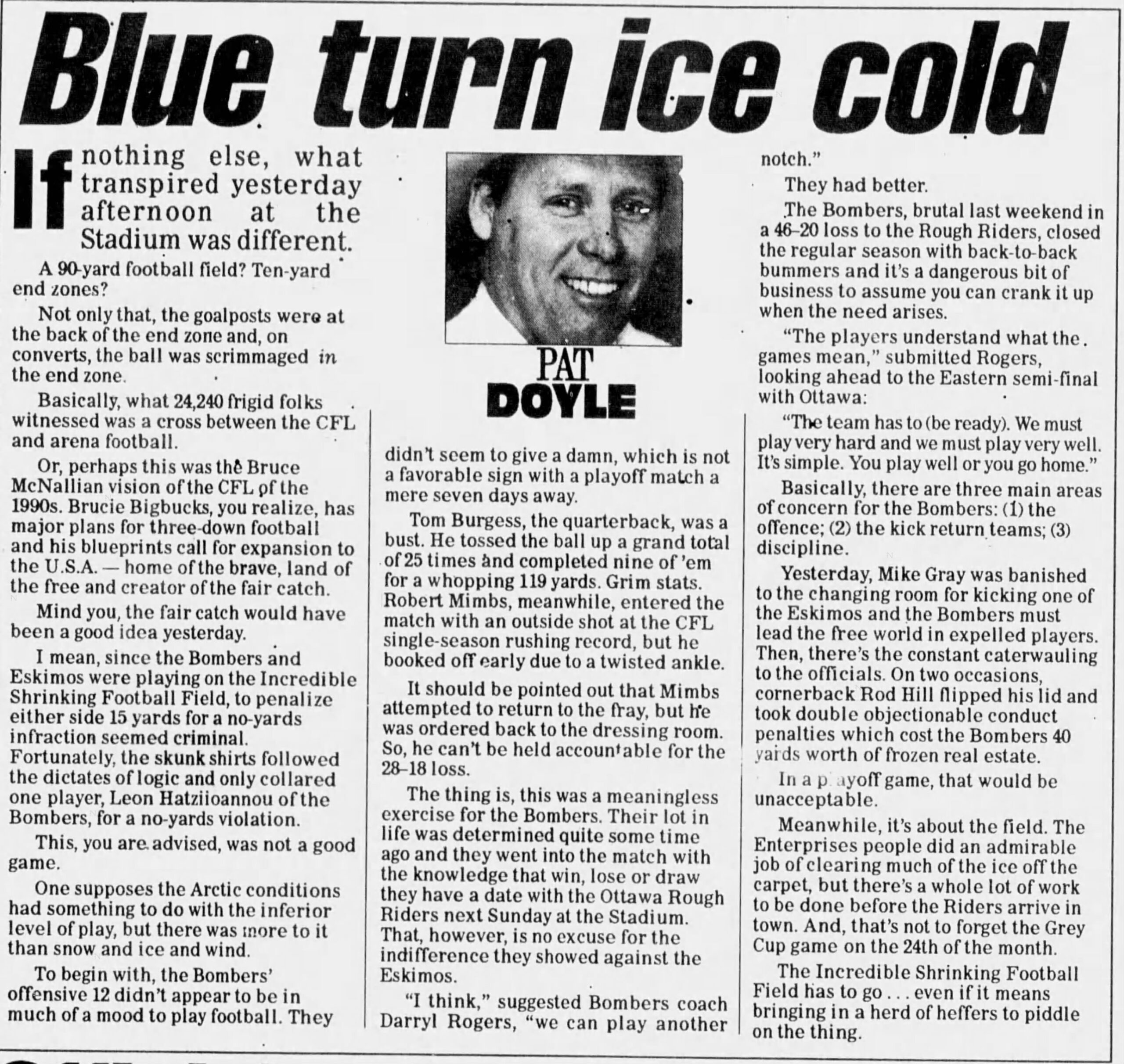
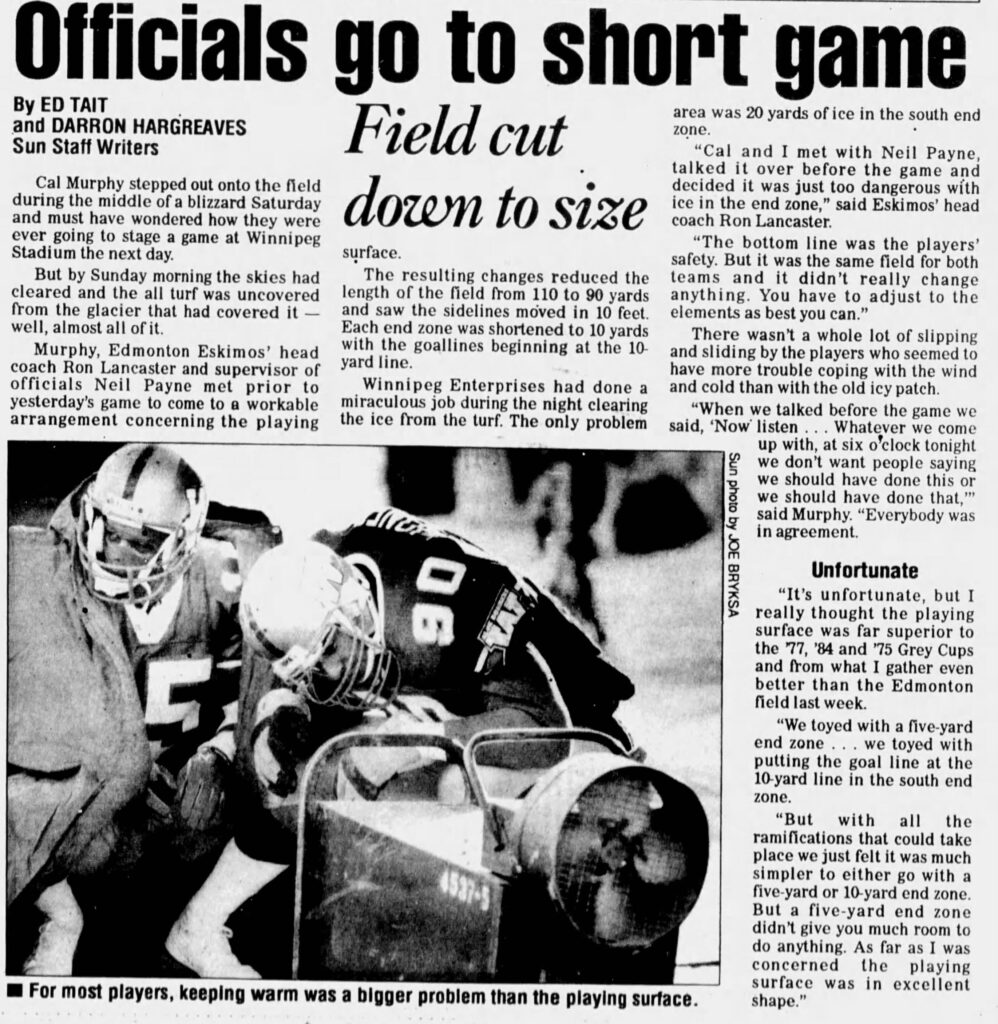
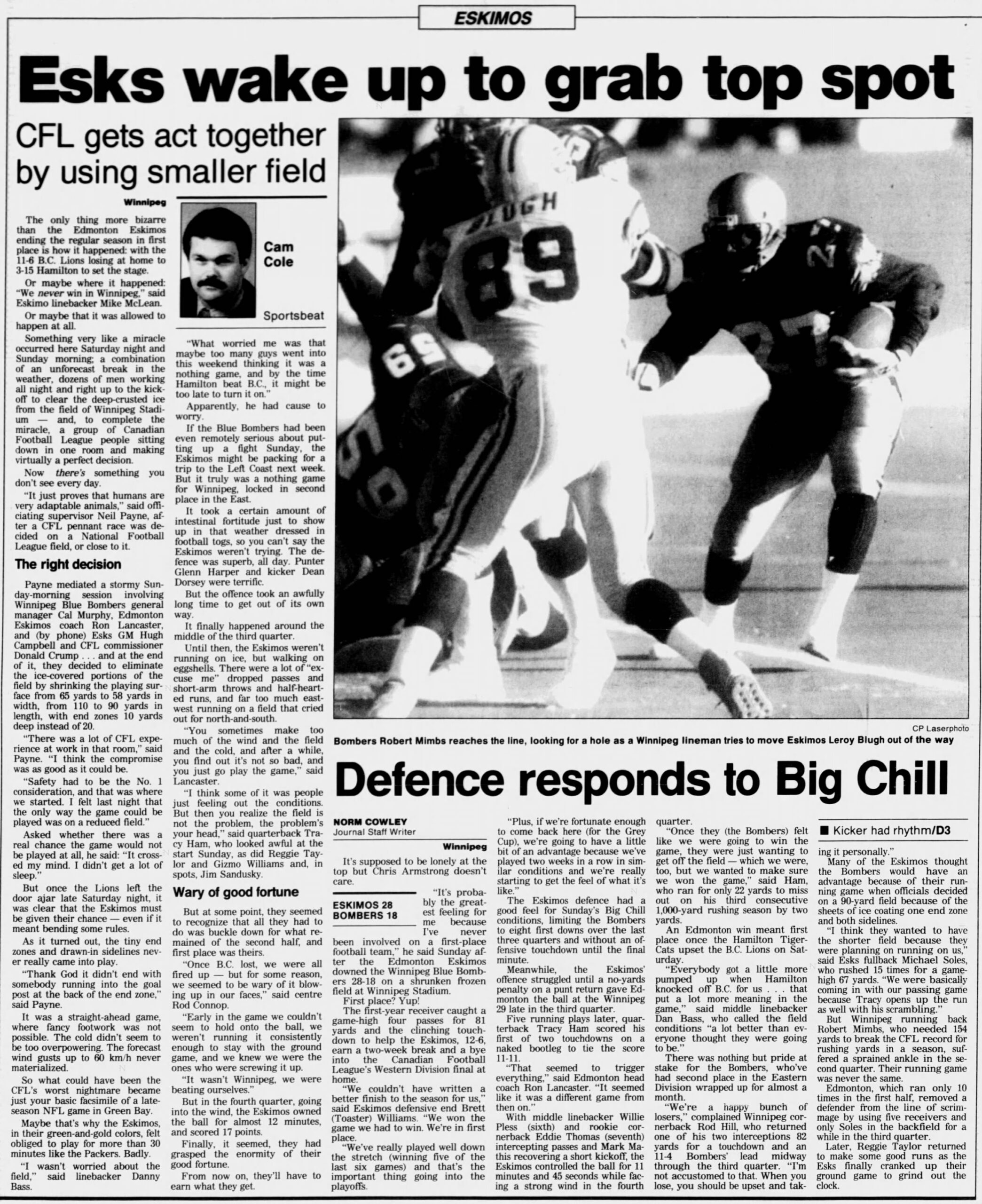
    The CFL’s long end zones posed a problem during the league’s brief foray into the United States. Most American football stadiums could not accommodate the longer Canadian field, particularly the 20 yard end zones. So, we ended up with a mishmash of end zones in the CFL’s U.S.-based stadiums. Without question the worst set up was in Memphis where the end zones were only seven yards in length near the sidelines; at most they were less than 15 yards deep in the centre.


    Whenever a sports league makes a rule change – especially if it’s a significant one – there will no doubt ensue a passionate debate amongst the fanbase. That’s probably healthy in the grand scheme of things; after all, apathy is a very difficult thing to overcome. So, if people are talking and you are in the conversation, that means people care. This week was certainly no different. CFL fans have proven they are some of the most passionate sports fans around. I thought I’d end with a selection of fan suggestions for the CFL published in the Toronto Star in 1986.

    CFL fan suggestions in the Toronto Star
    CFL fan suggestions in the Toronto Star
    Rule changes suggested by CFL fans published in the Toronto Star.

    Sources:
    The Toronto Star (13 February 1986)
    The Regina Leader Post (24 June 1986)

    Fediverse Reactions
  • Five Canadian Football Players Lost in 1956 Plane Crash Part II

    The 1956 plane crash that claimed the lives of five Canadian football players garnered widespread newspaper coverage across Canada and parts of the United States.

    Melvin Becket, Mario DeMarco, Gordon Sturtridge, and Ray Syrnyk of the Saskatchewan Roughriders and Calvin Jones of the Winnipeg Blue Bombers were aboard Trans-Canada Air Lines Flight 810 when it crashed into a remote area of British Columbia.

    Here is a sampling of news articles about the tragedy:

    Regina Leader-Post front page, December 10, 1956
    Front page of the Regina Leader-Post on December 10, 1956.
    Regina Leader-Post article about Mario DeMarco
    Heart-breaking article in the Regina Leader-Post (December 10, 1956) expressing hope that Mario DeMarco and Melvin Becket would somehow survive the disaster.
    Iowa City Press-Citizen front page, December 10, 1956
    Front page of the Iowa City Press-Citizen (December 10, 1956) with a focus on Calvin Jones, who was a standout college player at the University of Iowa before joining the Winnipeg Blue Bombers.
    Saskatoon Star-Phoenix front page, December 10, 1956
    Front page of the Saskatoon Star-Phoenix on December 10, 1956.
    Fediverse Reactions