Category: Grey Cup

  • Canadian Football’s Quirky Playoffs, Part IV: Three Leagues Compete for the New Grey Cup in 1909

    This is the fourth article examining some of Canadian football’s rather interesting playoff formats used over the years. Be sure to check out parts I, II, and III.

    1909 was a special year in Canadian football. That’s the year when Earl Grey, who was serving as the Governor General of Canada, donated a trophy to be awarded to Canada’s amateur rugby football champion. Of course, this trophy as well as the championship game itself would become known as the Grey Cup.
    Only teams affiliated with the Canadian Rugby Union were eligible to compete for the new Grey Cup championship. So that meant no western clubs could challenge for the trophy.

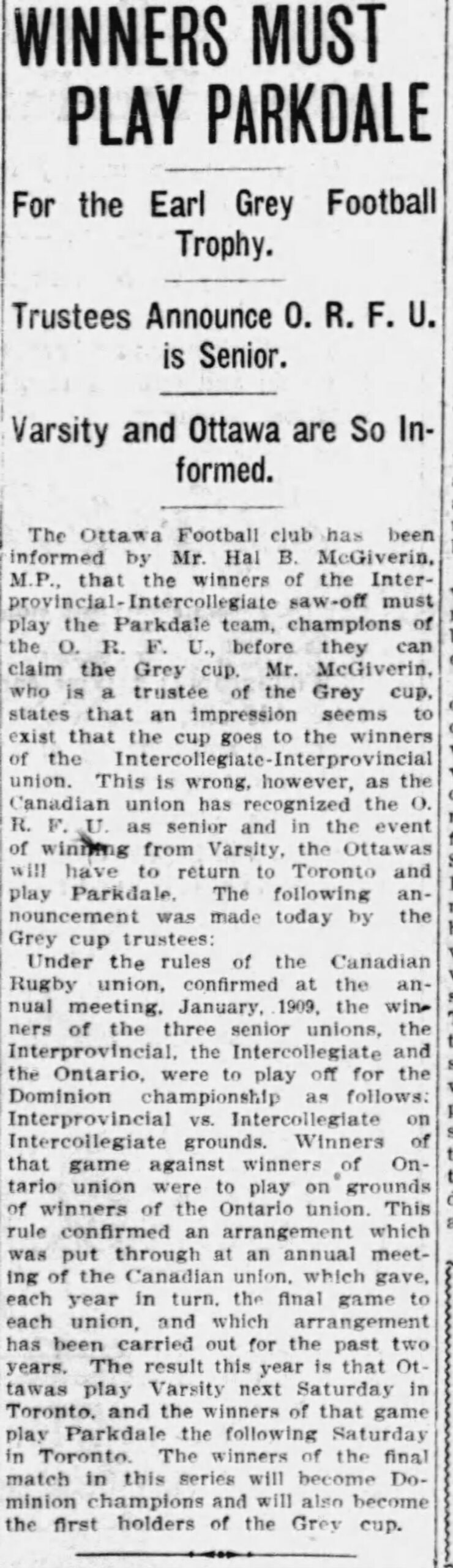
    Canadian football at the time was still an amateur affair, with senior football being the top level of play (above intermediate and junior). It was initially (mis)understood that the Grey Cup would be given to the winner of the Interprovincial Rugby Football Union (which was formed two years earlier) and Intercollegiate union game. But the CRU ruled a third league – the Ontario Rugby Football Union – was also a senior union and had the right to compete for the Grey Cup, as well.

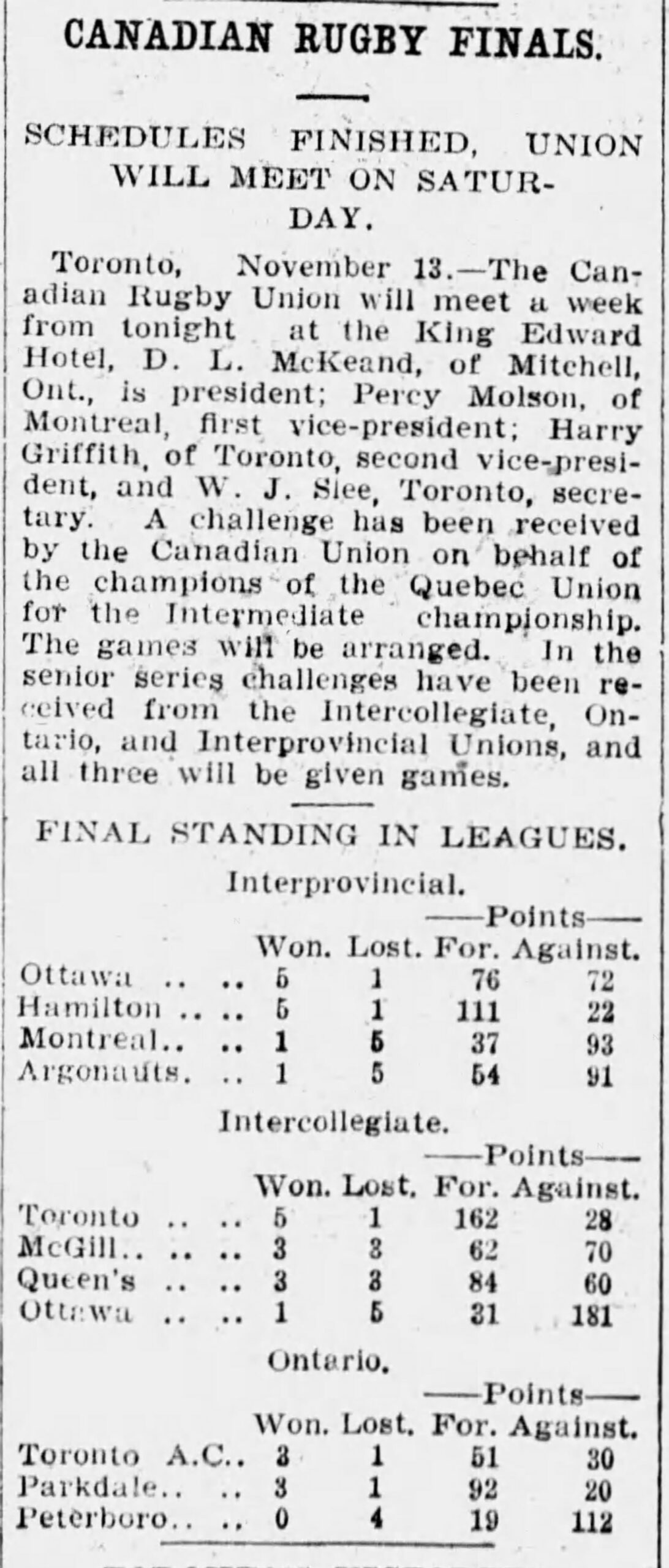
    The Montreal Gazette published the final standings for 1909 in all three senior leagues of the Canadian Rugby Union:

    Canadian Rugby Union standings and playoffs in 1909 (Montreal Gazette)
    Montreal Gazette, 15 November 1909

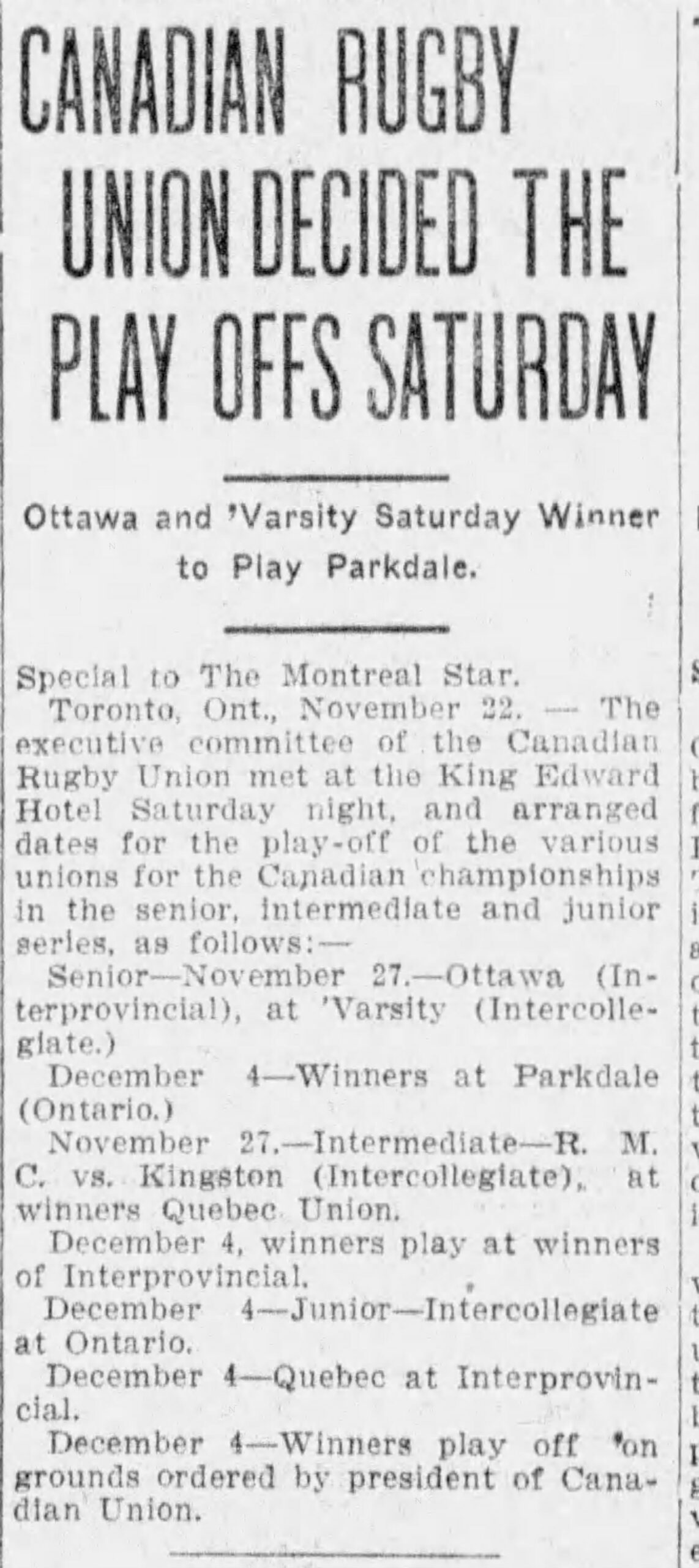
    The Canadian Rugby Union had previously established a rotational playoff system where the champion of each union would alternately receive a bye to and host the Dominion championship. Since the new Grey Cup was now the Dominion championship, the CRU simply extended this arrangement. For 1909, it was the ORFU’s year to host; so, the winner of the ORFU final would host the first-ever Grey Cup.

    Canadian Rugby Union Decided the Play Offs Saturday (Montreal Star)
    Montreal Star, 22 November 1909
    Winners Must Play Parkdale (Ottawa Citizen)
    Ottawa Citizen, 25 November 1909

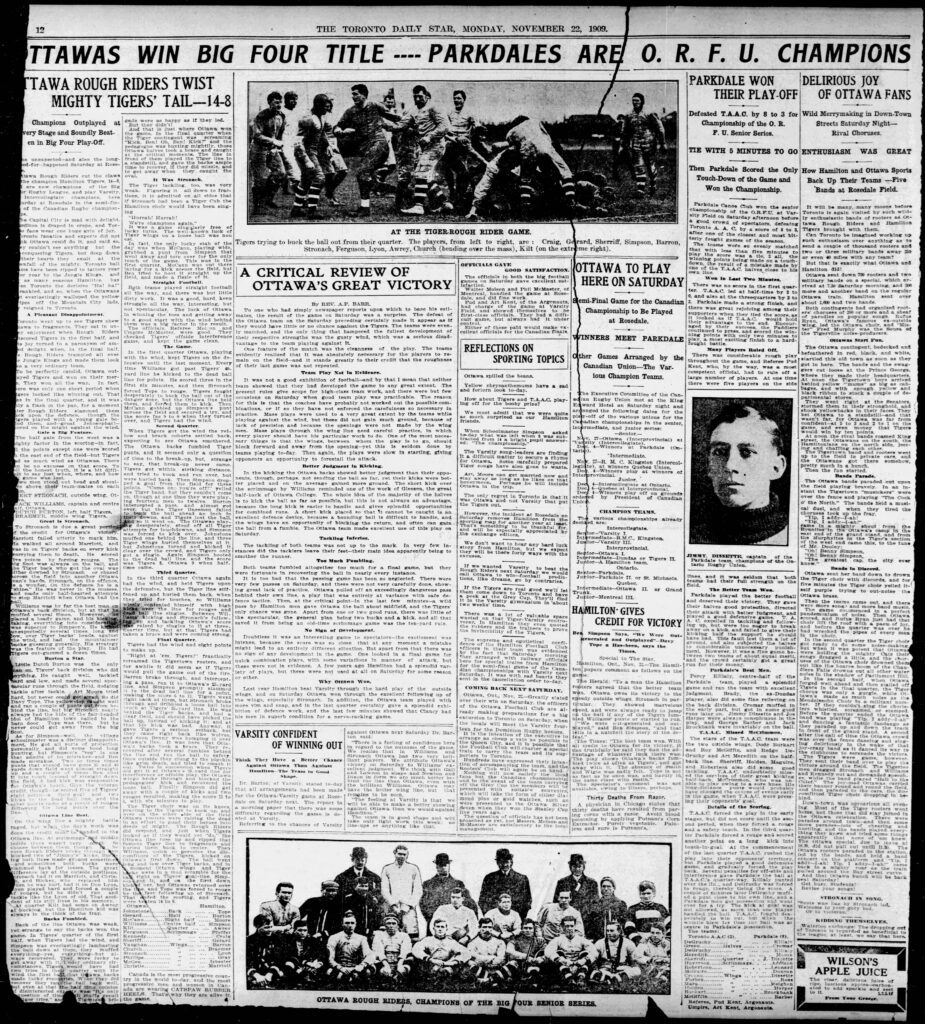
    On November 20th, Toronto Parkdale won the ORFU championship with an 8-3 win over the Toronto Amateur Athletic Club, securing their berth in the Grey Cup. On the same day, the Ottawa Rough Riders defeated the Hamilton Tigers 14-8 to win the IRFU championship.

    Below is some excellent coverage in the Toronto Star of the IRFU and ORFU playoffs.

    ORFU, IRFU playoff coverage (Toronto Star)
    Toronto Star, 22 November 1909

    On November 27th, the Rough Riders travelled to Toronto to play the University of Toronto in the Interprovincial-Intercollegiate final. Varsity won handily by a score of 31 to 7, setting up a Varsity vs. Parkdale all-Toronto final for the Grey Cup.

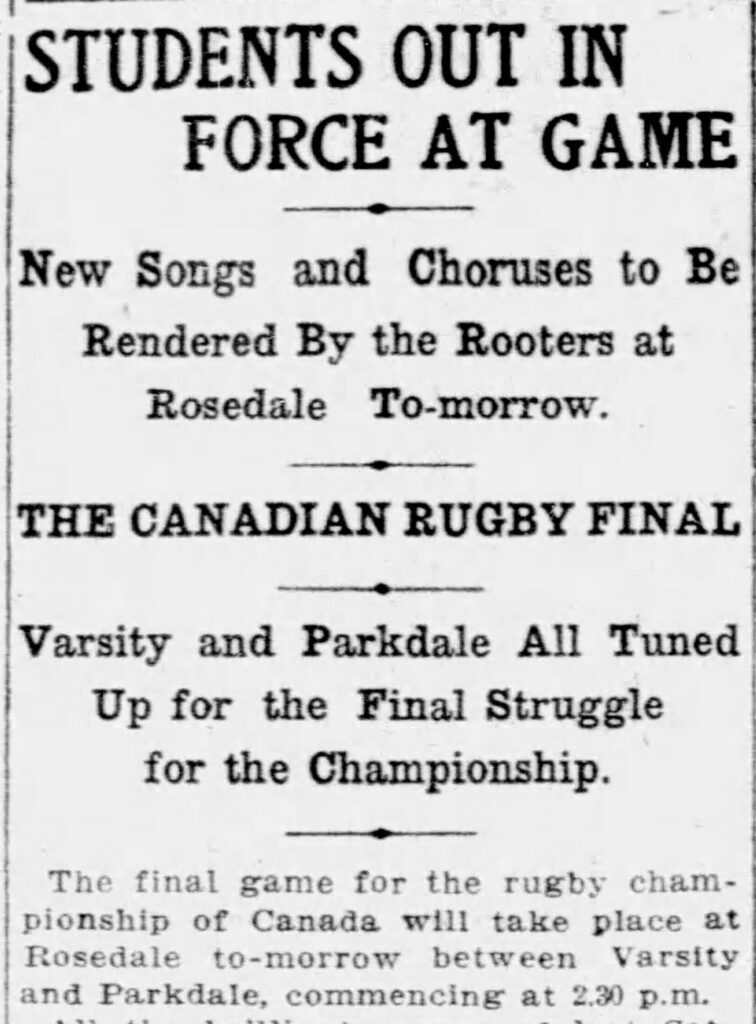
    Varsity to play Parkdale in first Grey Cup (Toronto Star)
    Toronto Star, 3 December 1909

    The historic matchup took place on December 4th at Toronto’s Rosedale Field. In the end, the University of Toronto came out on top, defeated Parkdale 26-6 to become the first Grey Cup champions.


    Sources:
    Montreal Gazette, 15 November 1909
    Montreal Star, 22 November 1909
    Ottawa Citizen, 25 November 1909
    Toronto Star, 22 November 1909
    Toronto Star, 6 December 1909

    Fediverse Reactions
  • Varsity Wins the Almost Forgotten Grey Cup

    In 1909, Governor General Earl Grey donated a trophy to be awarded to the amateur rugby football champions of Canada. The University of Toronto won the inaugural championship with a 26-6 win over Toronto Parkdale. Various teams in Toronto and Hamilton competed in the early Grey Cup contests before the game was put on hold after 1915 due to the First World War.

    The Grey Cup was then virtually forgotten. The trophy itself was locked away hidden in a storage vault. War has a way of resetting priorities, you see. After football resumed in Canada in 1919, there were growing organizational issues amongst some teams and disagreements amongst the rugby unions, climaxing in a decision by McGill University and Montreal to refuse to contest the Canadian Rugby Union playoffs. Alas, there was no Grey Cup in 1919, either.

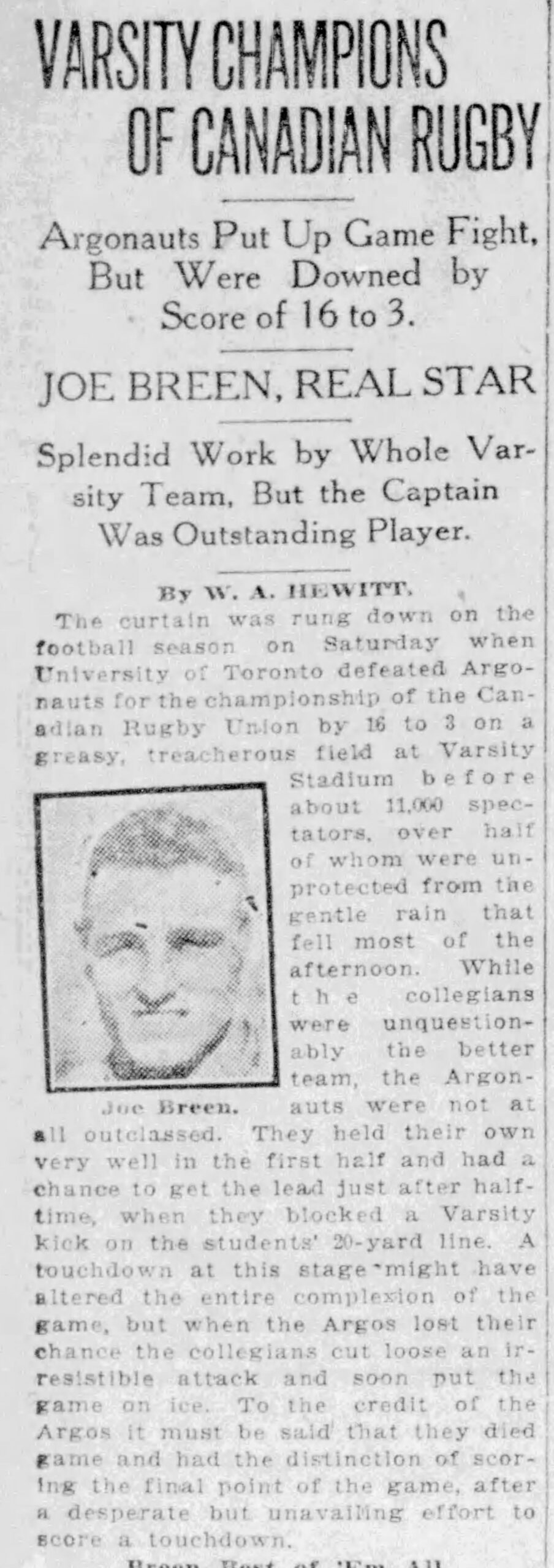
    Coverage of the 1920 Grey Cup in the Toronto Star on December 6, 1920.
    Coverage of the 1920 Grey Cup in the Toronto Star on December 6, 1920.

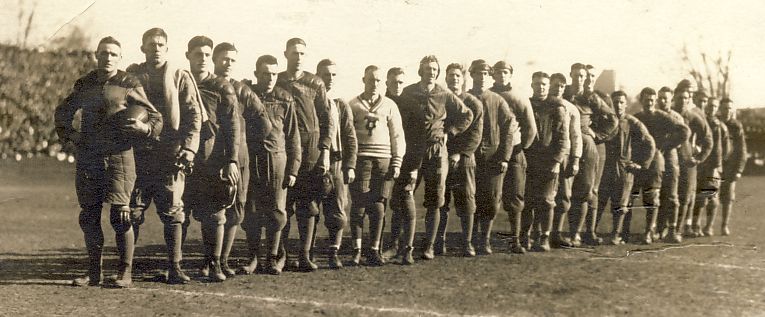
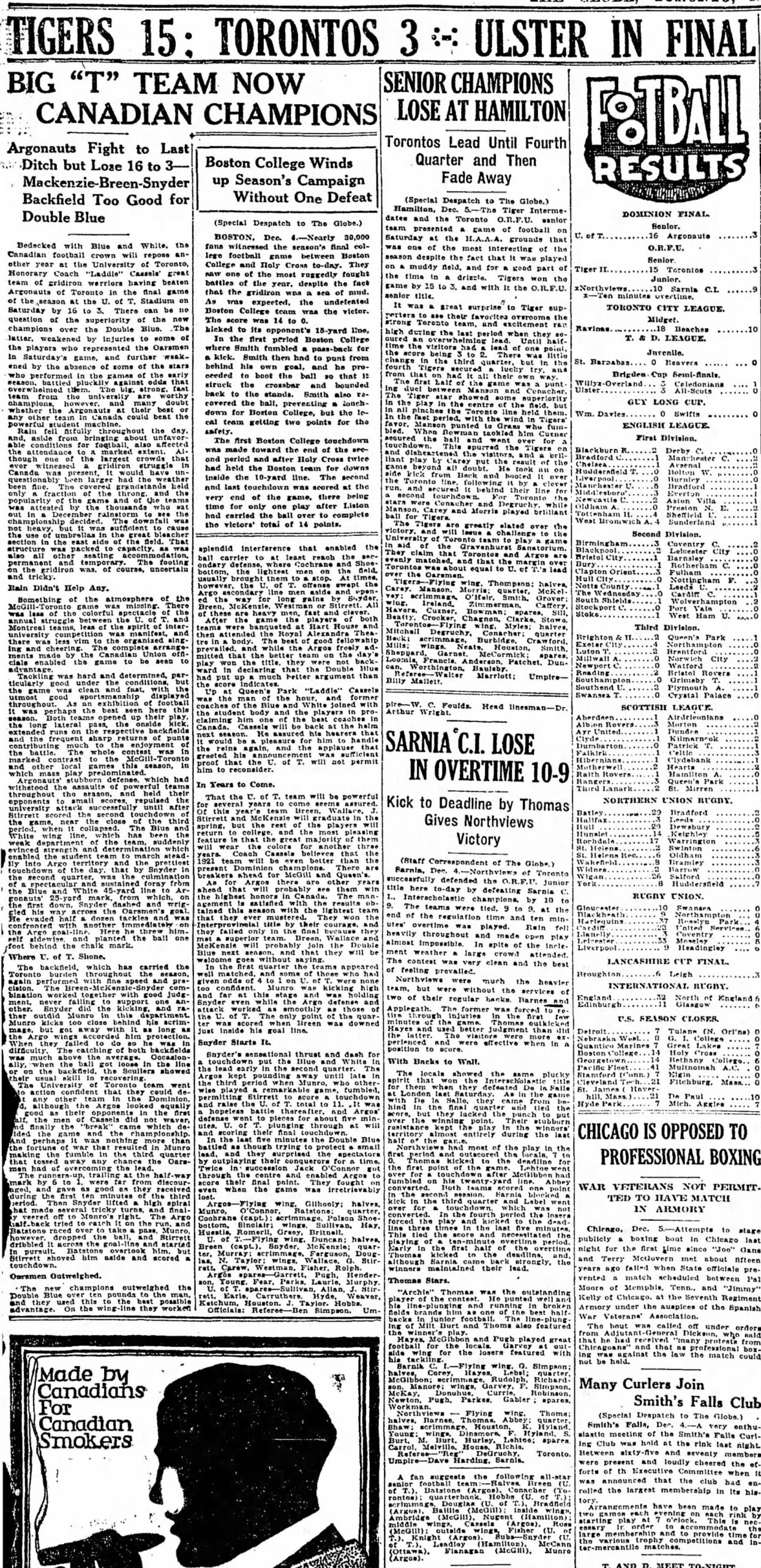
    But in 1920, the Grey Cup made its triumphant return. And a couple of familiar teams were back in the mix to win the big game. On Saturday, December 4, 1920, the University of Toronto played the Toronto Argonauts in the 8th edition of the Grey Cup. Played in less-than-ideal conditions (rain and mud!) at Toronto’s Varsity Stadium, Varsity’s Joe Breen was the star of the day, according to the Toronto Star, leading his team to a 16-3 victory over the Argonauts.

    Coverage of the 1920 Grey Cup in the Globe and Mail on December 6, 1920.
    Coverage of the 1920 Grey Cup in the Globe and Mail on December 6, 1920.

    This would be the University of Toronto’s fourth and final Grey Cup championship. At the time, Varsity was considered by many to be the best football team in the country. Their championship win cemented this sentiment.

    Despite being relegated to a dark memory hole just a few years prior, the Grey Cup was back. And perhaps that’s what mattered most.


    Sources:

    https://web.archive.org/web/20130820024400/http://cfl.ca/page/his_greycup_recap1920

    The Toronto Star, 6 December 1920

    The Globe and Mail, 6 December 1920

  • Getting Ready for the Grey Cup’s TV Debut

    It’s September 1952 and a new technology – black and white television – is taking the country and much of the world by storm. The Canadian Broadcasting Corporation (CBC) entered the TV business with two flagship stations: CBFT in Montreal and CBLT in Toronto.

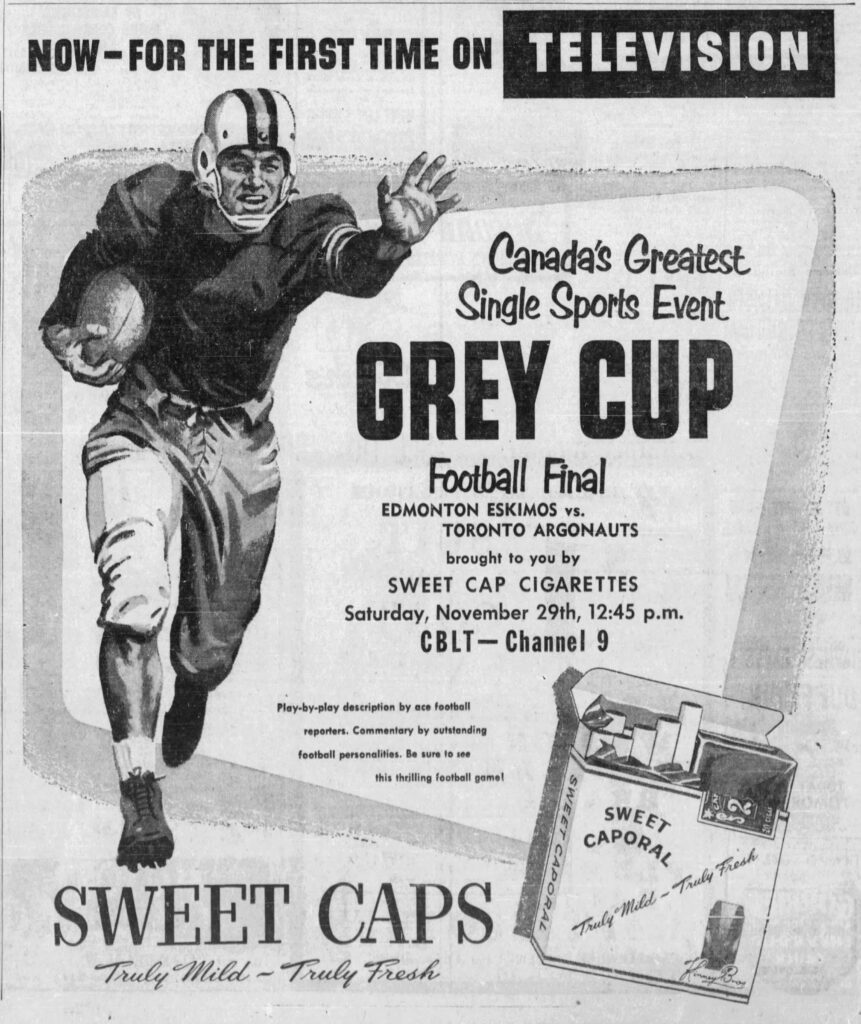
    The decision was soon made to broadcast the upcoming Grey Cup game on CBLT. The Canadian Rugby Union championship was scheduled for Saturday November 29th at Varsity Stadium in Toronto.

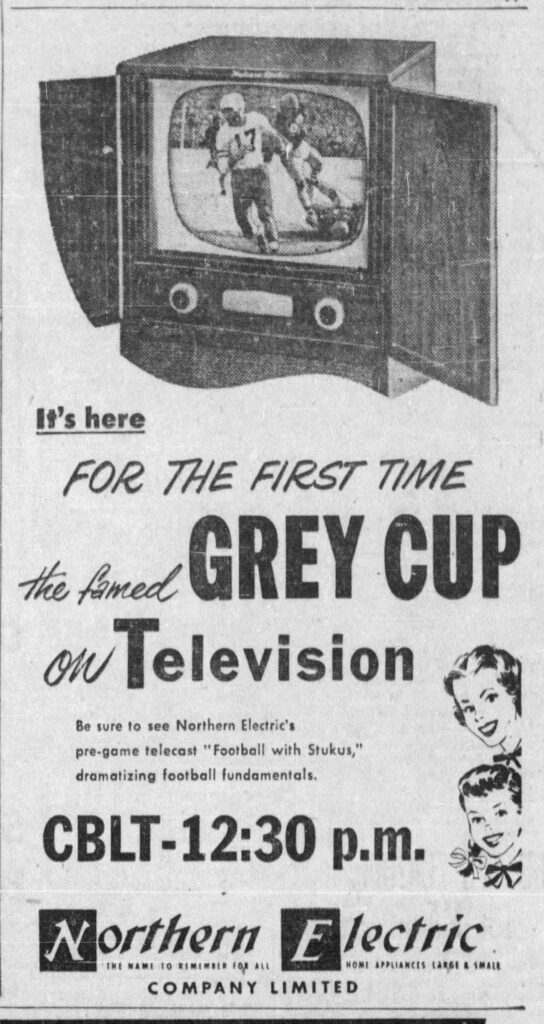
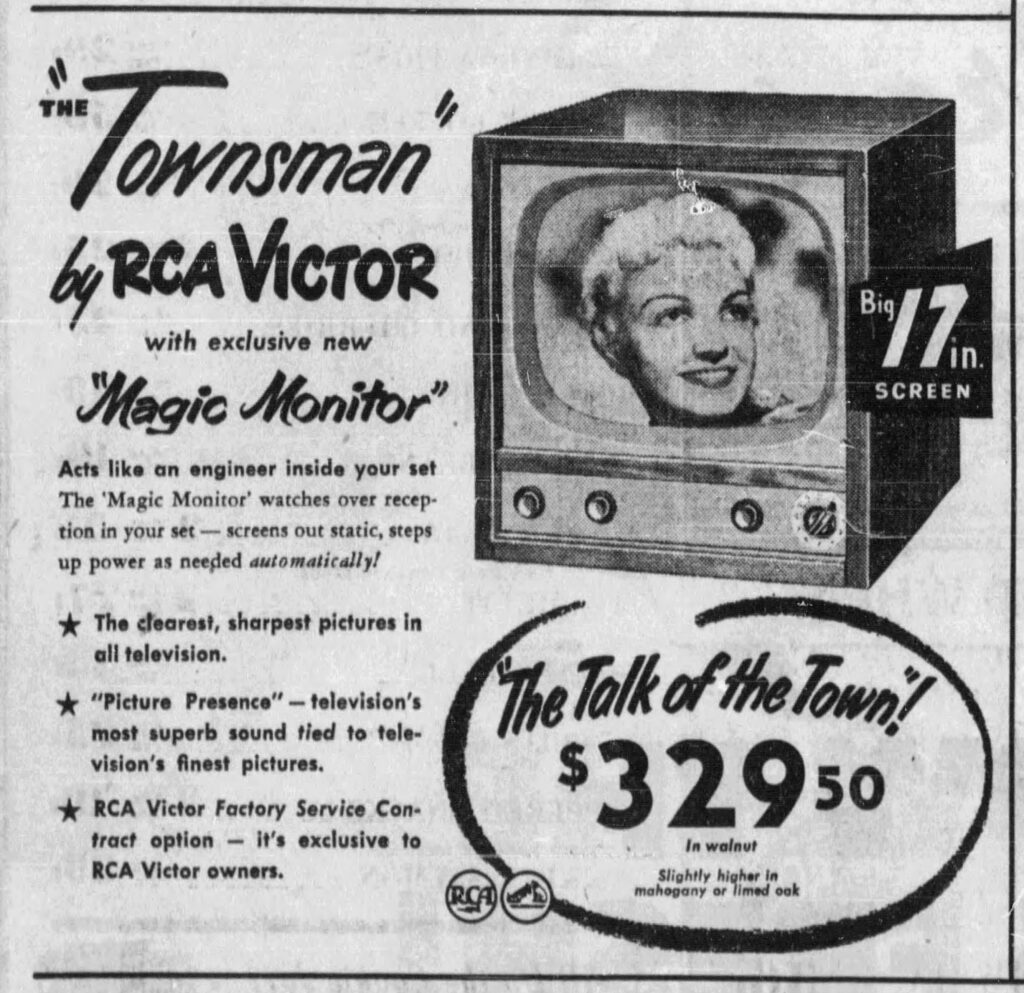
    The novelty factor of the new technology coupled with the popularity of the hometown Toronto Argonauts, who were playing in the championship, helped drive sales for television sets in Toronto. Several ads selling TVs appeared in local newspapers. These didn’t come cheap, but vendors were more than happy to set up affordable payment plans for excited football fans.

    While the Grey Cup game itself was the first Canadian football game ever televised, broadcast crews did a practice run a few days before in the playoff game between the Argonauts and the Sarnia Imperials of the Ontario Rugby Football Union. In those days, the ORFU still challenged for the Grey Cup. The Toronto-Sarnia Grey Cup semi-final game at Varsity Stadium was used as the dress rehearsal for the big game. The 1952 Grey Cup commentators Norm Marshall and Larry O’Brien were actually chosen after an audition for the roles was held during the Sarnia game.

    Notes about the TV practice run done during the Grey Cup semi-final between Toronto and Sarnia (Toronto Star, 27 November 1952)

    Pubs in and around Toronto with television sets were packed on the day of the game. Meanwhile, in nearby Hamilton, Westinghouse set up several TVs so that employees and friends could watch the game. The broadcast even included a short pre-game show hosted by Annis Stukus.

    In the end, the Argonauts defeated Edmonton by a score of 21-11 in front not only record crowd at Varsity Stadium but also tens of thousands of television viewers in the Toronto area. A new era for the Grey Cup and for Canadian television was here.


    Sources:

    Patskou, Paul. “The First Televised Grey Cup Game.” Canadian Football Research Society. Accessed October 28, 2025. https://www.canadianfootballresearch.ca/the-first-televised-grey-cup-game/.

    The Toronto Star, 27 November 1952

  • The Death of Earl Grey

    On August 29, 1917, newspapers on both sides of the Atlantic reported that Earl Grey had died at the age of 65. How well do you know the man who donated the trophy that bears his name, that symbol of Canadian football supremacy?

    Born Albert Henry George Grey in 1851 in London, England, he became the 4th Earl Grey upon the death of his uncle. He was a lawyer by profession and a former politician, serving as an MP in the British Parliament. He also briefly served as the administrator for Rhodesia (now Zimbabwe).

    In 1904, King Edward VII appointed Earl Grey as the Governor General of Canada. In those days, the vice regal not only represented the monarch in Canada but also acted as a representative for the British government. As such, the appointees were always a member of the British peerage and sometimes even a member of the Royal Family.

    Earl Grey Death Ottawa Citizen (1917)
    News of Earl Grey’s death as reported in the Ottawa Citizen on August 29, 1917.
    Earl Grey Death Ottawa Citizen (1917)

    By most accounts, Earl Grey was an immensely popular Governor General. He travelled the country intensively and was active in many areas of Canadian politics. Earl Grey was a strong supporter of national unity (he was largely responsible for the success of Quebec’s tercentenary celebrations!) and advocated for greater social justice for Canadians. Two of his other interests failed to gain traction, that being electoral reform and transforming the British Empire into an Imperial Federation.

    As Governor General, Earl Grey lent his support to several Canadian arts and sports initiatives. In 1909, he donated a trophy to be awarded for the Amateur Rugby Football Championship of Canada. Soon, the trophy would become known as the Grey Cup.

    Earl Grey Death Montreal Star (1917)
    Earl Grey’s death as reported in the Montreal Star on August 29, 1917.
    Earl Grey Death Newcastle Journal (1917)
    Earl Grey’s death as reported in the Newcastle Journal (UK) on August 30, 1917.

    Earl Grey’s tenure as Governor General ended in 1911, and he returned to England. Earl Grey died at his family home in Howick, England on August 29, 1917. He was remembered fondly by the press in both Canada and the United Kingdom as well as in countries around the world. He was survived by his wife Alice and three adult children.

    One particular quote (attributed to Sir Hamar Greenwood) nicely sums up Earl Grey and his impact on and connection to Canada: “Earl Grey came to Canada an Englishman and returned to England as a keen Canadian.”


    In reading the many newspaper articles about Earl Grey’s death you will notice a glaring omission. Most of them make little to no reference to the Grey Cup or to Grey’s support for Canadian football. At first glance, this appears rather odd. But it’s important to remember the times. At the time of Earl Grey’s death, Canada was in the midst of the First World War. Meaningful football hadn’t been played in Canada since 1914. There had only been six previous Grey Cup games, so the tradition hadn’t yet taken hold. In some ways, the Grey Cup was largely forgotten during the war years. Finally, the game was resurrected in 1920, setting up Earl Grey’s greatest legacy to Canada: the Grey Cup.


    Earl Grey was elected into the Canadian Football Hall of Fame in 1963, the year the hall was established.


    Sources:

    The Ottawa Citizen (29 August 1917)
    The Montreal Star (29 August 1917)
    The Newcastle Journal (30 August 1917)

    Fediverse Reactions
  • The Grey Cup of Hockey?

    Did you know that Governor General Earl Grey originally intended his Grey Cup trophy to be a national amateur hockey championship? The idea was for amateur hockey teams in various leagues across Canada to compete in a national playoff with the winner being awarded the Grey Cup. The Grey Cup was to be to be the amateur version of the Stanley Cup.

    Grey Cup for amateur hockey article in the Toronto Star
    Source: The Toronto Star, 14 January 1909, page 12

    However, in late 1908 Sir Montagu Allan – a prominent Montreal businessman – donated a trophy (the Allan Cup) that ultimately became the national amateur hockey championship.

    By summertime the Grey Cup was repositioned to be the amateur rugby football championship of the Dominion of Canada. Below is a Toronto Star article about Canada’s new rugby football trophy.

    Grey Cup for the rugby championships article in the Toronto Star
    Source: The Toronto Star, 1 June 1909, page 10

    The Allan Cup was first awarded on March 6, 1909 to the Ottawa Cliffsides. A week later Queen’s University challenged them to a game and win the trophy.

    The first Grey Cup was played on December 4, 1909 with the University of Toronto winning the championship.