When CFL Commissioner Stewart Johnston announced sweeping rule changes to the Canadian game last month, one modification that probably alarmed traditionalists the most was the change to the size of the CFL football field. In 2027, the field will shrink from 110 yards in length to 100 yards between the goal lines.
I can certainly sympathize with the “Save the 55” crowd. After all, we humans tend not to like change. Especially when it comes to changing something we cherish. But upon further review, it appears that 100-yard football fields are not new to Canadian football.
From the Rules of the Rugby Union Game of Football adopted by the Canadian Rugby Football Union, 14 September 1880
In fact, early Canadian football was played on 100 yard long fields. In 1880, the very first rule in the new Canadian Rugby Football Union rule book stated that “The Grounds shall be, as near as possible, 100 yards long by 50 yards broad.” Of course, it’s important to remember that the game around this time was more like rugby football than the gridiron game we are accustomed to today. But still, that’s a small field.
100 yard long field being adopted by the CRFU in November 1885. (Montreal Star, 14 November 1884)
100 yard long fields continued to be the norm for several years. While the 1884 CRFU Laws of the Game stated that the field of play should not exceed 110 yards in length, in 1885, the CRFU clarified that the field should be 100 yards long by 65 yards wide. It appears the 110 yard by 65 yard standard was finally widely adopted by the 1890s. That is the size of the field mentioned in the rules when the new Canadian Rugby Union was formed in 1891.
The 110 x 65 field we are accustomed to (taken from the Canadian Rugby Football Union Constitution and Laws of the Game published in 1884).
So, what’s the point of this discussion? Well, nothing really except to reiterate that Canadian football is not static. The rules and regulations of the game have been evolving since the beginning. And in the case of the 100 yard long field coming in 2027, it can be equally argued that rather than moving the CFL closer to the American game, we are instead taking Canadian football back to its early years.
Sources: Rules of the Rugby Union Game of Football adopted by the Canadian Rugby Football Union, 14 September 1880 Canadian Rugby Football Union Constitution and Laws of the Game, 1 July 1884 The Montreal Star, 14 November 1885
The Johnston Rules are coming to Canadian football. Proponents argue they will open up the Canadian game and lead to more exciting touchdowns. Opponents grumble they represent creeping Americanization of our unique brand of football. Others shrug their shoulders and wonder what all the fuss is about. Wherever you land on this spectrum one thing is clear: CFL Commissioner Stewart Johnston has introduced sweeping changes to Canadian football.
Now, there are plenty of places online to discuss (or vent about) these changes. But here at Canadian Football History, we focus on the past. One of the changes featured in the Johnston Rules is the shrinking of the field length and end zones. So, I thought it would be timely to revisit the last time the CFL modified its field dimensions.
Once upon a time, the regulation Canadian football field was 110 yards long between the goal lines with two 25 yard end zones. If you watch older CFL games you will realize just how massive the end zones were. The extra deep end zones gave quarterbacks some good real estate to pass for touchdowns.
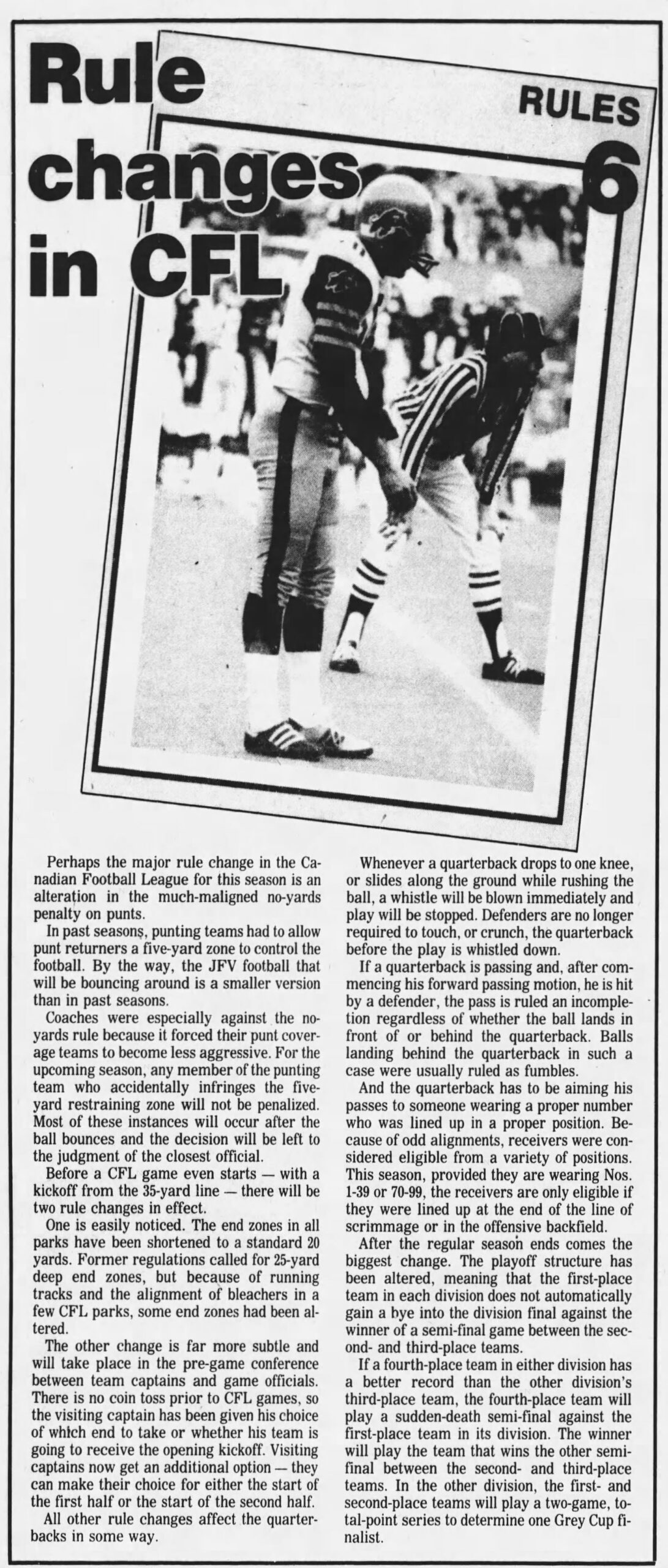
CFL rule changes, including shortening the end zones from 25 to 20 yards, in 1986. (Regina Leader-Post)
Then in 1983, Vancouver opened BC Place Stadium, the first domed stadium in Canada. The 60,000-seat stadium was a state-of-the-art facility that rivalled Montreal’s Olympic Stadium in terms of capacity and amenities. The trouble was that a full-length Canadian football field wouldn’t fit in the new stadium. So, the BC Lions played on a field that had only 20 yard end zones.
Other CFL stadiums couldn’t quite fit the full 25 yard end zones, either. So, they would clip the corners of the end zone and make do the best they could. Finally in 1986, the Canadian Football League officially adopted 20 yard end zones as the new standard.
A post card showing the 25 yard clipped end zones at Edmonton’s Commonwealth Stadium. (photo: Canadian Football Research Society)
The CFL’s long end zones posed a problem during the league’s brief foray into the United States. Most American football stadiums could not accommodate the longer Canadian field, particularly the 20 yard end zones. So, we ended up with a mishmash of end zones in the CFL’s U.S.-based stadiums. Without question the worst set up was in Memphis where the end zones were only seven yards in length near the sidelines; at most they were less than 15 yards deep in the centre.
The CFL used a heavily modified end zone in Memphis in 1995.
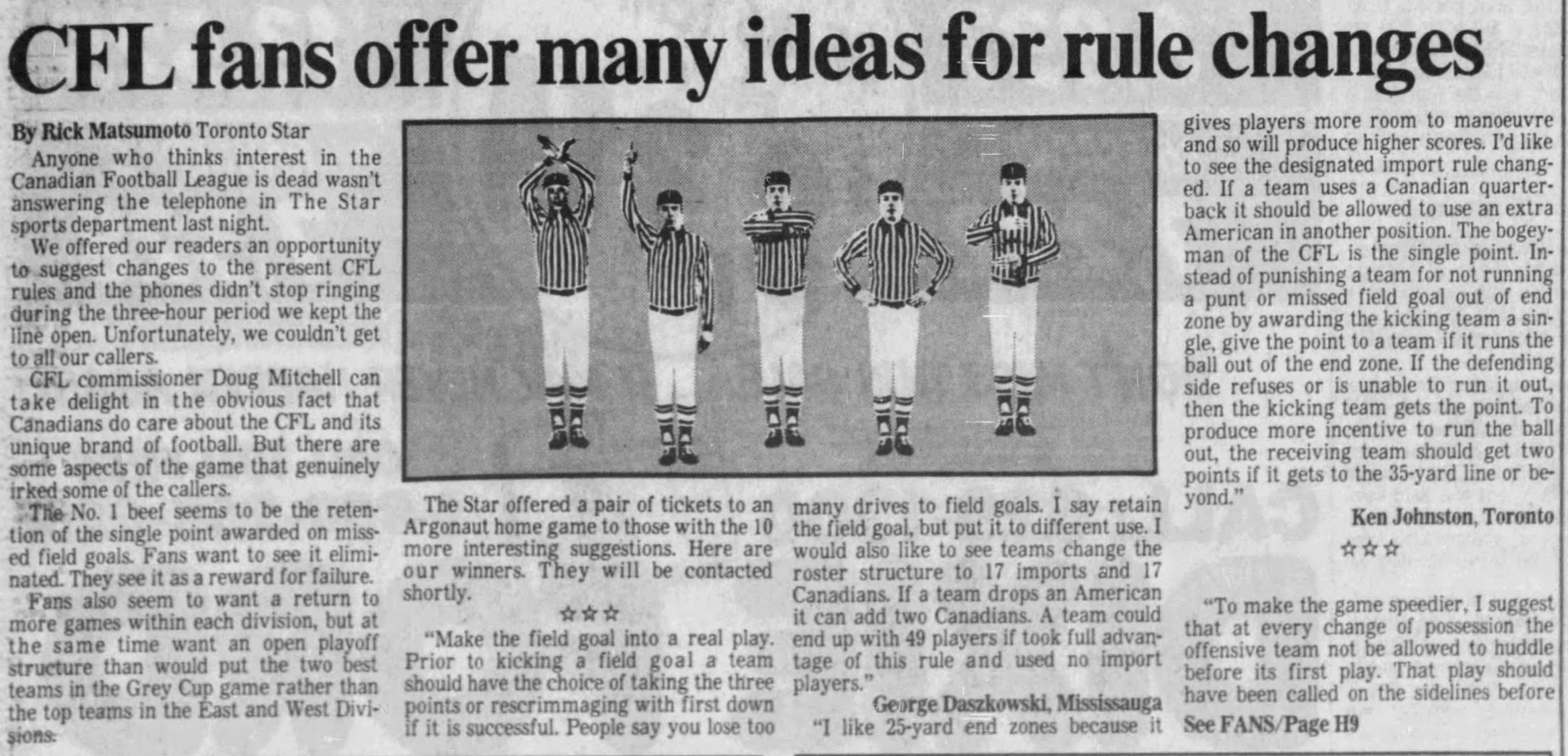
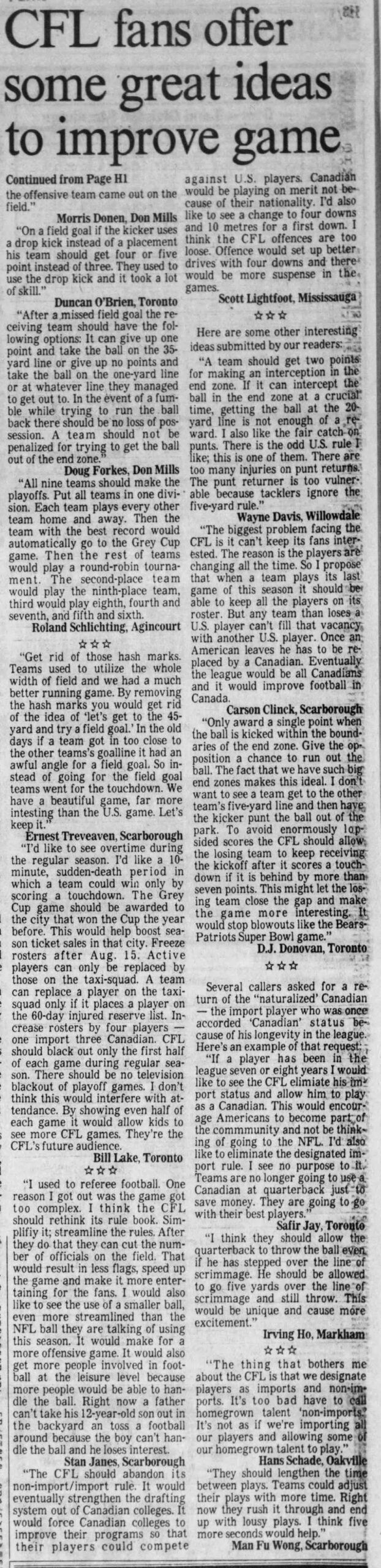
Whenever a sports league makes a rule change – especially if it’s a significant one – there will no doubt ensue a passionate debate amongst the fanbase. That’s probably healthy in the grand scheme of things; after all, apathy is a very difficult thing to overcome. So, if people are talking and you are in the conversation, that means people care. This week was certainly no different. CFL fans have proven they are some of the most passionate sports fans around. I thought I’d end with a selection of fan suggestions for the CFL published in the Toronto Star in 1986.
Rule changes suggested by CFL fans published in the Toronto Star.
Sources: The Toronto Star (13 February 1986) The Regina Leader Post (24 June 1986)
An observer today would simply shrug his shoulders after reading the contents. “What’s the big deal?” he would ask. But around the turn of the 20th century the Burnside Rules would revolutionize Canadian football. Named after Thrift Burnside, who captained the University of Toronto varsity football team, the so-called Burnside Rules helped transform Canadian football from a rugby-style game to the modern gridiron game we recognize today.
Proponents of the Burnside Rules promoted the idea that they made the game more open, more exciting, and easier to follow. Opponents argued they changed the very essence of Canadian football and risked the Americanization of the game. In hindsight, both sides were probably right.
So, what the heck were the Burnside Rules anyway? And how did they change the game of Canadian football so much? Let’s take a quick look.
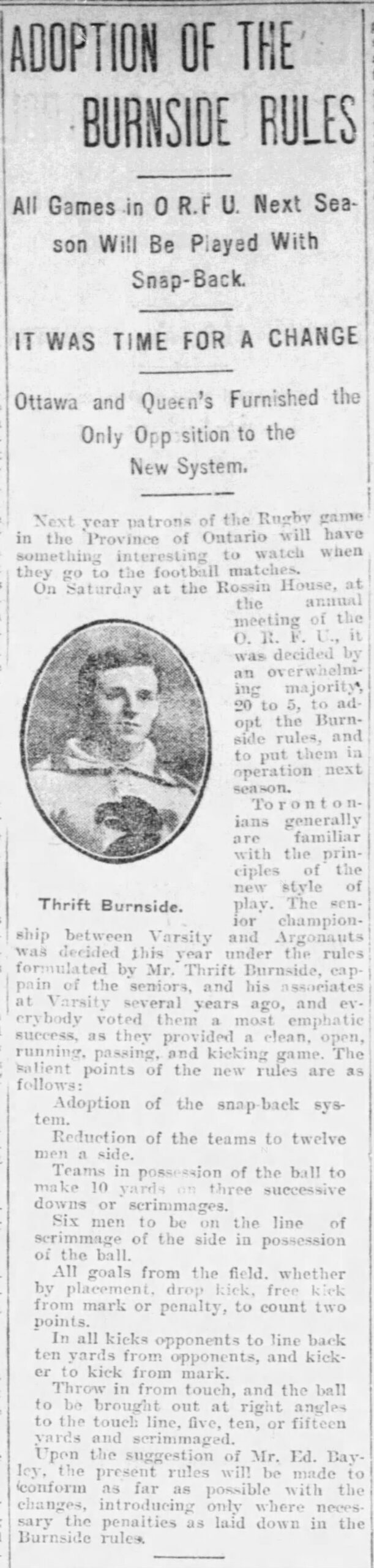
Perhaps the biggest difference in Mr. Burnside’s rules compared to traditional Canadian rugby at the time was the introduction of the downs system. The team with possession would now have three chances (or downs) to advance the ball ten yards. The other significant difference was adoption of the snap-back formation. Instead of a rugby scrum where players heeled the ball backwards, the offence would now line up along a fixed line of scrimmage and have the centre player on the line “snap back” the ball. Both the downs system and the snap-back formation were already being used in American football at the time.
Other rule changes included the reduction of the number of players from fifteen to twelve, scrimmaging instead of throw-ins from the sideline, and capping the number of players on the line of scrimmage at six. They also made some minor kicking and scoring adjustments.
A Fine Exposition of New Rugby
The first use the Burnside Rules was the first game of the Toronto city championship between the University of Toronto and the Toronto Argonauts on November 15, 1902. The rules received rave reviews from the Toronto Star, which hailed the game a “fine exposition of new rugby.”
Praising the Burnside Rules that were used in the Varsity-Argonauts game. (“Fine Exposition of New Rugby.” Toronto Star, 17 November 1902, p. 10.)
Still, the Burnside Rules were considered so radical by purists that their adoption divided clubs and unions and threatened to wreak havoc on Canadian football. On December 13, 1902, the Ontario Rugby Football Union formally adopted the Burnside Rules for the 1903 season. The Canadian Rugby Union and its other unions refused to adopt them initially. This led to the three CRU unions in Ontario and Quebec to play by three different sets of rules.
Article in the Toronto Star explaining the Burnside Rules after being adopted by the ORFU. (“Adoption of the Burnside Rules.” Toronto Star, 15 December 1902, p. 10.)
By the way, the Quebec Rugby Football Union probably had the most radical rule of all. While it didn’t adopt the snap-back formation it did implement its own version of a downs system. Basically, teams had to gain at least five yards on their third down, regardless of yards gained on the previous first or second down.
Comparing the three sets of rules in Canadian football for 1903 (Toronto Star, 22 December 1902, p. 9.)
Ottawa Opposed the Burnside Rules
The Ottawa Rough Riders lead the opposition to the ORFU’s adoption of the Burnside Rules. A column appearing in the Ottawa Citizen made abundantly clear Ottawa’s stance on the new rules and took to personally attacking Thrift Burnside. Such was the passion and divisiveness surrounding these sweeping changes.
A column in the Ottawa Citizen critical of Thrift Burnside and his rules. (Ottawa Citizen, 16 December 1902, p. 6.)
After unsuccessfully trying to convince the CRU to adopt the Burnside Rules, the ORFU opted to switch back to CRU rugby-style football in 1906. But in the years ahead, the down system and snap-back formation were eventually adopted across the country.
By the 1920s Canadian football had evolved and started to resemble the game we play and watch today. The Burnside Rules played a pivotal role in this evolution. By incorporating popular aspects of American football into the traditional Canadian game, the ORFU’s early adoption of the Burnside Rules helped shape the future of Canadian football.
More praise of the Burnside Rules by the Toronto Star. (Toronto Star, 17 November 1902, p. 10.)
Last week’s post centred around the debate about abolishing the rouge in Canadian football. This week let’s take a different approach to the single point and ask the following: What if the rouge were adopted into the American game?
While there is certainly no ongoing debate over such a move, it actually has been discussed before. In fact, the rouge has even been used in exhibition scrimmages in American college football. Below are a few news articles from the late 1930s about the possibility of the North Central Intercollegiate Athletic Conference incorporating the Canadian rouge into the U.S. game.
Source: The Montreal Star, 1 Dec 1938, page 31. (newspapers.com)
The pro-rouge camp was led by Charles Aaron West, the head coach at the University of North Dakota. Interestingly, the main argument for adopting the single-point rouge was that it would be an easy and effective way to break tied games. Plus, the rouge was deemed a reward to teams who moved the ball downfield by giving them the opportunity to simply kick for singles.
Source: The Brantford Expositor, 2 Dec 1938, page 21. (newspapers.com)
Of course, the Canadian rouge was ultimately not adopted and used in the broader U.S. college football game. But, Coach West and others certainly saw merit in the play. In 1946, West headed north and became the head coach of the Winnipeg Blue Bombers. His love for the Canadian rouge would have made the move a natural fit. Throughout history, the unique rules and nuances of Canadian football have been embraced by numerous American football coaches and players alike.
Source: The Edmonton Journal, 27 June 1939, page 15. (newspapers.com)
But, just imagine what it would be like today had Charles West got his way back in 1939. Would Americans be questioning whether the Rose Bowl or Super Bowl should be won on a missed field goal?
Quintessentially Canadian. Quirky. A reward for failure. Embarrassing. All of these have been used to describe a scoring play unique to Canadian football: the rouge.
The rouge (or a single) is a one-point score awarded to the team who kicks the ball into their opponent’s end zone and when the ball is not returned or kicked back out of the end zone by the opposing team. This can be as a result of a kickoff, punt, or missed field goal.
If the opposing team doesn’t get the ball out of their end zone or if the ball passes the dead ball line at the back of the end zone, a single point is scored for the kicking team.
From time to time a debate ensues over whether to keep or get rid of the rouge. Most CFL and Canadian football fans argue it’s an integral part of the Canadian game both strategically and culturally. But, others say its inclusion rewards failure (because a point is often scored on a missed field goal) or, worse, makes the CFL look unprofessional or gimmicky.
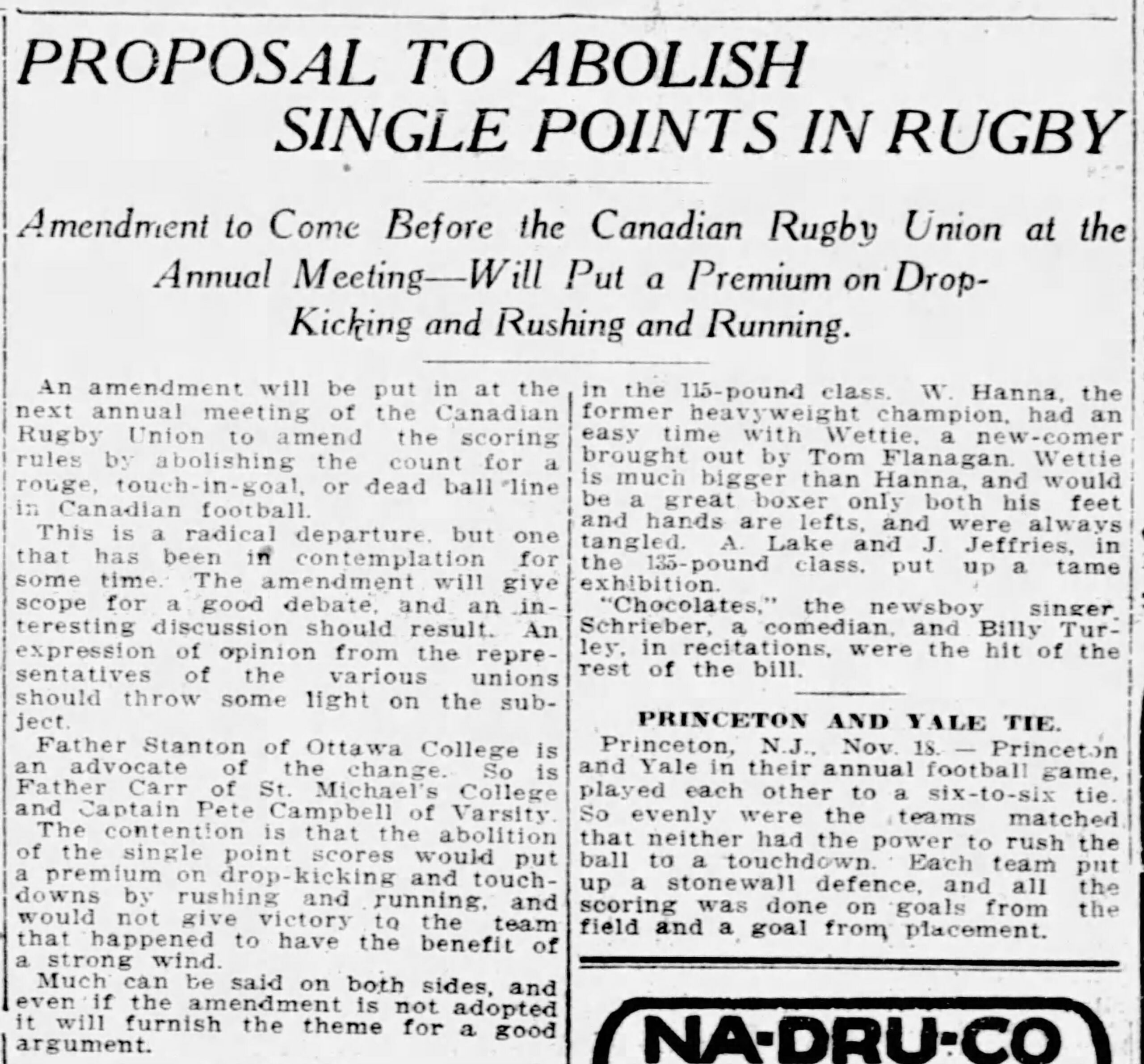
Regardless, the debate over the rouge is nothing new. Below is an article that appeared in the Toronto Star in 1912 about abolishing the rouge in Canadian football. Remember, back then Canadian football was often referred to as rugby.
The main argument in this article seems to be that getting rid of the rouge would encourage more touchdowns and drop kicks – and that teams would no longer be able to take advantage of strong winds to score single points.
Source: The Toronto Star, 19 November 1912, page 13. (newspapers.com)