Category: Saskatchewan

  • Ron Lancaster Retires

    When I first started following CFL football in the early 1990s, Ron Lancaster was considered one of the best coaches in the game. His Edmonton Eskimos were consistently in the hunt for top spot in the West Division. Perennial Grey Cup contenders.

    But long before he was coaching Edmonton onto victory, he was a standout player – one of the best quarterbacks in the game – for the Saskatchewan Roughriders. He actually started his CFL career with the Ottawa Rough Riders in 1960. He and Russ Jackson were Ottawa’s quarterbacking duo. In 1963, he joined the Green Riders.

    Ron Lancaster, dubbed “the Little General,” played 16 seasons with Saskatchewan. Throughout his time quarterbacking the Roughriders, Saskatchewan played in five Grey Cup games, winning in 1966, the Riders’ first championship. In fact, Lancaster had only one losing season in all those years. Quite a remarkable feat.

    That one losing season turned out to be Lancaster’s last…1978. The Roughriders finished with a dismal 4-11-1 record and placed last in the West Division, missing the playoffs. At the age of 40, the Little General would call it quits.

    Ron Lancaster’s final game was on Sunday October 29, 1978 at Commonwealth Stadium in Edmonton. Coming off the bench in the fourth quarter, he led the Roughriders back from a six-point deficit to defeat Edmonton 36-26.

    Here’s how the Regina Leader-Post described Lancaster’s final game:

    Article in the Regina Leader-Post about Ron Lancaster's final CFL game.
    Hughes, Bob. “Lancaster legend comes to appropriate close.” Regina Leader-Post, 30 October 1978, p. 17.

    Within days of playing for the last time, Ron Lancaster formally announced his retirement. He was the CFL’s first player to pass for over 50,000 yards and was selected as the league’s most outstanding player twice (1970 and 1976).

    Photo montage of Ron Lancaster

    Post-Retirement

    Upon retiring as a player, Lancaster was immediately named Saskatchewan’s new head coach, replacing Walt Posadowski. Lancaster’s first head coaching gig wasn’t as successful as his playing career, however, and the Riders missed the playoffs both years Lancaster was at the helm.

    In 1981, he moved to the broadcast booth and became the colour commentator for the CFL on CBC. It was in 1991 that he returned to the sidelines as Edmonton’s head coach.

    In late 1997, we football fans in Hamilton rejoiced as the Little General came east and took over the coaching duties for the Tiger-Cats. In one year, he helped turn around the Ti-Cats, leading the team to the Grey Cup for the first time in almost a decade.

    Sadly, Ron Lancaster died in 2008 just shy of his 70th birthday. A member of the Canadian Football Hall of Fame (inducted in 1982), the Little General is easily one of the greatest to play, coach, and call the game.

  • Saskatchewan Roughriders is Our Name

    Green is the Colour
    Football is the Game
    We’re all together and Winning is our aim
    So Cheer us on through the sun and rain
    Saskatchewan Roughriders is our name

    It’s a familiar tune to many CFL football fans across the country. The chorus ends with the line, “Saskatchewan Roughriders is our name.” So, just when and why did Regina’s football team become the Roughriders? As you will see, it’s… well…a bit complicated.

    The Regina Rugby Club was founded in 1910. They played in the Saskatchewan Rugby Football Union along with teams in Saskatoon and Moose Jaw. The SRFU joined the Alberta and Manitoba leagues to form the Western Canada Rugby Football Union in 1911.

    As early as 1912, the Regina club was being called the Roughriders or Rough Riders. The August 31, 1915 edition of the Regina Leader references the Regina Rough Riders as they kick off the 1915 season.

    An early reference to the Regina Roughriders in the Saskatoon Daily Star in 1912
    An early reference to the Regina Roughriders (The Saskatoon Daily Star, 19 October 1912, page 22)
    Regina Rough Riders Lift Lid of 1915 Season in the Regina Leader
    Source: The Regina Leader, 31 August 1915, page 2 (via newspapers.com)

    The early Regina team had a question of identity not only when it came to the club name but also around deciding which team colours to use. The original colours of the Regina Rugby Club were purple and gold. Then, blue and white. Finally, they settled on red and black. In an alternative universe is there a team called the Saskatchewan RedBlacks?

    After 1915, the “Rough Riders” moniker seemed to fall out of favour. The local newspaper went back to referring to the team simply as the Regina Rugby Club. But, in 1924, according to official team history, the Regina Rugby Club formally became the Regina Roughriders. After the Second World War, the team became the Saskatchewan Roughriders to represent the entire province and eventually changed their team colours to the familiar green and white.

    Regina now Saskatchewan Roughriders article in the Winnipeg Tribune in 1946.
    Source: The Winnipeg Tribune, 3 June 1946, page 14 (via newspapers.com)

    So, what is a “Rough Rider” or “Roughrider” anyway? The most likely answer is that it is a reference to the trainers or “rough riders” who broke wild horses on the Prairies. There is a strong suggestion that the Roughrider name was chosen to pay homage to the “rough riders” of the North-West Mounted Police.

    An alternative theory is that the Roughriders were named after future United States president Teddy Roosevelt’s Rough Rider cavalry regiment in the Spanish-American War of 1898. However, it’s generally accepted that the Roosevelt/Rough Rider connection is associated more with the Ottawa Rough Riders who played in the East.

    Yes, this is where we need to mention that for a long period of time in Canadian football (up to 1996) there were two teams that shared the Rough Riders/Roughriders moniker, each with a distinct yet connected history. This anomoly probably deserves its own blog post at some point.

    There is good article about the “Roughriders” name written by Rob Vanstone posted last year on the Sasktchewan Roughriders’ website. Check it out here: https://www.riderville.com/2024/12/09/rob-vanstone-the-name-game-100-years-of-roughriders/

    So cheer us on through the sun and rain…Saskatchewan Roughriders is our name!


    This is the fourth of a series of posts that will explore the stories behind the names of the existing Canadian Football League teams. See the previous post on the Edmonton Elks.

  • Tiger-Cat Defence Strangles Roughriders

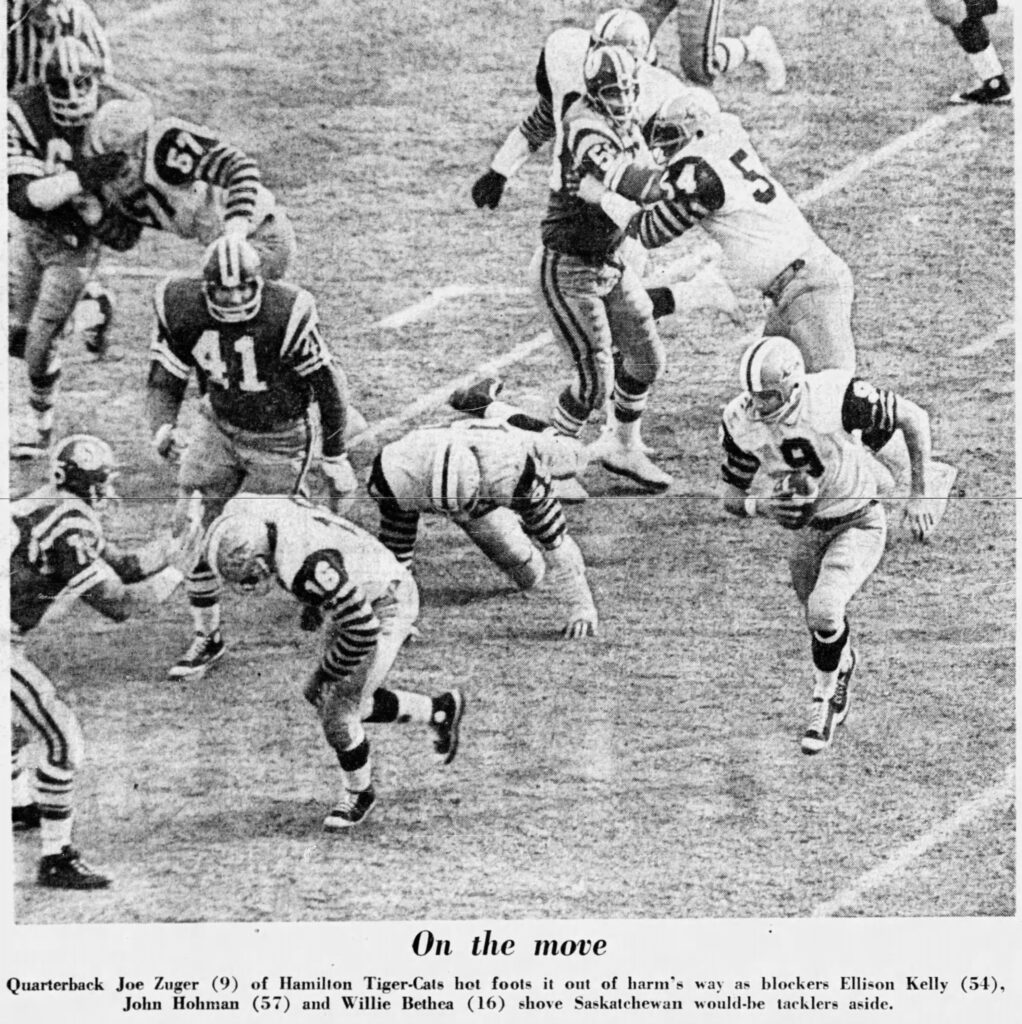
    “Tiger-Cat defence strangles Roughriders” read the headline in The Ottawa Citizen on Monday December 4, 1967. That pretty much sums up Hamilton’s 24-1 win over Saskatchewan in the 1967 Grey Cup game played a couple days earlier.

    1967 Grey Cup action (Ottawa Citizen)
    Source: The Ottawa Citizen, 4 December 1967, page 23.

    1967 – being Canada’s Centennial and all – featured the Grey Cup being played at Lansdowne Park in Ottawa. Tiger-Cats quarterback Joe Zuger (who recently passed away at the age of 84) scored a running touchdown, passed for a touched down, and kicked three singles, leading him to be named Grey Cup MVP.

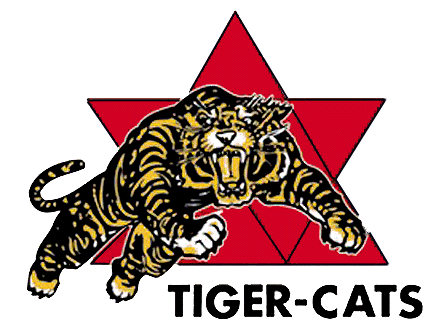
    The Hamilton Tiger-Cats used this commemorative logo in 1967 to celebrate Canada’s Centennial. (courtesy SportsLogos.Net)