Today I want to talk about fields. Canadian football fields, that is. There is still a lot of chatter about the CFL’s decision to adjust its field size in 2027, adopting a 100-yard-long field with 15-yard end zones. Previously, I have written about early Canadian football being played on 100-yard fields in the past. And there have been exhibition games played on similar length fields such as the 1992 game in Portland, Oregon.
But what if I told you there was a CFL game played on a 90-yard-long field? Yes, 90 yards. And ten-yard end zones. Say what? This was no exhibition match, either; rather it was a regular season CFL game that counted in the standings. It happened on Sunday November 3, 1991 in Winnipeg for a game between the Blue Bombers and the Edmonton Eskimos.
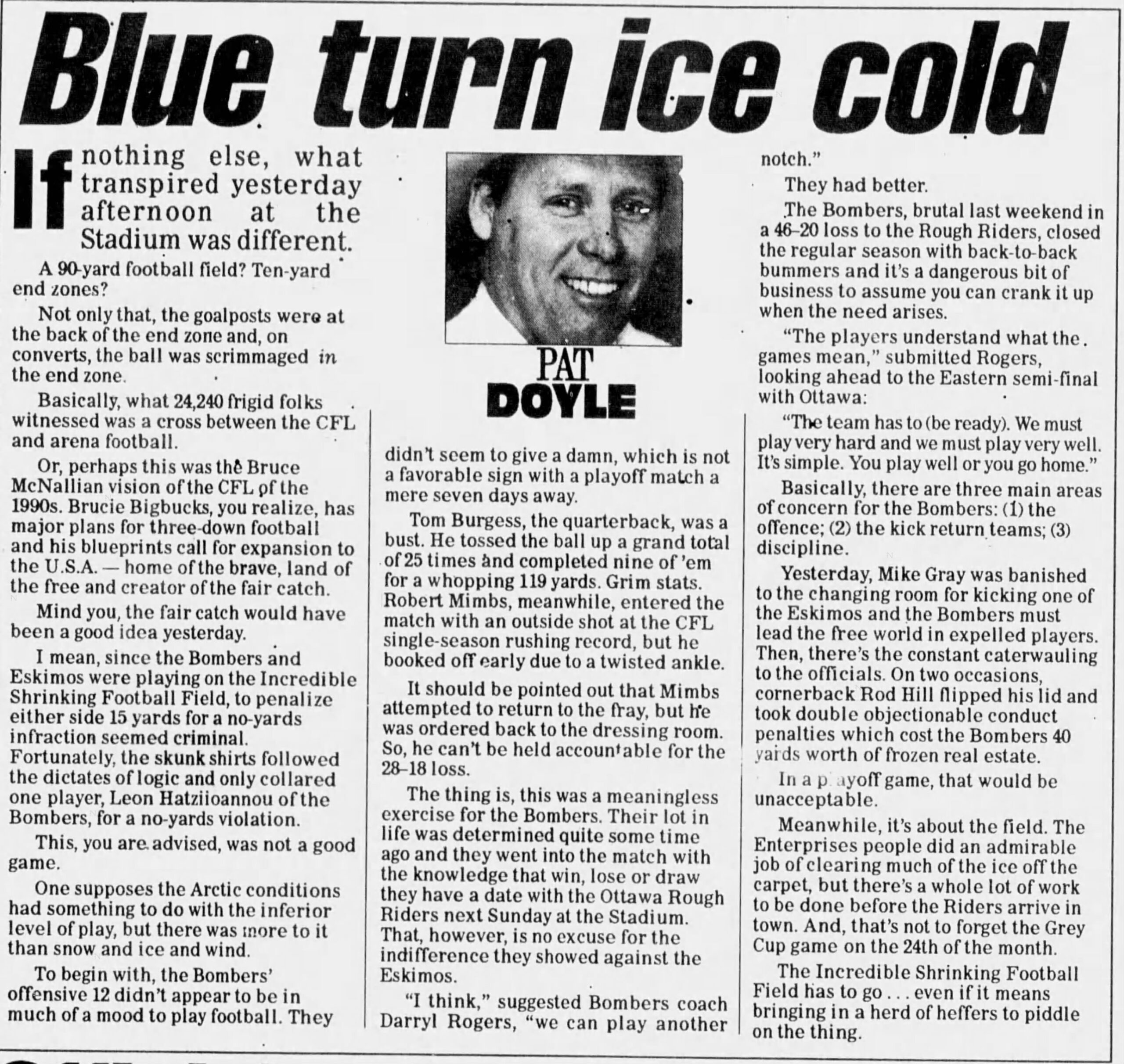
Column by Pat Doyle in the Winnipeg Sun about the CFL game on a shortened field (4 November 1991).
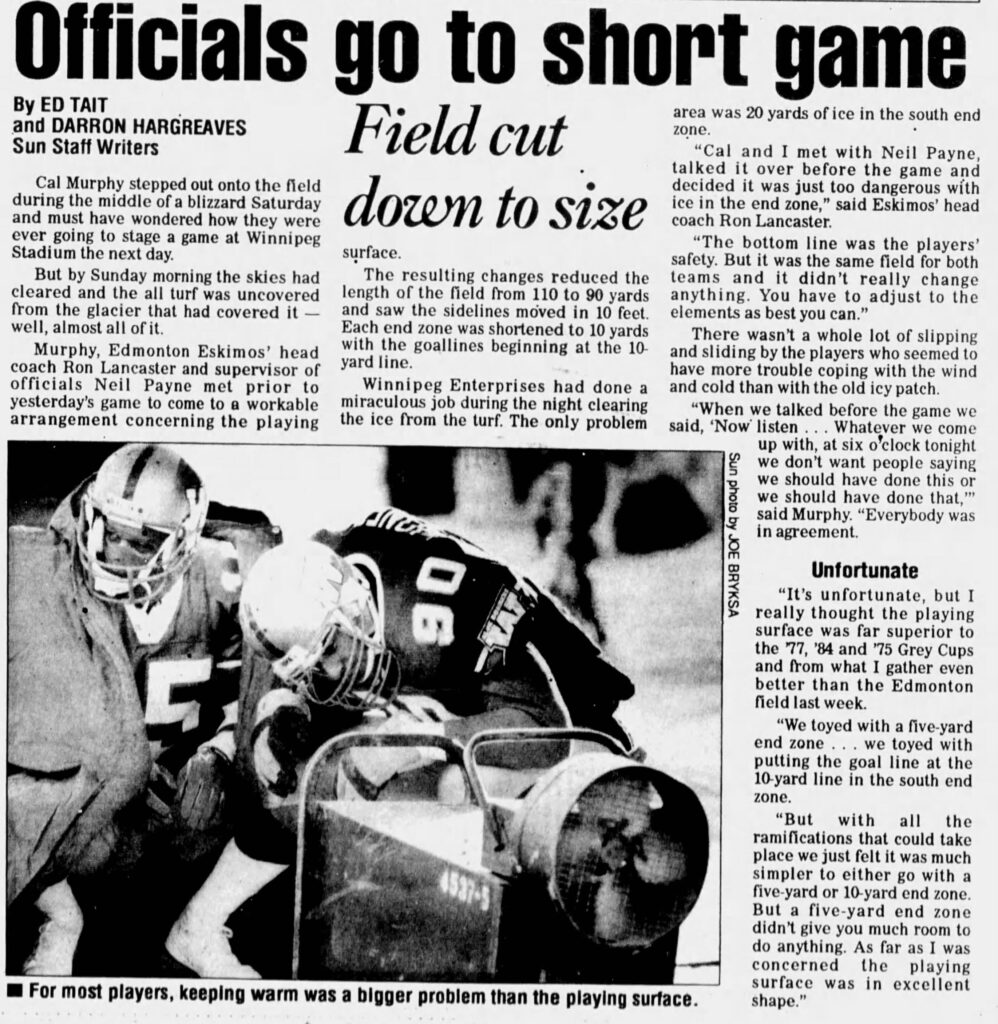
Thanks to a blizzard the previous day, the turf at Winnipeg Stadium was left covered in snow and ice. Although crews had worked diligently through the night, the field was still deemed too dangerous in the end zones and along the sidelines. So, a decision was made to modify the field dimensions in the name of player safety.
More coverage in the Winnipeg Sun by Ed Tait and Darron Hargreaves (4 November 1991).
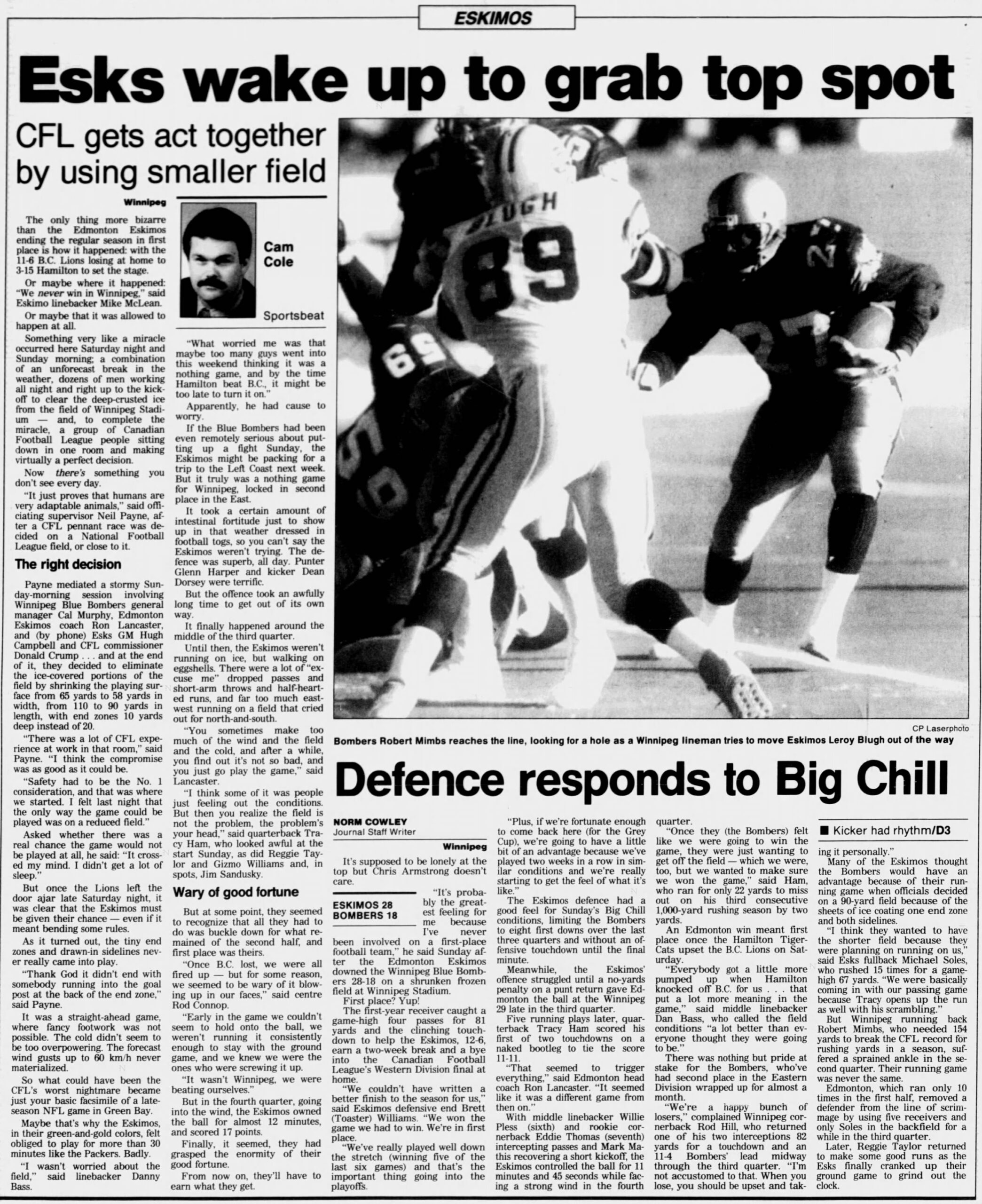
After consulting with the two teams, the CFL reduced the length of the playing surface to only 90 yards. End zones were reduced to ten yards. And the goal posts were placed in the back of the end zone. The width of the field was also reduced to just 58 yards. Ironically there were concerns players would run into the goal posts at the back of the end zones.
Article by Cam Cole in the Edmonton Journal about the shortened CFL field (4 November 1991).
Both Winnipeg and Edmonton made the best of the less-than-ideal situation, though. In the end, Edmonton emerged as victors, winning 28-18 to secure first placed in the Western Division.
So, as we football fans continue to debate the CFL’s pending field dimensions in 2027 let us remember the day the league played on a frozen shrunken field back in 1991.
Sources: Edmonton Journal, 4 November 1991 Ottawa Citizen, 4 November 1991 Winnipeg Sun, 4 November 1991
On July 14, 1994, fans attending the CFL game at Winnipeg Stadium were in for quite the night. In a rematch of the previous year’s Grey Cup, the Winnipeg Blue Bombers hosted the Edmonton Eskimos. Edmonton had beaten Winnipeg in that game and were the defending Grey Cup champions. No doubt the Winnipeg faithful were eager for revenge.
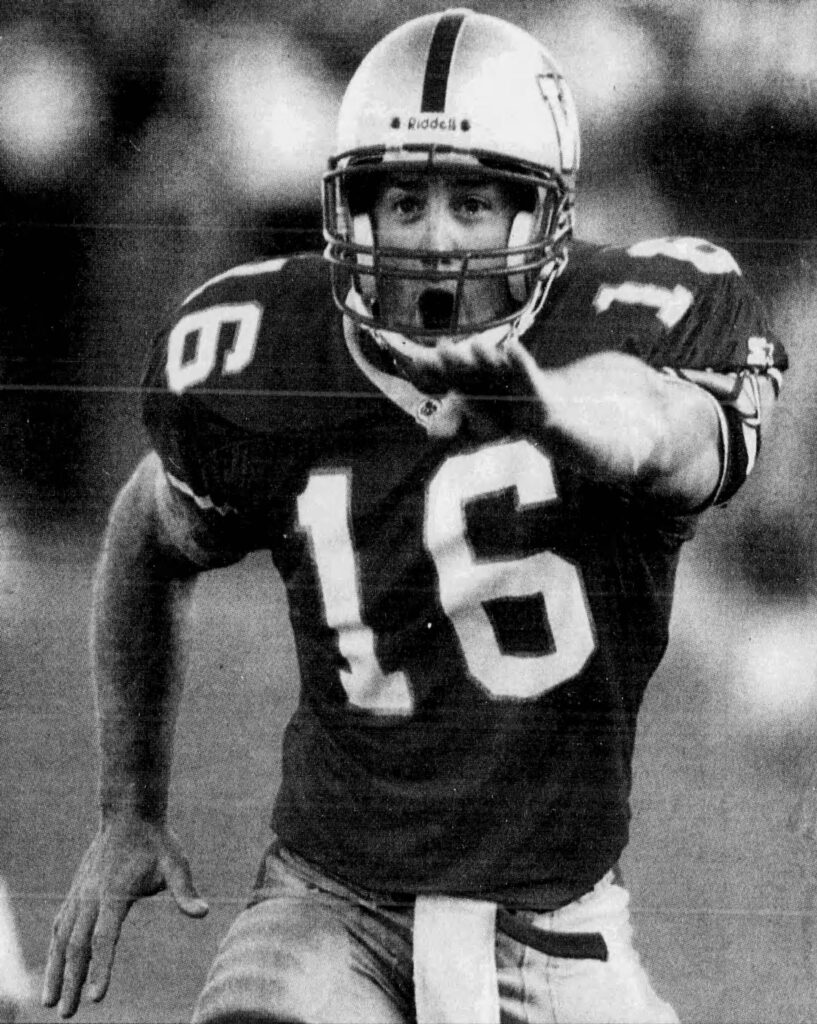
Winnipeg Quarterback Matt Dunigan (Winnipeg Sun)
The game featured two of the CFL’s best quarterbacks at the time. Edmonton’s offence was led by Damon Allen. Leading the charge for Winnipeg was Matt Dunigan. Two future hall of famers.
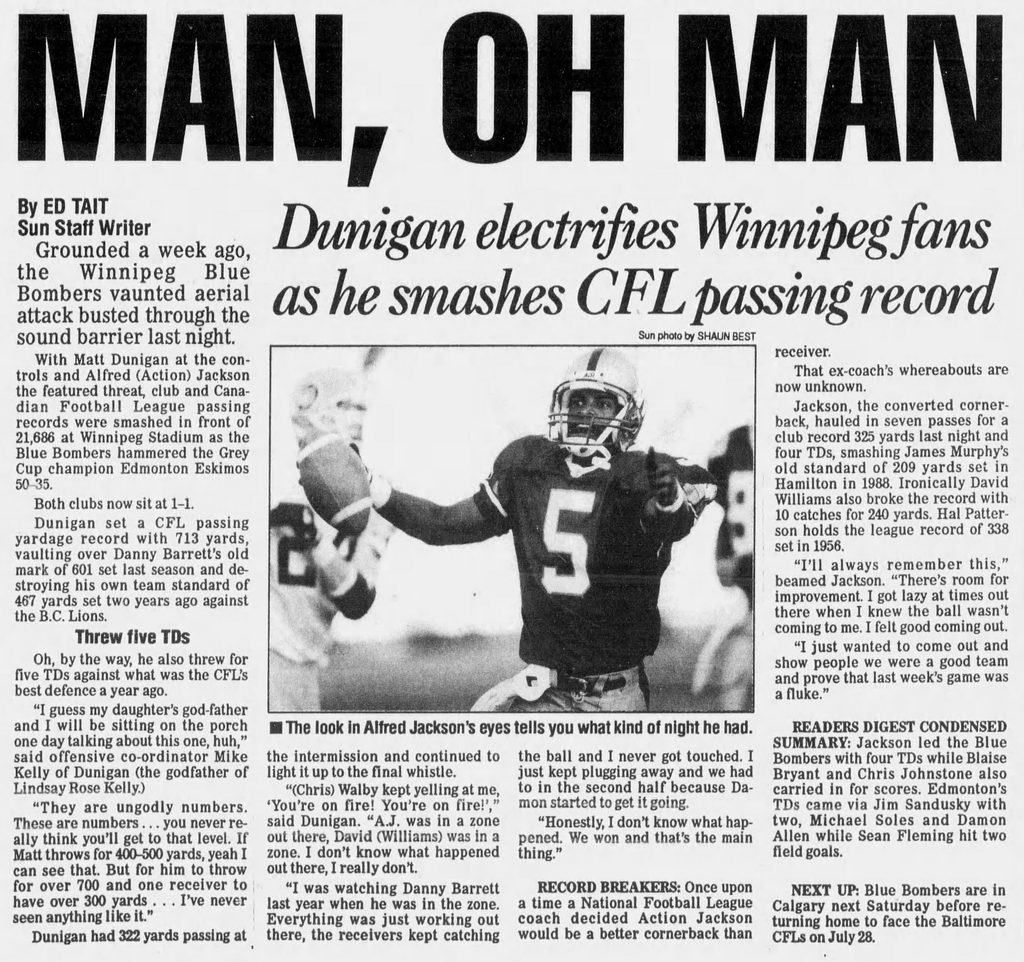
Dunigan’s go-to receiver on this night was clearly Alfred Jackson. Jackson, who previously played on defence, caught seven passes for 325 yards. He ended up scoring four touchdowns in the game. Winnipeg was up only 7-3 after the first quarter. It was during the second quarter when Dunigan and the Bombers really ramped up the aerial attack. Dunigan had already passed for over 300 yards by halftime. The dominance continued throughout the second half. After the final whistle, the game was over.
Account of the record-setting game by Ed Tait in the Winnipeg Sun.
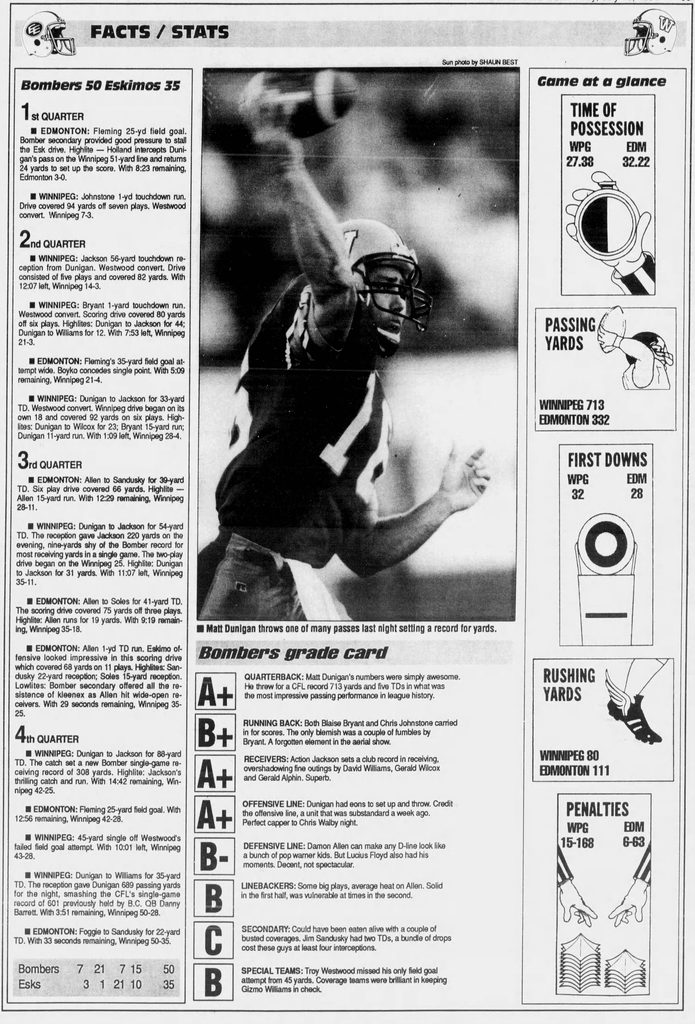
Final score. Winnipeg 50 Edmonton 35. And a new record. Matt Dunigan passed for 713 yards, breaking the CFL record for most yards passed in a single game and easily surpassing Danny Barrett’s 601-yard record set just one year earlier.
Game stats (Winnipeg vs. Edmonton) in the Winnipeg Sun.
Here are some of the quotes that appeared in the newspapers that help put the spectacular performance in perspective:
“That’s a lot of yards. Oh my, that’s a lot. That’s about as well as I’ve ever seen anyone play.” – Winnipeg Head Coach Cal Murphy
“That was impressive. When Matt is hot, he is dynamite.” – Edmonton Head Coach Ron Lancaster, a former quarterback himself
“Something happened out there. I don’t know what it was. They were catching everything. I was throwing everything. It just happened.” – Matt Dunigan
“They were ungodly numbers…I’ve never seen anything like that.” – Winnipeg Offensive Coordinator Mike Kelly
By the way, the record still stands.
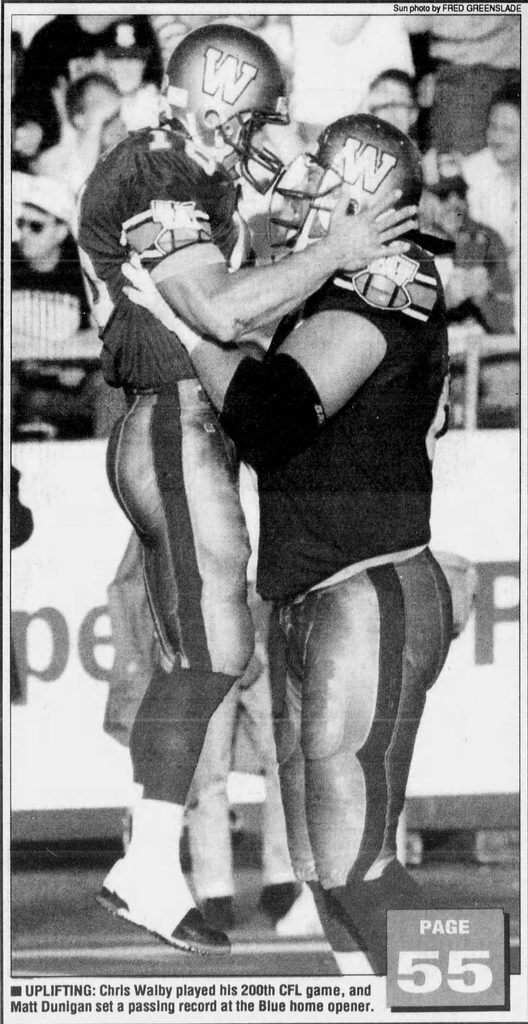
Fred Greenslade’s photo of Chris Walby picking up Matt Dunigan appeared on the front page of the Winnipeg Sun on July 15, 1994.
One of my favourite quarterbacks to play the game is Matt Dunigan. His style of play was so exciting to watch. The man played quarterback like a linebacker.
I was over the moon when he joined the Hamilton Tiger-Cats in 1996. After one particular game, we fans were invited onto the field to meet the players and get autographs.
Of course, I like everyone else made a beeline towards Dunigan. I was a tall, lanky first year university student. When I finally made it to the table where Dunigan was sitting, he looked up and remarked at my height. He then stood up and came to the other side of the table to stand next to me. Towering over him by several inches he looked up and said something along the lines of “that’s how I like my receivers.”
On August 14, 1958, the Canadian Football League played its first-ever game with the Winnipeg Blue Bombers hosting the Edmonton Eskimos at Winnipeg Stadium. The new CFL was founded earlier in the year when the Canadian Football Council withdrew from the Canadian Rugby Union to become a completely separate entity, renaming itself the “Canadian Football League” in the process.
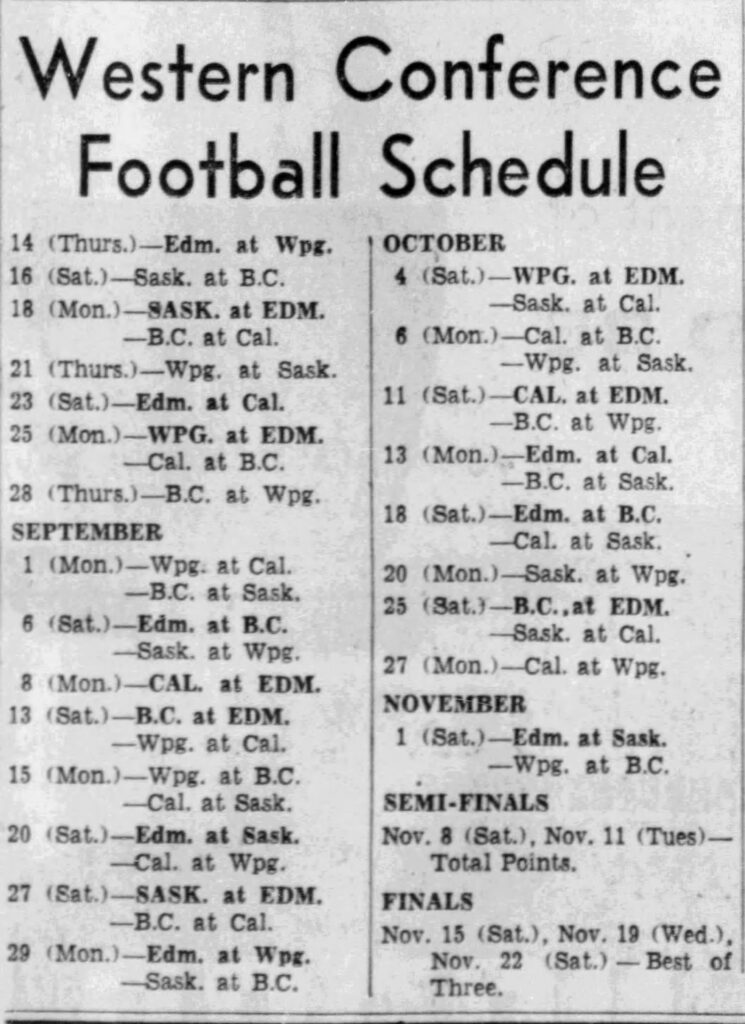
The 1958 WIFU schedule (Edmonton Journal, 14 August 1958).
One thing that stands out to me is the general lack of branding around the “CFL” moniker in the news coverage. Most news articles of the day stick to the established Western Interprovincial Football Union (WIFU) and Interprovincial Rugby Football Union (IRFU)/Big Four branding when covering the new league.
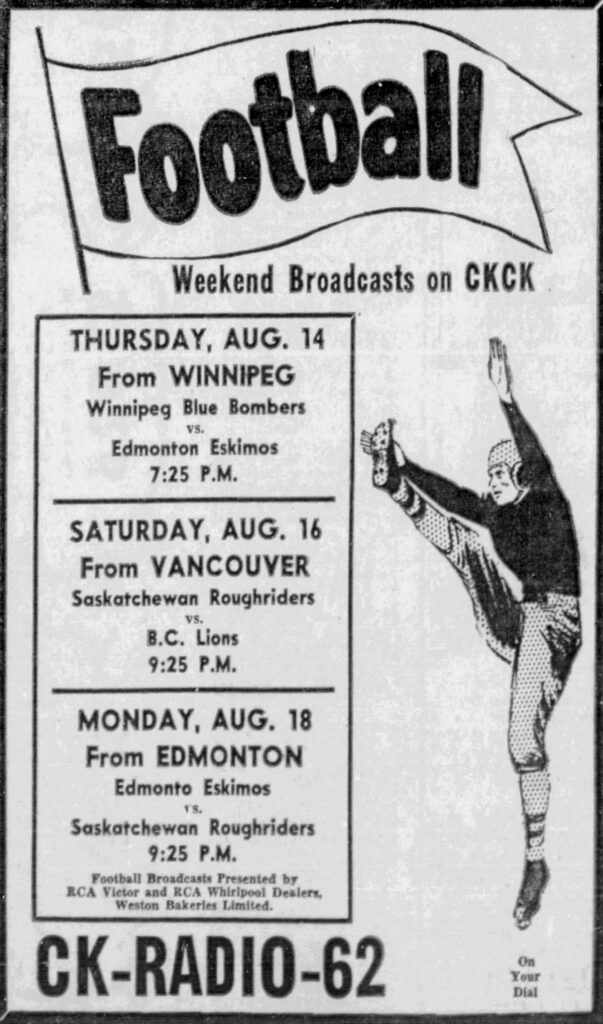
Advertisement for radio broadcasts of the first CFL games (Regina Leader-Post, 14 August 1958).
For all intents and purposes, the CFL was a new league in name only. The Big Four and the WIFU were still their own entities under CFL umbrella, and they maintained a high degree of independence still. While the rules of the game were uniform, the western clubs played 16 regular season games (four games against each opponent in the division) while the eastern clubs played 14 games. When it came to the playoffs, the western final was a best two out of three series while the eastern final was a two-game total point series.
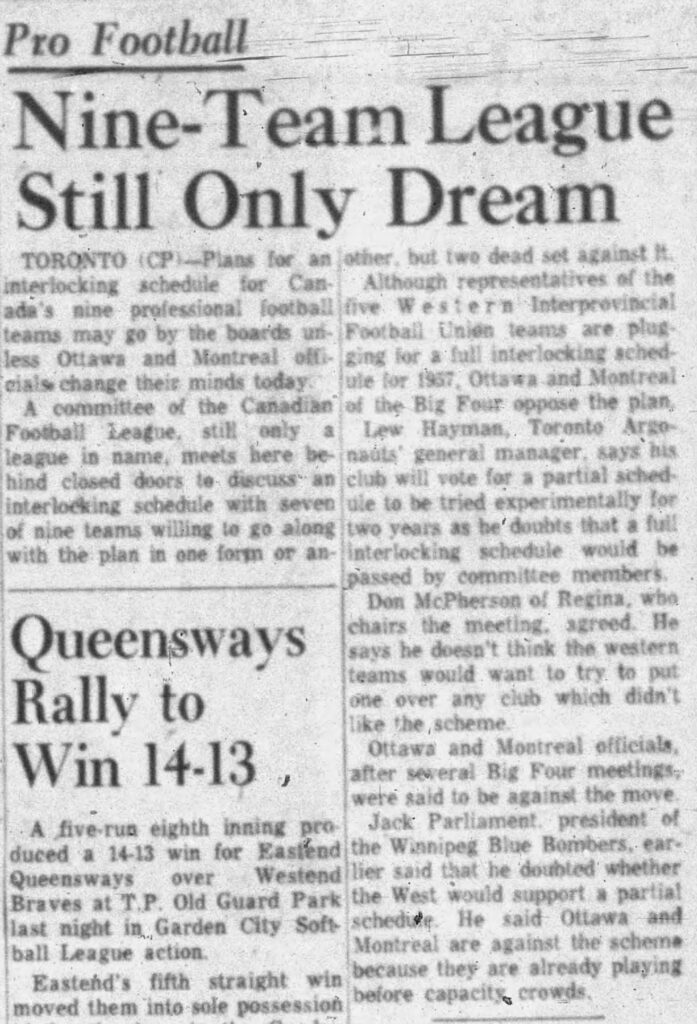
Canadian Press article about lack of interlocking schedule for the new CFL. (St. Catharines Standard, 8 August 1958).
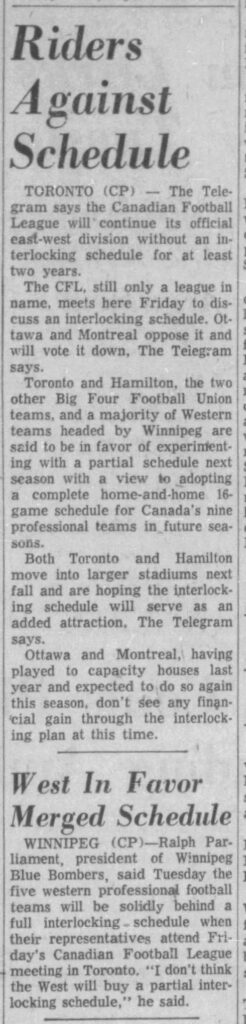
I also find it a bit humorous that from the onset of the CFL’s conception, the teams were at odds over adopting an interlocking schedule. It appears Montreal and Ottawa both initially opposed the implementation of an interlocking schedule. I guess self-interest and lack of big picture vision have always been built into the CFL’s DNA. It wasn’t until 1961 that the CFL finally adopted a partial interlocking schedule. Until then, the only time the east played the west was in the Grey Cup.
Article about the Ottawa Rough Riders and Montreal being opposed to an interlocking schedule in 1958 (Ottawa Citizen, 6 August 1958).
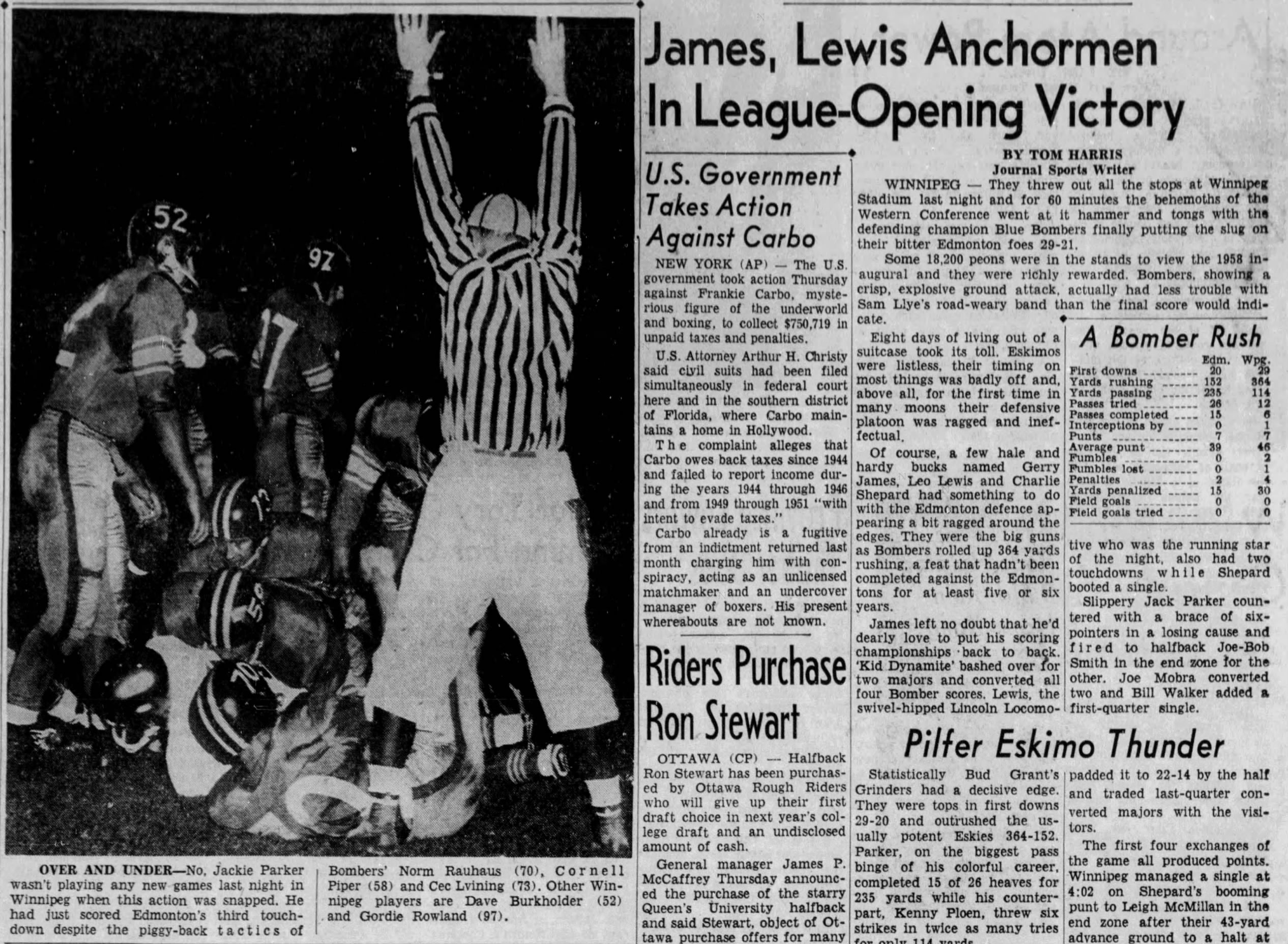
Now, back to that historic CFL debut in Winnipeg. The Bombers and Edmonton were seen as two powerhouses in the WIFU. In a rematch of the previous year’s western final, a crowd of 18,206 watched Winnipeg rush for 364 yards to overpower their rival. Here’s how the Edmonton Journal reported the game:
Account of the first CFL game (Edmonton Journal, 15 August 1958)
Final score. Winnipeg 29 Edmonton 21.
Sources: Edmonton Journal, 14 August 1958 Edmonton Journal, 15 August 1958 Ottawa Citizen, 6 August 1958 Regina Leader-Post, 14 August 1958 Regina Leader-Post, 15 August 1958 St. Catharines Standard, 8 August 1958
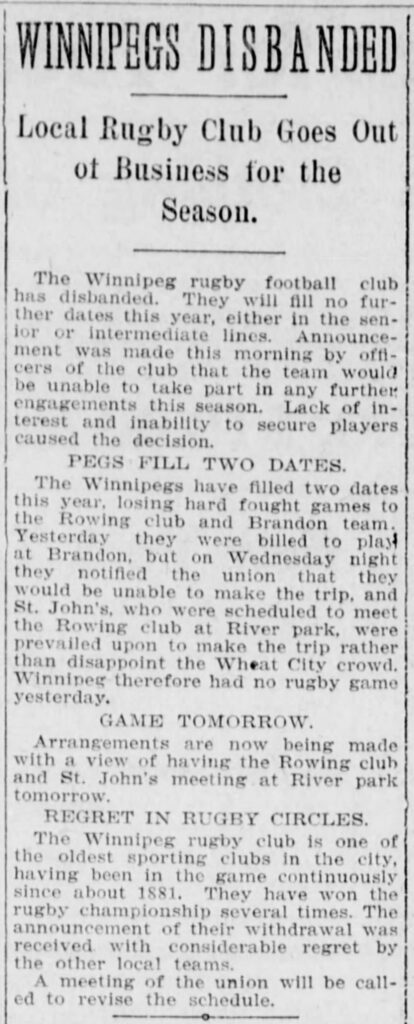
Today, we’re going to go west and examine a rather peculiar set up for the 1906 season of the Manitoba Rugby Football Union.
The MRFU was founded in 1892 and included a number of teams over the years. In 1906, four teams competed in the league’s senior competition: the Winnipeg Rugby Football Club (known as the Winnipegs), the St. John’s Rugby Football Club, the Winnipeg Rowing Club, and the Brandon Football Club.
Financial constraints led to an unbalanced schedule. For instance, Brandon – being the only team from outside of Winnipeg – was allowed to play just four games. On the other hand, St. John’s and the Rowing Club were scheduled to play five games each. The Winnipegs were originally scheduled to play six games.
To compensate for the unbalanced schedule, the MRFU devised a somewhat complicated but rather ingenious points system to provide some equity in the standings. Teams could receive a total of 30 points maximum on the season (if they won all their games). A value for a team’s win would be weighted depending on how many games they were to play. The formula used was 30 divided by the number of games played. In summary, Brandon would receive 7-1/2 points for each win (30 divided by four games played), St. John’s and the Rowing Club would receive 6 points for a win (30 divided by five games played), and a Winnipeg win would be worth five points (30 divided by six games played).
Here is how the Winnipeg Tribune explained the schedule and points system:
Winnipeg Tribune (14 September 1906)
The team with the most points in the standings was determined the champion. The Winnipegs picked up one win but lost two games and defaulted three of their remaining games after pulling out of the competition, finishing with a 1-5 record and five points.
Here is the article published in the Winnipeg Tribune about the Winnipeg Rugby Football Club ceasing operations during the 1906 MRFU season:
Winnipeg Tribune (19 October 1906)
The top two teams – Winnipeg Rowing Club and Brandon – squared off on Sunday October 28th in a game that ultimately determined the championship. The “Oarsmen” (as the rowing club was nicknamed) defeated Brandon by a score of 20-1. The win gave the Winnipeg Rowing Club an undefeated 4-0 record and 24 points in the standings. Brandon ended the season 3-1 with 22-1/2 points.
Winnipeg Tribune (19 October 1906)
The Rowing Club had one more game to play versus St. John’s, but the game was cancelled as it had no meaning in the standings, the Oarsmen having already earned the highest number of points to win the 1906 MRFU championship.
Of course, the MRFU wasn’t a member of the Canadian Rugby Union, so the Manitoba champion wasn’t eligible to compete in any playoff for the Dominion championship.
Sources: Winnipeg Tribune (14 September 1906) Winnipeg Tribune (19 October 1906) Winnipeg Tribune (29 October 1906)
When the Canadian Football League rolled out American expansion in the early 1990s, support for the idea was far from unanimous. Yes, proponents argued that U.S. expansion was the way forward to grow the league and to help stabilize the struggling Canadian teams. But detractors countered that the CFL simply stood too much to lose in the process.
Traditional CFL fans – many who had supported their teams for decades – feared the CFL would gradually lose its identity and uniqueness as more American teams came onboard. Canadian players felt threatened that they would ultimately lose their jobs once it became evident that the league’s import ratio could not be enforced in the United States due to American labour law. Add in some sceptical media and tepid team governors and it became quite apparent that this was going to take some serious convincing by Larry Smith, the CFL commissioner at the time, who was tasked with implementing the league’s expansion plan.
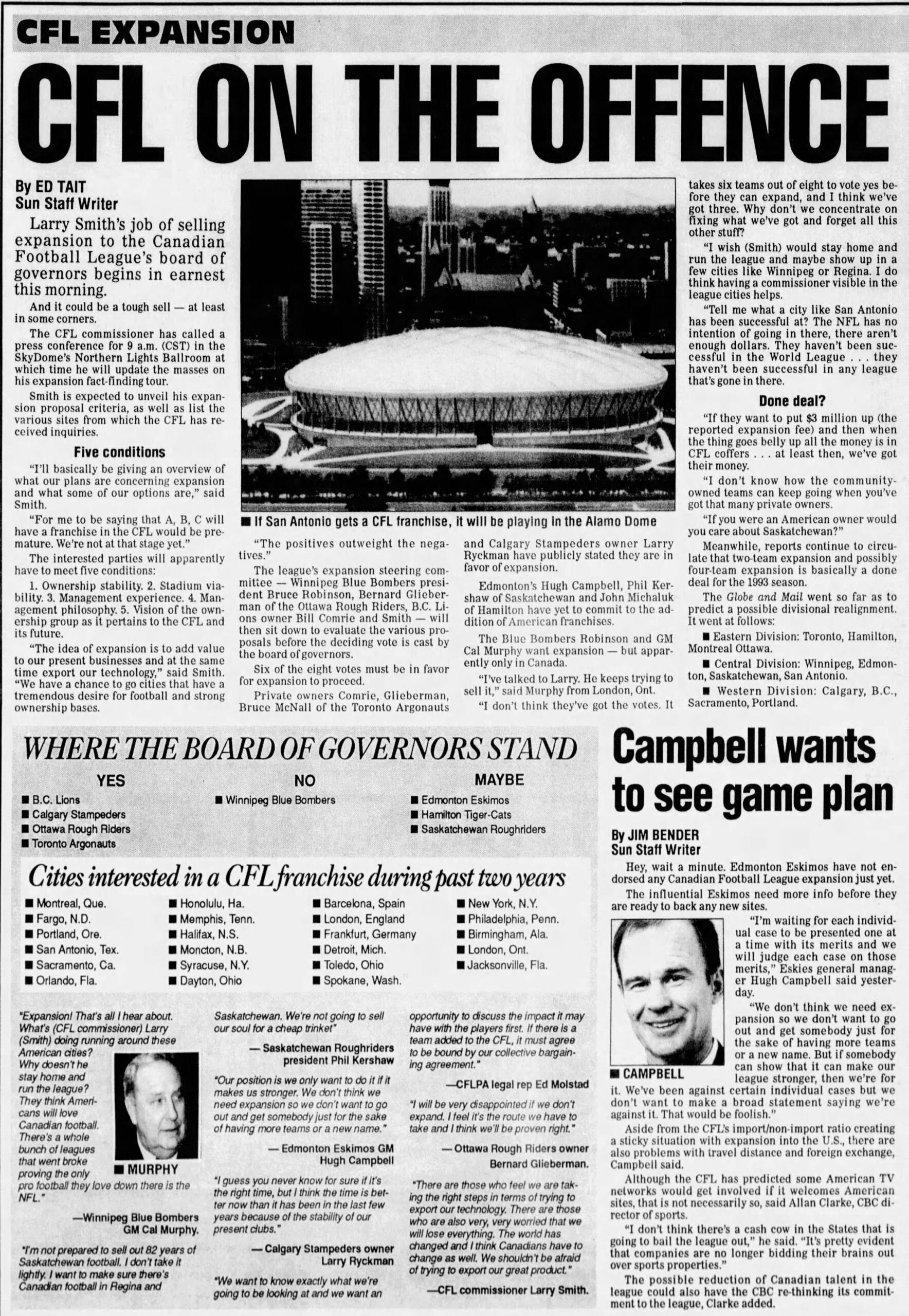
Perhaps the greatest opposition to CFL expansion to the United States came out of Winnipeg. Looking back, it appears the Manitoba capital was ground zero for opposition to American expansion. I had a great chat with Ed Tait on this subject. Ed was the beat reporter for the Winnipeg Sun covering the Blue Bombers at the time. He recalls how Winnipeg took a bit of heat for being against expansion.
Ed Tait’s piece in the Winnipeg Sun (November 12, 1992) along with other CFL expansion tidbits.
“Cal Murphy (Winnipeg GM and head coach) and Bruce Robinson (Blue Bombers president) were against it,” Ed recalls. “Cal Murphy being a Canadian certainly influenced his opposition, for sure.”
“I remember an article in one of the Toronto newspapers that basically called the Bomber organization a bunch of dinosaurs stuck in the past and unwilling to embrace change.” Winnipeg responded by selling t-shirts with the slogan Dinosaurs play hard rock football.
Winnipeg’s politicians even got into the debate. Winnipeg South Centre MP Lloyd Axworthy, who would later serve as a Minister of the Crown in Jean Chrétien’s government, introduced a Private Member’s Bill in the House of Commons to block the CFL from expanding to the U.S., raising the ire of Larry Smith.
Canadian Press article about Winnipeg MP Lloyd Axworthy anti-expansion bill.
In the end, though, the CFL’s Board of Governors approved the addition of Sacramento and San Antonio by a vote of 7-1. Yes, Winnipeg was the lone dissenter.
Ed Tait shared with me some of his memories of covering the Winnipeg Blue Bombers during the CFL USA era. He was in the room at the Coach of the Year dinner in Edmonton in January 1993 when San Antonio backed out just two weeks after being admitted. “We were all there to celebrate,” he recalls “Then we get the news that San Antonio isn’t going to happen. Larry Smith literally ducked out through the kitchen to avoid giving any interviews.” Talk about a rocky start.
Wild is the word he uses to describe the expansion experience. “They were definitely fun road trips. I kind of marvelled at covering a Bombers game in places like Shreveport, Louisiana and Birmingham, Alabama and Las Vegas,” he said.
The game in Las Vegas is notorious for drawing such a dismal crowd. Only 2,350 fans came out to Sam Boyd Stadium to watch the Las Vegas Posse host the Blue Bombers. And about a third of them were from Winnipeg who came down for the game. Yikes.
Ed shares the commonly held view that the CFL expanded out of desperation and didn’t do its homework on choosing expansion markets. “It made the league a bit of a laughing stock,” he admits. That said, Ed made a habit of collecting various memorabilia of the U.S.-based teams. No doubt, he recognized that the expansion experiment wouldn’t last and that the merchandise would be something unique to hold on to.
Perhaps my favourite story he shared was his experience in Shreveport. Apparently, Shreveport had a pretty high homicide rate. On the ride to the stadium, when he asked the taxi driver if it was true that most people there carried handguns for protection, the driver nonchalantly raised the console cover to show a loaded .45 handgun. Guess that answered that question.
Ed told me that the most memorable Grey Cup that he covered as a journalist was the 1994 game in Vancouver between the BC Lions and Baltimore. That was the first time an American team played in the Grey Cup. “The whole us vs. them made this Grey Cup very special,” he says. And just last year at the 2025 Grey Cup in Winnipeg, several fans from Baltimore were there proudly waving their Stallions flags, representatives from a short-lived and bygone era.
Some thirty plus years later, there are no American teams in the CFL. Sure, the topic of U.S. expansion comes up now and then. I guess we’ll have to wait and see if it ever gains any momentum again. But for now, I think it’s safe to say that the lone dissenters, the so-called dinosaurs in Winnipeg were right all along.
Special shoutout to Ed Tait, who is now the Senior Writer/Reporter for the Winnipeg Blue Bombers, for taking the time to share his thoughts and memories with me. Thanks Ed.
Sources: The Winnipeg Sun, 12 November 1992 The Ottawa Citizen, 29 November 1992