Category: Winnipeg

  • Canada’s First National Commissioner of Football

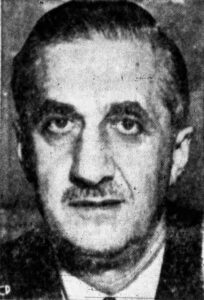
    As the CFL formally introduces Stewart Johnston as its new Commissioner this week, Canadian Football History looks back at the very first CFL Commissioner: Gerald Sydney Halter.

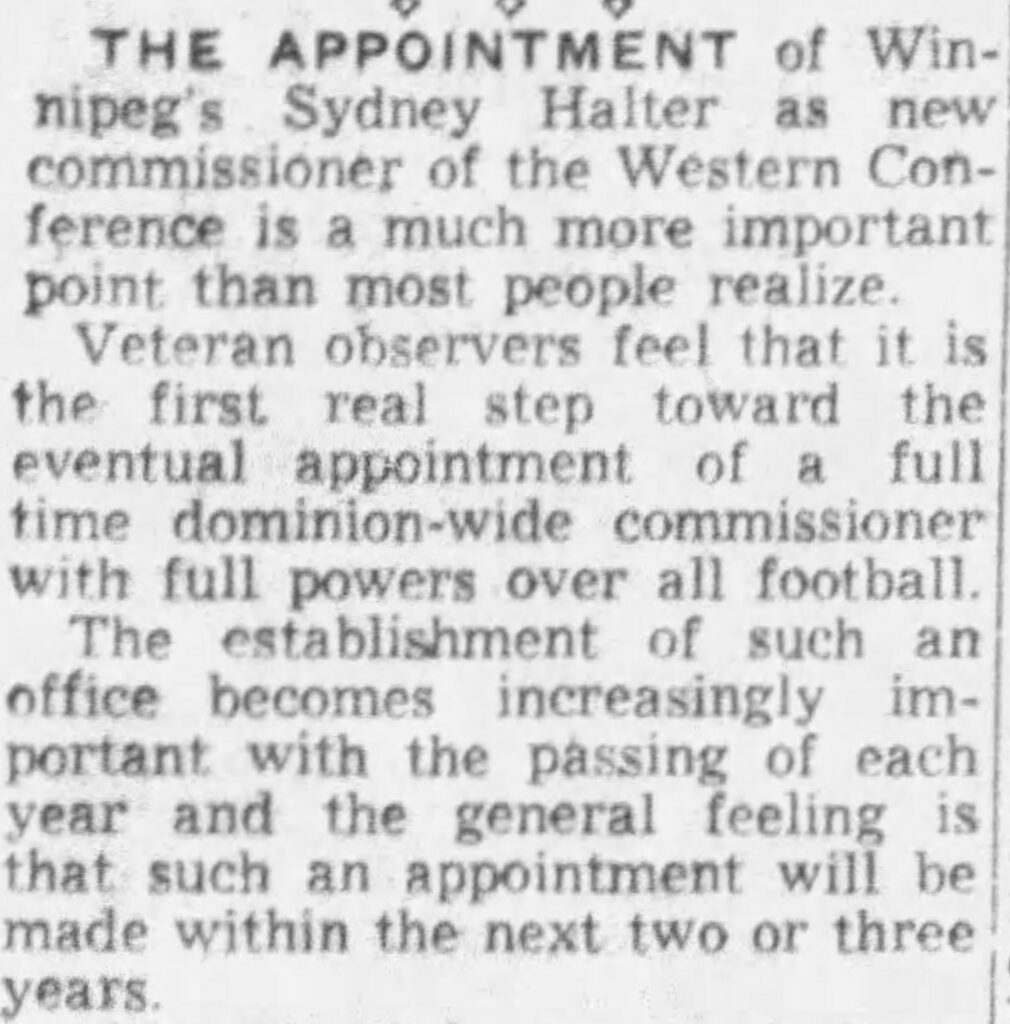
    Sydney Halter was born and raised in Winnipeg, Manitoba. He held various roles, including treasurer and president, in the Winnipeg Blue Bombers organization before being named the Commissioner of the Western Interprovincial Football Union in 1953.

    In 1956, he became the Registrar of the Canadian Football Council (CFC), a newly formed umbrella organization for both the WIFU and the eastern Interprovincial Rugby Football Union (the “Big Four”).

    Well regarded in football circles across the country, Sydney Halter was named “Canada’s first national commissioner of football” when the Canadian Football League was established by the CFC in 1958. By the way, I totally think the CFL should adopt “National Commissioner of Football” as the official job title for its top role.

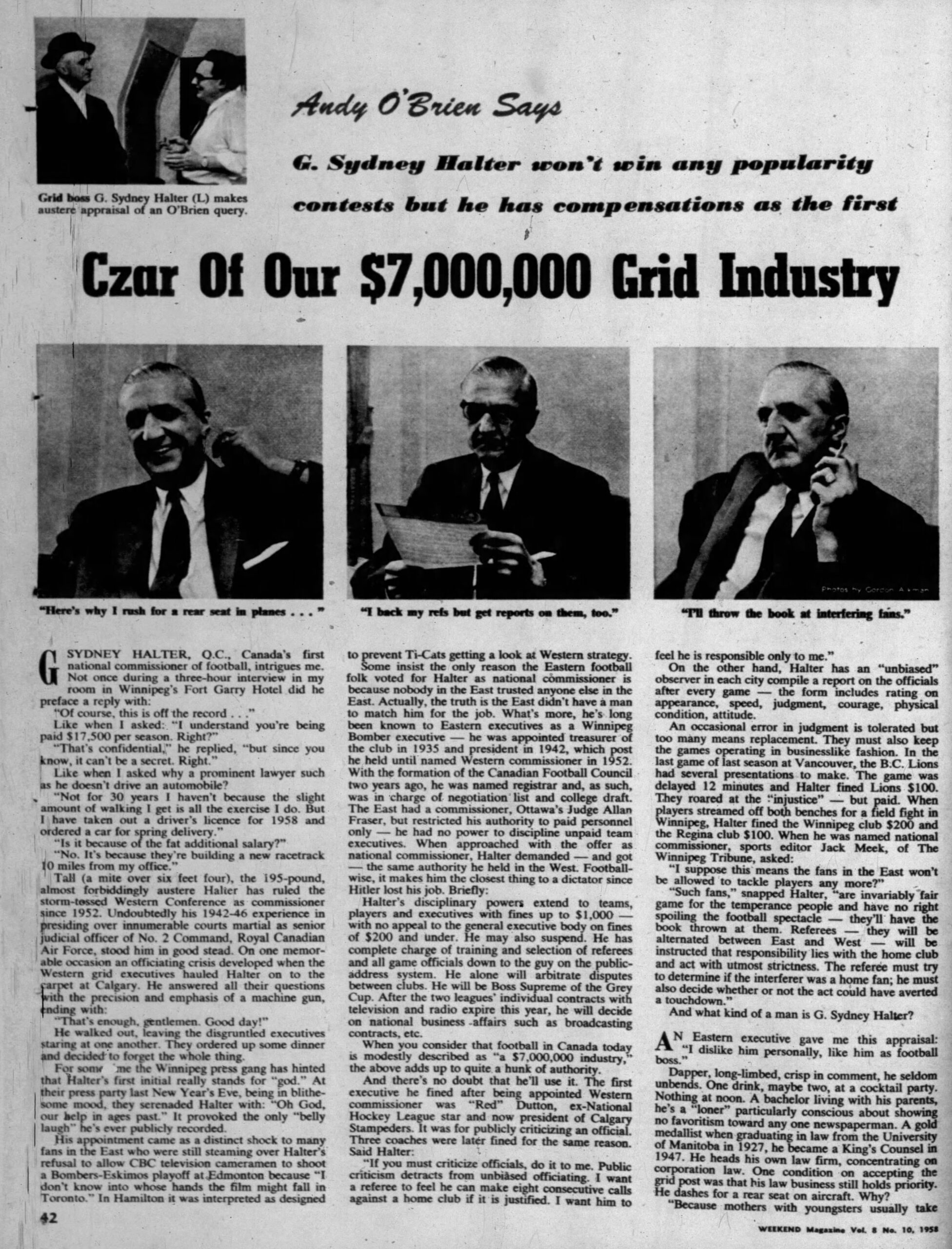
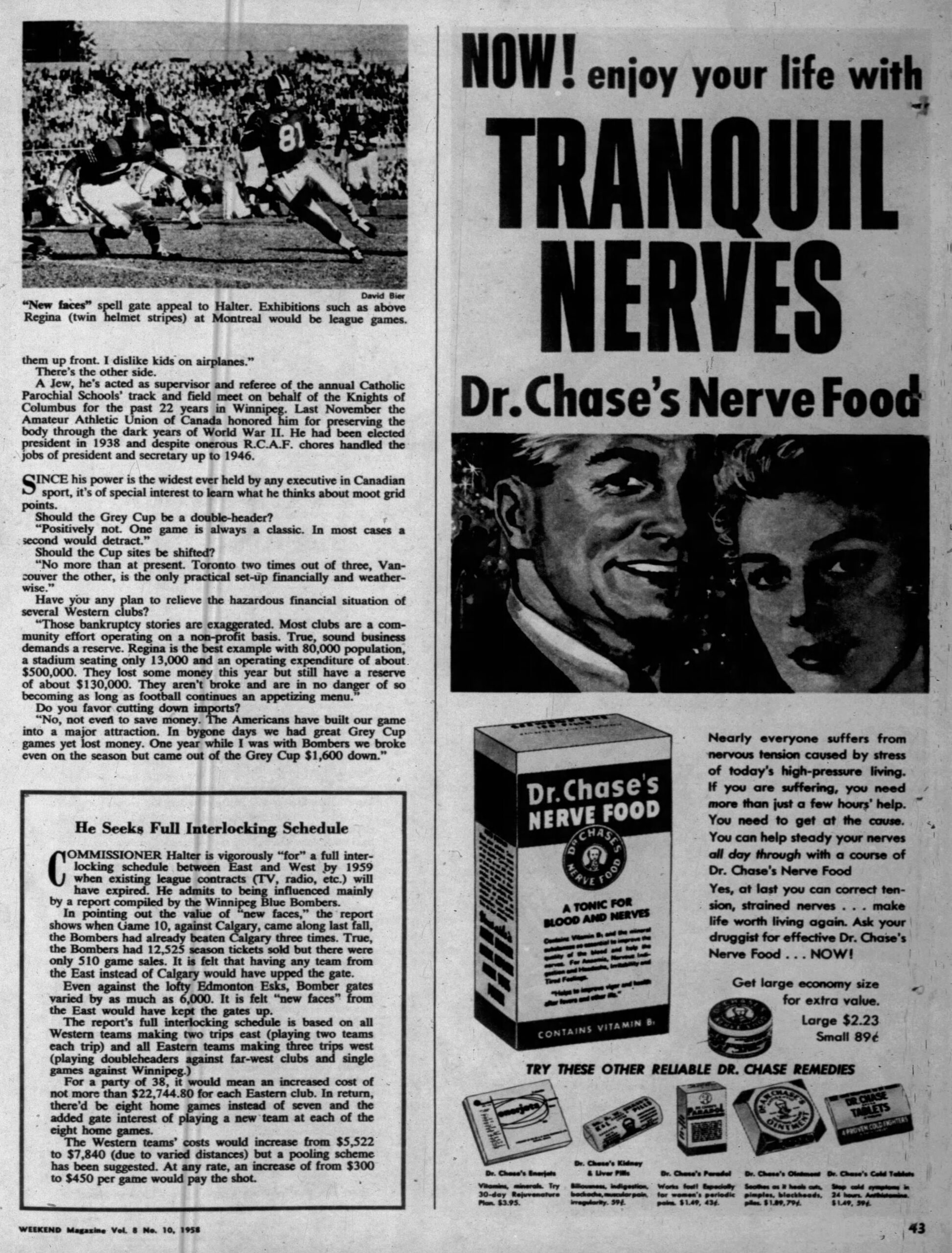
    Described as a chain-smoking bachelor or “loner” by some, Sydney Halter wielded quite a bit of power in his role as Canada’s professional football boss. The article below (click on them to enlarge) is lengthy but well worth the read. It portrays Halter as a straight shooter and touches on how he didn’t hesitate to deliver fines to players and teams – or fans who interfered in the game. Apparently, home fans tackling opposing players from scoring touchdowns was a thing. Yikes.

    O’Brien, Andy. “Czar of Our $7,000,000 Grid Industry.” The Hamilton Spectator, 8 March 1958, p. 90.
    O’Brien, Andy. “Czar of Our $7,000,000 Grid Industry.” The Hamilton Spectator, 8 March 1958, p. 91.

    Sydney Halter served as the CFL’s commissioner until 1966. He was an early advocate for an interlocking schedule between the East and the West. A lawyer by profession, he also served in the Royal Canadian Air Force and held leadership positions in other Canadian sporting organizations outside of football.

    Sydney Halter is a member of the Canadian Football Hall of Fame, inducted in 1966, as “the architect of the modern-day Canadian Football League.” He died in 1990. He was Jewish and was inducted posthumously into the International Jewish Sports Hall of Fame in 2005.

  • The Blue Bombers of Western Football

    The Winnipeg Blue Bombers. Boxing legend Joe Louis. Labatt Breweries. And the Toronto Blue Jays. Believe it or not there’s an interesting connection between these four entities spanning several decades.

    The Winnipeg Football Club was established in 1930. They were originally called the Winnipeg Rugby Football Club but dropped the “Rugby” from the team’s name not long after being formed. The team was unofficially known simply as the Winnipegs or the ‘Pegs for short. In the early days, the club wore green and white uniforms before quickly adopting blue and gold as their team colours. This colour choice plays an important part of the story as you will see.

    In 1935, Winnipeg travelled east to Hamilton and beat the hometown Tigers 18-12 in the Grey Cup. The victory gave the Winnipegs the distinction of becoming the first western team to win the Grey Cup championship. Enthusiastic crowds welcomed home the Winnipegs, and businesses lined up to congratulate the new champions of “Canadian rugby.”

    Hudson's Bay Company advertisement congratulating the Winnipegs on their 1935 Grey Cup victory
    Hudson’s Bay Company advertisement congratulating the Winnipegs on their 1935 Grey Cup victory (source: The Winnipeg Tribune, 10 December 1935, page 17)

    Around the same time, an African American by the name of Joe Louis was taking the professional boxing world by storm. He was given the racialized nickname “The Brown Bomber” by American media. The story goes that a local Winnipeg journalist named Vince Leah, catching wind of the “Brown Bomber” nickname, referred to the Winnipegs as the “Blue Bombers of Western Football.”

    The name stuck, and the football club became known as the Winnipeg Blue Bombers ever since.

    Winnipegs All Set to Open Campaign (1936)
    Media started referring to the Winnipegs as the “Blue Bombers” in 1936. (source: The Winnipeg Tribune, 5 September 1936, page 21.)
    Reference to the "Blue Bombers" as the name of Winnipeg's football team
    The Super Bombers (source: The Winnipeg Tribune, 31 October 1936, page 29.)

    In the 1950s, Labatt Breweries introduced a new brand of beer in the Manitoba market. With its colourful blue labelling, Winnipeg football fans referred to the beer as Labatt “Blue.” Labatt eventually adopted the name officially and became a sponsor of the Blue Bombers and the CFL.


    Fast forward a couple decades later. Toronto was awarded an expansion franchise in Major League Baseball. Labatt Breweries had a significant ownership stake in the new team and wanted to leverage its Labatt Blue brand. Toronto’s other two sports teams – the Argonauts and the Maple Leafs – both had blue as a team colour. The writing was on the wall. Toronto’s new sport team was also going to be blue. So, the Toronto Blue Jays were born.


    Further reading:

    Football in Winnipeg (Manitoba Museum)

    Labatt Blue origins (Labatt website)


    This is the fifth of a series of posts that will explore the stories behind the names of the existing Canadian Football League teams. See the previous post on the Saskatchewan Roughriders.

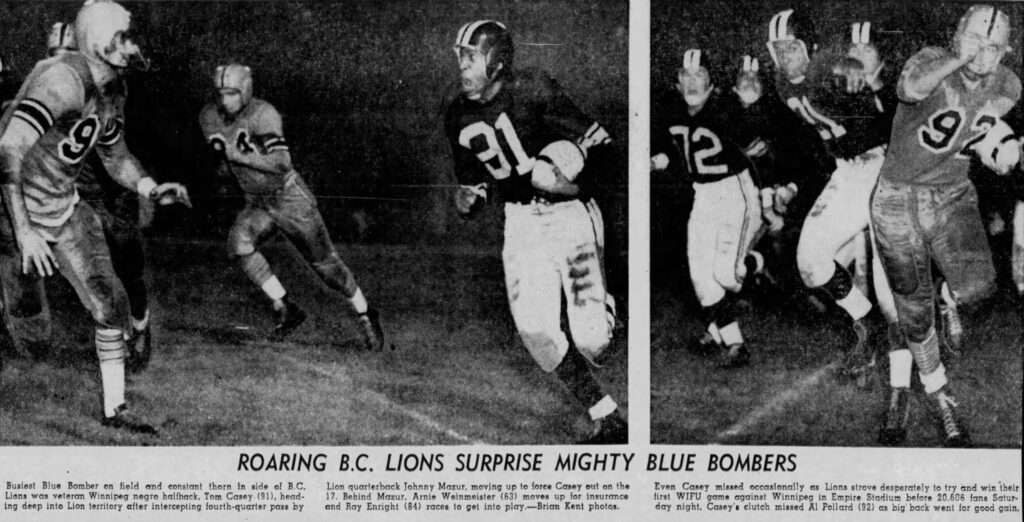
  • Roaring B.C. Lions Surprise Mighty Blue Bombers

    BC Lions first game action (Vancouver Sun)
    Source: The Vancouver Sun, 30 August 1954, page 14.

    On August 28, 1954, the British Columbia Lions made their debut in the Western Interprovincial Football Union narrowly losing to the Winnipeg Blue Bombers 8-6 at Empire Stadium in Vancouver.

    Winnipeg halfback Tom Casey (#91) was a key player in the Bombers’ victory.

    The game attracted a crowd of 20,606.