It’s Draft Day in the Canadian Football League. Today is the day when the CFL’s nine teams divvy up the incoming top Canadian players. It’s done in an orderly fashion through a number of rounds to allow for competitive fairness and to encourage parity.
In the early days of Canadian football, players tended to be locally based so there was really no need for a draft. Even as the game became more professional, teams selected players based on territorial rights.
In 1952, the Interprovincial Rugby Football Union (IRFU) aka the Big Four experimented with a draft. The draft allowed the four teams (Hamilton, Toronto, Ottawa, and Montreal) to name players who would then be off limits to the other clubs unless an agreement could be reached between the teams.
Source: “Big Four Draft List Complete For Campaign.” The Montreal Star, 12 July 1952, p. 22.
In 1953, the Big Four draft became more formalized. The draft was limited to forty Canadian players from five universities: McGill, Queen’s, the University of Toronto, McMaster, and the University of Western Ontario.
The Montreal Alouettes selected Doug McNichol, a defensive lineman, from the University of Western Ontario in the first pick overall.
“Alouettes Draft Doug McNichol.” The Montreal Star, 24 January 1953, p. 25.Image of Doug McNichol card courtesy of the Vintage Football Card Gallery.
It wasn’t until 1956 that a Canada-wide draft was held.
As the CFL formally introduces Stewart Johnston as its new Commissioner this week, Canadian Football History looks back at the very first CFL Commissioner: Gerald Sydney Halter.
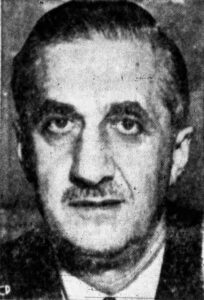
G. Sydney Halter, the CFL’s First Commissioner
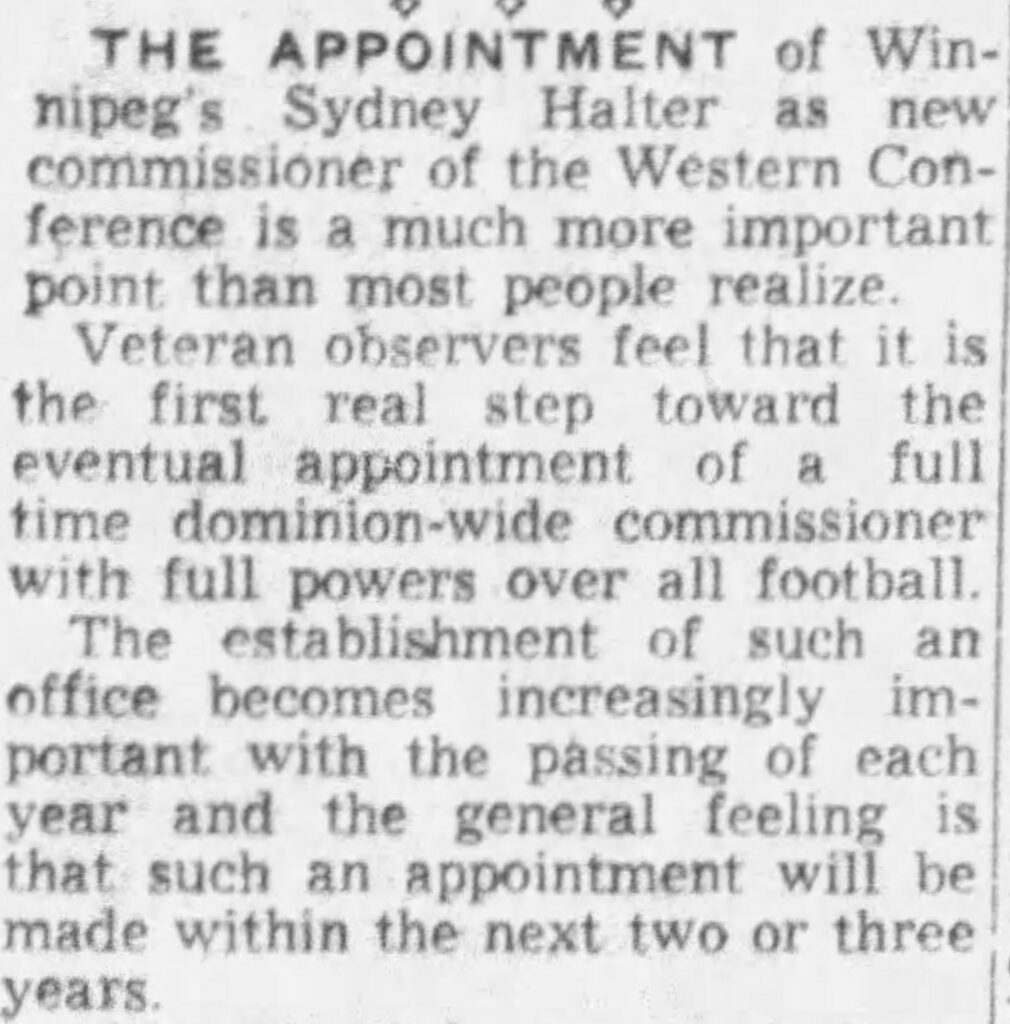
Sydney Halter was born and raised in Winnipeg, Manitoba. He held various roles, including treasurer and president, in the Winnipeg Blue Bombers organization before being named the Commissioner of the Western Interprovincial Football Union in 1953.
“Appointment of Sydney Halter.” The Calgary Herald, 31 March 1953, p. 25.
In 1956, he became the Registrar of the Canadian Football Council (CFC), a newly formed umbrella organization for both the WIFU and the eastern Interprovincial Rugby Football Union (the “Big Four”).
Well regarded in football circles across the country, Sydney Halter was named “Canada’s first national commissioner of football” when the Canadian Football League was established by the CFC in 1958. By the way, I totally think the CFL should adopt “National Commissioner of Football” as the official job title for its top role.
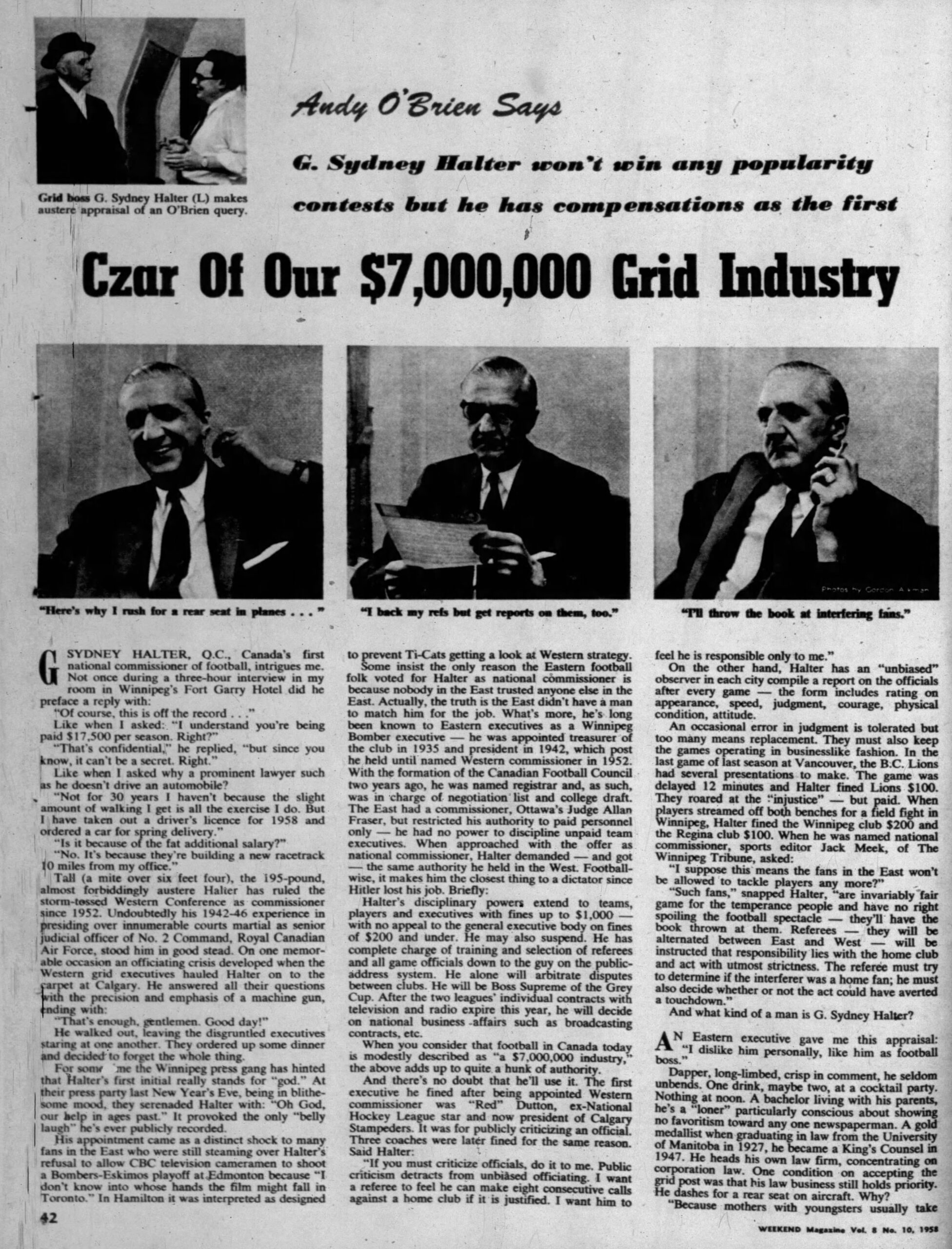
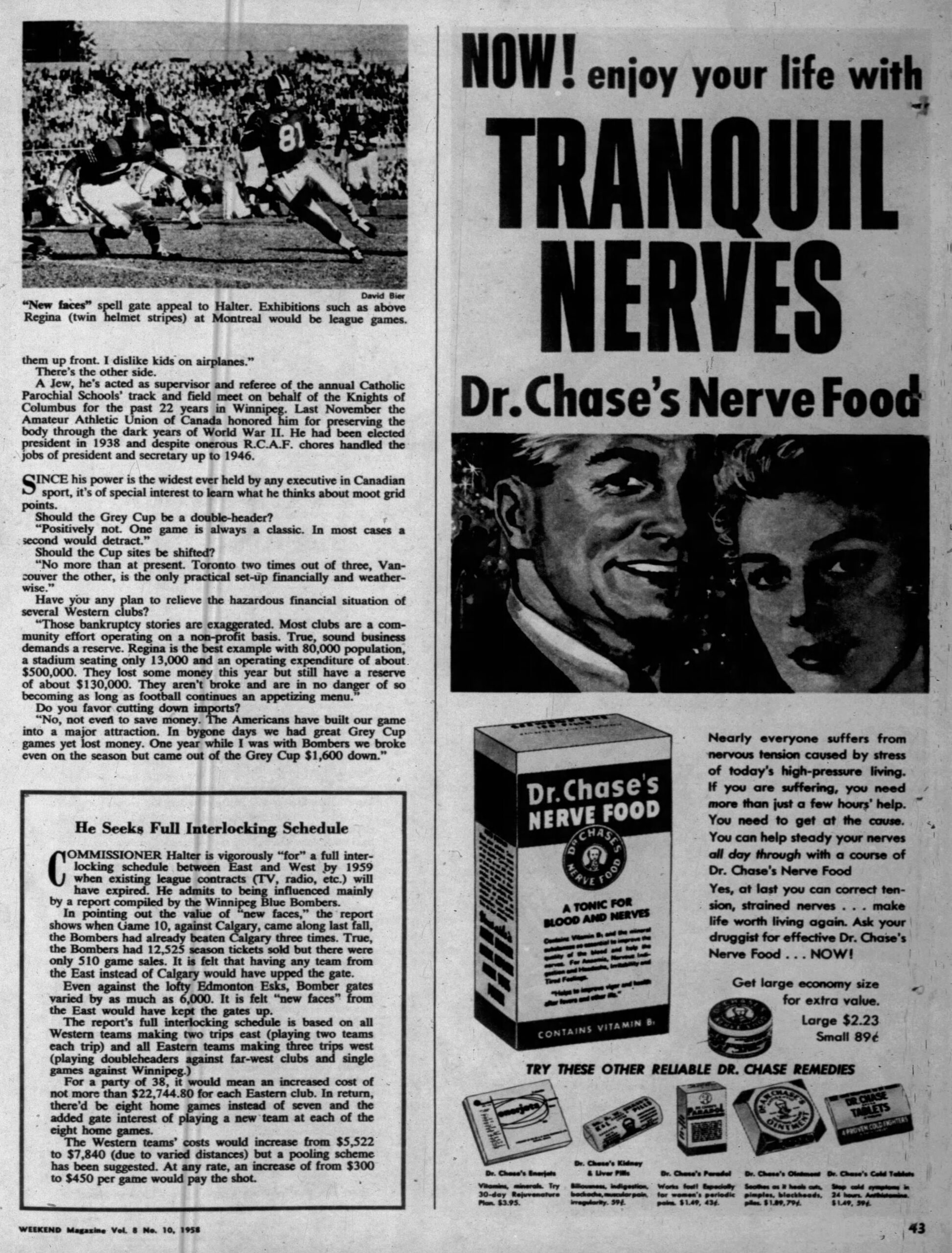
Described as a chain-smoking bachelor or “loner” by some, Sydney Halter wielded quite a bit of power in his role as Canada’s professional football boss. The article below (click on them to enlarge) is lengthy but well worth the read. It portrays Halter as a straight shooter and touches on how he didn’t hesitate to deliver fines to players and teams – or fans who interfered in the game. Apparently, home fans tackling opposing players from scoring touchdowns was a thing. Yikes.
O’Brien, Andy. “Czar of Our $7,000,000 Grid Industry.” The Hamilton Spectator, 8 March 1958, p. 90.O’Brien, Andy. “Czar of Our $7,000,000 Grid Industry.” The Hamilton Spectator, 8 March 1958, p. 91.
Sydney Halter served as the CFL’s commissioner until 1966. He was an early advocate for an interlocking schedule between the East and the West. A lawyer by profession, he also served in the Royal Canadian Air Force and held leadership positions in other Canadian sporting organizations outside of football.
They are one of the oldest professional sports teams in North America. For decades, they were the premier summer sporting attraction in Toronto. They are the legendary Toronto Argonauts – commonly known as the Argos.
Argonaut Rowing Club logo
The Argos were founded by the Toronto-based Argonaut Rowing Club on October 4, 1873. Playing rugby football allowed the rowers to keep in shape and build up strength. Many members of the Argonaut Rowing Club had connections to the University of Oxford and the University of Cambridge in England. So, the club adopted Oxford Blue and Cambridge Blue as their official colours – hence the term “Double Blue” – a nickname still used by the Argos today.
The Argonauts played their first rugby football game against Hamilton on October 18, 1873, winning by one goal and one touchdown to nothing at the University of Toronto. A rematch the following week in Hamilton, saw the home side securing the victory. This early home-and-home series served as a prelude to what would later become one of the CFL’s fiercest rivalries.
An account of the first football game between the Argonauts and Hamilton (The Hamilton Spectator, 20 October 1873, p 3.)The rematch in Hamilton vs. the Argonauts (The Hamilton Spectator, 28 October 1873, p 3.)
So, what exactly is an Argonaut?
To answer this question, you need to go back in history – way back – to 1400 BC or earlier. The Argonauts were great oarsmen of Greek mythology. According to legend, Jason and the Argonauts set sail on a ship named the Argo in their quest for the Golden Fleece. Over the years, the Argos have embraced this Greek mythology connection by incorporating imagery such as shields and ancient Greek warriors into their logos and uniforms. Their mascot is Jason the Argonaut.
The Argo painting by Greek artist Konstantinos Volanakis
Because of their rowing club roots, the Argos are often referred to as the Boatmen or the Scullers. The Argonaut Rowing Club continued to operate the Argos until 1956 when they sold the football team to private investors.
Like their ancient namesakes, who ultimately captured the Golden Fleece, the Toronto Argonauts continue their annual quest for the Grey Cup, having won the national championship a record 19 times – earning them their own place in the annals of history.
Depending on the criteria chosen and who you ask (relax, Argo fans!) the city of Hamilton boasts Canada’s oldest football club. The Hamilton Foot Ball Club was founded on November 3, 1869. Yes, they spelled football with two words back then. The team played in the Ontario Rugby Football Union from 1893 to 1906 before joining the new Interprovincial Rugby Football Union in 1907.
A news article announcing the founding of the Hamilton Foot Ball Club (The Hamilton Spectator, 4 November 1869, p 2.)
The team wore black and orange and later black and yellow uniforms and were known as the Tigers. It was this Tigers team that played in the second Grey Cup in 1910.
In 1941, the Tigers suspended play as a result of the Second World War. The IRFU itself shut down a year later. To fill the void, the Hamilton Wildcats were formed and played in the ORFU, winning the Grey Cup in 1943. Due to the high number of air force personnel playing for the team, the club was known as the Flying Wildcats during the war years.
After the war ended, the IRFU and the Hamilton Tigers resumed play. Unfortunately, the Hamilton market couldn’t support two football teams. Both the Tigers and the Wildcats found themselves competing for business and facing financial challenges. After a dispute with the IRFU, the Tigers and Wildcats actually swapped leagues for a couple of seasons with the Tigers playing in the ORFU and the Wildcats joining the IRFU in 1948.
“Merger of Wildcats, Tigers, Completed.” The Hamilton Spectator, 31 January 1950, p 24.
Finally, a group of Hamilton citizens pushed for the amalgamation of the Tigers and Wildcats. It was clear that Hamilton could sustain only one team, especially with the growing professionalization of the game of football.
Thus, in 1950, the Hamilton Tigers and the Hamilton Wildcats merged into one club and became the Hamilton Tiger-Cats.
The 1950 amalgamated Hamilton Tiger-Cats (photo courtesy of the Canadian Football Research Society)
The Winnipeg Blue Bombers. Boxing legend Joe Louis. Labatt Breweries. And the Toronto Blue Jays. Believe it or not there’s an interesting connection between these four entities spanning several decades.
The Winnipeg Football Club was established in 1930. They were originally called the Winnipeg Rugby Football Club but dropped the “Rugby” from the team’s name not long after being formed. The team was unofficially known simply as the Winnipegs or the ‘Pegs for short. In the early days, the club wore green and white uniforms before quickly adopting blue and gold as their team colours. This colour choice plays an important part of the story as you will see.
In 1935, Winnipeg travelled east to Hamilton and beat the hometown Tigers 18-12 in the Grey Cup. The victory gave the Winnipegs the distinction of becoming the first western team to win the Grey Cup championship. Enthusiastic crowds welcomed home the Winnipegs, and businesses lined up to congratulate the new champions of “Canadian rugby.”
Hudson’s Bay Company advertisement congratulating the Winnipegs on their 1935 Grey Cup victory (source: The Winnipeg Tribune, 10 December 1935, page 17)
Around the same time, an African American by the name of Joe Louis was taking the professional boxing world by storm. He was given the racialized nickname “The Brown Bomber” by American media. The story goes that a local Winnipeg journalist named Vince Leah, catching wind of the “Brown Bomber” nickname, referred to the Winnipegs as the “Blue Bombers of Western Football.”
The name stuck, and the football club became known as the Winnipeg Blue Bombers ever since.
Media started referring to the Winnipegs as the “Blue Bombers” in 1936. (source: The Winnipeg Tribune, 5 September 1936, page 21.)The Super Bombers (source: The Winnipeg Tribune, 31 October 1936, page 29.)
In the 1950s, Labatt Breweries introduced a new brand of beer in the Manitoba market. With its colourful blue labelling, Winnipeg football fans referred to the beer as Labatt “Blue.” Labatt eventually adopted the name officially and became a sponsor of the Blue Bombers and the CFL.
Fast forward a couple decades later. Toronto was awarded an expansion franchise in Major League Baseball. Labatt Breweries had a significant ownership stake in the new team and wanted to leverage its Labatt Blue brand. Toronto’s other two sports teams – the Argonauts and the Maple Leafs – both had blue as a team colour. The writing was on the wall. Toronto’s new sport team was also going to be blue. So, the Toronto Blue Jays were born.