Tag: 1900s in Canadian Football

  • Canadian Football’s Quirky Playoffs, Part IV: Three Leagues Compete for the New Grey Cup in 1909

    This is the fourth article examining some of Canadian football’s rather interesting playoff formats used over the years. Be sure to check out parts I, II, and III.

    1909 was a special year in Canadian football. That’s the year when Earl Grey, who was serving as the Governor General of Canada, donated a trophy to be awarded to Canada’s amateur rugby football champion. Of course, this trophy as well as the championship game itself would become known as the Grey Cup.
    Only teams affiliated with the Canadian Rugby Union were eligible to compete for the new Grey Cup championship. So that meant no western clubs could challenge for the trophy.

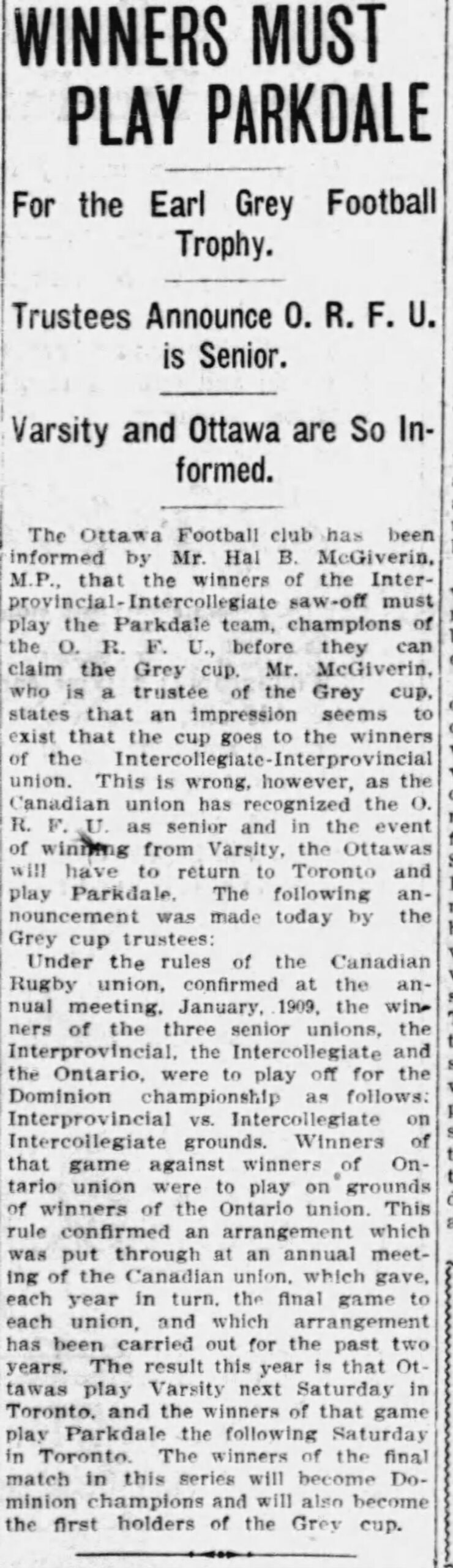
    Canadian football at the time was still an amateur affair, with senior football being the top level of play (above intermediate and junior). It was initially (mis)understood that the Grey Cup would be given to the winner of the Interprovincial Rugby Football Union (which was formed two years earlier) and Intercollegiate union game. But the CRU ruled a third league – the Ontario Rugby Football Union – was also a senior union and had the right to compete for the Grey Cup, as well.

    The Montreal Gazette published the final standings for 1909 in all three senior leagues of the Canadian Rugby Union:
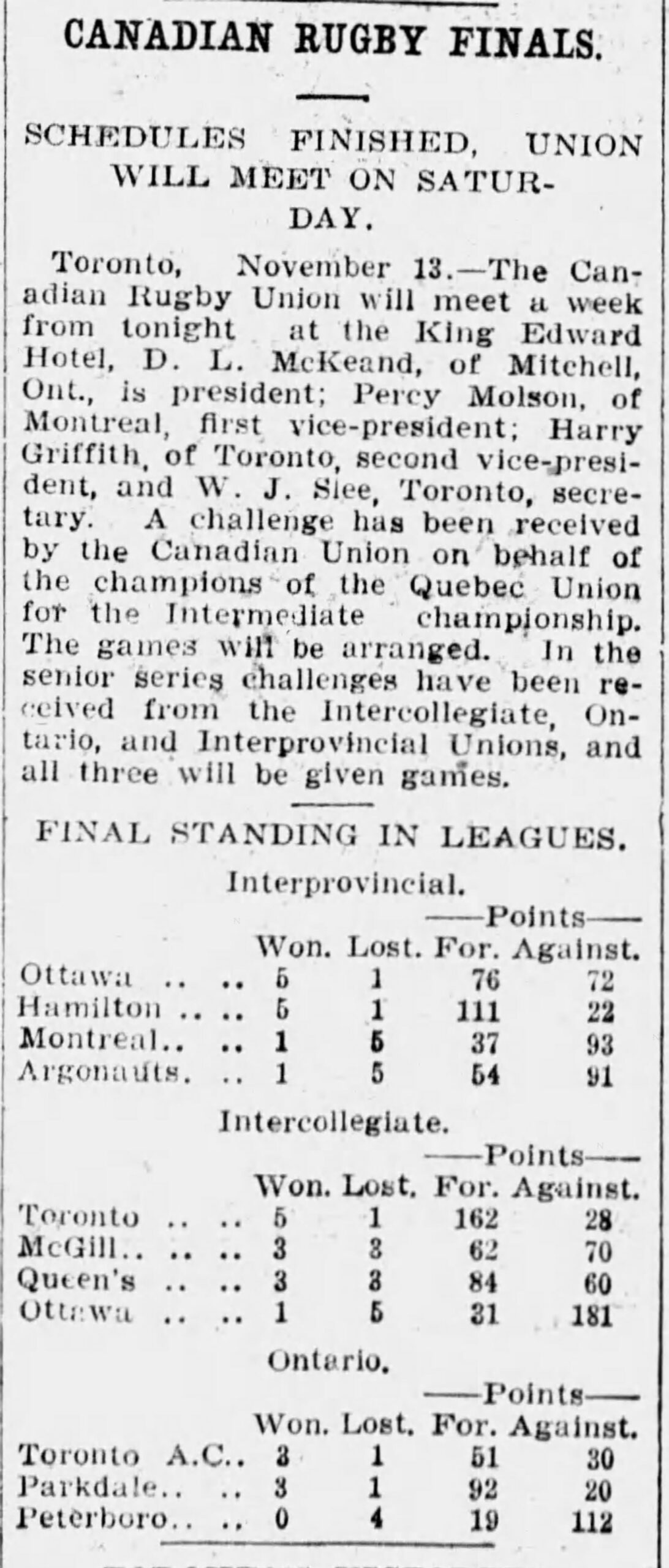
    Canadian Rugby Union standings and playoffs in 1909 (Montreal Gazette)
    Montreal Gazette, 15 November 1909

    The Canadian Rugby Union had previously established a rotational playoff system where the champion of each union would alternately receive a bye to and host the Dominion championship. Since the new Grey Cup was now the Dominion championship, the CRU simply extended this arrangement. For 1909, it was the ORFU’s year to host; so, the winner of the ORFU final would host the first-ever Grey Cup.
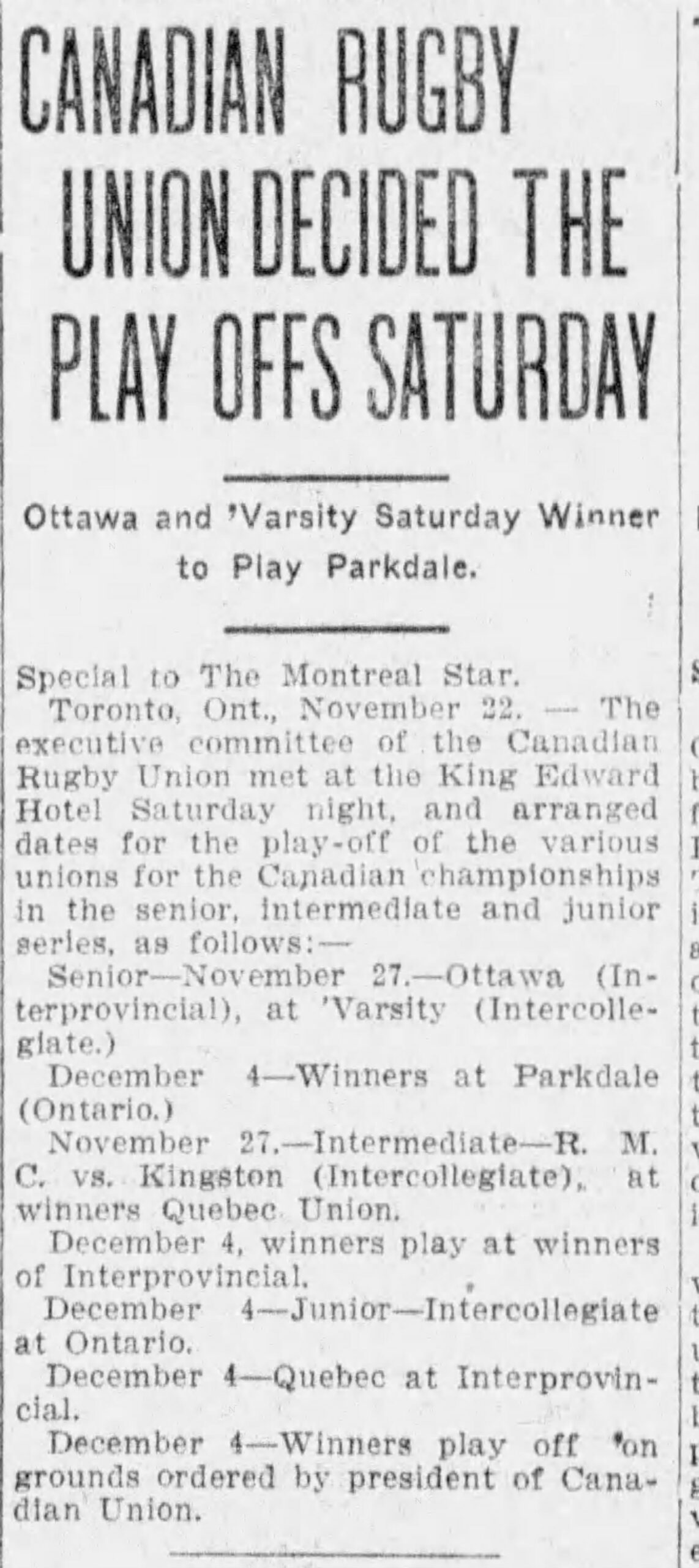
    Canadian Rugby Union Decided the Play Offs Saturday (Montreal Star)
    Montreal Star, 22 November 1909
    Winners Must Play Parkdale (Ottawa Citizen)
    Ottawa Citizen, 25 November 1909

    On November 20th, Toronto Parkdale won the ORFU championship with an 8-3 win over the Toronto Amateur Athletic Club, securing their berth in the Grey Cup. On the same day, the Ottawa Rough Riders defeated the Hamilton Tigers 14-8 to win the IRFU championship.

    Below is some excellent coverage in the Toronto Star of the IRFU and ORFU playoffs.
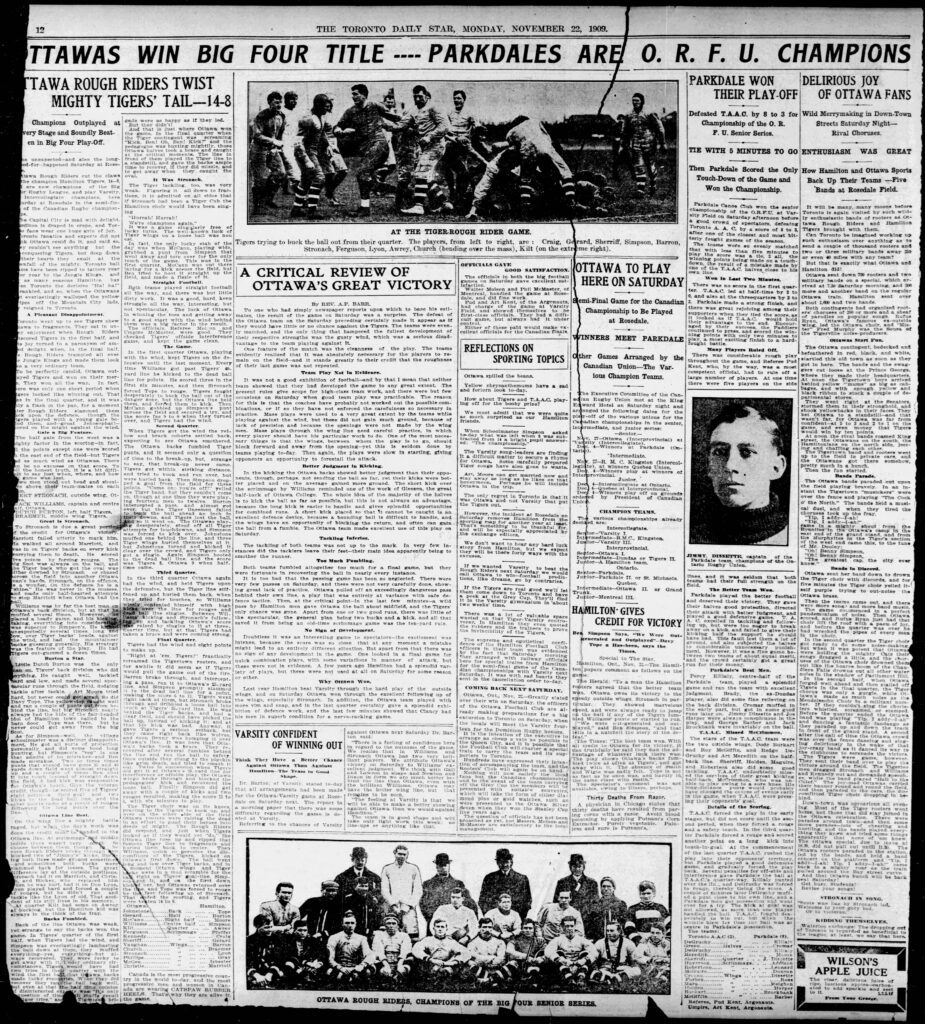
    ORFU, IRFU playoff coverage (Toronto Star)
    Toronto Star, 22 November 1909

    On November 27th, the Rough Riders travelled to Toronto to play the University of Toronto in the Interprovincial-Intercollegiate final. Varsity won handily by a score of 31 to 7, setting up a Varsity vs. Parkdale all-Toronto final for the Grey Cup.
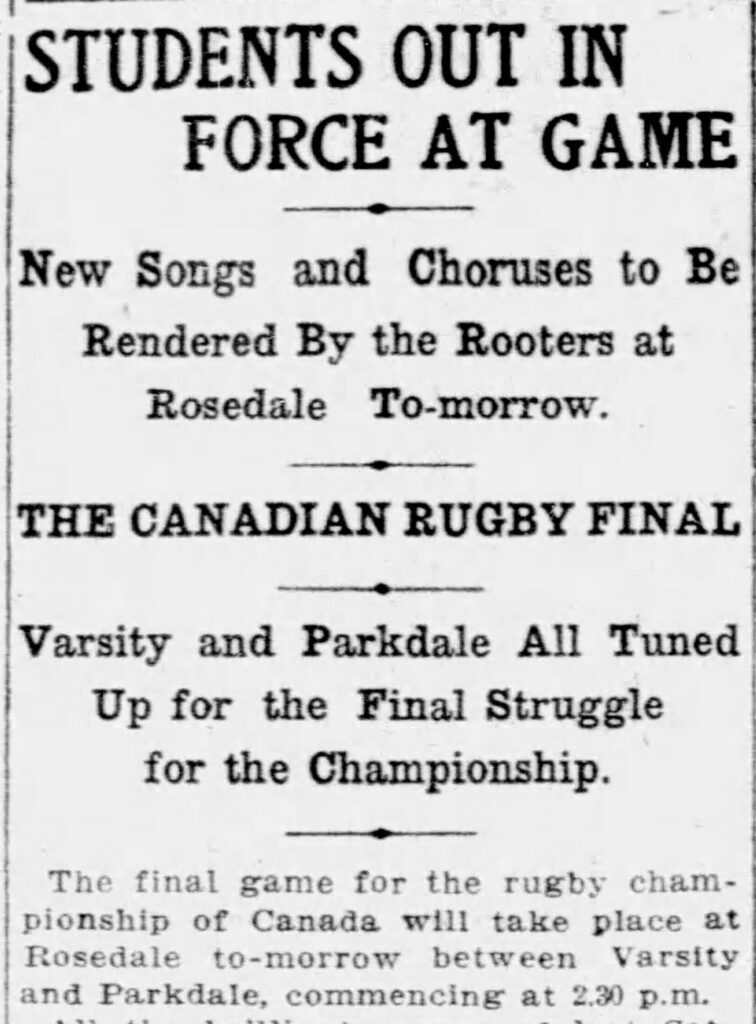
    Varsity to play Parkdale in first Grey Cup (Toronto Star)
    Toronto Star, 3 December 1909

    The historic matchup took place on December 4th at Toronto’s Rosedale Field. In the end, the University of Toronto came out on top, defeated Parkdale 26-6 to become the first Grey Cup champions.


    Sources:
    Montreal Gazette, 15 November 1909
    Montreal Star, 22 November 1909
    Ottawa Citizen, 25 November 1909
    Toronto Star, 22 November 1909
    Toronto Star, 6 December 1909

    Fediverse Reactions
  • Canadian Football’s Quirky Playoffs, Part III: Manitoba’s Unbalanced Schedule and Weighted Points System in 1906

    This is the third part of an ongoing series of articles looking back at some of Canadian football’s quirky playoff formats. Today, we’re going to go west and examine a rather peculiar set up for the 1906 season of the Manitoba Rugby Football Union.

    The MRFU was founded in 1892 and included a number of teams over the years. In 1906, four teams competed in the league’s senior competition: the Winnipeg Rugby Football Club (known as the Winnipegs), the St. John’s Rugby Football Club, the Winnipeg Rowing Club, and the Brandon Football Club.

    Financial constraints led to an unbalanced schedule. For instance, Brandon – being the only team from outside of Winnipeg – was allowed to play just four games. On the other hand, St. John’s and the Rowing Club were scheduled to play five games each. The Winnipegs were originally scheduled to play six games.

    To compensate for the unbalanced schedule, the MRFU devised a somewhat complicated but rather ingenious points system to provide some equity in the standings. Teams could receive a total of 30 points maximum on the season (if they won all their games). A value for a team’s win would be weighted depending on how many games they were to play. The formula used was 30 divided by the number of games played. In summary, Brandon would receive 7-1/2 points for each win (30 divided by four games played), St. John’s and the Rowing Club would receive 6 points for a win (30 divided by five games played), and a Winnipeg win would be worth five points (30 divided by six games played).

    Here is how the Winnipeg Tribune explained the schedule and points system:

    1906 MRFU schedule and points system explained in the Winnipeg Tribune (14 September 1906).
    Winnipeg Tribune (14 September 1906)

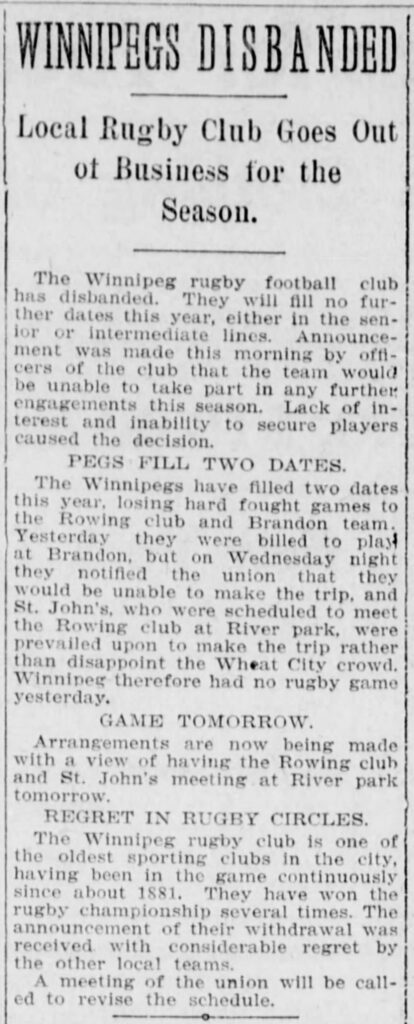
    The team with the most points in the standings was determined the champion. The Winnipegs picked up one win but lost two games and defaulted three of their remaining games after pulling out of the competition, finishing with a 1-5 record and five points.

    Here is the article published in the Winnipeg Tribune about the Winnipeg Rugby Football Club ceasing operations during the 1906 MRFU season:

    Article in the Winnipeg Tribune about the Winnipegs ceasing operations (19 October 1906).
    Winnipeg Tribune (19 October 1906)

    The top two teams – Winnipeg Rowing Club and Brandon – squared off on Sunday October 28th in a game that ultimately determined the championship. The “Oarsmen” (as the rowing club was nicknamed) defeated Brandon by a score of 20-1. The win gave the Winnipeg Rowing Club an undefeated 4-0 record and 24 points in the standings. Brandon ended the season 3-1 with 22-1/2 points.

    Article in the Winnipeg Tribune about Winnipeg Rowing Club winning the 1906 MRFU championship (29 October 1906).
    Winnipeg Tribune (19 October 1906)

    The Rowing Club had one more game to play versus St. John’s, but the game was cancelled as it had no meaning in the standings, the Oarsmen having already earned the highest number of points to win the 1906 MRFU championship.

    Of course, the MRFU wasn’t a member of the Canadian Rugby Union, so the Manitoba champion wasn’t eligible to compete in any playoff for the Dominion championship.


    Sources:
    Winnipeg Tribune (14 September 1906)
    Winnipeg Tribune (19 October 1906)
    Winnipeg Tribune (29 October 1906)

    Fediverse Reactions
  • The ORFU Adopts the Burnside Rules

    ORFU Adopts the Burnside Rules

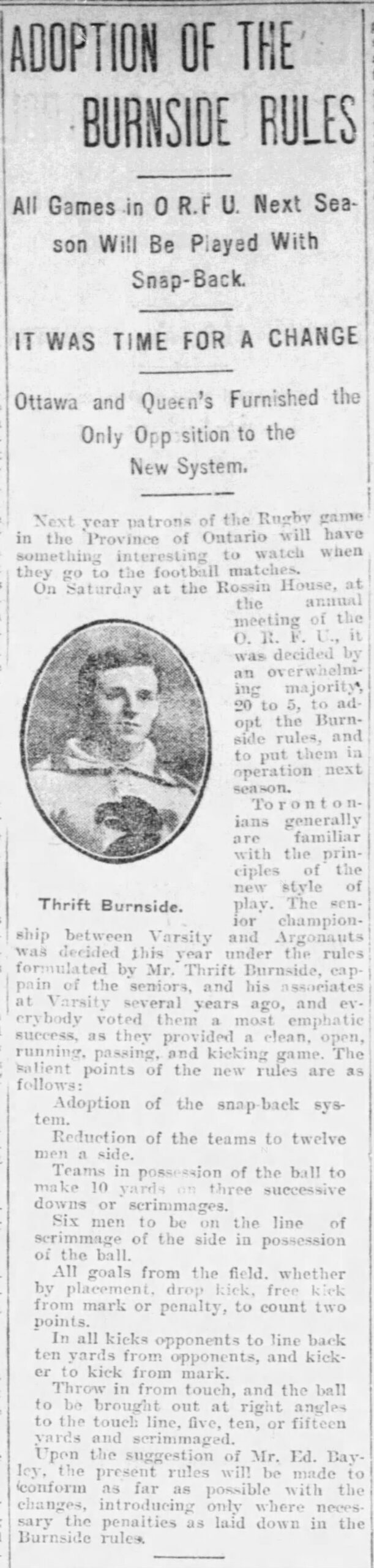
    An observer today would simply shrug his shoulders after reading the contents. “What’s the big deal?” he would ask. But around the turn of the 20th century the Burnside Rules would revolutionize Canadian football. Named after Thrift Burnside, who captained the University of Toronto varsity football team, the so-called Burnside Rules helped transform Canadian football from a rugby-style game to the modern gridiron game we recognize today.

    Proponents of the Burnside Rules promoted the idea that they made the game more open, more exciting, and easier to follow. Opponents argued they changed the very essence of Canadian football and risked the Americanization of the game. In hindsight, both sides were probably right.

    So, what the heck were the Burnside Rules anyway? And how did they change the game of Canadian football so much? Let’s take a quick look.

    Perhaps the biggest difference in Mr. Burnside’s rules compared to traditional Canadian rugby at the time was the introduction of the downs system. The team with possession would now have three chances (or downs) to advance the ball ten yards. The other significant difference was adoption of the snap-back formation. Instead of a rugby scrum where players heeled the ball backwards, the offence would now line up along a fixed line of scrimmage and have the centre player on the line “snap back” the ball. Both the downs system and the snap-back formation were already being used in American football at the time.

    Other rule changes included the reduction of the number of players from fifteen to twelve, scrimmaging instead of throw-ins from the sideline, and capping the number of players on the line of scrimmage at six. They also made some minor kicking and scoring adjustments.

    A Fine Exposition of New Rugby

    The first use the Burnside Rules was the first game of the Toronto city championship between the University of Toronto and the Toronto Argonauts on November 15, 1902. The rules received rave reviews from the Toronto Star, which hailed the game a “fine exposition of new rugby.”

    Praising the Burnside Rules that were used in the Varsity-Argonauts game.
    (“Fine Exposition of New Rugby.” Toronto Star, 17 November 1902, p. 10.)

    Still, the Burnside Rules were considered so radical by purists that their adoption divided clubs and unions and threatened to wreak havoc on Canadian football. On December 13, 1902, the Ontario Rugby Football Union formally adopted the Burnside Rules for the 1903 season. The Canadian Rugby Union and its other unions refused to adopt them initially. This led to the three CRU unions in Ontario and Quebec to play by three different sets of rules.

    Adoption of the Burnside Rules article in the Toronto Star
    Article in the Toronto Star explaining the Burnside Rules after being adopted by the ORFU.
    (“Adoption of the Burnside Rules.” Toronto Star, 15 December 1902, p. 10.)

    By the way, the Quebec Rugby Football Union probably had the most radical rule of all. While it didn’t adopt the snap-back formation it did implement its own version of a downs system. Basically, teams had to gain at least five yards on their third down, regardless of yards gained on the previous first or second down.

    Comparing three styles of Canadian football being played in 1903
    Comparing the three sets of rules in Canadian football for 1903
    (Toronto Star, 22 December 1902, p. 9.)

    Ottawa Opposed the Burnside Rules

    The Ottawa Rough Riders lead the opposition to the ORFU’s adoption of the Burnside Rules. A column appearing in the Ottawa Citizen made abundantly clear Ottawa’s stance on the new rules and took to personally attacking Thrift Burnside. Such was the passion and divisiveness surrounding these sweeping changes.

    Ottawa Citizen column critical of the Burnside Rules
    A column in the Ottawa Citizen critical of Thrift Burnside and his rules.
    (Ottawa Citizen, 16 December 1902, p. 6.)

    After unsuccessfully trying to convince the CRU to adopt the Burnside Rules, the ORFU opted to switch back to CRU rugby-style football in 1906. But in the years ahead, the down system and snap-back formation were eventually adopted across the country.

    By the 1920s Canadian football had evolved and started to resemble the game we play and watch today. The Burnside Rules played a pivotal role in this evolution. By incorporating popular aspects of American football into the traditional Canadian game, the ORFU’s early adoption of the Burnside Rules helped shape the future of Canadian football.

    More praise of the Burnside Rules by the Toronto Star.
    (Toronto Star, 17 November 1902, p. 10.)
  • The Grey Cup of Hockey?

    Did you know that Governor General Earl Grey originally intended his Grey Cup trophy to be a national amateur hockey championship? The idea was for amateur hockey teams in various leagues across Canada to compete in a national playoff with the winner being awarded the Grey Cup. The Grey Cup was to be to be the amateur version of the Stanley Cup.

    Grey Cup for amateur hockey article in the Toronto Star
    Source: The Toronto Star, 14 January 1909, page 12

    However, in late 1908 Sir Montagu Allan – a prominent Montreal businessman – donated a trophy (the Allan Cup) that ultimately became the national amateur hockey championship.

    By summertime the Grey Cup was repositioned to be the amateur rugby football championship of the Dominion of Canada. Below is a Toronto Star article about Canada’s new rugby football trophy.

    Grey Cup for the rugby championships article in the Toronto Star
    Source: The Toronto Star, 1 June 1909, page 10

    The Allan Cup was first awarded on March 6, 1909 to the Ottawa Cliffsides. A week later Queen’s University challenged them to a game and win the trophy.

    The first Grey Cup was played on December 4, 1909 with the University of Toronto winning the championship.

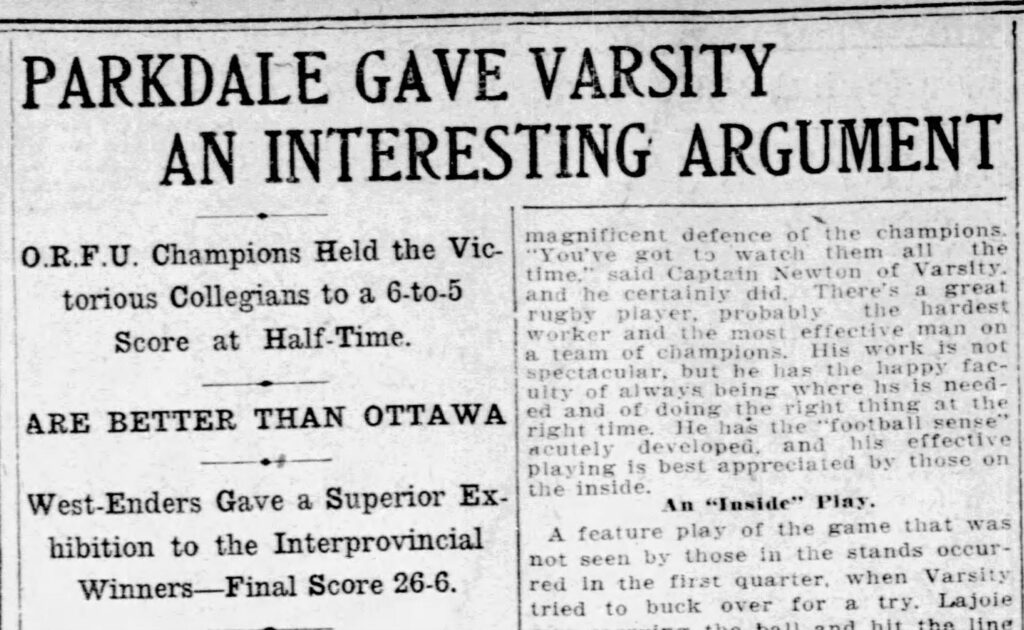
  • Parkdale Gave Varsity an Interesting Argument | U of T Wins First Grey Cup 26-6

    On Saturday December 4, 1909, the first Grey Cup game was played to crown the Dominion football champions. While the Grey Cup trophy itself wasn’t presented at the game (apparently the Governor General Earl Grey forgot to order the actual trophy), the game proved popular with the nearly 4,000 fans in attendance at Rosedale Field. Did they know they were witnessing history in the making?

    The University of Toronto – the intercollegiate champions – beat Toronto Parkdale, who were the champions of the Ontario Rugby Football Union, by a score of 26-6. Coverage in the Toronto Star the following Monday heaped plenty of praise on the ORFU squad, deemed a stronger team than the Ottawa Rough Riders – who Varsity handily beat a week earlier in the semi-final.

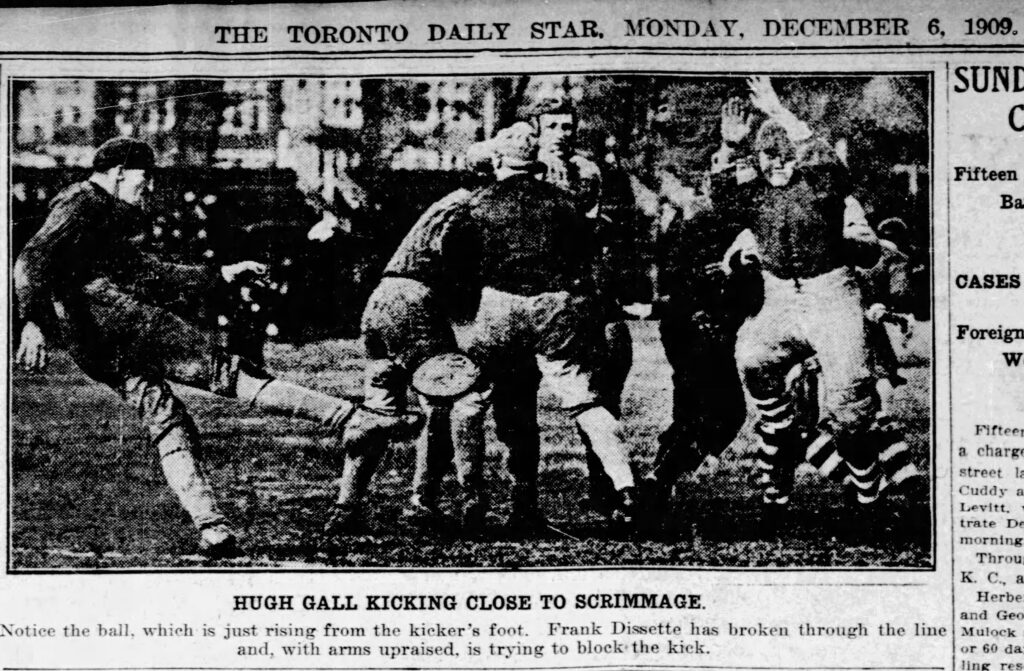
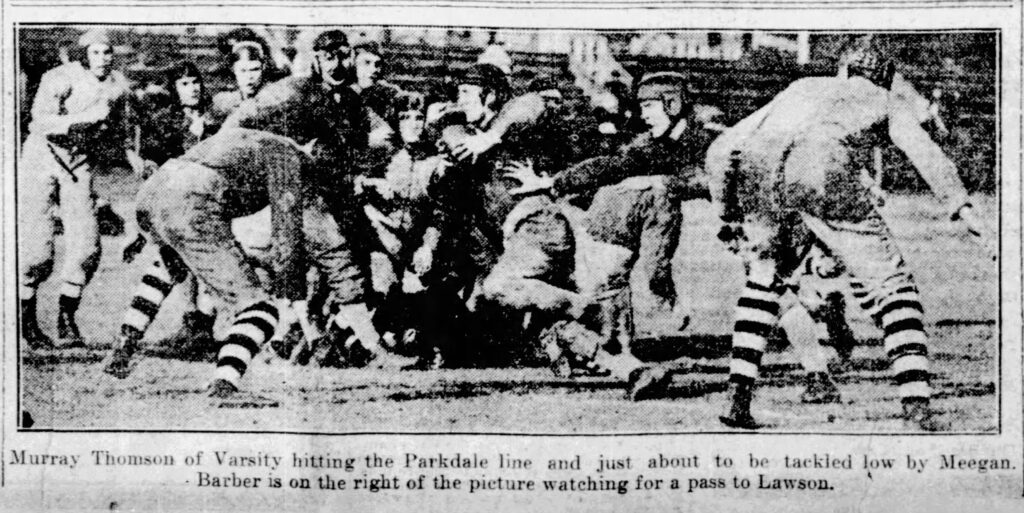
    Below are a couple of photos from the Toronto Star showing game action. I find these shots of early Canadian football absolutely fascinating.