1921 was a significant year in Canadian football. With the Western Canadian Rugby Football Union joining the Canadian Rugby Union, western clubs were finally eligible to compete for the Grey Cup.
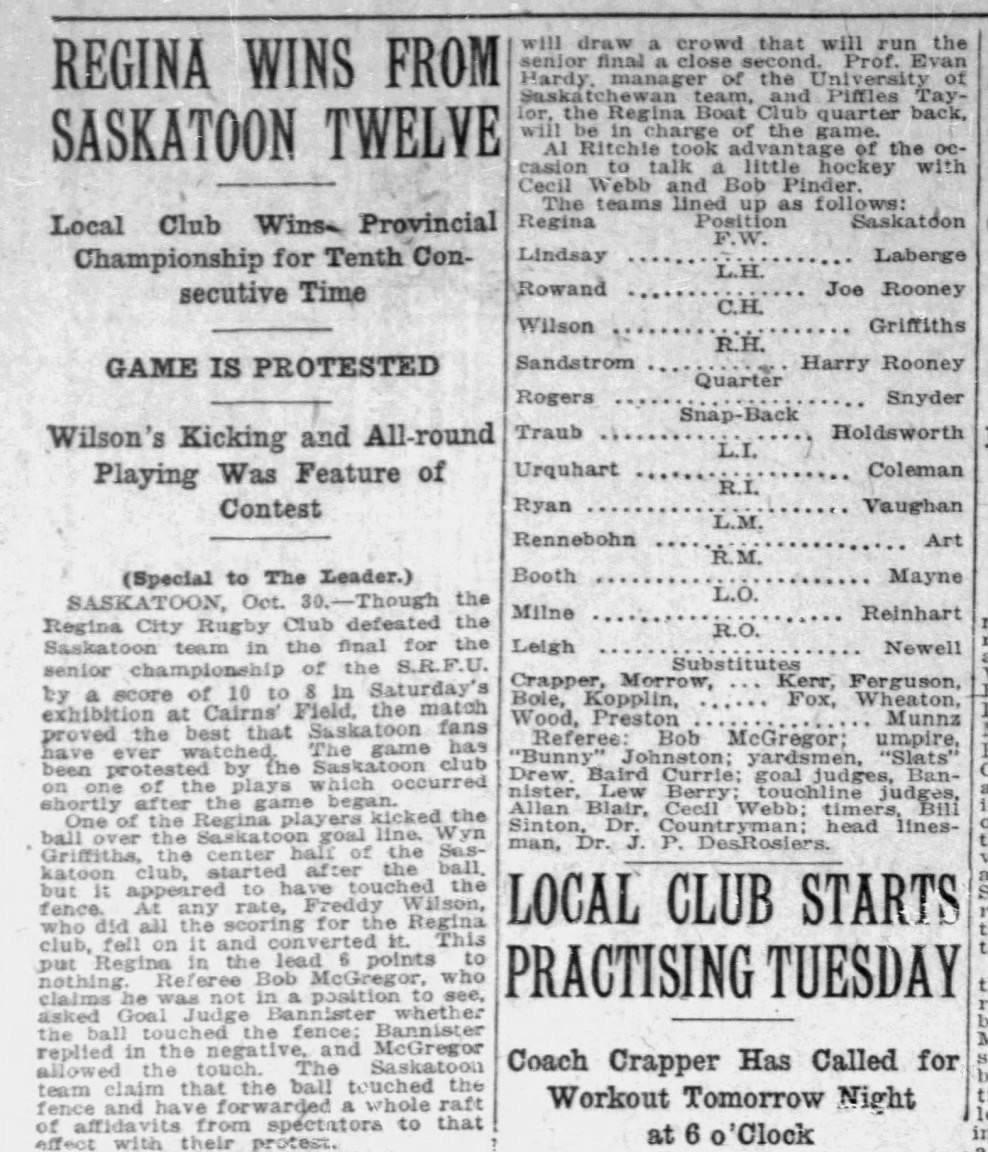
Article in the Regina Leader-Post about Regina initially winning the SRFU championship (31 November 1921).
The Regina Rugby Club was one of the favourites to win the Hugo Ross trophy (the WCRFU championship) and represent the West in this historic season of Canadian football. They finished with a perfect 4-0 record and went on to defeat Saskatoon 10-8 on Saturday October 29th to win the Saskatchewan Rugby Football Union championship. But hold on. Not quite so fast.
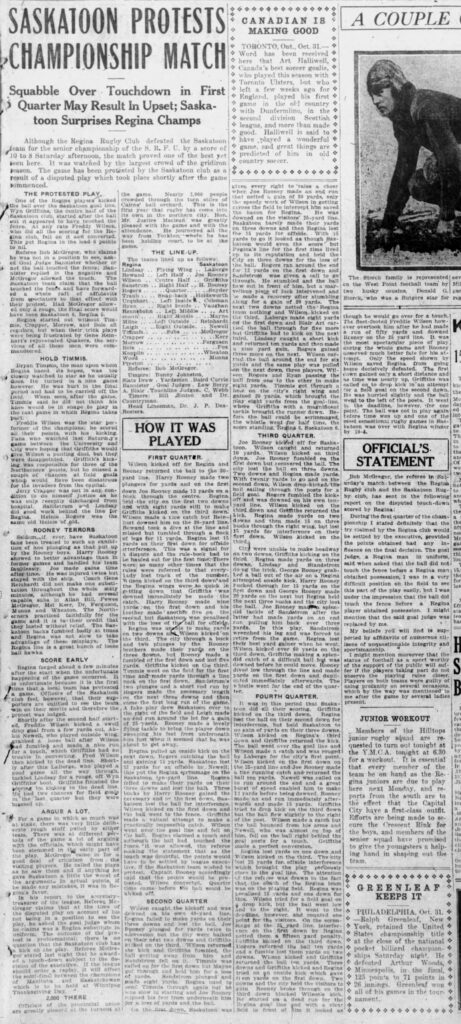
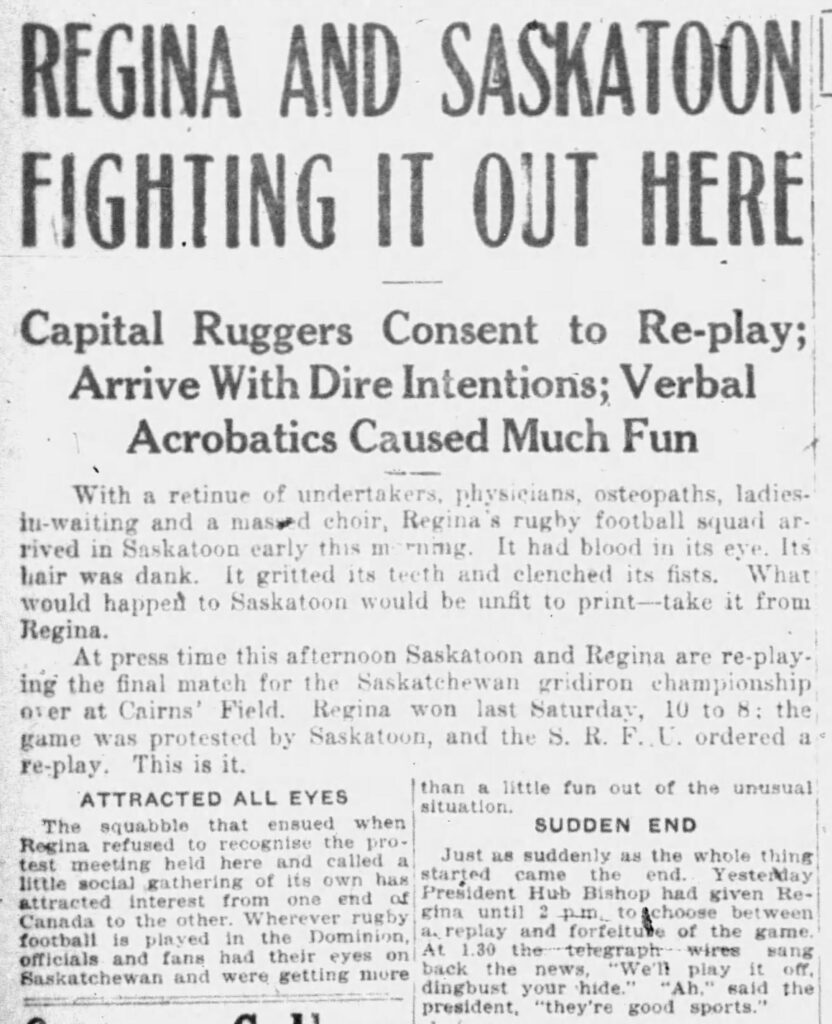
Article in the Saskatoon Daily Star summarizing the SRFU championship game that was protested by Saskatoon (31 October 1921).
The Saskatoon club protested the result and demanded a rematch. A controversial play early in the game saw Regina kick the ball into the Saskatoon endzone. Saskatoon’s Wyn Griffiths let up retrieving the ball as it appeared to have hit a fence. In the meantime, Regina player Freddy Wilson quite shrewdly jumped on the ball to score a touchdown.
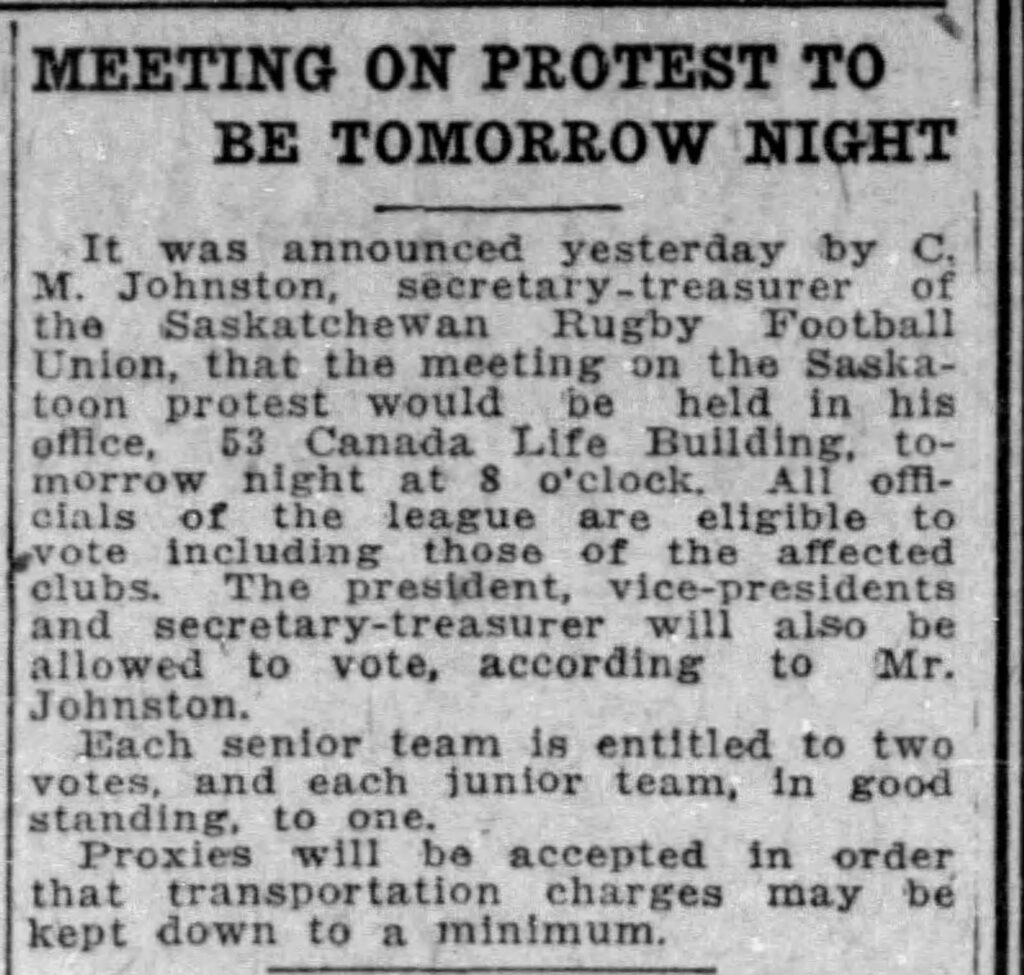
Notice of meeting published in the Regina Leader-Post to hear protest by Saskatoon (31 October 1921).
A meeting was held in Regina by the SRFU on November 1st to hear the protest. Presided over by SRFU Secretary-Treasurer C.M. Johnston, the protest was disallowed, and Regina was greenlighted to travel to Winnipeg to play the Victoria Rugby Club in the western semi-final game.
But…..
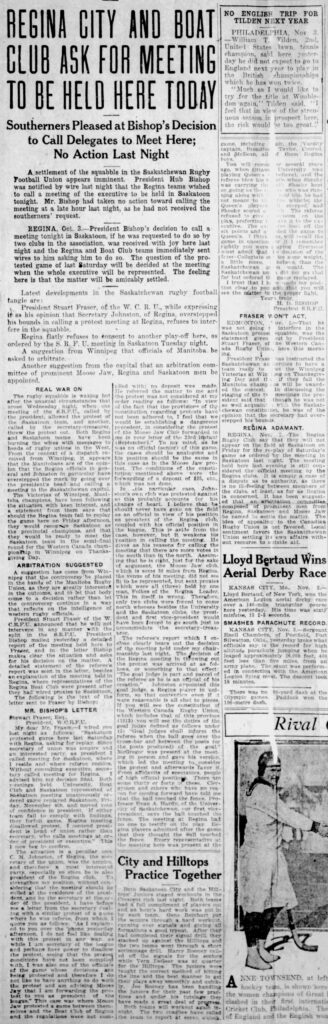
Another meeting was held in Saskatoon by the President of the SRFU, Hub Bishop. At this meeting, the Saskatoon protest was allowed, and the teams were ordered to play a rematch.
Article in the Saskatoon Phoenix Star about the conflicting decision on the Saskatoon protest (2 November 1921).
The WCRFU found themselves in a bit of a dilemma. Its president, Stuart Fraser, refused to get involved in sorting out the mess. He felt it was a matter strictly to be decided by the Saskatchewan union.
The saga continues (Saskatoon Star Phoenix, 3 November 1921).
Regina was steadfast against a rematch (and who can blame them really?) when Hub Bishop finally gave them the ultimatum. Play the rematch or lose by forfeiture. According to the press, Regina sent a wire to Bishop saying, “We’ll play it off, dingbust your hide” to which Bishop replied “Ah, they’re good sports.”
Article in the Saskatoon Daily Star with the final resolution: Regina and Saskatoon will play a rematch (4 November 1921).
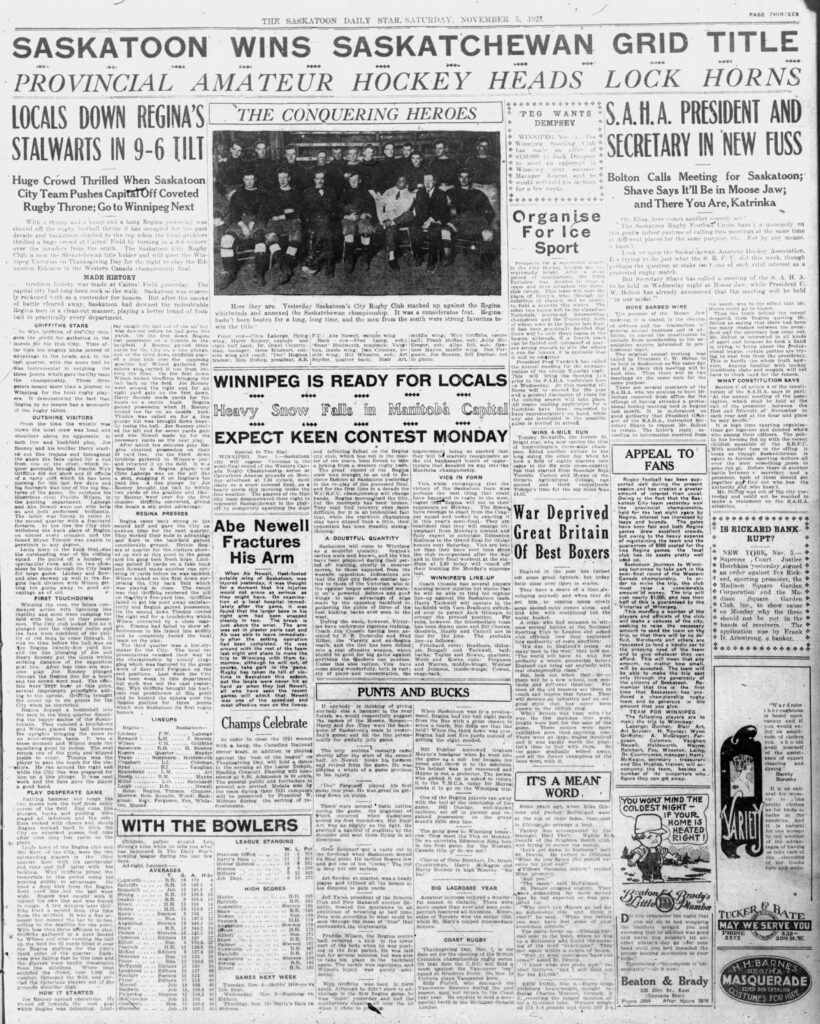
So, on November 4th the rematch was played at Saskatoon’s Cairns Field. The end result? Saskatoon defeated Regina 9-6. I can’t help but imagine how the fans in Saskatchewan and (elsewhere for that matter) would’ve reacted on social media had it been around at the time of this saga.
Game coverage of Saskatoon’s victory in the rematch (Saskatoon Daily Star, 5 November 1921).
Anyway, Saskatoon would go on and lose to the Victorias in Winnipeg a few days later, putting an end to the drama and controversy. And ultimately, Edmonton would represent the West in the 1921 Grey Cup.
Sources: Regina Leader-Post, 31 October 1921 Saskatoon Daily Star, 31 October 1921 Saskatoon Daily Star, 4 November 1921 Saskatoon Daily Star, 5 November 1921 Saskatoon Star Phoenix, 2 November 1921 Saskatoon Star Phoenix, 3 November 1921
On April 24, 1996, one of the most prolific kickers to play the Canadian game announced his retirement. Dave Ridgway played every game throughout his 14-year career in the Canadian Football League with the Saskatchewan Roughriders. Born in England, his family came to Canada in the 1970s. Ridgway played college football at the University of Toledo. In 1981, he was drafted by the Montreal Alouettes but didn’t make the team. The following year he signed with Saskatchewan as a free agent.
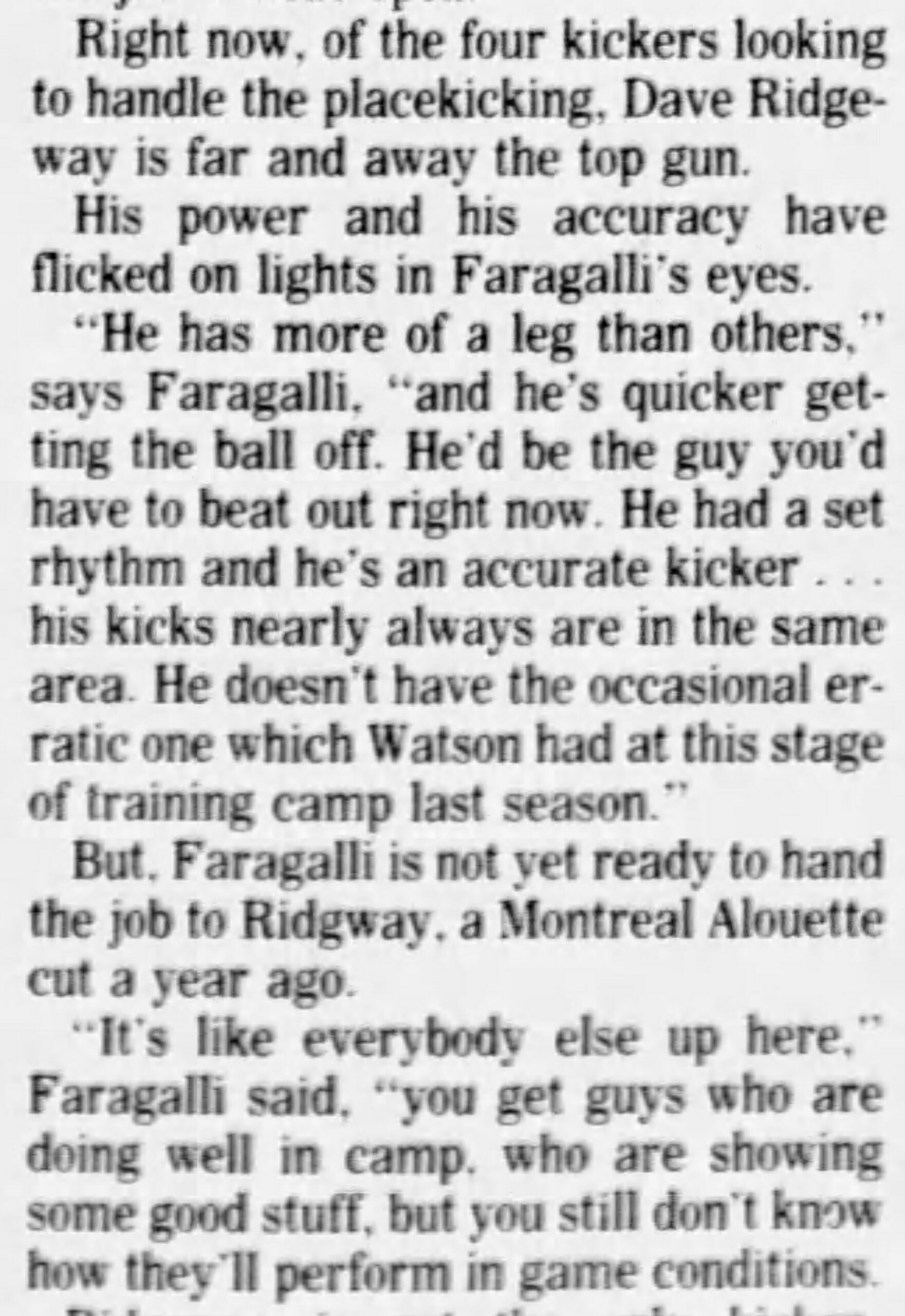
An account in the Regina Leader-Post of Saskatchewan head coach Joe Faragalli praising rookie kicker Dave Ridgway in 1982.
In 1987, he was traded to Edmonton then subsequently traded to Montreal. After the Alouettes folded prior to the season, the Roughriders once again signed him. Clearly, fate wanted Ridgway to be a Rider.
On September 6, 1987, Ridgway kicked a then record 60-yard field goal in the Labour Day weekend game against the Winipeg Blue Bombers. It was probably the second biggest field goal in his career; we’ll get to the biggest one shortly.
Playing a whopping 238 games in the CFL, Ridgway was known for his accuracy and ability to get the job done in clutch situations. He scored 574 field goals and a total of 2,374 points throughout his career. His 78% all-time field goal accuracy helped earn him the nickname “Robokicker.” This stat is even more remarkable when you consider the length of his playing career as well as the fact that half of those games were played at Taylor Field in Regina which was known for its often windy conditions.
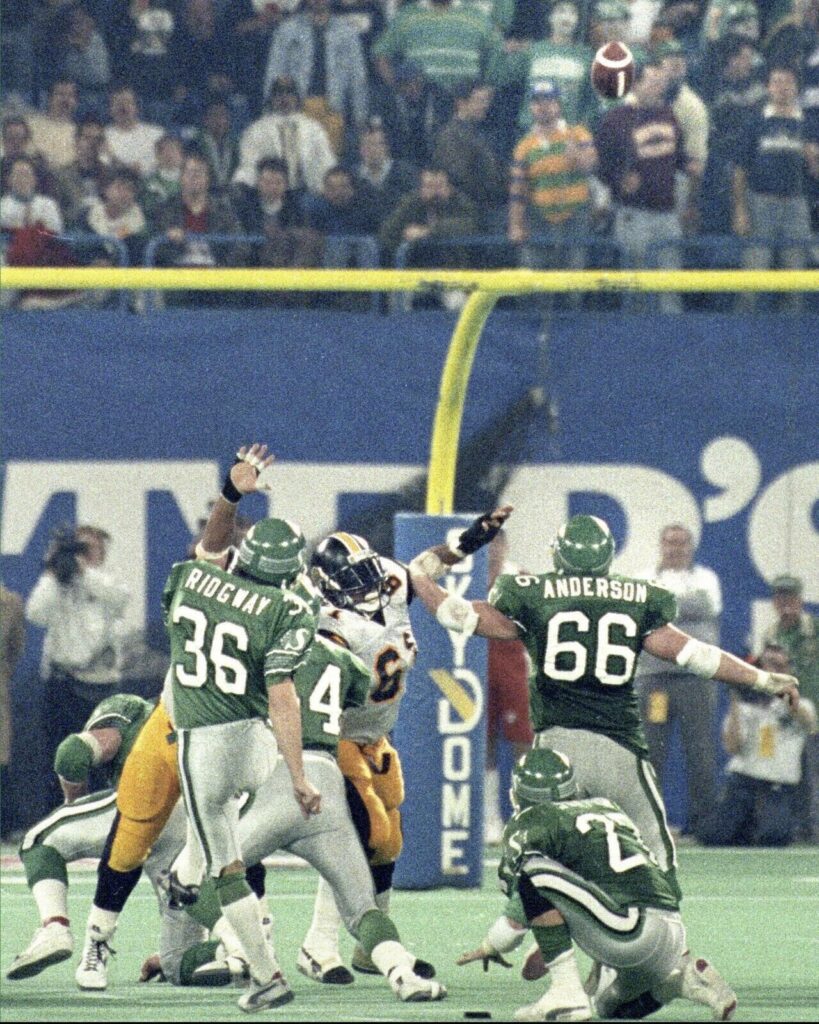
Dave Ridgway kicking the game winning field goal in the 1989 Grey Cup. (Photo: Canadian Football Research Society)
Now, let’s get to that biggest field goal. And this one’s tough to talk about as a Ti-Cat fan. But one must give credit where credit is due. In the dying seconds of the 1989 Grey Cup game versus Hamilton with the score tied at 40-40, Dave Ridgway booted a 35-yard field goal to win the game for the Riders. It was a dagger in the hearts of Tiger-Cat fans but a hard fought and well-deserved victory for Robokicker and the Green and White. The kick (or better known as “The Kick”) secured just the second Grey Cup championship for Saskatchewan.
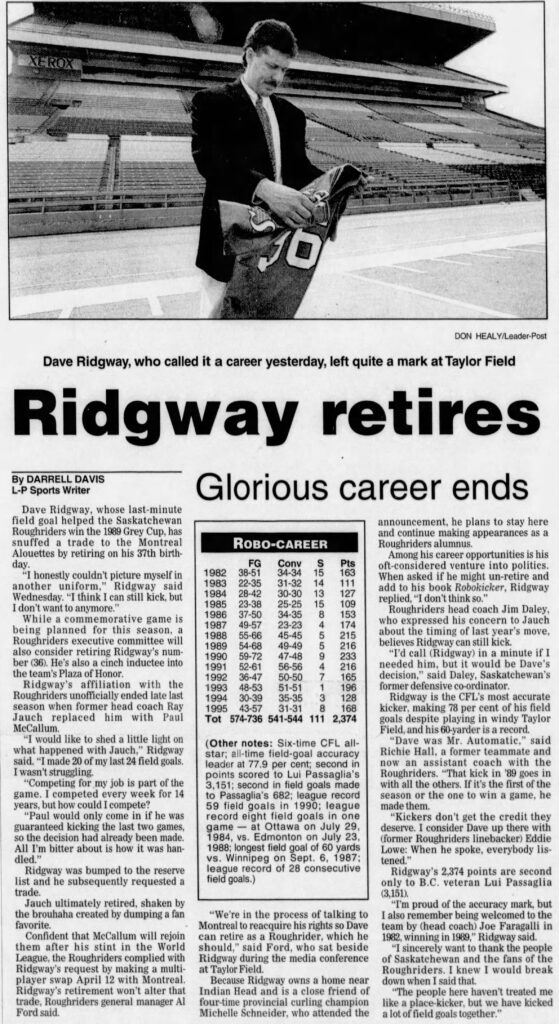
Prior to the 1996 season, Dave Ridgway was traded to Montreal. But rather than continue his career with the Als, he opted to call it a day and announced his retirement on his 37th birthday.
Regina Leader-Post article by Darrell Davis about the glorious career of Dave Ridgway (25 April 1996)
I reached out to Rod Pedersen, the former longtime voice of the Roughriders, to share his thoughts and memories of one of the CFL’s best. Rod was just nine years old when Ridgway arrived in Regina. “I was living in Milestone, SK collecting Roughriders trading cards from the local RCMP detachment which would’ve included Ridgway’s rookie card. My Dad was a Rider season ticket holder and took us to the games,” he recalls.
Ridgway’s loyalty to the Roughriders was clearly evident. “Dave’s a smart guy and realized quickly that the place you want to play in the CFL is Saskatchewan. The Riders weren’t very good back then (they were in the midst of missing the playoffs 11 years in a row) but the fans’ love for the team was real, and the players knew something special was being built by Rider management,” Rod continues.
I asked if there are any particular plays or special moments that stand out for him. “Well, they call him “Robokicker” for a reason, so it was nice to know, as a Rider fan, that generally anytime Ridgway went out for a field goal, he was going to make it. I mean, it’s an incredibly difficult task but Dave made it look easy. That didn’t ease much of our anxiety when he lined up a 35-yard field goal to win the 1989 Grey Cup, but we should’ve known. Ridgway’s accuracy made “The Miss” in the 1992 Western Semi-Final all the more unbelievable, and it lives in Rider lore to this day. That was also the last game Bob Poley and Roger Aldag ever played. There wasn’t any one single Ridgway kick that stands out, other than ’89, but he holds all the major records like most field goals in a season (59), most field goals in a game (8), and the longest field goal streak in Rider history (28).”
Rod’s mention of “The Miss” is a gentle reminder that even legends can falter. I remember watching that game on TV and seeing Ridgway slip on the natural grass at Edmonton’s Commonwealth Stadium on the final play of the game, dashing any chance of a Saskatchewan game-winning field goal.
Was Dave Ridgeway one of the greatest Riders off all time? Rod thinks so. “I think all the records I listed tells you that he is. Having his #36 retired, going into the Canadian Football Hall of Fame in 2003, these things all point to his legacy. More than anything though, in my role with the Riders I got to be around Dave a lot, interview him multiple times, and he’s always first class and very obliging. That means more to me than all the records.”
So, here’s to the man who gave Rider fans something to cheer about (and a championship to boot!) for 14 seasons. Thirty years later, the records still stand. And the legend of Robokicker lives on.
Melvin Becket, Mario DeMarco, Gordon Sturtridge, and Ray Syrnyk of the Saskatchewan Roughriders and Calvin Jones of the Winnipeg Blue Bombers were aboard Trans-Canada Air Lines Flight 810 when it crashed into a remote area of British Columbia.
Here is a sampling of news articles about the tragedy:
Front page of the Regina Leader-Post on December 10, 1956.Heart-breaking article in the Regina Leader-Post (December 10, 1956) expressing hope that Mario DeMarco and Melvin Becket would somehow survive the disaster.Front page of the Iowa City Press-Citizen (December 10, 1956) with a focus on Calvin Jones, who was a standout college player at the University of Iowa before joining the Winnipeg Blue Bombers.Front page of the Saskatoon Star-Phoenix on December 10, 1956.
On Sunday, December 9, 1956, tragedy struck Canadian football when five professional players lost their lives in one of the country’s worst aviation disasters.
Trans-Canada Air Lines Flight 810 left Vancouver that evening bound for Calgary with 62 passengers and crew onboard. Among the passengers were four members of the Saskatchewan Roughriders (Melvin Becket, Mario DeMarco, Gordon Sturtridge, and Ray Syrnyk) and Calvin Jones of the Winnipeg Blue Bombers. They were returning from Vancouver, where the 1956 Canadian Football Council all-star game was played the previous day.
About an hour after takeoff, the plane crashed into Mount Slesse, near Chilliwack, BC. All 62 people aboard the aircraft died. The crash site is in a remote area of British Columbia, which made recovery efforts virtually impossible. The remains of both the plane and the victims remain at the site to this day.
Here is a closer look at the five players who were lost in the disaster:
Melvin Becket was a native of Chicago, Illinois. He was drafted by the NFL’s Green Bay Packers but opted to play for the Saskatchewan Roughriders. His wife was expecting their child just after Christmas.
Mario DeMarco was an American from New Jersey. He and Melvin Becket were not only teammates; they were also business partners of a local gas station in Regina. The DeMarco–Becket Memorial Trophy is awarded to the Most Outstanding Offensive Lineman in the CFL’s West Division.
Calvin Jones was an African-American from Ohio who came to Canada to play professional football with the Winnipeg Blue Bombers after a standout college career at the University of Iowa. He missed an earlier flight out of Vancouver so was instead put on the ill-fated TCA Flight 810.
Gordon Sturtridge was a native of Winnipeg, where he started his professional football career. He was a three-time western all-star and played four seasons with Saskatchewan. His wife Mildred was also aboard the flight. They left behind three young children.
Ray Syrnyk was a native of Saskatoon and played on the 1953 Saskatoon Hilltops junior championship team. He was the youngest (22) of the five players lost.
For eons, the Canadian Football League published Media Guides or Fact Books for its teams. These little handbooks were meant to familiarize local journalists with the players and coaching staff of the team they were covering. They included biographies, statistics, records, and team histories.
Team media guides were also a great little souvenir for the savvy football fan. I have several in my own collection I like to peruse every now and then.
The CFL still produces them at least in electronic form. At least for some teams. I’m not sure if the league still offers print copies, though. It looks like they’ve met the same fate as game day programs and printed tickets, which is unfortunate.
Anyway, I thought what better way to spend the dog days of summer than by taking a look at some of these CFL media guides from the 1960s (or the late 1950s in a couple of cases). It was an exciting decade for the CFL and Canadian football.
Here are some photos of the media guides (front and back covers) for each CFL team from that era:
The above photos are courtesy of the good folks at the Canadian Football Research Society.