Tag: Saskatchewan Roughriders

  • The Terry Fox Kickoff: 45 Years Later

    On July 1, 1980, a young man jogged onto the field at Lansdowne Park in Ottawa to perform the ceremonial kickoff prior to the CFL exhibition game between the Ottawa Rough Riders and the Saskatchewan Roughriders.

    The crowd of almost 17,000 gave the 21-year-old a standing ovation. He wasn’t an ordinary 21-year-old by any stretch of the imagination. No, he was extraordinary in every sense of the word. He had one leg, having lost his other to cancer. Lansdowne Park was the latest stop on what he billed as his “Marathon of Hope” across Canada to raise money for cancer research. Of course, I’m talking about Terry Fox.
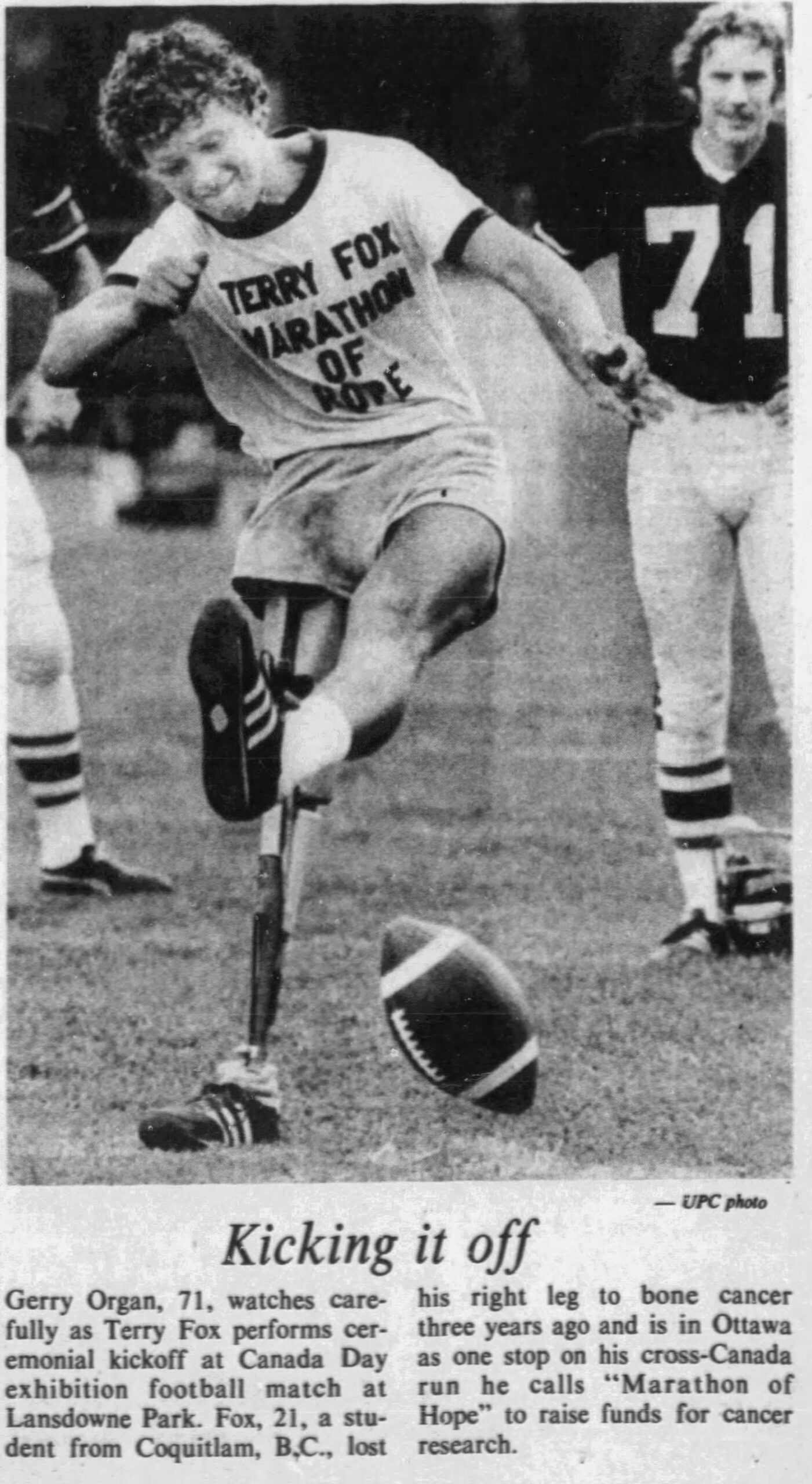
    A great shot of Terry Fox performing the ceremonial kickoff on Canada Day 1980 while Gerry Organ of the Ottawa Rough Riders looks on.
    (Ottawa Citizen, 2 July 1980, p. 28.)

    We Canadians are all familiar with Terry Fox, his story, and his legacy. I was only four years old (not even) at the time of the Marathon of Hope, but I do have some vague recollections of seeing coverage about it on TV. My Grandad met him while he was running through Halifax County in Nova Scotia and took a picture of him. I still have the photo.

    But we forget some of the historic imagery that Terry’s marathon produced along the way. The kickoff at the CFL game is but one example. Here’s how Ottawa Rough Rider great Tony Gabriel remembers the day:

    “I fondly remember meeting our young Canadian hero, Terry Fox, on July 1, 1980. He had begun his Marathon of Hope run across the nation and had reached Ottawa. Terry did our honorary kickoff that Canada Day, and I was fortunate as one of the captains for the Ottawa Rough Riders to get to shake his hand and wish him good luck in raising needed funds for Canadian cancer research.”

    Terry Fox clearly made an impression on the CFL Hall of Famer. In 2020, Gabriel launched a petition to put Terry Fox on the $5 bank note. Late last year, the government announced that Terry Fox would indeed be featured on the new note. “Over the past 45 years, the Terry Fox Foundation has raised $950 million! I am so heartened it was announced and successfully assured this year that this continuing honour for Terry will happen in the near future by the Bank of Canada,” Gabriel proudly boasts.
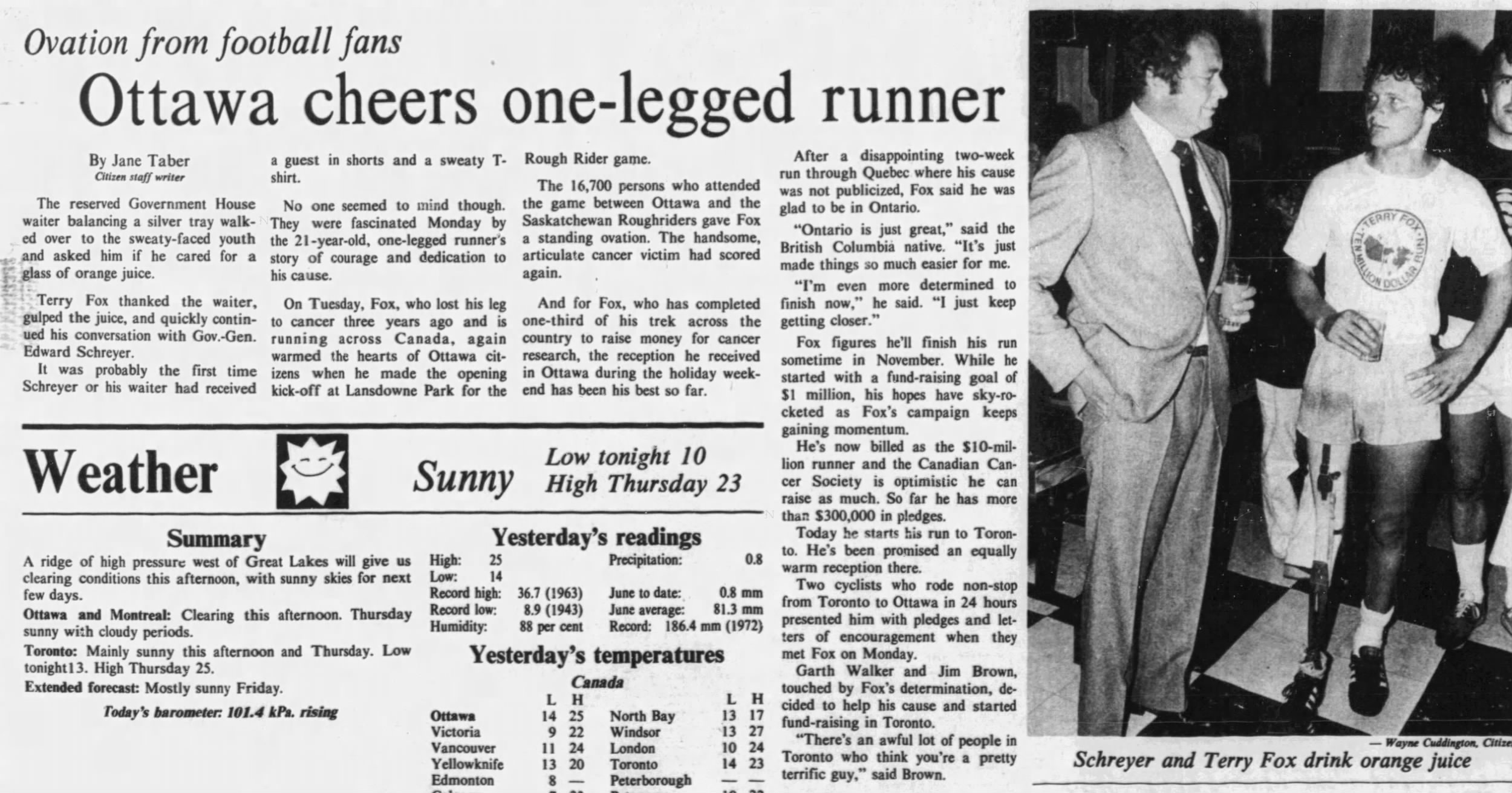
    An article in the Ottawa Citizen about Terry Fox’s stop in Ottawa during his Marathon of Hope.
    (Taber, Jane. “Ottawa cheers one-legged runner.” Ottawa Citizen, 2 July 1980, p. 2.)

    After leaving Ottawa – but not before hanging out with Governor General Ed Schreyer and Prime Minister Pierre Trudeau – Terry continued west into Southern Ontario before heading up to Northern Ontario towards Thunder Bay. Here, he sadly announced that his cancer had returned, thus ending the Marathon of Hope. Still, he travelled a distance of 5,373 kilometres over the course of 143 days and raised millions towards his cause.

    It’s been 45 years since Terry Fox captured our hearts and admiration. 45 years since the young man with one leg shared the field with some of the great CFL football stars of the day. 45 years since Terry Fox become a true Canadian legend.

    And now, let’s relive what I believe is one of the most iconic moments in Canadian sports history…the Terry Fox kickoff:


    Continue Terry Fox’s legacy. Join the Terry Fox Run or make a donation to the Terry Fox Foundation.

  • Saskatchewan Roughriders is Our Name

    Green is the Colour
    Football is the Game
    We’re all together and Winning is our aim
    So Cheer us on through the sun and rain
    Saskatchewan Roughriders is our name

    It’s a familiar tune to many CFL football fans across the country. The chorus ends with the line, “Saskatchewan Roughriders is our name.” So, just when and why did Regina’s football team become the Roughriders? As you will see, it’s… well…a bit complicated.

    The Regina Rugby Club was founded in 1910. They played in the Saskatchewan Rugby Football Union along with teams in Saskatoon and Moose Jaw. The SRFU joined the Alberta and Manitoba leagues to form the Western Canada Rugby Football Union in 1911.

    As early as 1912, the Regina club was being called the Roughriders or Rough Riders. The August 31, 1915 edition of the Regina Leader references the Regina Rough Riders as they kick off the 1915 season.

    An early reference to the Regina Roughriders in the Saskatoon Daily Star in 1912
    An early reference to the Regina Roughriders (The Saskatoon Daily Star, 19 October 1912, page 22)
    Regina Rough Riders Lift Lid of 1915 Season in the Regina Leader
    Source: The Regina Leader, 31 August 1915, page 2 (via newspapers.com)

    The early Regina team had a question of identity not only when it came to the club name but also around deciding which team colours to use. The original colours of the Regina Rugby Club were purple and gold. Then, blue and white. Finally, they settled on red and black. In an alternative universe is there a team called the Saskatchewan RedBlacks?

    After 1915, the “Rough Riders” moniker seemed to fall out of favour. The local newspaper went back to referring to the team simply as the Regina Rugby Club. But, in 1924, according to official team history, the Regina Rugby Club formally became the Regina Roughriders. After the Second World War, the team became the Saskatchewan Roughriders to represent the entire province and eventually changed their team colours to the familiar green and white.

    Regina now Saskatchewan Roughriders article in the Winnipeg Tribune in 1946.
    Source: The Winnipeg Tribune, 3 June 1946, page 14 (via newspapers.com)

    So, what is a “Rough Rider” or “Roughrider” anyway? The most likely answer is that it is a reference to the trainers or “rough riders” who broke wild horses on the Prairies. There is a strong suggestion that the Roughrider name was chosen to pay homage to the “rough riders” of the North-West Mounted Police.

    An alternative theory is that the Roughriders were named after future United States president Teddy Roosevelt’s Rough Rider cavalry regiment in the Spanish-American War of 1898. However, it’s generally accepted that the Roosevelt/Rough Rider connection is associated more with the Ottawa Rough Riders who played in the East.

    Yes, this is where we need to mention that for a long period of time in Canadian football (up to 1996) there were two teams that shared the Rough Riders/Roughriders moniker, each with a distinct yet connected history. This anomoly probably deserves its own blog post at some point.

    There is good article about the “Roughriders” name written by Rob Vanstone posted last year on the Sasktchewan Roughriders’ website. Check it out here: https://www.riderville.com/2024/12/09/rob-vanstone-the-name-game-100-years-of-roughriders/

    So cheer us on through the sun and rain…Saskatchewan Roughriders is our name!


    This is the fourth of a series of posts that will explore the stories behind the names of the existing Canadian Football League teams. See the previous post on the Edmonton Elks.

  • Tiger-Cat Defence Strangles Roughriders

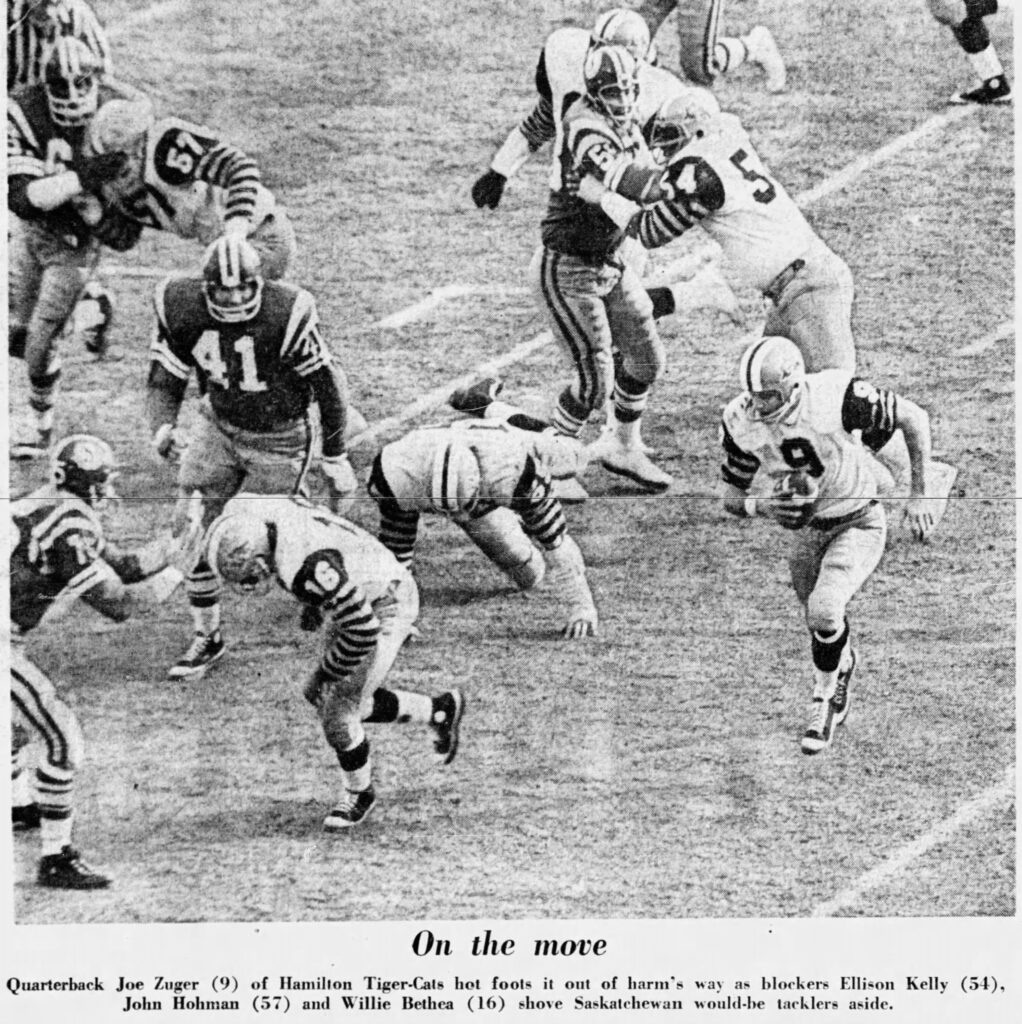
    “Tiger-Cat defence strangles Roughriders” read the headline in The Ottawa Citizen on Monday December 4, 1967. That pretty much sums up Hamilton’s 24-1 win over Saskatchewan in the 1967 Grey Cup game played a couple days earlier.

    1967 Grey Cup action (Ottawa Citizen)
    Source: The Ottawa Citizen, 4 December 1967, page 23.

    1967 – being Canada’s Centennial and all – featured the Grey Cup being played at Lansdowne Park in Ottawa. Tiger-Cats quarterback Joe Zuger (who recently passed away at the age of 84) scored a running touchdown, passed for a touched down, and kicked three singles, leading him to be named Grey Cup MVP.

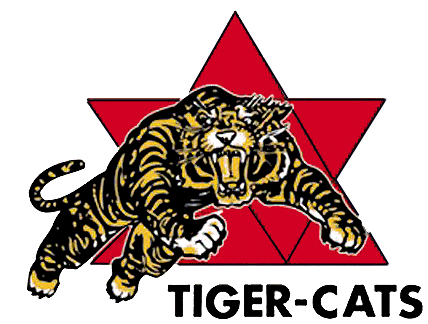
    The Hamilton Tiger-Cats used this commemorative logo in 1967 to celebrate Canada’s Centennial. (courtesy SportsLogos.Net)