1909 was a special year in Canadian football. That’s the year when Earl Grey, who was serving as the Governor General of Canada, donated a trophy to be awarded to Canada’s amateur rugby football champion. Of course, this trophy as well as the championship game itself would become known as the Grey Cup. Only teams affiliated with the Canadian Rugby Union were eligible to compete for the new Grey Cup championship. So that meant no western clubs could challenge for the trophy.
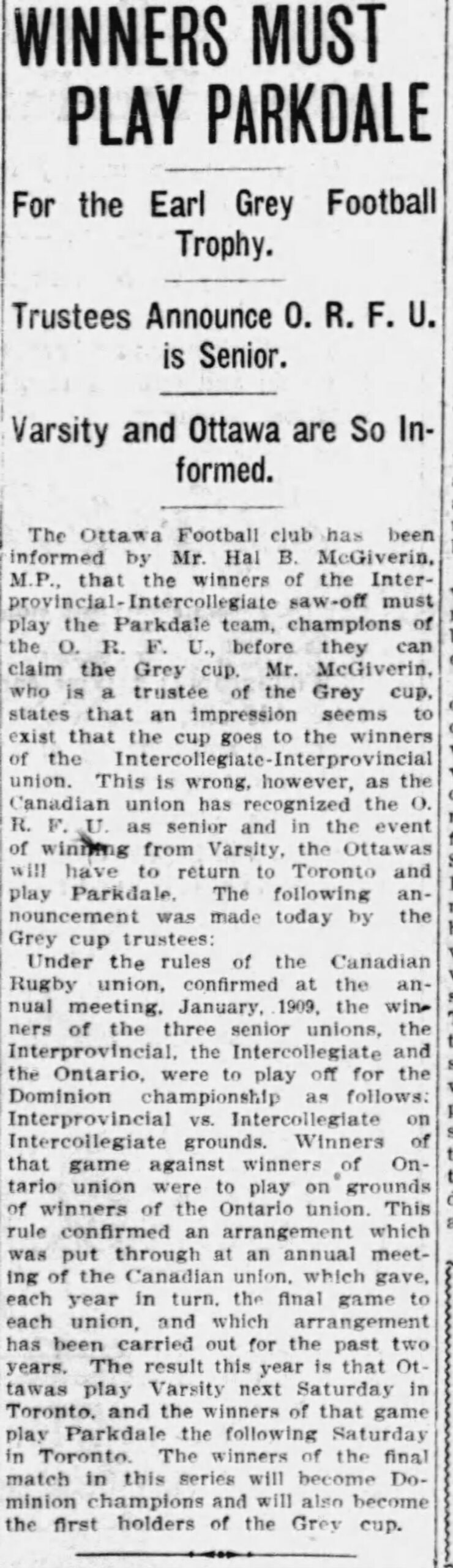
Canadian football at the time was still an amateur affair, with senior football being the top level of play (above intermediate and junior). It was initially (mis)understood that the Grey Cup would be given to the winner of the Interprovincial Rugby Football Union (which was formed two years earlier) and Intercollegiate union game. But the CRU ruled a third league – the Ontario Rugby Football Union – was also a senior union and had the right to compete for the Grey Cup, as well.
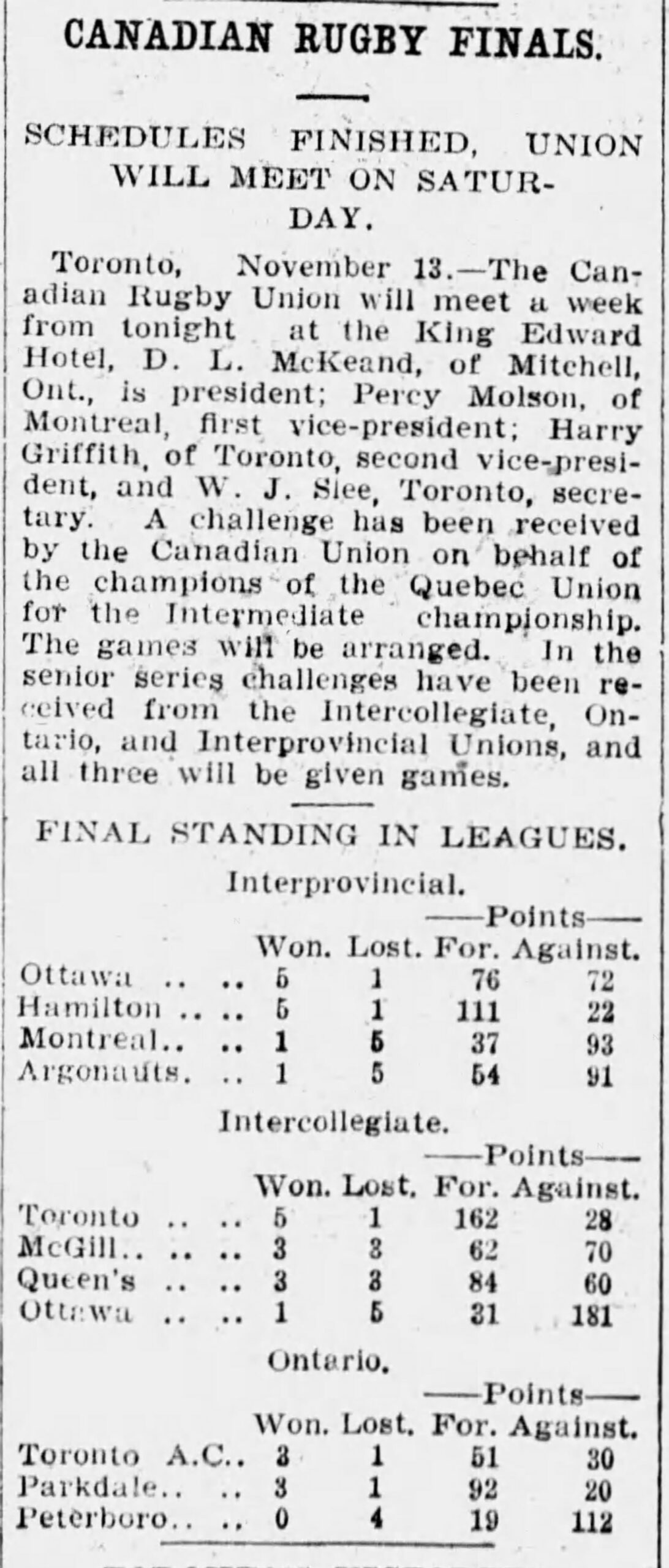
The Montreal Gazette published the final standings for 1909 in all three senior leagues of the Canadian Rugby Union:
Montreal Gazette, 15 November 1909
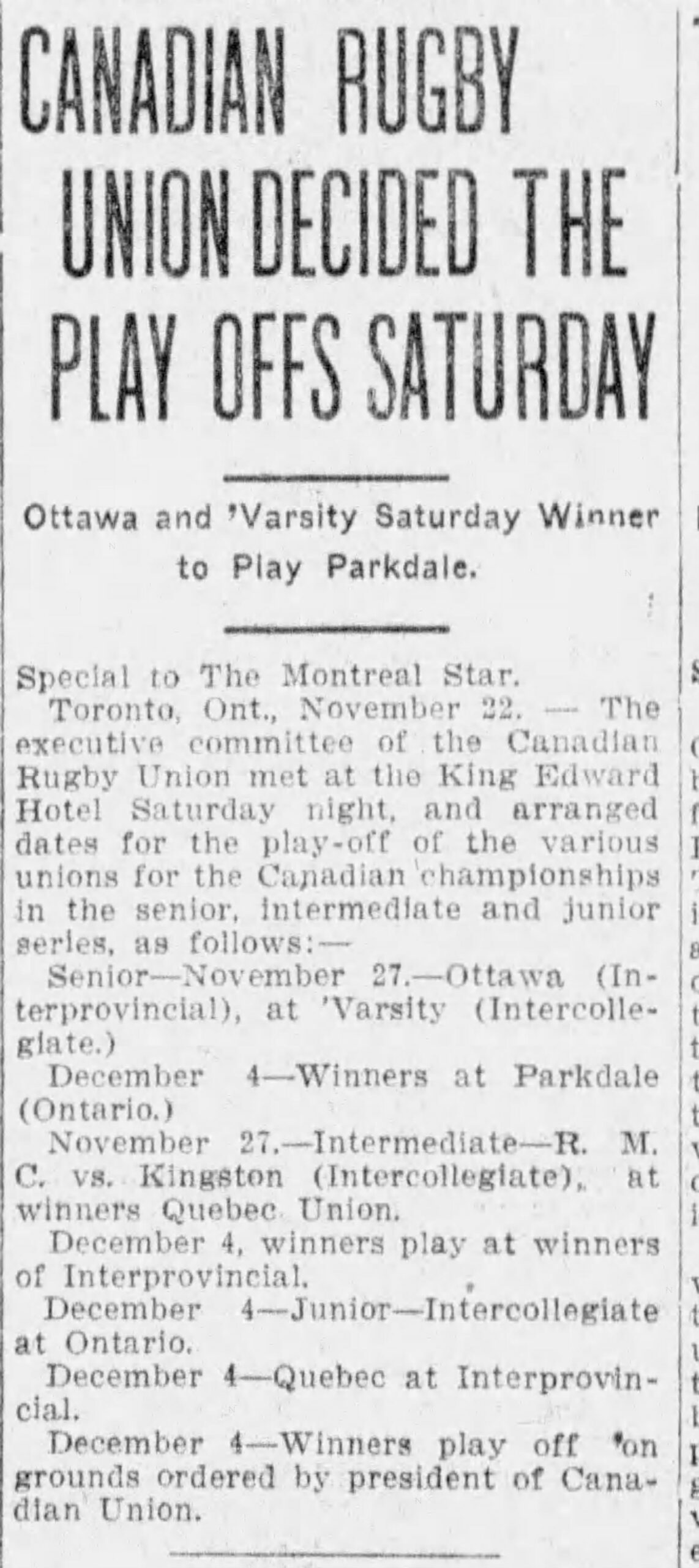
The Canadian Rugby Union had previously established a rotational playoff system where the champion of each union would alternately receive a bye to and host the Dominion championship. Since the new Grey Cup was now the Dominion championship, the CRU simply extended this arrangement. For 1909, it was the ORFU’s year to host; so, the winner of the ORFU final would host the first-ever Grey Cup.
Montreal Star, 22 November 1909Ottawa Citizen, 25 November 1909
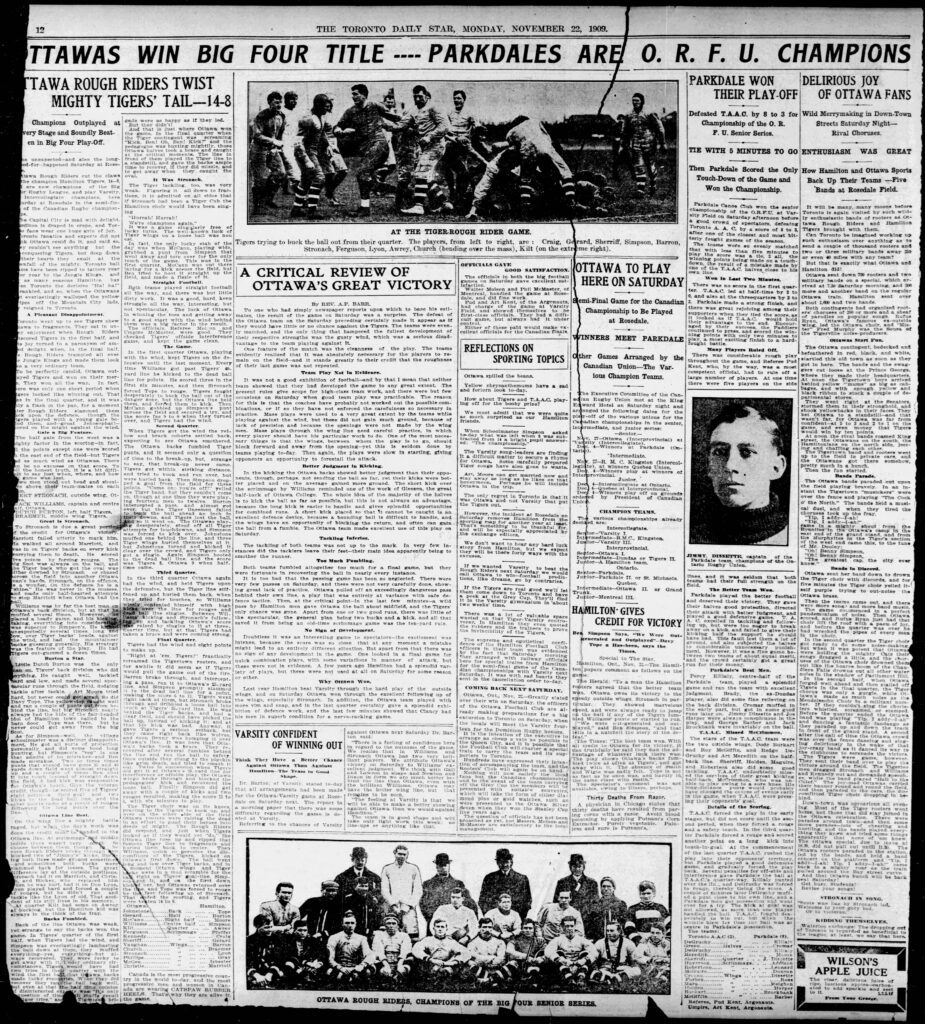
On November 20th, Toronto Parkdale won the ORFU championship with an 8-3 win over the Toronto Amateur Athletic Club, securing their berth in the Grey Cup. On the same day, the Ottawa Rough Riders defeated the Hamilton Tigers 14-8 to win the IRFU championship.
Below is some excellent coverage in the Toronto Star of the IRFU and ORFU playoffs.
Toronto Star, 22 November 1909
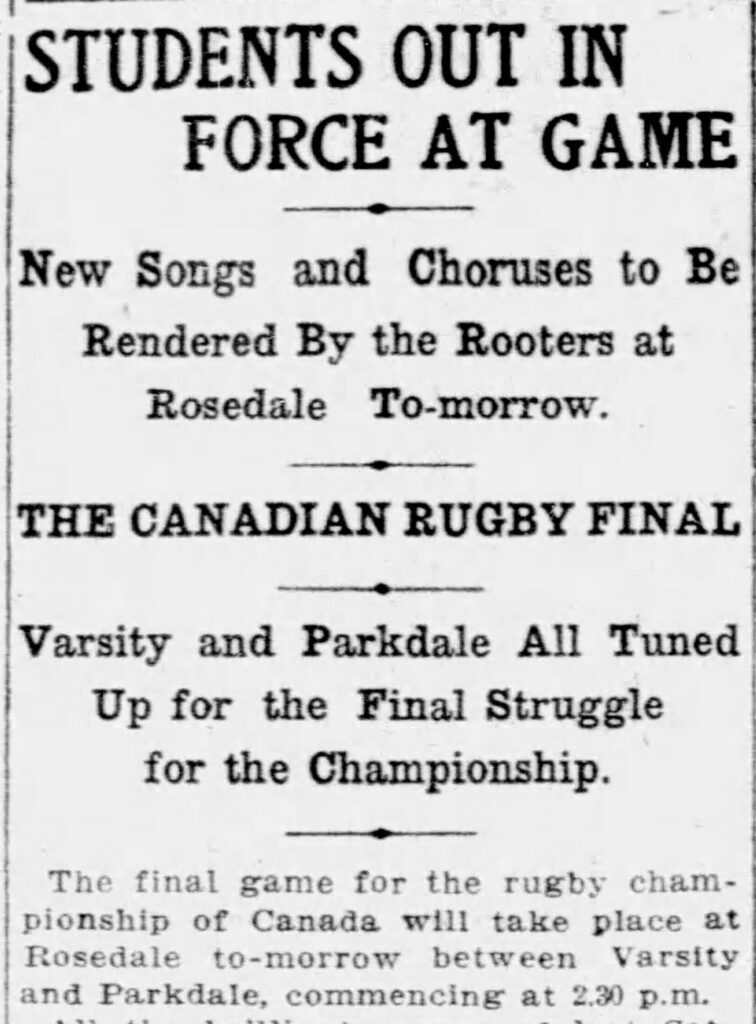
On November 27th, the Rough Riders travelled to Toronto to play the University of Toronto in the Interprovincial-Intercollegiate final. Varsity won handily by a score of 31 to 7, setting up a Varsity vs. Parkdale all-Toronto final for the Grey Cup.
Sources: Montreal Gazette, 15 November 1909 Montreal Star, 22 November 1909 Ottawa Citizen, 25 November 1909 Toronto Star, 22 November 1909 Toronto Star, 6 December 1909
News of the Canadian Rugby Football Union’s new Inter-provincial Rugby Match. (Hamilton Spectator)
It’s now a new year, and Canadian football is still finding its footing so to speak. Good or bad pun? And the CRFU held is second Dominion championship. Sort of. Not really.
But first, imagine this completely theorical scenario. The Montreal Alouettes and the Saskatchewan Roughriders win the East and West divisions respectively. But instead of the Als and Riders squaring off in the Grey Cup, the culminating game features a team of eastern all-stars playing a team of western all-stars instead. Sound silly? Well, this theorical scenario is how the Canadian football playoffs looked in 1885.
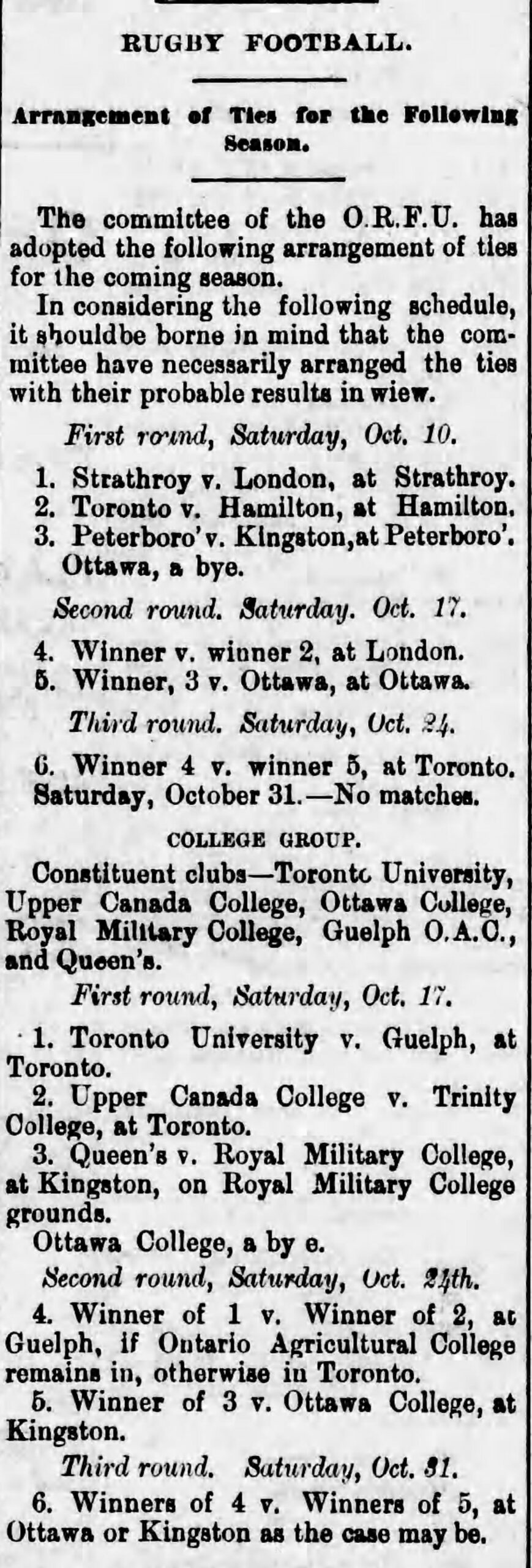
Like the previous year, the Ontario Rugby Football Union and the Quebec Rugby Football Union both used a tie schedule format. To recap, a tie in this context is simply a pairing of teams. Rather than a balanced schedule with standings, teams were paired up and competed in a knock-out style tournament. The Kingston Daily News featured the tie schedule for the ORFU. Have a look to see how the system worked:
1885 ORFU Tie Schedule in the Kingston Daily News
In 1885, the ORFU had two separate divisions, one for college teams and one for the city clubs. The winner of each division met for the Ontario Challenge Cup. In Quebec, there were only four teams – Montreal, Britannia, McGill, and Lennoxville – that competed for the Quebec Challenge Cup.
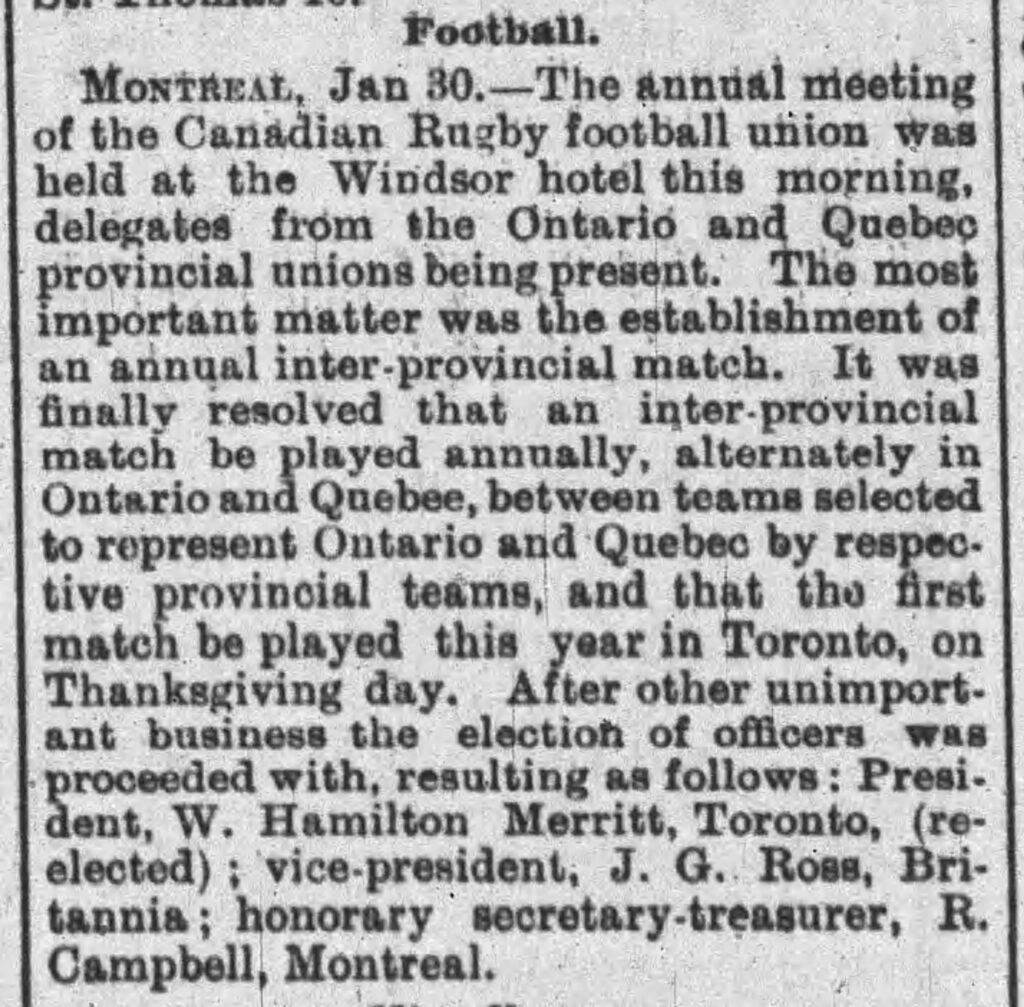
On January 30, 1885, the CRFU voted to hold an Inter-Provincial Rugby Match comprising players from Ontario and Quebec, selected by their respective unions. This new annual all-star game wasn’t actually intended to replace the Dominion championship, though. But fate had other ideas for 1885.
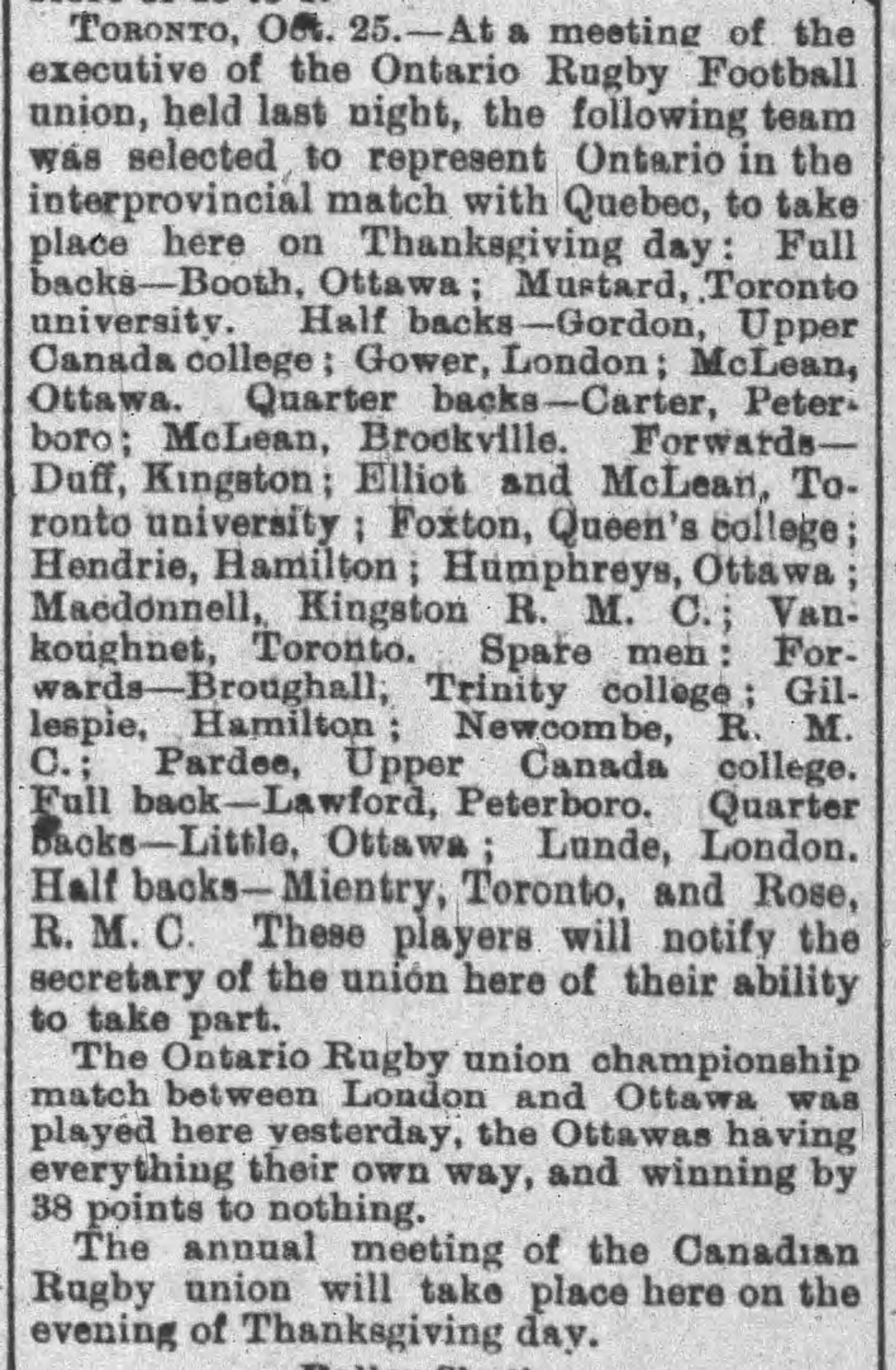
Ontario players selected for the 1885 Inter-provincial Rugby Match, Ottawa defeated London in the ORFU city division. (Hamilton Spectator)
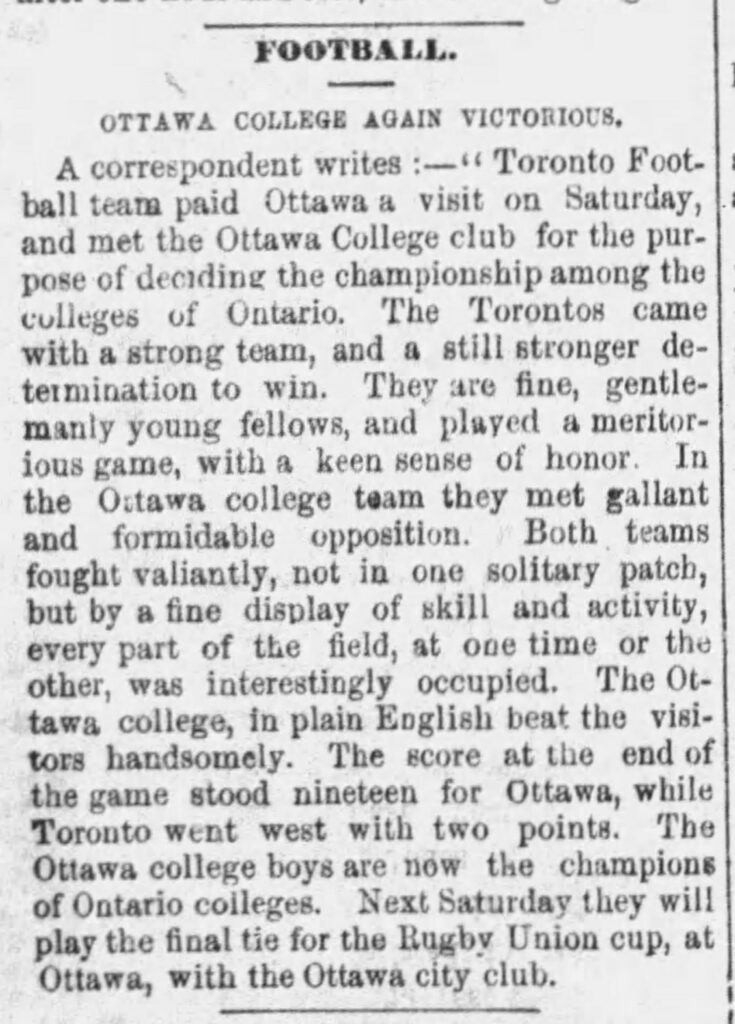
On October 25th, Ottawa dominated London 38-0 in Toronto to win the Ontario city division. On October 31st, Ottawa College defeated the University of Toronto by a score of 19-2 to win the college division. A week later Ottawa College defeated Ottawa City 21-0 in an all-Ottawa affair to win the Ontario Challenge Cup.
Ottawa College defeats University of Toronto to win the ORFU college division in 1885. (Montreal Gazette)
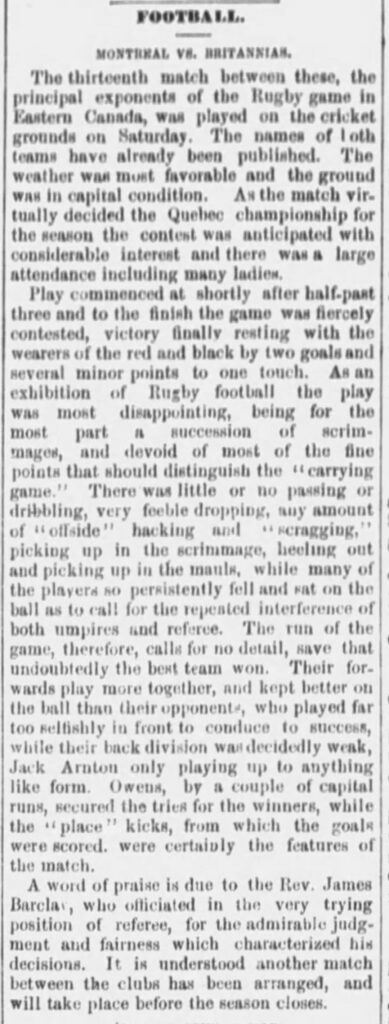
Meanwhile in Quebec, Montreal was once again that province’s dominant team. In a match to decide the winner of the Quebec Challenge Cup on October 10th, Montreal defeated rival Britannia by “two goals and several minor points to one touch.” (Montreal Gazette, 10 October 1885)
Montreal vs. Britannia in the Quebec Challenge Cup in 1885 (Montreal Gazette)
So, the stage was set for Ottawa College to travel to Montreal to play the Quebec champion in what would be the second Dominion championship. Except, it didn’t happen. In 1885, Montreal was engulfed in a smallpox epidemic. Public health concerns prompted a reluctant Ottawa College to forgo the trip to Montreal. Instead, suggestions were made for Montreal to travel to Ottawa and play the championship there.
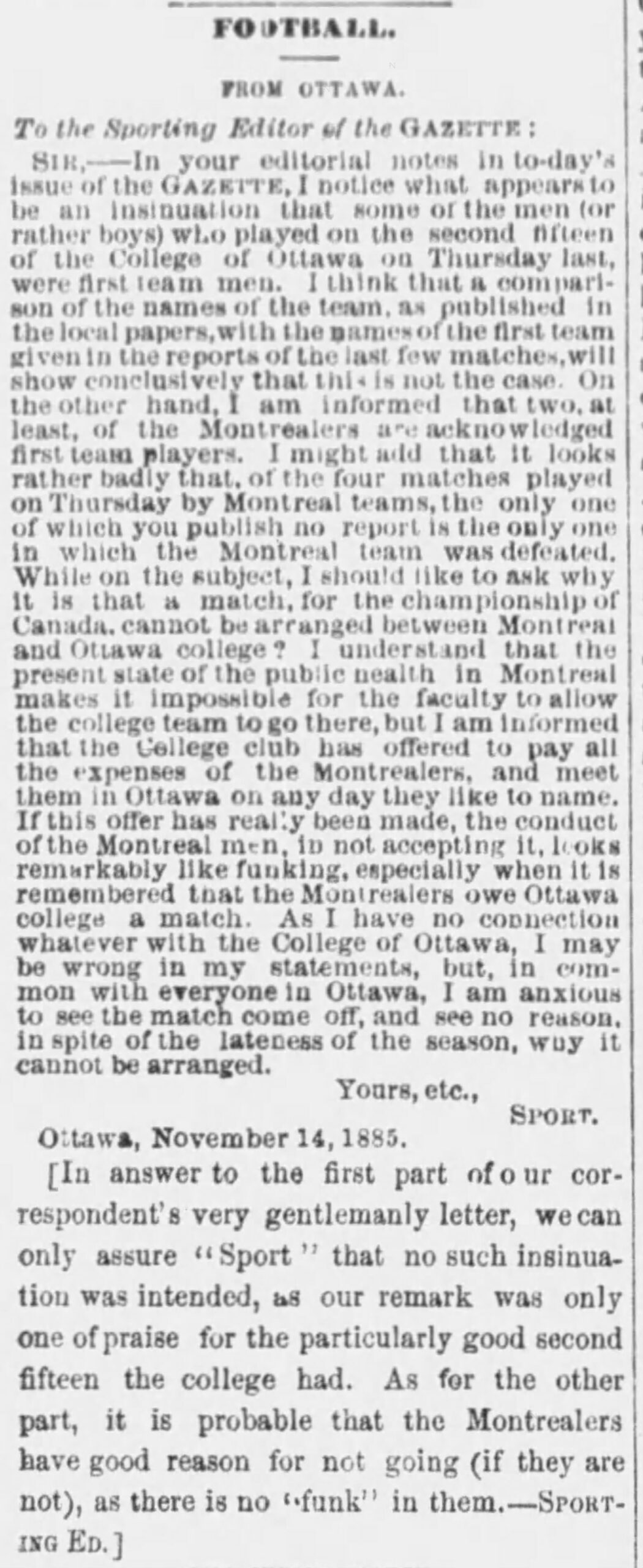
Letter from “Sport” accusing the Montreal Football Club of “funking.
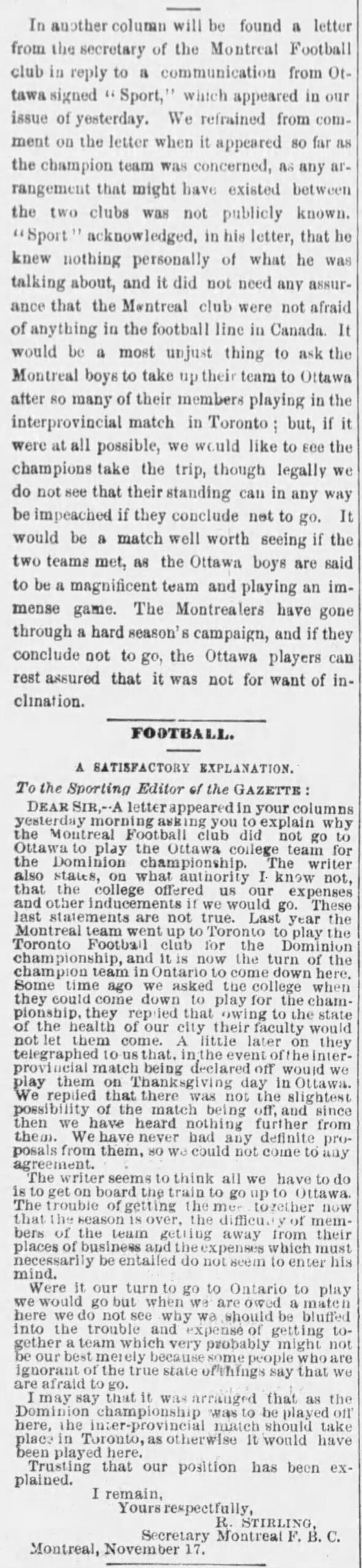
There was a rather testy exchange in the Montreal Gazette between a writer from Ottawa named “Sport” and Mr. R. Stirling, the secretary of the Montreal Football Club. “Sport” accused Montreal of “funking.” That’s old British slang for backing out because of fear. Stirling refuted the accusation and explained that logistics and costs simply made the proposal impractical. So that was the end of that. There was no Dominion championship game played in 1885.
Response to “Sport” from Mr. R. Stirling of the Montreal Football Club.
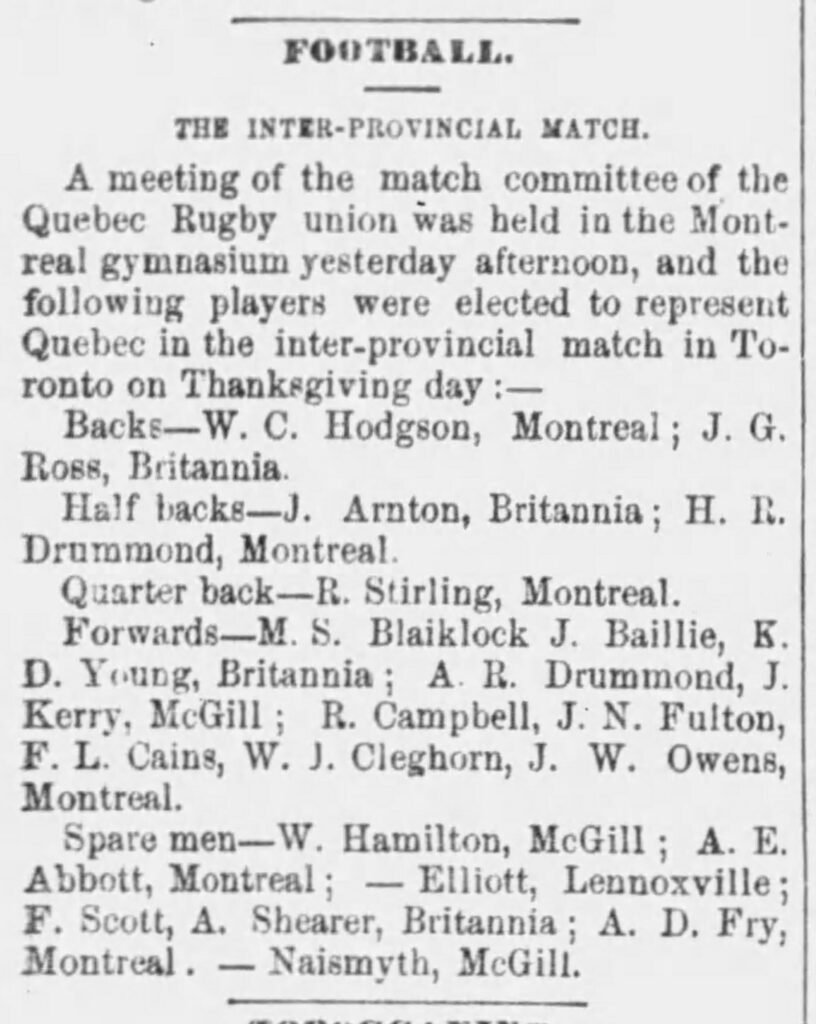
Instead, we were left with the first Inter-Provincial Rugby Match as being the pinnacle of the 1885 football season in Canada. Played on November 12th, which was Thanksgiving Day, in Toronto the Quebec all-stars scored 3 points over their Ontario counterparts. Because the rules of the day stated that a majority of 4 points were needed for a victory, the game was declared a draw.
Quebec players selected for the 1885 Inter-provincial Rugby Match. (Montreal Gazette)
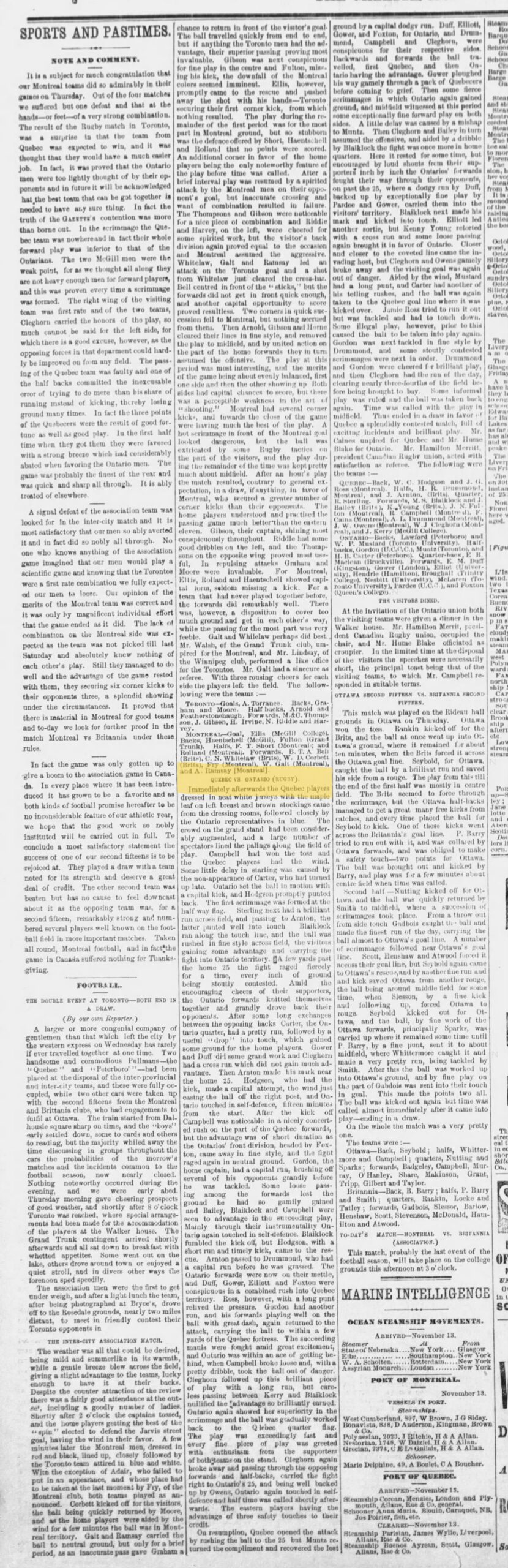
Check out the Montreal Gazette’s great summary of this game, as well as other games (including a soccer game) played on Thanksgiving Day in 1885.
Coverage of the 1885 Interprovincial Rugby Match plus other football games in Montreal Gazette.
So, in short…no Dominion championship. An all-star game ending in a draw instead. And some good old mudslinging in the press. That was the Canadian football playoff picture in 1885.
Sources: Canadian Football History Key Historical Milestones and Dates -1861-1889 by Robert Sproule Hamilton Spectator, 31 January 1885 Hamilton Spectator, 26 October 1885 Kingston Daily News, 13 June 1885 Montreal Gazette, 12 October 1885 Montreal Gazette, 3 November 1885 Montreal Gazette, 4 November 1885 Montreal Gazette, 14 November 1885 Montreal Gazette, 16 November 1885 Montreal Gazette, 18 November 1885
With the recent announcement that the CFL is changing its playoff format in 2027, I thought it would be an interesting learning experience to revisit some of the old playoff systems used in Canadian football, starting in 1884.
When the Canadian Rugby Football Union was relaunched in 1884, one of its mandates was to establish a national championship between the Ontario Rugby Football Union and the Quebec Rugby Football Union. Both the ORFU and QRFU held their own competitions using what was called the Tie Schedule. In this context, a tie refers to a match pairing between two teams and not a draw. Basically, Team A played Team B and the winner played Team C. The winner of that game played Team D and so forth until only one team remained undefeated. It was more or less a knock-out style tournament as opposed to a balanced round-robin schedule like the regular season we are accustomed to today.
In Quebec, the Montreal Football Club and the Britannia Football Club met on October 11th with Montreal securing a 14-2 victory. On the same day, McGill defeated Bishop’s by a score of 50-0. The following week, the two victors met with Montreal coming out on top 21-0 to win the QRFU. Montreal had defeated Britannia, McGill, as well as the Kingston Cadets.
Article about the Montreal-Britannia game. (Montreal Gazette, 3 November 1884)
Quebec also used the Challenge System where a team could “challenge” the champion, If the challengers won, they became the champions; if the champions won, they remained champions. On November 1st, Britannia challenged Montreal for the Quebec Union’s Challenge Cup. Montreal scored a rouge, the only point scored in the entire game. According to a report in the Montreal Gazette, the game was declared a draw. Montreal retained their title and was declared the Quebec champion. Apparently, this game was played using the old English Rugby rules. I presume this is the reason the game was officially a draw as only goals and tries were counted in English Rugby rules. Why this particular game was played using old English Rugby rules instead of the emerging Canadian-style game is rather odd. The article in the Gazette alludes to the game being rather boring.
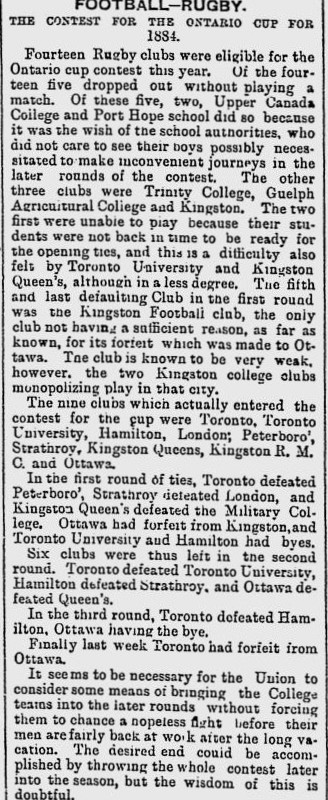
A summary of the 1884 Ontario Rugby Football Union playoffs. (Toronto Mail, 4 November 1884)
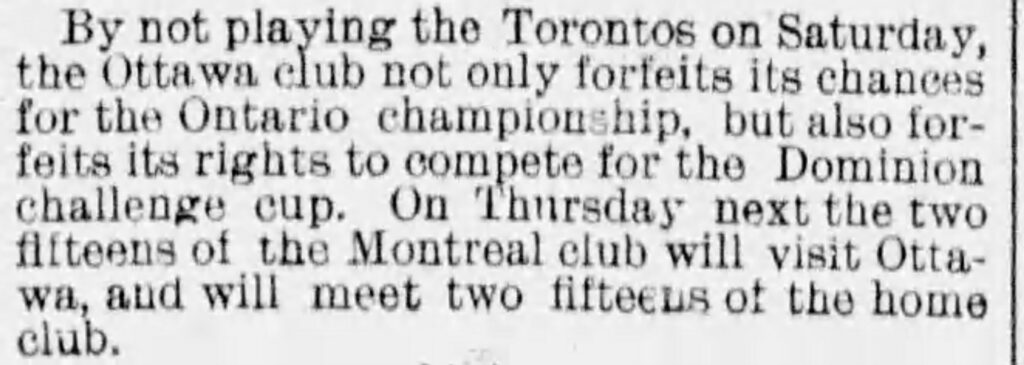
In Ontario, fourteen teams were eligible to compete in the playoffs for the Ontario Cup. Five of these teams chose not to play. The remaining nine – Toronto, University of Toronto, Hamilton, London, Peterboro, Strathroy, Queen’s University, Royal Military College, and Ottawa – were paired up in a knock-out style tournament lasting four rounds…well, almost four rounds. In the final game for the Ontario Cup, Toronto was supposed to host Ottawa. But Ottawa forfeited the game, leaving Toronto as the Ontario champions.
Ottawa forfeits the Ontario Challenge Cup. (Montreal Star, 3 November 1884)
So, that’s how the two provincial champions were crowned in 1884. Montreal was declared the Quebec champion after a draw against Britannia in a game that was played using different rules. Toronto was the declared the Ontario champion after Ottawa didn’t show up. A bit anti-climatic, eh?
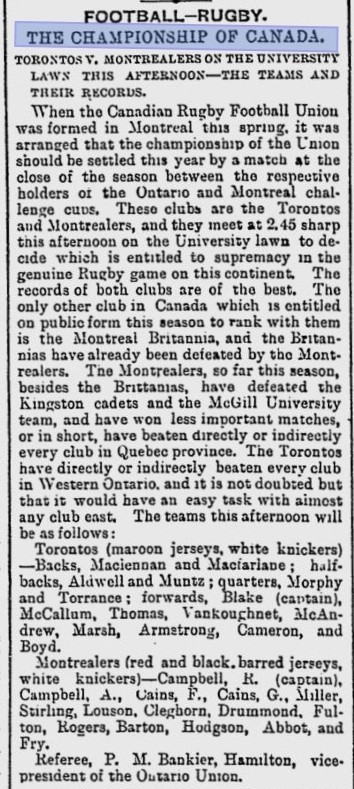
Preview of the CRFU Dominion Championship between Toronto and Montreal. (Toronto Mail, 6 November 1884)
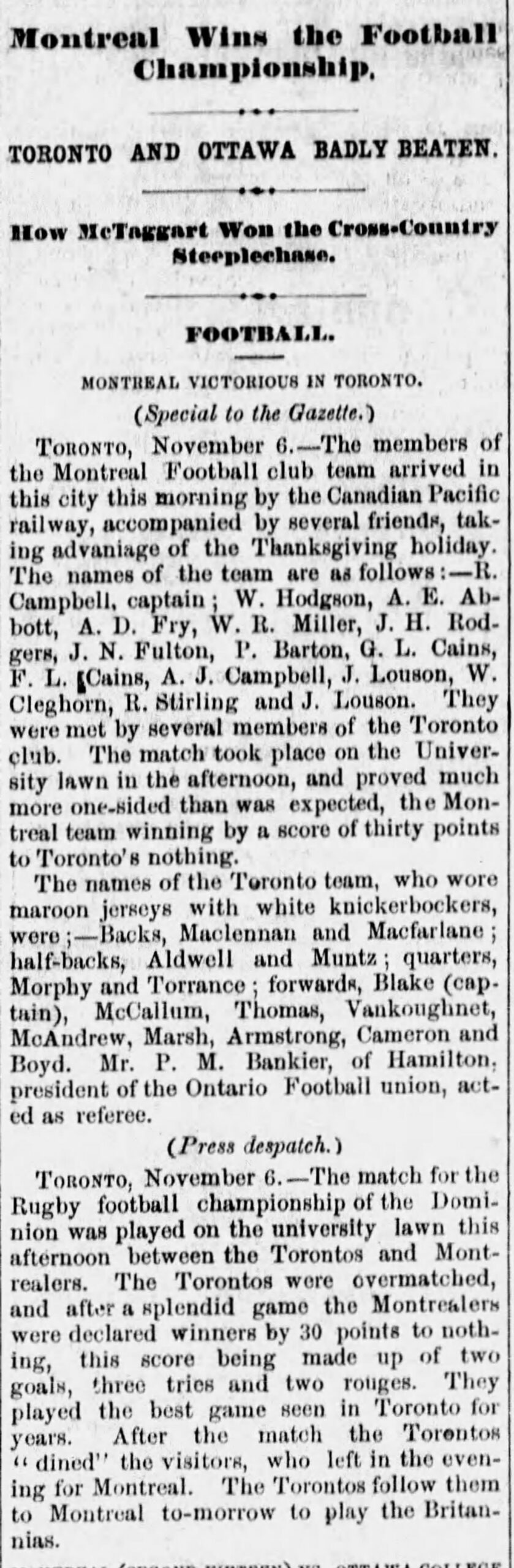
Nevertheless, the scene was set for the first-ever Rugby Football Championship of the Dominion. Held at the University of Toronto on November 6th, the Montreal Football Club handily defeated the Toronto Football Club by a score of 30-0 in front of 1500 fans. Montreal scored two goals, three tries, and two rouges.
Summary of the Montreal victory over Toronto in the first Dominion championship. (Montreal Gazette, 7 November 1884)
Despite the informalities and quirks associated with the season schedules used at the time, the domination of the Montreal Football Club arguably proved that they were strongest team in Canada and worthy of being called Dominion champions.
Something else stood out to me when researching the 1884 season. There were several more exhibition games played after the Dominion championship in Toronto. For instance, after losing the championship game Toronto travelled to Montreal to play the Britannias. Imagine the losing team of the Grey Cup playing a meaningless road game the following week? Ah, such are the peculiarities of good old Canadian football.
Special thanks to Robert Sproule who shared with me some of his research on early Canadian football during this period. It helped shed some light on on the tie schedule format and general structure of the leagues.
Sources: Canadian Football Timeline (Canadian Football Research Society) Important Dates in Canadian Football by Bob Sproule, Coffin Corner, 1991 Montreal Gazette, 3 November 1884 Montreal Gazette, 7 November 1884 Montreal Star, 3 November 1884 Toronto Mail, 4 November 1884 Toronto Mail, 6 November 1884
In 1909, Governor General Earl Grey donated a trophy to be awarded to the amateur rugby football champions of Canada. The University of Toronto won the inaugural championship with a 26-6 win over Toronto Parkdale. Various teams in Toronto and Hamilton competed in the early Grey Cup contests before the game was put on hold after 1915 due to the First World War.
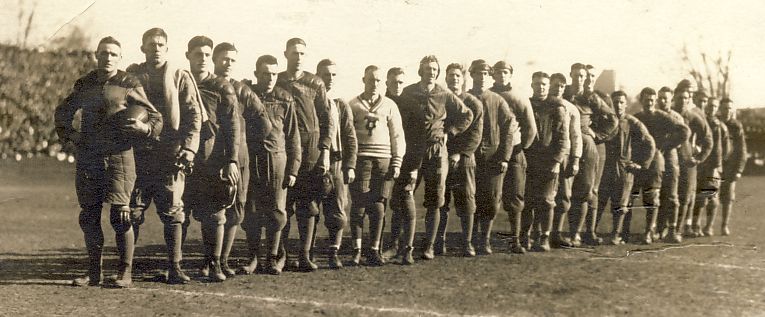
1920 University of Toronto Varsity Team (photo courtesy of the Canadian Football Research Society)
The Grey Cup was then virtually forgotten. The trophy itself was locked away hidden in a storage vault. War has a way of resetting priorities, you see. After football resumed in Canada in 1919, there were growing organizational issues amongst some teams and disagreements amongst the rugby unions, climaxing in a decision by McGill University and Montreal to refuse to contest the Canadian Rugby Union playoffs. Alas, there was no Grey Cup in 1919, either.
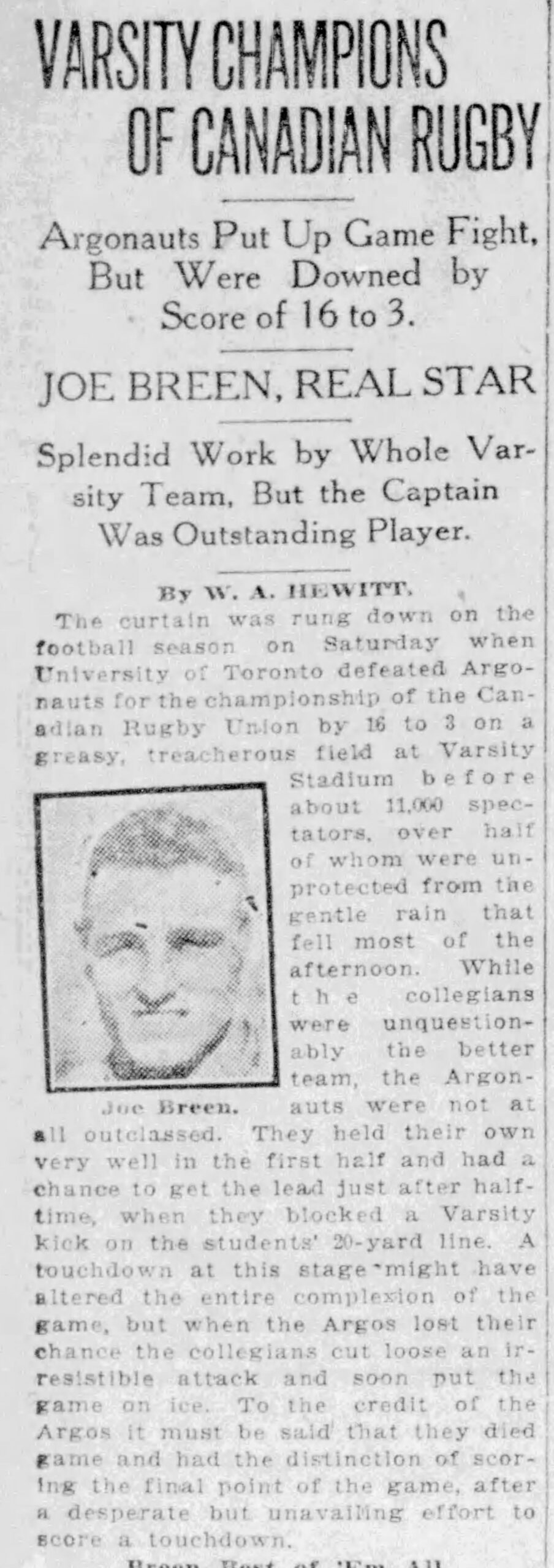
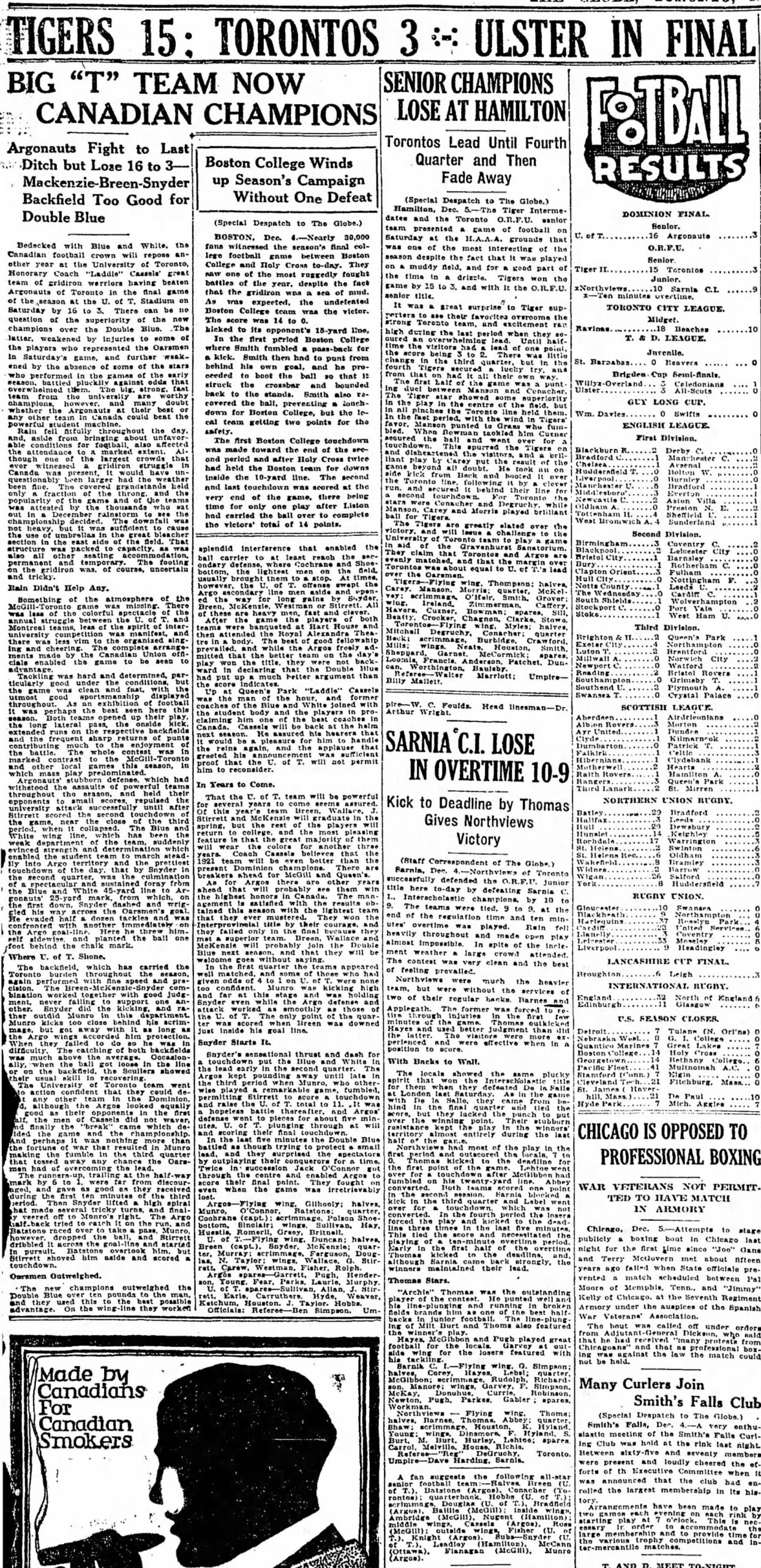
Coverage of the 1920 Grey Cup in the Toronto Star on December 6, 1920.
But in 1920, the Grey Cup made its triumphant return. And a couple of familiar teams were back in the mix to win the big game. On Saturday, December 4, 1920, the University of Toronto played the Toronto Argonauts in the 8th edition of the Grey Cup. Played in less-than-ideal conditions (rain and mud!) at Toronto’s Varsity Stadium, Varsity’s Joe Breen was the star of the day, according to the Toronto Star, leading his team to a 16-3 victory over the Argonauts.
Coverage of the 1920 Grey Cup in the Globe and Mail on December 6, 1920.
This would be the University of Toronto’s fourth and final Grey Cup championship. At the time, Varsity was considered by many to be the best football team in the country. Their championship win cemented this sentiment.
Despite being relegated to a dark memory hole just a few years prior, the Grey Cup was back. And perhaps that’s what mattered most.
It’s September 1952 and a new technology – black and white television – is taking the country and much of the world by storm. The Canadian Broadcasting Corporation (CBC) entered the TV business with two flagship stations: CBFT in Montreal and CBLT in Toronto.
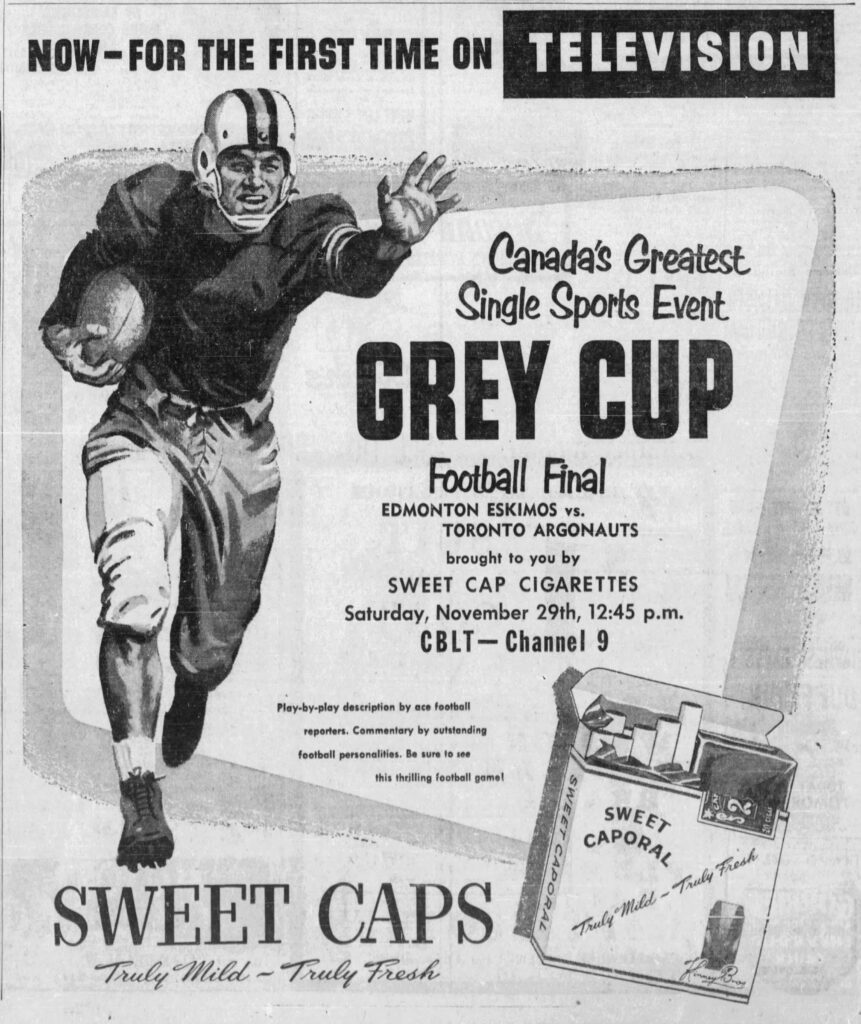
Grey Cup Advertisement for Sweet Caps cigarettes in the Toronto Star (27 November 1952)
The decision was soon made to broadcast the upcoming Grey Cup game on CBLT. The Canadian Rugby Union championship was scheduled for Saturday November 29th at Varsity Stadium in Toronto.
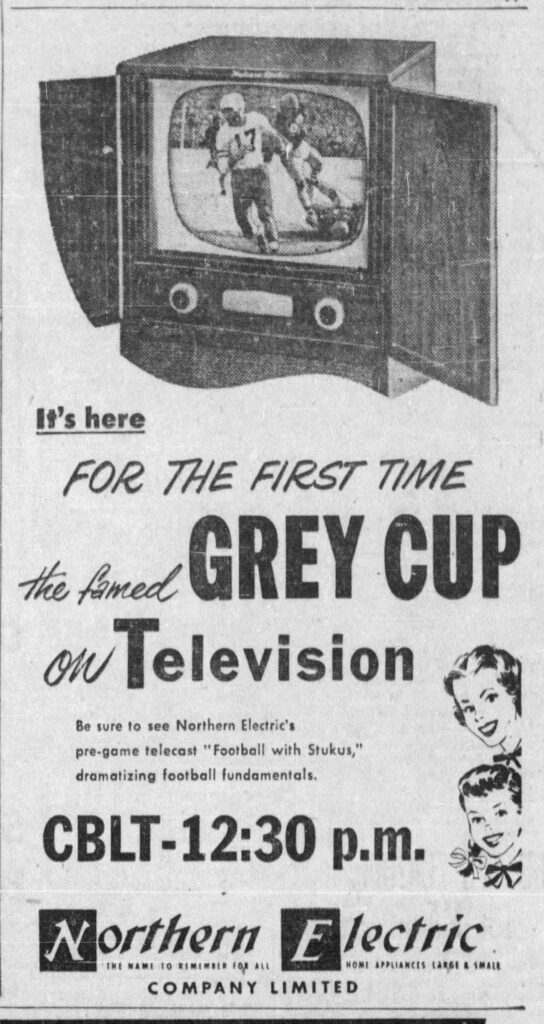
Grey Cup Advertisement by Northern Electric in the Toronto Star (27 November 1952)
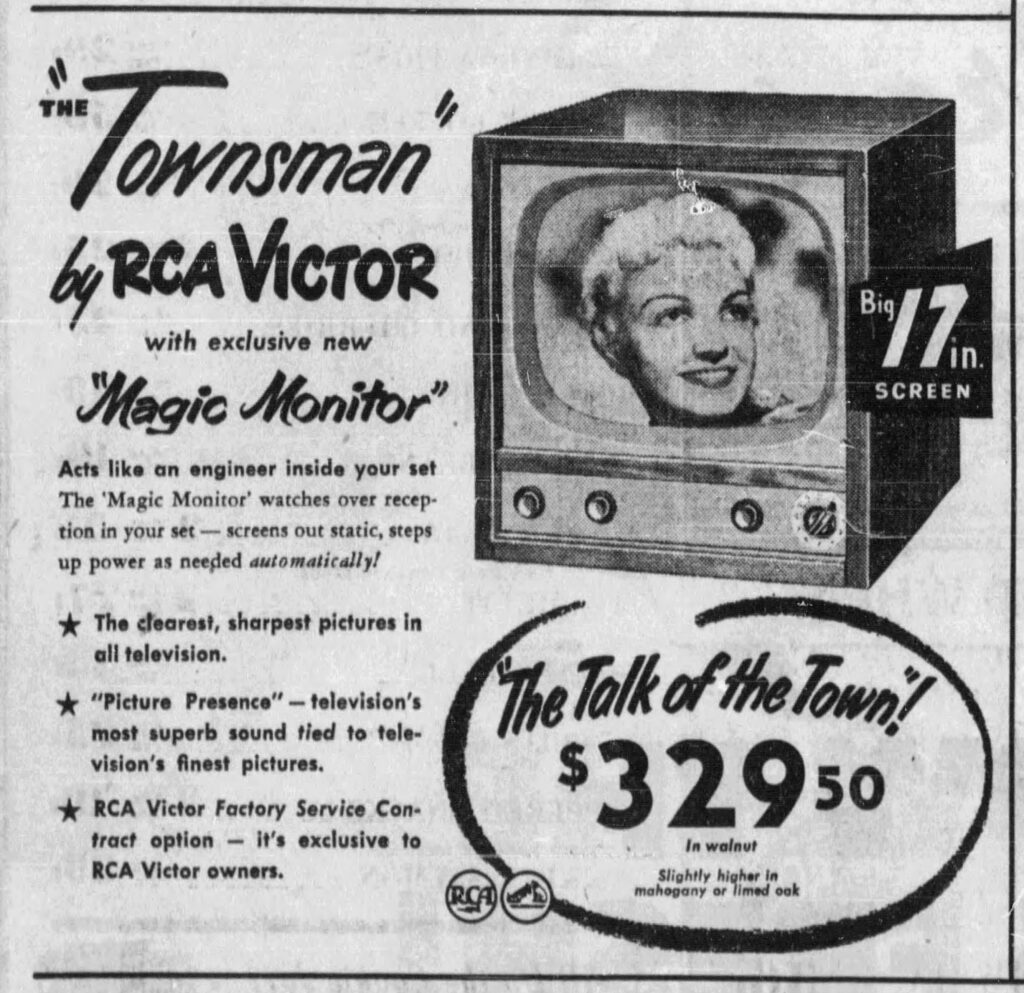
The novelty factor of the new technology coupled with the popularity of the hometown Toronto Argonauts, who were playing in the championship, helped drive sales for television sets in Toronto. Several ads selling TVs appeared in local newspapers. These didn’t come cheap, but vendors were more than happy to set up affordable payment plans for excited football fans.
Ads promoting TV sales
While the Grey Cup game itself was the first Canadian football game ever televised, broadcast crews did a practice run a few days before in the playoff game between the Argonauts and the Sarnia Imperials of the Ontario Rugby Football Union. In those days, the ORFU still challenged for the Grey Cup. The Toronto-Sarnia Grey Cup semi-final game at Varsity Stadium was used as the dress rehearsal for the big game. The 1952 Grey Cup commentators Norm Marshall and Larry O’Brien were actually chosen after an audition for the roles was held during the Sarnia game.
Notes about the TV practice run done during the Grey Cup semi-final between Toronto and Sarnia (Toronto Star, 27 November 1952)
Pubs in and around Toronto with television sets were packed on the day of the game. Meanwhile, in nearby Hamilton, Westinghouse set up several TVs so that employees and friends could watch the game. The broadcast even included a short pre-game show hosted by Annis Stukus.
In the end, the Argonauts defeated Edmonton by a score of 21-11 in front not only record crowd at Varsity Stadium but also tens of thousands of television viewers in the Toronto area. A new era for the Grey Cup and for Canadian television was here.