On Sunday, December 9, 1956, tragedy struck Canadian football when five professional players lost their lives in one of the country’s worst aviation disasters.
Trans-Canada Air Lines Flight 810 left Vancouver that evening bound for Calgary with 62 passengers and crew onboard. Among the passengers were four members of the Saskatchewan Roughriders (Melvin Becket, Mario DeMarco, Gordon Sturtridge, and Ray Syrnyk) and Calvin Jones of the Winnipeg Blue Bombers. They were returning from Vancouver, where the 1956 Canadian Football Council all-star game was played the previous day.
About an hour after takeoff, the plane crashed into Mount Slesse, near Chilliwack, BC. All 62 people aboard the aircraft died. The crash site is in a remote area of British Columbia, which made recovery efforts virtually impossible. The remains of both the plane and the victims remain at the site to this day.
Here is a closer look at the five players who were lost in the disaster:
Melvin Becket was a native of Chicago, Illinois. He was drafted by the NFL’s Green Bay Packers but opted to play for the Saskatchewan Roughriders. His wife was expecting their child just after Christmas.
Mario DeMarco was an American from New Jersey. He and Melvin Becket were not only teammates; they were also business partners of a local gas station in Regina. The DeMarco–Becket Memorial Trophy is awarded to the Most Outstanding Offensive Lineman in the CFL’s West Division.
Calvin Jones was an African-American from Ohio who came to Canada to play professional football with the Winnipeg Blue Bombers after a standout college career at the University of Iowa. He missed an earlier flight out of Vancouver so was instead put on the ill-fated TCA Flight 810.
Gordon Sturtridge was a native of Winnipeg, where he started his professional football career. He was a three-time western all-star and played four seasons with Saskatchewan. His wife Mildred was also aboard the flight. They left behind three young children.
Ray Syrnyk was a native of Saskatoon and played on the 1953 Saskatoon Hilltops junior championship team. He was the youngest (22) of the five players lost.
The first game played at McMahon Stadium featured the Stampeders hosting the Winnipeg Blue Bombers on August 15, 1960. On the day of the game, many Calgary-based companies took out ads in the Calgary Albertan and Calgary Herald newspapers to celebrate the opening of the new stadium. A lot of these firms were directly involved in the stadium’s construction.
Below is an assortment of the advertisements. Do you see any companies you recognize?
McMahon Stadium turned 65 this month. It is one of just a few of the “old” CFL stadiums still in use. Most CFL teams are playing in either relatively new or refurbished facilities. But back in 1960, the new McMahon Stadium was hailed as one of the finest football stadiums in the country.
Talk of building a new home for the Calgary Stampeders had been around for years. After some false starts and delays things finally got moving on March 15, 1960 when Stampeders President George McMahon unveiled plans for a new stadium to be constructed on land reserved for a future university campus.
Construction began the following month. Most of the concrete and other materials used was pre-fabricated offsite, and with a crew of up to 200 a day working the site, it meant construction could be expedited. Plus, the weather cooperated greatly so there were no delays on that front. With solid project management, an efficient labour team, and a little bit of luck, the stadium was completed in just 103 days.
Article in the Calgary Albertan about George and Frank McMahon
The total cost of McMahon Stadium came in at just over a million dollars. About a third of that was covered by George McMahon and his brother Frank. The McMahons were oil businessmen who were among the biggest boosters for the city of Calgary. They were respected and connected. It’s doubtful the stadium would’ve gotten built without their support. Not only did they put their own money into the project, but they were also the ones who arranged for its financing.
The initial capacity of McMahon Stadium was about 20,000. But it was built with expansion in mind. Over the years more seats and corporate amenities were added. At the time it was opened it was suggested that capacity could one day reach as high as 70,000. The Stampeders opened McMahon Stadium on August 15, 1960 against the Winnipeg Blue Bombers. Unfortunately for Stampeders fans, the home side came up short losing 38-23.
Article in the Calgary Herald comparing McMahon Stadium to other CFL stadiums.
McMahon Stadium hosted the 1975 Grey Cup, the first to be played in Calgary on November 23rd of that year. Since then, the Grey Cup has been played there four more times and will once again host the championship in 2026.
Arguably the biggest event held at McMahon Stadium was the Opening and Closing Ceremonies of the 1988 Winter Olympics.
Red Dutton loses the bet to George McMahon (Calgary Herald).
Burns and Dutton was the main contractor hired to construct McMahon Stadium. The firm was led by Mervin “Red” Dutton, who was a former president of the Stampeders. He bet George McMahon $1500 that the stadium wouldn’t be able to be completed in time for the Stampeders’ home opener. Well, his crew and subcontractors’ hard work cost him $1500. The stadium was completed on time. He lost the bet and ended up paying McMahon the $1500 in one-dollar bills.
I sometimes wonder why the McMahon Stadium model can’t be replicated when it comes to construction and financing. Today’s stadiums easily cost north of $200 million (and that’s on the cheap side) and take years to build. But there’s something to be said about the so-called McMahon way. Just get building it. Get the barebones up and going and add the capacity and amenities over time. It may not be ideal, but at least you’ll have a stadium to play in. I’m talking to you, Halifax – or anywhere else for that matter.
When McMahon Stadium opened, numerous companies (many of whom participated in its construction) ran ads in the Calgary newspapers praising the new facility. I’ll feature some of these in a subsequent post.
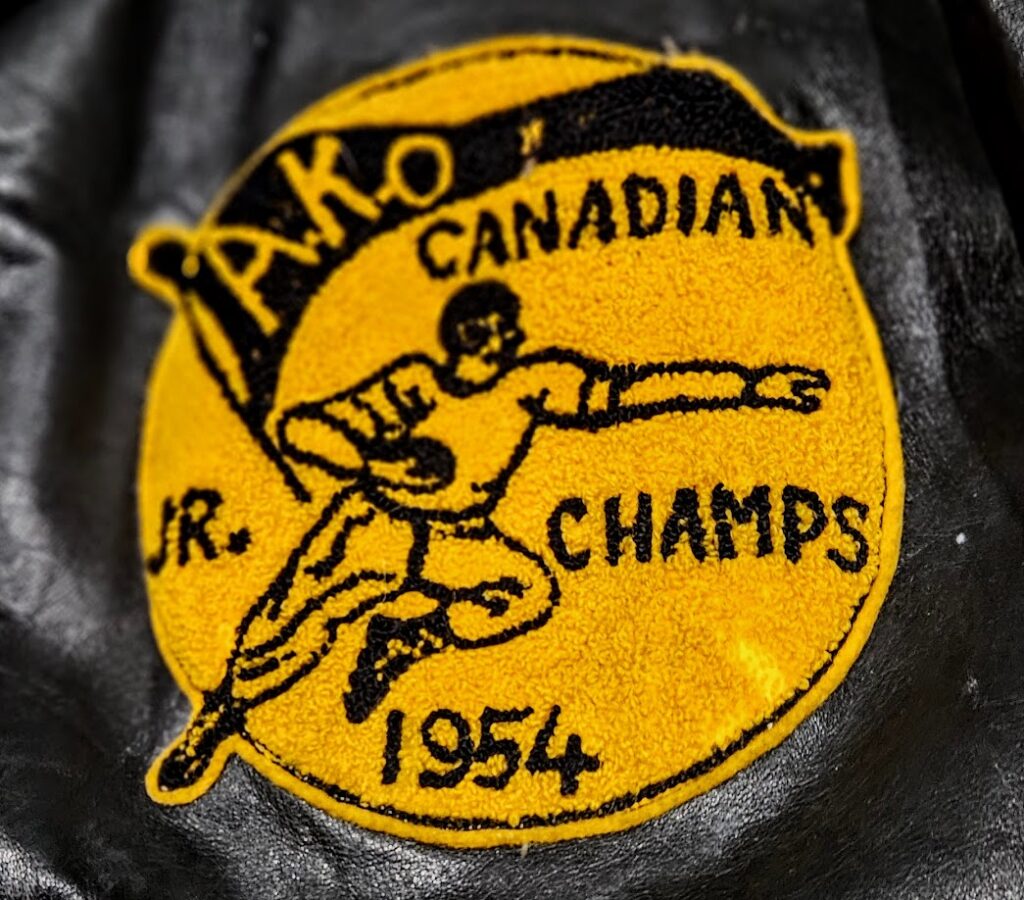
In the early to mid 1950s, the Windsor AKO Fratmen were the dominant junior football team in Ontario. They appeared in four consecutive national championships from 1952 to 1955, winning twice.
Windsor AKO 1954 Canadian junior football championship patch (Photo courtesy of Todd Ternovan)
It wasn’t uncommon for football teams to be owned or sponsored by other organizations. Even some senior teams followed this arrangement. Montreal’s team was operated by the Montreal Amateur Athletic Association and the Toronto Argonauts were a property of the Argonaut Rowing Club. It was the AKO (Alpha Kai Omega) Fraternity who owned and operated Windsor’s junior football team at the time.
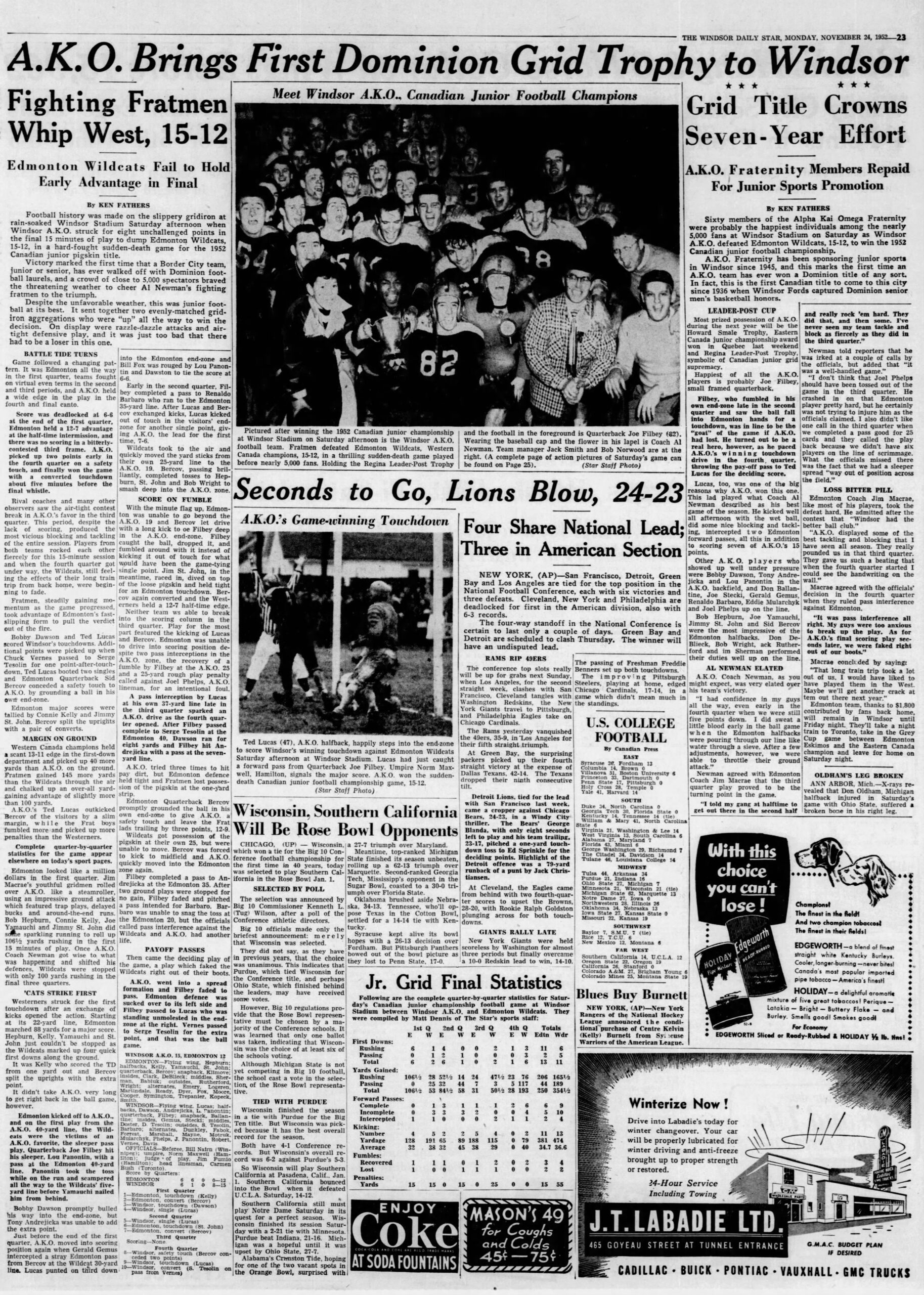
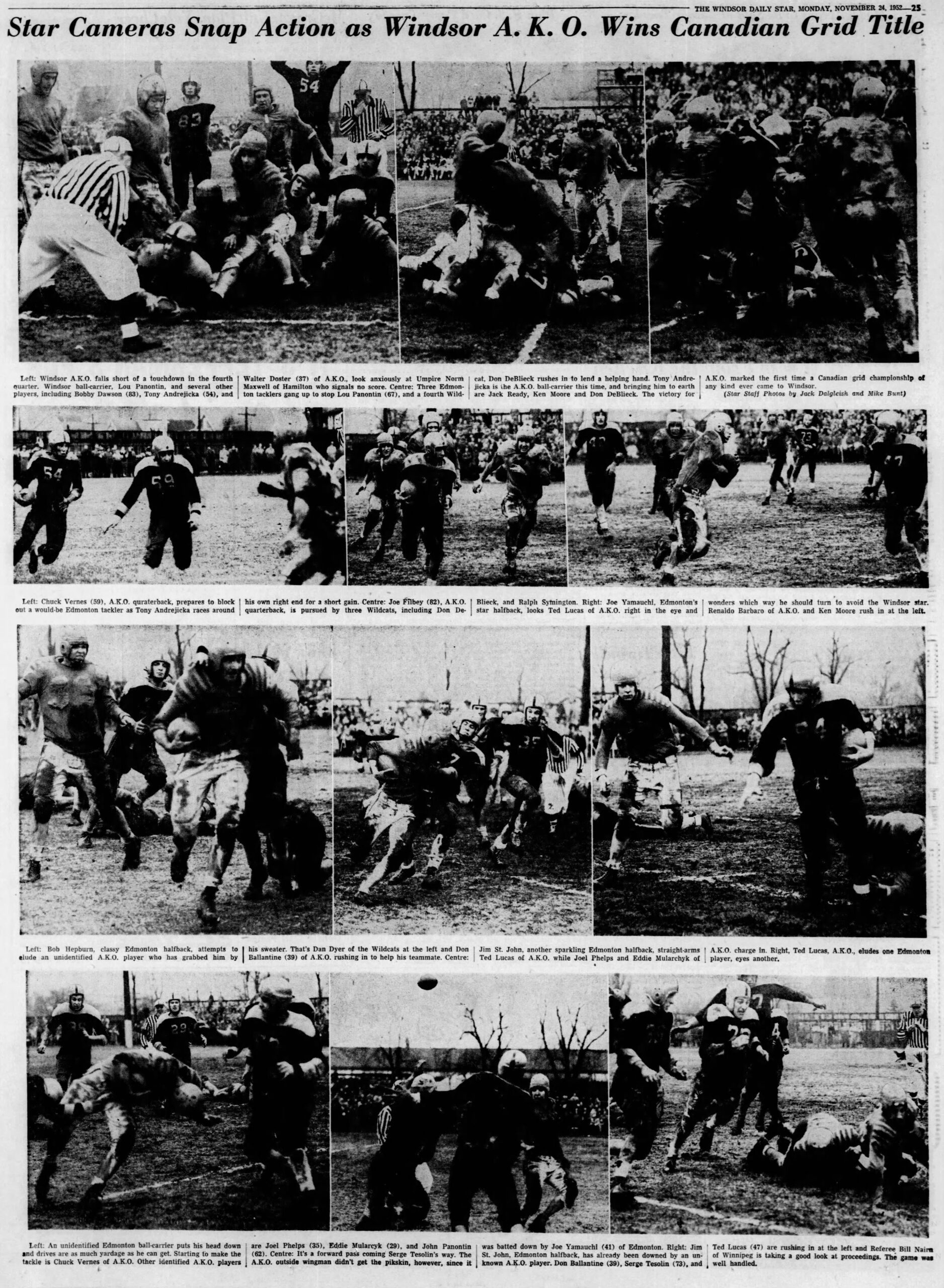
On November 22, 1952, Windsor won its first national championship in Canadian junior football. Known as the Leader Post trophy at the time, Windsor defeated the Edmonton Wildcats by a score of 15-12 in front of 5,000 fans at Windsor Stadium.
Coverage of the 1952 Canadian junior final in the Windsor Star.
Photos of the 1952 Canadian junior final. (Windsor Star)
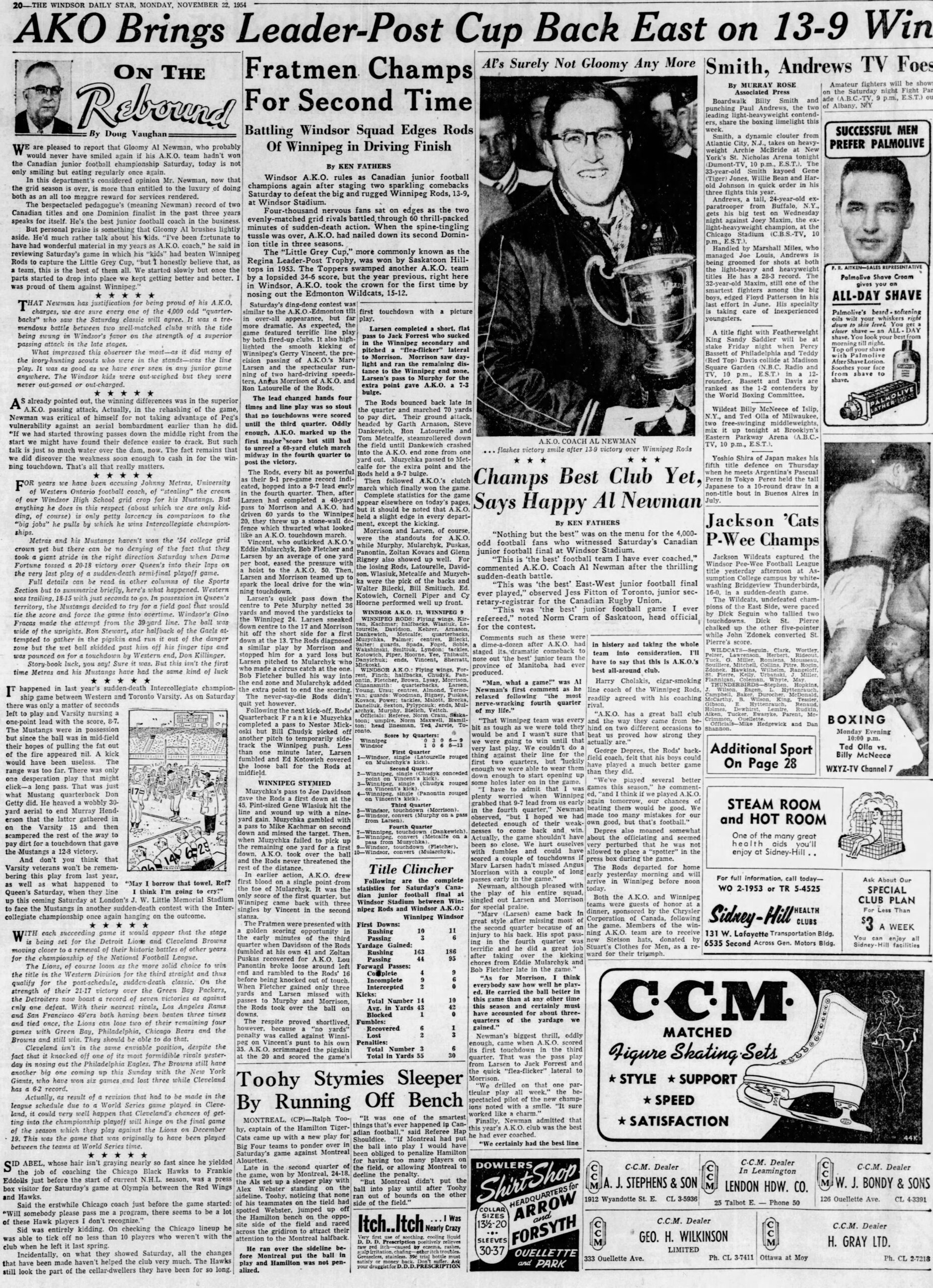
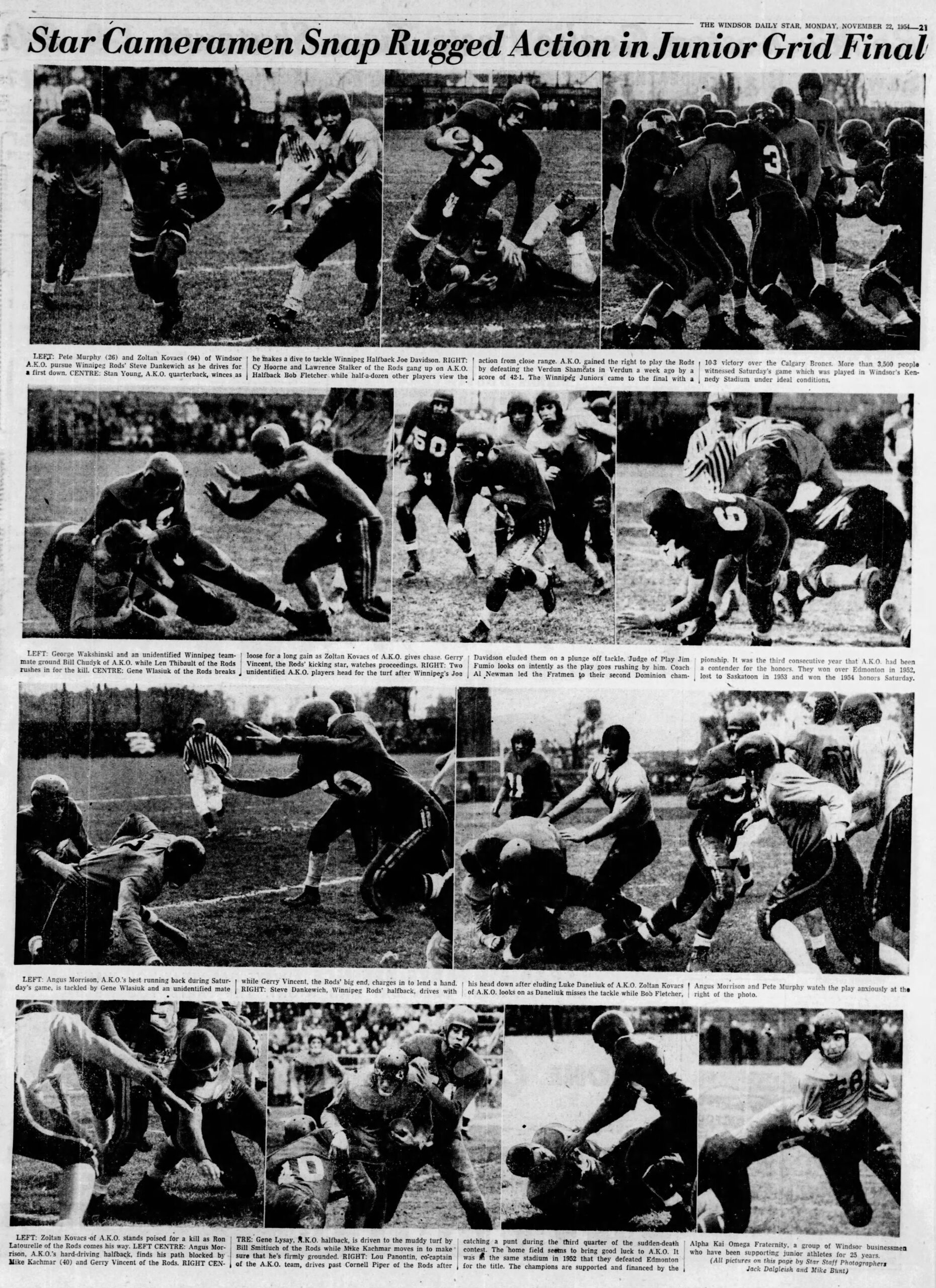
The following year, Windsor fell to the Saskatoon Hilltops before making a comeback in 1954. On November 20, 1954, another big crowd came out to see Windsor beat the Winnipeg Rods 13-9. It was Windsor’s second national championship in three years. They would lose to Winnipeg in a rematch in 1955.
Coverage of the 1954 Canadian junior final in the Windsor Star.
Photos of the 1954 Canadian junior final. (Windsor Star)
Windsor’s success in junior football in the 1950s – with two championships – was big news for the southern Ontario city. They were coached by Al Newman, considered by many to be one of the best coaches in Canadian junior football. Bobby Dawson, a standout player in the ’52 championship game, went on to a solid professional career with the Hamilton Tiger-Cats of the IRFU.
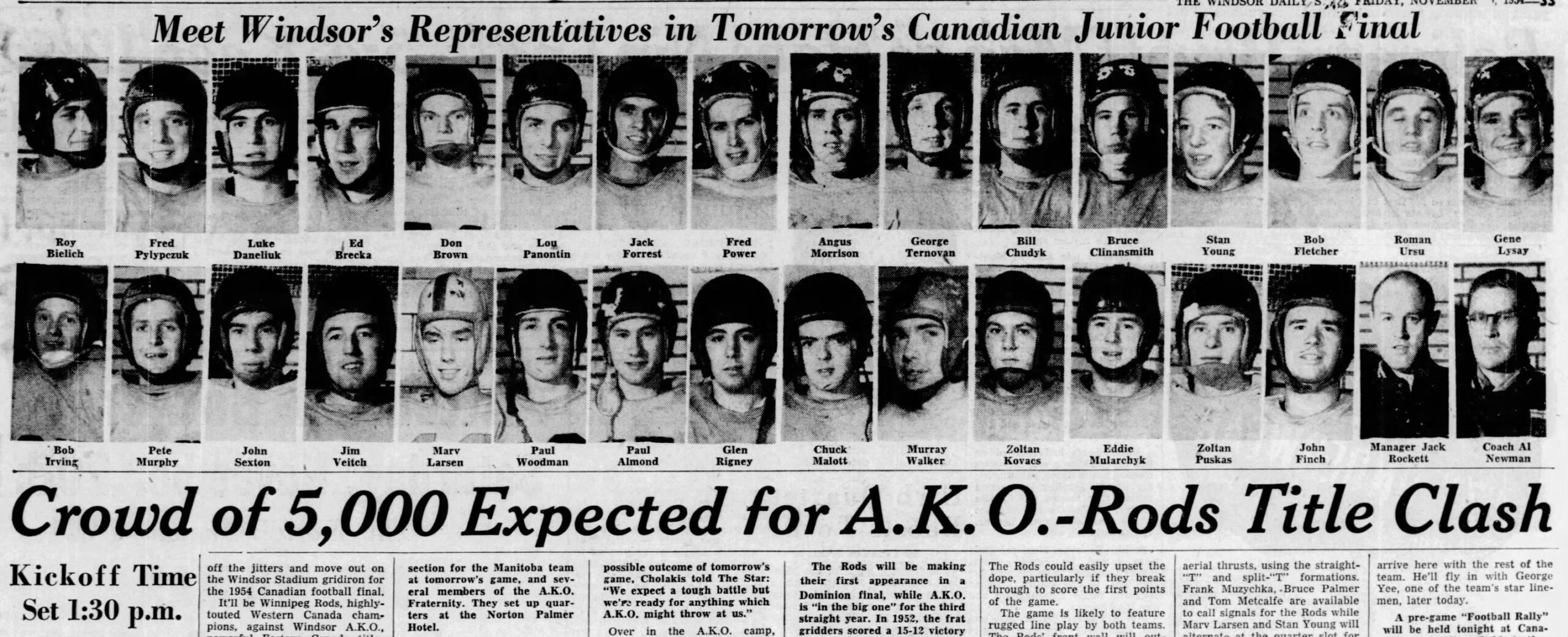
The Windsor AKO lineup for the 1954 junior final vs. Winnipeg
Playing on that 1954 championship team was a gentleman named George Ternovan, who would later become a councillor in the nearby municipality of St. Clair Beach in Essex County. He played defensive end. George’s son Todd kindly shared with me some photos of his father’s championship jacket as well as the football cleats he wore in the championship game.
Football cleats worn by George Ternovan of the Windsor AKO Fratmen in 1954.
George Ternovan’s 1954 Canadian junior football championship jacket.
Today, Windsor’s junior football team is known as the St. Clair Saints, having been sold to the St. Clair College’s Student Athletic Association in 2020. The Saints play in the Canadian Junior Football League and are the defending Canadian Bowl champions.
Known as the Little Grey Cup, the Leader Post Trophy (named after the Regina newspaper) was the name of the Canadian junior football championship for many years and was first awarded in 1925. In 1976, it was replaced by the Armadale Cup. Since 1989, the Canadian Junior Football League’s championship has been known as the Canadian Bowl.
Perhaps the most famous of the Windsor AKO football alumni is Tommy Grant who played in the 1955 junior final. He later played for the Hamilton Tiger-Cats and Winnipeg Blue Bombers and played in nine Grey Cup games. Grant was induced into the Canadian Football Hall of Fame in 1995.
Imagine this. The suits in the NFL are getting ready for their star-studded college draft. Everyone is talking about who’s going to be picked. Who’s going to make it to the big time. Fortune and fame await the lucky group of the chosen few. Then, news breaks that the projected number one pick overall has just signed a record deal with a team from Canada.
It might sound far fetched today, but this is exactly what happened in 1991. To truly appreciate the impact of this event you have to first understand where the CFL was in the early 90s. It was a league in some serious economic trouble. That’s putting it mildly. Attendance was in decline. Teams were losing money. Owners were walking away from their teams. The Montreal franchise had already folded. Plus, Canada was in the midst of a nasty recession not to mention a national unity crisis. These were depressing times.
Nevertheless, in February 1991 the CFL’s flagship franchise, the Toronto Argonauts, were purchased by the trio of businessman Bruce McNall, hockey star Wayne Gretzky, and actor John Candy. McNall et al saw an opportunity in growing Canadian football not just in Toronto but in the United States, as well. With some, let’s say, investment the game could be revitalized in Toronto and a lucrative U.S. market would eat up Canadian football like American apple pie.
That investment was a 21-year-old wide receiver out of Notre Dame college named Raghib “the Rocket” Ismail. Ismail had a stellar college football career and was considered to be the cream of the crop in the 1991 NFL Draft happening in April of that year. The Dallas Cowboys were expected to draft him as the first pick overall.
According to Paul Woods, who authored the book Year of the Rocket, Bruce McNall tasked then Argo General Manager Mike McCarthy to “think big.” McCarthy responded that there’d be nothing bigger than signing the Rocket. Sign the most recognizable college football star in America and lure him to Canada. That would put Toronto and the CFL on the radar. That would be a worthwhile investment indeed.
A publicity stunt? Oates, Bob. “Bruce McNall Tries to Buy a Rocket to Fire Up his Argonauts.” Los Angeles Times, 5 April 1991, p. 375.
NFL executives initially dismissed McNall’s interest in the Rocket as a mere publicity stunt. Surely, he wouldn’t actually open his wallet to make such a move. Or would he?
On April 20, 1991, McNall, who also owned the National Hockey League’s Los Angeles Kings, invited Raghib Ismail to a Stanley Cup playoff game at the Great Western Forum in Los Angeles. It was here that the Rocket officially signed the contract with the Toronto Argonauts.
A heads up was given to some Toronto media to allow them time to travel to California, and a press conference was held in Los Angeles to announce that Raghib “the Rocket” Ismail had signed a record $18 million contract with the CFL’s Toronto Argonauts. The deal made Ismail the highest paid professional football player at the time at $4.5 million dollars a year – half a million more than Joe Montana of the San Francisco 49ers.
Ismail’s salary compared to others (Toronto Star)
The next day, the Rocket was flown to Toronto to be formally introduced as the newest member of the Boatmen. News of the Rocket’s signing sent shockwaves throughout North America. NFL brass were stunned. The signing garnered front page coverage in the New York Times and USA Today. A new era was here. The CFL was about to step into the future more confident than ever. And the Rocket was going to be the face of that future.
The Rocket Signing made front pages news across North America including the Toronto Star.
The Argonauts enjoyed success on and off the field in 1991. They finished in first place in the East Division with a 13-5 record and averaged 37,000 fans per game at the new SkyDome. Road games brought out the crowds, as well. Rocketmania had swept the nation. The Argos defeated Winnipeg 42-3 in the Eastern Final before 50,380 fans before going on to beat the Calgary Stampeders in the 1991 Grey Cup. Ismail himself ended the season with 64 receptions for 1300 yards receiving and nine touchdowns.
The following season, the Argos struggled and went from first to worst, missing the playoffs with a 6-12 record. To make matters worse McNall was experiencing financial and legal problems. The magic was short-lived, it seemed. 1992 was becoming a bit of a nightmare. Ismail left the Argos and the CFL at the end of the season. Just like that, the Rocket era was over.
I asked Paul Woods if it could ever happen today. Could the CFL lure a number one NFL draft pick now? “No chance,” he says. The salary gap is just too wide now between the CFL and the NFL. It really was too wide in 1991. The economics just don’t make sense. The Rocket’s signing was a “one time thing never to be repeated,” he says.
He definitely believes that the Rocket’s signing was one of the “top ten” moments in all of Argonaut history. While he doesn’t quite credit the signing as saving the CFL per se, he does say it got the league thinking bigger and jolted it out of its traditional mom and pop mentality. “It injected optimism and excitement into the Argos and the CFL and gave them tons of attention.”
Yes, the Rocket’s stay in Toronto was short. But the hype surrounding that signing is still something to behold almost 35 years later.
Year of the Rocket by Paul Woods is available through Sutherland House, an independent Toronto-based publishing house.