A close game always makes for good entertainment for us football fans. We enjoy the back-and-forth battle and the inevitable drama that ultimately decides the final score. But sometimes the game is anything but close. That was the case on October 20, 1956 when the Montreal Alouettes cruised to an 82-14 victory over the Hamilton Tiger-Cats.
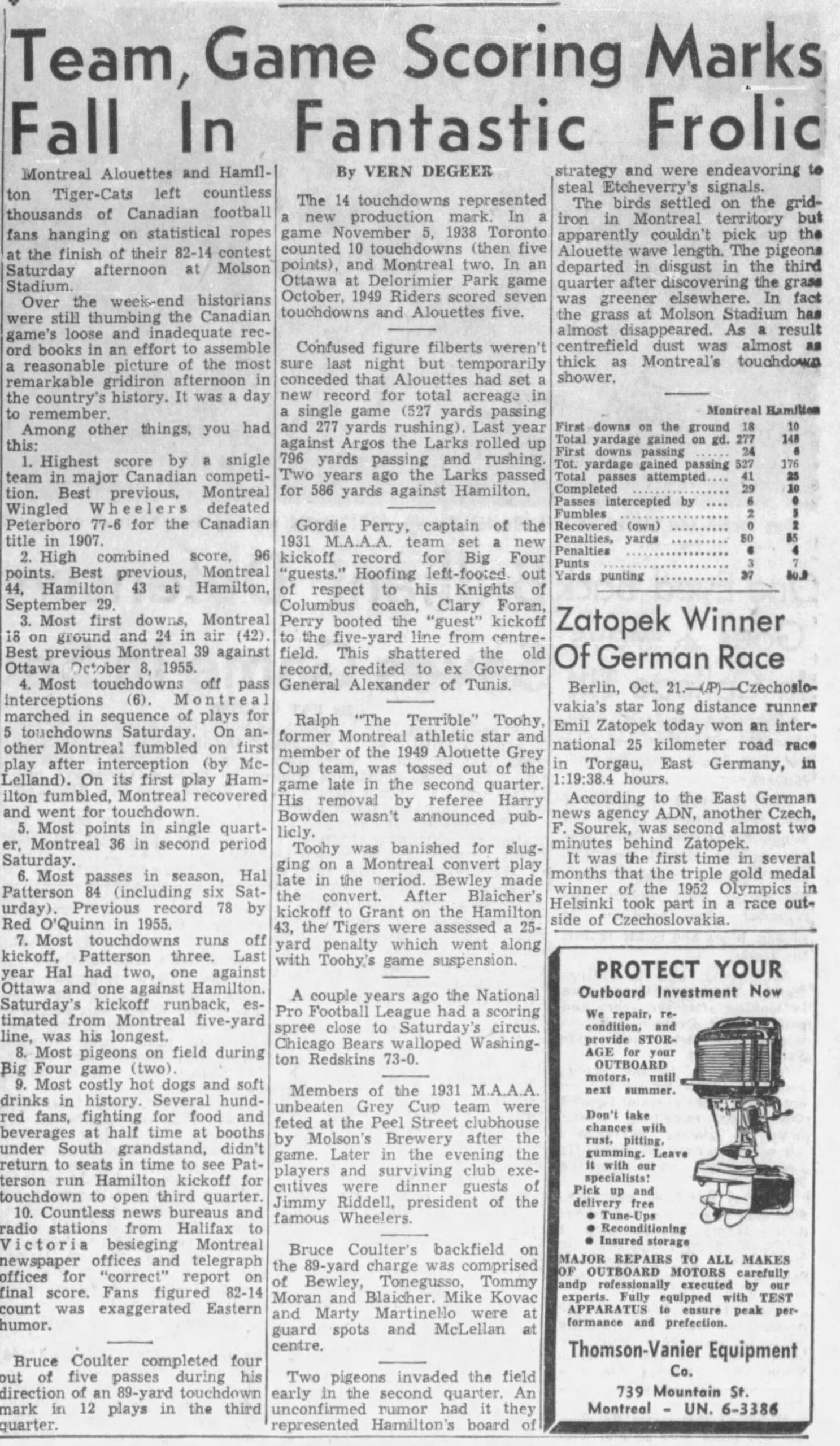
The headline in the Montreal Gazette tells the story.
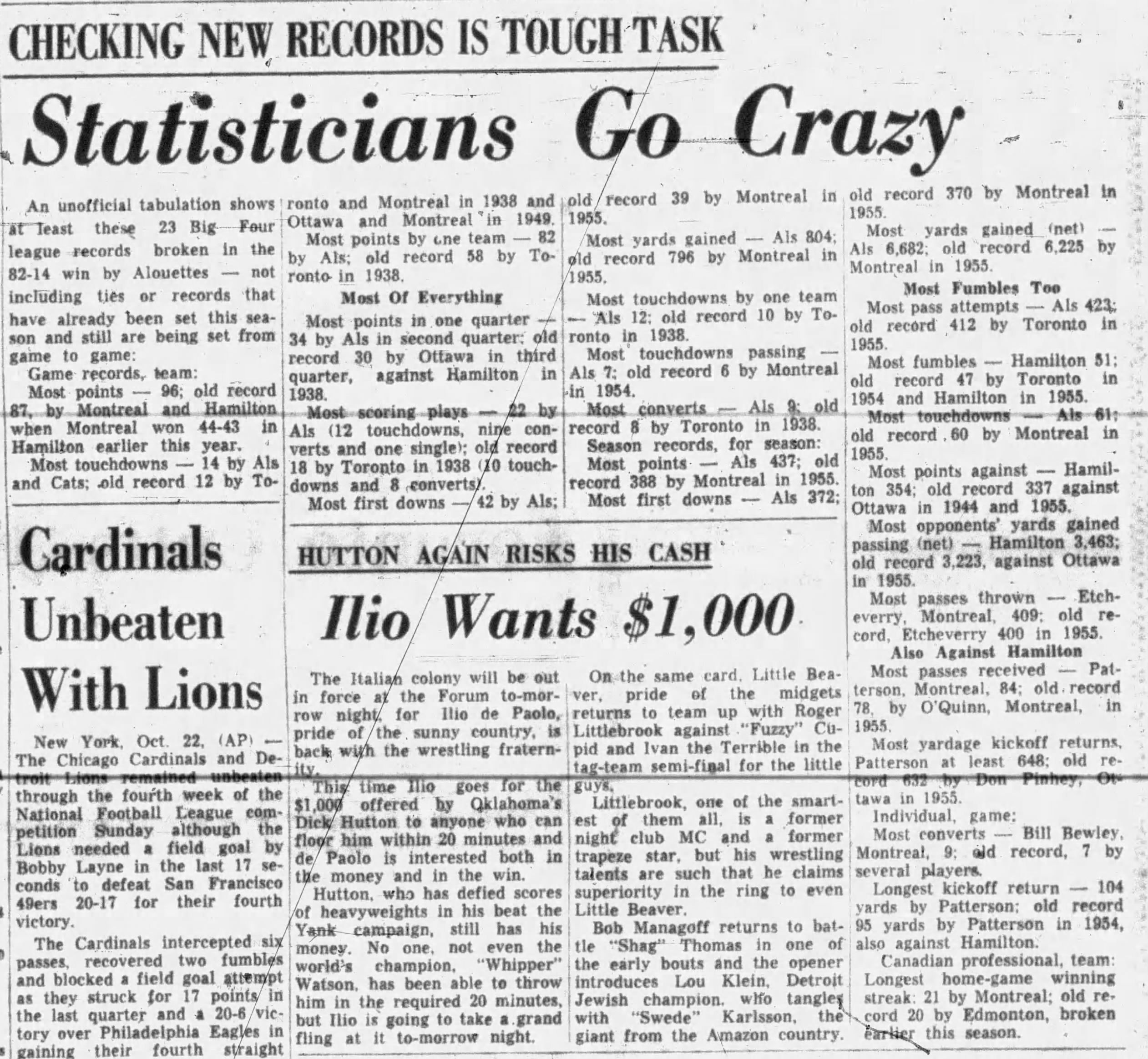
The crowd at Molson Stadium witnessed history in the making that Saturday afternoon with the Alouettes breaking a couple dozen IRFU/Big Four records. Newspapers in both Hamilton and Montreal remarked how the game kept the statisticians busy.
A recap of records broken as outlined in the Montreal Gazette. (Degeer, Vern. “Team, Game Scoring Marks Fall in Fantastic Frolic.” Montreal Gazette, 22 October 1956, p. 25.)The Hamilton Spectator’s recap of records broken. (“Statisticians Go Crazy.” Hamilton Spectator, 22 October 1956, p. 17.)
Montreal’s opening kickoff by Johnny Blaicher sailed through the Hamilton endzone to put the Alouettes up 1-0 from the get-go. What followed can only be described as good old fashion Canadian walloping.
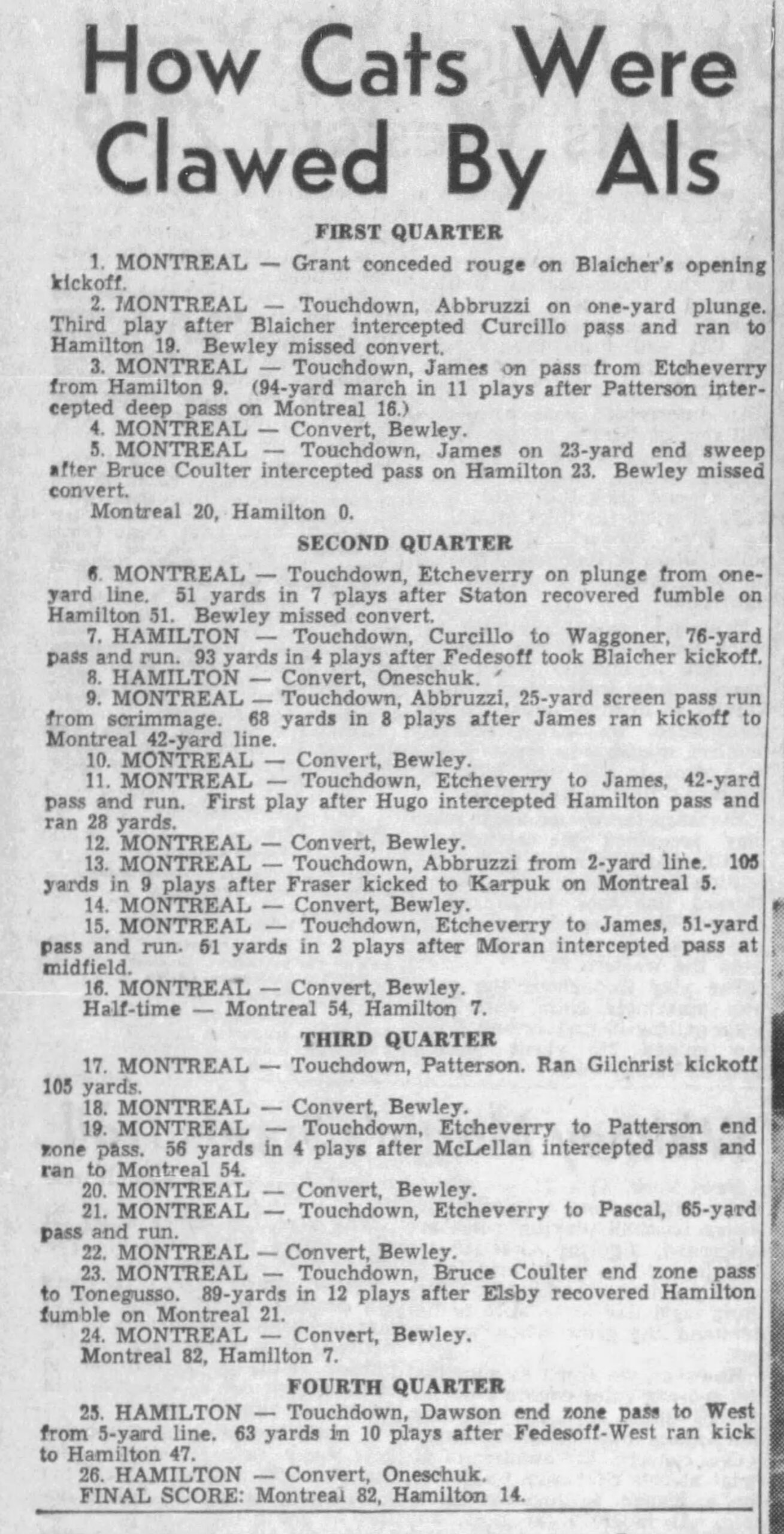
Led by quarterback Sam “The Rifle” Etcheverry, Montreal scored an incredible 12 touchdowns. Yes, twelve! The Alouettes were up 20-0 after the first quarter and went into halftime with a commanding 54-7 lead. I certainly wouldn’t’ve wanted to be in the Hamilton dressing room at the half.
Montreal players who scored touchdowns in the record-setting game. Future Alabama Governor Fob James scored four touchdowns for the Alouettes.
Unfortunately for the Ti-Cats the second half wasn’t any better. Montreal’s Hal Patterson returned Hamilton’s kickoff to start the third quarter a record-breaking 104 yards for a touchdown. Talk about going from bad to worse. Having his way with the Tiger-Cat defence all afternoon, the Rifle might’ve put the Als over the 100-point mark had he stayed in the entire game. His favourite target Fob James, who years later would become the Governor of Alabama, scored four majors for the Alouettes.
The Hamilton Spectator didn’t mince words. (Miller, Ivan. “Alouettes Re-write Record Book in Wild Game.” Hamilton Spectator, 22 October 1956, p. 16.)
With the astounding lopsided victory, Montreal clinched first place in the Big Four conference. The two teams would meet again the following month in a two-game total-point series for the IRFU final. Montreal came out on top, winning by a 78-62 combined score, but would lose to the Edmonton Eskimos in the 1956 Grey Cup game.
The 82-14 score set on October 20, 1956 still stands today as the largest margin of victory in a game played in the modern era of Canadian football.
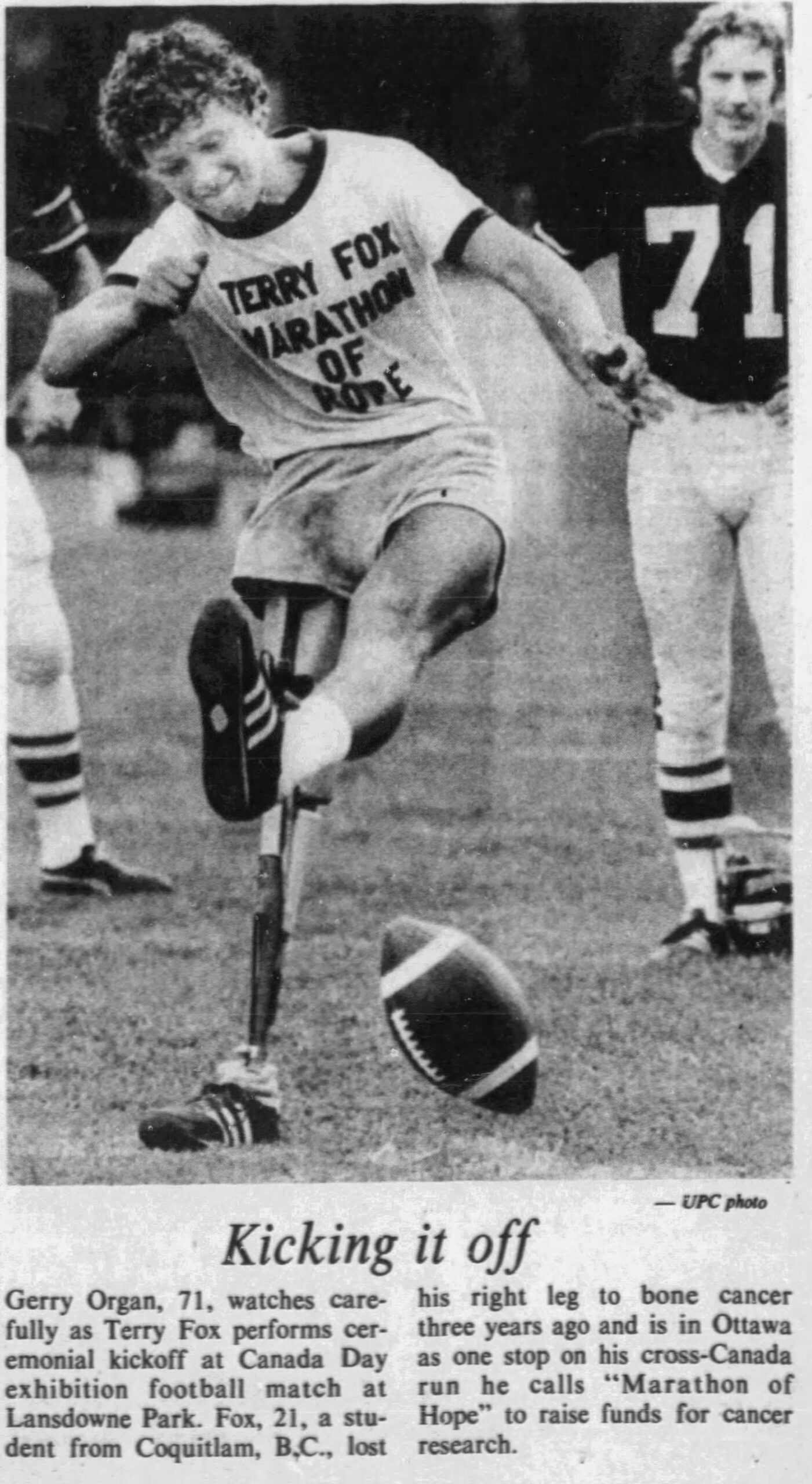
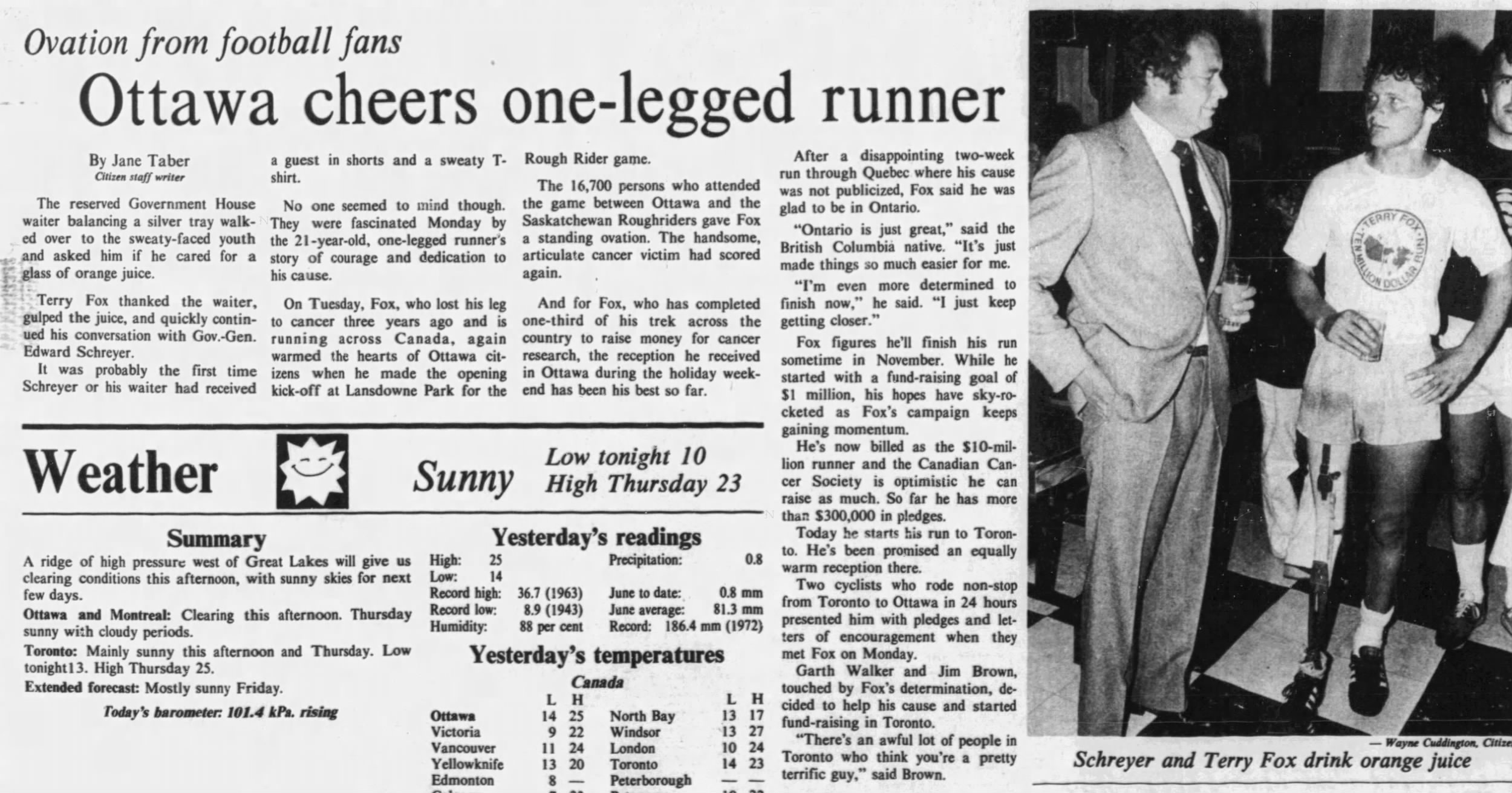
On July 1, 1980, a young man jogged onto the field at Lansdowne Park in Ottawa to perform the ceremonial kickoff prior to the CFL exhibition game between the Ottawa Rough Riders and the Saskatchewan Roughriders.
The crowd of almost 17,000 gave the 21-year-old a standing ovation. He wasn’t an ordinary 21-year-old by any stretch of the imagination. No, he was extraordinary in every sense of the word. He had one leg, having lost his other to cancer. Lansdowne Park was the latest stop on what he billed as his “Marathon of Hope” across Canada to raise money for cancer research. Of course, I’m talking about Terry Fox.
A great shot of Terry Fox performing the ceremonial kickoff on Canada Day 1980 while Gerry Organ of the Ottawa Rough Riders looks on. (Ottawa Citizen, 2 July 1980, p. 28.)
We Canadians are all familiar with Terry Fox, his story, and his legacy. I was only four years old (not even) at the time of the Marathon of Hope, but I do have some vague recollections of seeing coverage about it on TV. My Grandad met him while he was running through Halifax County in Nova Scotia and took a picture of him. I still have the photo.
But we forget some of the historic imagery that Terry’s marathon produced along the way. The kickoff at the CFL game is but one example. Here’s how Ottawa Rough Rider great Tony Gabriel remembers the day:
“I fondly remember meeting our young Canadian hero, Terry Fox, on July 1, 1980. He had begun his Marathon of Hope run across the nation and had reached Ottawa. Terry did our honorary kickoff that Canada Day, and I was fortunate as one of the captains for the Ottawa Rough Riders to get to shake his hand and wish him good luck in raising needed funds for Canadian cancer research.”
Terry Fox clearly made an impression on the CFL Hall of Famer. In 2020, Gabriel launched a petition to put Terry Fox on the $5 bank note. Late last year, the government announced that Terry Fox would indeed be featured on the new note. “Over the past 45 years, the Terry Fox Foundation has raised $950 million! I am so heartened it was announced and successfully assured this year that this continuing honour for Terry will happen in the near future by the Bank of Canada,” Gabriel proudly boasts.
An article in the Ottawa Citizen about Terry Fox’s stop in Ottawa during his Marathon of Hope. (Taber, Jane. “Ottawa cheers one-legged runner.” Ottawa Citizen, 2 July 1980, p. 2.)
After leaving Ottawa – but not before hanging out with Governor General Ed Schreyer and Prime Minister Pierre Trudeau – Terry continued west into Southern Ontario before heading up to Northern Ontario towards Thunder Bay. Here, he sadly announced that his cancer had returned, thus ending the Marathon of Hope. Still, he travelled a distance of 5,373 kilometres over the course of 143 days and raised millions towards his cause.
It’s been 45 years since Terry Fox captured our hearts and admiration. 45 years since the young man with one leg shared the field with some of the great CFL football stars of the day. 45 years since Terry Fox become a true Canadian legend.
And now, let’s relive what I believe is one of the most iconic moments in Canadian sports history…the Terry Fox kickoff:
An observer today would simply shrug his shoulders after reading the contents. “What’s the big deal?” he would ask. But around the turn of the 20th century the Burnside Rules would revolutionize Canadian football. Named after Thrift Burnside, who captained the University of Toronto varsity football team, the so-called Burnside Rules helped transform Canadian football from a rugby-style game to the modern gridiron game we recognize today.
Proponents of the Burnside Rules promoted the idea that they made the game more open, more exciting, and easier to follow. Opponents argued they changed the very essence of Canadian football and risked the Americanization of the game. In hindsight, both sides were probably right.
So, what the heck were the Burnside Rules anyway? And how did they change the game of Canadian football so much? Let’s take a quick look.
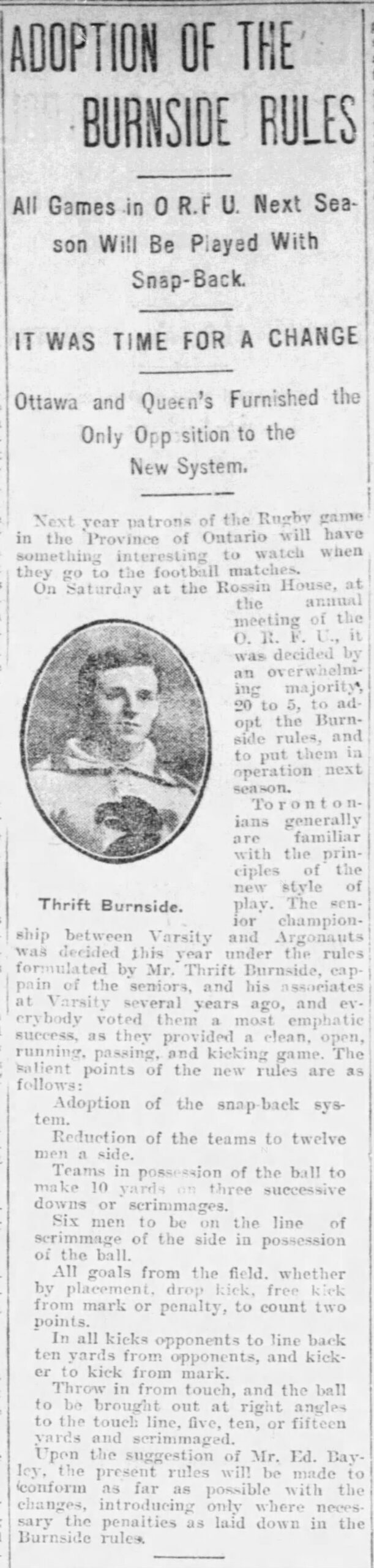
Perhaps the biggest difference in Mr. Burnside’s rules compared to traditional Canadian rugby at the time was the introduction of the downs system. The team with possession would now have three chances (or downs) to advance the ball ten yards. The other significant difference was adoption of the snap-back formation. Instead of a rugby scrum where players heeled the ball backwards, the offence would now line up along a fixed line of scrimmage and have the centre player on the line “snap back” the ball. Both the downs system and the snap-back formation were already being used in American football at the time.
Other rule changes included the reduction of the number of players from fifteen to twelve, scrimmaging instead of throw-ins from the sideline, and capping the number of players on the line of scrimmage at six. They also made some minor kicking and scoring adjustments.
A Fine Exposition of New Rugby
The first use the Burnside Rules was the first game of the Toronto city championship between the University of Toronto and the Toronto Argonauts on November 15, 1902. The rules received rave reviews from the Toronto Star, which hailed the game a “fine exposition of new rugby.”
Praising the Burnside Rules that were used in the Varsity-Argonauts game. (“Fine Exposition of New Rugby.” Toronto Star, 17 November 1902, p. 10.)
Still, the Burnside Rules were considered so radical by purists that their adoption divided clubs and unions and threatened to wreak havoc on Canadian football. On December 13, 1902, the Ontario Rugby Football Union formally adopted the Burnside Rules for the 1903 season. The Canadian Rugby Union and its other unions refused to adopt them initially. This led to the three CRU unions in Ontario and Quebec to play by three different sets of rules.
Article in the Toronto Star explaining the Burnside Rules after being adopted by the ORFU. (“Adoption of the Burnside Rules.” Toronto Star, 15 December 1902, p. 10.)
By the way, the Quebec Rugby Football Union probably had the most radical rule of all. While it didn’t adopt the snap-back formation it did implement its own version of a downs system. Basically, teams had to gain at least five yards on their third down, regardless of yards gained on the previous first or second down.
Comparing the three sets of rules in Canadian football for 1903 (Toronto Star, 22 December 1902, p. 9.)
Ottawa Opposed the Burnside Rules
The Ottawa Rough Riders lead the opposition to the ORFU’s adoption of the Burnside Rules. A column appearing in the Ottawa Citizen made abundantly clear Ottawa’s stance on the new rules and took to personally attacking Thrift Burnside. Such was the passion and divisiveness surrounding these sweeping changes.
A column in the Ottawa Citizen critical of Thrift Burnside and his rules. (Ottawa Citizen, 16 December 1902, p. 6.)
After unsuccessfully trying to convince the CRU to adopt the Burnside Rules, the ORFU opted to switch back to CRU rugby-style football in 1906. But in the years ahead, the down system and snap-back formation were eventually adopted across the country.
By the 1920s Canadian football had evolved and started to resemble the game we play and watch today. The Burnside Rules played a pivotal role in this evolution. By incorporating popular aspects of American football into the traditional Canadian game, the ORFU’s early adoption of the Burnside Rules helped shape the future of Canadian football.
More praise of the Burnside Rules by the Toronto Star. (Toronto Star, 17 November 1902, p. 10.)
That was the headline in my hometown’s newspaper, the Hamilton Spectator, after the CFL’s debut in Sacramento, California. I became a CFL fan in the early 1990s. It was a tumultuous time for the Canadian Football League. Some teams across the country were on the verge of collapse. Several others were struggling to stay afloat. Against this backdrop, the CFL opted to add teams in the United States. The benefits of U.S. expansion were two-fold. First, expansion fees could bring in some much-needed cash in the short term. Second, a bigger North American wide football league could open up even greater revenue (i.e., an American TV deal) long term.
An article in the Hamilton Spectator about Sacramento embracing the CFL. (Morris, Jim. “Sacramento falls in love with the CFL.” The Hamilton Spectator, 19 July 1993, p. 16.)
The first American team to join the CFL was the Sacramento Gold Miners in 1993. There was also supposed to be a team in San Antonio, Texas, as well, but it was kiboshed before playing a single down. So, the 1993 CFL season featured nine teams with the addition of the California capital.
The Gold Miners were spearheaded by Fred Anderson, a Sacramento businessman, who had owned the Sacramento Surge of the World League of American Football, a developmental spring league for the National Football League. The WLAF ceased operations in 1992. There was considerable overlap between the Surge and the Gold Miners. The teams’ colours were similar, and many former Surge players and personnel were brought into the Gold Miners’ organization. Kay Stephenson reprised his role as Sacramento’s head coach, having coached the Surge to the 1992 WLAF championship.
Because of U.S. labour laws, the Gold Miners were not required to have any Canadian players on their roster. Instead, they played with an all-American lineup. Some suggested this gave Sacramento a unique advantage over their Canadian counterparts. Yet, the team did struggle as an expansion team while adapting to the Canadian game.
The Gold Miners played their home games at Hornet Field on the campus of Sacramento State university. It was a rather bare bones stadium comprising temporary bleachers and portable washrooms. Nevertheless, the stage was set for a historic debut of Canadian football in northern California.
July 17, 1993
The Gold Miners and Stampeders about to go head to head in Sacramento Voet, Gary. “Today’s Game at a Glance.” The Sacramento Bee, 17 July 1993, p. 21)
The Sacramento Gold Miners opened the 1993 season with a two-game road trip, losing both games in Ottawa and Hamilton. Their first home game was played on Saturday July 17th against the Calgary Stampeders, the defending Grey Cup champions, led by marquee quarterback Doug Flutie.
Marking the field at Hornet Field in Sacramento prior to the CFL’s debut (The Sacramento Bee)
A crowd of 20,082 filed into Hornet Field that night to see a great offensive display of football. Flutie and Sacramento quarterback David Archer lit up the scoreboard in what was truly a wild west shootout. You couldn’t have asked for a more exciting game to introduce Sacramento fans to the CFL. Ultimately, the Stampeders came out on top 38-36. The Gold Miners dropped to 0-3.
Coverage of the historic first CFL game in Sacramento from a Sacramento perspective. (Voet, Gary. “Miners lose a shootout to Calgary.” The Sacramento Bee, 18 July 1993, p. 25.)
Sacramento finished their inaugural season with a 6-12 record, last place in the West Division. They were somewhat better the following year but still missed the playoffs in a competitive West division. Unfortunately, the Gold Miners would leave Sacramento following the 1994 season. After failing to secure a new stadium or upgrades to Hornet Field, Fred Anderson relocated the Gold Miners to the then-still-new Alamodome in San Antonio in 1995 where they became known as the Texans. In 1996, the CFL ended its American expansion experiment and returned to being an all-Canadian league.
I reached out to award-winning journalist Bob Graswich, who was a columnist for the Sacramento Bee during the Gold Miners’ CFL run. His column praising the Canadian game resonated with me because it was exactly how I felt (and still do!) about the CFL when compared to the big bad NFL. Reading that sentiment from an American writer helps validate my position.
Graswich told me the CFL was a “breath of fresh air” for Sacramento. “It was an exciting game, designed for the fans.” An antithesis of the NFL. He speaks very highly of Fred Anderson, saying he was somebody that was difficult not to like. Fred was a Sacramentan through and through, and he reluctantly moved the team only after he ran out of options. Graswich, who visited Anderson before his death, said Fred was truly disappointed that he couldn’t make the CFL work in Sacramento.
A column by Bob Graswich praising the CFL. Sums up my thoughts perfectly. (Graswich, R.E., “Thanks, Fred: You’ve givenus a better game.” The Sacramento Bee, 18 July 1993, p. 23.)
Fred Anderson was no doubt the most committed of the U.S. team owners. Perhaps under different circumstances and in a different time, things could’ve worked out better. Ironically, years later Sacramento State upgraded Hornet Field and renamed the field in Anderson’s honour – a fitting legacy for a man who did so much for football in Sacramento.
Perhaps it was the novelty factor. Perhaps it was the name and logo, which I really liked. Whatever the reason, I purchased a Sacramento Gold Miners t-shirt. It was one of my favourites, and I still have it. Well, my daughter actually took it and still wears it to school. How’s that for vintage CFL USA cool?
It didn’t last long. But football fans in Sacramento enjoyed it while they had it. For a brief period over thirty years ago, Sacramento indeed fell in love with the CFL.
I remember watching this game on television. My family had just returned from a summer road trip to northern Ontario and Ottawa. We made it home just in the nick of time to catch the game on CBC. I really felt like I was watching the beginning of something big. Seeing Americans embrace Canadian football seemed so satisfying to me at the time. It still does, really.
Back home in Calgary, Tom Elder was also watching this game with excitement. Tom has an extensive library of old CFL games on his Calgary Stampeders Classics YouTube channel . You can watch the historic Calgary-Sacramento game below. Please consider contributing to Tom’s project if you can. It takes a considerable amount of time, resources, and effort to help preserve some of these great CFL memories.
The Canadian Football League has long pined for a presence in Atlantic Canada. In fact, Halifax has been granted not one but two conditional expansion franchises, the emphasis on “conditional” as neither attempt materialized. When Moncton opened its new stadium in 2010 there was some chatter about the Hub City being a home for a future CFL team. While no expansion team has been forthcoming, Moncton has hosted three regular season CFL games. And of course, there have been regular season games played in Halifax and Acadia University in Wolfville, Nova Scotia, as well.
“CFL Tickets Go On Sale May 1.” Saint John Times-Globe, 23 April 1986, p. 29.
But the CFL actually made its debut in the Maritimes back 1986 when Saint John, New Brunswick hosted an exhibition game between the Montreal Alouettes and Winnipeg Blue Bombers. The game, played at the then newly constructed Canada Games Stadium, drew a crowd of over 11,000 fans who saw the Bombers down the Als 35-10.
“10,000 Assured for CFL Game.” Saint John Telegraph-Journal and Evening Times-Globe, 6 June 1986, p. 31.
It appears the game was designed to take the CFL on the road and expose the product to a new market rather than to test the waters for a prospective expansion site. In fact, CFL Commissioner Doug Mitchell seemed to go out his way to temper any expansion expectations. Still, New Brunswickers embraced the CFL and the players enjoyed the Atlantic hospitality.
Munford, Bruce. “Thousands Flock to See Bombers Blast Montreal.” Saint John Evening Times-Globe, 9 June 1986, p. 15.
The Bombers were quarterbacked by veteran Tom Clements, who had his way with the Montreal defence. A scary moment occurred early in the game when Montreal’s Nick Arakgi suffered a broken vertebrae when he was hit after reaching up high for an overthrown pass by Montreal quarterback Joe Barnes. He was taken to the hospital and ended up missing the entire 1986 CFL season.
Saint John Mayor Elsie Wayne was ecstatic about having the CFL in her city. She presented Winnipeg head coach Cal Murphy with a trophy called the Saint John CFL Cup after the game.
A Labatt’s ad sponsoring the CFL game in Saint John. (Saint John Telegraph-Journal, 6 June 1986, p. 71.)An ad promoting the CFL game in Saint John. (Saint John Telegraph-Journal, 6 June 1986, p. 72.)
The CFL’s success in Saint John in 1986 prompted the league to return the following year for another exhibition game. This time, Montreal played the Hamilton Tiger-Cats. The Ti-Cats won 14-13 in what turned out to be the last game for the Montreal Alouettes who folded a couple weeks later.
Kelly Ryback was the original “Buzz”, the mascot of the Winnipeg Blue Bombers. Here are his personal reflections of the event.
The ’86 trip was a career and life highlight!
I had never been to an ocean or feasted on lobster. I was on the advance team in Saint John Wednesday through Sunday.
We stayed at the Hilton on the harbour, ate lobster, mussels, and frog legs several times. We were hosted by Labatt’s with summer student valets. One became a friend for life, still 39 years later.
Meeting Mayor Elsie Wayne in her office was a hoot and she later hosted a fine reception where we were all presented with City of Saint John ties.
The crowd of 12K+ was fantastic and it was a bright, sunny day.
An absolutely incredible event.
A souvenir t-shirt from the 1986 CFL game in Saint John and a City of Saint John tie. Photo provided by Kelly Ryback.