Category: Toronto

  • Tiger-Cats Spoil Argos’ SkyDome Opener

    In the aftermath of the 1982 Grey Cup, which was played in a rainstorm at Exhibition Stadium, football fans in Toronto were clamouring for an indoor stadium. They got their wish when the new SkyDome hosted the 1989 CFL season opener on July 12, 1989. No more football in the rain, wind, or snow. Fans could now enjoy the game in a climate-controlled environment. Yet, the spectacular venue’s fully retractable roof meant fans could still enjoy outdoor football when the weather permitted. It was the best of both worlds.

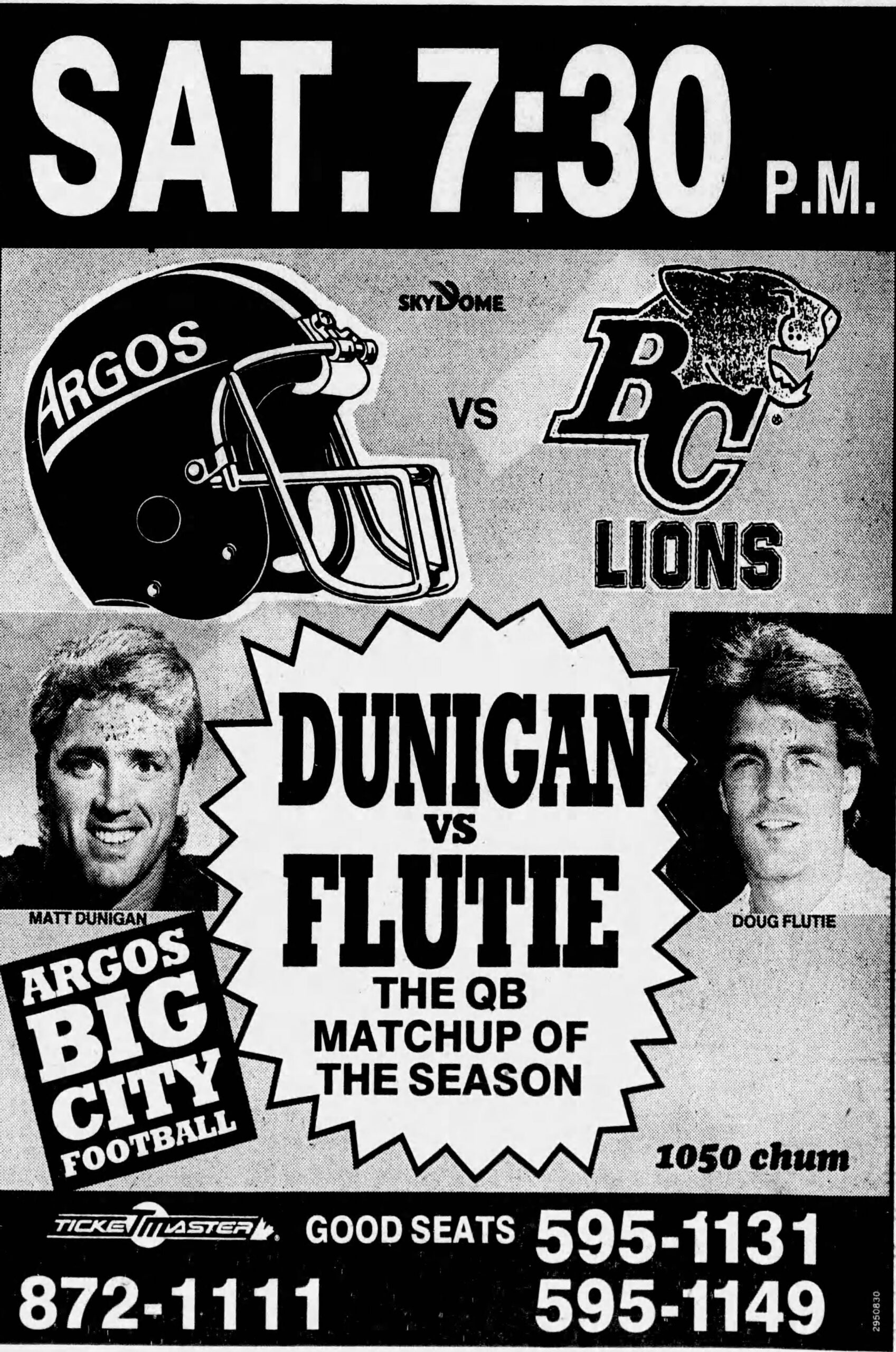
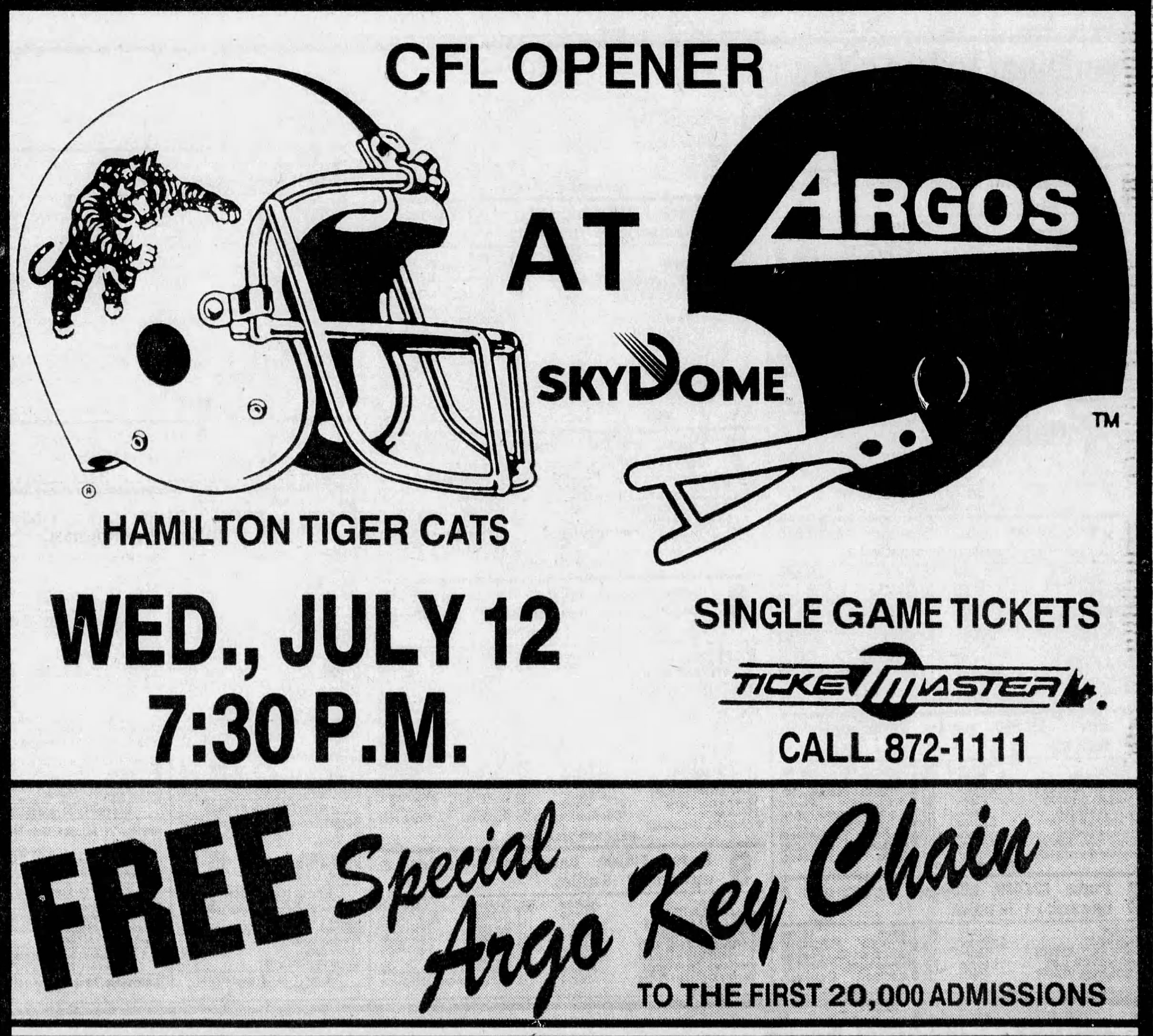
    Ad for the CFL opener at SkyDome
    Advertisement in the Toronto Star for the first CFL game at SkyDome.

    I remember when the SkyDome was built and marvelled at seeing it when driving through downtown Toronto. It really was a sight to behold. The first time I was inside it was for Wrestlemania VI in 1990. Twelve-year-old me was absolutely awestruck.

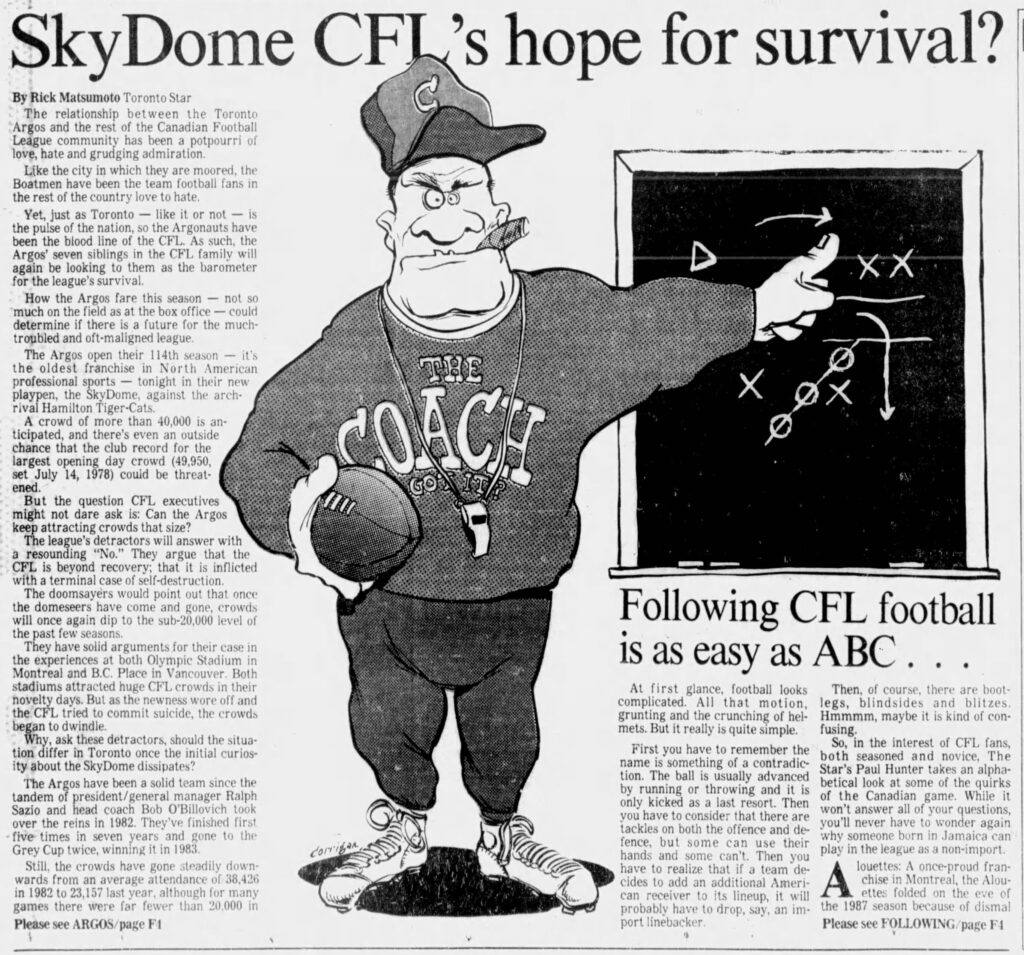
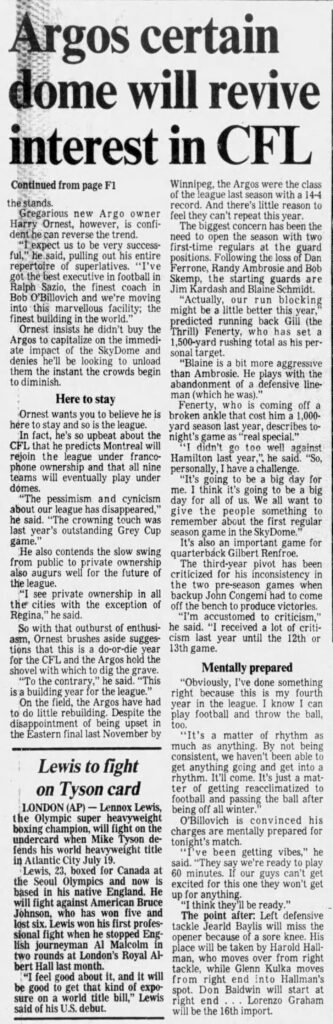
    OK, back to football. The SkyDome was touted a lifeline to the Toronto Argonauts and the entire the Canadian Football League. Surely, North America’s newest multi-million dollar major league stadium would be able to attract a whole new generation of fans to the CFL. The novelty factor alone was expected to bring in over 40,000 fans on opening night.

    Article in the Toronto Star touting the SkyDome as a saviour for the CFL
    Article in the Toronto Star touting the SkyDome as a saviour for the CFL
    Article in the Toronto Star touting the SkyDome as a saviour for the CFL.

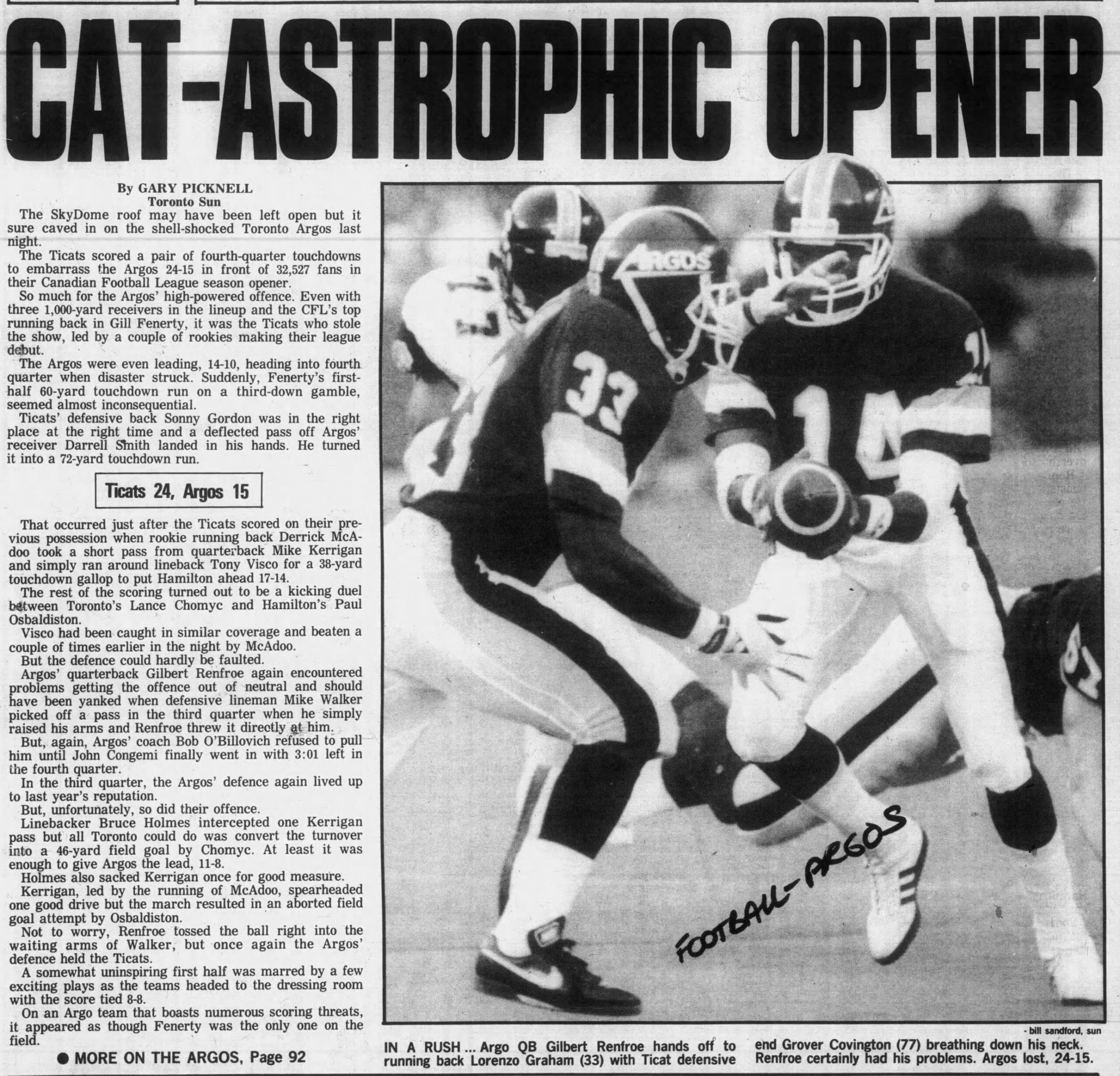
    Unfortunately for the Argos, the home opener turnout fell a bit short of expectations. Mind you, a still solid crowd (especially by today’s standards) of 32,527 was on hand to watch the historic game between the Argonauts and the rival Hamilton Tiger-Cats. Equally unfortunate for Toronto football fans, the Argos ended up on the losing end of scoreboard at SkyDome’s football christening.

    Led by quarterback Gilbert Renfroe, Toronto’s offence sputtered and managed to put up just 15 points. The Tiger-Cats scored two fourth quarter touchdowns – one a pass completion by rookie running back Derrick McAdoo and one an interception return by defensive back Sonny Gordon.

    The Tiger-Cats stole the show and won the game by a score of 25-14.

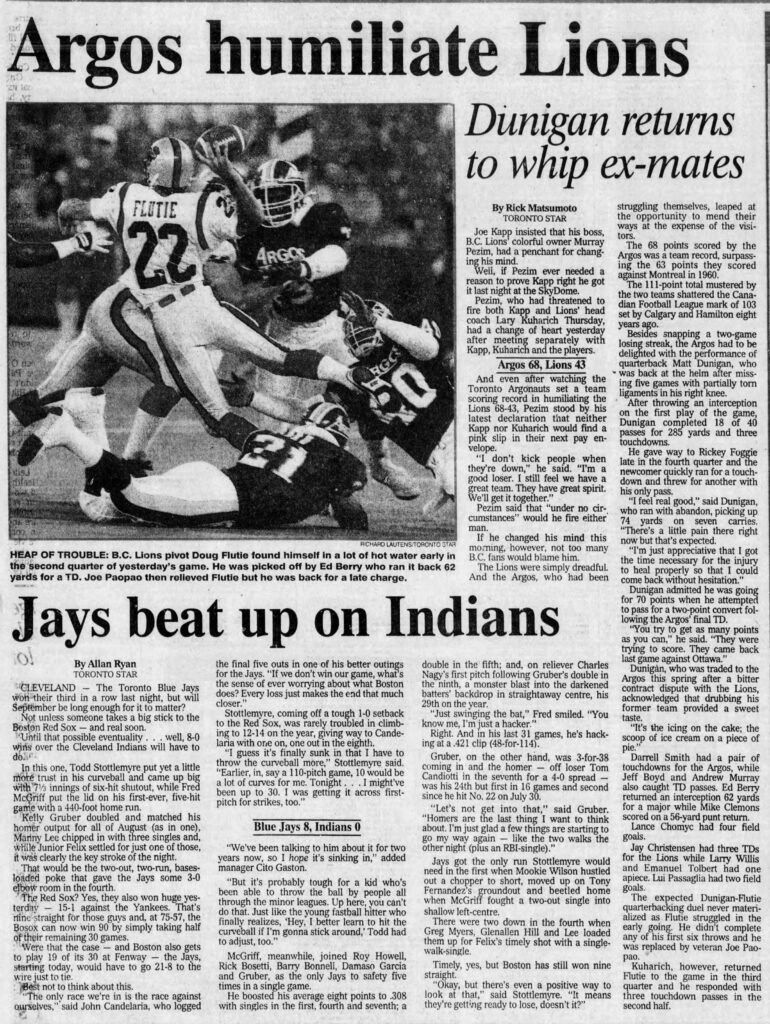
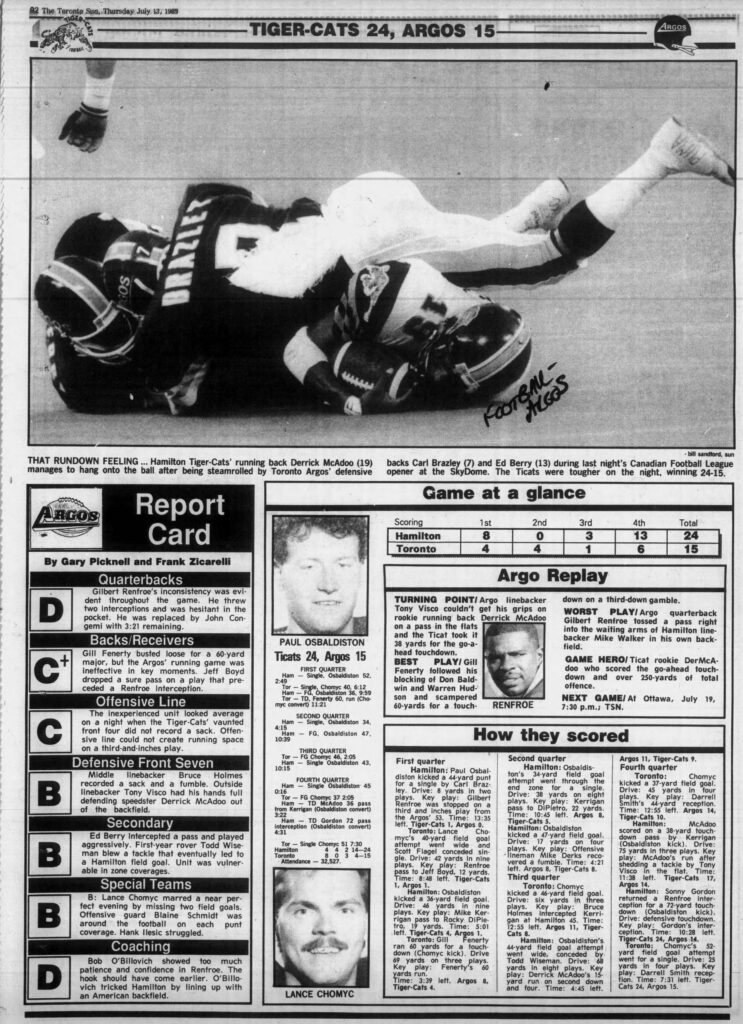
    Coverage in the Toronto Sun of the opening CFL game at SkyDome.
    Coverage in the Toronto Sun of the opening CFL game at SkyDome.
    Coverage in the Toronto Sun of the opening CFL game at SkyDome.

    The Argos did get a good bump in attendance in 1989 largely because of their new stadium. A crowd of over 54,000 attended the Grey Cup held at SkyDome that year. I do find it rather interesting how playing in a large, multipurpose, domed stadium went from being a huge positive with so much potential to more or less an albatross around the Argos within a couple of decades. Ironically, the Argonauts ultimately returned to the CNE grounds in 2016 when they moved into the smaller outdoor BMO Field.


    Sources:
    The Toronto Star, 12 July 1989
    The Toronto Sun, 13 July 1989

    Fediverse Reactions
  • Canadian Football’s Quirky Playoffs, Part IV: Three Leagues Compete for the New Grey Cup in 1909

    This is the fourth article examining some of Canadian football’s rather interesting playoff formats used over the years. Be sure to check out parts I, II, and III.

    1909 was a special year in Canadian football. That’s the year when Earl Grey, who was serving as the Governor General of Canada, donated a trophy to be awarded to Canada’s amateur rugby football champion. Of course, this trophy as well as the championship game itself would become known as the Grey Cup.
    Only teams affiliated with the Canadian Rugby Union were eligible to compete for the new Grey Cup championship. So that meant no western clubs could challenge for the trophy.

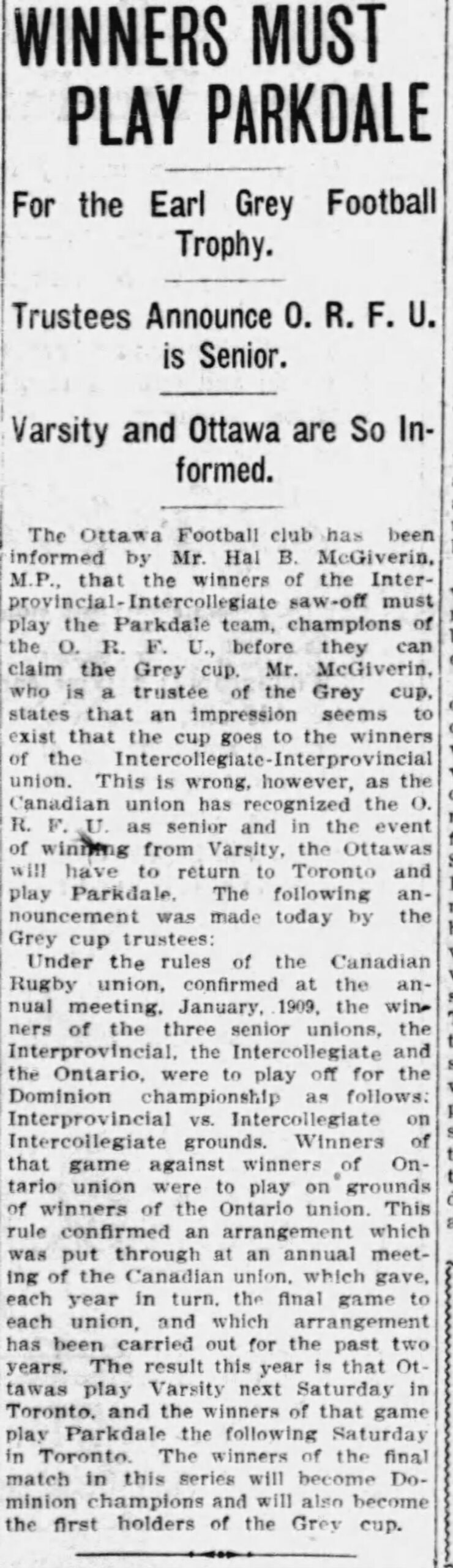
    Canadian football at the time was still an amateur affair, with senior football being the top level of play (above intermediate and junior). It was initially (mis)understood that the Grey Cup would be given to the winner of the Interprovincial Rugby Football Union (which was formed two years earlier) and Intercollegiate union game. But the CRU ruled a third league – the Ontario Rugby Football Union – was also a senior union and had the right to compete for the Grey Cup, as well.

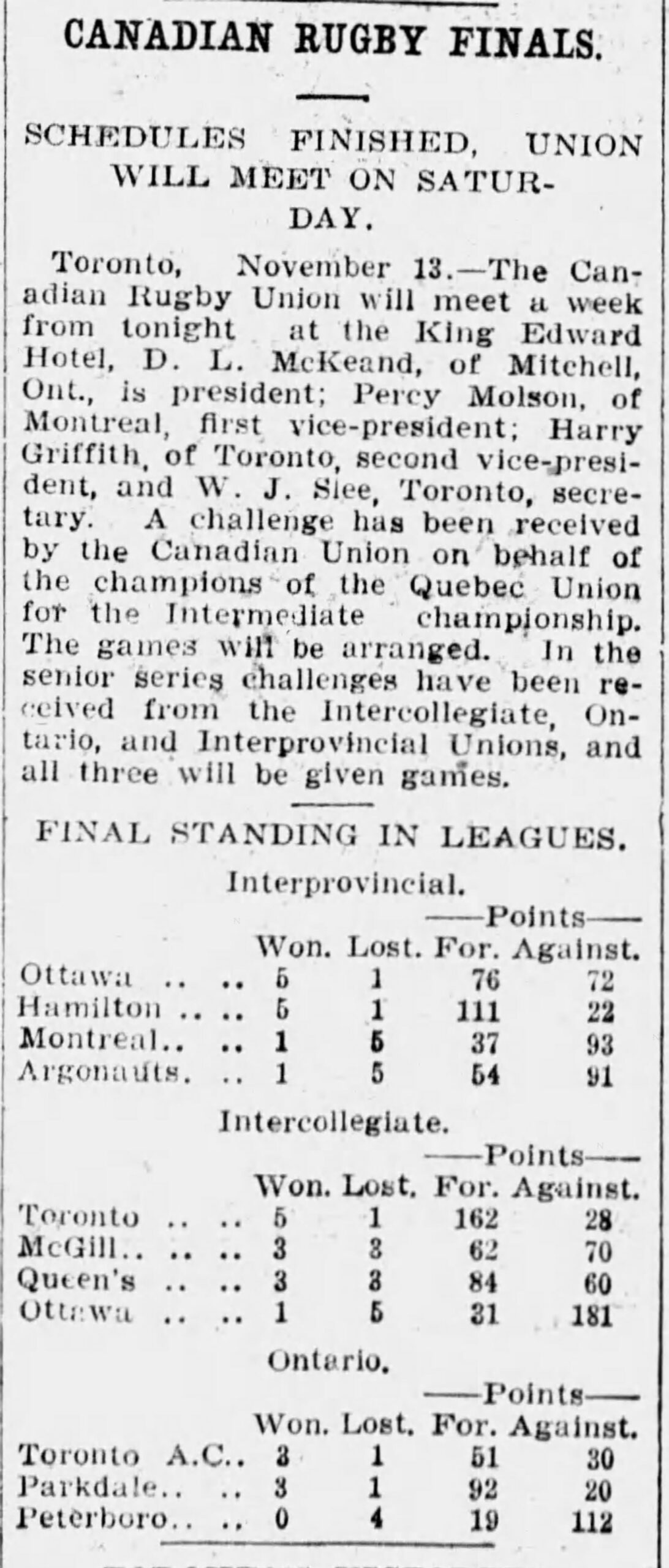
    The Montreal Gazette published the final standings for 1909 in all three senior leagues of the Canadian Rugby Union:

    Canadian Rugby Union standings and playoffs in 1909 (Montreal Gazette)
    Montreal Gazette, 15 November 1909

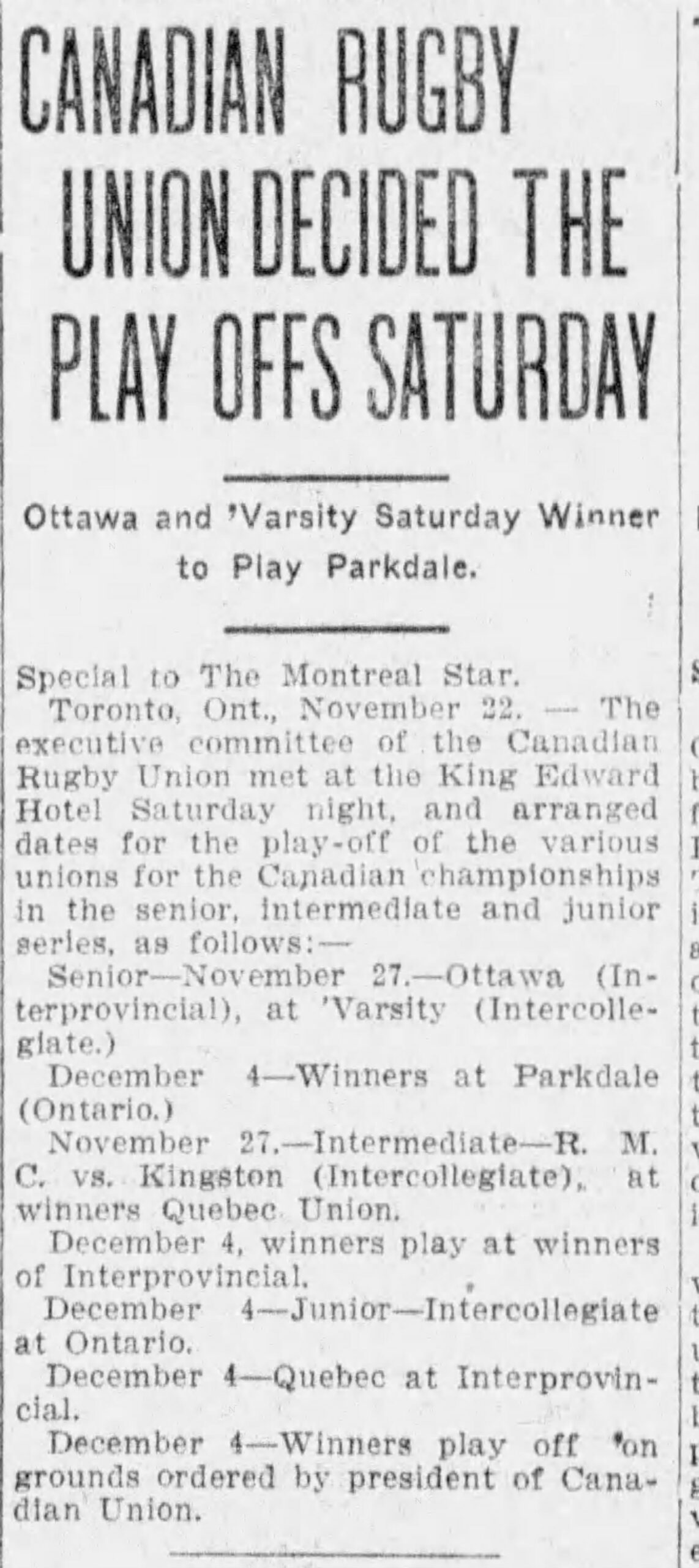
    The Canadian Rugby Union had previously established a rotational playoff system where the champion of each union would alternately receive a bye to and host the Dominion championship. Since the new Grey Cup was now the Dominion championship, the CRU simply extended this arrangement. For 1909, it was the ORFU’s year to host; so, the winner of the ORFU final would host the first-ever Grey Cup.

    Canadian Rugby Union Decided the Play Offs Saturday (Montreal Star)
    Montreal Star, 22 November 1909
    Winners Must Play Parkdale (Ottawa Citizen)
    Ottawa Citizen, 25 November 1909

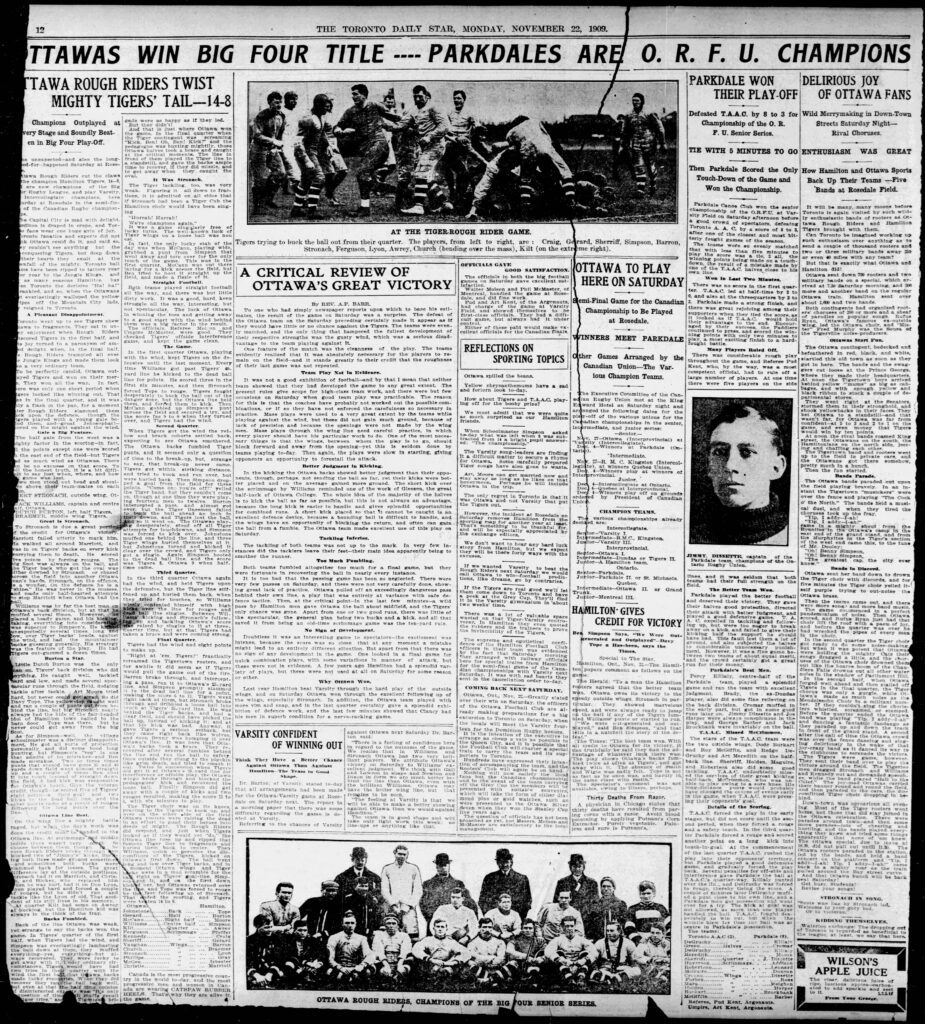
    On November 20th, Toronto Parkdale won the ORFU championship with an 8-3 win over the Toronto Amateur Athletic Club, securing their berth in the Grey Cup. On the same day, the Ottawa Rough Riders defeated the Hamilton Tigers 14-8 to win the IRFU championship.

    Below is some excellent coverage in the Toronto Star of the IRFU and ORFU playoffs.

    ORFU, IRFU playoff coverage (Toronto Star)
    Toronto Star, 22 November 1909

    On November 27th, the Rough Riders travelled to Toronto to play the University of Toronto in the Interprovincial-Intercollegiate final. Varsity won handily by a score of 31 to 7, setting up a Varsity vs. Parkdale all-Toronto final for the Grey Cup.

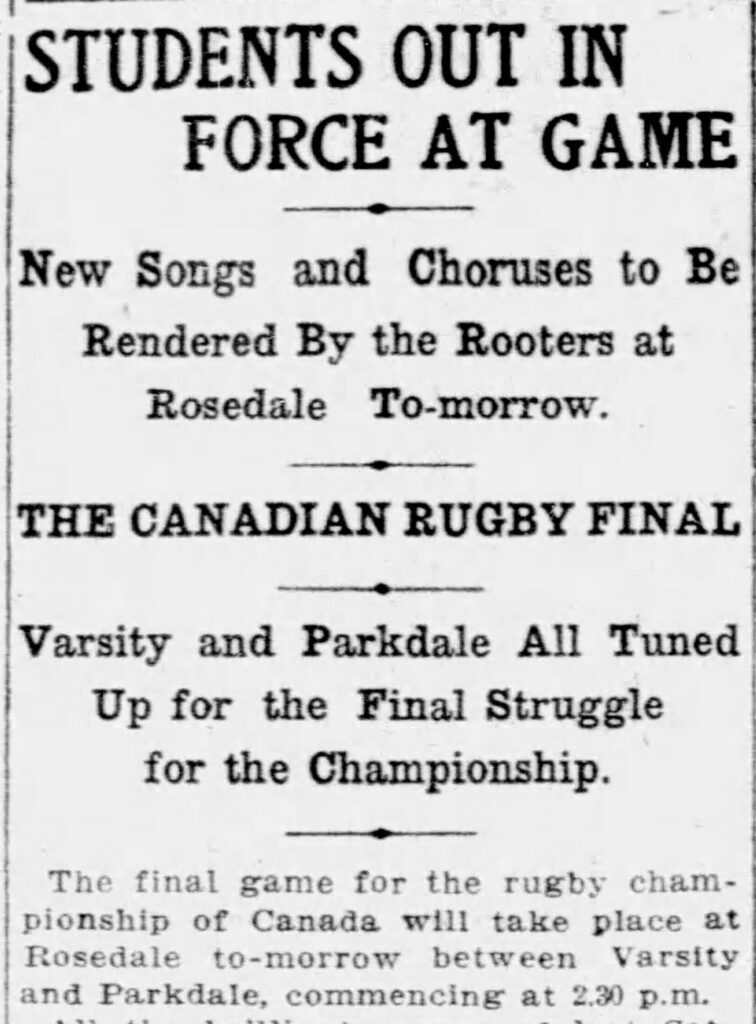
    Varsity to play Parkdale in first Grey Cup (Toronto Star)
    Toronto Star, 3 December 1909

    The historic matchup took place on December 4th at Toronto’s Rosedale Field. In the end, the University of Toronto came out on top, defeated Parkdale 26-6 to become the first Grey Cup champions.


    Sources:
    Montreal Gazette, 15 November 1909
    Montreal Star, 22 November 1909
    Ottawa Citizen, 25 November 1909
    Toronto Star, 22 November 1909
    Toronto Star, 6 December 1909

    Fediverse Reactions
  • Varsity Wins the Almost Forgotten Grey Cup

    In 1909, Governor General Earl Grey donated a trophy to be awarded to the amateur rugby football champions of Canada. The University of Toronto won the inaugural championship with a 26-6 win over Toronto Parkdale. Various teams in Toronto and Hamilton competed in the early Grey Cup contests before the game was put on hold after 1915 due to the First World War.

    The Grey Cup was then virtually forgotten. The trophy itself was locked away hidden in a storage vault. War has a way of resetting priorities, you see. After football resumed in Canada in 1919, there were growing organizational issues amongst some teams and disagreements amongst the rugby unions, climaxing in a decision by McGill University and Montreal to refuse to contest the Canadian Rugby Union playoffs. Alas, there was no Grey Cup in 1919, either.

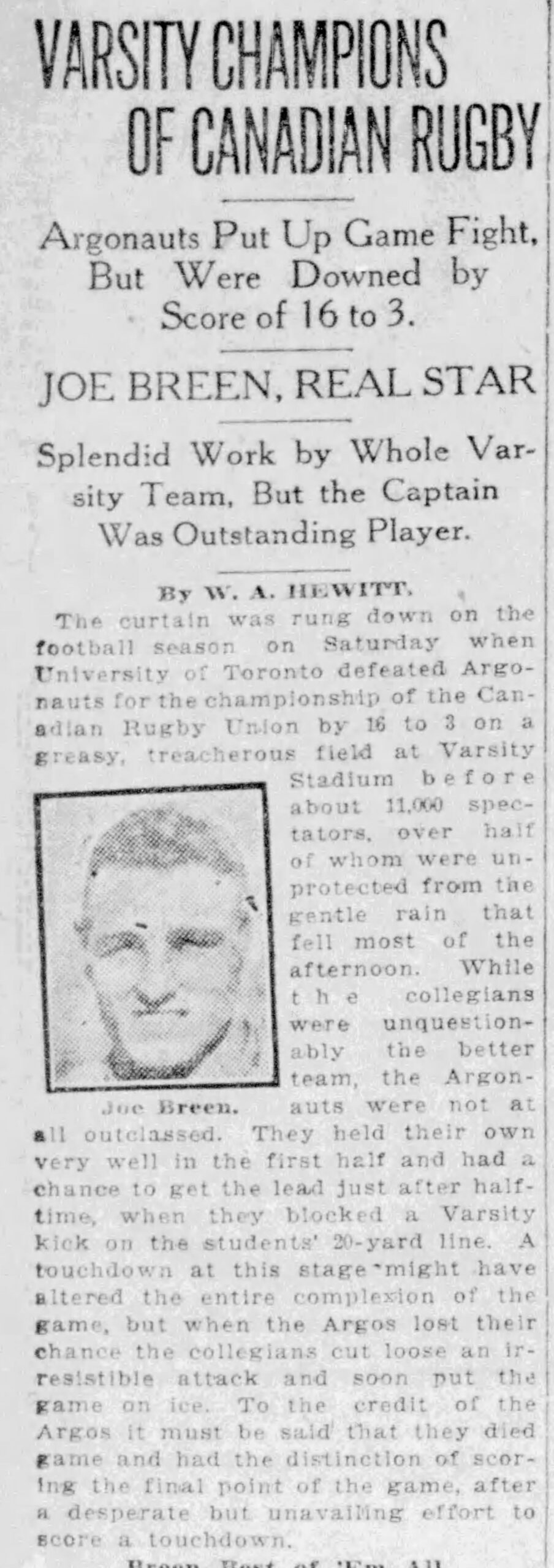
    Coverage of the 1920 Grey Cup in the Toronto Star on December 6, 1920.
    Coverage of the 1920 Grey Cup in the Toronto Star on December 6, 1920.

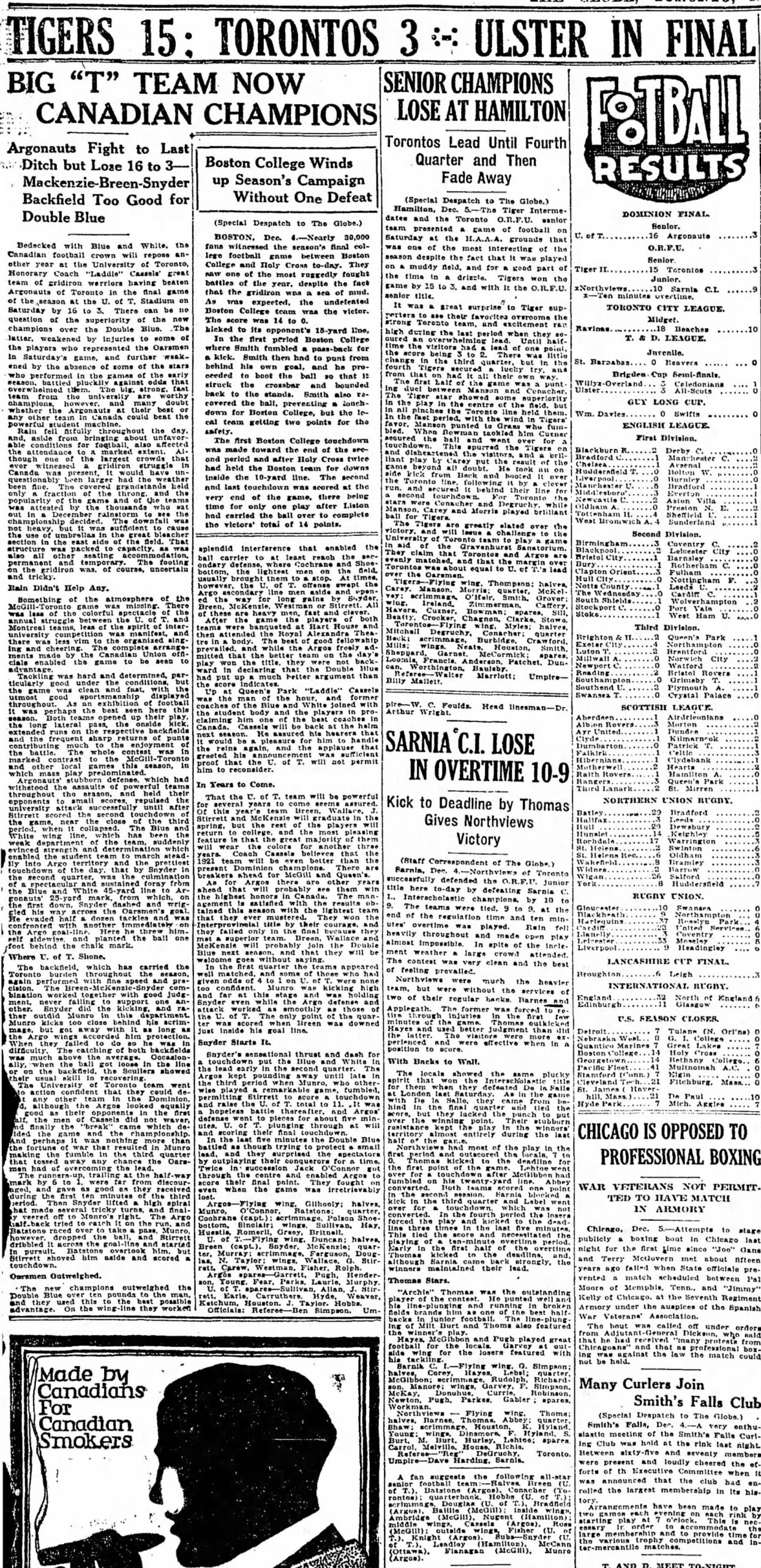
    But in 1920, the Grey Cup made its triumphant return. And a couple of familiar teams were back in the mix to win the big game. On Saturday, December 4, 1920, the University of Toronto played the Toronto Argonauts in the 8th edition of the Grey Cup. Played in less-than-ideal conditions (rain and mud!) at Toronto’s Varsity Stadium, Varsity’s Joe Breen was the star of the day, according to the Toronto Star, leading his team to a 16-3 victory over the Argonauts.

    Coverage of the 1920 Grey Cup in the Globe and Mail on December 6, 1920.
    Coverage of the 1920 Grey Cup in the Globe and Mail on December 6, 1920.

    This would be the University of Toronto’s fourth and final Grey Cup championship. At the time, Varsity was considered by many to be the best football team in the country. Their championship win cemented this sentiment.

    Despite being relegated to a dark memory hole just a few years prior, the Grey Cup was back. And perhaps that’s what mattered most.


    Sources:

    https://web.archive.org/web/20130820024400/http://cfl.ca/page/his_greycup_recap1920

    The Toronto Star, 6 December 1920

    The Globe and Mail, 6 December 1920

  • Getting Ready for the Grey Cup’s TV Debut

    It’s September 1952 and a new technology – black and white television – is taking the country and much of the world by storm. The Canadian Broadcasting Corporation (CBC) entered the TV business with two flagship stations: CBFT in Montreal and CBLT in Toronto.

    The decision was soon made to broadcast the upcoming Grey Cup game on CBLT. The Canadian Rugby Union championship was scheduled for Saturday November 29th at Varsity Stadium in Toronto.

    The novelty factor of the new technology coupled with the popularity of the hometown Toronto Argonauts, who were playing in the championship, helped drive sales for television sets in Toronto. Several ads selling TVs appeared in local newspapers. These didn’t come cheap, but vendors were more than happy to set up affordable payment plans for excited football fans.

    While the Grey Cup game itself was the first Canadian football game ever televised, broadcast crews did a practice run a few days before in the playoff game between the Argonauts and the Sarnia Imperials of the Ontario Rugby Football Union. In those days, the ORFU still challenged for the Grey Cup. The Toronto-Sarnia Grey Cup semi-final game at Varsity Stadium was used as the dress rehearsal for the big game. The 1952 Grey Cup commentators Norm Marshall and Larry O’Brien were actually chosen after an audition for the roles was held during the Sarnia game.

    Notes about the TV practice run done during the Grey Cup semi-final between Toronto and Sarnia (Toronto Star, 27 November 1952)

    Pubs in and around Toronto with television sets were packed on the day of the game. Meanwhile, in nearby Hamilton, Westinghouse set up several TVs so that employees and friends could watch the game. The broadcast even included a short pre-game show hosted by Annis Stukus.

    In the end, the Argonauts defeated Edmonton by a score of 21-11 in front not only record crowd at Varsity Stadium but also tens of thousands of television viewers in the Toronto area. A new era for the Grey Cup and for Canadian television was here.


    Sources:

    Patskou, Paul. “The First Televised Grey Cup Game.” Canadian Football Research Society. Accessed October 28, 2025. https://www.canadianfootballresearch.ca/the-first-televised-grey-cup-game/.

    The Toronto Star, 27 November 1952

  • Portland Hosts Fast Break CFL Football, Precursor to CFL USA Expansion

    In 1992, the Canadian Football League was looking to grow. Larry Smith was appointed the CFL’s new commissioner with a mandate to expand the CFL. Of course, Montreal and Halifax were high on Smith’s list of potential sites. But so, too, were several cities south of the border. One of these cities was Portland, Oregon.

    Located in the northwestern United States, Portland was a mid-sized city with a suitable stadium and a credible ownership group with the needed capital to both pay for and operate an expansion franchise. It was close enough to the border so that something “Canadian” didn’t sound too foreign. Heck, it was almost as if it could be a natural rival for the BC Lions. Paul Allen, the owner of the Portland Trail Blazers basketball team, was the man hoping to bring the CFL to Oregon.

    CFL Portland game article in the Oregonian newspaper (1992)

    To test the Portland market, the CFL played an exhibition game on Thursday, June 25, 1992 at Civic Stadium. The game was a rematch of the 1991 Grey Cup between the Toronto Argonauts and the Calgary Stampeders. The Argos had Raghib “the Rocket” Ismail as their marquee player. Calgary had the recently acquired future Hall of Famer Doug Flutie as their new quarterback. The stage was set for a great exhibition of Canadian football for the American fans featuring the CFL’s two biggest stars.

    In the lead up to the exhibition game, the Portland media seemed quite eager to welcome the CFL to town. Ads ran in the Oregonian newspaper promoting “fast-break,” “high flying” and “wide open” CFL football. Unsurprisingly, the Rocket was heavily promoted. Even the Trail Blazers’ Jerome Kersey was featured in advertising for the game.

    A decent crowd of 15,362 fans turned out on a hot Thursday night to watch the game. All in all, reviews were positive despite a rather lacklustre game. Calgary won 20-1. Yes, Americans got to see a Canadian rouge scored. In the end, though, no CFL expansion team came to Portland. Instead, Sacramento was awarded the CFL’s first U.S.-based expansion team. After a few years the CFL’s foray into the United States was over. Despite lots of talk and speculation, the CFL-in-Portland story was limited to a single exhibition game only.

    CFL gets warm welcome in Portland article in the Oregonian newspaper (1992)

    100 yard long fields are included in the Johnston Rules announced by CFL Commissioner Stewart Johnston recently. The 1992 exhibition game in Portland was the last time the CFL played on a field that was 100 yards in length. The standard CFL field didn’t fit at Portland Civic Stadium without heavy modifications, so the game was played on an American length football field that included ten-yard end zones. Have a look at the screen shots below to get a taste of what Canadian football on 100 yards will (sort of) look like in the future.


    You can watch the Toronto-Calgary exhibition game in Portland on the CFL Classics YouTube channel. The game was televised nationally on TSN.


    Sources:
    The Oregonian, 2 May 1992
    The Oregonian, 26 June 1992

    Fediverse Reactions