Tag: 1950s in Canadian Football

  • “Lions” New Moniker of B.C.’s WIFU Team

    This is the first of a series of posts that will explore the stories behind the names of the existing Canadian Football League teams.


    In 1953, a group of Vancouver businessmen got the greenlight for an expansion team in the Western Interprovincial Football Union (WIFU). The new team would begin play the following year and play their home games at the new Empire Stadium. Annis Stukus of Toronto was hired to be the club’s first head coach.

    With all the pieces in place, it was time give the new club a team name. A name-the-team contest was held and generated over 15,000 entries. The leading contenders were Lions, Grizzlies, Totems, Loggers, Tyees, and Cougars.

    It ultimately came down to Lions and Grizzlies. The Grizzlies was the name of Vancouver’s earlier entry in the WIFU that played just one season before ceasing operations after the WIFU suspended play as a result of the Second World War.

    Art Mercer and the BC Lions name contest
    Source: The Province, 2 April 1953, page 12.

    Ultimately, a committee settled on the name Lions. Locally, “the Lions” is the name given to twin mountain peaks near Vancouver that are said to resemble mountain lions. So, it was a natural pick.

    The team adopted a mountain lion for its logo and orange and black uniforms, paying homage to another historic Vancouver team, the Meralomas. Annis Stukus wanted to ensure the football team represented the entire province and not just the city of Vancouver. Thus, the British Columbia Lions were born.

    Newspaper article about Lions being the new name of BC's football team
    Source: The Province, 2 April 1953, page 12.

  • The Maple Leaf Forever: An Evolution of the CFL Logo

    It’s been 60 years since Queen Elizabeth II proclaimed Canada’s national flag featuring the prominent red maple leaf. The maple leaf is arguably the most Canadian symbol of all and has been used to represent Canada since the 19th century.

    So, it’s not surprising that this quintessentially symbol of Canadiana has always been featured one way or another in the logo of the Canadian Football League.

    When the CFL was founded in the late 1950s, the fledging league’s logo was what one would expect from the period: an “official” looking crest-like emblem similar to what you would see on an old company letterhead.

    The original CFL logo

    In the 1970s, the league adopted a more modern logo – the classic red maple leaf with the CFL/LCF initials inside a football helmet. Perhaps the CFL took inspiration from the new flag in incorporating the maple leaf into a logo that would span the next three decades.

    Classic LCF helmet logo
    Classic CFL helmet logo

    At the turn of the millennium, the CFL adopted a new logo featuring a stylized slanted maple leaf meshed with a flying red football atop bolded CFL/LCF initials.

    CFL logo adopted in 2000s

    The current CFL logo has been in use since the 2016 season. The maple leaf is minimalized with the focus on an abstract image of a football featuring three hashmarks and the CFL/LCF initials being prominently displayed.

    Current LCF logo
    Current CFL logo

    As Canadians find themselves celebrating the anniversary of their national flag amidst a newfound sense of Canadian patriotism, you have to wonder what may be in store next for the CFL’s logo. Does the league stick with the relatively young status quo? Or, do new opportunities arise for the league to further embrace its Canadian identity and perhaps give more prominence to the maple leaf once again?

    (You can check out more CFL logos at SportsLogos.Net)

  • Advertisement for 1951 Toronto Argonaut Season Tickets

    Toronto Argonauts season ticket advertisement in the Toronto Star

    It’s the summer of 1951 in southern Ontario, and the Toronto Argonauts are in the final push to sell season tickets for the upcoming season. Here is an ad that appeared in the Toronto Star on June 14 soliciting fans to purchase (or “subscribe for”) tickets for the Argos’ home games at Varsity Stadium.

    Check out the pricing for these tickets. $17.10 for the best seats in the house. That’s still less than $200 in today’s dollars. Good value for six games.

    The Argos went 7-5 in 1951, third place in the Interprovincial Rugby Football Union but good enough to qualify for the postseason. One of their star players that season was a running back named Ulysses “Crazy Legs” Curtis. He was one of the first black players to don the Double Blue.

  • The Very First CFL Schedule

    Happy New Year. As football fans across the country (im)patiently await the release of the 2025 CFL schedule, let’s go back in time to the very first CFL season schedule in 1958.

    In 1956, the eastern (IRFU) and western (WIFU) professional football leagues in Canada formed an umbrella organization called the Canadian Football Council. Two years later on January 19, 1958, the CFC was renamed the Canadian Football League.

    The inaugural CFL season kicked off on Thursday August 14, 1958 in Winnipeg with the Blue Bombers hosting the Edmonton Eskimos. Winnipeg won 29-21.

    For the first few CFL seasons eastern and western teams did not play one another. All regular season games were against teams in their respective conferences; interconference games didn’t occur until 1961. The only time the east played the west was in the Grey Cup.

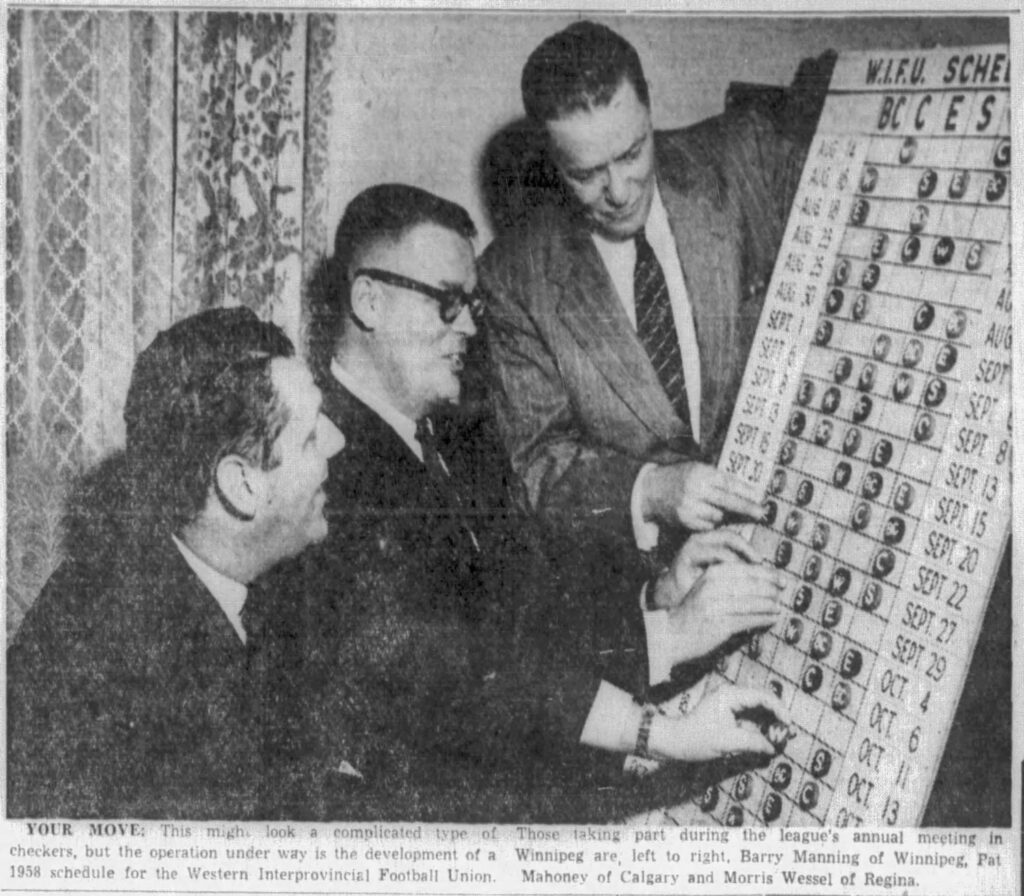
    WIFU schedule makers in 1958
    Early CFL schedule makers putting together the 1958 WIFU schedule. (Source: The Regina Leader Post, 20 January 1958, page 19.)

    A quick glance tells the tale of a gruelling schedule in 1958. Eastern teams played 14 games while their western counterparts played 16. All games were played within a short 12-week schedule kicking off in August. This meant western teams often played two games within two or three days. Ouch.

    CFLdb Statistics, an excellent online resource that is equally fun and informative, provides the full 1958 Canadian Football League schedule here: https://stats.cfldb.ca/league/cfl/schedule/1958/. Check it out and see how your favourite team did that year.

    And now, back to waiting on the 2025 CFL schedule…

  • Roaring B.C. Lions Surprise Mighty Blue Bombers

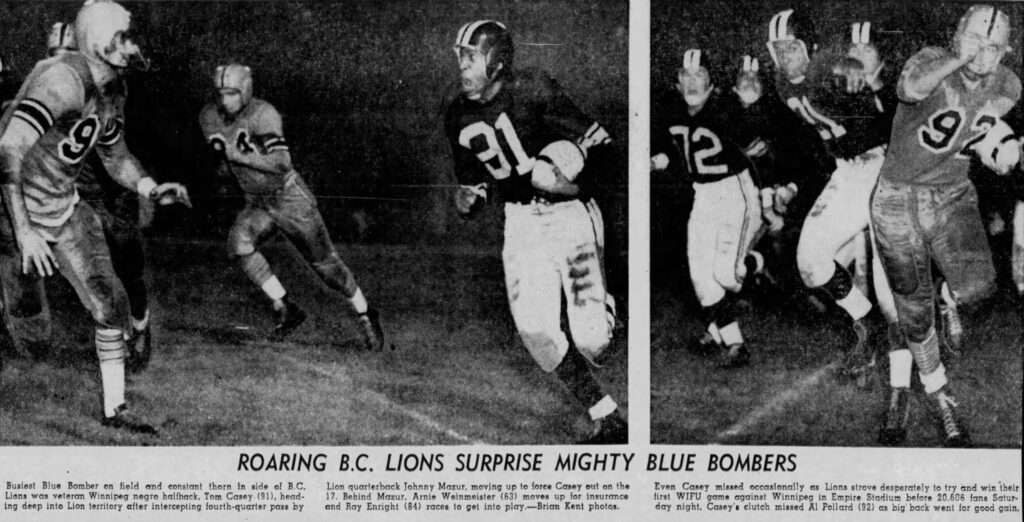
    BC Lions first game action (Vancouver Sun)
    Source: The Vancouver Sun, 30 August 1954, page 14.

    On August 28, 1954, the British Columbia Lions made their debut in the Western Interprovincial Football Union narrowly losing to the Winnipeg Blue Bombers 8-6 at Empire Stadium in Vancouver.

    Winnipeg halfback Tom Casey (#91) was a key player in the Bombers’ victory.

    The game attracted a crowd of 20,606.