

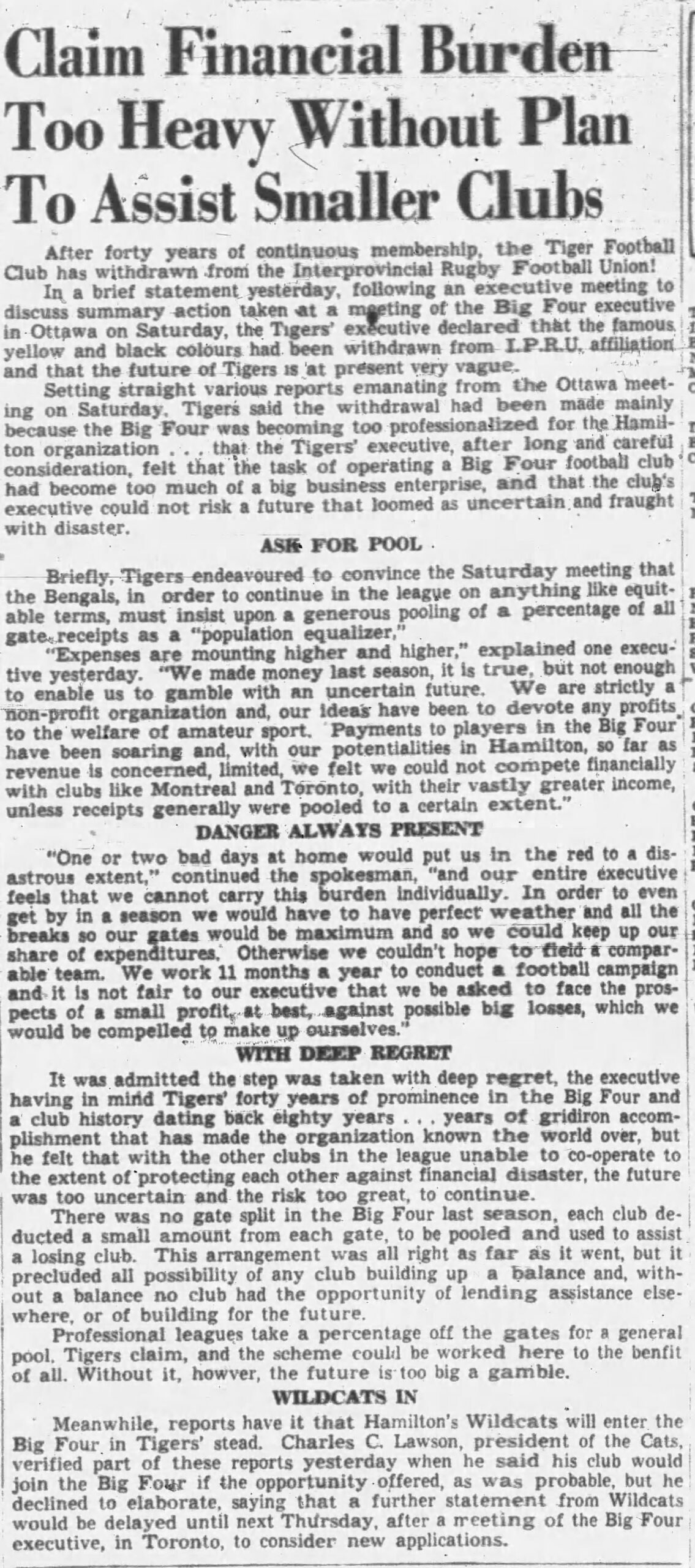
In the Spring of 1948, the Hamilton Tigers shocked the Canadian football world when they announced their withdrawal from the Interprovincial Rugby Football Union. A founding member of the league also known as the Big Four, the Tigers traced their roots back to 1869. They were undoubtedly the face of Hamilton football.
Like other teams in the IRFU, the Tigers temporarily disbanded during the Second World War. However, the Ontario Rugby Football Union, one of the other three major football leagues at the time, carried on. Hamilton had a team in the ORFU, as well – the Hamilton Wildcats. The Wildcats helped fill the void for Hamilton football fans in the absence of the Tigers.
Once the war ended and a sense or normalcy returned, the IRFU resumed operations. Suddenly, Hamilton had not one but two top tier football teams to root for. But sometimes more is not necessarily merrier.
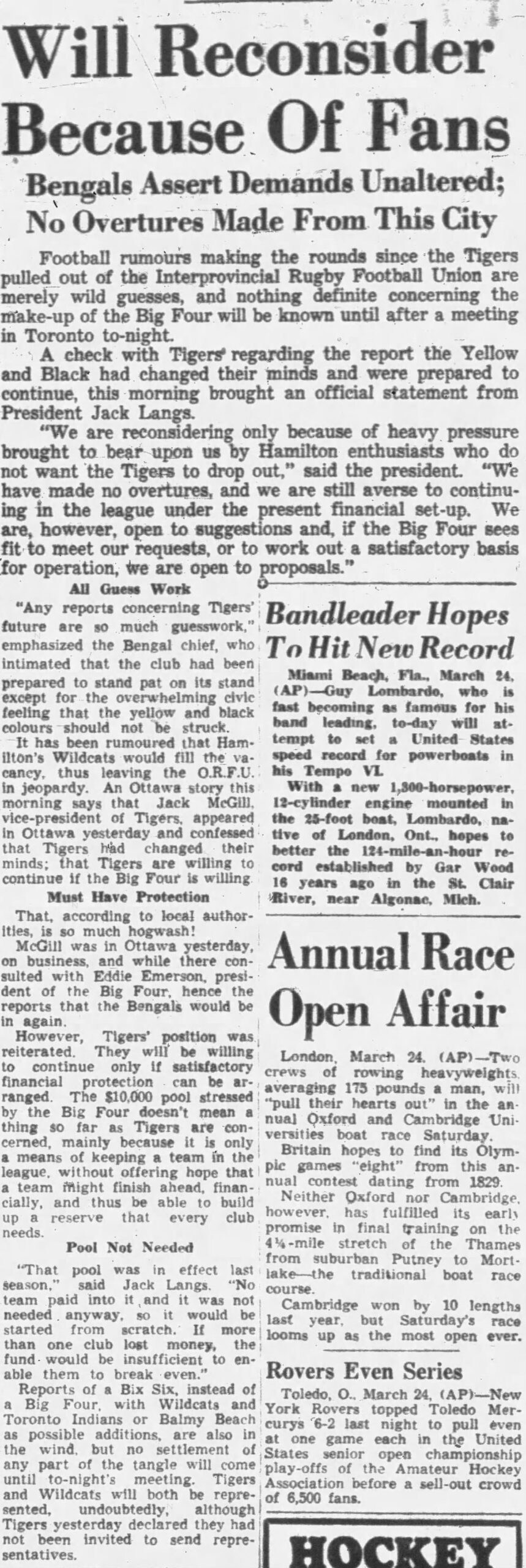
Faced with competition from the ORFU’s Wildcats and being at odds with fellow IRFU clubs when it came to revenue sharing, the Tigers found themselves in a precarious financial position. The team did make money but had a harder time competing against the larger clubs in Toronto and Montreal. The Tigers advocated for a scheme that would have IRFU teams split revenue by giving the visiting team up to a third of game day receipts. The other IRFU teams rejected the idea and instead offered up a $10,000 “share the loss” fund that would, in effect, reimburse teams operating in the red up to $10,000.
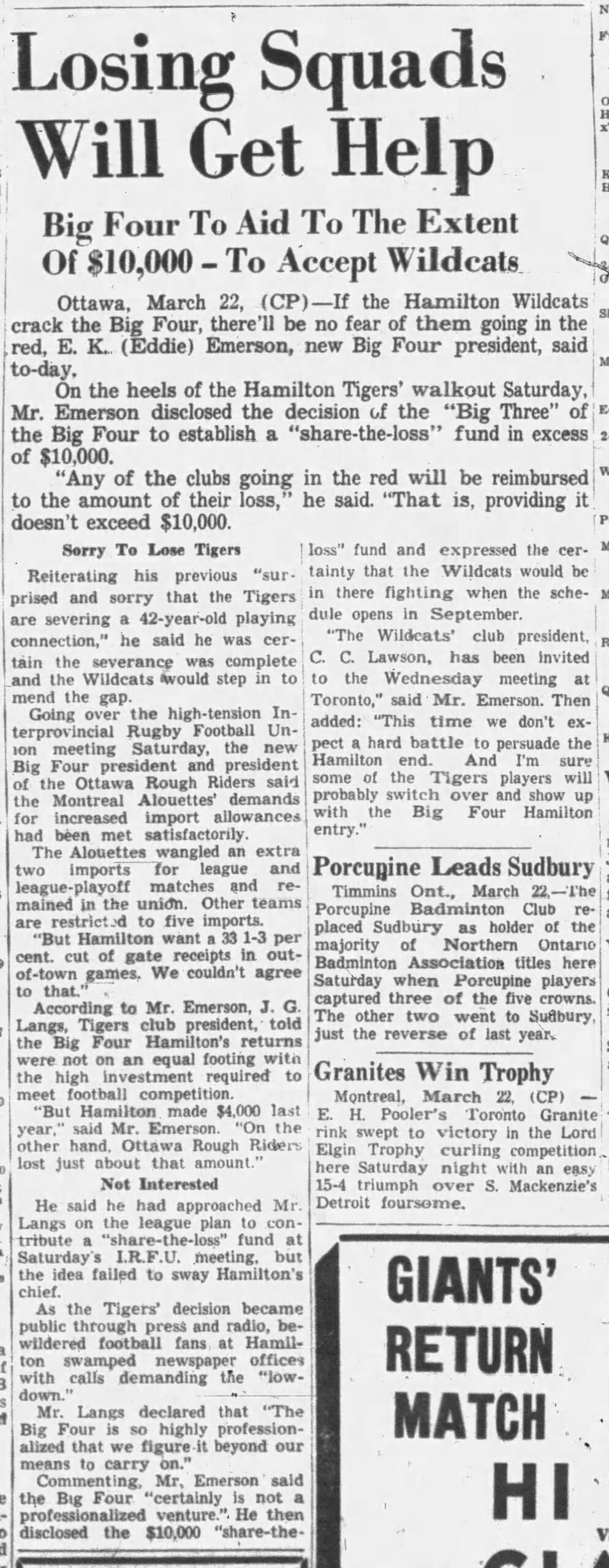
The Tigers and IRFU found themselves at a stalemate. At an IRFU meeting held at the Chateau Laurier in Ottawa on Saturday March 20, 1948, the Tigers announced they were quitting the Big Four. Tigers President J.G. Langs suggested the IRFU was becoming too professional and that the rising costs of competing couldn’t be offset without a more generous revenue sharing model. The Tigers’ abrupt withdrawal set off a chain reaction that would create some rather interesting drama in the days ahead.
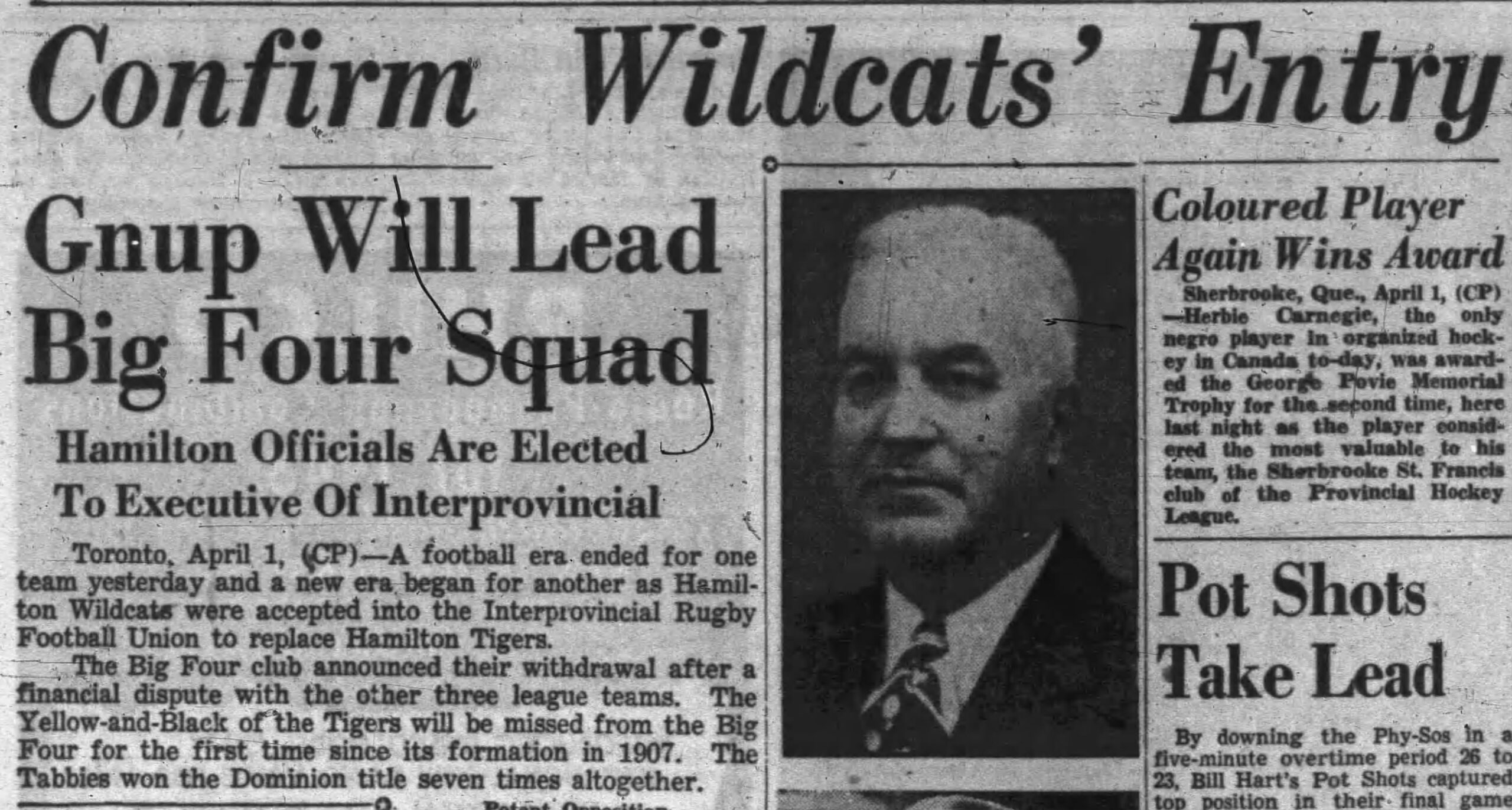
Almost immediately, reports began to circulate that the Wildcats would join the IRFU as Hamilton’s Big Four replacement team. At the time, they were arguably the best team in the ORFU and felt a jump to the IRFU would be a seamless transition. (Unfortunately, they struggled in the IRFU and won only a single game in their two seasons of play in that league.)
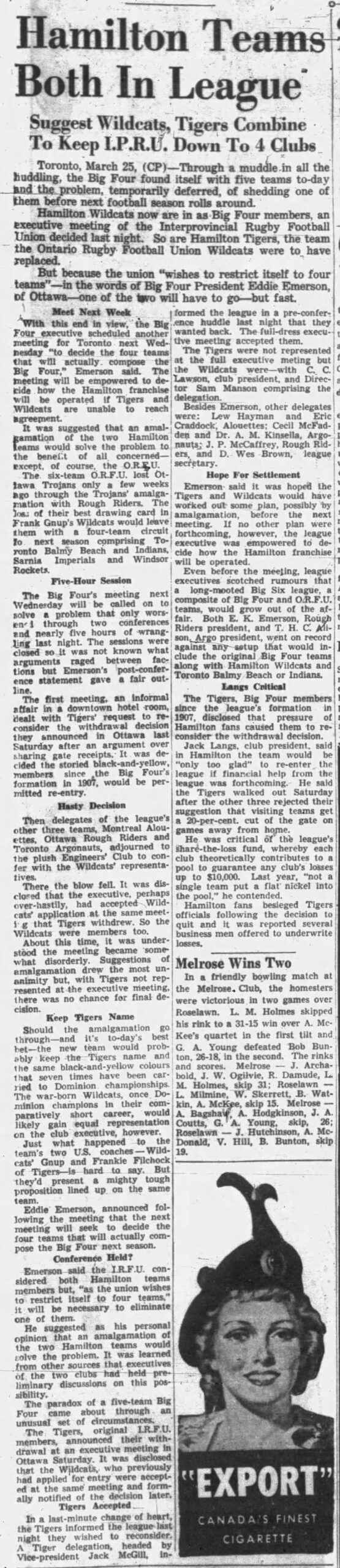
IRFU officials met again in Toronto to formally admit the Wildcats into the Big Four. Faced with mounting pressure from Hamilton fans, the Tigers withdrew their withdrawal and insisted on staying in the Big Four circuit. Their re-entry was approved. However, in a seemingly comedy of errors, it turns out that the IRFU had already admitted the Wildcats previously when the Tigers originally quit. So, the Big Four now had five teams, two in Hamilton.
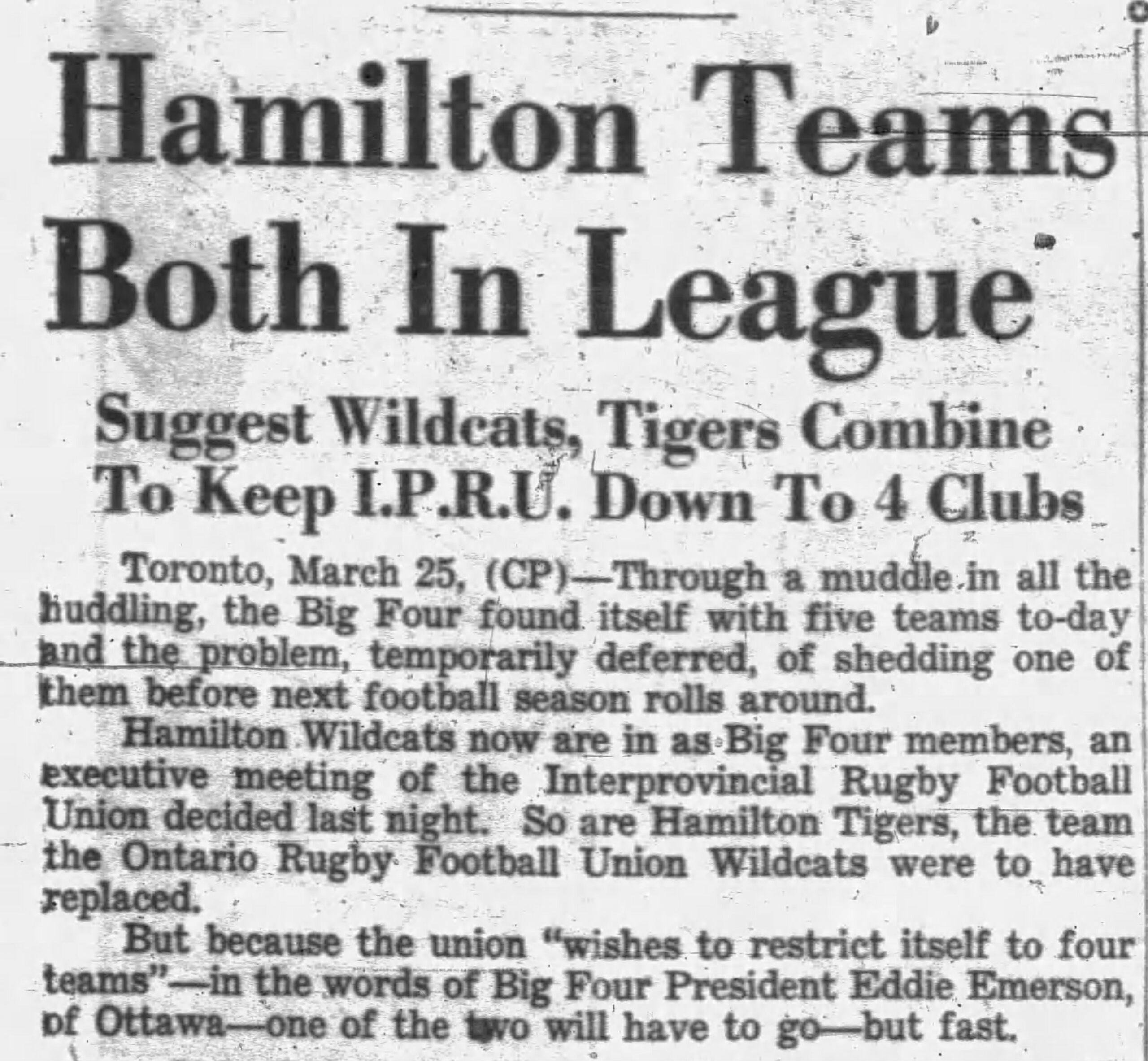
Although there were rumours of admitting a sixth team (likely Toronto Balmy Beach) to create a “Big Six” the IRFU executive team insisted on maintaining a four-team loop. They were adamant that one of the Hamilton teams had to go.
IRFU president Eddie Emerson was tasked with finding a solution. The “ideal” solution, it appeared, was for the Wildcats and Tigers to unite as one team in the Big Four. But the notion was nixed by both teams. In the lead up to what could have been one of the more dramatic football meetings the country has ever seen, the Tigers announced that they would no longer seek to stay in the IRFU, saving a potential showdown with football executives. Eddie Emerson was surely relieved. Instead, the Tigers would take the Wildcats’ place in the ORFU.
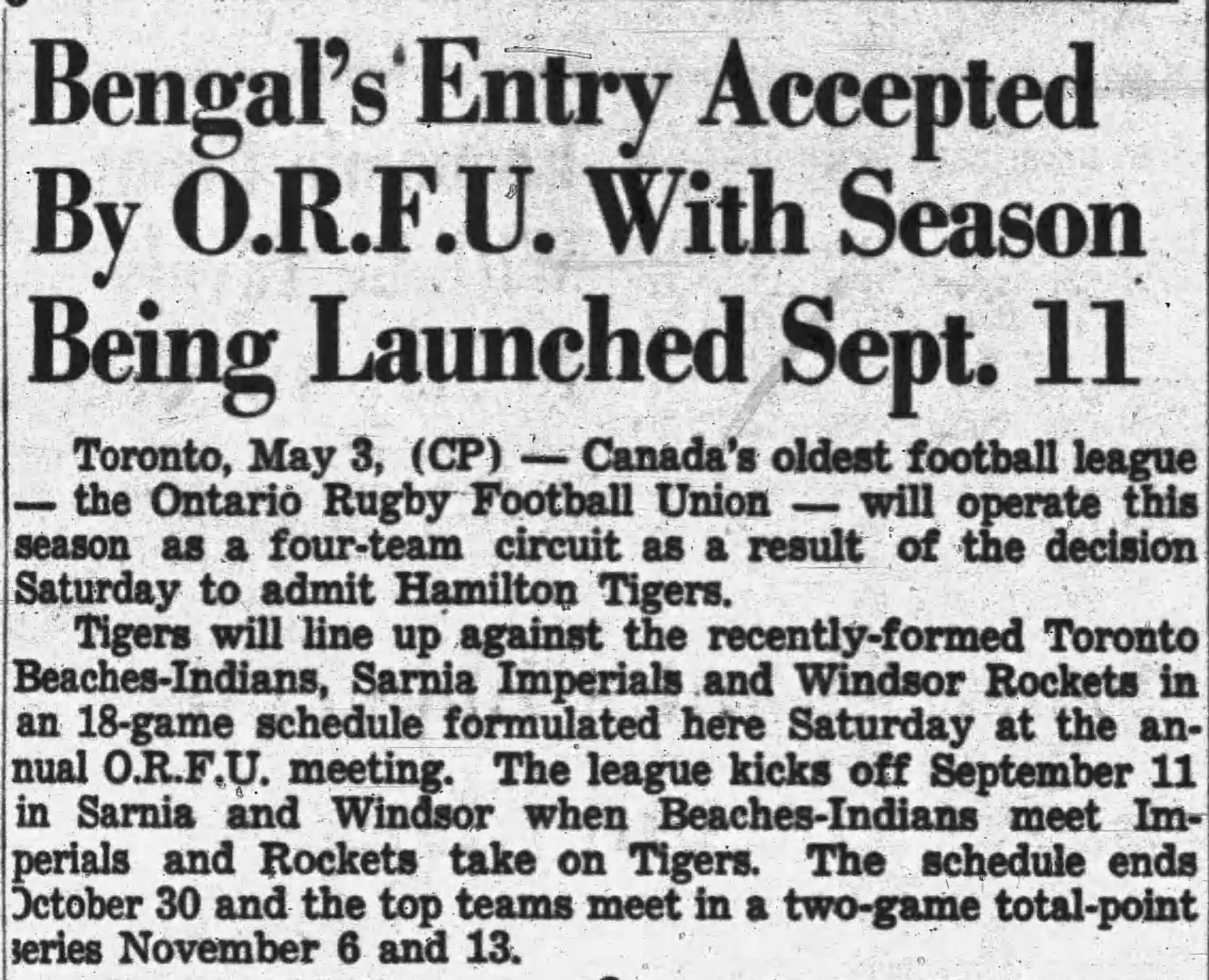
So, for two seasons – 1948 and 1949 – the Wildcats and Tigers played football in their new respective leagues. As mentioned earlier, the Wildcats struggled significantly in the Big Four. The Tigers fared better, at least on the field, finishing in first place in the ORFU. Off the field was another matter altogether. It was abundantly clear that Hamilton just couldn’t support two football teams in the increasingly professional era. As financial losses mounted, a group of Hamilton citizens revisited the idea of merging the two teams. In 1950, the original “ideal” solution was finally realised – the Tigers and Wildcats amalgamated and became the Hamilton Tiger-Cats.
Sources:
The Hamilton Spectator, 22 March 1948
The Hamilton Spectator, 24 March 1948
The Hamilton Spectator, 25 March 1948
The Hamilton Spectator, 1 April 1948
The Ottawa Citizen, 31 March 1948


Leave a Reply